1800: Suleiman al-Halabi, assassin of General Kleber

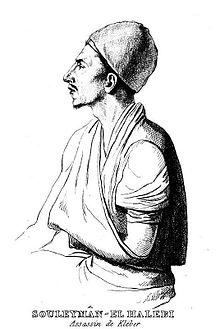
On this date in 1800 — which was the same date they buried his victim — the 23-year-old student Suleiman al-Halabi was put to death in Cairo for assassinating French General Jean Baptiste Kleber.
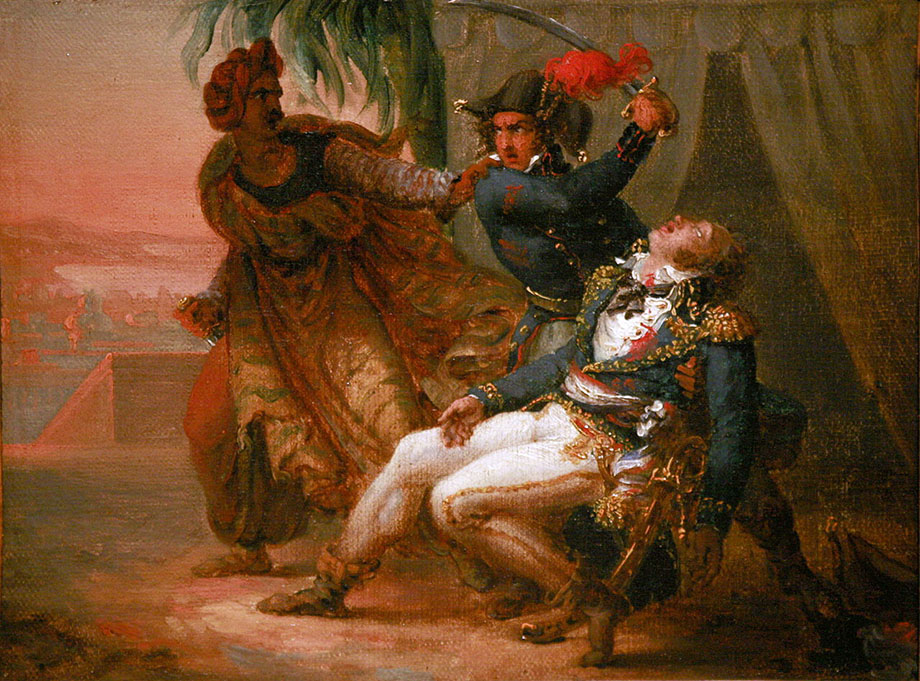
Casualty of the brief Napoleonic adventure in Egypt, Kleber had received supreme command of the expedition when Napoleon himself returned to France the previous year — a mission which involved running the English naval blockade that trapped the Armee d’Orient.

Kleber, a product of the French Revolution’s military meritocracy who had attained his rank capably suppressing the Vendee royalists, was certainly up to the martial tasks at hand. He routed a larger Ottoman-English-Mamluk force in March of 1800, and then smashed a revolt in Cairo.

But the Napoleonic invasion often figures as a periodization marker for this region: the germ of liberalism and nationalism that would tear apart the Ottoman Empire and set the scene for a recognizably modern Middle East. So it’s somewhat fitting that Kleber would be undone by a figure who could be lifted from the evening news,* the anti-occupation insurgent.

Suleiman al-Halabi (English Wikipedia entry | French) was a Syrian Kurd hailing from Aleppo. (“al-Halabi” means “of Aleppo”)

He had been in Cairo to study, but after a return visit home was induced by the Turks to attend himself to punishing the invader instead. He then made his way back to to Egypt where, disguising himself as a beggar, where he was able to approach the general innocuously and dagger him to death.

The French, of course, had just a few years before this point introduced its most distinctive execution device in place of the ghastly old methods, and employed it with egalite for commoner and king alike. Nor was France, as an imperial power, reluctant about exporting its invention to the every corner of earth.

But in this particular instance, the French decided to prioritize, er, cultural sensitivity.

The committee, after carrying through the trial with all due solemnity and process, thought it necessary to follow Egyptian customs in its application of punishment; it condemned the assassin to be impaled after having his right hand burned; and three of the guilty sheikhs to be beheaded and their bodies burned.

The “guilty sheikhs” in question were men to whom the killer had confided — not his plan, exactly, but the fact that he was on a jihad mission. Hey, close enough.

As for Suleiman al-Halabi himself,

The executioner Barthèlemy sat down on Suleiman’s belly, drew a knife from his pocket, and made a large incision to widen the rectum, then hammered the point of the stake into it with his mallet. Then he bound the patient’s arms and legs, raised the stake the air and mounted it in a prepared hole. Suleiman lived for four hours, and he had lived longer save that, during the absence of Barthèlemy, a soldier gave him a drink which caused his immediate death.

(Impaling victims could live for agonizing days, but the water caused Suleiman, mercifully, to quickly bleed out.)

Not content with going all Vlad the Impaler, the French then paid homage to the invasion’s scientific sub-theme** by shipping Suleiman’s remains back to France for use as an anthropological exhibit.† His skull still remains at the Musee de l’Homme to this day. What’s left in his homeland(s) is a martyr’s memory.

According to the scholar al-Jabarti, whose chronicle is one of the principal sources on this episode, the investigation indicated that Suleiman undertook his mission for no ideology save his family’s desperate need of the purse the Porte was willing to offer. But in the ensuing decades’ growth of nationalism and, eventually, anti-colonialism, the brave young Muslim dying on a spike to slay the French commander could not help but be viewed in an exalted light. (Notably, at the acme of Arab nationalism, the Egyptian writer Alfred Farag celebrated Suleiman as an avatar of resistance in a 1965 play. “I do not kill for revenge,” Farag’s Suleiman avers — and when pressed for the reason, he has a one-word reply: “Justice.”)

* Indeed, the name has been in the news: there’s a Suleiman al-Halabi neighborhood in Aleppo that has seen fighting during the ongoing Syrian civil war. Since it’s even a Kurdish neighborhood one can’t but suspect that it’s named for the man featured in this post; however, I haven’t been able to establish that with certainty. If any reader knows, a comment would be most welcome.

** Napoleon brought a corps of scientists and intellectuals along on his invasion, kicking off the modern Egyptology craze. His mission also uncovered the Rosetta Stone — although that artifact now resides in the British Museum because of the aforementioned naval blockade.

† According to Dark Trophies: Hunting and the Enemy Body in Modern War, phrenologists hailed Suleiman’s skull as an outstanding exemplar of criminality and fanaticism.

On this day..

1902: Hirsh Lekert, Jewish assassin

On this date in 1902, the Jewish socialist Hirsh Lekert was hanged in Vilna (Vilnius) for his attempt on that city’s governor.

The 22-year-old shoemaker, active in the Bund since childhood, was aggrieved along with many others by repressive measures taken against that leftist council by Vilna governor Victor von Wahl — culminating with the calculated humiliation he inflicted by personally overseeing the flogging of 20 Jews and 6 Poles arrested at a May Day demonstration.

As was the style at the time, Lekert took some retaliatory potshots at the municipal dictator on May 18, 1902. He scored a couple of flesh wounds before the police on hand beat him all to hell.

And that was pretty well that. Lekert got sent to face a military tribunal with a foreordained result. But he made his bones with posterity by refusing to apologize and instead fearlessly vindicating his action as a defense of the Jewish worker’s dignity.

This carried his legend in the early 20th century Jewish community much further than one might assume.

For Jewish Workers Bund, “the first great attempt at the organization of the Jewish masses for secular and independent political activity,”* Lekert’s uncompromising embrace of revolutionary violence created an internal controversy: radical workers saw a martyred hero; elites, and the Bund officially, were much more wary of terrorism provoking official backlash in an empire where Jewish communities were still liable to be targeted by pogroms at any time. All this during a renaissance of cultural and political thought among Eastern European Jewry.

Even decades later, the esteem remaining Lekert from his sacrifice gave his name power. Another generation of Jewish terrorists — in Mandate Palestine — was incensed at the British for flogging some Irgun members, leading Menachem Begin to invoke Lekert as his justification for kidnapping several British soldiers and flogging them. (Source) The British had no stomach for this, and desisted with floggings.

Artistic tributes followed as well — folk songs; plays by Arn Kushnirov and H. Leyvik; the bust that illustrates this post; a monument in Soviet Minsk; even this appearance in a 1927 silent film called His Excellency:

And from the hellish Vilna Ghetto under Nazi occupation, the great poet of the Holocaust Abraham Sutzkever depicted his “Teacher Mira” trying to keep her students’ heads up by reminding them of the Vilna cobbler who fought back.

Her skin, a windowpane in stains of dusk,
Mira must not reveal the darkness thus.
She bites her lip, of courage she will tell:
About Hirsh Lekert, how he fought and fell.

* Koppel Pinson, “Arkady Kremer, Vladimir Medem, and the Ideology of the Jewish ‘Bund'”, Jewish Social Studies July 1945.

On this day..

1471: Edward of Westminster, Prince of Wales, after the Battle of Tewkesbury

May 4, 1471 was the date of one of England’s most pivotal battles, Tewkesbury.

Tewkesbury was the last great victory in the War of the Roses for the House of York, and it must have seemed to contemporaries like the last victory Yorkists would ever need. The “kingmaker” Warwick was dead from a previous battle that April; the Lancastrian claimant Henry VI was imprisoned by the Yorkists, who would murder him before the month was out; and Henry’s heir apparent, the 17-year-old Prince of Wales, was put to death immediately after Tewkesbury.

Young Edward of Westminster had been stewing these past several years — until the aforementioned Kingmaker swung to his side — in exile in France, trying to finagle a way to rally the Lancastrian cause. Like many a teenager he was prone to nursing bilious fantasies of revenging himself on people, as the Milanese ambassador wrote in 1467.

This boy, though only thirteen years of age, already talks of nothing but of cutting off heads* or making war, as if he had everything in his hands or was the god of battle or the peaceful occupant of that throne.

“Peace” would not be the watchword of the abortive Lancastrian restoration attempt.

Shortly after returning to England, Edward had word of Warwick’s defeat. But having taken the trouble to come all this way from France, he still plowed ahead into the desperate stand at Tewkesbury. Edward had no experience at all in battlefield command.

When the Lancastrian lines broke at Tewkesbury, a disordered rout fled towards nearby Tewkesbury Abbey. The nobles who reached it would hole up there claiming the privilege of sanctuary … for just two days, at which point the victorious Yorkist King Edward IV had them arrested and put to swift execution, sanctuary be damned. (The abbey had to close to re-purify.)

Prince Edward didn’t even make it that long. There are varying accounts of his death at Tewkesbury suggesting a summary execution scenario of some kind.

In one version, the Duke of Clarence overtook him in flight. Clarence having himself briefly supported the rebellion before he returned to the Yorkist side, he’s supposed to have immediately beheaded the youth in a paroxysm of demonstrative loyalty.

Alternatively,

Prince Edward was taken as he fled towards the towne, by Sir Richard Crofts, and kept close … After the field was ended, proclamation was made, that whosoever could bring forth prince Edward alive or dead, should have an annuity of a hundred pounds during his life, and the princes life to be saved, if he were brought forth alive. Sir Richard Crofts, nothing mistrusting the kings promise, brought forth his prisoner prince Edward, being a faire and well proportioned young gentleman; whom when king Edward had well advised, he demanded of him, how he durst so presumptuously enter into his realm with banner displayed.

Whereunto the prince boldly answered, saying; “To recover my fathers kingdom and heritage, from his father and grandfather to him and from him after him to me lineally descended.” At which words king Edward said nothing, but with his hand thrust him from him, or (as some say) stroke him with his gauntlet; whom incontinently, George duke of Clarence, Richard duke of Gloucester, Thomas Grey marquess Dorset,** and William lord Hastings that stood by, suddenly murdered: for the which cruel act, the more part of the doers in their latter days drank of the like cup, by the righteous justice and due punishment of God.

Shakespeare dramatized this (considerably more dramatic — if admittedly less execution-like) version in Henry VI, Part 3.

Lancaster’s very dim (circa 1471) fortunes would ultimately be rescued in the 1480s by the grandson of a beheaded Welsh courtier — who won the throne as Henry VII and founded the Tudor dynasty.

* Edward as a seven-year-old was alleged to have been given the authority by his mother to decide what fate should befall the knights who had not successfully protected Henry VI from capture. Edward decreed their beheading.

** Ancestor of Lady Jane Grey.

On this day..

1975: Sisowath Sirik Matak, Cambodian prince

On this date in 1975, Sisowath Sirik Matak was executed with his aides by the Khmer Rouge.

As a young royal in French-administered Cambodia, Sirik Matak had had a shot to be selected as king in 1941. Instead, that dignity went to Norodom Sihanouk — and with it, Sihanouk would later charge, Sirik Matak’s lifelong resentment.

Sihanouk the “god-king” dominated the ensuing decades of Cambodian politics, and he kept Sirik Matak well away from domestic influence throughout the 1960s by shunting him off to a series of overseas diplomatic appointments. But the arch-conservative Sirik Matak’s longtime ally Lon Nol became Prime Minister in 1969 and took Sirik Matak on as his chief aide.

Sihanouk’s complex political career had by this time seen him abdicate the kingship as well as the Prime Ministership. Now he was head of state under the title “Prince” but by the end of the Sixties his power was faltering: an alliance with China yielded little as that country navigated the turbulent Cultural Revolution, while the Vietnam War next door fed into a Cambodian Civil War, too. (Sihanouk permitted the North Vietnamese to use bases in Cambodia.)

On March 18, 1970, Lon Nol deposed Prince Sihanouk in a bloodless coup — but it was Sirik Matak who orchestrated the move. There’s even an account that says Sirik Matak forced a wavering Lon Nol at gunpoint to go through with it.

The United States strongly supported the regime change, which was not exactly a portent of its success. Prince Sihanouk might be gone, but he did not take Cambodia’s civil conflict with him; arguably, his ouster intensified it, for Sihanouk was far more popular with the peasantry than the new, Washington-backed leaders. The existing secret bombing campaign the U.S. was directing at North Vietnamese refuges in Cambodia vastly intensified, becoming a campaign against the Khmer Rouge that outlasted the Vietnam War itself. Tens of thousands of people died under those bombs, and millions more were made refugees — and the insurgency only multiplied.

The impact of this bombing, the subject of much debate for the past three decades, is now clearer than ever. Civilian casualties in Cambodia drove an enraged populace into the arms of an insurgency that had enjoyed relatively little support until the bombing began, setting in motion the expansion of the Vietnam War deeper into Cambodia, a coup d’etat in 1970, the rapid rise of the Khmer Rouge, and ultimately the Cambodian genocide … the very domino effect that the Vietnam War was supposed to prevent …

[T]he bombs drove ordinary Cambodians into the arms of the Khmer Rouge, a group that seemed initially to have slim prospects of revolutionary success. Pol Pot himself described the Khmer Rouge during that period as “fewer than five thousand poorly armed guerrillas … scattered across the Cambodian landscape, uncertain about their strategy, tactics, loyalty, and leaders.”

Years after the war ended, journalist Bruce Palling asked Chhit Do, a former Khmer Rouge officer, if his forces had used the bombing as anti-American propaganda. Chhit replied:

Every time after there had been bombing, they would take the people to see the craters, to see how big and deep the craters were, to see how the earth had been gouged out and scorched…. The ordinary people sometimes literally shit in their pants when the big bombs and shells came. Their minds just froze up and they would wander around mute for three or four days. Terrified and half crazy, the people were ready to believe what they were told. It was because of their dissatisfaction with the bombing that they kept on co-operating with the Khmer Rouge, joining up with the Khmer Rouge, sending their children off to go with them…. Sometimes the bombs fell and hit little children, and their fathers would be all for the Khmer Rouge.

Ben Kiernan and Taylor Owen*

Within a few years, the capital fell to the growing insurgency. The U.S. offered asylum to the leaders of Cambodia’s collapsing government; many accepted it, but many others refused. Preferring near-certain execution at the hands of the Khmer Rouge (his name was already published on the movement’s list of “seven traitors”) Sisowath Sirik Matak reproached his U.S. patrons in a letter to the American ambassador declining evacuation.

Dear Excellency and friend,

I thank you very sincerely for your letter and for your offer to transport me towards freedom. I cannot, alas, leave in such a cowardly fashion.

As for you and in particular for your great country, I never believed for a moment that you would have this sentiment of abandoning a people which has chosen liberty. You have refused us your protection and we can do nothing about it. You leave us and it is my wish that you and your country will find happiness under the sky.

But mark it well that, if I shall die here on the spot and in my country that I love, it is too bad because we are all born and must die one day. I have only committed the mistake of believing in you, the Americans.

Please accept, E

Just days into the Khmer Rouge’s occupation of Phnom Penh, the Communists forced the French embassy to hand over Sirik Matak and a number of aides who had taken temporary refuge there. They were summarily executed (apparently by shooting) at the old Cercle Sportif swimming pool — a site that has since become the location of the new U.S. embassy.

* Taylor Owen has mapped the known U.S. bombing sorties into Cambodia; he discusses that project, and the ways the bombing impacted the Khmer Rouge, here.

On this day..

1687: The first of the Martyrs of Eperjes

On this date in 1687, the Austrian empire made the first of its many Protestant martyrs in Eperjes — the Hungarian name for the city now in Slovakia, where it is known as Prešov.

In the wake of the unsuccessful Zrinski-Frankopan Hungarian conspiracy against Hapsburg absolutism, the arch-Catholic Holy Roman Emperor Leopold did some cracking down.

Leopold suspended the Hungarian constitution and rounded up Protestant pastors, who “were not executed, but the choice of those convicted was between recantation and serving as galley slaves.” (Source)

Rough handling pushed the most aggrieved Hungarians into outright revolt in the 1670s, eventually led by the nobleman Imre Thököly.*

Thokoly enjoyed fantastic success, carving by force of arms a Principality of Upper Hungary roughly corresponding to present-day Slovakia. Squeezed as he was between the great powers of the Holy Roman Empire and the Ottoman Turks, Thokoly allied himself with Sultan Mehmed IV and aided the Turks’ 1683 siege of Vienna.

That meant that his followers would share the downfall of that enterprise.

After the siege was thrown off, Thokoly’s rebellion was gradually quashed, culminating in a 1685 battle at Presov — one of Thokoly’s major bastions. (Hungarian link)

Thereafter, Thokoly himself would be a ward of the Ottomans, alternately a prisoner or a vassal captain in the field. (He would briefly establish himself as Prince of Transylvania with Ottoman backing in 1690.)

Pope John Paul II and Evangelical bishop Jan Midriak prayed together at a monument to the Presov martyrs in 1995.(cc) image from Jozef Kotulic.

For Presov and those misfortunate enough to be caught there, matters were worse.

The Hapsburg military governor of the former rebel territory, Antonio Caraffa, set up a star chamber to deliver some harsh justice.

From February 1687, Presov Protestants trying to raise money to re-establish war-damaged schools were accused of conspiring to rise again and subjected to a series of torture-driven show trials.

The first four of these, Sigmund Zimmermann, Caspar Rauscher, Andreas Keczer and Franz Baranyay, were beheaded and quartered on March 5, 1687. All told, some two dozen would die over the course of 1687 in this hunt, most of them on the scaffold — the Martyrs of Eperjes. (German link.)


Statue of Imre Thokoly at Budapest’s Heroes’ Square. (cc) image from Hungarian Snow.

On this day..

1961: About fifteen anti-Lumumbists, in Stanleyville

Although it occurred some weeks before, the execution/murder of Congolese Prime Minister Patrice Lumumba only became public on February 13, 1961.

A week later, on February 20, pro-Lumumba forces in Stanleyville (today, Kisangani) shot approximately 15 prisoners in retaliation. Stanleyville was the headquarters of Lumumba ally Antoine Gizenga, whose enclave the late Lumumba had been trying to reach when he was captured. In the confused post-Lumumba days, Gizenga elevated himself to head of state for the rebellious Lumumbist state; 21 Communist-backed states would recognize this as Congo’s legitimate government, in opposition to the official one of Joseph Kasavubu.

Those suffering the Lumumba-backers’ wrath this date included ten politicians — notably Alfonse Songolo, a former Lumumbist minister who had prominently broken with that faction after Lumumba was deposed the previous autumn — plus five soldiers in the anti-Lumumba force of the bright young officer and future definitive author of Congolese horrors, Joseph-Desire Mobutu.

The London Times had reported (Feb. 23-24) that “usually well-informed sources” alleged the execution, but that the U.N. was unable itself to confirm the fact independently.

On this day..

c. 415 B.C.E.: The men of Melos

On an uncertain date in the winter of 416-415 B.C.E., the island of Melos surrendered to an Athenian siege during the ruinous Peloponnesian War.

Athens put all of Melos’s adult men to death, selling its women and children into slavery.

This ghastly event is covered by ThucydidesHistory. Thucydides’ account of the diplomatic negotiation between the mighty Athenians and the hopelessly outmuscled Melians is the subject of the Melian dialogue — a timeless classic of philosophy and statecraft.

The Athenians’ coldly realistic position — and their ultimate disposition of their conquest — is summed up in the wonderful epigraph, “the strong do what they will, and the weak suffer what they must.” (And numerous variations of this translation.)

As the reigning naval power, Athens (at war with a league led by its rival, the land power Sparta) had decided that an independent and neutral Melos would no longer be in the offing. The Melian dialogue pits Athens’ ultimatum to Melos to submit and save itself, against the Melians’ vain attempt to assert the justice of their cause; likewise, it is the dialogue of an imperial order against a holdover independent city-state from a fading era.

It’s a riveting read. The excerpts below are from this public-domain translation; there are others here and here.

Athenians: Well, then, we Athenians will use no flue words; we will not go out of our way to prove at length that we have a right to rule, because we overthrew the Persians; or that we attack you now because we are suffering any injury at your hands. We should not convince you if we did; nor must you expect to convince us by arguing that, although a colony of the Lacedaemonians, you have taken no part in their expeditions, or that you have never done us any wrong. But you and we should say what we really think, and aim only at what is possible, for we both alike know that into the discussion of human affairs the question of justice only enters where the pressure of necessity is equal, and that the powerful exact what they can, and the weak grant what they must.

Melians: Well, then, since you set aside justice and invite us to speak of expediency, in our judgment it is certainly expedient that you should respect a principle which is for the common good; and that to every man when in peril a reasonable claim should be accounted a claim of right, and any plea which he is disposed to urge, even if failing of the point a little, should help his cause. Your interest in this principle is quite as great as ours, inasmuch as you, if you fall, will incur the heaviest vengeance, and will be the most terrible example to mankind.

Athenians: The fall of our empire, if it should fall, is not an event to which we look forward with dismay; for ruling states such as Lacedaemon are not cruel to their vanquished enemies. And we are fighting not so much against the Lacedaemonians, as against our own subjects who may some day rise up and overcome their former masters. But this is a danger which you may leave to us. And we will now endeavour to show that we have come in the interests of our empire, and that in what we are about to say we are only seeking the preservation of your city. For we want to make you ours with the least trouble to ourselves, and it is for the interests of us both that you should not be destroyed.

Melians: It may be your interest to be our masters, but how can it be ours to be your slaves?

Athenians: To you the gain will be that by submission you will avert the worst; and we shall be all the richer for your preservation.

Melians: But must we be your enemies? Will you not receive us as friends if we are neutral and remain at peace with you?

Athenians: No, your enmity is not half so mischievous to us as your friendship; for the one is in the eyes of our subjects an argument of our power, the other of our weakness.

Over and over the Melian envoy is dismayed by his visitors’ indifference to the moral high ground. Frustrated of any concession, he resolves his embattled city to embark upon the remote hope of resistance in preference to voluntary servitude — leading the Athenians to part with this chilly sentiment:

You told us that the safety of your city would be your first care, but we remark that, in this long discussion, not a word has been uttered by you which would give a reasonable man expectation of deliverance. Your strongest grounds are hopes deferred, and what power you have is not to be compared with that which is already arrayed against you. Unless after we have withdrawn you mean to come, as even now you may, to a wiser conclusion, you are showing a great want of sense. For surely you cannot dream of flying to that false sense of honour which has been the ruin of so many when danger and dishonour were staring them in the face. Many men with their eyes still open to the consequences have found the word honour too much for them, and have suffered a mere name to lure them on, until it has drawn down upon them real and irretrievable calamities; through their own folly they have incurred a worse dishonour than fortune would have inflicted upon them. If you are wise you will not run this risk; you ought to see that there can be no disgrace in yielding to a great city which invites you to become her ally on reasonable terms, keeping your own land, and merely paying tribute; and that you will certainly gain no honour if, having to choose between two alternatives, safety and war, you obstinately prefer the worse. To maintain our rights against equals, to be politic with superiors, and to be moderate towards inferiors is the path of safety. Reflect once more when we have withdrawn, and say to yourselves over and over again that you are deliberating about your one and only country, which may be saved or may be destroyed by a single decision,

Athens wasn’t kidding.

Finding no traction with the Melian delegation, the greater power immediately besieged Melos. Thucydides recounts the Melians’ subsequent fate:

So the summer ended.

In the following winter the Lacedaemonians had intended to make an expedition into the Argive territory, but finding that the sacrifices which they offered at the frontier were unfavourable they returned home … About the same time the Melians took another part of the Athenian wall; for the fortifications were insufficiently guarded. Whereupon the Athenians sent fresh troops, under the command of Philocrates the son of Demeas. The place was now closely invested, and there was treachery among the citizens themselves. So the Melians were induced to surrender at discretion. The Athenians thereupon put to death all who were of military age, and made slaves of the women and children. They then colonised the island, sending thither 500 settlers of their own.


On top of everything else, the Athenian sack put an end to the production of Melian reliefs. (The island still had the glory of the Venus de Milo to look forward to, however.)

If there was a consolation for the scattered remains of the ruined Melian polis, it was that Athens’ cruel imperial hubris led it just months later to launch a catastrophic invasion of Sicily.

That defeat helped turn the Peloponnesian War decisively against Athens. Just eleven years after overrunning Melos, haughty Athens itself surrendered to a Spartan siege.

Thucydides, an exiled former Athenian general, deploys the classical dialogue form to great effect; his own perspective on the various arguments advanced in the Melian debate is difficult to discern with confidence. Clearly, however, it’s a topic of great interest to Thucydides, as his account dwells repeatedly on the conundrums touching justice and international relations: he’s one of the first intellectuals to explore what’s now thought of as the “realist” view of foreign policy. Compare the Melian Dialogue, for instance, to the Athenian demos‘s Mytilenian Debate; or, to the Plataean speech making a Melos-like appeal to the powerful Spartans.* And in one early passage, private Athenians appeal to Sparta and Corinth not to commence on war against the hegemony of Athens with words similar to those later used at Melos: “It has always been a rule that the weak should be subject to the strong; and besides, we consider that we are worthy of our power. Up till the present moment you, too, used to think that we were; but now, after calculating your own interest, you are beginning to talk in terms of right and wrong. Considerations of this kind have never yet turned people aside from the opportunities of aggrandizement offered by superior strength.”

At any rate, Thucydides’ proud city-empire would never recover from the inglorious fall inflicted by this war. The result was a fourth-century power vacuum which the Macedonia of Philip II and Alexander the Great eventually rose to fill.

* Thucydides also reports the Athenians hoisted by their own realpolitik when, in the Sicilian invasion, they attempt to appeal to Camarina for support. That city spurns the appeal, fearing subjugation should expansionist Athens prevail, and the revenge of their overwhelmingly powerful neighbor Syracuse otherwise.

On this day..

1980: Erdal Eren, leftist student

On this date in 1980, 17-year-old Turkish student radical Erdal Eren was hanged as a terrorist by the military regime.

Eren (Turkish Wikipedia link; most other links here are also in Turkish) was one of about 50 people executed following the military coup of September 12, 1980.

After a decade of bloody left-right civil strife, the Turkish generals toppled the civilian government on that date. Hundreds of thousands of arrests with rampant torture marked the period, but it did quell the endemic street fighting and terrorism of the 1970s.

Erdal Eren was actually arrested during the chaotic pre-coup period. February 1980 student protests after the murder of Sinan Suner, an activist of the communist Patriotic Revolutionary Youth Association, turned into a melee that resulted in an officer shot dead under confused circumstances. Eren was among 24 students rounded up.

Despite his youth, Eren was sentenced to die in a March 19 trial — but his appeals had legs until the post-coup military junta abruptly sent him to the gallows on December 13.

Eren went to his death with a brave step, gamely writing his family that he had witnessed so much torture in prison that death was a relief and not a terror.

He’s very warmly remembered today. A number of cultural artifacts pay tribute to the young martyr, including two different songs (“Two Children”, “Seventeen”) by Teoman, a relative of Erdal Eren’s.

On this day..

1944: Six German POWs, for Stalingrad’s Dulag-205

On this date in 1944, Wehrmacht Oberst Rudolf Körpert, his deputy Hauptmann Carl Frister, and officers Fritz Müsenthin, Otto Mäder, Richard Seidlitz and Kurt Wohlfarth, were shot in the Soviet Union for their treatment of Russian prisoners of war at Stalingrad.

This was nearly two years on since the Germans had surrendered the eastern front’s horrific signature battle.

The six captured men were principals at the little-known Dulag-205, a transit camp the Wehrmacht erected at Stalingrad for Soviet prisoners of war pending westward deportation to less extemporaneous prisons. (And less extemporaneous mistreatment.)

A minuscule 10 acres, the camp was eventually crammed with up to 3,400 prisoners, triple its anticipated capacity. There was nowhere to send them once the Germans were fatally encircled, and as supplies failed in the last terrible weeks of the besieged Kessel (“cauldron”), the subsistence prisoner rations of putrefying-horseflesh soup were cut off entirely.

Several dozen dropped dead of starvation, overwork, and summary execution each day thence until the merciful end. When the Red Army finally took control of the camp on Jan. 22, 1943, it discovered corpses with obvious signs of cannibalism.

Frank Ellis has the definitive treatment of this affair in “Dulag-205: The German Army’s Death Camp for Soviet Prisoners at Stalingrad” (Journal of Slavic Military Studies, March 2006), and the facts in this posts are drawn from Ellis’s examination of the Dulag-205 interrogation and trial records.*

Our captured men enjoyed the company of NKVD and SMERSH interrogators for a number of months, under what duresses one shudders to imagine.

The rescued Soviet soldiers — who were themselves suspect in the eyes of Stalinist authorities merely for having been captured — provided ample firsthand corroboration of Dulag-205’s miserable conditions.

“The guards were allowed to shoot without any warning at prisoners who approached the barbed wire barrier, who tried to jump the queue for food and at prisoners who tried to have a piss in the wrong place,” one POW told his Soviet interrogators. “Hardly any water or bread was given to the prisoners. The prisoners slept in the dugouts without any bedding, jammed tight. The prisoners were never able to rest since they had to sleep standing and sitting. … There were no baths in the camp. During my whole time in the camp — about 5 months — I did not wash once.”

Moscow had by this time already begun rolling out war crimes trials relating to the German invasion. The guys who were captured with starving Red Army prisoners cannibalizing one another were going to be a prime target.

The subaltern officers, according to Ellis, generally tried to put the blame on Körpert and further up the chain of command, and understandably so. Mäder was a mere adjutant. Siedlitz was the director of camp construction. They weren’t the ones who got the Sixth Army encircled or cut prisoner rations or even made camp-specific decisions like when to set the dogs on a disobedient captive. They had no ability to transfer the prisoners back to the Soviets or to any less horrible detention on their side of the lines. Otto Mäder:

My service in the Dulag was a great spiritual torment for me. It was dreadful to see the terrible condition of Russian prisoners.

I stand before the court at that time when the main culprits responsible for the death of 3,000 Soviet prisoners — Field Marshall Paulus, the army’s chief-of-staff, General Schmidt, Lieutenant-Colonel Kunowski and the army quartermaster — do not stand before the court. They are not only guilty of the death of Soviet prisoners-of-war, but have put us on the accused’s bench!

You’d expect the guy to say that to a Soviet tribunal, certainly — especially a lawyer, which Mäder was also — but that doesn’t make it untrue. This case was actually evaluated in post-Soviet Russia for possible posthumous rehabilitation. (No dice.)

Intriguingly, the Wehrmacht officers were not tried for violations of the Geneva Conventions; indeed, the USSR had not ratified all of the Geneva Conventions, and this put Germany (which had ratified them) in an ambiguous position relative to its non-ratifying belligerent. (A less kind way to say it might be that the difference served to rationalize dreadfully inhumane treatment.)

Rather, Körpert et al were charged under Soviet laws promulgated only after the Battle of Stalingrad, a sketchy maneuver which Ellis thinks suggests that prosecutors hoped to avoid setting a precedent that could be cited by Germany relative to the USSR’s none-too-gentle treatment of its own prisoners of war.

* Ellis also has a topical recent book out, The Stalingrad Cauldron: Inside the Encirclement and Destruction of the 6th Army.

On this day..

1939: Six assassins of Armand Calinescu

On this date in 1939, Romanian Prime Minister Armand Calinescu was gunned down on a Bucharest street in an ambush by the Iron Guard. (Romanian link)

Before the day was out, six of members of the hit squad were lined up and machine-gunned on the very same spot.

Armand Calinescu

Calinescu was a conservative politician trying to fight off the rising fascist movement in his country — that aforesaid Iron Guard — and preferred to keep Romania in politic neutrality and friendly with England and France rather than hitching its fate to Nazi Germany.

This entailed an increasingly acrimonious struggle throughout the 1930s against the fascists. Calinescu once called the Guard “an association of assassins,” and the prospect of taking a bullet from them can’t have been far from his mind. Calinescu’s fingerprints were all over press closures, pre-emptive arrests, and still worse offenses to outrage the far right. After years in the cabinet working hand-in-glove with the hated-by-fascists King Carol II, Calinescu finally became Prime Minister in March of 1939. Carol hoped he could be the bulwark against a Legionary takeover.

If by his enemies ye may know a man, know that Calinescu was taken seriously enough for a multilateral meeting between representatives of the Iron Guard, fascist Italy, and Nazi Germany in order to make the arrangements for his murder. But Calinescu would probably have just as soon have preferred his life to this tribute of his foes.

Upon news of the assassination, Calinescu’s place was immediately filled by Gen. Gheorghe Argesanu, whose one week as head of government was distinguished by a ruthless crackdown on his country’s homegrown terrorists.* The very next day’s British papers, in the same stories reporting the assassination, carried news “of an exemplary punishment” delivered within hours: “Last night, under the glare of powerful arc lamps, the murderers were publicly executed by machine-gun on the spot where the crime had been committed.” (London Times, September 22, 1939)

Nor was that the last exemplar.

The Times reported on September 25th that the ensuing days had seen “more than 300 former Iron Guards were shot” all around the country, including many “in the open street as a public example, on the pattern of the machine-gun executions in public at the scene of the crime.”

The “example” did not have the intended effect: in the span of another year, a fascist-aligned government had control of Bucharest and King Carol had hightailed it to Mexico, never to return.

* The Iron Guard would pay back Argesanu a year later by killing him during the Jilava massacre of its political prisoners.

On this day..