1646: Twelve at an Evora auto da fe

This date in 1646, the city of Evora, Portugal, celebrated an auto-da-fe — one of those festivals of Catholic orthodoxy in which penitents were paraded and the most wicked amongst them burnt to death.

They were also fine times for the Inquisitors who prosecuted them, and a burden on the public treasury only made sustainable by the contemporary looting of the New World. We turn for this account of profligacy to The Marrano Factory, a book whose thesis is that the alleged “Judaizers” these displays were meant to showcase were mostly just regular Catholics caught up by the chance factors of torture-adduced accusations or the presence of some remote Jewish ancestor on the family tree.

It’s not hard to see from what follows why the guys running them might have been convinced they were doing God’s work. It’s difficult, after all, to get a man to understand something when his sweetmeats and rabbit feast depend on his not understanding it.

With time and experience, the auto-da-fe publico and its minutely regulated ceremonial grew into a grand and pompous pageant. It was attended by the top brass, often by the king and the royal family and, much as a carnival, it galvanized the whole city into communal bustle …

All defendants appearing at autos-da-fe, public or private, had to wear a sanbenito. At the Evora public auto-da-fe of November 18, 1646, 165 covados (one covado = 0.66 meters) of red and yellow cloth were used, i.e., about 87 meters of cloth for 115 penitents and persons to be executed, costing a total of 62,700 reals at 380 per covado. On the two sides were painted the insignia corresponding to the offenses. In the case of those on death row, painters called in by the Inquisition had — seeing but unseen — to sketch their features and then paint on one side of the sanbenito their portrait, head engulfed by flames.

The day on which a forthcoming auto-da-fe publico was announced in the palace of the Holy Office was a festive one, as we can ascertain from the quantity of compotes and various pastries, procured from neighboring convents and delivered on that day to the secret chambers of the Inquisition. According to the List of Expenses for the Evora auto of November 18, 1646, 64,820 reals were spent on these dainties, hence more than on the 87 meters of cloth for the sanbenitos … and more than triple the cost of feeding a prisoner during an entire year (20,000 reals). It is worth noting that prison fare included meat, in order to test whether the prisoners were observing Jewish dietary laws. This fabulous quantity and variety of foodstuffs was destined exclusively for higher echelons of lawyers and clergy, i.e., three Inquisitors, four deputies, four notaries and a prosecutor, besides the six Jesuit fathers who confessed the six persons sentenced to death …

The feasting did not stop there. Since Friday was a “fast” day on which Catholics abstain from meat, six varieties of fish (sole, mullet, eel, pollock, snapper and sardines) as well as flour and olive oil to cook them in and seasonings for fish-cakes, to the tune of 27,546 reals, were delivered at the Palace of the Inquisition, to be eaten on that day and the left overs [sic] on the Saturday preceding the auto. This fish was distributed to everyone, including the guards who received also rations of bread, meat, wine and fruit, for a total value of 760 reals. The day of the ceremony proper saw the “auto-da-fe supper,” which we are coming to, by and by.

When they were done killing, it was time for the “auto-da-fe supper,” served at the estaus. In the Evora account of November 18, 1646 it comprised about 14 kilos of lamb, 20 young chickens and pullets, 12 roasting chickens, 4 ducks, 4 rabbits, 3 turkeys (each one cost more than what was paid to the painter for one portrait of a prisoner condemned to death); one sow “which was divided by the Gentlemen Inquisitors and the notaries” and one large fruit basket, containing Bosc pears, bergamots, chapel apples and rennets. Like the sweatmeats and compotes which had arrived at the palace of the Holy Office a fortnight before the auto, this repast was meant for the higher officials … it is a curious thing that there were as many turkeys as Inquisitors, as many duck and rabbits as deputies and notaries. This evokes both the idea of an alimentary hierarchy and a kind of remuneration in commodities. However that may be, the total expense of these men in food on the occasion of the auto came to about 110,000 reals (not to mention the porcelain and cutlery), or more than half of the total expense of the auto-da-fe.

The count of 12 executed people comes from a footnote in the text attributing a 3,600-real bill to the painter Miguel Fernandes for sanbenitos of hellfire made for the condemned. However, “executed” people “could refer to live people (‘executed in the flesh’) and to dead or otherwise unavailable people (‘executed in effigy’ or ‘executed in statue’) and in the latter case their effigies (‘statues’) were to be decked out and then ‘executed’.” So, call it a total of 12 flesh-and-bones people and effigies, in some combination; if there’s a firm accounting of who was executed (and whether they were alive, dead, or absent at the time) at this particular auto, I have not yet been able to locate it.


Unrelated: Evora’s Bone Chapel.

On this day..

1864: Retaliatory executions by John Mosby

Though executioners don’t quite bat 1.000 — who does, at any human endeavor? — the field on the whole succeeds more often than not.

On this date in 1864, the Confederate guerrilla John S. Mosby had seven Union prisoners executed, but he only managed to kill three of them — an efficiency very well below the Mendoza Line for the executioner’s trade.

It was a rare competence gap for the brilliant cavalryman.

The irregulars Mosby commanded in the Shenandoah Valley had frustrated for six months the consolidation of rampant northern armies, thereby preserving the Confederate capital of Richmond and extending the Civil War.

The situation had quick become intolerable for the Union, and Gen. Ulysses Grant emphasized (pdf) to Gen. Phil Sheridan the cruel anti-insurgent tactics he would countenance for “the necessity of clearing out the country so that it would not support Mosby’s gang. So long as the war lasts they must be prevented from raising another crop.”

By way of example-setting, the Union army had summarily executed six of Mosby’s rangers at Front Royal in September — followed by a seventh who was captured in early October in Rappahanock County.

Incensed, the Confederate “gray ghost” began stockpiling blue bodies from the offending command of George Armstrong Custer — yes, the Little Bighorn guy; he was perceived by Mosby to be responsible for the atrocity, although the actual paper trail on the execution order seems to be a little sketchy.

Mosby, who fancied himself the genteel sort who would closely abide the laws of war when fighting for the right to maintain human chattel, sent a lawlerly appeal up the chain of command seeking permission “to hang an equal number of Custer’s men.” General Robert E. Lee and Confederate Secretary of War James Sedden granted it.

Twenty-seven captives were therefore assembled and subjected to a lethal lottery. Jay Simson’s Custer and the Front Royal Executions of 1864 recounts this horrible affair in an excrutiatingly page-turning narration.

The preparations began innocently enough on a quiet Sunday morning (November 6, 1864) when 27 Union prisoners of war were ushered with no explanation about what was happening out of a brick storehouse located in Rectortown, Virginia …

[They] were then marched to the banks of Goose Creek, about half a mile away. some, but definitely not all, of this specially selected pool of 27 prisoners belonged to Custer’s commands both past and present … [but] of the seven men eventually selected to die on Mosby’s orders only two were actually members of the Michigan Cavalry Brigade.

All 27 of the prisoners were lined up along Goose Creek and then made to draw slips of paper from a hat. Twenty of those slips of paper which were part of the macabre lottery were simply that, blank pieces of paper. The other seven — one for each of Mosby’s men executed at Front Royal and in Rappahanock County — were marked with a number …

Of the men who were forced to draw those slips of paper, some of them simply stared into space. Others, once they understood what was happening, prayed. There were a few of them who simply broke down.

Among the prisoners was a young drummer boy … who broke down completely, sobbing … He drew a blank slip and immediately proclaimed: “Damn it, ain’t I lucky!” When a second drummer boy was found to be unlucky enough to have drawn one of the marked slips of paper, upon the request of the men who had been spared, Mosby personally ordered the boy to be released from the seven condemned prisoners and the 18 remaining prisoners (excluding the first drummer boy) drew from the slips of paper for a second time.

Then one of the seven adults also got himself swapped out of the scrap by flashing a Masonic sign at a Confederate lodge member. The things that stand between life and death.

Out of the nine to come under death’s pall and the seven who were actually marched overnight to the place of execution (as close to Custer’s camp as Mosby dared) only three were there successfully ushered past death’s threshold.

At 4 a.m. on Monday, November 7, 1864 (the day before the election which would give Abraham Lincoln his second term in the White House and would therefore become the signature on the death warrant of the Confederacy), the Rangers and their prisoners reached the execution site in Beemer’s Woods, a mile west of Berryville, and the executions were carried forward. However, everything did not go exactly according to plan.

In the pre-dawn darkness and confusion (either through carelessness or lack of caring for their orders, since none of the prisoners had actually been involved in depredations against Confederate civilians) the Rangers allowed two of the seven prisoners (one of whom, G.H. Soule, 5th Michigan Cavalry Regiment, punched out a guard) to escape outright. Two other prisoners were apparently shot in the head, but surviving, having only been grazed, also escaped since they pretended, and were apparently believed, to be dead. The remaining three prisoners were hanged. The identities and whether or not these three prisoners were members of either Custer or Powell’s commands are unknown. Lt. Thompson, in accordance with his orders attached a placard to one of the hanged men (just as similar placards had been attached to the bodies of all three of Mosby’s hanged men). Mosby’s placard read: “These men have been hung in retaliation for an equal number of Colonel Mosby’s men hung by order of General Custer at Front Royal. Measure for Measure.”

Believing his purpose accomplished, or at any rate close enough for rebel government work, Mosby then wrote to Union General Sheridan justifying the action and assuring him that future “prisoners falling into my hands will be treated with the kindness due to their condition, unless some new act of barbarity shall compel me, reluctantly, to adopt a line of policy repugnant to humanity.”

The letter, and the 3-out-of-7 reprisal, actually worked — with no further measures exacted for measure or tits given for tat. For the waning months of the war the rival forces confined themselves to killing one another on the battlefield, and not in the stockade.

Well, mostly: one of the conspirators in the plot to assassinate Abraham Lincoln in April 1865 — which did assassinate Lincoln, but was really a wider attempt to decapitate the entire northern government — was a former Mosby’s ranger named Lewis Powell aka Payne. Lincoln killer John Wilkes Booth also seemed to flee in Mosby’s direction (Mosby’s units were still in the field, not covered by the April 9 Appomattox surrender.) There exists an unproven but delicious speculative hypothesis that the hand of John Mosby was among those behind an exponentially more ambitious “line of policy repugnant to humanity.”

Be that as it may, Mosby actually became a Republican after the war — for which he received some Southern death threats — and lived fifty eventful years. Among other things, the aged Mosby regaled the young George Patton (whose father Mosby knew) with Civil War stories.

On this day..

1801: James Legg, crucified ecorche

On this date in 1801, 73-year-old James Legg(e) was hanged for murdering his mate William Lamb(e) at Chelsea Hospital.

Both men were pensioned ensigns from His Majesty’s service. According to the trial transcript, Legg was sinking into obvious depression. A nurse of long acquaintance remarked on

a lowness, a melancholy and deranged state; knowing him so long, I took the opportunity of asking him what was the matter with him, and the reason of his melancholy; he told me his mind was confused; that he had no rest night or day; that he was hurried from place to place, and could not tell what he was doing; and I really was afraid he would make away with himself; I was always unhappy when he was out of my sight, for fear he should do himself an injury; I never mentioned it to the doctor, because he was harmless … sometimes when I spoke to him, he would start like a person surprized out of a sleep; sometimes he would give me an answer, and sometimes only just a bow; I still observed that lowness and melancholy, and that his head was always confused down to the time of this unfortunate event.

Ah. The “unfortunate event.” Legg took it to mind that Lamb was “a tyrannical tempered man” who gave him “repeated insults” and challenged him to a duel. (Lamb’s widow, the only witness to the murder, said her husband had no beef with his killer.)

When Lamb quizzically (or scornfully) discarded the pistol that the irate Legg had forced into his hand, Legg just shot him dead.

He probably had no expectation that he’d just punched his ticket to artistic immortality.

Legg hanged exactly a month after the homicide. During the interval, three Royal Academy of Arts members — sculptor Thomas Banks and painters Benjamin West and Richard Cosway — pulled some strings with the Chelsea Hospital surgeon Joseph Carpue to get Legg’s body after death.

These gentlemen had an idea that centuries of artistic representation of Christ’s crucifixion were nonsense from a physiological point of view.


Giotto crucifixion fresco, c. 1300.

It was a natural outgrowth of Europe’s long fascination with anatomical accuracy — a fascination that made liberal use of executed bodies.

Despite the centrality of Christ’s crucifixion to western culture, nobody had seen an actual crucifixion — not for centuries. So, sure, you can make the guy on the cross look like a proportioned, three-dimensional human being …


Possible Michelangelo (otherwise, Marcello Venusti) Crucifixion with the Madonna, St. John and Two Mourning Angels.

… but is this really what a proportioned, three-dimensional human being would look like when nailed to a cross?

That Chelsea surgeon Carpue and his artist friends had the best way to find out. (Well … the second-best.)

“A building was erected near the place of the execution; a cross provided,” Carpue recorded. After hanging, “the subject was nailed on the cross; the cross suspended … the body, being warm, fell into the position that a dead body must fall into … When cool, a cast was made, under the direction of Mr. Banks, and when the mob was dispersed it was removed to my theatre.” West supposedly exclaimed that he had “never before seen the human hand” until he saw James Legg’s nailed and stretched.

Carpue proceeded to flay the cadaver and make a second cast from the grisly skin-less ecorche … an artistic/anatomical practice of the age whose best-known product is Smugglerius, also cast from a hanged man.

That latter ecorche still survives, and the despondent veteran James Legg’s last pose, hypothetically in the manner of the Savior, can be seen to this day the Royal Academy.

(Debate and experimentation over the particulars of an execution by cross also continue to this day.)

On this day..

1812: Claude-Francois de Malet and his conspirators

Two centuries ago today,* the author of one of the weirdest attempted coups in history was shot with his co-conspirators.

Picture Valkyrie in Napoleonic Europe.

Claude-Francois de Malet (English Wikipedia entry | French) had spent the years of his confinement for republican sensibilities painstakingly readying bogus orders and decrees for the eventual rollout of the most audacious putsch you’d ever want to putsch.

While Bonaparte was off on campaign trashing Russia, Malet broke out of his sanitarium and went to work.

Donning a general’s uniform, Malet on Oct. 23, 1812 presented a forged announcement of the Emperor’s recent demise … and started issuing orders. He bluffed the release of imprisoned allies, and got a legitimate general to order the arrest of Napoleon’s most prominent deputies in Paris. (It’s a good job that general obeyed Malet, because when one officer asked to kindly see the arrest warrant Malet was using on him, Malet responded by shooting him in the face.)

For a few hours that morning the Malet conspirators almost put themselves in control, almost normalized their sudden rearrangement of authority with its reassuringly familiar official paperwork. Later, when interrogated for the identities of his accomplices, Malet would retort, “You, yourself, Sir, and all of France — if I had succeeded!”

But the attempted coup which aimed so high ultimately made for little but tantalizing counterfactual history. Officers with clearer heads soon realized that they had received communiques from the Emperor dated after his purported October 7 death; one of those officers arrested Malet.

A tribunal was constituted later that same date. It had little difficulty condemning 14 (French link) during the small hours of the morning on Oct. 29. They were shot later that same day (at least, most of them were; there are oddly conflicting accounts on this point). This public-domain French text preserves a first-person narration of the scene, in which Malet himself — usurping authority to the very last — commands the firing platoon that’s lined up to shoot his comrades.

120 bullets riddled these unfortunates, who fell all except Malet. He stood on his hands and knees and raised his hands to his chest as he was only wounded, and retreated to the wall on which he leaned:

“And me, my friends!” cried he, “You forgot me!”

(One of the executed fellow-officers was Gen. Victor Lahorie. Lahorie’s lover was Sophie Trebuchet, and his lover’s son, Victor Hugo, was about to catapult himself to literary fame.)

While the Malet plot failed on its own terms, it got quite a lot farther than it had any right to expect — and this fact rightly alarmed the Corsican.

“Bad News From France”, by Vasily Vereshchagin, depicts a retreating Napoleon — bunking in an Orthodox church — finding out about Malet.

Was his position that precarious? And why, if some officers genuinely believed him dead, did nobody hail as emperor his infant son and designated heir?

Napoleon had already begun his catastrophic retreat from Russia when he got word of Malet’s attempted coup d’etat; the struggling Grande Armee was dwindling daily under the battering of cold, desertion, and Russian snipers. Now this?

Upon discovering his late narrow escape from a homefront conspiracy, Napoleon left his miserable troops under the command of Murat* and raced ahead of them back to Paris to secure his own position.

This new confluence of domestic vulnerability and foreign defeat marks the beginning of the end for Napoleon. Europe ganged up on the weakened French, and less than 18 months after Malet faced his executioners, France’s own generals forced Napoleon to abdicate.

* Murat soon ditched the army himself to try to preserve himself as King of Naples. (That didn’t end well.) The once-gigantic army’s remnants finally straggled home under the third-string leadership of Eugene de Beauharnais — the capable son of Josephine’s guillotined first husband.

On this day..

2000: Yopougon Massacre

This date in 2000 saw the most notorious incident in a dreadful wave of election violence in the West African nation of Ivory Coast.

The context was the aftermath of a contentious 2000 presidential election summoned by a coup government that had overthrown the previous regime the year before.

Ivorian politics pitted the more prosperous coastal Christian south against the more rural Muslim inlands, but the 2000 election did not: Alassane Ouattara, the northern/Muslim standard-bearer was eliminated from the election by a conveniently-introduced summer 2000 law disqualifying candidates with a foreign parent. Ouattara was a former Ivorian Prime Minister, but for this election, he wasn’t Ivorian enough to stand.

Political bad blood became political bloodsport with the Oct. 22 election.

On Thursday, Oct. 26, 2000 — which was also the day that election’s winner Laurent Gbagbo was officially sworn in, despite thousands protesting — pro-Gbagbo militias went to town on Ouattara supporters, Muslims, immigrants.

In pro-Gbagbo sections of Abidjan like the suburbs of Abobo and Yopougon, ethnic Dyula or Dioula were rounded up en masse, mosques attacked by mobs, and people menaced, beaten, or worse.

The Human Rights Watch report “The New Racism: The Political Manipulation of Ethnicity in Côte d’Ivoire” gathers a number of these eyewitness accounts, including the summary execution/mass murder of 57 that would make global headlines (French link):

In the late afternoon of October 27, the bullet-ridden bodies of fifty-seven young men were found dumped in two piles in a forest clearing on the outskirts of Yopougon. After speaking with two survivors of and several witnesses to events surrounding the massacre, Human Rights Watch researchers established that paramilitary gendarmes based at the Gendarme Camp of Abobo were directly responsible for the killings. This incident was the single worst atrocity of the election period.

The massacre took place on October 26, 2000 in two stages. The first involved the shooting of detainees at the Gendarme Camp of Abobo, where young men rounded up from Abobo neighborhood were taken during the morning and early afternoon of October 26, 2000. Prior to the shooting detainees were subject to … brutality and torture … At approximately 3:00 p.m…. at least two gendarmes opened fire on the detainees held there, killing some thirty to forty.

The second stage showed the signs of being a well-planned operation. Well-armed gendarmes deployed intoa neighborhood bordering the Gendarme Camp of Abobo and rounded up between eight and thirteen young men who were used as porters to load the dead onto a truck and later dispose of the bodies in the forest. The porters and all other survivors were then gunned down, though some were not killed. These survivors described the presence of one truck, two jeeps, and the involvement of some thirty gendarmes in this operation.

Two men (they’re both directly quoted in the Human Rights Watch report) survived the second stage of the massacre by playing dead.

This unpunished incident — eight gendarmes were tried, but all acquitted — has blended into the rich tapestry of grievances stoking Ivory Coast tensions down to the present day.

Laurent Gbagbo … under arrest. (Not for this massacre.)

When outright civil war erupted in 2002, anti-Gbagbo rebels reportedly yelled “This is for Yopougon!” when gunning down policemen.

In 2010 Ouattara beat Gbagbo in yet another presidential election. That led to a fresh round of nasty civil war.

That war’s upshot was to seat Ouattara — he’s President of the Ivory Coast as of this writing — and to extradite Gbagbo for war crimes proceedings at the Hague. But in the course of that more recent bloodletting, Yopougon once again became a massacre site, and its football pitch “an open-air cemetery”.

On this day..

1865: Paul Bogle

On this date in 1865, Baptist deacon Paul Bogle was hanged at the Morant Bay courthouse for his part in that locale’s eponymous rebellion.


Third World’s “1865 (96 degrees in the shade)” celebrates Paul Bogle: “Today I stand here a victim the truth is I’ll never die”

Bogle helped lead of the protests-cum-riots that became that rebellion.

Baptists played an essential role in the affair, which has led some to call it the “Native Baptist War”. And indeed, Baptism had long intertwined with underclass resistance: Jamaica’s most famous slave rebel, Samuel Sharpe, was also a Baptist deacon. A previous royal governor in Jamaica had once warned that “the worst evil which hangs with a menacing aspect over the destinies of this island is the influence exercised with baneful effect by the majority of Baptist missionaries.”

From the standpoint of the powerful in Jamaica and Britain, 1865 would vindicate that warning.

A (white) Baptist missionary named Edward Underhill had penned a January 1865 letter bemoaning the miserable condition of most Jamaicans and starkly disputing received wisdom that blacks were just too lazy to work: “The simple fact is, there is not sufficient employment for the people; there is neither work for them, nor the capital to employ them.” (Underhill later wrote a book on the events, The tragedy of Morant Bay, a narrative of the distrubances in the Island of Jamaica in 1865.)

Underhill’s letter got into public circulation and as a result there were a number of “Underhill meetings” perhaps comprising an “Underhill movement” on the island in 1865 — essentially a going social campaign that rooted deeply in Jamaica’s native Baptist communities. Though “native Baptists” is a vague term, it distinguishes not only black from white but, in the words of Mary Turner, a whole “proliferation of sects in which the slaves developed religious forms, more or less Christian in content that reflected their needs more closely than the orthodox churches, black or white.”

William Gordon had switched his religious allegiance to native Baptist and was known to speak at Underhill meetings: that’s part of what got him hanged.

Likewise, our day’s focus, Paul Bogle, was a native Baptist minister, in the St. Thomas-in-the-East parish — and it was the protest of Bogle and his supporters against an unjust prosecution that started the whole rebellion off.


Statue of a militant Paul Bogle (that’s a sword in his hands) outside the Morant Bay courthouse where all the trouble started. (cc) image from dubdem sound systems.

There was, accordingly, an immediate reward out on Bogle’s head, and an immediate demonization in the respectable English press. There, he was “the notorious Paul Bogle,” in the words of one letter to the editor (London Times, Nov. 18 1865), in whose Baptist chapel rebellious “panthers” wantonly “drank rum mixed with gunpowder and the brains of their victims.”

By the time that letter had been dispatched, Bogle’s purported orgies had long since been interrupted: captured by Maroons, he was delivered to custody, instantly tried, an hanged that very day in a batch of 18 rebels.

A horror to Victorian planters, Bogle has won the reverence of posterity as a freedom fighter and national hero.


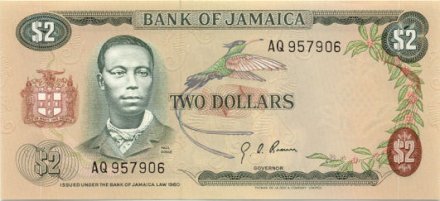
Paul Bogle on the (now out-of-circulation) Jamaican two-dollar bill.

On this day..

1629: Jeronimus Cornelisz and other Batavia mutineers

It was 2 Oct 1629, Dutchman Jeronimus Cornelisz was noosed along with 15 other men by the Dutch East Indies Company for a reign of terror that included mutiny and murder off the coast of Australia.* Six others would eventually hang in the infamous affair, two marooned on the Australian mainland, and many more punished for the gruesome atrocities committed on the Southern Ocean.

Cornelisz was not such an assuming character when he boarded the vessel Batavia in 1628.

This definitive history of the Batavia mutiny is by one of the web’s best history bloggers, Mike Dash. He reprinted an interview largely about this book here.

Rather, he was a marginally failed merchant, someone who could buy his way on board as an under-merchant** and sail to the southern seas for the prospect of a new life. It has been speculated (here, for instance) that his move to Indonesia was motivated by a desire to put oceanic distances between himself — an apothecary who couldn’t make it in Haarlem — and prosecutors pursuing Anabaptists and other heretics. It didn’t help, either, that his infant child had recently died of the disgracing condition of syphilis. All that is enough to send a man to Indonesia, apparently.

Though Cornelisz was not a successful businessman, he was an energetic protagonist from his own station in life and could, eventually, win over any suggestible person with his intelligence and wit. It didn’t take long to do just that to the ship’s skipper, Ariaen Jacobsz — who already held a grudge against the Batavia‘s upper-merchant (and fleet commander), Francisco Pelsaert.

In due time their thoughts turned to the ship’s valuable cargo — silver and trade goods headed for the Mughal Empire. As night follows day, the next thoughts turned to mutiny.

Cornelisz pulled in people from each of the major groups onboard† to help with his mutiny without attracting the attention of the Pelsaert. All the plot needed was a kickstart to turn enough people against the commander.

In the part where the villain reveals his plot, Cornelisz’s goes like this: A group of hooded mutineers assaults the mostly widely lusted-after woman among the socialite passengers, Lucretia (Creesje) Jans; once the assault is reported, the commander must respond; but if the assailants are well-hidden, he must make an example arbitrarily, which pushes his men towards mutiny.

And, like a movie villain’s evil plot, Cornelisz’s didn’t come off.

The captain punished nobody for the assault, as Creesje could not identify the assailants. The shipboard mutiny withered on the vine. But lucky for Cornelisz, the captain had no inkling that the ship’s under-merchant was involved — though he was pretty sure the skipper and boatswain had something to do with it.

In the midst of those days of planned insurrection, the Batavia hit a slightly larger speed bump. On June 4, the vessel ran aground on Morning Reef.

There were few casualties from the initial crash, and the remainder escaped in groups, crammed onto small coral islands in the remote but plausibly survivable Houtman Abrolhos chain off the west coast of Australia.

The ship’s complement was eventually transferred to Beacon Island and Traitors Island — with limited water (but plenty of silver!), it was clear to Pelsaert there would be few people left if they didn’t get some help. Off went the captain with 47 crew and passengers in a longboat, leaving more than 250 behind to fend for themselves on the isles.

Two months later, Pelsaert found himself in the colonial city Batavia (today, the Indonesian capital Jakarta) appealing to the local authorities at the Dutch East Indies Company for a ship to rescue his stranded crew and passengers. He was quickly given the Sardam — another vessel in his fleet — with a skeleton crew to pick up the passengers (oh, and all that silver).

But he wasn’t going to need all those passenger quarters.

Cornelisz, as under-merchant, had technical rank in the emergency, and he had taken over the situation at the islands when the commander left. The refugee pharmacist reveled in the power, certainly amplified by the dozen chests of treasure the Batavia carried.

So here’s your motivation: a fortune in booty and the South Seas as your playground. This is the stuff of rum wishes and buccaneer dreams.

And Lord of the Flies nightmares.

Sensing the the time was ripe to lighten the group’s victual needs, Cornelisz‡ sent 15 men to search a larger island visible to the west for water. This journey, Cornelisz was convinced, would be fruitless, so any possible power rivals he could find went off. As well, Cornelisz shipped a larger group to Long Island to get more space.

And then began the killing.


Detail view (click for the full image) of a 1647 engraving of the carnage on Beacon Island. Cornelisz had a good 110 homicides on his soul’s account by the time it was all said and done.

Some 20 mutineers formed a tight inner circle with fantasies of having their way on the island until the rescue boat could be commandeered for piracy. The purpose of the killings was simply to knock the number of residents down closer to 40 or 45 so that the mutineers would be overwhelmingly dominant when the rescue boat came. That’s a tough task when starting with almost 200 people.

At first, killings proceeded under faux-juridical cover: theft and slander were enough to endanger everyone in these cramped quarters, so Cornelisz would have his men claim illegal activities were afoot and kill one or more of the people he considered either threats or non-entities among the group.

A few loyal footsoldiers did most of the killing, along with some pressed into service with the threat of violence; pretty soon the numbers on the island had dwindled noticeably.

With vague ideas of riches and a growing bloodlust, killing essentially became sport. Families were done to death wholesale, by whatever means were available — drowning, slitting throats, bludgeoning. Those liable to fight back might be jumped by a group at the beach, sometimes getting all of the above.

And before you go thinking murder was the only thing the mutineers had on their minds, they retained at least a few women (including Creesje) as private consorts.


Now is the time to mention that Cornelisz was personally acquainted with notorious (and then-imprisoned) degenerate artist Johannes van der Beeck. This is van der Beeck’s Faun and Nymphs.

But remember those doomed guys searching for water two islands over?

Turns out they found it, along with ample food, and they were now occupying the largest island in the chain.

They, along with 30 or so who escaped Cornelisz’s clutches over the course of two months, were the Resistance, and they were full of incriminating knowledge about what had been going down over on psycho isle.

One of the original group, Wiebbe Hayes, had taken charge of the island’s affairs, and he had done quite well. Those living on what is now known as West Wallabi Island were far better off than their Beacon counterparts.

Back on Beacon, Cornelisz was forced to ration water — even to his favorites — and had thoughts that the High Islanders might scupper his search party takeover plot. So late in July, he sent an amphibious landing team to attack High Island. Cornelisz’s men were met with a line of opposition at the beach, armed with pikes made of driftwood with nails. The mutineers retreated.

Weeks later, Assault II began; like most sequels, it fell on its face. Assault III, Cornelisz decided, should include cunning, cunning like an ostensible negotiation to trade the clothing Cornelisz had hoarded for water and food.

Hayes was even a little more cunning that that, and when Cornelisz and his four top lieutenants came ashore and began sweet-talking, he and his men seized four of them. (The fifth, Wouter Loos, escaped.)

Knowing that having mutineers on his island would be trouble, Hayes convened his council, which swiftly decided to dispatch any prisoner not named Jeronimus: that one was tossed in a pit and given birds to pluck for Hayes’ army.

Two weeks went by before the mutineers (now led by Loos) got up the courage to attack again, but by the time they took to the channels and began a long-range gun assault, the Sardam was in the archipelago. Hayes got to Pelsaert first and informed him of the planned mutiny. Pelsaert trained all his weapons on the mutineers’ boat until they decided to disarm.

The trials were done in the Dutch way, including some amount of torture. Pelsaert finally decided he had enough evidence against the mutineers, and his small tribunal passed 16 death sentences. (One was commuted to exile.) That included a half dozen who had one or more hands lopped off before their passage to the gallows.


Detail view (click for the full image) of the mutineers’ execution.

Three weeks later, when the Sardam returned to Batavia, five more of the rescued mutineers were executed, and a sixth — the boatswain involved in the assault on Creesje — was put to death while Pelsaert was out.

Once word got out, Cornelisz’s heinous crimes were known around the world and Southern sailors heard the tales for hundreds of years to come.

Pelsaert, meanwhile, was partly blamed for the incident and saw the Company seize his assets: he was dead within a year. As for Hayes, he was promoted, but his further adventures are unknown.

The remains of the shipwreck that commenced this hecatomb are still visible at Houtman Abrolhos, from cannons off the original Batavia to the fort built by Wiebbe Hayes and his men — everyday monuments to a hellish ordeal.

* Technically the first European settlers in Australia.

** Dutch merchant vessels were headed by an upper-merchant, who had control over decisions on the ship and represented the overriding interest of the Dutch United East India Company. In addition, an under-merchant was taken aboard as his second-in-command Company man. The skipper was considered head of the crew and placed in charge of navigational concerns, but his role was subordinate to the upper-merchant.

† Like all Dutch merchant vessels, the Batavia featured four major classes of people on board:

  • a standard crew to run the vessel;
  • a complement of soldiers who were generally kept below-decks but could be recruited to maintain order and would disembark at the destination;
  • a group which tended to shipboard needs (surgeon, cook, and so on);
  • and merchants and passengers, who had social standing over the rest.

‡ Technically, Cornelisz was part of a three-member council in charge of the shipwrecked. The initial council was selected from among the socially significant survivors, but Cornelisz used his rank to quickly dissolve that group and appoint two of his own future mutineers as his cohorts. Needless to say, the judiciary wasn’t independent after that.

On this day..

782: 4,500 Saxons by order of Charlemagne

On an unknown date in the latter half of 782, Charlemagne did some seriously nasty business with a captured army of Saxons.

In the late 8th century, the King of the Franks was fighting a decades-long running campaign against Saxon tribes at the edge of his sprawling European empire.

One part Christianizing the pagans and two (or more) parts territorial aggrandizement, Charlemagne’s exertions on the Rhinish frontier were opposed by Widukind, or Witikind, or Widochind, whose “forest-child” name belies its owner’s legendary ferocity.


Widukind was reclaimed in the Renaissance as a patriotic or national figure. (Source)

In the summer of 782, when Charlemagne perhaps thought he had whatever passed for peace among the querulous Saxons, Widukind raised a revolt and dealt the Franks a stinging defeat that put a couple of imperial legates into the ground and made some martyrs out of clerics he found in the wrong place at the time.

Charlemagne’s forces counterattacked and routed the Saxons at the Battle of Suntel (or Sonnethal) Mountain, and thereupon

questioned the primores of the Saxons, all of whom be had summoned to attend him, as to who was responsible for the rebellion which had taken place. And since they all declared that Widukind was the author of this wickedness but were unable to deliver him up in view of the fact that he had taken himself off to the Northmen once the deed had been done, no fewer than 4500 of the others, those who had fallen in with his promptings and committed such a gross outrage, were handed over and at the place on the river Aller called Verden, at the king’s command, all beheaded in a single day. Thus was punishment executed; and the king then retired to winter-quarters at Thionville, where he celebrated both the Lord’s birthday and Easter in the customary fashion.

This merciless slaughter of prisoners is one of the lasting blights on Charlemagne’s impressive reputation. Even so, the reputation had the last word: three years later, Witikind was finally defeated and delivered up, in person, to the Frankish ruler … who accepted the Saxon pagan’s submission and forced him to convert to Christianity.


Charlemagne receives Witikind’s submission at Paderborn in 785.

On this day..

1783: Mutinous prisoners of the Swift

On this date in 1783, six men were hanged at Tyburn for “returning before expiry” from convict transportation.

This was a neat little euphemism covering a very desperate act at the sundering of the American colonies from their mother country.

We’ve previously covered in these pages the underappreciated extent of convict transportation from the British Isles in populating the future United States. Anthony Vaver, who blogs at Early American Crime, in his recent book Bound With An Iron Chain pegs convicts as the second-largest bloc of American “immigrants,” (after African slaves) to the tune of 50,000 souls in the 18th century.

The American Revolution put a halt to that human traffic.

In time, London would transition to dumping its criminal cargo on Australia.

But at the moment the colonies broke free, the Down Under wasn’t yet fulfilling that role, and policymakers faced a conundrum. The judicial machinery continued to sentence thieves to transportation; without an outlet, those unfortunates accumulated cheek to jowl aboard stinking prison hulks on the Thames.

What to do? In 1785, a Parliamentary committee looked back wistfully on the good old days:

That the old system of transporting to America answered every good purpose that could be expected from it; that it tended directly to reclaim the objects on which it was inflicted, and to render them good citizens; that the climate being temperate, and the means of gaining a livelihood easy, it was safe to entrust country magistrates with the discretionary power of inflicting it … that it tended to break, in their infancy, those gangs and combinations which have since proved so injurious to the community; that it was not attended with much expense to the public …

(cited in Botany Bay: The Real Story)

Well, it so happened that this effective and affordable solution, though interrupted by war, was not legally barred in the new United States.

So Britain did what any cost-conscious imperial power would do: sent out a ship with some convicts to see if they couldn’t still be gifted to labor-hungry America. “Perhaps a greater insult to any Nation could hardly have been offered,” griped one Founding Father afterwards.

The gallows held little terror for some prisoners sentenced to convict transportation, who might even have preferred execution. London’s Public Advertiser reported this never-implemented threat on March 24, 1785:

We hear that one of the respited capital convicts, who received sentence of transportation at the adjourned session at the Old Bailey, told the Recorder, in his own name and those of his companions, that they did not esteem the being pardoned, on condition of transportation to Africa, as an act of mercy, but had much rather be hanged at home; and that they were determined to endeavour to sink either the lighter which is to convey them to Gravesend (to which place they are to be guarded by 30 of the militia) or the ship which is to carry them over.

Alright, America. You don’t have to be that way about it.

The ship detailed for this insulting mission was the Swift, and its passage was troubled long before it sighted the Chesapeake. The “cargo” of the Swift mutinied and ran the ship aground in England.

Thirty-nine escapees were recaptured and most sentenced once again to transportation, but six swung at Tyburn on this date. They really were at the end of an era, and not only of North American convict transportation: Tyburn itself hosted its last public execution just a few weeks later.

Nothing daunted, the owners of the Swift reassembled a slate of captives and made another run, reaching Annapolis, Md. on Christmas eve: fortuitous timing, because irritated state legislators weren’t in session and therefore couldn’t block the ship’s unwanted merchandising. The problem was, it was little better wanted by its intended market. According to Vaver, “[o]nly 30 of those on board were sold by mid-January … [the shippers] managed to sell most of the convicts by the spring, but they incurred serious losses after having to provide food, clothing, and medicine for those who languished on board the ship until they could be unloaded.”

They were the last British convicts sold in her rebellious colonies. One last ship made another voyage in 1784 and was turned away flat by every U.S. port, finally managing to offload in British Honduras.

Ere the decade was out, London had established a new penal colony at Botany Bay and set about transferring this particular “special relationship” from the United States to Australia.

On this day..

1763: Gabriela Silang

On this date in 1763, the mestiza Philippines national hero Maria Josefa Gabriela Carino Silang was captured and summarily hanged — along with a number of the soldiers she had led against the Spanish.


Monument to Gabriela Silang in Makati City, Philippines. (cc) image from Jun Acullador.

Gabriela took primary leadership of a 2,000-strong rebel army after its co-leader, her husband Diego, was assassinated by his enemies in May 1763.

Said enemies were the Spanish colonial authorities, whom Diego and his helpmate Gabriela had raised revolt against and with an army wielding homemade muskets and blowguns, driven from the capital of Ilocos Sur. It was Great Britain’s occupation of the Philippines during the Seven Years War that opened the opportunity for the rebellion: the British even appointed Diego Silang governor of the province his army was in the process of conquering. They just didn’t actually help him.

Spain’s assault on the rebels, once organized, was sufficiently overwhelming to drive Gabriela Silang out of the city of Vigan, and then to repel her counterattack — the occasion for her capture and her death.

Gabriela Silang is memorialized in a number of monuments and place names in the Philippines; the women’s organization GABRIELA also engineered its acronym to pay tribute to her.

On this day..