1894: John Cronin, by an automated gallows

From the Dec. 18, 1894 Atchison (Ks.) Daily:

HARTFORD, Conn., Dec. 18. — John Cronin was hanged here at 1:00 o’clock this morning.

The execution of Cronin was especially interesting, being the first hanging in this state under the law passed by the last general assembly and the first trial of an automatic gallows in the east.

This last is the idea of Warden Woodbridge. Aided by James H. Rabbett, a forger, now serving a two and one-half years’ sentence, the warden evolved what he considers an improvement on the hanging machine in use in Colorado.

Small shot has been substituted for water in the operation of the lever which releases the weight and an arrangement made whereby the execution may be stayed at any moment.

The compartment in which the shot are confined resembles an hour glass and the mechanism is thoroughly under the warden’s control. The shot was started in motion by the movement of a lever, and another lever would have enabled the warden to have stopped it at any time. The progress of the shot and the approaching moment when the weight would be released is indicated on a dial resembling a clock.

When Cronin had been seated in the chair and made fast, a signal from the executioner indicated to the man who had charge of the lever that he was ready. The machinery was then set in motion, there being no visible evidence of anything unusual.

The adjustment of the machine was made so perfect that the weight of 306 pounds made no perceptible noise as it was released and fell back to the ground beneath. Instantaneously the victim was jerked into the air, falling backward to within 2 feet of the floor.

One of the principal improvements over the Colorado appliance is the fact that the prisoner is not his own executioner. With the original machine,* when the prisoner was placed on the chair it released a lever which started the mechanism and in this way the man was practically forced to commit suicide.

John Cronin’s crime was the murder of Albert Skinner, at South Windsor, October 6, 1893. He was prompted by revenge for some fancied grievance. He had been boarding with Skinner for several months, but finally was ordered away. A fight ensued at the time and Cronin then went on a protracted debauch. The morning of the murder he went to Skinner’s house and meeting Skinner in the yard immediately shot him, inflicting a fatal wound.

* Developed to hang Dr. T. Thatcher Graves but to my knowledge never actually used.

On this day..

1720: Edward Hunt, the first counterfeiter executed in colonial Pennsylvania

On November 19, 1720, Edward Hunt was hanged in Philadelphia. He was the only Pennsylvanian executed for treason prior to the American Revolution — that treason being not the betrayal of the state (in the sense we might think of it today), but counterfeiting.

In the bitterness of his scaffold speech, which disdains the customary acknowledge-my-guilt, pray-for-my-soul form of the genre to complain about his case, Hunt made plain that he was not reconciled to the justice men had rendered him.

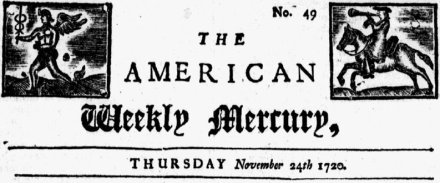
The American Weekly Mercury of Thursday, November 24 published “this extraordinary Piece” only with a preface complaining that “it is evident, that the following Speech was intended to misrepresent the Administration and Justice of this Government, as well as to infuse both ill Principles and Practices into the Minds of the People.”

The Dying Speech of Edward Hunt, formerly taken in Rebellion at Preston, and transported a bound Servant to the Island of Antigua, before his Execution upon the 19th Instant, at Philadelphia, where he had been legally convicted of High Treason, and most justly condemn’d for his Counterfeiting Spanish Silver Coin, made current* by Act of Parliament within all his Majesties Colonies in America.

It may be expected, that I should say some thing now concerning my Life and Conversation, which i must with Sorrow own to God and the Word has not been according to the Precepts and Principles of the Church, in which I was bred and educated: But with a sincere repentance and hearty Sorrow I do lament all the Errors of my past Life, firmly believing in my Saviour Jesus Christ, in whose Merits and ever flowing Mercy I do only trust for Salvation and Pardon, who has promised Eternal Life on no other Terms to the most Righteous upon Earth.

As to the Crime that now I suffer for in particular, I must own it is an Offence against the Laws, which I hope God will pardon me since he knows that I did not do it with any Design to cheat or defraud any one, or to make a Practice of Coining; but being ignorant of the Breach of any Laws of God or Man, I thought I might cut those Impressions as innocently as any other, or the Stamps that the Gentlemen of this place imploy’d me about, to make Farthings.** I am an English Subject, and desired to have the Privilege of the Laws of England, but it was not granted in any Point, except in Condemning me.

I am the first unhappy Instance of this kind that ever suffered in the King’s Dominions, pray God it may be a Warning to all, not to offend wilfully in the same that I did through Ignorance: For if I had known it, I would not have taken all the World to have done it. God give me a patient Resignation to submit to his blessed Will, in whatsoever he please.

I do heartily ask Forgiveness of all that I have offended in any manner of way, and do sincerely forgive all that have injured or offended me; particularly Mr. John Moore and Morris Birchfield, and the Evidence that swore against me in that Tryal. I do solemnly declare, That I know not any thing, or have been guilty of any one thing laid to my Charge in that Matter, or any of the other things laid to my Charge, by John Butler, either in England or Ireland.

I did petition the Honourable Governor for a Reprieve, until the King’s Pleasure was known concerning me, being I could not be tried by the Laws of England in all Points, as a Church of England Man ought to be: But it was a Privilege too great for me to obtain. Pray God to forgive them all, and every one that has a hand in taking away my Life any manner of way, and that my Blood be not required at their Hands, for they know not what they do. I am on Earth judged and condemned to die for the Breach of a Law of Man that was not duly published, which for that Reason I transgress’d it ignorantly, though the first that suffers for the Transgression of unknown Laws, or that was sentenced according to the Laws of England, without the Privilege of a Subject, which I desired of the Judge, which I know was not qualified by the same Laws to try me.

I do not know what Advantage there can be to any in my Death, and that I could not appeal to my King, neither before nor after my Tryal. I do not speak this because I am not in Charity with all the World, I do, from the Bottom of my Heart, forgive all in Obedience to my Saviour’s Command and Example, who suffered more for me, being innocent, and had not only done no Harm, but Good, and pray’d even for is cruel Persecutors and Murderers, and promised, That those that follow his Examples in this World by patiently enduring the Cross, shall reign with him to all Eternity: To Him therefore I commit all, an my poor Wife, beseeching him to help her, and be her Support and Comfort, and preserve her poor Soul free from the Polutions [sic] of the World, that through his precious Merits we may meet where we shall be both happy to all Eternity, in the merciful Arms of our dear Lord and Saviour Jesus, who I do beseech to receive my poor Soul.

According to Kenneth Scott’s Counterfeiting in Colonial America, Edward Hunt’s wife, Martha, got a £500 fine and a lifetime prison sentence for misprision of treason. (If that book is up your alley, Scott has an even more specific Counterfeiting in Colonial Pennsylvania.)

* Early colonial American commerce was severely hampered by a shortage of English/British currency. As a result, coins minted in Spain’s lucrative southern territories served as the colonies’ primary currency in the 17th and 18th centuries, particularly the iconic eight-real silver “pieces of eight”.

This is the reason why the currency of the present-day U.S. isn’t an “American pound sterling” but the almighty dollar: Dutch colonists had brought a coin called the leeuwendaalder to their former New Amsterdam (New York) province, the name deriving from the German thaler. As the pieces of eight corresponded to the thaler/daalder, it inherited the same name. Indeed, the “Spanish Dollar” remained legal tender in the post-colonial United States until 1857.

This is also the reason for reckoning of the eight constituent bits that comprised the dollar, and hence of the American colloquialism “two bits” to denote $0.25 … and, later, the adjective “two-bit” to man something cheap, mean, or small-time.

** They may have been Spain’s coins, but it’s wildly implausible that any Englishman could think he could counterfeit “innocently.”

On this day..

1688: Goodwife Ann Glover, Salem trial run

On this date in 1688, colonial Boston hanged its last witch … or, its first Catholic martyr.

Goodwife Ann Glover was an Irishwoman who had been among some 50,000 Catholics deported to Barbados* by Oliver Cromwell during the 1650s.

1688 finds her with a daughter, desperately poor, as housekeepers in Boston to one John Goodwin and his family.

After one of Goodwin’s daughters accused the Glovers of stealing some linen, the daughter got cussed out and — per Cotton Mather’s credulous account of the washerwoman’s devilry — “visited with strange Fits, beyond those that attend an Epilepsy or a Catalepsy, or those that they call The Diseases of Astonishment.” In fact, four Goodwin children began suffering these symptoms, and would do so for weeks on end, only abating enough for meals and a good night’s sleep. (They would finally be cured, weeks after their supernatural tormenter’s hanging, by having to fast for a couple of days.)

The family doctor diagnosed “an hellish Witchcraft.” Mather has an extensive description of their thrashings, but his contemporary, Boston merchant Robert Calef, charged in his anti-Mather tract More Wonders of the Invisible World that Mather himself did not shy from “taking home one of the children, and managing such intrigues with that child, and printing such an account of the whole … as conduced much to the kindling of those flames, that in sir William‘s time threatened the destruction of this country.”

This Glover case is Cotton Mather’s underreported debut on the witchcraft scene. With the moderating hand of his father away, the ambitious 25-year-old divine took on a starring role in the drama. He would boast of it in published material in the years following, and as Thomas Hutchinson later observed,

The printed account was published with a preface by Mr. Baxter, who says, ‘the evidence is so convincing, that he must be a very obdurate Sadducee who will not believe.’ It obtained credit sufficient, together with other preparatives, to dispose the whole country to be easily imposed upon by the more extensive and more tragical scene, which was presently after acted at Salem … these books were in New-England, and the conformity between the behavior of Goodwin’s children and most of the supposed bewitched at Salem, and the behavior of those in England, is so exact, as to leave no room to doubt the stories had been read by the New England persons themselves, or had been told to them by others who had read them. Indeed, this conformity, instead of giving suspicion, was urged in confirmation of the truth of both.

Years later, when the public turned against Mather’s appalling leading role in the Salem Witch Trials, one of the Goodwin children was among the parishioners whom Mather detailed to come to his defense. “[Mather] never gave me the least advice, neither face to face nor by way of epistles, neither directly nor indirectly,” insisted Nathaniel Goodwin, later to become the executor of his estate. “[H]e never advised me to anything concerning the law, or trial of the accused person.”**

Eventually persuaded by the children’s mysterious or staged illnesses, the town magistrates hauled Goody Glover in for questioning and set upon her poor command of the King’s English. Glover was a native speaker of Gaelic; she had lived in Boston for only a few years, and it’s likely that whatever degree of English she picked up in her indenture in Barbados was heavily creolized by that island’s enormous mid-17th century influx of African slaves for the sugar plantations.

Whatever she said sounded like it came straight from perdition to the ears of Cotton Mather.

she being sent for by the Justices, gave such a wretched Account of her self, that they saw cause to commit her unto the Gaolers Custody. Goodwin had no proof that could have done her any Hurt; but the Hag had not power to deny her interest in the Enchantment of the Children; and I when she was asked, Whether she believed there was a God? her Answer was too blasphemous and horrible for any Pen of mine to mention. An Experiment was made, Whether she could recite the Lords Prayer; and it was found, that tho clause after clause was most carefully repeated unto her, yet when she said it after them that prompted her, she could not Possibly avoid making Nonsense of it, with some ridiculous Depravations. …

It was not long before the Witch thus in the Trap, was brought upon her Tryal; at which, thro’ the Efficacy of a Charm, I suppose, used upon her, by one or some of her Cruel the Court could receive Answers from her in one but the Irish, which was her Native Language; altho she under-stood the English very well, and had accustomed her whole Family to none but that Language in her former Conversation; and therefore the Communication between the Bench and the Bar,’ was now cheefly convey’d by two honest and faithful men that were interpreters.

Just imagine how apoplectic this guy would be if he ever heard “para Espanol o prima dos.”

One can readily picture confusion and malice multiplying one upon the other as it passes not only between two different tongues but also between two different cosmologies. We don’t know very much about Ann Glover; even her name is a slave name. But she was Catholic, and so had a religious world of saints and symbols that her persecutors could readily equate with demons. (Querying her in the condemned cell at one point, Mather is told that “saints” forbid her cooperating with his Protestant exhortations, but he understands it as “spirits” — apparently the Gaelic word is one and the same — and he presses her for the identities of these infernal agents.) She probably did not remotely share her prim persecutors’ regard for temperance and submission. She was of course poor and uneducated, ready prey for the entrapment of a well-schooled prig who could scarcely conceive the lives she had already led in Ireland and Barbados. If one likes, one might take her as the luckless victim of a conservative clergy’s backlash against the slow fade of its authority.

Glover’s broken speech and wrong religion surely made it easy to “other” her. Even so, at least in Mather’s construction, Goodwife Glover’s condemnation reads as if it proceeded with at least the partial participation of the accused.

Several rag dolls were recovered from Glover’s home, and Mather says that Glover agreed that these were “her way to torment the Objects of her malice … by wetting of her Finger with her Spittle, and streaking of those little Images.” Even if this matter is just as her foe depicts it, Glover wouldn’t exactly by the only person in history to be irritated by her employer, nor to satisfy her vengeance on some fetish of an untouchable enemy.

Glover might herself have believed in the folk magic whose practice was only slowly ebbing away at this time; Mather even says that Glover obligingly healed a boy whom she had bewitched when his mother testified at her trial.

Or she might have defiantly embraced the sorcery accusations against her as a last rebuke to the Puritans who had torn her from hearth and home all those years before and now despised her as an idolatrous papist. Her contemporary defender Robert Calef just thought she was a bit out of her gourd; “the generality of her answers were nonsense, and her behaviour like that of one distracted,” giving “crazy answers to some ensaring questions.” The court actually explored this possibility as well by empaneling a group of medical men to explore Glover’s competency. They found her compos mentis.

It’s too bad that we don’t have Goodwife Glover’s own account of herself. Instead we read her through axe-grinding interlocutors.

Mather wearied his victim with demands to convert, along with an interpreter since “she entertained me [in her cell] with nothing but Irish.” (He didn’t mean whiskey.) It was only “against her will” that Mather prayed with her — or maybe more like “at her” — although he also claimed to have extracted an admission that other witches were operating who would continue to afflict the Goodwin children.

She was drawn on this date to the gallows at Boston Neck — coincidentally almost the very spot where Boston’s Catholic Cathedral of the Holy Cross stands today.

There’s a precious alleged† first-person account of her execution:

There was a great concourse of people to see if the Papist would relent … Her one cat was there, fearsome to see. They would to destroy the cat, but Mr. Calef would not [permit the cat to be killed]. Before her execution she was bold and impudent, making to forgive her accusers and those who put her off … She predicted that her death would not relieve the children, saying it was not she afflicted them.

November 16 is now, by a 1988 tricentennial resolution of Boston’s considerably more Catholic-friendly city council, Goody Glover Day in that city. What better spot to celebrate than at Goody Glover’s Irish pub?

* Such deportees were said to be “Barbadosed”.

** This is not the only link between those Massachusetts witch-hunts; Rebecca Nurse, one of the women hanged at Salem, might have visited Ann Glover in jail.

† So far as I have been able to determine this widely-reproduced quote sources entirely to a 1905 Journal of the American Irish Historical Society piece. This was itself reproduced from a strongly partisan article titled “A Forgotten Heroine” and published in a devotional Catholic magazine, The Ave Maria. It was written by Harold Dijon, an instructor at a Baltimore Catholic school, without primary footnotes — only a general citation that it has “been gleaned from Cotton Mather, Upham, Drake, Moore, Owens, Calef, Cartrie, and papers of the Massachusetts Historical Society.” I have not been able to locate the document Dijon quotes here.

On this day..

1942: Eddie Leonski, the Brownout Strangler

(Thanks to Meaghan Good of the Charley Project for the guest post. -ed.)

On this date in 1942, a boyishly handsome G.I. named Edward Joseph “Eddie” Leonski was hanged at Pentridge Prison in Melbourne, Australia.

Although his crimes were committed in Australia and were not war-related, he was court-martialed and sentenced to die under American military law.

This was the first and last time a foreign national who committed crimes in Australia was tried and sentenced under the laws of their own country. Eddie was only the second U.S. serviceman to be executed in World War II. (The first, James Rowe, had been convicted of murdering another soldier and was hanged in Arizona just three weeks earlier.)

Known as the “Brownout Strangler” due to his penchant for attacking women at night on Melbourne’s dimly lit streets, Leonski killed three people and assaulted several others of the course of just over two weeks, from May 3 to May 18, 1942. He said he was fascinated by women’s singing and killed his victims to “get at their voices.”

Leonski was born in New Jersey in 1917, the sixth child of Polish/Russian immigrant parents, and grew up in New York City. Crime historian Harold Schechter notes he had the kind of unstable childhood, dysfunctional family background and mommy issues typical of serial killers:

Both [parents were] confirmed alcoholics. He was seven when his father abandoned the family. Not long afterward, his mother, Amelia, took up with another drunkard. She herself suffered at least two mental breakdowns, severe enough to land her in Bellevue, where she was diagnosed with both manic-depression and incipient schizophrenia. From an early age, three of his brothers were chronic troublemakers, eventually racking up lengthy rap sheets. One of them ended up in a state institution, where he lived out his life.

According to all accounts, Eddie was the apple of his unstable mother’s eye. He, in turn, had the kind of deeply disturbing attachment to her found in other homicidal mama’s boys.

On the surface Eddie seemed to have risen above his origins. He began weight-lifting in adolescence and eventually developed an impressive physique. Following high school he took a three-year stenography course and graduated in the top ten percent of his class. He was a promising employee at a Manhattan supermarket chain before he was drafted into the Army in 1941.

Leonski didn’t do nearly so well in the military: although he was reliable and charming when sober, he drank heavily and was unstable and aggressive when under the influence. As a result, he was always in some minor trouble or another.

But there was a war on and the United States was not in a position to be picky about who would serve. Eddie was sent to Australia in early 1942.

Only weeks after his arrival, he began attacking women and trying to choke them. The first few times, he was interrupted and had to flee before he could accomplish his purpose. Then his crime spree was interrupted in the last week of March after he went AWOL on a six-day bender and was thrown into the brig for a month. As soon as he got out he began stalking women again.

At 2:00 a.m. on May 3, an extremely intoxicated Leonski encountered 40-year-old Ivy Violet McLeod waiting for a streetcar near a dry cleaner’s. He strangled her to death and ripped off her clothing, but was scared away when he heard footsteps.

McLeod’s body was found several hours later: “legs wide apart and feet tucked under her thighs, with genitals exposed.” Her killer had not had time to rape her.

A week later, Eddie was in a restaurant when he struck up a conversation with 31-year-old Pauline Buchan Thompson, a policeman’s wife and mother of two. They went to a bar after dinner and spent several hours talking and drinking.

Close to midnight, Eddie offered to escort her home. On the way, Mrs. Thompson started drunkenly singing.

“She had a nice voice,” he said in his confession. He got angry when she stopped: “I got mad and then tore at her, I tore her apart.”

A few hours later a night watchman found her body on the very steps of her boardinghouse. Like Mrs. McLeod, she was nearly nude with her legs splayed, but had not been raped.

Hours later, a hung-over Eddie Leonski was nursing the hair of the dog that bit him when he told a fellow soldier what he’d done. He made more statements about the two murders over the next few days, but his friend didn’t believe him and told no one what Leonski was saying — time during which Leonski made three more unsuccessful assaults on women.

Eddie’s friend finally took him seriously on the morning of May 19, after the body of 41-year-old Gladys Lillian Hosking was found sprawled in a patch of yellow mud outside Camp Pell, where the American soldiers were stationed.

The previous night, Eddie had come in after midnight, slathered head to toe in the same yellow mud. Too drunk to clean himself up (he’d consumed an incredible thirty beers and seven whiskeys that day), he just shed his soiled clothes and collapsed into bed.

Leonski’s friend finally went to the cops.

When he was arrested, Eddie made no pretense of innocence: he quickly confessed, and various witnesses to his aborted attacks identified him. (That said, Ivan Chapman’s out-of-print book on Leonski makes the point that the evidence against him might not really have held up without those confessions: 1940s forensics techniques would not have yielded a positive match to a victim from his bloodstained trousers, and the yellow mud could easily have been picked up innocently by any drunken G.I. who stumbled traversing the trench.)

Fredric Wertham, a noted forensic psychiatrist who never met Leonski, believed he was insane and the murders were prompted by his twisted relationship with his mother:

That his three victims were all women considerably older than he was is psychiatrically most significant. He unconsciously linked their voices with his mother. The whole psychological explosion occurred in a period of deprivation when he was away from home and separated from his mother — but not from her dominating image. The deeds constituted symbolic matricide.

Very Norman Batesian.

Army psychiatrists, however, believed that while Eddie Leonski was certainly a psychopath, he was not psychotic and was fully aware of the wrongfulness of his acts. Douglas MacArthur personally signed the death warrant.

Eddie maintained a positive, chipper attitude awaiting execution. He spent his time memorizing Oscar Wilde’s Ballad of Reading Gaol, and converted to Catholicism, and went to the gallows singing a popular song that was called, ironically, “It’s a Lovely Day Tomorrow.”

His remains were moved several times before finally finding a permanent grave in a military cemetery in Hawaii. The Australian modernist artist Albert Tucker made a painting titled “Memory of Leonski.” The film Death of a Soldier is based on his crimes.

On this day..

1918: Louis Harris and Ernest Jackson, the last British soldiers shot at dawn

(Thanks to Meaghan Good of the Charley Project for the guest post. -ed.)

On November 7, 1918, mere days before the end of World War I, British privates Louis Harris and Ernest Jackson were shot for desertion and cowardice. Jackson, of the 24th Battalion Royal Fusiliers, and Harris, of the 10th Battalion West Yorkshire Regiment, were the last British soldiers shot for military offenses in the First World War.

Jackson had been conscripted into the military in July 1916 and sent to France in November. He first ran into trouble in April 1917, when he went AWOL for 28 hours and was sentenced to two years in prison. In most cases the sentence would have been suspended, but for some reason that didn’t happen with Jackson and he spent sixteen months behind bars before he was released and returned to his battalion in August 1918.

A little over a month later, on September 29, he disappeared from his battalion transport lines near Flesquières, where he’d been sick and waiting to be sent to the field ambulance.

Arrested on October 3, Jackson got sent back to the to the 24th Battalion, which was then at Noyelles, 3,000 yards from the front lines. By mid-afternoon he had dropped out of sight again, but was arrested by the military police the next day at Douellens. On October 8, Jackson’s NCO found his arms and equipment in a shelter not far from where he’d gone missing.

Jackson faced a Field General Court Martial (FGCM) on three charges:

  1. Going AWOL on September 29
  2. Deserting on October 4
  3. “Shamefully casting away his arms, ammunition and equipment in the presence of the enemy” on October 4

When asked to explain himself before the tribunal, Jackson said, “I left because I could not stand the treatment I was receiving. I wanted to get away from everything … I have been looked down on by everyone and that is the cause of my being here today.” He added that both his parents had died in insane asylums and he himself suffered from “mental problems caused by worries.”

The FGCM would have none of it and sentenced Jackson to death. He was shot at St. Python in northern France at 6:10 a.m. He was 32 years old.

Nineteen minutes later and 25 kilometers away, at Locquignol, Private Louis Harris faced the firing squad.

Harris had volunteered for the Army in 1915, but was discharged as unfit. He got conscripted in 1916, however, and was sent to France in July, where he served as part of a Lewis gun team. On September 2, in the middle of an attack at Rocquigny, while there was “no firing and practically no opposition,” Harris ditched his kit and his comrades and vanished. He was arrested the next day and faced an FGCM for desertion and cowardice.

The book Blindfold and Alone: British Military Executions in the Great War notes,

Harris — surprisingly … was not defended at his trial and made no attempt to cross-examine any of the witnesses, nor did he make a statement in his own defence. It would appear that the 23-year-old soldier either did not understand the seriousness of his position, or was resigned to his fate.

He was found not guilty of cowardice, but guilty of desertion, and his bad record (which included repeated charges of insubordination) was held against him. His CO wrote, “Pte. Harris L. has not got a good record in this Battalion. His fighting value is NIL.” The Brigade Commander agreed, summing up his case thusly:

I recommend that the extreme penalty be carried out for the following reasons:

  1. Pte. Harris’s action was deliberate.
  2. He has previously attempted to desert unsuccessfully.
  3. He is worthless as a soldier.
  4. During an action he deliberately abandoned his comrades.
  5. His example is a disgraceful one.

Harris’s execution was, as previously stated, the last. Four days later on November 11, the war ended and all death sentences for military offenses were commuted to penal servitude. In 1929 the death penalty was abolished for desertion and other military crimes.

On this day..

1984: Velma Barfield, the first woman in the modern era

The first execution of a woman* in the U.S. “modern” death penalty era took place at Raleigh, North Carolina’s Central Prison on this date in 1984 when 52-year-old Velma Barfield received a lethal injection for poisoning her fiance.**

Barfield was already twice a widow in 1977 when her prospective third spouse Stuart Taylor began suffering agonizing stomach pain at church. He died shortly after.

A thorough coroner and a tip call to police by Barfield’s sister each independently flagged arsenic as the cause. Exploration of her past uncovered a disturbing pattern of people near to Velma Barfield who died in spells of nausea, vomiting, and diarrhea.

She would confess when confronted to poisoning off not only her late fiance, but also her mother and two elderly people for whom she was a paid caregiver, all during the 1970s — a period when she was afflicted by addictions to numerous prescription drugs. There are at least two other probable murders she may have authored during this time.† “It’s the saddest thing but it seems like everybody my mother ever gets close to dies,” one of her sons remarked innocently at Taylor’s service, before the criminal suspicions surfaced.

Like the second American woman executed — Karla Faye Tucker more than 13 years later — Barfield was mediagenic, devoutly Christian, and white. Like Tucker, Barfield made national news as she approached her execution date. Time magazine, 60 Minutes, even international press descended on Raleigh.

The bespectacled, crocheting grandmother ended up declining to appeal to the Supreme Court or file other delaying actions that were available to her so that she could meet her execution with greater dignity, but she still sought mercy from the governor. Her sterling prison record was her strongest card; staff routinely broke a “no contact with other inmates” rule (the entire death row women’s section consisted of Barfield alone) in order to put the matronly “Mama Margie”‡ around inmates whom her ministrations could help.

Unfortunately for Velma Barfield, her clemency pitch was addressed to Gov. Jim Hunt at the peak of his ferocious 1984 U.S. Senate run against Jesse Helms, the most expensive Senate race in U.S. history up to that point. Hunt wasn’t about to go soft on arsenic killers four days before the polls opened. (He still lost by 86,280 votes.)

In the small morning hours this date in 1984, dressed in pink cotton pajamas and an adult diaper, Velma Barfield gave a last statement apologizing for “all the hurt that I have caused,” laid down on a gurney to receive the IV lines, and was put to sleep.

* The last execution of any woman in the U.S. prior to Velma Barfield’s was all the way back in 1962.

** Last meal: Cheez Doodles and Coca-Cola.

† Her first husband, and the father of her children, died in a suspicious fire in 1970; shortly before her execution, Velma admitted to her family that she had started it. Singer Jonathan Byrd is the grandson of the apparent first poisoning victim, whose death Barfield only confessed very late in the game to the minister who helped her write her book: Jennings Barfield was already afflicted with emphysema and diabetes when the two wed in 1971, so his death a few months later failed to raise any eyebrows. Byrd eventually composed a song about his grandfather and his deadly bride, titled “Velma”.

‡ Full name: Margie Velma Barfield. She was born Margie Velma Bullard.

On this day..

1964: Eric Edgar Cooke, the Night Caller

On this date in 1964, Western Australia conducted its last hanging — that of Eric Edgar Cooke.

Cooke was one of Australia’s worst serial killers, and also one of its strangest: the eight homicides were almost unpatterned save for their rage.

A harelipped, bullied youth turned delinquent turned small-time criminal — he had numerous arrests to his name for theft, for vandalism, for torching a church that rejected his choir audition, for auto theft and for being a peeping tom — Cooke busted out of obscurity and into nightmares on the night of Australia Day 1963 when he gunned down five random people in Perth‘s comfortable suburbs. But even by then he had already been stabbing and shooting at people, and menacing them with cars.

Cooke’s Australia Day spree comprised four distinct incidents united to one another and to Cooke’s previous patterns by little but a lust for the hunt: his sole methodology was opportunism. Cooke shot a couple parked in a car (they survived), then an accountant through his apartment window (not so lucky); then, Cooke murdered a young man asleep on an open veranda, and rang the doorbell of another house to lure a fifth victim (both of these men also died).

As he’d been previously arrested on the strength of his fingerprints, Cooke had taken the precaution to wear gloves, leaving police a very cold trail indeed. The shock of the one night’s carnage multiplied as weeks, and then months, elapsed with no arrest. Thirty thousand men were fingerprinted in a futile fishing expedition.

An isolated western city in the midst of a transformative population boom, Perth learned mistrust from Eric Edgar Cooke. Of course that can’t literally be true; Perth was half a million people strong by this time. But in the civic memory Cooke’s Australia Day signposts an innocence lost. Estelle Blackburn in her Broken Lives depicts Cooke as the baleful spirit come to scourge Perth’s newly, complacently prosperous. (See this pdf.) It was

[t]he small city … [that] had ways of a friendly, easy going big country town where people left their doors unlocked and their car keys in the ignition of open cars. They trusted each other. He turned it into a city of suspicion and terror. For the first time people started locking the doors of their homes and cars, stopped going out at night and slept with guns or any weapons they could find under their pillows.

There’s a kernel of truth in this cliche, for Cooke liberally exploited Perthians’ inattention to security. When finally arrested in August of 1963 after he shot an 18-year-old babysitter, his confession explained that thanks to car owners’ habit of just leaving the keys in the ignition, he had frequently stolen vehicles parked for the night, used them in hit-and-runs or other crimes, and returned them before morning … the owners very often none the wiser.

Cooke had, meanwhile, also strangled a social worker in the Perth suburbs in February 1963, and stabbed to death a South Perth beautician during a home invasion robbery back in 1959. He proved to have a photographic memory of his misdeeds, and could detail exactly the objects he had stolen in hundreds of long-past burglaries. He copped in all to eight murders and 14 attempted murders.

With such evidence from Cooke’s own mouth his barristers had little choice but to pursue an insanity defense. This didn’t fly with the courts, but neither too did Cooke’s more embarrassing admissions to two murders for which two other men were already imprisoned. (Officially, the crown only credited him with six of his eight kills.) A “villainous unscrupulous liar” he was called for those claims; Darryl Beamish and John Button each served many more years in prison for these two disputed murders; with Blackburn’s help, they were both formally vindicated in the 2000s.

On this day..

1571: Hans Haslibacher, Bern Anabaptist

On this date in 1571, Anabaptist Hans Haslibacher was martyred in Bern, Switzerland.

Haslibacher (German link) joined the oft-suppressed movement in 1532 and quickly established himself as one of the most energetic proselytizers in the Emmental in Bern canton.

Condemned at last in 1571 after a lifetime of arrests, he was honored in a 32-stanza anonymous poem “Das Haslibacherlied” (German) alleging that Haslibacher prophesied that his death would be marked with three signs:

  1. His head when struck off would spring into a hat and laugh aloud;
  2. The sun would turn blood-red;
  3. The town fountain would spew blood.

According to the poem, all three prophesies came to pass … and “the hangman too was heard to say: / ‘Tis guiltless blood I’ve shed today.”

The Swiss Anabaptists are noteworthy as the confessional ancestors of the present-day Amish: the latter sect is named for 17th century Bern canton Anabaptist Jakob Ammann, who was the leader of one faction in a 1693 schism within the Swiss Anabaptist community.

Fortunately (though not for this here site) that schism emerged too late in the day for a classic religious martyrdom. Hans Haslibacher, in fact, was the last Anabaptist put to death for his faith in Bern.

On this day..

1940: Hans Vollenweider, the last guillotined in Switzerland

On this date in 1940, Hans Vollenweider became the last person executed in Switzerland.

The Swiss had long experience with executions by beheading and, of course, with mechanical refinements, so adoption of the guillotine was a natural fit … especially after Napoleon overran Switzerland.

Actually, Switzerland had experimented with guillotine-like machines centuries before the French introduced the device, but in the 19th century its Jacobin associations led to a running tug-of-war that saw some cantons abolish the guillotine (German link) in favor of a return to public beheading with a sword. At the same time, the pan-European move away from capital punishment saw a precipitous decline in actual executions, culminating with outright abolition in Switzerland’s 1874 constitution.

Although the death penalty was narrowly reinstated by referendum* (more German) in 1879, its use thereafter was sparing and often contested. In 1938, Switzerland adopted by referendum a new, federal criminal code abolishing the death penalty.

But that code did not take legal effect until January 1, 1942 … and in the intervening years, two people would be controversially guillotined under the outgoing statutes.

Hans Vollenweider (German link) “enjoys” the distinction of being the last of these.

He was a triple murderer, although formally condemned only for one of these homicides — and condemned by an Obwalden court not even a month before, on September 19. Vollenweider’s last legal appeal and his application mercy were disposed of in the week before he lost his head.

There’s a 2004 German-language documentary film about this milestone execution, Vollenweider – Die Geschichte eines Mörders (Vollenweider – The Story of a Murderer).

Vollenweider was the last person executed in Switzerland for an “ordinary” crime, but the death penalty did remain on the books for treason until 1992. Seventeen additional people were executed for that crime during World War II — executed by shooting, not beheading.

Switzerland today has abolished the death penalty at the constitutional level for all crimes. It does retain one single guillotine left in a warehouse somewhere as its last keepsake from an increasingly distant era.

* More precisely, the individual cantons were granted the right to introduce the death penalty in their own territories.

On this day..

1648: Alice Bishop

(Thanks to Meaghan Good of the Charley Project for the guest post. -ed.)

On this date in 1648, 32-year-old Alice Bishop was hanged on the gallows in Plymouth Colony, Massachusetts for the murder of her young daughter — an apparently motiveless crime which must have shocked her fellow settlers.

Almost nothing is known about Alice’s early life. She probably, although not definitely, came over on the Mayflower. The prevailing theory is that her parents were Mayflower passengers Christopher Martin and Marie Prower. They died within a week of each other in January 1621, before the actual settlement of Plymouth even began.

If that’s the case, Alice had been an orphan for the better part of a year by the time the first Thanksgiving rolled around. She was presumably raised by one of the other families. She would marry twice and have three daughters: Abigail, Martha and Damaris.

By 1648, Alice was living with her second husband, the Plymouth newcomer Richard Bishop, who was Damaris’s father. The family seems to have been unexceptional, just another household trying to eke out a living in a harsh and unforgiving environment.

Somewhere along the line, something went very wrong.

On July 22, 1648, while Richard Bishop was away from home, family friend Rachel Ramsden dropped by the Bishops’ residence and spent some time with Alice. Alice’s four-year-old middle child, Martha Clark, was asleep in bed in the loft, which was accessible by ladder. (Where the other two children were has not been recorded.)

At some point, Alice gave Rachel a kettle and asked her to go fetch some buttermilk from a neighbor’s house.

When Rachel returned, she noticed blood on the floor beneath the ladder. Alice was “sad and dumpish,” and when Rachel asked her what was going on, she wordlessly pointed up at the loft.

Rachel climbed up to have a look: there was blood everywhere; Martha’s mattress was drenched in it.

Rachel fled the house in a panic, found her parents and told them she thought Alice had murdered her daughter. Her father rushed to find the colonial governor. A posse of twelve armed men assembled and went to the Bishop house. By the time the men arrived, Alice was in hysterics.

Ascending to the loft, they found Martha’s body. The child was lying on her left side, “with her throat cut with divers gashes crose wayes, the wind pipe cut and stuke into the throat downward, and the bloody knife lying by the side.” Nothing could be done for her.

Alice freely admitted she had murdered her daughter and said she was sorry for it, but she claimed she had no recollection of the crime. When they asked her why she’d done it, she had no answer for them.

She was the fifth person hanged in the Plymouth Colony, and the first woman.

We will never know why Alice Bishop killed her daughter Martha, and why she did it in such a ferocious manner. One of her descendants has a website about her that attempts to answer that question.

Severe mental illness, perhaps post-partum psychosis, is an obvious answer, but not the only one. The site notes another potentially significant fact: both of Alice’s parents died when she was four years old, and she killed her daughter at the same age.

Richard Bishop survived his wife by nearly a quarter-century. As for the children: youngest child Damaris Bishop grew up, married and had three sons, but Abigail Clark, Alice’s oldest child, vanishes from history after her mother’s execution.

On this day..