On this date in 1981, Mustapha Danso was executed for an attempted coup in Gambia.
Gambia (or “The Gambia”: we’re going to dispense with the article here) is a sliver of a country hugging the Gambia River, entirely surrounded (save the coast) by Senegal.
It became independent of Great Britain in 1970 under the leadership of Dawda Jawara, who held the Gambian presidency democratically from that time until 1994. Mustapha Danso, our date’s principal, was one of a coterie of disaffected Gambian junior officers who were scheming a coup against Jawara as the 1980s got underway.
In October 1980, Danso walked up to the deputy commander of the Gambia Field Force, Eku Mahoney, and coolly shot him dead. “Although the first speculations blamed the constable’s action on possible illicit drug influence,” notes a book about Gambia’s subsequent, and successful, 1994 junior officers’ coup, “Mustapha Danso’s unresentful attitude after the incident convinced many people that there was more to it than what met the eye.” Mahoney may have been killed because he was viewed by the prospective coupists as an obstacle.
Danso caught a death sentence, but since Gambia never actually executed anyone, it was essentially symbolic.
That is, until July 1981, when Jawara was in London to attend the wedding of Prince Charles and Lady Diana. Danso’s former comrades in the Field Force seized the opportunity to join a coup mounted by leftist politician Kukoi Samba Sanyang against the “corrupt, tribalistic, and despotic” Jawara in favor of “the dictatorship of the proletariat.”
From London, Jawara summoned Senegalese aid: Gambia’s neighbor and sometime rival dispatched troops who successfully crushed the rebellion within a week. Some 500 people lost their lives during the turmoil, and its leaders fled abroad. (Kukoi Sanyang died a few months ago as of this writing, but his version of the “people’s revolution under my able leadership” can be perused here.)
While the coup itself was suppressed, Jawara went pretty easy (as these things go) on his actual or perceived enemies. Danso was the only party to the plot who was executed, and Jawara went out of his way to declare normalcy instead of using a national security emergency to smash up everything.
“In the aftermath of this threat to our internal security some have asked whether it would be appropriate at the time to consolidate both the power of the State and the power of the executive. Let me state categorically and unequivocally that the system of democracy that has always existed will prevail. There will be no dictatorship in The Gambia — neither by the President, nor by the Government, nor by the proletariat.” (Source)
Danso was the first and, for 30 years the only, person executed in Gambia; the country has retained the death penalty in law, but was long considered de facto abolitionist. That changed suddenly in August 2012 when current president Yahya Jammeh unexpectedly ordered nine condemned prisoners put to death on a single day.
The city of Vienna only has one documented execution for witchcraft to its illustrious history. It occurred on this date in 1583.
Elisabeth Plainacher (English Wikipedia entry | German) was a miller’s daughter from Mank who had lived most of her 70 or so years during the Protestant Reformation and the Catholic Counter-Reformation, that social conflict so productive of witchcraft accusations.
It would factor very specifically in Elsa’s case, since she herself was a Protestant in a very Catholic place.
Elsa’s daughter Margaret died in childbirth, and Elsa took all four of the surviving children into her own care while Margaret’s widower went his own way. Three of these children would die in her care; the fourth became an epileptic in her teens, finally leading Margaret’s (Catholic) former husband to accuse his mother-in-law of bewitching everybody.
The accusation was ill-timed for the “witch”: Jesuit zealot Georg Scherer got hold of the case and put the epileptic teenager through a gantlet of exorcisms that he claimed expunged 12,652 infernal spirits. Scherer’s accounting must have been as rigorous as his faith.
“Scholars and men of understanding know that devils have neither flesh nor limbs, but are spirits, and therefore need no place or space as do our bodies,” Scherer later wrote by way of explaining the crowded tenancy. “A hundred thousand legions of spirits could all be collected together on the point of a needle.” Scherer preached, and later published, a sermon this holy combat, titled “A Christian remembrance of the most recent deliverance of a young woman who was possessed by 12,652 devils.”
This was a relentlessness which Elsa Plainacher was not formed to resist. She was a humble miller with some family drama, and then suddenly she was under torture (German link) in the imperial capital with the day’s headline pulpit-basher at her throat. She soon admitted whatever devilries her torturers demanded of her: giving the epileptic over to the devil, desecrating the Host, all that sort of thing.
On September 27, 1583, she was drug by a horse to an open field where she was burned at the stake. Her ashes were consigned to the Danube. Plainacherin even persisted (more German) in the local vernacular for a time as a dirty word.
Posterity’s apology for this horrible fate comes in the form of a small Vienna street, Elsa-Plainacher-Gasse, named after her. (There’s also a Plainachergasse in her native Mank.)
Early this morning in 1970, in the prison at Cajamarca, Peru, Ubilberto Vasquez Bautista was shot for the slaughter of a young shepherdess.
The young girl — either 9 or 11 years old — had been raped, then stabbed 27 times.
Udilberto Vasquez was found with some blood incriminatingly all over his underwear. Though he never admitted guilt, his story went through a few iterations, one of which entailed pointing the finger at his brother. (… with whom he shared underwear, I guess.)
Basically desperate for any angle, his attorney pushed that as a defense.
As one might readily infer from his presence on these pages, not that defense nor any other sufficed to save his client’s life.
Rather, Vasquez became the first victim (Spanish link, as are nearly all those that follow) of draconian new legislation imposed by the Juan Velasco Alvarado dictatorship reinstating capital punishment for fatal sexual assaults on particularly young victims.** This law was only in place from 1969 to 1973, so it was bad timing as much as anything for Udilberto Vasquez. (Peru’s 1979 constitution would restrict the death penalty to wartime treason.)
In execution, Vasquez joined the curious pantheon of Latin American folk saints comprised of ordinary criminals (usually ones thought to be innocent). Vasquez had converted in prison to the Adventist Church, and some fellow inmates believed he had the power to work miracles.
Latter-day supplicants hoping for same crowd to a mausoleum-shrine, especially on Nov. 1, All Saints’ Day. He’s credited with many miracles rescuing the health and fortunes of devotees.†
Such divine providence necessarily implies a view of its author’s innocence in that whole rape-murder thing. Among followers, the attorney’s notion of Vasquez’s brother’s culpability — and still more, the sacrificial concept that Vasquez willingly gave himself to protect his brother (which seems at odds with Vasquez blaming his brother) — has improved into a mythic truism.
* In addition to the book, Graziano has a fascinating site on his investigations into folk religiosity in the Spanish Americas, CulturesOfDevotion.com.
The Canadian province of Manitoba logged its first judicial hanging on this date in 1874.
Private Joseph Michaud, an artillery gunner, earned the distinction with one of the classic criminal archetypes, the ill-advised bender. Having snuck out on the town — Winnipeg, in this case — a progressively more belligerent Michaud found himself by the wee hours slashing with his knife one of his fellow duty-derelicters.
That other soldier wasn’t the murder victim: it was, instead, a passerby who saw Michaud brandishing his weapon and attempted to intervene. The boozy artillerist chased that poor man down and left the Good Samaritan a bloodied corpse in the street, pocked with thirty or more knife wounds.
Once he sobered up, Michaud was as appalled as anyone. At his trial, his plea was “coupable dans mon coeur et je merite la morte.” (“Guilty in my heart and I deserve to die.”) In a similar vein, Canada’s temperance movement seized on the case of the remorseful young man driven to an act of madness by drink. “The miserable end of this young man Michaud ought to be a lesson to our young men to keep away form the temptation of strong drink.” (That quote and a longer summation of the trial are here.)
On this day in 1849, forgotten mass murderer Rebecca Smith was hanged before a large crowd outside Devizes Prison in Wiltshire, England. She’d been convicted of the murder of her one-month-old baby, Richard.
Smith was the fifteenth person executed in the UK that year, and she would be the last woman in British history to be put to death for the infanticide of her own child. (Not to be confused with infanticide in general.)
Lionel Rose, in his book Massacre of the Innocents: Infanticide in Great Britain 1800-1939, described Rebecca Smith as “an impoverished depressive and the wife of a drunkard.” In many ways she fit the profile for perpetrators of infanticide then and now: most women who commit these acts are desperate, often young, often impoverished, often unmarried, unable to take care of their babies and not knowing where to turn.
In many jurisdictions today, such women are treated leniently. 19th-century judges and juries did the same and rarely convicted the defendants of murder, which at the time entailed an automatic death sentence; they would usually try to go for an outright acquittal or, at worst, a manslaughter verdict.
As Rose notes in his book, “Between 1849 and 1864 there had been only 39 convictions of mothers for the willful murder of their children, almost all of them under 1 year and all but 5 illegitimate. From 1849 the Home Secretary invariably reprieved mothers who killed their own infants under twelve months … Between 1849 and 1877 only two more women were to be executed for child murder.”
One had slaughtered her four-year-old son; another killed not only her own child but also the child of her lover’s former mistress, to get him out of having to pay child support.
Rebecca’s case was something else altogether, though.
Her behavior before little Richard’s death was suspicious: she claimed the infant was “wasting away” when he was in fact the picture of health, and she went around in her home village of Bratton asking where she could buy arsenic.
When Richard died suddenly a short time later, the police launched a homicide investigation. On autopsy his body was found to be riddled with poison.
He had clearly been murdered in cold blood, but in spite of this the jury recommended mercy.
However, after her conviction Rebecca confessed that she had poisoned not just Richard but seven more of the eleven children born to her. Seven! All of them except Richard were killed only a day or so after birth. Her statements were confirmed when the authorities exhumed the children’s bodies and autopsied them.
Aged forty-three, ‘undernourished and in poor health, living in great poverty and almost illiterate’, she had borne eleven children during eighteen* years of marriage, but only one, the first-born, was still alive. […] Her husband was an alcoholic who never earned much money and frittered away the £100 that her father left to her; although a seemingly pious woman, Smith felt that murder was a kinder fate than slow starvation. […] Seen by her neighbors as inoffensive and industrious, she claimed that her only fear was that her surviving daughter would be neglected after her death.
Two of her non-murdered children also died of natural causes; only one daughter survived to adulthood.
[H]er conduct was most becoming. Mild and contented in her manner and deportment might be thought that she was totally incapable of the unnatural crime of which she was convicted. Free from guile or hypocrisy, she at once unhesitatingly confessed her crime, and acknowledged the justice of the punishment that awaited her, and frequently expressed a hope that others would take warning by her fate. At the same time she was extremely ignorant, and betrayed a want of any deep feeling.
The modern reader may be shocked that she was able to get away with it for so long, but it wasn’t necessarily all that unusual.
The infant mortality rate in 19th-century Britain was so high, particularly among the poor, and the methods for investigating murders and potential murders were so primitive, that a person could commit such crimes repeatedly with very little fear of being detected.
Rebecca Smith was certainly not the only mother of that time and place who killed several of her own children during infancy, and she was probably not the most prolific, either. The only thing that stands out about her is that she got caught.
In spite of what she did, when you look at her life, it’s difficult not to pity her. But as Watson explained, “A confession to eight murders made a reprieve impossible.”
* Some sources say she was married twenty-eight (not eighteen) years.
On this date in 1929, James Horace Alderman, the “King of the Rum Runners” or the “Pirate of the Gulf Stream”, was hanged at a custom-built gallows at a Florida Coast Guard base.
But as he came into his own, his business on the high seas was smuggling, often Chinese immigrant workers trying to sneak into the U.S. from Cuba. It’s rumored that Alderman killed some of these people, too.
Either way, Prohibition made for a much more profitable racket hauling liquor from Caribbean manufacturers to the Everglades, where it could take a train ride and be distributed all the way up the Atlantic coast.
On August 27, 1927, a Coast Guard cutter stopped and boarded Alderman’s speedboat and seized fifty barrels of whiske. Even worse, Alderman shot two of the cutter’s boarders dead.
Alderman’s case might look pretty open and shut, but Floridians proved to be extremely resistant to hosting a federal execution. (The feds at this point generally administered executions in their own name, but at the execution sites of whatever state the malcreant happened to live with. Julius and Ethel Rosenberg, for example, simply died in New York state’s iconic electric chair.
The final judicial decision on this strange question so far from the long-ago deliberations at Liberty Hall came down like this: Florida’s facilities could be barred to the federal government, and that they should carry out the execution on nearby federal property. The U.S. Coast Guard was forced to build a temporary gallows for Alderman inside its seaplane hangar and base no. 6. (Here’s Alderman’s detah warrant, if you’re into that sort of thing.) A short drop from the platform led to an agonizing 12-minute strangulation.
Because Florida itself had only a few years prior ditched hanging in favor of the electric chair, Alderman’s execution was the last judicial hanging in (but not by!) the state of Florida.
On this date in 1899, the gallows of gold rush boom down Dawson City, Yukon strained for three murderers.
The 1896 gold strike in the Klondike triggered a huge rush of prospectors warming sub-Arctic climes with visions of sudden wealth. “When the world rang with the tale of Arctic gold, and the lure of the North gripped the heartstrings of men,” as put by that lure’s great muse Jack London, who himself had already come and gone from the Dawson City by this time, and struck his own variety of fortune in the process.
Miners pouring into the Yukon did not, of course, enter virgin territory. Native peoples had occupied it for thousands of years.
In May 1898, two prospectors, Christian Fox and William Meehan, camped near the mouth of McClintock Creek were only mildly uneasy about the arrival of the Nantucks, Tagish brothers who set up an adjacent camp. Relations were amicable for a while, but when returning one afternoon from the day’s work the prospectors were suddenly fired upon from ambush by their neighbors.
Meehan was slain in the fusillade. The injured Christian Fox managed to float away, get to land, and reach a miners’ settlement. He described the attack thus:
I was lying on the sacks against the side of the boat … and I saw Joe standing with his gun like this … and all the boys went into the brush, and I says to myself “Now they have shot us for our outfit, and are hurrying down to the next bend in the river to catch the boat … My only show is to get to the opposite side of the river and try to make for a white habitation” … I took the paddle in my hand and tried to paddle the boat but I was too weak, so I … used it as a pry … The boat ran up to a nice little level place where it was grassy and as I stepped out I stepped over the leg of my partner as he was stretched out over the boat with his head back and his mouth open and I saw that he was dead, and I said “Good by Billy old boy, I can do nothing for you here.”
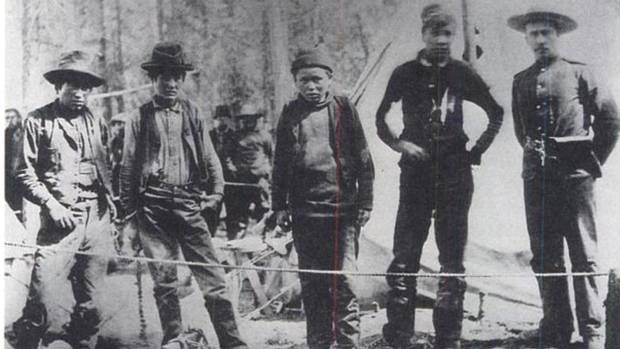
By Fox’s report, the four Nantucks were soon taken into custody.
The four Nantuck brothers, shackled after arrest.
The trial unfolded in a court at the territorial capital of Dawson City. A compelling chapter in Strange Things Done: Murder in Yukon History does wonderful work with the cultural disconnections, including a two-page exchange between judge and interpreter (and, off-camera, Frank Nantuck) in which the court struggles to get the accused sworn “so help me God” since Frank’s cosmology has no idea of an afterlife. “He says, when he is dead he is dead — that is all I can get out of him,” the helpless middleman reports.
Q Has he any knowledge of God at all or any idea about a future state of rewards and punishments?
A No sir.
Q Or any clear belief in religion of any kind?
A No sir.
Q Will you say to him that we want him to tell us the truth and not to tell us anything that is not the truth; that he may be punished if he tells us anything that is not the truth; that we are going to ask him some questions and that he must tell us just the truth; ask him if he will agree to do that.
The outcome of the trial will not surprise and there was no question but that the Nantucks had done the shooting. What the Dawson court only barely noted was that brothers had been detailed to avenge two Tagish deaths. An old woman had previously been given or found some “baking powder” and proceeded to make bread with it: in fact, it was arsenic, which was used in mining. Here again is the cultural dislocation; the Nantucks living next to Fox and Meehan were trying to feel out whether those two prospectors were of the tribe that had provided this poison, and of equivalent social rank to the two men who died eating the arsenic-bread. Basically, neither side in this subarctic tragedy had any concept of what the other was on about.
There’s a play about this case, Justice. Peruse the play’s pdf companion study guide on the real historical case here.
In the end, all four Nantucks were condemned to die; Frank was probably still a minor, and he had cooperated with the investigation, so his sentence was commuted to life imprisonment … which did not turn out to be very long at all, since Frank and his condemned brother Joe both died in jail of tuberculosis during the 1898-99 winter.
Momentarily sensational, the case was long forgotten among whites; it has, however, remained in the oral tradition of Yukon First Peoples. Both communities, however, saw the case brought to the fore when excavations accidentally turned up their remains — along with those of two other hanged men.
One of the other two was the third man to hang this date, a fellow by the name of Ed Henderson. Henderson was an American prospector whose fate might be a bit less instructive for posterity. He suffered from a horrible bladder infection that caused him to pass bloody water every 15 or 20 minutes. “The tortures of the damned,” he described it to court. Wincing yet?
The fact that Henderson suffered from it meant his two prospector-mates suffered from it as well — call it purgatory-level suffering; a member of their party had to relieve himself constantly and thrashed about in his sleeping bag all night for the agony it caused him.
Their empathy for his situation was overturned along with Ed Henderson’s inside-the-tent piss-bowl one night. The drenched and vengeful Tomberg Peterson started an immediate brawl, but Henderson’s leaky plumbing didn’t impair his ability to shoot Peterson dead. Henderson himself reported the incident when the prospectors reached their destination, possibly thinking that no jury would convict him.
The trio comprises the first men hanged by the Yukon Territory, which was only separated from the Northwest Territory in 1898. In fact, there was a bizarre procedural deficiency for the Nantucks (but not for Henderson): they were condemned by the court of the wrong, former territory since word of the territories’ separation had not reached Dawson City at the time of the trial. Nobody saw fit to remedy this blunder, however.
On this day in 1949, Jordan hanged Jacob Bokai. The Syrian Jew was the first Israeli intelligence agent put to death in service of the infant state. (At least, the first that’s been publicly acknowledged.)
Posing as a Palestinian named Najib Ibrahim Hamuda, Bokai’s mission to infiltrate Jordan started at a Palestinian refugee camp in Jaffa, where he was abused by the guards to establish his credentials. Those beatings went for naught, however, as Bokai never made it past the checkpoint: he was arrested immediately upon passing the Mandelbaum Gate into Jordan on 4 May 1949. Since he refused to cop to his mission or his Jewish identity, he was given a Muslim burial after hanging for espionage.
That charge was indeed well-founded: Bokai is now openly honored at a memorial to Israeli agents opened in 1985.
According to the story related by a former Mossad chief who gave a tour of this place to Tom Friedman back when the latter was the Times‘ Middle East scribe and not its leading nutter columnist — just mind the source is what I’m saying here — the doomed “Mr. Hamuda” still managed to get a message back to his Israeli handlers reassuring them that the enhanced interrogation he enjoyed in Jordan prior to execution had not compromised whatever operations he was privy to: “I did not commit treason.”
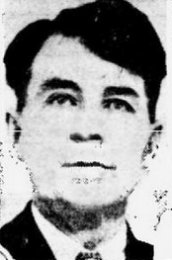
The most recent execution in the Russian Federation was that of serial killer Sergey Golovkin on this date in 1996.
Known as “The Fisher” or “The Boa”, Golovkin (English Wikipedia entry | Russian) grew up in Moscow as a shy outsider type (Russian link) with a noticeable slump and a predilection for animal cruelty, the kind of whom oblivious classmates will later say that they never saw it coming. He graduated from an agricultural academy and worked as a horse-breeding expert: people skills just weren’t his thing.
But people killing skills …
Golovkin committed his first murder in 1986,* forcing a 16-year-old boy into the woods near a north Moscow train station where he raped and strangled him and then mauled the corpse. Months later, the same treatment befell a 12-year-old whom Golovkin kidnapped from a summer camp, with even more horrible mutilations: the dead child was beheaded, emasculated and disemboweled. A third victim he killed in 1989.
But Golovkin really got going in 1990, after he bought a car and dug a garage cellar — a spot which he soon realized doubled as a dungeon. There he had the privacy for eight more homicides in the ensuing two years, each of the grisliest particulars.
One example to suffice: after having had his fill of raping, he proceeded to hang one victim to death with a makeshift noose; then, Golovkin trussed the carcass upside-down like a slab of meat, and savaged it from head to toe. Ears, nose, and genitals he sliced off, the skull prised open and the brain torched.** Golovkin even indulged a bit of experimental cannibalism on this occasion, but found he didn’t like the taste and left that particular grotesquerie out of his repertoire thereafter.
Reports and rumors of a monster at work by this time drew the attention of a police force that had been notoriously slow to figure out how to investigate serial killers. Golovkin had his garage in (and, hence, the victims had disappeared from) the vicinity of the outlying horse-stud farm where he worked; however, his registered residence was in Moscow itself, and this discrepancy helped investigators to overlook him as a suspect for a time.
But post-Chikatilo, the police were learning fast. The investigating team was soon able to put together a profile of the killer, and link the furtive and opportunistic 1986 killings to the more methodical maniac at work in the early 1990s. Golovkin was finally arrested in October 1992 and soon confessed all — a confession scarcely required given the macabre artifacts disgorged by his homemade abattoir.
Golovkin was shot on 2 August 1996, with the traditional “single bullet to the back of the head” method. Russia at that time was in the process of implementing a moratorium on executions as part of its entrance into the Council of Europe. Though the moratorium has wavered at times, it has held ever since. Golovkin, as of writing, is the last person judicially executed on Russian soil to date. Even so, the moratorium has never quite become a full de jure abolition of the death penalty.
There the matter rests, for now. For the future, who knows? There’s no indication of a real push to restore the death penalty on the horizon, but it bears remembering that absolutist Russia actually abolished the death penalty for 22 years in the 18th century. That moratorium didn’t stick.
* Golovkin attempted a similar murder in 1984, but the 17-year-old victim whom he raped managed to escape, prompting the rattled newbie predator to lay low for a while. That boy would later testify at Golovkin’s 1993 trial.
** Golovkin worked with animals professionally, and had beyond that the human anatomical expertise appropriate to his avocation. On one occasion when he kidnapped multiple boys together, he dismembered the one in front of the other, giving a little impromptu instructional to the survivor using the viscera. Golovkin later told investigators that the (temporarily) surviving child took it all in with odd calmness.
On this date in 1955, Albert Pierrepoint escorted the alluringly tragic Ruth Ellis to the gallows at Holloway Prison — the last woman ever hanged in Great Britain.
The former hostess had tracked her inconstant and abusive lover David Blakely to a Hampstead pub a few months before — getting the ride, and the murder weapon, from her unrequited hanger-on Desmond Cussen — and shot Blakely dead on the street. Five bullets: the last, a coup de grace. (Another missed entirely and winged a passerby.)
A bitterly controversial case from the moment it entered the public eye, Ellis’s hanging bolstered the movement to abolish Britain’s death penalty. Juridically, however, it was resolved in the blink of an eye when a crown’s attorney cross-examined the murderess:
Christmas Humphreys: Mrs. Ellis, when you fired that revolver at close range into the body of David Blakely what did you intend to do?
Ellis: It was obvious that when I shot him I intended to kill him.
The jury, which never heard that Blakely regularly beat his killer (including once to induce a miscarriage), needed 14 minutes to convict her.
ET: I think at a certain point in time, everyone in Great Britain would have known who Ruth Ellis was, and quite a few abroad, too. How true is that still, nearing 60 years after her execution?
I think her name is still quite familiar, to be honest.
When I began researching the book, everyone I discussed it with either already knew the very basic facts of Ruth’s story, and at the very least that she was the last woman to be hanged in England. The 1985 biopic Dance with a Stranger left a big impression too, even though it wasn’t entirely faithful to Ruth’s character, making her seem much more hysterical a personality than she actually was, although I thought Miranda Richardson was brilliant in the role — as she always is!
What led you to the Ruth Ellis story?
I’ve always been interested in Ruth and that period in history — and I vividly remember going to see ‘Dance with a Stranger’ when it came out in the cinemas here. But it always struck me that her full story had never been told, particularly the last few months of her life after she shot David Blakely. And a couple of years ago there was quite an intense debate about bringing back capital punishment; Ruth’s name was always mentioned in relation to that particular argument, and I really felt it was time to explore her whole story.
What are the greatest misconceptions people have of her? Have her previous biographies and screen portrayals fed those misconceptions?
Without doubt, many people see Ruth as she was shown in ‘Dance with a Stranger’ — very screechy, out of control and violently jealous.
I think it’s true to say that she and David were both deeply jealous of each other (both giving the other reason to be so), but Ruth was not as hysterical as she was portrayed in the film. In fact, it was quite the opposite — the men were hysterical and it was Ruth who usually vented a sort of quiet fury. There is one scene in the film which shows her smashing the windows of David’s car and screaming in the street. Reading the original police statement about that night reveals a very different story; she was described as very calm and rational. There was no screaming, and although she did damage the vehicle, it was not remotely as it was shown in the film.
I think other adaptations have also done her a disservice. Ironically, probably the most accurate portrayal is in the film ‘Pierrepoint,’ where the character of Ruth appears for no more than a minute or two on screen.
I get the sense that Ruth was always running uphill against her class position, trying to climb a little higher than she could reach — right up to the end where her lover is a well-off cad and the rivals for the lover’s affection are his middle-class friends. What role did England’s class relations have in Ruth Ellis’s life and death, and in the way that others perceived her? Do they still shape the way we talk about her all these years later?
Class and politics played a huge role in Ruth’s life generally.
England was distinctly class-led at the time and when the case hit the headlines, she was described as a working-class floozie who attached herself to the upper-class David Blakely purely in order to hoist herself up the class ladder.
That couldn’t have been further from the truth; if she was only interested in using men to better herself socially, she would surely have married her sometime-lover Desmond Cussen, who was a much steadier prospect with money and property and who wanted very much to marry her. Ruth worked hard to better herself but she didn’t use the men she loved to do so.
And when it came to her trial, the class values of the time were heavy in the courtroom with the male barristers and judge and so on all very much men of the upper classes — and who viewed her accordingly. I hope we have got beyond all that nonsense now — but it does add a very distinct dimension to discussions of her case.
She was working as a hostess when she met David Blakely. What would a hostess do, who worked in this trade, and who were the clientele? Was it usual for “real” relationships to evolve? Do people still have this job in the same form as Ruth had it?
Hostessing in the clubs in which Ruth worked was quite straightforward — or it should have been, but there was Morris Conley to contend with, and he was quite a character.
Ruth’s basic job description was to look good and to chat to customers (mostly men) in the clubs, laugh at their jokes and keep them buying food and drink for as long as possible. Most hostesses were in their late teens and early twenties, working-class girls who thought the lifestyle was more glamorous than toiling in a factory or in a shop.
They were usually paid badly and relied on tips to make ends meet, but were given a dress allowance so that they could look as alluring as possible. The clientele mainly consisted of demobbed servicemen who suddenly seemed to have lost their attractiveness to women after the war — where once they had been heroes, by the late 1940s many of them were down on their luck and working as door-to-door salesmen, very lonely and eager to talk to pretty young girls about their war exploits.
The girls who worked for Morris Conley, like Ruth, were expected to sleep with the clients if that was asked of them, and often had to sleep with ‘Morrie’ and his less than respectable friends too. Many of them were very poor young women who lived in flats owned by Conley and his wife — and if they didn’t toe the line, they lost their jobs and their homes in one fell swoop.
Did real relationships evolve? Yes, they did, but very rarely. There are girls all over the world doing very similar jobs today — from London to Japan and everywhere in between too, no doubt.
You have this quote from Ruth about David Blakely: ‘I thought the world of him; I put him on the highest of pedestals. He could do nothing wrong and I trusted him implicitly.’ Ruth had an alcoholic, abusive father, and then she had two children from marriages with two different men that both fell apart — one from bigamy and abandonment, the second from alcoholism and domestic violence. Blakely himself cheated on her. Why wasn’t she more cynical about Blakely? If you take away the tragic ending to this particular relationship, was something like this a pattern she was doomed to keep repeating ad infinitum?
She loved him — it’s really as simple as that.
Although she obviously had a good degree of self-awareness and knew what David was and always would be, she truly loved him and for a time believed they had a future together. As for a pattern — I don’t know. Perhaps if she had met one good, steady man to whom she was attracted as much as she was to David, her life — and David’s too of course — might have been very different.
I’m going to phrase this inelegantly: what is the DEAL with Desmond Cussen?
Good question! I really think that he was as confused and tormented by everything that was happening as a result of Ruth’s and David’s relationship as Ruth herself.
I think he did love Ruth, and he tried hard to make things work with her, but he knew her heart was with David. His apparent lack of self-respect and backbone is baffling — quite why he kept ferrying her across London and out to Buckinghamshire in pursuit of David is a bit mystifying. I did question in the book why no one seemed to query his state of mind as much as Ruth’s — and as to whether he gave her the gun or not, knowing what she intended to do … I am sure he did, even though he must have known where it would end for Ruth herself.
Perhaps he hoped that with David out of the way, she would be reprieved and they could then have a life together. But I really don’t know!
Ruth’s legal defence was legendarily feeble. That said, I’m very interested in the barrister’s attempt to frame its insanity defense around feminine hysteria — “the effect of jealousy upon a female mind can so work as to unseat the reason and can operate to a degree in which a male mind is quite incapable of operating.” This was bound to be undermined by Ruth’s own calm and the statements about her intent to kill that she gave to police and in court. Was it the case that the law at the time didn’t have the instruments to situate Ruth’s context and state of mind, other than hysterical/not? Or could an abler barrister have presented a different story?
I think part of the difficulty is obviously that the defence of diminished responsibility was not introduced in the courts here until 1957 — largely as a direct result of this particular case.
Ruth’s lawyers tried to argue this as a defence for her to some extent, but it just wasn’t possible legally. That said, I think they served her quite badly and didn’t bring out so much that might have enabled the jury to see her crime in context. There was no mention of the abuse in her childhood, no mention of the violence she had suffered at the hands of her ex-husband and very little said about David’s own brutal treatment of her.
But Ruth herself did not seem to care much what happened in the courtroom, once it became evident that the story as she saw it — David’s friends having, in her view, deliberately destroyed the relationship between them — was not going to come to light. She gave up, and volunteered nothing that could have helped her, minimizing the violence to which she had been subjected and dismissing most of the questions put to her in a short sentence or two.
She also infamously replied to the prosecution’s question of what she intended to do when she set out to find David with the gun, “It is obvious when I shot him I intended to kill him.” That one line completely sealed her fate.
Despite all this, the public did seem to be shocked by Ruth Ellis’s hanging, and it’s supposed to have boosted the anti-death penalty campaign. If one may phrase it this way, were people shocked for the right reasons? How much did the symbolic “Ruth Ellis” that even her supporters among the general public had in view have to do with the real person as you understand her?
I think any case is always immeasurably more complex than it is presented in newspaper columns and headlines.
I think, again, the outcry at her execution has to be seen in context — people were becoming more and more opposed to the death penalty and there had been some very high-profile, contentious cases that really did cause a great deal of debate, anger, and distress: the hanging of Timothy Evans in 1950 and of Derek Bentley in 1953 for instance (both of whom were posthumously pardoned).
The fact that Ruth was a young, attractive, lively woman with two small children caused many people to question the validity of capital punishment. It was her death on the scaffold that gave the abolition movement its emotional spur.
What became of Ruth Ellis’s body after her hanging? And what became of her family and the others who were part of the story?
Ruth was buried in the confines of Holloway Prison after her execution, sharing her unmarked grave with four other women who had been hanged there. In 1971, when the prison was demolished and rebuilt, her body was released to her son for burial.
He had hoped to lay his mother to rest alongside David Blakely at the Holy Trinity churchyard in Penn but the vicar there would not allow it. Ruth was instead buried in the churchyard of St Mary’s in Amersham, a few miles away.
As to what became of her family: her son Andre (who was ten when Ruth was executed) was diagnosed with schizophrenia as a very young man and never came to terms with the loss of his mother. He committed suicide in 1982. Ruth’s daughter, Georgina, had quite a colourful life, becoming a successful model who was in the newspapers fairly often as part of the George Best ‘set.’ She married and had children and worked hard to win a posthumous pardon for her mother, of whom she spoke often. She died of cancer at the age of only 50.
As for Desmond Cussen: he emigrated to Australia and opened a flower shop there. He never married and became an alcoholic, dying in Perth on 8 May 1991 of pneumonia and organ failure following a fracture dislocation of the neck in a fall at his home.

 The young girl — either 9 or 11 years old — had been raped, then stabbed 27 times.
 Known as “The Fisher” or “The Boa”, Golovkin (
