1862: Nathaniel Gordon, slave trader

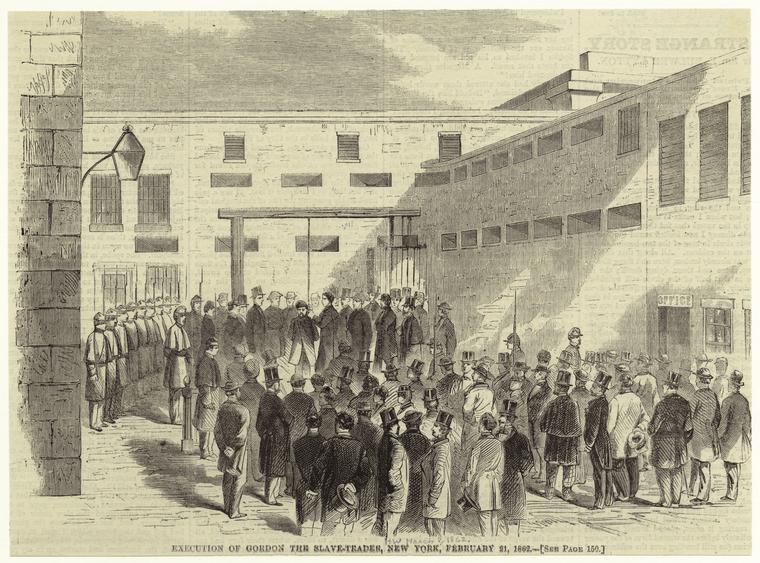
On this date in 1862, the American commercial shipper Nathaniel Gordon was hanged at the Tombs for slave trading.
Importing slaves to the U.S. had been nominally illegal for over half a century, but had never been strongly enforced. In 1820, slaving (regardless of destination) had even been defined as piracy, a capital crime.

Importation of kidnapped Africans into the United States did significantly abate during this period, and that was just fine with U.S. slaveowners ever paranoid of servile rebellion.

But a voracious demand for conscript labor persisted elsewhere whatever the legal situation. About 3 million slaves arrived to Brazil and Cuba, the principal slave shipment destinations, between 1790 and 1860 — even though the traffic was formally illicit for most of this time.

Great Britain was endeavoring to strangle the Atlantic slave trade, but the diplomatic weight she had to throw around Europe didn’t play in the U.S. Washington’s adamant refusal to permit the Royal Navy to board and search U.S.-flagged ships made the stars and stripes the banner of choice for human traffickers profitably plying the African coast. “As late as 1859 there were seven slavers regularly fitted out in New York, and many more in all the larger ports,” one history avers.

Hanging crime? No slave-runner had ever gone to the gallows as a “pirate” — not until Nathaniel Gordon.

The U.S. Navy did mount its own anti-slaving patrols, but the odd seizure of human cargo was more in the line of costs of doing business than a legal terror for merchants.

So Gordon, son of triangle trade port Portland, Maine and a veteran of several known slaving runs, didn’t necessarily think much of it on August 8, 1860, when the Mohican brought Gordon’s ship to bear 50 miles from the Congo with 897 naked Africans stuffed in the hold, bound for Havana. Half of his slaves were children.

“The stench from the hold was fearful, and the filth and dirt upon their persons indescribably offensive,” Harpers reported.

Gordon chilled in very loose confinement in the Tombs, even enjoying family leave furloughs as he readied for the customary slap on the wrist.

But with Abraham Lincoln’s election in 1860, Gordon was promoted to demonstration case.

After a hung jury in June 1861, the feds won a conviction and death sentence on those long-unused piracy laws in November 1861.

Many New Yorkers were shocked at the prospect of such draconian punishment.

Abraham Lincoln found himself besieged by appeals public and private against the unprecedented judgment. “For more than forty years the statute under which he has been convicted has been a dead letter, because the moral sense of the community revolted at the penalty of death imposed on an act when done between Africa and Cuba which the law sanctioned between Maryland and Carolina,” Gordon’s counsel Judge Gilbert Dean wrote in an open letter to the President* — an argument that could hardly be more poorly calibrated to impress in 1862.

Despite Lincoln’s famous proclivity for the humanitarian pardon, he stood absolutely firm on the precedent Gordon’s hanging would set — especially in the midst of a bloody civil war driven by the very legal sanction Dean had cited so approvingly. As Lincoln wrote on February 4, 1862,

I think I would personally prefer to let this man live in confinement and let him meditate on his deeds, yet in the name of justice and the majesty of law, there ought to be one case, at least one specific instance, of a professional slave-trader, a Northern white man, given the exact penalty of death because of the incalculable number of deaths he and his kind inflicted upon black men amid the horror of the sea-voyage from Africa.

Gordon’s hanging was the one case — the only one ever.

* New York Times, Feb. 21, 1862.

On this day..

1844: Hester Foster and William Young Graham

(Thanks to Meaghan Good of the Charley Project for the guest post. -ed.)

At 1:30 p.m. on this date in 1844 at the Columbus Penitentiary in Ohio, William Young Graham, aka William Clark, and Hester Foster, aka Helen or Esther, were hanged together for their respective crimes.

It was an integrated execution: Graham was a white man, and Foster was black.

Foster was the first woman to be executed in Ohio. (There have been just three more … so far.) The previous spring, while incarcerated for some offense lost to history, she beat a white female prisoner to death with a fire shovel. As this history of Franklin County notes, Foster admitted to her actions, but claimed the murder wasn’t premeditated and therefore not a death penalty crime.

Graham’s crime was somewhat similar; within a few months of the murder Foster committed, he killed a prison guard with an ax. He claimed insanity by way of defense.

The pair’s public execution was attended by thousands. In the atmosphere of “noise, confusion, drunkenness and disorder,” one attendee, a Mr. Sullivan Sweet, was accidentally trampled to death. Many more Ohio men would face the death penalty in coming years, but Ohio’s next execution of a woman would not be until almost a century later, with the electrocution of serial poisoner Anna Marie Hahn in 1938.

On this day..

1481: Diego Suson, by his daughter’s hand

On this date in 1481, Spain’s first auto-da-fe under the recently established Spanish Inquisition saw six burned at the stake in Seville.

These pageants of orthodox Catholic authority, with parades of heretics publicly confessing their error and being received back into the community on penitential terms, while others more contumacious were consigned to the flames, would soon become one of the signature features of Inquisition Spain. Some 700 people were executed at such events over the decade to come.

But here in the early 1480s, the terrifying powers of the Holy Office for the Propagation of Faith (the Inquisition’s business-card title) were, well … unexpected.


/Mandatory

Don Diego Suson, one of the six put to death this date, was the wealthy patriarch of a marrano family — Jews, who had converted a century prior. The Inquisition’s whole founding spirit was the sense of characters like Torquemada that as such conversions had generally been obtained under duress, the families in question were still secretly maintaining their Semitic rites. That would make them apostates (since they were baptized and supposedly Christian), and it would implicate them in God knows what other malignancy (since they were malignant Jews).

Spain, you’ll recall, is at this point about 11 years away from expelling all its Jews full stop.

This made it especially dicey for Suson that he was also a rabbi to an underground community of still-practicing “converted” Jews. (Spanish source) Torquemada was on to a real thing here.

Unfortunately his daughter — so the legend says — didn’t quite grasp what the Inquisitors had coming and lightly betrayed the fact to her Christian lover. In no time at all, the guys with the racks and thumbscrews had the terrible family secret in hand.

It’s said that the beautiful (of course) daughter was so riven with grief and shame for the careless destruction of her father that she shut herself up in a convent … and arranged that when she died her guilt-stricken head should be hung up at her former home.

The location of this macabre monument is still marked in Seville today; once known as the Calle de la Muerte, it is now called the Calle Susona.

On this day..

1999: Leo Echegaray, by lethal injection in the Philippines

On this date in 1999, the Philippines resumed executions after 23 years with its first-ever lethal injection.

Judicial executions had ceased during the Marcos dictatorship’s martial law period — extrajudicial killings were another story — and formally all but abolished after Marcos fell in 1986.

But rampant crime made an execution comeback a potent political issue that helped to carry Fidel Ramos* to the presidency in 1992. The revival would bring along the latest upgrades in killing-people technology: whereas the Philippines had previously used the electric chair, a holdover from its former colonial domination by the United States, it now followed America’s footsteps in preferring the sanitized experience of lethal injection.

Leo Echegaray, destined to become the first person to meet such a fate in the Philippines, was a house painter convicted of raping his daughter or stepdaughter. (Despite Rodessa’s surname, her mother and Leo never married. Rodessa Echegaray’s uncertain biological parentage was at issue in the case, as to the question of whether the rape could be said to be incestuous: rape committed by a father was a specific subcategory of rape under the law uniquely eligible for the maximum penalty.)

The Supreme Court had no interest in parsing DNA, finding that the parenthood “disclaimer cannot save him from the abyss where perpetrators of heinous crimes ought to be.”

“The victim’s tender age and the accused-appellant’s moral ascendancy and influence over her are factors which forced Rodessa to succumb to the accused’s selfish and bestial craving,” it ruled. “The law has made it inevitable under the circumstances of this case that the accused-appellant face the supreme penalty of death.”

That was in 1996. By the time Echegaray came to the actual end of his appeals cycle, Ramos had given way to the mercurial Joseph Estrada. A former actor, Estrada put his showmanship to use by having his telephone hotline to the prison disconnected prior to Echegaray’s execution to underscore his resolve not to entertain any 11th-hour commutation.

The 11th hour was of intense interest to everyone else. The supposedly secret time and circumstances of Echegaray’s move to the death house was leaked and resulted in a circus scene as the doomed prisoner, Bible in hand and “Execute Justice, Not People” pinned his orange prison jumpsuit, pushed through a raucous crowd of journalists to a van waiting to drive him to New Bilibid Prison in Muntinlupa for his milestone date. The undignified “execution fiesta” continued hours later in the official witness room, where media jostled for the best seats, and even to Echegaray’s last rest as reporters hounded the hearse and beyond. (Actual example: “I’m here at the funeral parlor and I’m holding Leo’s leg. It’s a bit warm and it looks like he is only sleeping.”)

Once the death chamber’s seal was cracked, it saw steady traffic: Six other people suffered execution in the Philippines during the ensuing 12 months. Then, as abruptly as capital punishment had returned to the Philippines, it blinked away.

Whether pricked by his conscience or by the political resistance of the Vatican, Estrada’s flamboyant resolve appeared to waver after Echegaray’s execution, even leading to one appalling occasion where he tried frantically to call in a last-second stay for another man but couldn’t get through until the execution was underway. Estrada finally suspended executions once again in March 2000 to honor the millenial Jubilee of Christ‘s birth. Estrada himself didn’t last much longer after that moratorium expired, and his successor President Gloria Arroyo also finalized no death sentences during her term — until in 2006 Arroyo signed repeal legislation and commuted all 1,230 existing death sentences.

* Ramos had formerly been a Philippines Constabulary officer, and in that capacity been personally present at the televised 1973 execution of heroin kingpin Lim Seng.

On this day..

1989: Vladimir Lulek, the last Czech executed

On this date in 1989, the then-united Czechoslovakia hanged Vladimir Lulek for slaughtering his wife and four children. (Czech link, as are the others in this post.)

Lulek, who died at Prague’s Pankrac Prison, has the distinction of being the last person executed in what now constitutes the present-day Czech Republic. (A Slovak man named Stefan Svitek was put to death later that same year in Bratislava; Svitek holds that same distinction for both present-day Slovakia and for the former Czechoslovakia as a whole.)

On this day..

1973: Lim Seng, under Philippines martial law

On this date in 1973,* under the then-new martial law regime of Philippines strongman Ferdinand Marcos, a 52-year-old Chinese businessman was shot at Fort Bonifacio.**

Lim Seng was a struggling restauranteur in the 1960s when he dove into the heroin business.

He wasn’t struggling much longer.

He quickly became the Walter White of Manila heroin production, exploiting ties to criminal syndicates in the Golden Triangle to churn out (by the early 1970s) 1.2 tons of smack. Ninety percent of it was exported to the United States. (.pdf source on Lim Seng’s criminal career)

The other 10% helped feed a burgeoning heroin addiction among Manila students, leading to a seminal 1972 anti-drug law under which Lim Seng was arrested days after martial law came down that September. He faced a military, rather than a civilian trial.

Naturally quite wealthy from his enterprise, he evidently believed up until the last moments that he could buy his way out of execution. Little did he understand that he had been ticketed to demonstrate the incipient dictatorship’s iron fist: thousands of civilian spectators crowded the ropeline of the rifle range to glimpse the garishly publicized ceremony, while others took in the radio broadcast or news footage.

Lim Seng was the first person executed by the Marcos regime for drug trafficking.

* Lim Seng was tried in December 1972, and some sources report this as his execution date. Contemporary newspaper accounts unambiguously confirm that the execution took place on January 15, 1973.

** Fort Andres Bonifacio, formerly a base of the U.S. occupation called Fort McKinley, was christened for an executed Filipino patriot.

On this day..

1909: The Pollet gang, breaking the French moratorium

Warning: Graphic severed head pictures await at the bottom of this post.

On this date in 1909, the guillotine returned France after an absence of more than three years.

The sitting president was a staunch death penalty opponent and had blocked all executions since his term began in 1906. That was about the same span of time that the Pollet gang had, in the words of a New York Times wire report,* “infested the Belgian-French frontier, robbing churches, houses, and inns, holding up stage coaches and belated travelers, and torturing and slaying their victims according to the old piratical adage that dead men tell no tales.”

Abel Pollet had been a smuggler who put his native gift for leadership to good use organizing his fellow traffickers into a more lucratively violent line of work. Thanks, presumably, to the syndicate’s pre-existing professional aptitude for evasion, it persisted for years and authored a quantity of robberies and murders that authorities could only guess at. (The official homicide estimation ran north of 50.) It was a spree so atrocious that it helped force the end of the whole death penalty moratorium since sentiment was so strong against the Hazebrouck gang .

Incited by the many depredations and perhaps starved from years without the bloody spectacle of public execution, a vast concourse of 30,000 mobbed the guillotine at Bethune.

“At midnight there were 2,000 watchers in the square,” one report ran. “The main street of the town was crowded as on the eve of a fete. Soon after midnight men brought ladders and benches to the square and mounted them to obtain an uninterrupted view. Others climbed into the branches of trees, where their presence was revealed by the glow of cigarettes and pipes in the dark among the branches.”

Undeterred by the steady winter’s drizzle, they would wait all the night through, their numbers continually augmented as road-trippers arrived by train.

At four in the morning the dread traveling executioner Anton Diebler, who had already plied this trade for a generation and more and would continue in the role for another 30 years, arrived with four assistants to set up the guillotine. It was only with difficulty that police restrained the pawing mob.

By half-past five the public prosecutor officially informed the condemned men what they surely already knew — that there would be no mercy. The crowd on the square would have its prey.

As the first robber, Theophile Deroo, emerged at 7:25 a.m., “there was a painful silence, and then an outbreak of hoots and curses from the crowd.” A wilting Deroo had to be hustled to the board amid the jeers. “A mort! A mort!” came the howls.

Three times in the next eight minutes the executioners furiously scrubbed the apparatus clean while guards (per the Times) “held the crowd back with main force.”

Canut Vromant followed coolly; Auguste Pollet was third, fighting and shouting. His brother, the leader Abel Pollet, went under a rain of curses that he answered with the words “Down with the priests! Long live the Republic!”

People are ghoulish. Far be it from us to deny them.


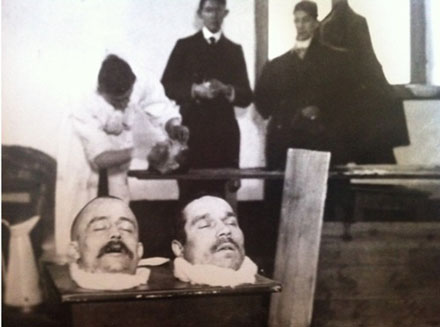
Top: the heads of the Pollet brothers. Middle: The heads of their two accomplices. Bottom: Canut Vromant’s headless trunk awaits autopsy. All images from the invaluable Bois de Justice, via this goregrish forum.


After the quadruple executions, the heads are cleaned up. (Source)

Perhaps, dear reader, you find the public exhibition of these severed heads objectionable. If so, you have an ally in the French state that did the severing.

For years, French elites had been fretting the indecorous behavior of the crowd at what was supposed to be a solemn occasion. The advent of photography only made matters worse, for now the discomfiting head-chopping exercise could be shared with those indisposed to sitting up all night smoking pipes in trees.

But as the moratorium gave way, the rising media form of cinema promised even more debased exhibitions. Enterprising cinematographers were already staging execution re-creations; now there was the prospect for film audiences to be incited to countless bloodlust frenzies by on-the-scene deathporn footage of hated criminals going under the blade. It was in response to just this fear that France a bit later in 1909 promulgated (French link) its first film censorship rules — forbidding in this case the public display of film liable to disturb the public tranquility.

* Jan. 16, 1909 … under the excited headline “THIRST FOR BLOOD AMONG THE FRENCH”,

On this day..

404: St. Telemachus, gladiator-slayer

January 1, 404 is the date of the last known gladiatorial combat in Rome, and therefore also the traditional martyrdom date of St. Telemachus — who gave his life to end the games.

Rome’s infamous bloodsport dated to the foggy natal days of the Republic, perhaps beginning as funerary rituals borrowed from the Etruscans or Campanians. Its efflorescence into ubiquitous public entertainment diversified for special occasions by stupefyingly wasteful grotesques like naval battles in a flooded stadium or exotic animal fights marks — moralistically if not materially — the empire’s decadence and decline. Fitting indeed that Rome’s most impressive lower-class rebellion originated with a gladiator, Spartacus.

The spectacle was as popular as it was dangerous. For trainers and recruiters, it was also enormously lucrative, yet it was simultaneously distasteful in its own time and gladiators (for their brief lives) were a stigmatized caste.

No public crime scandalized Rome’s Senatorial class historians like an emperor who showed genuine relish for the games. Cassius Dio had to personally sit in the stands and applaud the notorious tyrant Commodus who styled himself Hercules and fought personally on the blood-drunk sands of the Colosseum; he revenges himself in his history expanding sneeringly on his former sovereign’s degrading exploits — Commodus “took great pride in the fact that he was left-handed. His antagonist would be some athlete or perchance a gladiator armed with a wand; sometimes it was a man that he himself had challenged, sometimes one chosen by the people, for in this as well as in other matters he put himself on an equal footing with the other gladiators, except for the fact that they enter the lists for a very small sum, whereas Commodus received a million sesterces from the gladiatorial fund each day.” Commodus “of course won” his fights against opponents who had no choice but to yield to the emperor; the bouts were “like child’s play.”

Gladiatorial games’ long-term decline might have set in motion because they were so godawful expensive and a Rome gradually less vast and omnipotent just didn’t have the resources to burn on a new Super Bowl every time some frontier general marched into town to proclaim himself emperor for the next six months.

But Christians especially lodged early and vociferous critiques of the games and curtailing — and finally eliminating — gladiatorial combat is a signal contribution to humanity by the early faith. Tertullian composed a letter, On Spectacles, dedicated to proving to Christians with a weakness for low pleasures that men slaying one another for sport are idolatry and murder.

Christianity’s growing strength in the empire would eventually position it to put a stop to the evil show. The upstart faith’s first regnant champion, Constantine, laid down the first imperial ban on gladiator fights (“Those who were condemned to become gladiators for their crimes are to work from now on in the mines. Thus they pay for their crimes without having to pour their blood.”). As was his wont, Constantine was less than constant about following his own directive, intermittent directives by emperors over the decades to come testify to the ancient sport’s deep-rooted popularity but also to the steady pressure that ascendant Christianity continued to apply against it.

Its fade was gradual, but the closest thing we have to a specific end point is January 1, 404, games sponsored by the teenage Western Roman emperor Honorius to celebrate Stilicho‘s parrying the latest Gothic thrust.

Into this carnage, it is said, strode a Greek monk, Telemachus who publicly objected to the unfolding spectacle. For his trouble he was killed by mob action or official order. The story of what exactly happened has evolved over time but its upshot was that Honorius proceeded to ban the ungodly exhibition. It never again resumed (at least in the West), leaving the field clear in future centuries for Rome’s other degenerate sport, charioteering.

In these games of Honorius, the inhuman combats of gladiators polluted for the last time the amphitheatre of Rome. The first Christian emperor may claim the honour of the first edict which condemned the art and amusement of shedding human blood; but this benevolent law expressed the wishes of the prince, without reforming an inveterate abuse which degraded a civilised nation below the condition of savage cannibals. Several hundred, perhaps several thousand, victims were annually slaughtered in the great cities of the empire; and the month of December, more peculiarly devoted to the combats of gladiators, still exhibited to the eyes of the Roman people a grateful spectacle of blood and cruelty. Amidst the general joy of the victory of Pollentia, a Christian poet exhorted the emperor to extirpate, by his authority, the horrid custom which had so long resisted the voice of humanity and religion. The pathetic representations of Prudentius were less effectual than the generous boldness of Telemachus, an Asiatic monk, whose death was more useful to mankind than his life. The Romans were provoked by the interruption of their pleasures; and the rash monk, who had descended into the arena, to separate the gladiators, was overwhelmed under a shower of stones. But the madness of the people soon subsided: they respected the memory of Telemachus, who had deserved the honours of martyrdom; and they submitted, without a murmur, to the laws of Honorius, which abolished for ever the human sacrifices of the amphitheatre. The citizens, who adhered to the manners of their ancestors, might perhaps insinuate that the last remains of a martial spirit were preserved in this school of fortitude, which accustomed the Romans to the sight of blood, and to the contempt of death: a vain and cruel prejudice, so nobly confuted by the valour of ancient Greece and of modern Europe! (Gibbon)

On this day..

1854: Uhazy, amid Minnesotan depravity

On this date in 1854, a Dakota Indian named Uhazy was publicly hanged in a scene of “Total Depravity” at St. Paul, Minnesota — the first execution in the Minnesota Territory.

Uhazy (many other transliterations are possible) was convicted of the 1852 murder of a German woman near Shakopee. He then enjoyed the hospitality of St. Paul’s jail for two solid years while his appeals played out.

Even when juridical remedies proved unavailing, there was at least some public sentiment for his reprieve.

A large number of ladies (including the wife of the previous governor) applied to territorial Gov. William Gorman for clemency. Gorman refused it.

Besides, if he granted such a petition, Gorman replied, “others of his savage tribe might be tempted to hope for a like release, and commit a like offence; and the danger of such results would be far greater from Indians than from civilized man.”

“Civilized man’s” tense relationship with the “savage tribe” would in a few years spark a brief war and (in Mankato, Minn.) the largest mass execution in U.S. history.

Civilization had a different challenge on this occasion: the ribald street scenes that often accompanied public hangings.

St. Paul’s own Daily Minnesota Pioneer (Dec. 30, 1854) were far too genteel to report from the scene, a fact which of itself suggests the intelligentsia’s growing moral disgust for witnessing people witnessing executions.

As we had no inclination to witness the tragedy, we are unable to give the lovers of the dreadful a detail of the poor fellow’s suffering; but understand he met his fate with all that stoicism for which his race is noted.

Others were not so retiring. The scene they reported does not flatter; the mob was so large and unruly that when the sheriff set about erecting a scaffold that morning in a downtown square, he was obliged by Gov. Gorman to relocate it to St. Anthony Hill for public safety. (See this book.) Uhazy didn’t hang until 3 o’clock in the afternoon.

“Liquor was openly passed through the crowd, and the last moments of the poor Indian were disturbed by bacchanalian yells and cries,” one paper editorialized. “Remarks too heartless and depraved, in regard to the deceased, to come from men, were freely bandied. A half-drunken father could be seen holding in his arms a child eager to see well; giddy and senseless girls chatted with their attendants, and old women were seen vying with drunken ruffians for a place near the gallows.”

Capital punishment in general and the public spectacle of execution specifically long troubled the Minnesotan conscience. The Espy file credits Minnesota with just 28 executions in addition to that aforementioned Mankato mass-hanging; in 1889, the state moved all its exections behind prison walls and away from drunken ruffians. It hasn’t executed anybody at any venue since 1906.

On this day..

1022: Medieval Europe’s first heresy executions

The first documented executions of heretics in medieval Europe occurred on this date in 1022 in Orleans, when 13 or so were burned at Orleans.

The French king at this time was Robert II, known to history as “Robert the Pious” because he was so violent with the sub-orthodox.* In addition to this date’s burnings, he’s noted for inciting anti-Jewish persecutions that in some places drove local Jewry to drown themselves fleeing pogroms.

For those within Christianity, starting now, Robert’s Piety meant much tighter scrutiny of potentially deviant doctrines.

Now, these were not the first-ever Christian-on-Christian heresy executions in the West. But so far as is known they marked a revival of the practice after some six centuries of disuse — dating back to the Roman Empire when rival strains of early Christianity fought things out. That was ancient history, and not only literally; by this point in the Middle Ages, “heresy” was not nearly so dangerous a charge among Christian disputants as it would come to be after 1022.

The period’s chronicles paint the early eleventh century as a time of rising heresies, or rather rising fear of heresies. It’s an idea that would have a blazingly bright future.

What’s remarkable is that this tradition was resuscitated not for the exemplary punishment an itinerant band of outsiders or some marginal, radical sect, but for canons of the Orleans Cathedral — “certain clerks, raised from childhood in holy religion and educated as deeply in sacred as in profane letters … Some were priests, some deacons, some sub-deacons. The chief among them were Stephen and Lisois.” Their positions situate them as elite, establishment characters.

The “heresy” in question has in the past been speculatively associated with the gnostic Bogomils on the strength of one account that describes them as “Manicheans”. It hints at a tantalizing underground history of fugitive Bulgarian mystics. Unfortunately the author of that account was an epic swindler, and was not a firsthand witness to the trial. Besides, thanks to St. Augustine, “Manicheaism” was the medieval byword for heresy of any sort. There’s no concrete reason to ascribe Manicheaism to those burnt this day.

According to R.I. Moore‘s engaging The War On Heresy: Faith and Power in Medieval Europe** (from which all quotes in this post derive), it was precisely because of their high ranks that the Orleans “heretics” were targeted — and so far from being the purveyors of some devilish doctrine, they were basically the victims of a political purge for which “heresy” was the stalking-horse.

Moore’s argument, in fine, is that King Robert, who was the scion of the new and uncertain Capetian dynasty, was in a tight spot vis-a-vis his powerful neighbors. He had previously married one Bertha, the mother of one of the Count of Blois; Robert, however, put her aside in favor of Constance, kin to the Count of Anjou. However, he had flip-flopped a couple of times between these two spouses, and the domestic relations mirrored the king’s political maneuvering opposite Blois, Anjou, and Normandy, where the trial was held. Richard II, Duke of Normandy,† was a Blois ally; it was Richard’s uncle who claimed to have busted the heresy by infiltrating the group.

The heresy charge, Moore argues, “was a manoeuvre by the supporters of the Blois faction, still hoping for the restoration of Bertha, against those of Constance and her Angevin connections.” They were able to attack Constance’s circle via her spiritual (and temporal) allies, and they were able to force the deposition of the Constance-friendly Archbishop of Orleans in favor of their own candidate.

It was a move very dangerous to the king. He was able to counter it only by dissociating himself from his former favourites at a hastily summoned trial. As Paul of St Père described it, ‘The king and Queen Constance had come to Orléans, as Harfast had asked, with a number of bishops, and at his suggestion the whole wicked gang was arrested by royal officials at the house where they met, and brought before the king and queen and an assembly of clerks and bishops at the church of Ste Croix.’

It was, Moore says, “like a kangaroo court.” Stephen had been Queen Constance’s own confessor; one later chronicler, exaggerating events he did not witness, claimed that Constance actually struck out Stephen’s eye with her staff as the condemned were hauled out of their home church for the stakes.

We have no way to know if the representation of the prelates’ beliefs that comes down to us bears any relationship to their real thoughts. If so, the grounds upon which this “wicked gang” were targeted does indeed read like heresy: denying the Virgin birth, the Resurrection, the efficacy of baptism, and transubstantiation. Certainly a rap sheet like that would be enough to get a body burned in the heretic-hunting centuries to come.

Moore speculates that these “heretics” were basically neoplatonists who had some off-script ideas or experiences and got demagogued by Bertha’s people on that basis. The disdainfully condescending supposed riposte of the condemned certainly sounds calculated to put their persecutors in their place.

You may tell all this to those who are learned in earthly things, who believe the fabrications which men have written on the skins of animals. We believe in the law written within us by the Holy Spirit, and hold everything else, except what we have learned from God, the maker of all things, empty, unnecessary and remote from divinity. Therefore bring an end to your speeches and do with us what you will. Now we see our king reigning in heaven. He will raise us to his right hand in triumph and give us eternal joy.

Being heretics, of course, they didn’t get to drop the mic with their noble defiance ringing from the page.

when the flames began to burn them savagely they cried out as loudly as they could from the middle of the fire that they had been terribly deceived by the trickery of the devil, that the views they had recently held of God and Lord of All were bad, and that as punishment for their blasphemy against Him they would endure much torment in this world and more in that to come. Many of those standing near by heard this, and moved by pity and humanity, approached, seeking to pluck them from the furnace even when half roasted. But they could do nothing, for the avenging flames consumed them, and reduced them straight away to dust.

For more on the primary(ish) sources that document this event and their various problem points, see this pdf.

* Notwithstanding his piety, Robert had actually been excommunicated for his marriage to Bertha, who was his cousin.

** Of interest in the same vein, Moore’s The Formation of a Persecuting Society: Authority and Deviance in Western Europe 950-1250.

† More about Richard II, Duke of Normandy, in this podcast episode from Lars Brownworth’s Norman Centuries. You might be familiar with his grandson, William the Conqueror.

On this day..