1865: The Jacksonville Mutineers

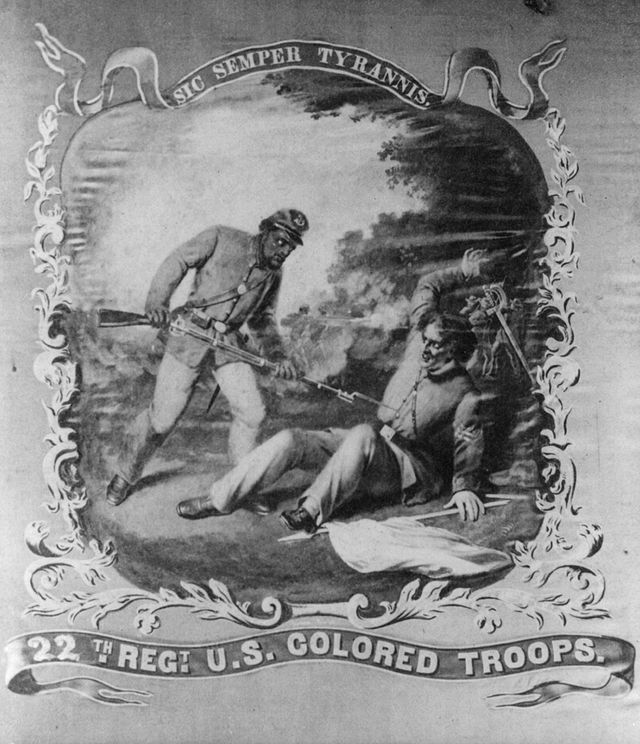
On this date in 1865, six African-American infantrymen were shot in Fernandina, Florida, for the Jacksonville Mutiny.

Formed in 1863, the 3rd Infantry Regiment, United States Colored Troops served in the trenchworks around Fort Wagner — the grinding siege in the summer of 1863 that followed the bloody attempt to storm the fort immortalized in the 1989 film Glory.

The Third was subsequently transferred to Union-occupied Jacksonville, Florida for duty garrisoning a conquered town of the Confederacy whose white citizens chafed doubly at their presence. But the unit had weathered both the boredom of the garrison and the hostility of white Floridians, and was set to muster out and return home on Halloween of 1865.

All U.S. Colored Troop regiments were officered by white men, putting an inevitable racial tinge on the inherent potential tension between enlistees and their commanders — the triggering event in our story. Heading the Third was a fellow named John L. Brower, Lieutenant Colonel by rank courtesy of his political connections but of nearly no actual military experience.

Ohio National Guard Judge Advocate General Kevin Bennett, in his 1992 article about the mutiny,* calls Brower a “martinet”; elevated to command of the Third on September 12 for what should have been a mostly ceremonial interim, Brower delighted in enforcing stringent wartime discipline months after Appomattox. While no man welcomes the taste of the lash when he’s one foot out the door back to civilian life, excess discipline meted out by cruel white overseers was particularly bad form for Colored Troop regiments.

From the standpoint of black Americans, the war had been all about destroying slavery; they had practically had to force this objective, and their own presence,** into the conflict. Being strung up by the thumbs for petty theft — Brower’s decreed punishment for one of his charges on October 29 — was far too evocative of the hated Slave Power.

“Inexperienced officers often assumed that because these men had been slaves before enlistment, they would bear to be treated as such afterwards,” one white Colored Troop commander later remembered. “Experience proved to the contrary. Any punishment resembling that meted out by the overseers caused irreparable damage.”†


The inclination of black troops to reject servile treatment and the anxiety that this provoked among their officers and the larger white community must surely be read in view of the perplexing new conditions following the Civil War.

Even among whites who supported it in principle, slavery abolition meant an unsettling and uncertain rearrangement of civilization — or at least, it potentially meant that. Would the economy continue to function without slavery? Would the daily conventions and assumptions that had sustained whites north and south have to be entirely renegotiated?

“Once let the black man get upon his person the brass letter, U.S., let him get an eagle on his button, and a musket on his shoulder and bullets in his pocket, there is no power on earth that can deny that he has earned the right to citizenship,” Frederick Douglass had proclaimed. Now that the war had finished, what else did those musket-toting sable fellows think they had earned the right to?

Press reports over the course of 1865 show a continuing theme of “Negro mutinies”: it is for wiser studies than this post to determine whether the trend such stories represent is disturbances among the black soldiery, or an exaggerated preoccupation among their white countrymen. In either event, Jacksonville was very far from unique even if the punishments were exemplary.


From the June 16, 1865 Cleveland Plain Dealer, concerning black soldiers on a steamer bound for Texas calling at Fort Monroe who, chagrined at the assignment, refused to permit the steamer’s resuming its journey.


From the June 19, 1865 Philadelphia Inquirer, concerning a company refusing to embark for Texas. “Certain evil disposed persons put it into the heads of these credulous colored soldiers that they were to be sent to Texas as servants for the white troops,” runs the report. “Doubtless some secret enemies of the Government instilled similar subtle falsehoods into the simple minds of the blacks who were disarmed at Fortress Monroe a few days ago.”


From the September 30, 1865 Daily National Intelligencer (Washington, D.C.), concerning a mutiny reported near Hilton, N.C.


From the Oct. 1, 1865 Daily Constitutionalist (Augusta, Ga.), reporting a disturbance begun when a black regiment demonstrated against a court-martial for one of their comrades accused (and acquitted) of stealing a hat.

In the midst of all of this — right about the time of the incident in this post, in fact — bulletins reached American shores of the Morant Bay Rebellion, a bloody rebellion of black laborers in British-controlled Jamaica. Slavery had been abolished on that Caribbean island more than 30 years prior: what did that uprising augur for the races in these United States?


Subtext becomes text: the Norwich (Conn.) Aurora, December 23, 1865. “The African released from restraint, and the passion of the savage provoked, will realize the scenes formerly witnessed in Hayti.” (The full article (pdf))

For our case, the name of the man punished like a slave is lost, but we do know what he did: steal some molasses from the kitchen. That’s how six of his comrades ultimately wound up looking down the barrels of their executioners.

A Lt. Greybill caught the greedy nosher and decreed a rough summary punishment, which the arriving Brower arrived helped to enforce on the resisting prisoner. “Tying up by the thumbs” was a brutal and humiliating treatment that lifted the man by those digits (often dislocated in the process) until only his toes remained on the ground, barely supporting his weight, and left him there for hours. In the film 12 Years a Slave, we see a man subjected to this sort of tiptoeing, but with a rope about the neck instead of about the thumbs.

Other enlisted men gathered around this pitiful scene, complaining about what they saw. A Private Jacob Plowden, who will eventually number among our day’s six executees, cried out that “it was a damn shame for a man to be tied up like that, white soldiers were not tied up that way nor other colored soldiers, only in our regiment.”

Plowden announced that “there was not going to be any more of it, that he would die on the spot but he would be damned if he wasn’t the man to cut him down.” Another private, Jonathan Miller, joined the incitement — “Let’s take him down, we are not going to have any more of tying men up by the thumbs.” A number of the black soldiers, 25 to 35 or so, began advancing on Brower and the hanging molasses-thief. Brower drew his sidearm and fired into them, wounding a man and sending the soldiers scurrying — some dispersing, but other dashing off to tents to arm themselves.

Several non-lethal fights now occurred in various spots around the camp between soldiers and officers, and eventually between the disaffected soldiers and arriving brethren from Company K, who had been summoned to calm the situation.

Lt. Col. Brower exchanged shots with several of the men who armed themselves, and in a bit of symmetry with the distasteful punishment that had started the whole mess, he had his thumb shot off in the process. One of the privates who had been heard complaining of the thumb-hanging, now playing peacemaker, grabbed the injured officer and escorted him to a safe building, warning some men who tried to pursue them to “stop their damn foolishness.”

Elsewhere, a Lt. Fenno sabered a protestor, and got bashed over the head with a fence-post in response. Neither injury was life-threatening to its recipient. Some shots were exchanged elsewhere in camp and/or fired demonstratively into the air, again to no fatal effect. And a Private James Thomas cut down the post where the source of all the disturbance, the fellow who just wanted an extra ration of molasses, was hanging.

This was the whole of the commotion, which Company K reinforcements soon quelled.

In a speedy series of court-martials lasting from Oct. 31 to Nov. 3, thirteen men were convicted of mutiny in this affair, and a fourteenth of conduct prejudicial to good order (his offense: not during the mutiny but after all was over, saying of Brower, “the God-damned son of a bitch, he shot my cousin. Where is he? Let me see him.”) A fifteenth man was acquitted. All 15 accused mounted their own defense, without counsel or aid — generally endeavoring to show that they had either not armed themselves or (and this was the decisive factor for the six whose conviction carried a death sentence) not fired their weapon.

The trial itself posed interesting procedural dilemmas, which Bennett explores at length in his article: first, because it was a mutiny case, the white officers of the Third who comprised the jurors were also, awkwardly, the brother-officers of the witnesses who testified against the mutineers.

And second, although the Civil War was over, Florida still technically remained in a state of rebellion, and this enabled the unit to convene a general court-martial, issue death sentences, and even carry them out without allowing any appeal to Washington. General John Foster gave the final approval to the sentences and transmitted case files to Washington after the fact; that was all the six condemned had by way of legal or executive review.

On December 10, he received a telegraph ordering him to suspend one of the death sentences in response to an inquiry raised by U.S. Senator Edgar Cowan: Cowan had been contacted by one of his constituents, who represented that Private David Craig, whom the constituent had raised from childhood, had written him complaining of his wrongful conviction. According to Sen. Cowan, the allegation was that Craig had been directed to collect arms from the mutineers as the disturbance came to an end, but was thereafter arrested in the confusion for being armed with the weapons he collected. But December 10 was nine days too late, and the late Private Craig’s case file disturbingly seems to have been lost from the National Archives.

The other five shot by musketry this date were:

  • Joseph Green
  • James Allen
  • Jacob Plowden
  • Joseph Nathaniel
  • Thomas Howard

Lt. Col. Brower only testified at one of the courts-martial, and was sent home almost immediately afterwards. He’d lost his thumb for his adventure as an officer and a gentleman, but between the original provocative punishment that he helped enforce, and then inflaming a tense situation by shooting at his soldiers, the brass was probably just as pleased to see him go as were his subordinates.

The non-executed mutineers who received prison terms (up to 15 years) had their sentences commuted following a review in 1866. The rest of the regiment mustered out as scheduled at the end of October, two days after the Jacksonville Mutiny.

* B. Kevin Bennett, “The Jacksonville Mutiny”, Civil War History, Volume 38, Number 1, March 1992. Bennett’s article is the source of all of the quotes in this post not otherwise cited.

** See I Freed Myself, or this podcast interview with its author, David Williams.

† See here for a fascinating instance of this at sea in June 1865, by the author of Becoming American under Fire: Irish Americans, African Americans, and the Politics of Citizenship during the Civil War Era

On this day..

1651: Wilhelm Biener, faithful counsellor

On this date in 1651, Wilhelm Biener, late the chancellor of Tyrol, lost his head to the rancor of Tyrol’s landed aristocracy.

A barrister by training and eventually a judge, Biener or Bienner (English Wikipedia entry | German) transitioned into a court position under Leopold V, Archduke of Austria. Leopold’s death in 1632 left a four-year-old heir, Ferdinand Charles; the boy’s mother, Claudia de’ Medici, leaned increasingly on Biener’s counsel as she ably kept Tyrol in order (and out of the devastating Thirty Years’ War) while little Ferdinand aged towards his majority.

As a commoner, no dynastic entanglements of his own divided his attentions from the state’s own interest, a fact that Claudia de’ Medici recognized in elevating Biener to the chancellorship in 1638, and that the land’s magnates recognized in the strictly levied taxes Biener extracted from their resentful purses.


Detail view (click for full image) of Karl Anrather’s 1891 painting of Wilhelm Biener holding forth against the Tiroler Landtag, from the Ferdinandeum at Innsbruck.

We’ve seen quite often enough in these pages that the danger undertaken by such figures should their enemies ever find power over them mitigates the honors and emoluments they are like to enjoy while in office. One gets a sense of the undercurrent of biding violence from the remark of the Bishop of Brixen, directed to forward the required revenues in a letter less deferential than a senior cleric thought he was due: “The man deserves to lose the fingers that could write such an intemperate effusion!”

For Biener, the volcano opened under him with the death of his patron Claudia de’ Medici on Christmas Day 1648. Her boy Ferdinand Charles was all of 20 years old now, wet behind the ears and enamored of courtly profligacy. Despite his affection for Biener and his long service to his mother, the young prince would vacillate on sparing the consigliere until it was too late.

Biener’s enemies struck with a secret trial accusing him of wetting his own beak on the imposts he had imposed on Tirol; the account below of what followed from a travelogue probably reflects the posthumous myth of Biener more faithfully than it does the real man.

[Biener] was ultimately condemned, in 1651, to lose his head. Biener sent a statement of his case to the Archduke Ferdinand Karl; and the young prince, believing the honesty of his mother’s faithful adviser, immediately ordered a reprieve. The worst enemy and prime accuser of the fallen favourite was Schmaus, President of the Council … and he contrived by detaining the messenger to make him arrive just too late in Rattenberg, then still a strong fortress, where he lay confined, and where the sentence was to be carried out.

Biener had all along steadfastly maintained his innocence; and stepping on to the scaffold, he had again repeated the assertion, adding, “So truly as I am innocent, I summon my accuser before the Judgment-seat above before another year is out.” When the executioner stooped to lift up the head before the people, he found lying by its side three fingers of his right hand, without having had any knowledge that he had struck them off, though he might have done so by the unhappy man having raised his hand in the way of the sword in the last struggle. [more likely they were folded in prayer. -ed.] The people, however, saw in it the fulfilment of the words of the bishop, as well as a ghastly challenge accompanying his dying message to President Schmaus. Nor did they forget to note that the latter died of a terrible malady some months before the close of the year.

Biener’s wife lost her senses when she knew the terrible circumstances of his death; the consolations of her director and of her son, who lived to his ninetieth year in the Franciscan convent at Innsbruck, were alike powerless to calm her. She escaped in the night, and wandered out into the mountains no one knows whither. But the people say she lives on to be a witness of her husband’s innocence, and may be met on lonely ways proclaiming it, but never harming any. Only, when anyone is to die in Büchsenhausen, where her married life passed so pleasantly, the ‘Bienerweible’ will appear and warn them.

Living on in Tyrol folk tradition, Biener took a leap into the Romantic-era national consciousness thanks to writer Hermann Schmid, who popularized Biener’s legend with a 19th century historical novel, The Chancellor of Tyrol; public domain versions can be read online in two volumes (1, 2); a theatrical adaptation by Josef Wenter is still staged to this day. It’s possible that this imprint on the Zeitgeist led a Bohemian writer to christen his fictional executed outlaw “Vilem” in the Czech poem Maj.


Marker honoring Wilhelm Biener in the Austrian Tyrol town of Rattenberg, where Biener was executed on July 17, 1651.

On this day..

1817: Two-fifths of the condemned in Valenciennes

From the York Herald and General Advertiser (York, England) of Saturday, Aug. 16, 1817.

Five English soldiers being on guard, the 18th of June last, at one of the gates of Valenciennes, committed a robbery on the house of an individual, and were condemned to be hanged. They were conducted, by the orders of Lord Wellington, on the 3d of July, outside the walls of the town, to undergo their punishment.

The people followed the culprits, invoking, in accents of sorrow, the pity of their officers, and crying “Mercy! Mercy!”

Two of them were executed, and the other three received their pardon at the very moment they were about to part with life. At this news the joy of the numerous spectators was extreme, and the thanks they addressed to the English General were no doubt less eloquent than the joy from which they emanated.

On this day..

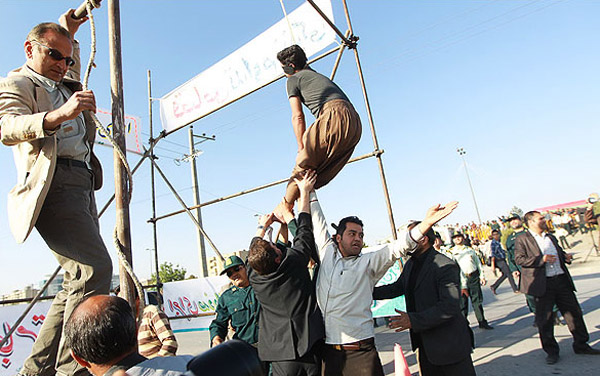
2013: Vahid Zare pardoned while hanging

Last year on this date, an astonishing scene unfolded at a public hanging in Mashhad, near the Iran-Afghanistan border.

Vahid Zare, a robber who murdered a young military conscript pursuing him, was the man due for execution.

Moments after he was dropped and began strangling, the family of his victim pardoned him — their right under Iranian law. Zare was immediately rescued mid-hanging, and his executioner helped him off the gallows for transportation to a local hospital.

The graphic pictures that follow tell an astonishing story.

On this day..

1730: Neither James Prouse nor James Mitchel, much to their surprise

January 14, 1730, was the date appointed for the public hanging in Philadelphia of James Prouse and James Mitchel for burglary.

Prouse, for his part, admitted the crime but insisted that James Mitchel had nothing to do with it — and Mitchel insisted the same. This ultimately generated considerable support for clemency which the authorities did not seem inclined to act upon.

Naturally the young newspaperman Benjamin Franklin — just turning 24 in January 1730 — was keen to publish this affecting story in his Philadelphia Gazette. Through the magic of public domain, he’s generously allowed us to republish his account from the January 20, 1730 Gazette as our guest post today.

Hyperlinks are, as one may surmise, Executed Today‘s own annotations.


We think our Readers will not be displeased to have the following remarkable Transaction related to them in this particular Manner.

Wednesday the 14th Instant, being the Day appointed for the Execution of James Prouse and James Mitchel for Burglary, suitable Preparations were accordingly made. The tender Youth of one of them (who was but about 19) and the supposed Innocence of the other as to the Fact for which they were condemned, had induced the Judges (upon the Application of some compassionate People) to recommend them to His Honour‘s known Clemency: But several Malefactors having been already pardoned, and every Body being sensible, that, considering the great Increase of Vagrants and idle Persons, by the late large Importation of such from several Parts of Europe, it was become necessary for the common Good to make some Examples, there was but little Reason to hope that either, and less that both of them might escape the Punishment justly due to Crimes of that enormous Nature. About 11 o’Clock the Bell began to Toll, and a numerous Croud of People was gathered near the Prison, to see these unhappy young Men brought forth to suffer. While their Irons were taken off, and their Arms were binding, Prouse cry’d immoderately; but Mitchel (who had himself all along behaved with unusual Fortitude) endeavoured in a friendly tender Manner to comfort him: Do not cry, Jemmy; (says he) In an Hour or two it will be over with us, and we shall both be easy. They were then placed in a Cart, together with a Coffin for each of them, and led thro’ the Town to the Place of Execution: Prouse appear’d extreamly dejected, but Mitchel seemed to support himself with a becoming manly Constancy: When they arriv’d at the fatal Tree, they were told that it was expected they should make some Confession of their Crimes, and say something by Way of Exhortation to the People. Prouse was at length with some Difficulty prevailed on to speak; he said, his Confession had been taken in Writing the Evening before; he acknowledged the Fact for which he was to die, but said, That Greyer who had sworn against him was the Person that persuaded him to it; and declared that he had never wronged any Man beside Mr. Sheed, and his Master. Mitchel being desired to speak, reply’d with a sober compos’d Countenance, What would you have me to say? I am innocent of the Fact. He was then told, that it did not appear well in him to persist in asserting his Innocence; that he had had a fair Trial, and was found guilty by twelve honest and good Men. He only answer’d, I am innocent; and it will appear so before God; and sat down. Then they were both bid to stand up, and the Ropes were order’d to be thrown over the Beam; when the Sheriff took a Paper out of his Pocket and began to read. The poor Wretches, whose Souls were at that Time fill’d with the immediate Terrors of approaching Death, having nothing else before their Eyes, and being without the least Apprehension or Hope of a Reprieve, took but little Notice of what was read; or it seems imagined it to be some previous Matter of Form, as a Warrant for their Execution or the like, ’till they heard the Words PITY and MERCY [And whereas the said James Prouse and James Mitchel have been recommended to me as proper Objects of Pity and Mercy.] Immediately Mitchel fell into the most violent Agony; and having only said, God bless the Governor, he swooned away in the Cart. Suitable Means were used to recover him; and when he came a little to himself, he added; I have been a great Sinner; I have been guilty of almost every Crime; Sabbath-breaking in particular, which led me into ill Company; but Theft I never was guilty of. God bless the Governor; and God Almighty’s Name be praised; and then swooned again. Prouse likewise seemed to be overwhelmed with Joy, but did not swoon. All the Way back to the Prison, Mitchel lean’d on his Coffin, being unable to support himself, and shed Tears in abundance. He who went out to die with a large Share of Resolution and Fortitude, returned in the most dispirited Manner imaginable; being utterly over-power’d by the Force of that sudden Turn of excessive Joy, for which he had been no Way prepared. The Concern that appeared in every Face while these Criminals were leading to Execution, and the Joy that diffused it self thro’ the whole Multitude, so visible in their Countenances upon the mention of a Reprieve, seems to be a pleasing Instance, and no small Argument of the general laudable Humanity even of our common People, who were unanimous in their loud Acclamations of God bless the Governor for his Mercy.

The following are Copies of the Papers delivered out by Prouse and Mitchel the Evening before, with little or no Alteration from their own Words.

I James Prouse was born in the Town of Brentford in Middlesex County in Old England, of honest Parents, who gave me but little Education. My Father was a Corporal in the late Lord Oxford’s Regiment of Horse, (then named the said Lord’s Blues) and I was for some Time in the Care of an Uncle who lived at Eling near Brentford aforesaid, and who would have given me good Learning; but I being young would not take his good Counsel, and in the 12th Year of my Age came into Philadelphia, where I was recommended to one of the best of Masters, who never let me want for any Thing: But I minding the evil Insinuations of wicked People, more than the good Dictates of my Master, and having not the Fear of God before my Eyes, am deservedly brought to this wretched and shameful End. I acknowledge I justly merit Death for the Fact which condemns me; but I never had the least Design or Thought of the like, until often press’d, and at length seduced to it by John Greyer, who was the only Person that ruined me. He often solicited me to be guilty of other Crimes of the like Nature, but I never was guilty of any such, neither with him or any one else; neither did I ever wrong any Man before, save my too indulgent Master; from whom I now and then pilfer’d a Yard or the like of Cloth, in order to make Money to spend with the said Greyer. As for James Mitchel who dies for the same Fact with me, as I hope to receive Mercy at the great Tribunal, he the said James Mitchel is intirely innocent, (*) and knew nothing of the Fact until apprehended and taken. I am about Nineteen Years of Age and die a Protestant.

JAMES PROUSE.

(*) N. B. He declared the same Thing at the Bar just before he received Sentence.

The Speech or Declaration of James Mitchel written with his own Hand.

I James Mitchel, was born, at Antrim in the Kingdom of Ireland, of good and honest Parents, and brought up with them until the Age of 13 Years, and had a suitable Education given me, such as being taught to read and write English, with some Latin; and might have been further instructed, but at my earnest Request was bound Apprentice to a Book-binder, and served 4 Years to that Trade; after which I left the Kingdom and went for England in order to be further improved in my Business; but there had the Misfortune to be press’d on board the Berwick Man of War, commanded by the Honorable George Gordon, and having been at several Parts abroad, returned to England in Octob. 1728. where I was by Sickness reduced to a very sad Condition, through which I came over to this Country a Servant; here I was it seems unfortunately led into bad Company, and one Evening by James Prouse was raised out of my Bed to go and drink with him and one Greyer, the which Greyer after parting gave to the said James Prouse Six-pence, which was all the Money I saw that Night and till next Morning, and then James Prouse took out of his Pocket a 15 Shilling Bill, and desired me to get it changed for him, in order to spend some of it; but coming unto Town I was apprehended for the robbing of Mr. George Sheed, and now am to die for the same. I die a Protestant.

JAMES MITCHEL.

On this day..

1803: Joseph Samuel survives three hangings

On this date in 1803, Joseph Samuel just wouldn’t hang.

Transported to Australia in 1801 for theft, Joseph Samuel was part of a cohort of Sydney Cove convicts who, on the night of August 25-26, burgled a house.

The band was surprised by constable Joseph Luker, himself a former convict. One or more of the thieves battered him to death on the spot with whatever was at hand: recovered with Luker’s broken body at morning’s light were a bloodied wheelbarrow wheel, and the hilt of Luker’s own cutlass, buried in his brains. Luker was the first policeman killed on duty in Australia, and his name can be found on the country’s National Police Memorial.

But the order of the day in 1803 was a different sort of memorial. “Avenging Heaven directs the Hand of Justice, and the Manes of the Deceased inspires us with Indignation and Resentment,” the Sydney Gazette fulminated. The need to cut a deal for crown’s evidence with one of Samuel’s compatriots eventually meant that Samuel was the only one to bear the vengeance of Luker’s Manes. (A third man, Isaac Simmonds, was acquitted at trial, but he was so heavily suspected that he was made to attend the execution.)

We’ll pick up the narration of the Sydney Gazette (Oct. 2, 1803):

James Hardwicke were brought, in pursuance of the sentence passed upon them on the preceding Friday.

Both prisoners conducted themselves with becoming decency; and when the Reverend Mr. MARSDEN had performed the duties of his function, and quitted Hardwicke, he turned to Samuels (who being a Jew, was prepared by a person of his own profession) and questioning him on the subject of the murder of Luker, he solemnly declared, that during the interval of his confinement in the cell with Isacc [sic] Simmonds, nicknamed Hikey Bull, they in the Hebrew tongue exchanged an oath, by which they bound themselves to secrecy and silence in whatever they might then disclose.

Conjured by that GOD before whom he was shortly to appear, not to advance any thing in his latter moments that would endanger his salvation, he now repeated with an air of firmness what he had before declared ; and appearing deeply imprest with a becoming sense of his approaching end, appealed to Heaven to bear him testimony that Simmonds had, under the influence of the oath by which they were reciprocally bound, acknowledged to him that Luker had accidentally surprised him … and that he, in consequence thereof, had “knocked him down, and given him a topper for luck!” … [and] that he would hang 500 Christians to save himself.

Simmonds, as we’ve noted, was right there in forced attendance at the public hanging, and as Samuel’s accusations started the audience murmuring, Simmonds tried to interject his denials. The very fact that the words were spoken by a man on the brink of death and presumably in fear for his soul made Samuel a credible accuser in the eyes of the populace, “in whose breasts a sentiment of abhorrence was universally awakened … and the feelings of the multitude burst forth into invective.” Yikes.

While the gendarmes moved to protect Simmonds from the possible wrath of his neighbors, and Hardwicke received a last-minute pardon,* Samuel commenced the inadvertently superlative finishing act of his persuasive performance.

at length the signal was given, and the cart drove from under him; but by the concussion the suspending cord was separated about the centre, and the culprit fell to the ground, on which he remained motionless with his face downwards. The cart returned, and the criminal was supported on each side until another rope was applied in lieu of the former: he was again launched off, but the line unrove, and, continued to flip until the legs of the sufferer trailed along the ground, the body being only half suspended.

All that beheld were also moved at his protracted sufferings; nor did some hesitate to declare that the invisible hand of Providence was at work in the behalf of him who had revealed the circumstances above related. To every appearance lifeless, the body was now raised, and supported on men’s shoulders, while the executioner prepared anew the work of death. The body was gently lowered, but when left alone, again fell prostrate to the earth, this rope having also snapped short, close to the neck.

Compassion could no longer bear restraint; winged with humanity, the Provost Marshal sped to His EXCELLENCY‘S presence, in which the success of his mission overcame him; A Reprieve was announced — and if Mercy be a fault, it is the dearest attribute of GOD, and surely in Heaven it may find extenuation!

Samuells when the Provost Marshal arrived with the tidings which diffused gladness throughout every heart, was incapable of participating in the general satisfaction. By what he had endured his reasonable faculties were totally impaired; and when his nerves recovered somewhat from their feebleness, he uttered many incoherences, and was alone ignorant of what had past. Surgical assistance has since restored him; And MAY THE GRATEFUL REMEMBRANCE OF THESE EVENTS DIRECT HIS FUTURE COURSES!

It didn’t.

In 1806, Samuel made an escape attempt with some other convicts by boat. It was swept away in a tempest, with all presumed lost at sea.

* A number of sources claim that Hardwicke did hang successfully while Samuel’s rope repeatedly broke. We think the eyewitness newspaper report days after the execution to the effect that Hardwicke was reprieved is by far the more credible report.

On this day..

1812: Not Pierre Bezukhov, in War and Peace

On this date* in French-occupied Moscow of the War of 1812, many alleged arsonists — unnamed and unnumbered — were shot by Napoleon’s army in the ashes of Moscow.

Although real, flesh-and-blood Muscovites died, they are best known via their bespectacled fictional companion, Pierre Bezukhov, whose miraculous escape is one of the pivotal episodes of Tolstoy’s War and Peace.

Merely the greatest novel in history by some reckonings — we’ll just let Tolstoy fight it out with Dostoyevsky for top of table in the competitive 19th Century Russia literary scene — the epic War and Peace tracks that country’s transformation under the revolutionary pressures of the Napoleonic age.

In Russian director Sergey Bondarchuk’s sprawling cinematic adaptation of War and Peace, the part of Pierre Bezukhov is played by Bondarchuk himself.

Pierre Bezukhov (“without ears”) is one of the book’s central figures, the illegitimate son of a count who unexpectedly inherits, forever consumed with his next impulsive, passionate quest for meaning (boozing around, freemasonry, religion …).

Pierre finds himself present in Moscow when the Grande Armee rolls in following its Pyrrhic victory at the Battle of Borodino. His fancy of the moment is to assassinate Napoleon: “he suddenly felt that what before had seemed to him merely a possibility had now become absolutely necessary and inevitable. He must remain in Moscow, concealing his name, and must meet Napoleon and kill him, and either perish or put an end to the misery of all Europe.” And to think, a younger Pierre actually used to admire Napoleon.


Historically, the city of Moscow started burning as soon as the French occupied it. The reasons for this conflagration have been widely disputed; Tolstoy detours in War and Peace to characterize it as nothing more than the natural consequence of the occupation, when the city’s civil infrastructure has broken down and the everyday fires that spark in wooden buildings are more liable to grow out of control.

The French blamed terrorists.

A bulletin of the Grande Armee dated September 20 (Gregorian date; this corresponds to the Julian date September 8) reports on the successful efforts to bring arsonists to heel through the expedient of mass executions.

Three hundred incendiaries have been arrested and shot; they were provided with fuse six inches long, which they had between two pieces of wood: they had also squibs, which they threw upon the roofs of the houses. The wretch Rastapchin had these prepared, on the pretence that he wished to send a balloon, full of combustible matter, amidst the French army …

The fires subsided on the 19th and 20th; three quarters of the city are burned; among other palaces that beautiful one of Catherine, which had been newly furnished: not above a quarter of the houses remain. …

Manufactures were beginning to flourish at Moscow: they are destroyed. The conflagration of this capital will throw Russia one hundred years back. The weather is becoming rainy: the greatest part of the army is in barracks in Moscow.


In this paranoid occupation, the fictional Pierre, wandering Moscow armed without a good excuse, gets himself picked up by French troops.

The travail of his resulting drumhead trial offers the anti-authoritarian (and anti-death penalty) Tolstoy the opportunity to reflect on the “legal” arrangements, a passage Tolstoy dates September 8 on the Julian calendar — the same day that army bulletin above was penned.

[Pierre] learned that all these prisoners (he, probably, among them) were to be tried for incendiarism. On the third day he was taken with the others to a house where a French general with a white mustache sat with two colonels and other Frenchmen with scarves on their arms. With the precision and definiteness customary in addressing prisoners, and which is supposed to preclude human frailty, Pierre like the others was questioned as to who he was, where he had been, with what object, and so on.

These questions, like questions put at trials generally, left the essence of the matter aside, shut out the possibility of that essence’s being revealed, and were designed only to form a channel through which the judges wished the answers of the accused to flow so as to lead to the desired result, namely a conviction. As soon as Pierre began to say anything that did not fit in with that aim, the channel was removed and the water could flow to waste. Pierre felt, moreover, what the accused always feel at their trial, perplexity as to why these questions were put to him. He had a feeling that it was only out of condescension or a kind of civility that this device of placing a channel was employed. He knew he was in these men’s power, that only by force had they brought him there, that force alone gave them the right to demand answers to their questions, and that the sole object of that assembly was to inculpate him. And so, as they had the power and wish to inculpate him, this expedient of an inquiry and trial seemed unnecessary. It was evident that any answer would lead to conviction.

It’s only by Pierre’s chance ability to forge a human connection with the officer detailed to condemn him that he’s mysteriously, and arbitrarily, not sentenced to death — a fact that Pierre doesn’t even realize until he’s led out with the rest of the prisoners only to see that it’s “only” the others who are being shot. This is the narration at length from Book XII, Chapters 10-11.

On the eighth of September an officer- a very important one judging by the respect the guards showed him- entered the coach house where the prisoners were. This officer, probably someone on the staff, was holding a paper in his hand, and called over all the Russians there, naming Pierre as “the man who does not give his name.” Glancing indolently and indifferently at all the prisoners, he ordered the officer in charge to have them decently dressed and tidied up before taking them to the marshal. An hour later a squad of soldiers arrived and Pierre with thirteen others was led to the Virgin’s Field. It was a fine day, sunny after rain, and the air was unusually pure. The smoke did not hang low as on the day when Pierre had been taken from the guardhouse on the Zubovski rampart, but rose through the pure air in columns. No flames were seen, but columns of smoke rose on all sides, and all Moscow as far as Pierre could see was one vast charred ruin. On all sides there were waste spaces with only stoves and chimney stacks still standing, and here and there the blackened walls of some brick houses. Pierre gazed at the ruins and did not recognize districts he had known well. Here and there he could see churches that had not been burned. The Kremlin, which was not destroyed, gleamed white in the distance with its towers and the belfry of Ivan the Great. The domes of the New Convent of the Virgin glittered brightly and its bells were ringing particularly clearly. These bells reminded Pierre that it was Sunday and the feast of the Nativity of the Virgin. But there seemed to be no one to celebrate this holiday: everywhere were blackened ruins, and the few Russians to be seen were tattered and frightened people who tried to hide when they saw the French.

…

Pierre had been taken by one set of soldiers and led first to one and then to another place with dozens of other men, and it seemed that they might have forgotten him, or confused him with the others. But no: the answers he had given when questioned had come back to him in his designation as “the man who does not give his name,” and under that appellation, which to Pierre seemed terrible, they were now leading him somewhere with unhesitating assurance on their faces that he and all the other prisoners were exactly the ones they wanted and that they were being taken to the proper place. Pierre felt himself to be an insignificant chip fallen among the wheels of a machine whose action he did not understand but which was working well.

He and the other prisoners were taken to the right side of the Virgin’s Field, to a large white house with an immense garden not far from the convent. This was Prince Shcherbatov‘s house, where Pierre had often been in other days, and which, as he learned from the talk of the soldiers, was now occupied by the marshal, the Duke of Eckmuhl (Davout).

They were taken to the entrance and led into the house one by one. Pierre was the sixth to enter. He was conducted through a glass gallery, an anteroom, and a hall, which were familiar to him, into a long low study at the door of which stood an adjutant.

Davout, spectacles on nose, sat bent over a table at the further end of the room. Pierre went close up to him, but Davout, evidently consulting a paper that lay before him, did not look up. Without raising his eyes, he said in a low voice:

“Who are you?”

Pierre was silent because he was incapable of uttering a word. To him Davout was not merely a French general, but a man notorious for his cruelty. Looking at his cold face, as he sat like a stern schoolmaster who was prepared to wait awhile for an answer, Pierre felt that every instant of delay might cost him his life; but he did not know what to say. He did not venture to repeat what he had said at his first examination, yet to disclose his rank and position was dangerous and embarrassing. So he was silent. But before he had decided what to do, Davout raised his head, pushed his spectacles back on his forehead, screwed up his eyes, and looked intently at him.

“I know that man,” he said in a cold, measured tone, evidently calculated to frighten Pierre.

The chill that had been running down Pierre’s back now seized his head as in a vise.

“You cannot know me, General, I have never seen you…”

“He is a Russian spy,” Davout interrupted, addressing another general who was present, but whom Pierre had not noticed.

Davout turned away. With an unexpected reverberation in his voice Pierre rapidly began:

“No, monseigneur,” he said, suddenly remembering that Davout was a duke. “No, monseigneur, you cannot have known me. I am a militia officer and have not quitted Moscow.”

“Your name?” asked Davout.

“Bezukhov.”

“What proof have I that you are not lying?”

“Monseigneur!” exclaimed Pierre, not in an offended but in a pleading voice.

Davout looked up and gazed intently at him. For some seconds they looked at one another, and that look saved Pierre. Apart from conditions of war and law, that look established human relations between the two men. At that moment an immense number of things passed dimly through both their minds, and they realized that they were both children of humanity and were brothers.

At the first glance, when Davout had only raised his head from the papers where human affairs and lives were indicated by numbers, Pierre was merely a circumstance, and Davout could have shot him without burdening his conscience with an evil deed, but now he saw in him a human being. He reflected for a moment.

“How can you show me that you are telling the truth?” said Davout coldly.

Pierre remembered Ramballe, and named him and his regiment and the street where the house was.

“You are not what you say,” returned Davout.

In a trembling, faltering voice Pierre began adducing proofs of the truth of his statements.

But at that moment an adjutant entered and reported something to Davout.

Davout brightened up at the news the adjutant brought, and began buttoning up his uniform. It seemed that he had quite forgotten Pierre.

When the adjutant reminded him of the prisoner, he jerked his head in Pierre’s direction with a frown and ordered him to be led away. But where they were to take him Pierre did not know: back to the coach house or to the place of execution his companions had pointed out to him as they crossed the Virgin’s Field.

He turned his head and saw that the adjutant was putting another question to Davout.

“Yes, of course!” replied Davout, but what this “yes” meant, Pierre did not know.

Pierre could not afterwards remember how he went, whether it was far, or in which direction. His faculties were quite numbed, he was stupefied, and noticing nothing around him went on moving his legs as the others did till they all stopped and he stopped too. The only thought in his mind at that time was: who was it that had really sentenced him to death? Not the men on the commission that had first examined him — not one of them wished to or, evidently, could have done it. It was not Davout, who had looked at him in so human a way. In another moment Davout would have realized that he was doing wrong, but just then the adjutant had come in and interrupted him. The adjutant, also, had evidently had no evil intent though he might have refrained from coming in. Then who was executing him, killing him, depriving him of life — him, Pierre, with all his memories, aspirations, hopes, and thoughts? Who was doing this? And Pierre felt that it was no one.

It was a system — a concurrence of circumstances.

A system of some sort was killing him — Pierre — depriving him of life, of everything, annihilating him.

From Prince Shcherbatov’s house the prisoners were led straight down the Virgin’s Field, to the left of the nunnery, as far as a kitchen garden in which a post had been set up. Beyond that post a fresh pit had been dug in the ground, and near the post and the pit a large crowd stood in a semicircle. The crowd consisted of a few Russians and many of Napoleon’s soldiers who were not on duty- Germans, Italians, and Frenchmen, in a variety of uniforms. To the right and left of the post stood rows of French troops in blue uniforms with red epaulets and high boots and shakos.

The prisoners were placed in a certain order, according to the list (Pierre was sixth), and were led to the post. Several drums suddenly began to beat on both sides of them, and at that sound Pierre felt as if part of his soul had been torn away. He lost the power of thinking or understanding. He could only hear and see. And he had only one wish- that the frightful thing that had to happen should happen quickly. Pierre looked round at his fellow prisoners and scrutinized them.

The two first were convicts with shaven heads. One was tall and thin, the other dark, shaggy, and sinewy, with a flat nose. The third was a domestic serf, about forty-five years old, with grizzled hair and a plump, well-nourished body. The fourth was a peasant, a very handsome man with a broad, light-brown beard and black eyes. The fifth was a factory hand, a thin, sallow-faced lad of eighteen in a loose coat.

Pierre heard the French consulting whether to shoot them separately or two at a time. “In couples,” replied the officer in command in a calm voice. There was a stir in the ranks of the soldiers and it was evident that they were all hurrying — not as men hurry to do something they understand, but as people hurry to finish a necessary but unpleasant and incomprehensible task.

A French official wearing a scarf came up to the right of the row of prisoners and read out the sentence in Russian and in French.

Then two pairs of Frenchmen approached the criminals and at the officer’s command took the two convicts who stood first in the row. The convicts stopped when they reached the post and, while sacks were being brought, looked dumbly around as a wounded beast looks at an approaching huntsman. One crossed himself continually, the other scratched his back and made a movement of the lips resembling a smile. With hurried hands the soldiers blindfolded them, drawing the sacks over their heads, and bound them to the post.

Twelve sharpshooters with muskets stepped out of the ranks with a firm regular tread and halted eight paces from the post. Pierre turned away to avoid seeing what was going to happen. Suddenly a crackling, rolling noise was heard which seemed to him louder than the most terrific thunder, and he looked round. There was some smoke, and the Frenchmen were doing something near the pit, with pale faces and trembling hands. Two more prisoners were led up. In the same way and with similar looks, these two glanced vainly at the onlookers with only a silent appeal for protection in their eyes, evidently unable to understand or believe what was going to happen to them. They could not believe it because they alone knew what their life meant to them, and so they neither understood nor believed that it could be taken from them.

Again Pierre did not wish to look and again turned away; but again the sound as of a frightful explosion struck his ear, and at the same moment he saw smoke, blood, and the pale, scared faces of the Frenchmen who were again doing something by the post, their trembling hands impeding one another. Pierre, breathing heavily, looked around as if asking what it meant. The same question was expressed in all the looks that met his.

On the faces of all the Russians and of the French soldiers and officers without exception, he read the same dismay, horror, and conflict that were in his own heart. “But who, after all, is doing this? They are all suffering as I am. Who then is it? Who?” flashed for an instant through his mind.

“Sharpshooters of the 86th, forward!” shouted someone. The fifth prisoner, the one next to Pierre, was led away- alone. Pierre did not understand that he was saved, that he and the rest had been brought there only to witness the execution. With ever-growing horror, and no sense of joy or relief, he gazed at what was taking place. The fifth man was the factory lad in the loose cloak. The moment they laid hands on him he sprang aside in terror and clutched at Pierre. (Pierre shuddered and shook himself free.) The lad was unable to walk. They dragged him along, holding him up under the arms, and he screamed. When they got him to the post he grew quiet, as if he suddenly understood something. Whether he understood that screaming was useless or whether he thought it incredible that men should kill him, at any rate he took his stand at the post, waiting to be blindfolded like the others, and like a wounded animal looked around him with glittering eyes.

Pierre was no longer able to turn away and close his eyes. His curiosity and agitation, like that of the whole crowd, reached the highest pitch at this fifth murder. Like the others this fifth man seemed calm; he wrapped his loose cloak closer and rubbed one bare foot with the other.

When they began to blindfold him he himself adjusted the knot which hurt the back of his head; then when they propped him against the bloodstained post, he leaned back and, not being comfortable in that position, straightened himself, adjusted his feet, and leaned back again more comfortably. Pierre did not take his eyes from him and did not miss his slightest movement.

Probably a word of command was given and was followed by the reports of eight muskets; but try as he would Pierre could not afterwards remember having heard the slightest sound of the shots. He only saw how the workman suddenly sank down on the cords that held him, how blood showed itself in two places, how the ropes slackened under the weight of the hanging body, and how the workman sat down, his head hanging unnaturally and one leg bent under him. Pierre ran up to the post. No one hindered him. Pale, frightened people were doing something around the workman. The lower jaw of an old Frenchman with a thick mustache trembled as he untied the ropes. The body collapsed. The soldiers dragged it awkwardly from the post and began pushing it into the pit.

They all plainly and certainly knew that they were criminals who must hide the traces of their guilt as quickly as possible.

Pierre glanced into the pit and saw that the factory lad was lying with his knees close up to his head and one shoulder higher than the other. That shoulder rose and fell rhythmically and convulsively, but spadefuls of earth were already being thrown over the whole body. One of the soldiers, evidently suffering, shouted gruffly and angrily at Pierre to go back. But Pierre did not understand him and remained near the post, and no one drove him away.

When the pit had been filled up a command was given. Pierre was taken back to his place, and the rows of troops on both sides of the post made a half turn and went past it at a measured pace. The twenty-four sharpshooters with discharged muskets, standing in the center of the circle, ran back to their places as the companies passed by.

Pierre gazed now with dazed eyes at these sharpshooters who ran in couples out of the circle. All but one rejoined their companies. This one, a young soldier, his face deadly pale, his shako pushed back, and his musket resting on the ground, still stood near the pit at the spot from which he had fired. He swayed like a drunken man, taking some steps forward and back to save himself from falling. An old, noncommissioned officer ran out of the ranks and taking him by the elbow dragged him to his company. The crowd of Russians and Frenchmen began to disperse. They all went away silently and with drooping heads.

“That will teach them to start fires,” said one of the Frenchmen.

Pierre glanced round at the speaker and saw that it was a soldier who was trying to find some relief after what had been done, but was not able to do so. Without finishing what he had begun to say he made a hopeless movement with his arm and went away.

* It’s our practice (although we’re sure it’s been violated here and there) to utilize Gregorian dates universally after the mid-18th century, even for executions in Orthodox Christendom where the Julian calendar prevailed into the 20th century. For this post, seeing as it’s straight from the text of Tolstoy himself, in his magnum opus, channeling the soul of the Russian rodina, we’re making an exception: the 12-day-slower, local-to-Russia Julian calendar prevails … just like the Russians themselves did.

On this day..

1934: Anna Antonio, enough for a million men

(Thanks to Meaghan Good of the Charley Project for the guest post. -ed.)

On this date in Sing Sing Prison in New York, Italian-American Anna Antonio was electrocuted for murder.

She’d been convicted of hiring two hit men, Sam Ferraci and Vincent Saetta, to kill her husband Salvatore for his $5,000 in life insurance. The dirty deed was done at Easter in 1933: Salvatore’s body turned up beside a country road, full of holes. He’d been shot five times and stabbed fifteen times.

When Saetta and Ferraci were picked up, they implicated Anna. All three conspirators were convicted and sentenced to death. They spent sixteen months on death row, where Anna was the sole female inmate, attended by three matrons.

As chronicled in Geoffrey Abbott’s book Amazing Stories of Female Executions, Anna had been originally scheduled to die with Ferraci and Saetta at 11:00 p.m. on June 28. The executioner, Robert G. Elliott, arrived, set everything up and waited … and waited … and waited …

No one appeared.

It wasn’t until 1:15 a.m. that he was told to just go home: no one would die tonight.

Just ten minutes before eleven on that night, Saetta had had a talk with the prison warden, unburdened himself and signed an affidavit. He admitted he and Ferraci had killed Salvatore, but he said the motive was a $75 drug debt. He swore Anna had had no part in the crime.

In an earlier conversation with a prison clerk, Saetta had said he and his partner in crime had only said Anna was involved because they thought this would save their own lives: “They’ll never send me to the hot seat. Not while there’s a dame in the case. In New York they don’t like to send a woman to the chair and they can’t send me and not her.”

The governor, Herbert Henry Lehman, thought it prudent to issue a 24-hour stay for all three of the condemned in order to investigate this new evidence. Anna Antonio fainted with relief at hearing the news.

Twenty-four hours later, she was again facing the chair. Again, Executioner Elliott showed up at Sing Sing, and again he was turned away: the stay had been extended by a week.

At the end of the week, a further stay was granted; the state was still mulling over what to do.

Meanwhile, the suspense was, pun intended, killing Mrs. Antonio. Abbott records:

At that stage the state of the condemned women can hardly be imagined; suffice it to say that her wardresses reported their prisoner’s condition alternated between bouts of hysteria and collapsing into a semi-coma. Eventually the decision was issued that all executions would take place on 9 August and all hopes were dashed.

She had weighed 100 pounds on June 28, but in the interim she stopped eating and dropped fifteen pounds in six weeks: she was probably among the smallest people to ever sit in the electric chair.* At one point she cried in anguish, “I have already died enough for a million men!” The Crime Library provides a detailed account of her execution.

On the last day of her life (which, horribly enough, was also her daughter’s birthday), Anna told the prison warden she was innocent. She reminded the warden that her late husband had been a drug dealer and said if she had wanted him dead, she could have just killed him with one of the guns that were lying around the house.

She did, however, admit that prior to the murder, Ferraci and Saetta had told her they intended to kill Salvatore. She said she had chosen not to try to prevent it because she was afraid for herself and her three children. Anna didn’t particularly care much for Salvatore anyway; he was violent and abusive.

Anna spent the day of August 9 playing with her children. She may have been expecting yet another reprieve; when she was told the execution was definitely on this time, she seemed stunned.

When asked about a last meal, she said simply, “I want nothing.”

She walked calmly into the death chamber at 11:12 p.m. and was pronounced dead four minutes later. Ferraci came after her, and Saetta was last.

* Even 14-year-old George Stinney, who was too small for the electrocution mask, weighed in at 90 pounds.

On this day..

1612: Refried Edward Wightman

“Well, it is so often the way, sir, too late one thinks of what one should have said. Sir Thomas More, for instance — burned alive for refusing to recant his Catholicism — must have been kicking himself, as the flames licked higher, that it never occurred to him to say, ‘I recant my Catholicism.'”

-Edmund Blackadder, Ink and Incapability

On this date in 1612, Edward Wightman became the last person burnt for heresy in England.*

The clothier’s religious dissension had macerated in Puritanism — which was bad enough — and decanted into a heady potion of “the wicked heresies of Ebion, Cerinthus, Valentinian, Arius, Macedonius, Simon Magus, Manichees, Photinus, and of the Anabaptists and other arch heretics, and moreover, of other cursed opinions belched by the instinct of Satan.” Sort of a cafeteria heretic.

All this made a delectable smorgasbord when Wightman went on spectacular public trial late in 1611. Yet even this was not so much the direct outcome of a strict anti-heretic policy as of political rearrangements of the moment: essentially the Calvinist Archbishop of Canterbury George Abbott vs. anti-Calvinists like the future Archbishop of Canterbury William Laud. Laud was involved in Wightman’s prosecution.

As these worthies maneuvered for influence, our irrepressible preacher

was batted back and forth like a shuttlecock between the spring and autumn of 1611 … In the first ten weeks of his imprisonment, Wightman was brought before the High Commission four times before being discharged uncondemned in mid-June 1611; after an initial burst of energy and concern, the court appears to have decided to take no immediate action against the accused heretic who remained imprisoned at the king’s pleasure.**

There had not been a person put to death for heresy since 1589. Elizabeth I — she who eschewed “windows into men’s souls” — rarely hunted citizens for doctrinal difference alone. (Catholicism was constructed, rightly or wrongly, as treason: a crime of the state, rather than of the conscience.)

Wightman made himself a target by publicly flaunting his strange beliefs,† and by late in 16121 the anti-Calvinists had control of the process and a perceived opportunity to score political points by prosecuting him. The trial was a cinch, since Wightman made no bones about his dissension.

One is almost so inured to the hagiographic style of the day, martyr unflinchingly thrusting flesh into flame, that one might well forget how very unpleasant burning alive must be.

Wightman, as the heat of the pyre warmed under him on March 9, shrieked out an agonized recantation, or maybe just something of animal pain that the crowd misinterpreted. Infernus interruptus ensued and the stake was actually doused, with the singed near-executee removed to convalesce and formalize his timely abjuration.

But reprieve recovered the recusant’s recalcitrance, and he soon resumed his error, “every day more blasphemous.” So on this date, Wightman

was caried agayne to the stake where feeling the heat of the fier again would have recanted, but for all his crieinge the sheriff tould hyme he showld cosen him no more and comanded faggottes to be sett to him whear roringe he was burned to ashes.

It was not until 1677 that England abolished the death penalty for all religious offenses.

There’s an alleged family connection from Wightman’s descendants to most of the Wightmans and Whitmans in North America. That would include the 19th century U.S. missionary Marcus Whitman, who pioneered the Oregon trail, triggered a notorious Native American massacre against his homestead, and is the namesake of Walla Walla’s Whitman College.

* Not to be confused with the last-ever burnt, which wasn’t until 1789.

** Ian Atherton and David Como, “The Burning of Edward Wightman: Puritanism, Prelacy and the Politics of Heresy in Early Modern England,” English Historical Review, Dec. 2005. Recommended reading for anyone interested in really unpacking Wightman’s world and outlook.

† According to interrogators, Wightman “affirmed my selfe to be that prophet promised in the 18 of Deuteronomie. And that Elyas in the 4th of Malachie promised to be sent before the great and fearfull day of the Lord. And that comfortor in the 16th of John which should convince the world of sinne of righteousnes and of Judgment.”

On this day..

1865: Antone Richers, Galveston deserter

On this date in 1865, the Confederate forces defending Galveston, Texas shot Antone Richers for desertion.

With the U.S. Civil War into its mopping-up phase, the Texas port was bracing for the Union to land an irresistible force. Many soldiers inclined less to brace than to bow: with the handwriting on the wall for any fool to see, the grey army suffered an epidemic of judicious desertions.

Antone Richers was one of these. Just, maybe not so judicious.

Richers was retrieved from the drink when the stolen boat he was attempting to ride out to the Union blockade capsized, and the upright Confederate officer who pulled him out wouldn’t take a bribe to keep keep quiet about it.

Condemned “to be shot to death with musketry” for his trouble, Richers died this date in especially pitiable fashion. According to Battle on the Bay: The Civil War Struggle for Galveston, a newspaper report of the execution ran thus:

A sharp rattle of musketry, and the prisoner fell dead, several balls having passed through his breast … The saddest part of the story remains to be told. The friends of [the prisoner] had sent Rev. Father Ansteadt on the day before the execution, by hand car, to Houston, as bearer of documents addressed to General Walker, showing that [Richers] was not of sound mind, and setting forth other reasons why he ought to be respited. The telegraph line between [Galveston] and Houston broke down the evening before the execution, and remained down [until] fifteen minutes after the execution. No intelligence from General Walker could therefore reach [Galveston]. But as soon as the telegraph operated, a dispatch was received from General Walker, dated the night before, containing an order for the respite of Anton [Richers]. It was too late — the man was dead.

It was Galveston’s second and last military execution of the war.


Galveston’s Confederate monument, erected by the Daughters of the Confederacy: “Dignified Resignation”. (cc) image from Patrick Feller.

On this day..