1621: Not Katharina Kepler, thanks to her son Johannes

On October 4, 1621, the Duke of Württemberg declared Katharina Kepler free of a witchcraft charge for which she had barely avoided execution … with the help of her son, the astronomer Johannes Kepler.

The famous scientist was very well along his career, and his mother (German Wikipedia link) a too-old-for-this-crap 69, when authorities in her native town of Leonberg initiated proceedings in 1615.

It says here she was an eccentric, cantankerous old dame, just the sort liable to face a gossip campaign that would promote her into partnership with the Evil One. She was only one of a number of people targeted in the town’s witch-spasm, noticeably occurring as the Catholic-Protestant conflict was stoking that crucible of modernity, the Thirty Years’ War — a fine time and place for infernal superstition.

Several of the suspected were put to death.*

Kepler, whose heterodoxy and heliocentrism made him a touchy figure in a fraught time for scientists, might have done her no favors with his trippy Dream, whose overt musings on “daemons” and the like might have drawn suspicion onto the family. Johannes made six years of atonement struggling — ultimately successfully — to keep his mother alive and untortured.

Commuting back and forth from his work in Linz (showing an admirable capacity for keeping his head while others about him were in danger of losing theirs, Kepler discovered his third law of planetary motion in 1618; apparently he also read Galileo’s father on one of the trips between Linz and Leonberg), he organized his mother’s defense and wrote her briefs in his own hand.

It finally paid off.

The judicial college at the University of Tübingen — Kepler had matriculated there as a younger man — opened the door to Katharina’s release by declaring the evidence insufficient either way, and issuing a split-the-baby conviction directing that she be shown but not subjected to the instruments of torture.

On September 28, 1620, the Feast of St. Wenceslas, the executioner showed Katharina Kepler the instruments of torture, the pricking needles, the rack, the branding irons. Her son Johannes Kepler was nearby, fuming, praying for it to be over. He was forty-nine and, with Galileo Galilei, one of the greatest astronomers of the age — the emperor’s mathematician, the genius who had calculated the true orbits of the planets and revealed the laws of optics to the world. Dukes listened to him. Barons asked his advice. And yet when the town gossips of Leonberg set their will against him, determined to take the life of his mother on trumped-up charges of witchcraft, he could not stop them.

There were tidal forces at work in this little town. The events around the duchy of Württemberg would gather into themselves all the violent changes of the day, for by their conviction of Katharina, the consistory (the duke’s council), the magistrates, and the Lutheran church authorities had bundled together their fear of Copernicus and their anger against Johannes, a man they had already convicted of heresy. The Reformation, like an earthquake, had cracked Western Christianity, stable since the fifth century, into Catholics and Protestants, and the Protestants into Lutherans, Zwinglians, Calvinists, Anglicans, and Anabaptists, with the many camps drifting apart like tectonic plates. Even the heavens had begun changing, and Kepler had been a part of that change. … Fear ruled Europe — fear of difference, fear of change.

And there, in one corner of Swabia in southern Germany, the mother of a famous man, a mathematician and scientist, a respected, pious Lutheran, nearly paid with her life.

Early that morning, she was led to the torturer by Aulber, the bailiff of Güglingen, who was accompanied by a scribe for recording her confession, and three court representatives. The torturer, with the bailiff standing to one side, then shouted at her for a long time, commanding her to repent and tell the truth and threatening her if she didn’t. He showed her each instrument and described in detail all that it would do to her body — the prickers, the long needles for picking at the flesh; the hot irons for branding; the pincers for pulling and tearing at the body; the rack; the garrote; and the gallows for hanging, drawing, and quartering. He adjured her to repent, to confess her crimes, so that even if she would not survive in this world, she could at least go to God with a clear conscience.

Stubborn Katharina was having none of it.

Do with me what you want. Even if you were to pull one vein after another out of my body, I would have nothing to admit. (Source)

Having survived the “torture,” she was in the clear; at her son’s relentless insistence, the Duke ordered her released six days later.

Katharina Kepler died naturally the following April. There’s a school named for her (German link) in nearby Güglingen, Germany, where ma Kepler spent 14 months in prison. (German again)

* This German timeline of Leonberg says the witchsmeller got nine out of 10 targets. Other versions have slightly different head counts for the persecution; at any rate, Katharina wasn’t alone.

On this day..

1776: Nathan Hale, with regrets

On this date in 1776, Revolutionary spy Nathan Hale was hanged by the British in Manhattan — allegedly uttering the immortal last words, “I only regret that I have but one life to lose for my country.”

Nathan Hale statuary (with bound feet and hands) ironically stationed at Washington D.C.’s Department of Justice. Like statues are at the Chicago Tribune building and the Yale University campus; dueling plaques in New York contend to mark the execution spot.

Two years out of Yale when the Revolution broke out in 1775, the Connecticut-born Hale hitched onto the Continental Army and was directly promoted to captain.

When British Gen. William Howe landed at New York in the summer of 1776, Nathan Hale volunteered to slip behind enemy lines and reconnoiter enemy strength for George Washington. It turned out to be his mission into eternity.

As one might suspect, there’s a great deal more to Nathan Hale than his last words — and a fair bit of uncertainty about what his last words really were. Hale’s Wikipedia page retails many versions of the line from many sources.

The sentiment commonly attributed him (formulated in slight variations, e.g., “I only regret that I have but one life to give to my country”) was supposed to have been reported by a British officer attending him; it’s certainly a punchier version than, e.g., a Revolutionary War era report of “I am so satisfied with the cause in which I have engaged, that my only regret is, that I have not more lives than one to offer in its service.” Gah.

If all these presumably paraphrased reports have the gist right, it’s possible the 21-year-old recited an identical sentiment in the tragic play Cato:*

How beautiful is death, when earn’d by virtue!
Who would not be that youth? What pity is it
That we can die but once to serve our country.

There’s much more about this short-lived character and his larger-than-life transfiguration in mythologia Americana. The Library of Congress has a collection of links, and William Phelps recently penned this new (and surprisingly, first) biography of the revolutionary legend.

* The play was all the rage among patriots; Patrick Henry might have plucked his immortal “give me liberty or give me death” line from it, too. (“It is not now time to talk of aught/But chains or conquest, liberty or death.”)

Part of the Themed Set: Counterrevolution.

On this day..

46 B.C.E.: Vercingetorix the Gaul

On an uncertain date around this time — sort of — in 46 B.C.E., the Gallic chief Vercingetorix was marched as Julius Caesar’s star captive in Rome, then strangled in prison.

A nobleman who in the course of things would have been destined for that class of domestic elites bought off by Rome for orderly management of conquered provinces, Vercingetorix instead mounted a massive and effective semi-guerrilla resistance. A few months after Caesar had declared “Mission Accomplished” and Gaul at peace, it rose in arms … and, as Vercingetorix rolled out a scorched-earth defense, in flames.

Julius Caesar, then serving a long and lucrative career as Governor of Gaul, managed only with difficulty — and staggering bloodshed — to pacify the province at the Battle of Alesia. It was a signal military engagement in the development of the Roman Empire, cementing Roman power in Gaul for centuries to come.

The wily barbarian’s revolt and the very serious danger it posed to Caesar’s ambitions are the subject of a five-part BBC documentary.

Vercingetorix’s allegedly theatrical surrender to Caesar essentially ended the Gauls stubborn, centuries-long resistance to Roman dominion.

Yes, that’s the Highlander, Christopher Lambert, playing the French Braveheart version of barbarian heroism in Druids. HBO’s series Rome went with a less romantic version:

Either way, the once-intractable province became the bastion from which Caesar would overthrow the foundering Roman Republic.

Political rivals in the capital for whom Caesar’s Gallic campaign was nothing to celebrate denied Caesar a ceremonial Triumph and maneuvered to check the ambitious general. When the conflict came to a head in 49 B.C.E., Caesar’s bold move from the provincial borders of Gaul into Italy — crossing the Rubicon — ignited civil war in Rome.

Vercingetorix languished in Roman chains all along, until Caesar finally mopped up his enemies in the field and returned to Rome, where he celebrated an extravagant quadruple Triumph for his various military achievements.

As described by Appian,

when he returned to Rome he had four triumphs together: one for his Gallic wars, in which he had added many great nations to the Roman sway and subdued others that had revolted; one for the Pontic war against Pharnaces;* one for the war in Africa against the African allies of L. Scipio, in which the historian Juba (the son of King Juba), then an infant, was led a captive. Between the Gallic and the Pontic triumphs he introduced a kind of Egyptian triumph, in which he led some captives taken in the naval engagement on the Nile.** Although he took care not to inscribe any Roman names in his triumph (as it would have been unseemly in his eyes and base and inauspicious in those of the Roman people to triumph over fellow-citizens), yet all these misfortunes were represented in the processions and the men also by various images and pictures, all except Pompey, whom alone he did not venture to exhibit, since he was still greatly regretted by all. The people, although restrained by fear, groaned over their domestic ills, especially when they saw the picture of Lucius Scipio, the general-in-chief, wounded in the breast by his own hand, casting himself into the sea, and Petreius committing self-destruction at the banquet, and Cato torn apart by himself like a wild beast. They applauded the death of Achillas and Pothinus, and laughed at the flight of Pharnaces.

It is said that money to the amount of 60,500 silver talents was borne in the procession and 2822 crowns of gold weighing 20,414 pounds, from which wealth Caesar made apportionments immediately after the triumph, paying the army all that he had promised and more. Each soldier received 5000 Attic drachmas, each centurion double, and each tribune of infantry and perfect of cavalry fourfold that sum. To each plebeian citizen also was given an Attic mina. He gave also various spectacles with horses and music, a combat of foot-soldiers, 1000 on each side, and a cavalry fight of 200 on each side. There was also another combat of horse and foot together. There was a combat of elephants, twenty against twenty, and a naval engagement of 4000 oarsmen, where 1000 fighting men contended on each side. He erected the temple to Venus, his ancestress, as he had vowed to do when he was about to begin the Battle of Pharsalus, and he laid out ground around the temple which he intended to be a forum for the Roman people, not for buying and selling, but a meeting-place for the transaction of public business, like the public squares of the Persians, where the people assemble to seek justice or to learn the laws. He placed a beautiful image of Cleopatra by the side of the goddess, which stands there to this day. He caused an enumeration of the people to be made, and it is said that it was found to be only one half of the number existing before this war.

War is hell.

At the Gallic triumph, Vercingetorix — by far the most fearsome enemy Caesar had to display vis-a-vis a five-year-old child and the sister of his lover — was at last the center of attention again for a day. Still defiant, he was marched through the Eternal City, then strangled at the Tullianum, or Mamertine Prison.

But which day? The bare fact is that we just don’t know, but this one has more than the typical imprecision that characterizes dating ancient events. This footnote on a page about Egyptian royalty grapples with the timing.

Suetonius gives us that his Triumphs were celebrated

four times in one month, each Triumph succeeding the former by an interval of a few days.

Since Cassius Dio claims that Caesar dedicated the Temple of Venus (datable to late September of 46) on the last day of the last Triumph, that presumably makes September the “one month” of the various celebrations.

That’s about as close as it gets, but even “September” comes with a caveat. During his few months in Rome between campaigns, Caesar accomplished a frenetic civil agenda (it helps to be dictator). Perhaps none is of such recognizable consequence for posterity as reform of the wacky solar-lunar hybrid Roman calendar — and 46 B.C.E. was the very year he implemented it.

Disdaining incrementalism, Caesar tackled the mess the Roman calendar had become at once, by stuffing the year 46 up to 445 days. As a result, 365 days after the execution of Vercingetorix was not September of 45, but July (or possibly June) — and those months are sometimes given for the dates of Caesar’s Triumphs on this basis. Since Caesar actually won his decisive battle in April of 46 B.C.E. and returned to Rome that July, the potential for confusion multiplies: if you’re not accounting for the exceptional calendar, July Triumphs appear initially plausible.

It is here that one beholds the essential subjectivity behind a putatively mechanistic device like a calendar: if Vercingetorix was executed in spring or summer, was he executed in September?

Whenever it was that he was throttled in the Mamertine, Vercingetorix did not go quietly. If his cause of resistance to Roman authority was doomed for the time being, the eternal allure of rebellion — and, as the Gallic lands later germinated France, the proto-nationalism of his cause — secured him his own symbolic immortality.


Napoleon III, with his complex relationship to the Gallic and Italic dreams of another age, was just the man to put up this statue of Vercingetorix where the barbarian was thought to have made his last stand. Its inscription reads:

La Gaule unie
Formant une seule nation
Animée d’un même esprit,
Peut défier l’Univers.

* The speedily resolved Pontic War gave us Caesar’s “veni, vidi, vici”.

** It was at the Egyptian triumph that Cleopatra’s sister Arsinoe was marched, though she was not executed afterwards.

On this day..

1872: Patrick Morrissey, by a future U.S. president

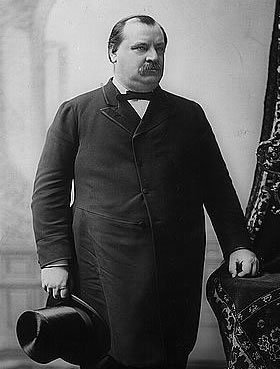
On this date in 1872, Buffalo sheriff — and future U.S. President — Grover Cleveland personally sprang the trap to hang matricide Patrick Morrissey.

Grover Cleveland hanged convicts on two non-consecutive occasions.

Morrissey’s drunken altercation with his widowed mother, that led to a stabbing, that led him to the gallows, would obviously be lost to remembrance but for his accidental association with the man who would become president 12 years later. Of course, it was precisely the other way around at the time of the hanging — so the New York Times article (pdf) on the execution has a pleasurable aspect of discovered curiosity: for the newsman, a dull just-the-facts slog in a forgettable day’s work; for posterity, an accidental glimpse at history’s backstage.*

Cleveland had taken office as Erie County sheriff the year before, his stepping stone from a legal practice into an illustrious electoral career in the Democratic Party that would see him rise to Mayor of Buffalo and Governor of New York (and, after his death, to the $20 bill).

One of Cleveland’s duties as sheriff was to carry out death sentences; he declined to delegate the responsibility to one of his assistants — the hagiography says that his ethical rectitude compelled him to assume the weighty responsibility personally — and handled Morrissey’s dispatch with his own hands.

With his subsequent ascent in the political realm, Cleveland’s activities this day made him the rare notable executioner to earn his fame in another walk of life.

Or infamy, as the case may be. In an era of competitive sloganeering and sobriquets,** Cleveland’s Republican opponents tried to hang him — so to speak — with the nickname “The Buffalo Hangman”.

* The other death row murderer referenced in the Times story was Cleveland’s second (and last) execution on February 14, 1873.

** Like most presidential pols of the time, Cleveland had many more nicknames, both friendly and not — “Uncle Jumbo” because of his girth; “Old Veto” for his liberal use of executive power; and others. (He was also elected a bachelor and married a 22-year-old beauty while in office. Eat your heart out, Bill Clinton.) The New Yorker avers that Buffalo voters during Cleveland’s early local incarnation actually knew him by the avuncular-yet-unwholesome handle of “Big Steve”.

On this day..

1638: Three (of four) English colonists for murdering a Native American

Four hundred years removed from the events surrounding the colonization of Massachusetts by English settlers through the 1620’s, it’s difficult to properly evaluate the mindsets of either colonist or colonizer in this time of violent encounters and expansive cultural shifts.

The 1638 case of Arthur Peach, Thomas Jackson, Richard Stinnings, and Daniel Cross serves as a potent reminder that the relationship between the interlopers and natives in the early years of these meetings was driven as much by tribal politics as by interpersonal attitudes.

Peach, by all accounts, was not on track to be elected Plymouth Man of the Year. A servant of Edward Winslow, one of the Mayflower originals responsible for political gaming with the native leaders, Peach was dispatched to serve in the Pequot War in 1637. The war pitted English colonists and some of their tribal neighbors against the Pequots and resulted in the slaughter of hundreds of Pequot in several attacks.

Peach went work-idle in the post-war years, enjoying his remaining youth: he frequently drank and spent evenings in merriment with his friends, accumulating a sizable debt in the process; said merriment also extended to impregnating Dorothy Temple, a servant of Stephen Hopkins (who was, in one of the less surprising twists, later charged with allowing drunken merriment of his servants in his house).

Plymouth Colony leader William Bradford: Can’t we all get along?

William Bradford speculates that it was to escape punishment for this latter social offense that Peach convinced three other indentured servants to break their bonds and follow him to the nearby Dutch plantations. No matter the motive, they were ill-advised to join him.

Along the way, the quartet came across a man of the Nipmuc tribe (allied with the English and Narragansett during the recent war) named Penowanyanquis. They convinced him to stay, smoked a pipe and talked trade, then stabbed and robbed him, leaving him for what they thought was dead; Penowanyanquis was found on the road and lived for several more days, plenty of time to describe his attackers to first his tribesmen, then the Englishman Roger Williams.

The Plymouth authorities accepted the case (in Plymouth, though the event occurred far from its apparent jurisdiction) in the interests of maintaining the tenuous peace with the New England natives — in Bradford’s words, “The Gov[ernment] in the Bay were aquented with it, but refferrd it hither, because it was done in this jurissdiction; but pressed by all means that justice might be done in it; or els the countrie must rise and see justice done, otherwise it would raise a warr.”

Peach, Jackson, and Stinnings were caught at Aquidneck Island, while Cross fled to Piscataqua (New Hampshire), where it was traditional for locals to refuse to help Plymouth colonials. The three detainees were tried, with much of the trial devoted to proving that Penowanyanquis was, in fact, dead. It took two Narragansett to affirm upon pain of their own heads that Penowanyanquis had succumbed to his injuries, but their testimony sent three whites to the gallows for killing an Indian; for the second time since the Plymouth colony was established 18 years prior, a murderer was hanged.*

The oddity of the affair is not that such a conviction occurred — it was a long-standing colonial tradition to uphold treaties with natives through civil law and break them in a variety of other ways — but the reaction of persons involved before and during the trial. To wit:

Ousamequin coming from Plymouth told me that the four men were all guilty. I answered but one; he replied true, one wounded him, but all lay in wait two days and assisted. Also that the principal must not die, for he was Mr. Winslow’s man; and also that the Indian was by birth a Nipmuck man, so not worthy that any other man should die for him.

Ousamequin, here making the case that Peach should be spared, was another name for Massasoit, the old chief of the Pokanoket whose special kinship with Peach’s indenturerer Winslow was cemented after the settler brought a severely ill Massasoit European remedies when the chief was struck with an unnamed ailment in 1623.

Nor, indeed, were the colonists uniformly positive about the event: Bradford reports that “[s]ome of the rude and ignorant sorte murmured that any English should be put to death for the Indean.”

Massasoit himself seems to have been the only thing holding the colonial relationship together: Metacomet (“King Philip”) took the title of Great Sachem shortly after Massasoit’s death, and his alliances with other tribes exacerbated the harsh feeling towards English attempts to Christianize their neighboring “heathens”. With the white population expanding swiftly beyond its early boundaries, a small event was bound to spell trouble, and when the Christian convert John Sassamon (an Indian) was found murdered and three Wampanoag were executed for the deed, Indian sovereignty was impugned.

King Philip’s War was on, and it did not end well for the native Americans.

No.

To his credit, Peach still produced a son, and Temple’s pregnancy ended the public life of Hopkins. Hopkins was charged with mistreating Temple, who was his indentured servant, and ordered to pay for both her and her child through the two years remaining on her contract.

Hopkins dissented and was jailed, bailed out four days later by John Holmes, who purchased Temple’s servitude for a whopping three pounds (somewhere between 1/4 and 1/2 the price of a cow). Her son remains unnamed in the record, but after giving birth, Temple was charged with producing a bastard child and whipped. Her fate thereafter is lost to the mists of history, as are the future exploits of Daniel Cross.

* The first was Mayflower original John Billington, who was executed in 1630 for shooting John Newcomen to resolve what was apparently a long-standing dispute.

On this day..

1850: Prof. John Webster, for the timeless conflict between donors and academics

On this date in 1850, a 57-year-old Harvard professor expiated upon a gallows at Boston’s Leverett Square the murder of one of the university’s donors.

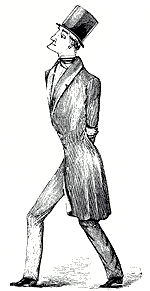
The buzz of Boston in 1849-50, the Parkman-Webster murder case began with the disappearance of one of the crimson’s great benefactors, George Parkman, a Boston Brahmin known for his Ministry of Silly Walks gait about town (see right). According to Oliver Wendell Holmes, Sr. (who appeared as a witness at the trial of Parkman’s accused murderer), “he abstained while others indulged, he walked while others rode, he worked while others slept.”

Also, he inherited a ridiculous sum of money, and was tight with the debtors to whom he lent it.

Back before collection agencies, Parkman disappeared in November 1849 while making the rounds to shake down his borrowers. Within days, suspicion settled on Harvard anatomy and geology professor John Webster, who had squandered his own pile of money buying rock collections and maintaining appearances and such, and sank into desperate hock to the jutting-chinned ambulator who had helped him land the Ivy League appointment in the first place.

A weighty circumstantial case soon formed against Webster, with the invaluable aid of a snoopy janitor who turned up human remains in the office and testified to incriminating-sounding conversations.

Elites-on-elite crime epidemics always churn the scandal mills. Henry Wadsworth Longfellow’s wife Fanny wrote a friend,

You will see by the papers what dark horror overshadows us like an eclipse. Of course we cannot believe Dr. Webster guilty, bad as the evidence looks. … Many suspect the janitor, who is known to be a bad man and to have wished for the reward offered for Dr. Parkman’s body. … I trust our minds will be soon relieved, but, meanwhile, they are soiled by new details continually.

“Harvard professors do not often commit murder,” or so they say. (This was still a century before Robert McNamara.)

Boston high society was about to see a whole different side of Harvard.

Although perhaps individually explicable — anatomists had plausible reasons to have human remains at work, and other anatomists than Webster could have had access to his office — the cumulative weight of Webster’s ham-handed attempts to declare that he had paid up his debts to Parkman just before the latter’s mysterious disappearance, of the discovery of what (disputed) dental forensics declared to be Parkman’s dentures, of the ghastly appearance of a torso (disputedly) declared to be Parkman’s stuffed in a tea chest at Webster’s offices started to really make the man look guilty.

In view of a mediocre defense, the jury convicted Webster of whacking his own professional benefactor, in the university building erected on said benefactor’s donated plot of land.

Talk about donor recognition.

While the prof’s seeming post-conviction acceptance of guilt — in a plain strategem to secure clemency — and generally shifty demeanor have cemented him as the definitive perpetrator in the standard historical reading,* Fanny’s snobbish take on the “bad man,” janitor (and moonlight body-snatcher) Ephraim Littlefield, has not been entirely lost to the tradition.

At the end of the day, everything about the case is circumstantial — indeed, besides being historically noteworthy for the first use of dental forensic evidence in a murder trial (forensics we might find rather speculative and unconvincing today), Webster’s case generated a landmark ruling from the judge’s jury instruction establishing “reasonable doubt” as the threshold for criminal conviction rather than the “absolute certainty” Webster’s prosecutors had no hope of attaining; that ruling influences American jurisprudence down to the present day.

And one cannot but notice how many of the circumstances — creepily playing Sherlock Holmes with a freelance dig into the professor’s furnace to discover charred bones, for instance — were provided by the fellow-suspect-turned-star-witness Littlefield, who niftily reaped the $3,000 reward for his offices in substituting Webster for himself under the pall of suspicion.

According to peripatetic crime blogger Laura James, a forthcoming (2009) book promises to revisit the sensational trial, “to examine all the intricacies for ourselves — not aided by the eager voice of the janitor.”

* Bemis, one of the prosecutors, wrote the go-to source on the Webster trial, available from Google Books; another contemporaneous account is here.

On this day..

1966: Sayyid Qutb

On this date in 1966, author and intellectual Sayyid Qutb was hanged for plotting to overthrow the Egyptian state.

Qutb — whose names can be transliterated many ways (Saïd, Syed, Seyyid, Sayid, or Sayed; Koteb, Kotb, Qutub or Kutb) — was one of the most influential Islamist thinkers of the 20th century, and helped shape the ideas of Osama bin Laden.

A traditionally-minded Muslim civil servant in a westernizing Egypt, Qutb’s journey to radicalism is traditionally dated to his late 1940’s study abroad in the U.S. at what is now the University of Northern Colorado, where the decadence, materialism, and lax morality of the global hegemon saw him seeing existential evil in the everyday all around him:

The American girl is well acquainted with her body’s seductive capacity. She knows it lies in the face, and in expressive eyes, and thirsty lips. She knows seductiveness lies in the round breasts, the full buttocks, and in the shapely thighs, sleek legs — and she shows all this and does not hide it.

Qutb left Greeley, Colo., in 1950 with a master’s degree and an intention to mount an Islamic revolution in his home country that would implement sharia and keep shapely thighs safely under wraps. (Qutb never married, bemoaning the scanty pickings of pure fish in the sea. He may have faced the gallows a virgin.)

He hooked up with the outlawed Muslim Brotherhood, landed in Egypt’s famously savage prisons (future president Anwar Sadat was one of his judges), and the experience of torture hardened his commitment to a vanguard-led revolution. He kept up his prolific writing output, penning perhaps his most notable work, Milestones (the text was later used against him at his capital trial).

Qutb’s release in 1964 was only for a few months, before Egyptian security got wind of a new Muslim Brotherhood plot to overthrow the government and rounded up Qutb as the supposed ringleader — or just railroaded him because it didn’t like where he was going with passages like

there are many practical obstacles in establishing God’s rule on earth, such as the power of the state, the social system and traditions and, in general, the whole human environment. Islam uses force only to remove these obstacles so that there may not remain any wall between Islam and individual human beings.

With the benefit of hindsight, one can readily imagine that his martyr’s death did not squelch his movement, but greatened his stature to admiring eyes.

But it was hardly a direct path into an un-critiqued hall of martyrs in an undifferentiated “radical Islam”. While Qutb had his own influence in Egypt, Cairo has managed to keep the lid on the Muslim Brotherhood. Qutbism, however, was exported to Saudi Arabia — which intentionally imported it for various practical and geopolitical reasons — where it flourished, often in a fractious relationship with official Saudi Wahhabism.

One of Qutb’s students was the uncle of Ayman al-Zawahiri, and the hanged intellectual greatly influenced Zawahiri’s own path into radicalism and to al-Qaeda. Since September 11, of course, the path Qutb himself followed has become of much more pressing interest to the West as well as within the Muslim world.

Some noteworthy works by Sayyid Qutb

On this day..

1191: Muslim prisoners at Acre

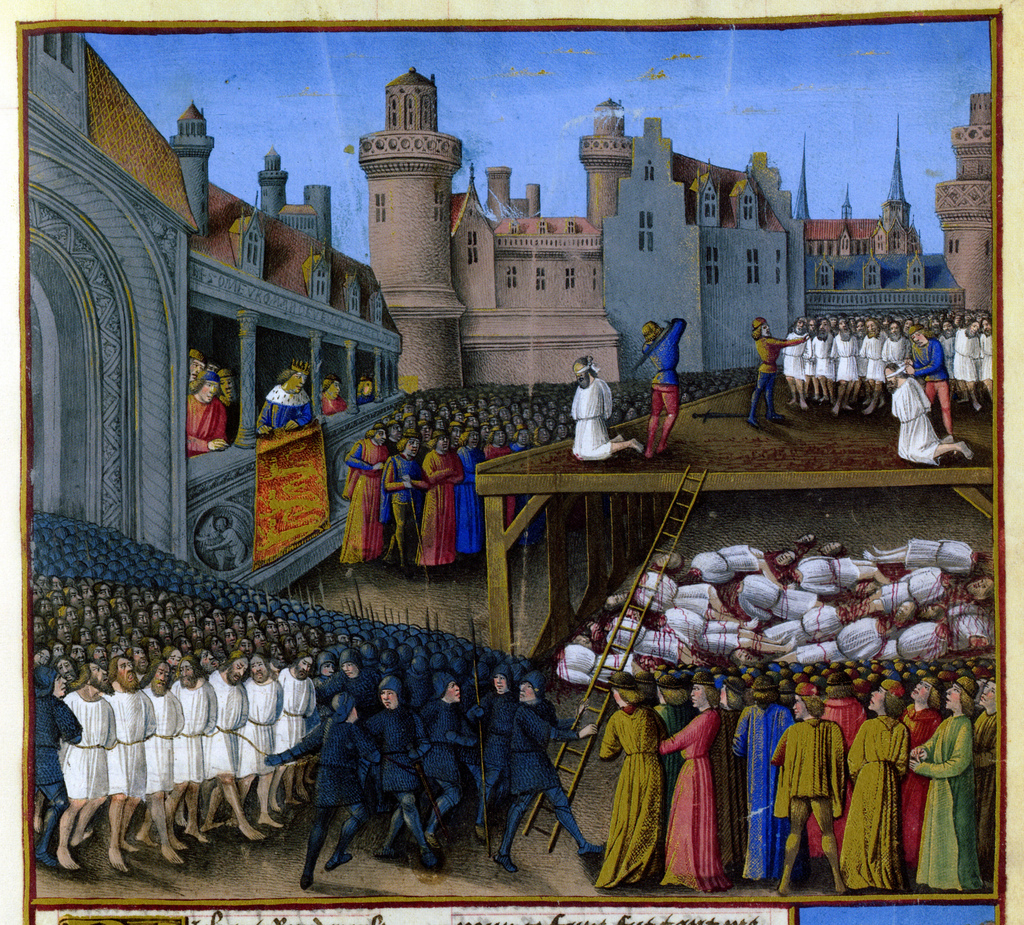
On this date in 1191, Richard the Lionheart had 2,700 Muslim prisoners of Acre demonstratively executed before his opposite number Saladin, when ransom arrangements dilated.

Courtesy of Project Gutenberg, here is Guizot on this ugly prod to action from the Third Crusade

From the 1st of August, 1191, to the 9th of October, 1192, King Richard remained alone in the East as chief of the crusade and defender of Christendom. He pertains, during that period, to the history of England, and no longer to that of France. We will, however, recall a few facts to show how fruitless, for the cause of Christendom in the East, was the prolongation of his stay and what strange deeds—at one time of savage barbarism, and at another of mad pride or fantastic knight-errantry—were united in him with noble instincts and the most heroic courage. On the 20th of August, 1191, five weeks after the surrender of St. Jean d’Acre, he found that Saladin was not fulfilling with sufficient promptitude the conditions of capitulation, and, to bring him up to time, he ordered the decapitation, before the walls of the place, of, according to some, twenty-five hundred, and, according to others, five thousand, Mussulman prisoners remaining in his hands.

The only effect of this massacre was, that during Richard’s first campaign after Philip’s departure for France, Saladin put to the sword all the Christians taken in battle or caught straggling, and ordered their bodies to be left without burial, as those of the garrison of St. Jean d’Acre had been. Some months afterwards Richard conceived the idea of putting an end to the struggle between Christendom and Islamry, which he was not succeeding in terminating by war, by a marriage. He had a sister, Joan of England, widow of William II., king of Sicily; and Saladin had a brother, Malek-Adhel, a valiant warrior, respected by the Christians. Richard had proposals made to Saladin to unite them in marriage and set them to reign together over the Christians and Mussulmans in the kingdom of Jerusalem. The only result of the negotiation was to give Saladin time for repairing the fortifications of Jerusalem, and to bring down upon King Richard and his sister, on the part of the Christian bishops, the fiercest threats of the fulminations of the Church. With the exception of this ridiculous incident, Richard’s life, during the whole course of this year, was nothing but a series of great or small battles, desperately contested, against Saladin. When Richard had obtained a success, he pursued it in a haughty, passionate spirit; when he suffered a check, he offered Saladin peace, but always on condition of surrendering Jerusalem to the Christians, and Saladin always answered, “Jerusalem never was yours, and we may not without sin give it up to you; for it is the place where the mysteries of our religion were accomplished, and the last one of my soldiers will perish before the Mussulmans renounce conquests made in the name of Mahomet.”

Good thing that Jerusalem issue has since been cleared up.

The BBC treated the scenario — complete with the resultant loss of the last chunk of the supposed True Cross — in a chunk of its 90-minute documentary on the Third Crusade:

On this day..

1936: Rainey Bethea, America’s last public hanging

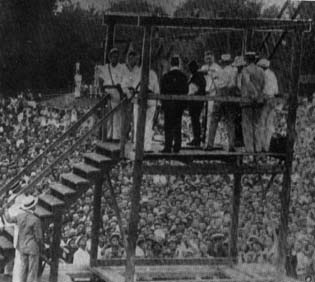
On this date in 1936, thousands thronged Owensboro, Kentucky, for a glimpse of what would prove to be the last public hanging in the United States.

The U.S. followed the trend of its onetime mother country, England, in moving the formerly iconic public hanging increasingly behind closed doors, but its federalist structure made that change uneven. In Kentucky itself at this time, the law displayed sedimentary layers of death penalty history.

Caught up for killing a 70-year-old woman — done in the midst of a drunken burglary, he had left a telltale ring at the scene; fingerprint analysis also helped establish his guilt — Rainey Bethea was on the hook for murder, robbery and rape. The former two indictments would have subjected him to (private) electrocution at the state penitentiary. The latter charge still carried the punishment of public hanging in the local county seat.

Bethea was charged only with rape.

While the explicit sentencing disparity between the crimes bears the clear marks of racism and patriarchy that made purported black-on-white sexual crimes such live fodder for lynch law, and the four-and-a-half-minute jury deliberation doesn’t have the look of solemnity, Bethea’s actual guilt seems fairly well-established.

But the case attracted a nationwide media swarm not for any exceptional quality of the crime or the anachronistic nature of the punishment, but for the involvement of a female sheriff. The “matronly” (virtually all descriptions of her gravitate to this adjective) Florence Thompson had inherited the top law enforcement post upon the death of her husband … and that meant she had inherited the responsibility of hanging Rainey Bethea, which would make her the first American woman to supervise an execution.

Would she or wouldn’t she? The press descended on Owensboro to cover the edifying spectacle of a plump mother stringing up a rapist, or else maneuvering her way out of the job. Thompson played cagey until the very last moment, when the ringers she had secretly hired appeared on the scaffold while she watched from a nearby vehicle.

In this photo, Bethea — almost totally obscured between his escorts — has just begun ascending the gallows.

The man who threw the trap showed up drunk and performed appallingly, but press reports subsequently focused on the beastly behavior of the “jeering” crowd rushing the gallows to tear souvenirs from the corpse. (For instance, Time and the New York Times.)

But according to Perry T. Ryan’s 1992 review of the case — including interviews with surviving witnesses — little to nothing of the kind occurred. Ryan claims Bethea faced about the most dignified hanging mob imaginable.

Maybe hyped-up atrocities in the hinterlands were part of what distant editors demanded after H.L. Mencken at the Scopes trial. Certainly, the local Messenger-Inquirer painted a sharply different picture from more prominent outlets in this August 16 editorial (titled “Panderers Galore”) whose themes could have stepped fresh from a modern cable TV gabfest:

Ambitious and irresponsible reporters and photographers who swarmed into Owensboro for the Bethea hanging dipped their ready hands into the cloaca of evil designs and plastered over the name of this fair city the dirty results of their pandering.

Those who saw the dawn kindling in the east and ushering in the last sunrise of the despicable creature about to die, did not expect all of the watchers to be in reverent mood, but a calm, quiet demeanor characterized their behavior, as a group, throughout their long wait, surprisingly moderate for an occasion on which the law was exacting the supreme penalty.

Considering the size of the throng that witnessed the hanging Friday morning and that it was composed largely of people, who journeyed to Owensboro from distant places, the wonder is that there was no demonstration, no emotional outburst. There was not the semblance of ‘mob impulse’ or ‘eagerness for the kill.’ For the sensation seeking star scribes of quacks of American journalism, it was entirely too tame an affair. This is the reason that some of them reported it as they wanted it to be — not as it was.

They heard a very few people on the outskirts of the crowd call out at different times: ‘Hurry up,’ ‘Get it over’ or ‘hang him.’ To give screaming bulletins to the yellow press and to ruthless radio commentators, they magnified and colored it into a scene of ‘great disorder’ though there was never a general outcry of any kind.

When a priest held up his hand from the scaffold for silence, as Bethea was about to go to his death, there was no ‘blood thirst’ mob ‘shouting and yelling.’ Present were several thousand, who came from near and far to see a man legally hanged for the most heinous crime ever committed in Daviess county, and several thousand more, who turned out to see how the rest would act. When that hand went up in a gesture for silence, the buzz of the multitude’s conversations died down till the fall of the proverbial pin could have been heard.

The smart scribes and sob sisters looked on. All they saw was a black man standing on a scaffold with a rope around his neck and a mass of people peering up at him. That was too tame, they would call it a ‘jeering’ throng. All they heard was the click of the trap door. That would not do. There would have to be ‘cheering.’ So they said there was. Then they heard cameramen from cities where nothing is cared about the horrible crime Bethea committed. They were bawling at officials to ‘move out of the way,’ to ‘give us a break.’ They had to have their souvenirs to show the half civilized readers of their yellow sheets. The boys and girls who had to tell the story needed more color to regale them with atrocious accounts of how the people behaved. They found a few individuals who had gone in the bizarre which inspired thundering headlines about ‘gayety’ and ‘carnival’ spirit.

In administering the last sacrament, the Rev. H. J. Lammers, of Louisville, made an opening in the hood. When the doctors pronounced Bethea dead, one of the attendants at the scaffold took a tag off the hood. Another then took a fragment and others, who were at arms length from the dead man, followed suit. The blunder of tearing off that tag gave the high powered thrill-writers their big opening. They pictured the crowd as tearing Bethea’s clothes from his body. The crowd was never in disorder and Bethea’s clothes were never torn.

The ‘souvenir hunting mob’ did not even pick up the sox [sic] and shoes the doomed man left at the foot of the gallows. It did not so much as touch the basket in which Agnew and Wheatley, colored undertakers, placed the body, clothes and all, or molest it or them in the slightest as they bore it away.

The scavenger writers who came to depict a ‘jolly holiday’ and ‘gala occasion’ had both, but they never saw a more orderly throng at a baseball game.

The public hanging of Bethea was not a disgrace to Kentucky. But, a disgrace to Illinois, Missouri, Tennessee, and some other states, was the spectacle made of it in their scandal monger press. Owensboro should not be surprised at the scurrilous attack upon it by lurid writers and glib tongued talkers in northern and eastern states for they delight to distort any news from Kentucky into weird barbaric tales. We have learned how best to protect our women from rapists-murderers, white or colored. The only way, it seems, that we will ever be able to protect them from the cruelties of a sordid section of the press, will be by softening the state’s anti-rape law, which makes public hanging mandatory. So many as favor that will please tell the legislature.

Vendors of news occupy an important place in the nation, and their purpose should always be to maintain unquestioned exactness of facts. Where the subject matter is susceptible to coloring there should be no sacrifice of truth. To pervert the high honor of the profession for the paltry reward of more readers is a dangerous venture and one that should be curbed.

Owensboro’s citizenry, than which no finer representatives of high-bred Americans can be found anywhere, regrets that it was necessary to invoke the Mosaic law, but a sobered regret and a more solemn memory is that the hanging was eagerly seized upon and transformed into a picturization of the exhibition of low passions loosed.

We are proud of our city, and justly so, for no people are of finer fiber. The putrid pens of those who wore the garb of the news profession painted in lurid colors purported happenings, and it is sad but true that such distorted reports are accepted while the plain statement of facts is discarded as an attempted apology.

Thousands of those who witnessed the Bethea hanging came from outside the county. They belonged to good families in their communities, temporarily bereft of their better judgment and bent on viewing a scene which ordinarily would be extremely repugnant to them. And the out-of-town reporters found in the visitors elements to embody in their sordid stories.

A thoughtless word here and there, expressed without cognizance of its probability of misuse, and the staid citizen away from home becomes to the wild-eyed correspondent a Kentuckian gunning for human game. There should be available means of calling to account the writer who for a few filthy shekels diverts his sense of justice into the recording of things that never were.

As the editorial intimates, regardless of what actually happened in Owensboro, the circus atmosphere quickly brought the matter of public hangings into question. In 1938, the Kentucky legislature moved all executions behind prison walls … and Bethea secured an indefinite claim to the status of last person publicly executed in the United States.

Part of the Themed Set: At the End of the Rope.

On this day..

1944: Eight July 20 plotters

On this date in 1944, Nazi Germany’s juridical vengeance against Hitler’s near-assassins commenced.

Barely two weeks after Col. Stauffenberg‘s bomb had barely missed slaying the Fuhrer, eight of his principal co-conspirators stood show trials at the Volksgerichtshof (People’s Court) before hectoring prig Roland Freisler.

The outcome, of course, was foreordained.

Apparently orders had come down from on high to make the deaths as degrading as possible; this batch, convicted August 7-8, was hanged naked this day at Berlin’s Plotzensee Prison on thin cord (piano wire, say some sources, although it’s not clear to me whether this is literally true) suspended from meathooks while cameras rolled. Video and stills from the ghastly scene were shipped back to Hitler’s bomb-damaged Polish outpost for the edification of the powers that be.

The eight fitted for those nooses were:

Many hundreds more would follow, both at Plotzensee and throughout the Reich where persons distantly connected to the plotters and various miscellaneous resistance figures were swept up in the purge.

On this day..