On this date in 1777, a general of the American Revolution laconically asserted his prerogatives with the hanging of a British spy.
A former ranger in the British service, Israel Putnam — he may or may not be the “don’t fire until you see the whites of their eyes” guy — was camped at Peekskill, New York, when he caught one Edmund Palmer stalking the camp.
It was early in the American Revolution, and American spies were being hanged by the British … but the commanders of Albion evidently entertained some notion that the shoe would not go on the other foot. When Palmer was condemned to death for spying, the British General Sir Henry Clinton hurried a missive to his opposite number under flag of truce claiming Palmer as a British lieutenant.
Old Put firmly believed “the speedy execution of spies is agreeable to the laws of nature and nations and absolutely necessary to the preservation of the army.” (According to the unimpeachable sourcing that is the “about” page of an intel e-learning university named for him.)
And Putnam’s reply to Clinton, a terse little masterpiece answering Cicero‘s dictum that “Brevity is a great praise of eloquence,” was one for the ages.
Headquarters, 7th August, 1777.
Sir — Edmund Palmer, an officer in the enemy’s service, was taken as a spy lurking within our lines; he has been tried as a spy, condemned as a spy, and shall be executed as a spy, and the flag is ordered to depart immediately.
Yours, &c.,
Israel Putnam
P.S. He has accordingly been executed.
(Some versions give the slightly zippier postscript as “afternoon — he is hanged.”)
Read all about this spry American Cincinnatus in Old Put, a now-public-domain book published for America’s centennial celebration; or at this enthusiastic fan page. Also of some now-current relevance: tangential background on the jurisdictional wrangling around military commissions at this period, here.
On this date in 1890 the iconic symbol of the American death penalty made its grisly debut upon the person of William Kemmler at New York’s Auburn Prison.
The long New World tradition of hanging condemned prisoners came under fire as a barbarism in the late 19th century, leading reformers to look for killing procedures less likely to result in a horrendously protracted strangulation or a midair decapitation. As Empire State Governor David Hill put it,
The present mode of executing criminals by hanging has come down to us from the dark ages, and it may well be questioned whether the science of the present day cannot provide a means for taking the life of such as are condemned to die in a less barbarous manner.
On this stage, Executed Today presents a rogues’ gallery of homo Americanus, the salesmen and swindlers who would help the U.S.A. ride the lightning.
The Dentist
A true renaissance man, Buffalo dentist Dr. Alfred Southwick, applied his active mind to the need to better kill a fellow, and soon hit upon an inspiration — that is to say, a town drunk hit upon an electrical generator and died instantaneously, and the observant Southwick said “eureka!”
Without the subsequent industry of this neglected gentleman, who added to his repertoire scientifically-minded electrical butchery of animals alongside political gladhandings to bring a flutter to a busybody’s heart, the Chair’s entire oeuvre of machismo-sadism might have missed the country altogether. Just imagine living in a world where New York had pioneered its other leading reform alternative: lethal injection.
(This, incidentally, is why the chair is a chair, and not a bed or a stake or a St. Andrew’s Cross: because the guy who thought of it spent all day administering his own tender mercies to seated penitents.)
The Plutocrats
As Southwick nagged his senator and shocked stray cats into the great hereafter, the gears of commerce strove relentlessly ever-onward. The business of America was ever business, and never more so than the Gilded Age.
And the business of killing people was about to become the biggest business there was.
The age of electricity was buzzing into incandescence, and two rival standards were at currents amped over eventual dominance of this stupendous industry. Thomas Edison’s earlier Direct Current (DC) standard was being challenged by Nikolai Tesla’s Alternating Current (AC), backed by the financial muscle of George Westinghouse.
Cheaper and more efficient, AC tilted the playing field against Edison. Seeing his days numbered, the Wizard of Menlo Park fought back the way any dinosaur industry would: dirty.
This clip of the electric demise of a circus elephant — don’t hit “play” if you’re not up for animal cruelty — is from some years later (Edison kept tilting at windmills and megafauna carcasses as his DC empire disappeared), but it’ll give a sense of the horrifying spectacle.
With the New York legislature’s embrace of Southwick’s seated voltage people-eater, Edison turned his PR gears on the state, demanding they adopt his competitor’s “deadlier” current for the contraption. And they did, reflecting a widespread belief inculcated by Edison’s experiments — as this New York Times article on an Edison crony’s public livestock-killing show in the days leading up to the advent of the electrocution law indicates:
The experiments proved the alternating current to be the most deadly force known to science, and that less than half the pressure used in this city for electric lighting by this system is sufficient to cause instant death.
After Jan. 1 the alternating current will undoubtedly drive the hangmen out of business in this State.
Too bad for Edison that the business he was really trying to kill was made of sturdier stuff.
The Alcoholic Vegetable Merchant
As the 1880’s wane, we come at last to our subject — in several senses of the term — an illiterate nobody of German stock who chanced to kill his common-law wife with just the right timing to join in a new kind of experiment.
William Kemmler mounted a “cruel and unusual punishment” appeal against his sentence funded by Westinghouse himself: no dice. Perhaps appreciating the odd foothold on history he was about to attain, he showed little worry as he entered the execution room and sat himself — “undoubtedly the coolest man in the room,” a journalist present reported.
The End of the Beginning
That reporter’s description for the New York Herald graphically captures humanity’s first horrible encounter with this “humanitarian” machine, beginning with the prisoner’s parting remarks.*
Doubtless he knew that his words will go down in history and he had his lesson well learned. He addressed his audience [in] a commonplace way and without hesitation.
…
“Well, gentleman, I wish everyone good luck in this world, and I think I am going to a good place, and the papers have been sa[yi]ng a lot of stuff that isn’t so. That’s all I have to say.”
And so with a parting shot at what he was good enough to refer to not long ago as “those d—d reporters,” William Kemmler took his leave of earth. The quiet demeanor of the man as he entered had made a strong impression on those in the room. His self-possession after his oratorical effort simply amazed them. He got up out of his chair as though he were anxious to try the experiment, not as though he courted death, but as though he was thoroughly prepared for it. …
There was no delay. Kemmler constantly encouraged the workers at the straps with “Take your time; don’t be in a hurry; do it well; be sure everything is all right.” He did not speak with any nervous apprehension.
Warden Durston leaned over, drawing the buckle of the straps about the arm. “It won’t hurt you, Bill,” he said, “I’ll be with you all the time.”
A minute later Kemmler said, “There’s plenty of time.” He said it as calmly as the conductor of a streetcar might have encouraged a passenger not to hurry.
…
Kemmler was pinioned so close that he could hardly have moved a muscle except those of his mouth.
The Warden took a last look at the straps. “This is all right,” he said.
“All right,” said Dr. Spitzka, and then bent over and said, “God bless you, Kemmler.”
“Thank you,” said the little man, quietly.
“Ready?” Said the Warden.
“Ready,” answered the doctors.
“Goodbye,” said the Warden to Kemmler. There was no response.
GAVE THE SIGNAL.
The Warden stepped to the door leading into the next room. It was then forty-three and one-half minutes past six o’clock by the prison clock. “Everything is ready,” said the Warden to some one hidden from view in the next room.
The answer came like a flash in the sudden convulsion that went over the frame of the chair. If it seemed rigid before under the influence of the straps, [it] was doubly so now has it strained against them.
The seconds ticked off. Dr. McDonald, who was holding the stopwatch, said “Stop.”
Two voices near him echoed, “Stop.”
The Warden stepped to the door of the next room and repeated the word “Stop.”
As the syllable [passed] his lips the forehead of the man in the chair [grew] dark [in] color, while his nose, or so much of it as was exposed, appeared a dark red.
There was very little apparent relaxation of the body, however. [A] fly lighted on the nose and walked about unconcernedly. The witnesses drew nearer to the chair.
“He’s dead,” said Spitzka, authoritatively.
“Oh, yes, he’s dead,” said McDonald.
“You’ll notice,” said Spitzka, “the post-mortem appearance of the nose immediately. There is that remarkable change that cannot be mistaken for anything else, that remarkable appearance of the nose.”
The other doctors nodded [assent]. They looked at the body critically for a minute and then Spitzka said, [“]oh, undo that now. The body can be taken to the hospital.”
“Well, I can’t let you gentlemen out of here until I have your certificates,” said the Warden.
FOUND SIGNS OF LIFE.
It was while this businesslike conversation was going on that Dr. Balch made a discovery.
“McDonald,” he cried, “McDonald, look at that rupture,” he pointed at the abrasion of the skin on Kemmler’s right thumb. In the contraction of the muscles the figurehead[?] scraped against it and removed the skin, and from that little [wound] blood was flowing-[an] almost certain indication of life.
A low cry of horror went through the assemblage.
“[Turn] on the current,” excitedly cried Dr. Spitzka. “This man is not dead.”
The crowd fell back from the chair, as though they were in danger. The Warden sprang into the closed door and pounded on it with his hand.
“Start the current!” he cried. As he spoke of fluid began to drop from Kemmler’s mouth and to run down his beard; a groaning sound came from his lips, repeated and growing louder each time.
It seemed [an] age before the card was again turned on. In fact it was just seventy-three seconds from the end of the first contact when the first sound was heard to issue from Kemmler’s lips, and it was not more than a half [minute] before the card was again turned on.
RECOVERING CONSCIOUSNESS.
But every second to that time the horrible sound from those groaning lips was becoming more distinct, [a straining] of the chest against the leather harness stronger and more evident.
The man was coming to life. The spectators grew faint and sick. [Men] who had stood over dead and dying [men] and had cut [men] to pieces without an emotion [grew] pale and turned their heads away.
One witness was forced to lie down while one of the doctors fanned him.
But [the end] came at last. There was another convulsion of the body, and … it became rigid with the rigidity of iron.
“That man wasn’t dead,” cried Spitzka excitedly. As he spoke the body twitched again. The electrician had given the current gain new alternation and now 2,000 volts [were] playing in short, successive shocks down Kemmler spine. The sound ceased with the first convulsion, but the fluid continued to trip from the mouth and down the beard, making the body a sickening spectacle.
“Keep it on now until he’s killed,” said one of the doctors. …
“Keep it on! Keep it on!” Cried Warden Durston through the door.
Silence reigned for a moment. A bell without began to [toll] solemnly. …
BURNED BY THE CURRENT.
Then from the chair came a sizzling sound, as of [meat] cooking on hand. Following it immediately a billow of smoke came from the body and filled the air of the room with the odor of burning hair.
There was a cry from all the members of the little group, and Warden Durston cried through the door leading to the next room to [turn] the current off.
More shocking — so to speak — papers ran the next day’s headline “Kemmler Westinghoused,” the verb “to Westinghouse” being another shameless Edisonian bid to stamp his marketing project onto the Queen’s English. This fine, rounded, archaic neologism the right sports anchor could resuscitate as a fresh synonym for thrashing, horsewhipping, poleaxing, or else (in greater justice) for moderation and decency as the only principal in the sordid affair that rejected death-dealing by electricity.
(Officially, Edison also opposed the death penalty. Like Dr. Guillotin, he was doing his part for humanity in the meantime … just with a little skin in the game. Did we mention the business of America is business?)
Official reviews for the “art of killing by electricity” were, ahem, mixed.
“They could have done better with an axe.”**
-George Westinghouse
“Strong men fainted and fell like logs on the floor.”
-New York Herald
“Revolting … a disgrace to civilization.”
-New York Times
“We live in a higher civilization from this day on.”
-Alfred Southwick
Books (remarkably numerous!) about the creation of the electric chair
It should, in fairness, be noted that the U.S. was not the only country (pdf) to mull an electrocution chair in the 19th century … but it was (and for a long time remained) the only one to actually use one.
* The Herald excerpt, along with several other articles from the same paper about the Kemmler execution, is here, but the text has obviously been generated from a scan with uneven results. As I do not have access to the originals, [bracketed] remarks in the excerpt indicate this author’s own interpretations or interpolations of seemingly mistaken transcriptions.
** Some sources make it “would have done better with an axe.”
On this date in 1794, the curtain — and the blade — fell on the Terror.
Maximilien Robespierre, who had breakfasted the previous day as master of France, was guillotined this evening with his chief lieutenants and partisans.
His fall came as sudden and inevitable as his rise had been unpredictable.
Five years before, Robespierre was an unprosperous Arras attorney of fashionably liberal philosophies, and you wouldn’t have given a sou for the prospects of his being remembered five minutes after he died. Yet it would come that his inseparable lieutenant Saint-Just would remark with understatement, “The words we have spoken will never be forgotten on earth.”
The historic convocation of the Estates-General thrust him onto the political stage where he would make the dread name that follows him, starting off in the Revolution’s inception as a far-left deputy. He took a notable early stand against the death penalty, with several arguments that are quite familiar by our day:
The first obligation of a legislator is to form and preserve public morals, the source of all freedom, source of all social happiness. When in running to a particular goal he turns away from this general and essential goal he commits the most vulgar and dire of errors. The king must thus present to the people the purest model of justice and reason. If in place of this powerful, calm and moderate severity that should characterize it they place anger and vengeance; if they spill human blood that they could spare and that they have no right to spread; if they spread out before the people cruel scenes and cadavers wounded by torture, it then alters in the hearts of citizens the ideas of the just and the unjust; they plant the seed in the midst of society of ferocious prejudices that will produce others in their turn. Man is no longer for man so sacred an object: we have a less grand idea of his dignity when public authority puts his life at risk. The idea of murder inspires less fear when the law itself gives the example and the spectacle. The horror of crime is diminished when it is punished by another crime. Do not confuse the effectiveness of a penalty with the excess of severity: the one is absolutely opposed to the other. Everything seconds moderate laws; everything conspires against cruel laws.
For Robespierre, it was an abomination for the nation to deal out death within its community, but his Rousseauan elevation of the collective and abstract People made extirpating existential threats to the community itself an altogether different matter.
The future tyrant’s anti-death penalty case for executing the deposed Louis XVI, flowing directly from those principles, makes interesting reading and is excerpted at length (all emphases added) here for its topicality:
When a nation has been forced to resort to the right of insurrection it returns to a state of nature as regards its tyrant. How can the latter invoke the social compact? He has annihilated it. The nation can preserve it still, if it thinks fit, in whatever concerns the interrelations of its citizens: but the effect of tyranny and insurrection is to break it entirely as regards the tyrant; it is to throw them into mutual war; the tribunals, the judiciary procedures, are made for the members of the city. … The right to punish the tyrant and that to dethrone him are the same thing. The one does not admit of different forms from the other. The tyrant’s trial is insurrection; his judgment is the fall of his power; his penalty, whatever the liberty of the people demands.
Peoples do not judge like judiciary courts. They pass no sentences; they hurl the thunderbolt. They do not condemn kings: they thrust them back into oblivion; and this justice is not inferior to that of courts. If they arm themselves against their oppressors for their own safety, why should they be bound to adopt a mode of punishing them which would be a new danger to themselves?
…
As for me, I abhor the penalty of death so lavish in your laws, and I have neither love nor hatred for Louis. Crimes only I hate. I have asked the Assembly, which you still call Constituent, for the abolition of the death penalty, and it is not my fault if the first principles of reason seem to it moral and political heresies. But if you never bethought yourselves to invoke them in favor of so many unfortunates whose offenses are less their own than those of the government, by what fatality do you remember them only to plead the cause of the greatest of all criminals? You ask an exception to the death penalty for him alone against whom it can be legitimate! Yes, the penalty of death generally is a crime, and for that reason alone, according to the indestructible principles of nature, it can be justified only in cases when it is necessary for the safety of individuals or the social body. Public safety never demands it against ordinary offenses, because society can always guard against them by other means and make the offender powerless to harm it. But a dethroned king in the bosom of a revolution which is anything but cemented by laws, a king whose name suffices to draw the scourge of war on the agitated nation, neither prison nor exile can render his existence immaterial to the public welfare: and this cruel exception to ordinary laws which justice approves can be imputed only to the nature of his crimes.
It is with regret that I utter this fatal truth. But Louis must die, because the country must live.
“Pity is treason.”
Months later, as head of the Committee of Public Safety — the Orwellian name harkens to the body’s power to judge who lay inside the community and who, lying outside, made war upon it — he would find an inexhaustible fifth column of kindred threats to the Revolution.
But Revolutionary France really was in a war for its survival, against external and internal foes alike. The monarchist for whom crime multiplied upon crime every day after the Tennis Court Oath has the easiest time of this period, for every step brings a new monstrosity. And it is well enough to call Robespierre illiberal, to shudder at his prim and icy persona.
But if the French Revolution’s liberte, egalite, fraternite is a legacy for celebration — as it is to much of the west, and much of the world — one must grapple with the place of this man and his methods.
Merely because they are the paths not taken, one hardly seems entitled to assume that at that tumultuous moment the rule of a constitutional monarchy heir to all the monstrosity of the ancien regime, the government of the Girondins who had launched the nearly fatal war against Austria, or that of Danton‘s haute bourgeoisie would necessarily have delivered France to a better place, or even a different one.
For a Dickens, Robespierre’s Terror is simply the appalling wrong turn of a high-minded movement. For Trotsky, “the Incorruptible”* is the admirable sword of France’s bourgeois revolution who effects the needful task of annihilating the feudal nobility, who presses fearlessly forward seeing that the only alternative is the slide into Bonaparte. Between the two lie many readings of the man.
Whether an aberration, a visionary, or a necessity, he waded a sea of blood for his frightening twins Virtue and Terror.
The fall of 9 Thermidor preceded Robespierre’s execution by a full — and very eventful — day. Arrested by the Convention, he was promptly liberated by his base in the Paris Commune which came within a whisker of overthrowing the Convention at that very moment. Instead, a frantic few hours of marshaling the armed power of the Revolution’s rival claimants to leadership ensued ending in a fray which saw the Robespierrists overpowered.
Robespierre was shot through the jaw in the process of signing an appeal to arms — some say a botched suicide, but a wound from the invading national guard is more generally believed; at any rate, the bloodied document with his signature begun “R-o-” is one of the age’s most arresting historical artifacts.
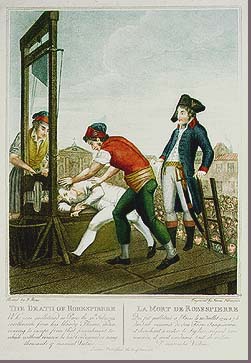
Horrifically injured, he lay most of the following day exposed for public derision before he was hauled with his party to the guillotine, re-erected in the Place de la Revolution for this most memorable execution. In Carlyle’s florid (and free) narration:
Robespierre lay in an anteroom of the Convention hall, while his Prison-escort was getting ready; the mangled jaw bound up rudely with bloody linen: a spectacle to men. He lies stretched on a table, a deal box his pillow; the sheath of the pistol is still clenched convulsively in his hand. Men bully him, insult him: his eyes still indicate intelligence; he speaks no word. … -O reader, can thy hard heart hold out against that? His trousers were nankeen; the stockings had fallen down over the ankles. He spake no more word in this world.
…
Fouquier had but to identify; his Prisoners being already Out of Law.** At four in the afternoon, never before were the streets of Paris seen so crowded. From the Palais de Justice to the Place de la Revolution … it is one dense stirring mass; all windows crammed; the very roofs and ridge-tiles budding forth human Curiosity, in strange gladness. … All eyes are on Robespierre’s Tumbril, where he, his jaw bound in dirty linen, with his half-dead Brother, and half-dead Henriot, lie shattered; their “seventeen hours” of agony about to end. The Gendarmes point their swords at him, to show the people which is he. A woman springs on the Tumbril; clutching the side of it with one hand; waving the other Sibyl-like; and exclaims: “The death of thee gladdens my very heart, m’enivre de joie;” Robespierre opened his eyes; “Scelerat, go down to Hell, with the curses of all wives and mothers!” — At the foot of the scaffold, they stretched him on the ground till his turn came. Lifted aloft, his eyes again opened; caught the bloody axe. Samson wrenched the coat off him; wrenched the dirty linen from his jaw: the jaw fell powerless, there burst from him a cry; — hideous to hear and see. Samson, thou canst not be too quick!
Samson’s work done, there bursts forth shout on shout of applause. Shout, which prolongs itself not only over Paris, but over France, but over Europe, and down to this generation. Deservedly, and also undeservedly. O unhappiest Advocate of Arras, wert thou worse than other Advocates? Stricter man, according to his Formula, to his Credo and his Cant, of probities, benevolences, pleasures-of-virtue, and such like, lived not in that age. A man fitted, in some luckier settled age, to have become one of those incorruptible barren Pattern-Figures, and have had marble-tablets and funeral-sermons. His poor landlord, the Cabinet-maker in the Rue Saint-Honore, loved him; his Brother died for him. May God be merciful to him, and to us!
* Even his enemies agreed — sometimes adding it to the bill of particulars against him — that Robespierre lived a life of personal moderation; he lived as a boarder with a working-class family, and disdained to avail the politician’s typical harvest of political graft.
** The Convention had decreed Robespierre’s outlawry when he escaped custody; his immediate execution was, of course, akin to the logic he had once turned against the king.
July 27th, 1794 — the 9th of Thermidor, year II — is inscribed in history as the day Robespierre fell, when a parliamentary coup d’etat between the right and the remnants of the parties he had destroyed shouted him down as he readied the National Convention for his next purge.
This scene from the multinational bicentennial epic La Revolution Francaise conflates the events of 8 Thermidor — when Robespierre delivered a menacing two-hour address but provoked outcries by failing to name the deputies he implicated in “conspiracy” — and 9 Thermidor, when Robespierre’s lieutenant Saint-Just was shouted down from the podium and Robespierre ended up staggering through the benches appealing against the imprecations of his colleagues as his arrest is decreed.
Even as the month of Thermidor’s eponymous epochal event was unfolding, the daily gears of Revolutionary justice were turning: the usual haul of unfortunates condemned, including seven women from the previous day’s batch of Saint Lazare prison conspirators who had pled their bellies to buy a day.
That day was one day too little.
Stanley Loomis is overtly hostile to the Revolution, but his middlebrow sensibilities are well-tuned for the pathos of the scene:
Indifferent to the storms that were raging in the Convention, the Revolutionary Tribunal continued to go about its implacable business with cold efficiency. The arrest of its President [the Robespierrist Rene-Francois Dumas (the link is French), who was taken in the courtroom] startled no one. Since its inception that court had been witness to too many dramas to be astonished any further. Dumas quietly departed; the trials continued. Forty-two prisoners were sentenced to death. By four o’clock their hair had been cut and they were ready to be sent on their way. But Samson, aware of disturbances in the St. Antoine quarter of the city, suggested to [prosecutor] Fouquier[-Tinville] that the executions be deferred until the morrow.*
“Justice must take its course,” snapped the Public Prosecutor. “Do your work.”
And so the last “batch” lumbered off in the direction of the Faubourg St. Antoine and the Place de la Nation. With the exception of the Princesse de Monaco, they were nearly all obscure and humble members of the petite bourgeoisie. Hanriot, waving his sabre, conducted the procession to the place of execution. By seven o’clock that evening, as the minutes of the military escort poignantly show, the unfortunate victims, who had been so close to deliverance, had all been executed.
Henriot proceeded directly from his escort service to the Convention to liberate Robespierre for the night’s brief pitched battle against the Convention, and here we take our leave of them, for now. We shall meet both of them on the scaffold tomorrow.
Not on the wagon** with the Princess of Monaco was a man whom Loomis would have pitied rather less.
The bloated, penniless 54-year-old fruit of an ancient noble house, Donatien Alphonse François de Sade, Marquis de Sade had, in the most recent chapter of his astounding career, navigated the Revolution in the improbable guise of a proletarian section head and revolutionary tribunal judge, until his own arrest late the previous year.
This day, de Sade’s name was on a list of prisoners to be seized from Madelonnettes Prison — “Sade, former count, captain of Capet’s guards in 1792, has corresponded with enemies of the republic,” it said — which he had occupied until a recent transfer to Picpus, a monastery converted into a prison adjacent to the guillotine’s place at the Place de la Nation. Whether the result of another of the many bureaucratic snafus we’ve witnessed this week or a well-placed bribe from his friend and/or mistress Marie-Constance Quesnet, the guards were in the wrong place, didn’t find him, and didn’t care to dig any further.
Three months later, he was — for the last time in his life — a free man.
One could hardly say that the Revolution made the author of Justine the man he so (in)famously was — but having lived within sight of the blade that might any day be called upon to chop off his own head, and the entire tableau of the years preceding, left their impression. Hundreds of bodies from the Terror were stuffed in the unpropitious clay of the makeshift jail’s yards under de Sade’s cell. “Those few months in the shadow of the guillotine did me more harm than all the years of my incarceration under the King,” he wrote a friend.
strangely mixing real memories with very Sadean embellishments … Plots, betrayals, denunciations, beheadings: these fictional motifs and Sadean phantasies are linked with the reality and the imaginary of the Revolution.
Good for what ails you.
* Sanson’s diaries — a memoir of the family business constructed by the famous executioner’s grandson — leave off before the events of Thermidor and suggest that the hecatombs of the Terror were taking their toll on the aging headsman. Other accounts of this day have the tumbrils stopped in the streets by clemency-inclined onlookers, only to be forcibly extricated by Henriot.
Minutes after midnight this date in 1944, four senior Wehrmacht officers who had come within an ace of murdering Adolf Hitler less than 12 hours earlier were summarily shot in Berlin — the first of thousands executed for the most famous assassination attempt on the Fuhrer.
One of those rare moments where historical epochs (arguably) turn on the minutest exigencies of chance, the so-called July 20 plot had seen Col. Claus Schenk Graf von Stauffenberg insinuate a bomb into Hitler’s conference room in modern-day eastern Poland, then fly back to Berlin to mount a coup d’etat.
Blam
Stauffenberg had every reason as he left Wolfsschanze to believe the devastating blast at 12:42 p.m. must have killed the Nazi dictator. Little did he know that another officer at the table where the high command was plotting strategy for the eastern front had, in the name of legroom, shifted the deadly satchel to the other side of a heavy oak table support — shielding Hitler from the brunt of the explosion.
Four men died. Hitler had hearing loss, an injury to his right arm, and one hell of a grudge.
Stauffenberg weaseled out of the confused bunker and flew back to Berlin, expecting that his confederates were even then launching Operation Valkyrie — a contingency plan for martial law in the case of civic disturbance that the conspirators intended to use to mount a coup.
Failure to Communicate
Control and distribution of information was not the least of the many threads in the tapestry of July 20, 1944. Hitler had risen to power on his artful grasp of propaganda; today, his headquarters’ mastery of communications would overpower the putschists’ rank amateurism.
While en route, Stauffenberg had no ability to communicate to the wider world. Landing in Berlin three hours after the not-quite-deadly-enough blast at Wolfsschanze, he must have been stunned to find that Valkyrie had not been launched. Apparently, fragmentary reports from the east were unclear as to whether Hitler had survived; everyone was reluctant about committing himself.
Frantically, Stauffenberg — already deeply committed — rallied his comrades and set the treasonable gears into motion. But by this time, communications with Hitler’s headquarters had been re-established and contradictory reports of the assassination attempt’s success were flying in Berlin. Stauffenberg’s sincere but incorrect eyewitness testimony of Hitler’s death became increasingly untenable. Compounded by the sluggish and ill-coordinated action of the conspirators, officers of a more opportunist bent soon began lining up with the bad guys.
Joseph Goebbels, the senior Nazi in Berlin and Hitler’s wizard of public relations, was inexplicably left unmolested for hours — long enough to phone the radio station (also never seized) an announcement of Hitler’s survival. “To think that these revolutionaries weren’t even smart enough to cut the telephone wires! My little daughter would have thought of that.”
Conspirators’ orders to military units around Berlin went out late, piecemeal, and far too often fell on ears already deaf to the appeals. In some cases, the proclamations that should have been queued up for inundating the airwaves instantaneously were with some other officer not on the scene, and consequently were haphazardly redrafted on the fly — for telex operators who had caught the day’s drift themselves and intentionally delayed or ignored them.
From the perspective of a radio editor it was tragic. Tragic because the way in which details were handled made it obvious that this revolt had had very lithe chance of succeeding. (Source)
The coup fell apart almost as soon as it began.
Fromm Here to Eternity
Most decisively of all, timely information had prevented any participation by Gen. Friedrich Fromm, Stauffenberg’s commanding officer and the head of the Reserve Army — it was that position that allowed his aide access to Hitler’s person, and it was under his authority that the putschists were issuing their Valkyrie orders.
Fromm fell in the “opportunist” camp, and would have been ready to strike had the Fuhrer been demonstrably killed. But a telephone connection straight from the scene of the crime assured him that Hitler had survived … and that his adjutant was a wanted man.
Fromm the potential collaborator quickly turned the tables on Stauffenberg and company late on the night of the 20th.
The Schwein Abides
Before advancing to our heroes’ foreordained fate, take a moment to appreciate this newsreel rushed into production to assure the German public that everything was under control. It’s an impressive advance on statist slick-talking from Germany’s World War I clunkers (like this):
Notice Hitler greeting Mussolini — the two had been scheduled to meet that day; it would be their last encounter in this world. His maimed right arm hanging concealed beneath a greatcoat, Hitler shakes left-handed.
Fromm … had quickly made up his mind to eliminate these men and not only to cover up the traces — for though he had refused to engage actively in the plot, he had known of it for months, sheltering the assassins and not reporting their plans — but to curry favor with Hitler as the man who put down the revolt. In the world of the Nazi gangsters it was much too late for this, but Fromm did not realize it.
He … announce[d] that “in the name of the Fuehrer” he had called a session of a “court-martial” (there is no evidence that he had) and that it had pronounced death sentences on four officers: “Colonel of the Genera Staff Mertz, General Olbricht, this colonel whose name I no longer know [Stauffenberg, his aide], and this lieutenant [Haeften].”
…
In the courtyard below in the dim rays of the blackout-hooded headlights of an Army car the four officers were quickly dispatched by a firing squad. Eyewitnesses say there was much tumult and shouting, mostly by the guards, who were in a hurry because of the danger of a bombing attack — British planes had been over Berlin almost every night that summer. Stauffenberg died crying, “Long live our sacred Germany!”
The courtyard of the Bendlerblock on modern-day Stauffenbergstrasse in Berlin, where Col. Stauffenberg and three compatriots were shot. Photo by Daniel Ullrich, licensed by CC-by-sa.
Minutes after they died, the SS arrived on the scene and forbade any further executions of potential witnesses.
Fromm’s gambit didn’t work any better than Stauffenberg’s had: he was arrested right away, and was himself later shot.
What If?
While the afternoon’s theatrics may have been doomed from the moment Hitler arose unkilled from the bomb’s debris, his miraculous escape from death — “confirmation of the task imposed upon me by Providence,” he told the nation in a radio address an hour after Stauffenberg’s execution — is an inexhaustible mine for historical hypothesizing.
That the bomb could have, and would have with the least change in the principle variables, slain the dictator is widely accepted; a 2005 reconstruction of the blast scene by the Discovery Channel supports that belief in the context of the cable-documentary-friendly format* of Adolf Hitler plus slow-mo explosives. (Parts 1, 2 and 3 of this series set up the episodes excerpted here with the plot’s historical background and the crew’s investigation into the precise dimensions of the blast space — a combination of file footage, modern recreation shots, talking heads, and tromping about the forest in the modern remains of Wolfsschanze.)
But that’s the easy what-if.
More problematic — and well into the realm of bar-stool dickering — are the questions of what would have happened if the explosive had hit its target.
Stauffenberg enjoys latter-day popularity in Germany — the street where he was shot bears his name — in no small measure because of the confessedly quixotic nature of the attempted murder. Indeed, he probably died at the height of his potential popularity for history.
But it’s not for nothing that this attempt (though it did have many botched antecedents) took place in the weeks when Germany’s military position went from desperate to disastrous. Over the preceding two months, Soviet offenses had pushed the front back to the prewar Polish border, and the Normandy landing had opened a rapidly expanding western front. The assassination had a healthy dose of self-interest … and therefore was at least potentially antithetical to other interests at play in the great conflagration.
The motivation of sparing the Fatherland the ravages of war on its own soil is not ignoble of itself, of course. But given this opposition circle’s years-long failure to take effective action against Hitler while he went from successful crime to successful crime, one might ask a little more than a late-breaking suicidal gambit for unreserved historical vindication.
The German military’s deal with the devil had seen Europe’s greatest armed forces squandered by its dumbest commander. The end result would bleed the Nazi state white at unspeakable human cost … but also, arguably, towards one of the better postwar outcomes imaginable.
And would the coup even have achieved the goal of leaving Germany unoccupied? It seems impossible to think that any outcome would have been worse than Hitler, and the last year of the war was also its bloodiest … but among the spectrum of counterfactual alternatives, the appealing possibilities mostly seem to work out in spite of the plotters, rather than because of them.
1. Civil War?
Countercoups, or even outright civil war, might very likely have erupted between rivals for succession. This might have worked out as the best-case situation — fragmenting German resistance and hastening the inevitable — but it might also have given Germany a leaner, meaner fascism with a path to enduring long-term. Predicting any particular arrangement of players to emerge from this black box is a just-so story, and any of them probably leads to one of the other three alternatives; certainly the plotters weren’t banking on their own subsequent overthrow.
2. Status Quo Ante?
The coup might have utterly failed to obtain peace. German was close to defeat; the Allies were demanding unconditional surrender, and the entire point of the plot was to surrender on better terms than that. Had no quarter been offered, the putschist government might then have fought on (either by choice, or by the compulsion of internal politics) to much the same end, although quite plausibly with much less gratuitous bloodletting in the camps. Accidentally abating the Holocaust would be a very significant plus, of course, but probably not what posterity has in mind when it goes naming streets for the man.
3. World War Against Russia?
The new government might have successfully made peace with the western Allies, which was its fervent hope. Under the circumstances of the summer of 1944, that practically implied the continuation of the global war with the capitalist and fascist powers aligning against the USSR. The horrors of the eastern front up to the summer of 1944 then would likely pale in comparison to what followed. You could tell the story so that it all works out in the end, but replacing the long Cold War with an immediate hot war, especially with the United States less than a year away from its first successful A-bomb test, isn’t exactly a presumptive improvement.
4. 1918 Redux?
In the all but unimaginable case that the post-Hitler government successfully sued for peace on both its fronts (or accepted unconditional surrender), it would have had to give up to a Soviet buffer zone much of what the Soviets ultimately conquered. Millions who died fighting for it, and millions more who died in concentration camps while the fighting played out, and millions of women raped by the conquering Red Army, would have considered that arrangement an improvement; still, the peace itself could have ensconced a less crazy and therefore more durable military dictatorship in central Europe, which wouldn’t necessarily seem like an altogether positive outcome vis-a-vis the actual postwar history. More worryingly, this might have horribly recapitulated the post-World War I scenario in which the liberal politicians who accepted defeat, and not the crazed reactionaries who caused it, were blamed for the loss, fueling the subsequent rise of some unattractive revanchist successor state. Precisely because that example would have been uppermost in the officers’ own minds, it’s hard to believe this least-bloodthirsty path would have been the actual consequence of the coup.
And so on …
Second-order effects from any of these possibilities generate a novelist’s trove of alternative histories. What would the map of eastern Europe have looked like? Whither European Jewry … and therefore the postwar state of Israel … and therefore the political chessboard in the Middle East? What would an early resolution in Europe have meant for the Pacific theater, or for the Chinese revolution? How would decolonization movements have been affected had the war concluded earlier, or had it transformed into a worldwide anti-Communist war?
Postscript
Somewhere in those alternate realities, staff at the re-education camp are bantering over happy hour about what would have happened if Stauffenberg had failed.
Who knows if “internally peacable European social democracies” are a bullet point for the pie-eyed optimists, or the incorrigible pessimists?
A few of the books about Stauffenberg and Operation Valkyrie
Poor Col. Stauffenberg is due to be played by a smirking Tom Cruise in the biopic Valkyrie, a role that has drawn some slightly overheated controversy in Germany over Cruise’s adherence to Scientology.
In the small hours after midnight on the night of July 16-17 90 years ago, the former Tsar Nicholas II, his wife, children, and four family retainers, were shot in a Yekaterinburg basement by their Bolshevik jailers.
Doting family man, vacillating dictator, as weak and rich as Croesus … the doomed Emperor and Autocrat of All the Russias was a man small of stature. His reign emerged under a bad star when 1,300 Muscovites were trampled to death in the crush for his coronation largesse; 18 years later, Nicholas‘s support for Serbia against Austria-Hungary was instrumental in pitching Europe into World War I, a blunder for which he reaped a whirlwind long in the making.
When an anti-Bolshevik force approached Yekaterinburg (or Ekaterinburg), where the deposed royals had been stashed in a commandeered private residence,* Yakov Sverdlov (for whom the city was subsequently renamed) ordered the prisoners shot — not only the tsar, but his beloved wife, their hemophiliac heir, and those four daughters who had to be bayoneted because the state jewels secreted in their corsets shielded them from the gunfire.
The executioners (here’s the account of their leader; here’s another guard’s version) did their best to destroy and conceal the remains, helping fuel subsequent rumors that one of the children had survived and escaped.
Those rumors are only now, with post-Soviet investigation and DNA forensics, being debunked, and not yet to the satisfaction of all comers. This very week, Moscow affirmed (though the Orthodox church has not accepted) that the last of Nicholas’s family had been accounted for:
Modern nostalgia for this unimpressive sovereign is making a minor comeback, with Nicholas absurdly contending in a current poll for the title of “greatest Russian” … supported not only by the miseries of the state that succeeded his, but by the family’s decent and accessible private life.
Even a monarchist — especially a monarchist! — shouldn’t reason that the greatest monarch is the one who drove the bus over the cliff. But much is forgiven a martyr. Indeed, like Charles I of England, the last Romanov monarch has been posthumously saddled with divine sanction; he and all the family are certified “passion bearers”. (Update: And possible future relics!)
A handful of the many books about the Romanovs and their fall
* The Ipatiev House where the tsar was held (and shot) no longer stands. On its spot is a church consecrated five years ago yesterday to the Romanov canonization.
Update: The Romanovs were officially rehabilitated by the Russian Supreme Court on October 1, 2008.
On this date in 1685, the haughty Duke of Monmouth mounted the scaffold at London’s Tower Hill to suffer beheading for treason, and tipped the headsman with the words, “Here are six guineas for you and do not hack me as you did my Lord Russell. I have heard you struck him four or five times; If you strike me twice, I cannot promise you not to stir.”*
Upon this tart public reminder of his recent and infamous failure of craft, the eponymous executioner Jack Ketch quite came apart.
Monmouth, certainly, would have appreciated the advance that would bring the guillotine. Beheading by a free-swinging axe was a ghoulishly inexact procedure: bad aim, insufficient force, an untimely flinch, or the tough neck muscles of a grizzled campaigner regularly complicated the process, often to the fury of spectators. Jack Ketch is sometimes reported a sadist, and sometimes a professional hangman so rarely summoned to give a nobleman the chop that he simply lacked proficiency. Either way, he’d been on the job for a generation by this time: his reputation for infelicity with the blade preceded him.
Historical fiction from the perspective of the Duke of Monmouth.
Monmouth, an illegitimate son of King Charles II, had cause to dread Ketch’s offices for the rebellious culmination of a long power struggle with his uncle, the future King James II.
The personal contest between these men for the throne of England was the echo of the decades-old struggles straining the English polity — the Reformation and the reach of royal authority.
As it became known that the king’s brother James had gone from Catholic sympathizer to Catholic convert, Protestants began maneuvering to keep him from inheriting the crown. For three years, Parliament pushed the Exclusion Bill, which would have excluded James from succession.**
Favor among the bill’s supporters settled on the Protestant playboy Monmouth — politically convenient rumors that he was actually a legitimate child began circulating. “Weak, bad, and beautiful,” this unfriendly-to-Monmouth free book has him; whatever he was, his allies in the House of Commons were handily outmaneuvered. The Exclusion measures failed, and in 1685, James II began his reign as England’s last Roman Catholic monarch.
Monmouth’s hopes had been raised, however, and he proceeded to invade England at Dorset with a somewhat ragtag army that was routed by the Protestant royal troops who remained loyal to James at the Battle of Sedgemoor — not quite the last battle fought on English soil, but the last consequential one (the last fought with pitchforks makes a livelier distinction). Monmouth was caught trying to get away in a shepherd’s disguise. Other fugitives of his cause were hunted mercilessly.
The defeated duke was reputedly not above begging the sovereign for his life; obviously, that didn’t work out. But his cause was a popular one, nearing reverence among some commoners. Jack Ketch may have had a case of the butterflies even before the duke undressed him … and as it turns out, Ketch almost left the scaffold worse than his victim.
The hangman addressed himself to his office. But he had been disconcerted by what the Duke had said. The first blow inflicted only a slight wound. The Duke struggled, rose from the block, and looked reproachfully at the executioner. The head sank down once more. The stroke was repeated again and again; but still the neck was not severed, and the body continued to move. Yells of rage and horror rose from the crowd. Ketch flung down the axe with a curse. ‘I cannot do it,’ he said; ‘my heart fails me.’ ‘Take up the axe, man,’ cried the sheriff. ‘Fling him over the rails,’ roared the mob. At length the axe was taken up. Two more blows extinguished the last remains of life; but a knife was used to separate the head from the shoulders. The crowd was wrought up to such an ecstasy of rage that the executioner was in danger of being torn in pieces, and was conveyed away under a strong guard.
In the meantime many handkerchiefs were dipped in the Duke’s blood; for, by a large part of the multitude he was regarded as a martyr who had died for the Protestant religion.
Just the sort of soil for posthumous tall tales — that his execution was bogus and he was in hiding to return again, or had been packed off to France to become the Man in the Iron Mask. One possibly better-founded legend is that his head was set back upon its stump to sit him for what must have been a pungent portrait.
Protestant opponents of James were much thicker on the ground than the Duke’s own person, of course. They soon succeeded where Monmouth had failed.
* Slightly different versions of this address from the Duke to the executioner are recorded. Macaulay omits the “if you strike me twice” clause but adds “My servant will give you some more gold if you do the work well”; a more polite (barely) construction suggests “Do not serve me as you did my Lord Russell.”
** The factions in this dispute — the “Petitioners” (supporting the bill) and the “Abhorrers” (supporting the king) — evolved into the Whig and Tory political parties.
On this date in 1726, an obscure boatswain who had mutinied for the liberty of piracy succumbed but did not submit on the gallows in Boston.
Fly overthrew (figuratively and literally — they both ended up in the drink) a tyrannous captain and first mate on a British slave ship in May, reconstituting it Fame’s Revenge, and in a northward journey from North Carolina to New England captured a few less-than-lucrative ships in a month and change.
[T]he early-eighteenth-century pirate ship was a world turned upside down, made so by the articles of agreement that established the rules and customs of the pirates’ alternative social order. Pirates “distributed justice,” elected their officers, divided their loot equally, and established a different discipline. They limited the authority of the captain, resisted many of the practices of capitalist merchant shipping industry, and maintained a multicultural, multiracial, and multinational social order. They demonstrated quite clearly — and subversively — that ships did not have to be run in the brutal and oppressive ways of the merchant service and the Royal Navy.
Rediker’s sympathetic but unromantic work treats the radical, doomed sphere of resistance pirates offered to the enormous cruelty of the developing Atlantic economy: grinding exploitation of white sailors in the service of the black slave trade under the iron hand of the empire (British, in this case, but hardly exclusive to Old Blighty.)
Fleeing from hideous “benefits” of Imperialism such as slavery, serfdom, racism and intolerance, from the tortures of impressment and the living death of the plantations, the Buccaneers adopted Indian ways, intermarried with Caribs, accepted blacks and Spaniards as equals, rejected all nationality, elected their captains democratically, and reverted to the “state of Nature.” Having declared themselves “at war with all the world,” they sailed forth to plunder under mutual contracts called “Articles” which were so egalitarian that every member received a full share and the Captain usually only 1 1/4 or 1 1/2 shares. Flogging and punishments were forbidden — quarrels were settled by vote or by the code duello.
Certainly many men (and women) turned to piracy for many different reasons. Rediker’s work on the systematic brutality in the guts of the imperial economy and the pressures of resistance and coercion they spawned finds an outstanding individual exponent in this day’s victim.
Fly walked indifferently to the gallows; to the astonishment of the spectators, he upbraided the hangman’s poor knot and remade with his own hands the instrument for his own neck — one last use of his seaman’s proficiency with ropes.
On Fly’s turn upon that fatal stage, he would not read from the classics — not cower before his executioners, not salute the majesty of the crown that hung him, not enjoin the mob to straighten up and sail right, and certainly not be cowed on the cusp of the eternal by officious colonial holy roller Cotton Mather’s vain personal bid to convert the corsair:
When the time came for last words on that awful occasion, Mather wanted Fly and his fellow pirates to act as preachers — that is, he wanted them to provide examples and warnings to those who were assembled to watch the execution. They all complied. Samuel Cole, Henry Greenville, and George Condick [three of Fly’s crew], perhaps hoping for a last-minute pardon, stood penitently before the crowd and warned all to obey their parents and superiors and not to curse, drink, whore, or profane the Lord’s day. These three pirates acknowledged the justice of the proceedings against them, and they thanked the ministers for their assistance. Fly, however, did not ask for forgiveness, did not praise the authorities, and did not affirm the values of Christianity, as he was supposed to do, but he did issue a warning. Addressing the port-city crowd thick with ship captains and sailors, he proclaimed his final, fondest wish: that “all Masters of Vessels might take Warning by the Fate of the Captain (meaning Captain Green) that he had murder’d, and to pay Sailors their Wages when due, and to treat them better; saying, that their Barbarity to them made so many turn Pyrates.” Fly thus used his last breath to protest the conditions of work at sea, what he called “Bad Usage.” He would be launched into eternity with the brash threat of mutiny on his lips.
“Bad Usage.” Rediker later defines it as “the violent disciplinary regime of the eighteenth-century deep-sea sailing ship, the ordinary and pervasive violence of labor discipline as practiced by the ship captain as he moved the commodities that were the lifeblood of the capitalist world economy.”
The resistance to a pattern of savage floggings, cheated wages, and the whole spectrum of rough and arbitrary authority on a shipboard dictatorship might be spontaneous and individual in the instant … but it was thick with the stuff of solidarity, and the fraternity of outlawry could make people equal across the boundaries of national rivalry and institutional racism — “Villains of all Nations,” as the title goes.
And the obdurate, like Fly, could every now and then move the pastors who were sent to thunder hellfire at them rather than the other way around.
As it happened, the “stupid” and “impenitent” pirate [Mather uses these words to describe Fly elsewhere] was able to convince the self-righteous minister of at least one primary cause of piracy. During his execution sermon, Mather made it a point to address the ship captains in the crowd, telling them in no uncertain terms that they must hereafter avoid being “too like the Devil in their Barbarous Usage of the Men that are under them and lay them under Tempations to do Desperate Things.”
After the hanging, William Fly’s body was gibbeted as a warning on Nixes Mate, a barely-there speck of an island at the mouth of Boston Harbor. For Rediker, this date marks the end of the Golden Age of Piracy.
Although the full book is worth the buy, a paper Rediker wrote on the subject prior the book’s publication is available free online.
On this date in 1535, Sir — later Saint — Thomas More kept his conscience at the expense of his head on Tower Hill.
For all More‘s greatness — as intellectual, polemicist, lawyer, statesman, father — none of his many gifts at the end could avail him beside his commitment to Catholicism at the dawn of the English Reformation.
Yet it is for those gifts that he cut such a commanding presence in his times, for those very reasons that his sovereign hounded his first citizen to assent to the divorce and remarriage he was fixed upon.
A devotee and friend of Erasmus from years before, More was in Henry’s more orthodox youth the king’s very scourge of Protestantism. His scatological invective against Martin Luther in Responsio ad Lutherum — much in the impolite tenor of Catholic-Protestant rhetoric continent-wide, it should be noted — is of the sort to crimson the cheeks of the milquetoast modern:
Since he has written that he already has a prior right to bespatter and besmirch the royal crown with shit, will we not have the posterior right to proclaim the beshitted tongue of this practitioner of posterioristics most fit to lick with his anterior the very posterior of a pissing she-mule until he shall have learned more correctly to infer posterior conclusions from prior premises?
Over that hairshirt, he wore the robes of state. But his engagement with the world had a selective bent that must have exasperated his colleague and predecessor as Lord Chancellor, Cardinal Wolsey. Orson Welles and Paul Scofield spar here in the definitive More hagiography A Man for All Seasons over the intellectual’s delicate refusal to dirty his gloves with the great matter of state before them — the annulment the king demanded of his marriage to the Queen (and More’s friend) Catherine of Aragon:
Peas in a pod, these two: Wolsey, the cleric grounded in realpolitik; More, the barrister who trusts to God. (More considered holy orders as a young man.)
Our man’s reputation for honesty in a den of hypocrites has certainly outrun Wolsey’s. Still, all More’s disdain for the deal-making that invests the sovereign majesty and all his foreboding for the relationship he had with his dangerous king were not quite enough to stop him accepting the Chancellorship and the opportunity to stamp out Lutheranism … knowing perfectly well the simultaneous thrust of Henry’s boudoir policy.
It all cuts quite a contrast to More’s (barely) pre-Reformation text, Utopia (available free from Project Gutenberg), which named a literary genre and described an imagined society of tolerant primitive communism that surely would have blanched at its inventor’s coming role in the state’s machinations:
I can have no other notion of all the other governments that I see or know, than that they are a conspiracy of the rich, who, on pretence of managing the public, only pursue their private ends, and devise all the ways and arts they can find out; first, that they may, without danger, preserve all that they have so ill-acquired, and then, that they may engage the poor to toil and labour for them at as low rates as possible, and oppress them as much as they please
…
[E]very man might be of what religion he pleased, and might endeavour to draw others to it by the force of argument and by amicable and modest ways, but without bitterness against those of other opinions; but that he ought to use no other force but that of persuasion, and was neither to mix with it reproaches nor violence* …
It’s not a given that More himself agrees with every (or even any) sentiment expressed in Utopia, but his most famous work’s criticism of the death penalty too liberally applied makes interesting reading.
[E]xtreme justice is an extreme injury: for we ought not to approve of those terrible laws that make the smallest offences capital … God has commanded us not to kill, and shall we kill so easily for a little money [i.e., execute petty thieves]? But if one shall say, that by that law we are only forbid to kill any except when the laws of the land allow of it, upon the same grounds, laws may be made, in some cases, to allow of adultery and perjury: for God having taken from us the right of disposing either of our own or of other people’s lives, if it is pretended that the mutual consent of men in making laws can authorise man-slaughter in cases in which God has given us no example, that it frees people from the obligation of the divine law, and so makes murder a lawful action, what is this, but to give a preference to human laws before the divine? and, if this is once admitted, by the same rule men may, in all other things, put what restrictions they please upon the laws of God.
This insistence on the supremacy of divine law over human institutions forms the basis of his objection to parliament’s overthrowing the papacy — which he expressed openly only after he was convicted by obviously perjured “jailhouse snitch” testimony
[Y]ou have no authority, without the common consent of all Christians, to make a law or Act of Parliament or Council against the union of Christendom.
Paul Scofield bears enjoying in the role in A Man for All Seasons:
More is sometimes suspected of desiring martyrdom since he marched so unerringly into it, but he also made every attempt to survive Henry’s demand the he affirm the royal remarriage and the king’s ecclesiastical supremacy by withdrawing silently from the public sphere rather than openly opposing it. More had by every account an enviable, downright happy life at his own hearth, and a tender and intellectual relationship with his favorite daughter Meg. (Meg corresponded with her father in prison, collected his works, and retrieved his head from London Bridge.)
But by his way of thinking — Meg tried to talk him out of it — he couldn’t swear to the Act of Succession acknowledging the king’s right to divorce Queen Catherine and disinherit her daughter Mary if Henry decided to force the choice. And in the king’s eyes, there was no middle ground for someone of the ex-Chancellor’s stature.
Henry could see to it, though, to cut his old friend a break and commute the sentence from drawing and quartering to “mere” beheading, here depicted in the past season of the Showtime series The Tudors.
More’s last moments as rendered here — the ironic remark at the foot of the scaffold, “See me safe up: for my coming down, I can shift for myself”;** his generous answer to the headsman’s plea for forgiveness — are well-documented. Undoubtedly, his sturdy martyr’s bearing, the extension of a life of joyful piety, helped cement for posterity the fame he held in life.
And that dying address — “I die the King’s good servant, but God’s first” — gathers in one sentiment free of bombast or self-pity the irreconcilable demands of conscience that would lead many thousands besides More to Henry VIII’s scaffolds, and rings equally true to less lethal challenges to the conscience in every land and time since.
Anne Boleyn, who caused More’s fate, shared it less than a year afterwards.
Thomas More was canonized by the Catholic Church in 1935 — the patron saint of politicians. Rather bizarrely, July 6 is also his feast day on the Anglican calendar, a tribute to the nearly universal regard his memory enjoys.
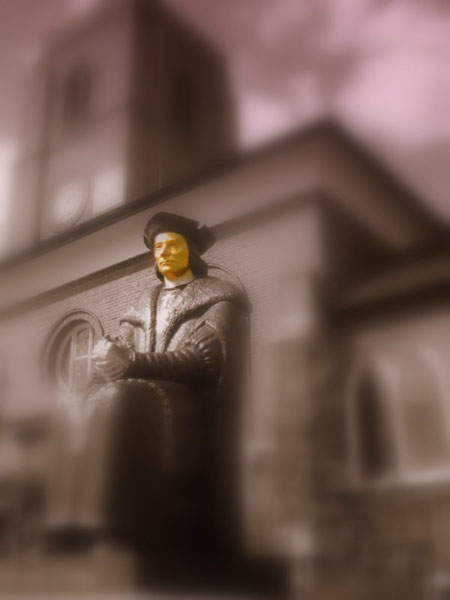
Chelsea resident Thomas More’s statue at the (Anglican) Chelsea Old Church.
* Despite its religious tolerance, More’s Utopia — anticipating Dostoyevsky — maintains:
a solemn and severe law against such as should so far degenerate from the dignity of human nature, as to think that our souls died with our bodies, or that the world was governed by chance, without a wise overruling Providence … since a man of such principles must needs, as oft as he dares do it, despise all their laws and customs: for there is no doubt to be made, that a man who is afraid of nothing but the law, and apprehends nothing after death, will not scruple to break through all the laws of his country, either by fraud or force, when by this means he may satisfy his appetites.
On this date in 1766, a 20-year-old French chevalier’s freethinking proclivities got him beheaded and burned for impiety in one of Bourbon France’s most notorious episodes of religious chauvanism.
it was the epoch of belief, it was the epoch of incredulity,
it was the season of Light, it was the season of Darkness
The luckless youth and a couple of friends had pissed off a local judge, which got ugly for them when the unexplained vandalism of a town crucifix availed the opportunity for the magistrate to wield a sledgehammer against a fly.
De la Barre’s volume of Voltaire was tossed onto the pyre with him. That Enlightenment colossus made a measured posthumous effort at having the boy rehabilitated* — primarily for the benefit of his more judicious friend, who had fled the country and required his death sentence in absentia be lifted in order to inherit the family estate — but the verdict was not set aside until the French Revolution, a few months after the end of the Terror.
France’s overall secular trajectory since has rendered this date a sort of national freethinkers’ holiday, Chevalier de la Barre Day. A statue of its namesake stands in Paris’ Montmarte:
* Voltaire’s writings on the case in the original French are collected by the Association Le Chevalier de la Barre here.


 Robespierre lay in an anteroom of the Convention hall, while his Prison-escort was getting ready; the mangled jaw bound up rudely with bloody linen: a spectacle to men. He lies stretched on a table, a deal box his pillow; the sheath of the pistol is still clenched convulsively in his hand. Men bully him, insult him: his eyes still indicate intelligence; he speaks no word. … -O reader, can thy hard heart hold out against that? His trousers were nankeen; the stockings had fallen down over the ankles. He spake no more word in this world.
 While en route, Stauffenberg had no ability to communicate to the wider world. Landing in Berlin three hours after the not-quite-deadly-enough blast at Wolfsschanze, he must have been stunned to find that Valkyrie had not been launched. Apparently, fragmentary reports from the east were unclear as to whether Hitler had survived; everyone was reluctant about committing himself.
 The hangman addressed himself to his office. But he had been disconcerted by what the Duke had said. The first blow inflicted only a slight wound. The Duke struggled, rose from the block, and looked reproachfully at the executioner. The head sank down once more. The stroke was repeated again and again; but still the neck was not severed, and the body continued to move. Yells of rage and horror rose from the crowd. Ketch flung down the axe with a curse. ‘I cannot do it,’ he said; ‘my heart fails me.’ ‘Take up the axe, man,’ cried the sheriff. ‘Fling him over the rails,’ roared the mob. At length the axe was taken up. Two more blows extinguished the last remains of life; but a knife was used to separate the head from the shoulders. The crowd was wrought up to such an ecstasy of rage that the executioner was in danger of being torn in pieces, and was conveyed away under a strong guard.