
I have one body
And to you I offer and return it.
Here is my flesh;
Here is my blood;
Let me be slain, reduced to nothing;
Let my bones be split apart
For those for whom I am praying, if such is your will.-Prayer of St. Catherine of Siena (Source)
This date in 1375 is the best data point we have for the beheading of Niccolo di Toldo.
The Sienese archives offer scant documentation of this political execution; a decree of June 4, 1375 orders his examination for “the discord sowed by him in the city of Siena, pernicious and deadly to the state of the present government” — and a couple of letters on Niccolo’s behalf from the governor of neighboring Perugia. Francis Thomas Luongo in The Saintly Politics of Catherine of Siena — we will come to Catherine presently — next points in lieu of any remaining record of Niccolo’s execution to “the necrology of the Sienese Dominican friary [which] includes an entry for one ‘Nicholaus, familiarius of the Lord Senator,’ who died and was entombed in the cloister of San Domenico on 20 June, the vigil of the feast of Corpus Christi.” It’s not certain that this is the same man but the description fits him, and the date is one week after the last known letter on his behalf from Perugia — which was an appeal for mercy.
We are as ignorant of Niccolo di Toldo’s offense as we are of the date of his death. But his position (in the household of a senator) and his Perugian affiliation suggest him an agent of papal subversion.
Siena’s centuries-long decline from the ranks of Italy’s city-state powers dates ultimately to the Black Death outbreak of 1348. The Plague devastated Siena.
The ensuing generations saw authority in the great Tuscan city furiously contested; the government turned over repeatedly in the 1360s — the Dodici (the Twelve), the Tredici, the Quindici, each an executive committee of interested parties in the coalition of the day.
From the late 1360s and through the 1370s, the Quindici held sway: reformist guild leaders* who were opposed by the the deposed (and by now proscribed) ex-Dodici, Siena’s great magnates in alliance with the papacy. (Luongo delves into Sienese politics in considerable detail in his book.) By year’s end Siena would join a city-state coalition led by Florence that fought a three-year war against the papal states with the excellent name “the War of Eight Saints”.
That coalition and that thrust of policy is likely what a “political subversive” in 1375 Siena would be subverting. And the governor of Perugia appealing to the Sienese for Toldo’s life? He was a French cardinal, kin to Pope Gregory XI.**
Little as we know of Niccolo di Toldo prior to his death, that execution is one of the most famous in all of medieval Europe.
The wretch was comforted in his last days by Catherine of Siena, a young mystic — and, not incidentally, an increasingly influential opponent of the anti-curial political climate. Today, Catherine is the patron saint not only of Siena but of all Europe, and her dessicated head (sawed off her body by devotees for use as a fetish) greets the reverent and the gawker alike, enthroned in its grisly reliquary in the Basilica San Domenico.

Catherine found Niccolo angry at his impending fate, initially refusing to see any spiritual counselor: no state of mind for a soul to meet its maker. Any of the confraternities tasked at this time with succoring those about to face execution would have been charged with bringing such a person to a condition of resignation and penitence.
Catherine achieved her mission to join the doomed man to God but much, much more than that: her account of their relationship, up to the moment when she ecstatically catches his falling bloody head, is a celebration of erotic mysticism. It’s also one of the most famous episodes of the saint’s life.
Niccolo’s virgin helpmate was herself noted for her mystical “marriage to Christ”: in it, Catherine presented her heart to the phantom Savior, and he his ritually circumcised foreskin to her.
Converging religious fervor and carnality mark her interaction with Niccolo, too; at one point she implies that she has sublimated the condemned traitor’s attraction to her into piety, and (as Catherine wrote a follower),
God’s measureless and burning goodness tricked him, creating in him such an affection and love in the desire of me in God, that he did not know how to abide without God, and he said: ‘Stay with me and do not leave me. Like this I cannot but be alright, and I will die content!’ and he had his head resting on my breast. I sensed an intense joy, a fragrance of his blood, and it was not without the fragrance of my own, which I wait to shed for the sweet husband Jesus.
Catherine saw Niccolo di Toldo only twice in the days leading up to his execution. When he went to the block, she was there to meet him: in fact, she was there early and made bold to occupy the condemned’s place on the scaffold, and to stretch her own neck out over the headsman’s block that her kindred spirit would soon soak in gore. It was as if preparing his bridal bed, where she would embrace Niccolo even as the executioner struck — the two as passionately near to one in soul and body as the logistics of a heavy blade’s arc can permit.
[H]e arrived, as a meek lamb, and seeing me, he began to laugh, and he wanted me to make the sign of the cross. When he received the sign, I said, “Come on! to the nuptials, my sweet brother! for soon you will be in life without end.” He got down with great meekness, and I stretched out his neck, and leaning down, I reminded him of the blood of the Lamb. His mouth said nothing but “Jesus” and “Catherine.” And, as he was saying thus, I received his head in my hands, closing his eyes on divine goodness and saying, “I want this!” (“lo voglio”)†
She clutched to herself the lifeless head that had dropped into her lap and beheld “with the greatest envy” Niccolo’s soul ascending in the martyrdom Catherine aspired to. Afterwards, she was reluctant to wash out the clothes spattered with blood from the sacred climax of death.
The Dominican friar Caffarini, an ally of Catherine who was later to become of the principal exponents of her canonization, wrote of the tableau that Niccolo
accepted death while still at a young age, in the presence of the Virgin and with her receiving his head into her hands, with such marvelous devotion that it was like the transitus of some devout martyr and not the death of one who was condemned for a human crime. And everyone watching among whom I was only one was so moved internally and from the heart that I do not remember any previous burial accompanied with as much devotion as that one.

Panel of Francesco Messina‘s 1962 monument to St. Catherine of Siena outside Rome’s Castel Sant’Angelo.
* Apart from the enmity of the papal party, the powerful guild leaders of the Quindici faced working-class opposition that resulted in a 1378 revolt.
** Gregory XI was the guy who moved the papacy back from Avignon to Rome.
† Translated excerpts culled from snippets and excerpts in various locations. Original Italian versions of Catherine’s poetic letters are available in public-domain Google books here; there’s also a recent English translation by Susan Noffke.
On this day..
- 1679: Five Jesuits, for the Popish Plot
- 1483: Fernando II, Duke of Braganza
- 1890: Elizabeth and Josiah Potts, wife and husband
- 1684: Sir Thomas Armstrong, Whig plotter
- 1816: Peter Lung, uxoricide
- 1979: Bill Stewart, ABC News reporter
- 1944: Jakob Edelstein and family
- 1945: 8 American flyers at Fukuoka
- 1911: Sitarane and Fontaine, Reunion Island occultists
- 1940: Tirailleurs Senegalais, for France
- 1962: Marthinus Rossouw, for services rendered
- 1864: William Johnson, a bad example

 This ferocious group was a severe mismatch for
 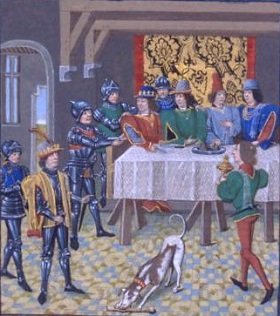 The king of France, on Tuesday the 5th of April, which was the Tuesday after midlent Sunday, set out early, completely armed, from Mainville, attended by about one hundred lances. There were with him his son the earl of Anjou, his brother the duke of Orleans, the lord John d’Artois, earl of Eu, the lord Charles his brother, cousins-german to the king, the earl of Tancarville, sir Arnold d’Andreghen, marshal of France, and many other barons and knights. They rode straight for the castle of Rouen, by a back way, without passing through the town, and on entering found, in the hall of the castle, Charles, duke of Normandy, Charles king of Navarre, John earl of Harcourt, the lords de Preaux, de Clerc, de Graville, and some others seated at dinner. The king immediately ordered them all, except the dauphin, to be arrested, as also sir William and sir Louis de Harcourt, brothers to the earl, the lord Fricquet de Friquart, the lord de Tournebeu, the lord Maubué de Mamesnars, two squires called Oliver Doublet and John de Vaubatu, and many others. He had them shut up in different rooms in the castle; and his reason for so doing was, that, since the reconciliation made on occasion of the death of the constable of France, the king of Navarre had conspired and done many things contrary to the honour of the king, and the good of his realm: the earl of Harcourt had also used many injurious expressions in the castle of Vaudreuil, when an assembly was holden there to grant a subsidy to the king of France against the said king, in order to prevent, as much as lay in his power, the subsidy from being agreed to. The king, after this, sat down to dinner, and afterwards, mounting his horse, rode, attended by all his company, to a field behind the castle, called the Field of Pardon.
 The man whom future foes on the national stage would deride as the “Buffalo Hangman”
 Once just a regular prison electrician, Elliott graduated himself to the euphemism in 1926 and was soon the go-to angel of electric death throughout the northeast. He