1882: Dead Shot, Dandy Jim and Skippy, mutinous Apache scouts

On this date in 1882,* the U.S. Army hanged three White Mountain Apache scouts as mutineers.

This small tragedy in the long-running Apache Wars of the American Southwest had its seeds in the 1870s, when the Army forced onto the San Carlos reservation several bands of Apache peoples, including the Chiricahua, Yavapai, and the Western Apache nations of Tonto, White Mountain, and Cibecue.

The concentration proved potent, unexpectedly so since the tribes in question were not all on friendly terms with one another.

Noch-ay-del-klinne (many other transliterations are possible), an influential White Mountain medicine man of 36 summers or so — and a man who had been to Washington DC with a peace delegation and laid his own eyes on the encroaching industrial civilization — began cultivating something very like a ghost dance for the San Carlos Indians.

Though the ghost dance is most closely associated with the Lakota Sioux, several years and several hundred kilometers’ distance from the Apache of Arizona, the movement actually originated among the much nearer Nevada Paiute. Incarnations of ghost dancing throughout the American West gave a millenial expression to indigenes’ shared trauma of defeat, displacement, and death.

Noch-ay-del-klinne’s rituals were called Na’Ilde’, meaning raising from the dead,** and his prophesy that lost comrades would rise from their graves and the white man would vanish from Apache lands when the corn was ripe, spoke to that trauma for the denizens of the San Carlos reservation — and alarmed the U.S. Army troops stationed at nearby Fort Apache. Especially troubling was the “fraternizing that went on between tribes and elements of tribes which had always held for each other the most deadly aversion,” in the words of the later memoir of Thomas Cruse, who commanded the army’s company of native Apache scouts. He had granted leave for some of his scouts to attend these dances and didn’t like what he saw when they returned.

After the medicine dances began around the post I noticed a change. Generally they [the scouts] are very ready to communicate anything they know or may have seen, but after these dances they became very uncommunicative and would not tell anything that was going on among the other Indians or among themselves … when they came back they were not only exhausted and unfit for duty, but they showed surliness and insubordination. They grumbled constantly and made vague remarks about the country being theirs, not ours. Dozens of small incidents showed that something, or someone, was giving them new thoughts.

Cruse gave a grim — and as events soon proved, sound — assessment of his men’s unreliability: “he entirely distrusted his scouts in event of the rising of the White Mountains and believed all or nearly all would go with the enemy.” But the affirmative reply to Cruse’s plea to discharge the unit was delayed due to telegraph problems by the time that unit set out with Col. Eugene Asa Carr on an August 1881 mission to arrest Noch-ay-del-klinne.†

This incursion, which will set in motion dozens of untimely deaths, was entirely aggressive, justified by no act of overt hostility by the Apache. Although Cruse was writing many years after the fact, his complaints about his subalterns’ “surliness” and “new thoughts” have the ring of the boss’s know-your-placeism, as directed in this same period at social insubordination elsewhere in the American experiment — at organized labor, for example; or at Black men and women.

The army found the medicine man and took him into custody on August 30. That evening, as the troop bivouaced down for the night, Apaches began gathering ominously beyond their fringes. They were visibly armed, and unhappy about the unprovoked seizure of Noch-ay-del-klinne; according to an oral history relayed by Tom Friday, the orphaned son of one of the men destined for the gallows in this post, “All Cibecue Indian people know that the soldiers were coming. They were ready for them. They were ready to fight. They sent word to all Indians, ‘Come, clean your guns; get ready.’ … The Indians were very angry: they had done no wrong and could not understand why the soldiers would come.”‡

Whether upon an arranged signal or merely the alert of the sort of random confrontation this situation invited, those Apaches started firing at the army camp — and as Cruse had anticipated, his scouts in the breach adhered to their people, not the flag.

The Battle of Cibecue Creek could easily have wiped out the expedition, for as one of their number named William Carter later wrote, there were at the outset of “more than 100 Indians besides the scouts in camp, and less than forty dismounted men engaged in a hand-to-hand conflict.”

In averting catastrophe, Carr was one of four U.S. soldiers to earn the Medal of Honor for gallantry in the battle, repulsing the hostiles from the camp and scrambling his surprised men to hold off any further attacks until night dispelled the combatants. He also had Noch-ay-del-klinne summarily shot during the fight. Carter again:

Before leaving the field Colonel Carr sent Lieutenant Carter to examine the body of the Medicine Man and determine if life was extinct. Strange to say, notwithstanding his wounds [he’d been shot in the head -ed.], he was still alive. The recovery of this Indian, if left in the hands of his friends, would have given him a commanding influence over these superstitious people, which would have resulted in endless war. Colonel Carr then repeated the order for his death, specifying that no more shots should be fired. Guide Burns was directed to carry out the order with the understanding that a knife was to be used. Burns, fearing failure, took an ax and crushed the forehead of the deluded fanatic, and from this time forward every person murdered by these Apaches was treated in a similar manner.

Carr’s bloodied expedition proceeded that night upon a forced march for the safety of Fort Apache, reaching it the following afternoon — although “many of the Indians had preceded the command, and all night they were haranguing in the vicinity. They covered the roads and trails, and killed a number of citizens.” The fort came under a brief siege in the ensuing days, and hostilities in the resulting regional uprising dragged on for two years, concluding with the outcome customary for the Apache Wars.

Four of the absconded scouts were arrested in the months ahead and tried at court-martial. (Other captured Apache who were not enlisted in the army were not prosecuted for the firefight.) A Private Mucheco was sentenced to hard labor at Alcatraz. The other three, sergeants jauntily known to the whites as Dead Shot, Dandy Jim, and Skippy,

On the appointed day, per a detailed report in the New York Herald (March 4, 1882),

Wagons of all descriptions loaded with men anxious to see the execution of the Indian scouts, Dead Shot, Dandy Jim and Skippy, came pouring into this place from Wilcox, Thomas, Safford and all points from very early this morning. The time not being known at which the event would take place, there was a state of suspense until the moment arrived for the execution. The gallows was erected in front of the guard house and was fourteen feet high, with a platform six feet four inches from the ground and a distance of seven feet four inches from the floor to the gallows pole. The whole measured twelve feet in length by eight feet wide. The rope used was three-quarters of an inch thick and the drop was four feet six inches.

Dandy Jim, from this forum thread.

[On the scaffold] Dead Shot said he had nothing to say. What was being done was correct. He would probably meet his people. He had suffered much in this world and now he was through and would see his people. Since he first saw white men he had been well treated. He had plenty to eat and plenty of clothes, but this day paid for all he got from the white men. He also said Dandy Jim was a nephew and Eskiticha, or “Skippy,” a cousin of his. He had seen a good many of his people die and did not know where they went, but he was going to follow. He thought there was no use in dressing an Indian up as he was and then hanging him. When he came into San Carlos, if he had done anything wrong, he would not have given himself up, yet he gave up his rifle and the twenty rounds of ammunition that were furnished him at Camp Apache.

Dandy Jim said he had to be hanged, as such were the orders. He could not talk much. It was no use to beg for his life, as people would only laugh at him for his trouble. Eskiticha said: — “The sun is going down, and God is looking after me.” He did not think they were doing right, as he had never done anything to warrant being hanged.

The chaplain, Rev. A.D. Mitchell, then repeated a short prayer, which was interpreted by Merijilda, when all retired from the scaffold, except the hangman, a military prisoner. The black caps were then placed over the heads of the men, and at one o’clock the drop fell. Death was instantaneous in the case of Dead Shot and Eskiticha; Dandy Jim quivered once or twice. After being allowed to hang about twenty minutes they were cut down and pronounced dead by the doctors.

* The same date as an unrelated Mississippi double hanging, previously covered in these pages.

** According to John R. Welch, Chip Colwell-Chanthaphonh and Mark Altaha in “Retracing the Battle of Cibecue: Western Apache, Documentary, and Archaeological Interpretations,” Kiva, Winter 2005. Noch-ay-del-klinne had some exposure to Christian doctrine, which seems present in his own movement’s interest in resurrection.

† Also in the scouting party for this mission was famed frontiersman and eventual Executed Today client Tom Horn.

‡ Thomas Friday’s full account of this affair — which is a second-hand version, since Friday himself was a small child at this time — comes courtesy of William B. Kessel in “The Battle of Cibecue and Its Aftermath: A White Mountain Apache’s Account,” Ethnohistory, Spring 1974.

On this day..

1525: Cuauhtémoc, the last Aztec emperor

Although the primary accounts — those by conquistadors Hernán Cortés and Bernal Díaz del Castillo, and historian Francisco Lopez de Gomara* — did not explicitly record the date, February 28 is the traditionally recognized anniversary of the execution of the last Aztec emperor, Cuauhtémoc.

A monument to Cuauhtemoc in Mexico City. (Author’s photo; public domain)

Cuauhtemoc (English Wikipedia entry | Spanish) was enthroned early in 1521, in a Tenochtitlan already in the train of devastation brought by the Spanish, which had over the preceding months laid low the Emperor Moctezuma II (by violence) and his brother Cuitlahuac (by smallpox, a disease that halved the city’s population within a year).

He was about 23 or 24 years old, a nobleman who must have distinguished himself in war — “a handsome man, both as regards his countenance and his figure,” in Bernal Diaz’s estimation; “a valiant man and a good warrior” by Gomara’s account.

And it would fall to him to bear his proud kingdom’s ruin.

Having previously been welcomed to Tenochtitlan as guests, Cortes and the Spanish had fought their way out and now returned as besiegers, joined by most of the Aztecs’ resentful former subject kingdoms. They soon had Tenochtitlan in a stranglehold, undaunted by the frightening sacrifice of captured prisoners.

all in a moment the large drum of Huitzilopochtli again resounded from the summit of the temple, accompanied by all the hellish music of shell trumpets, horns, and other instruments. The sound was truly dismal and terrifying, but still more agonizing was all this to us when we looked up and beheld how the Mexicans were mercilessly sacrificing to their idols our unfortunate companions, who had been captured in Cortes’ flight across the opening.

We could plainly see the platform, with the chapel in which those cursed idols stood; how the Mexicans had adorned the heads of the Spaniards with feathers, and compelled their victims to dance round the god Huitzilopochtli; we saw how they stretched them out at full length on a large stone, ripped open their breasts with flint knives, tore out the palpitating heart, and offered it to their idols. Alas! we were forced to be spectators of all this, and how they then seized hold of the dead bodies by the legs and threw them headlong down the steps of the temple, at the bottom of which other executioners stood ready to receive them, who severed the arms, legs, and heads from the bodies, drew the skin off the faces, which were tanned with the beards still adhering to them, and produced as spectacles of mockery and derision at their feasts ; the legs, arms, and other parts of the body being cut up and devoured!

In this way the Mexicans served all the Spaniards they took prisoners; and the entrails alone were thrown to the tigers, lions, otters, and serpents, which were kept in cages. These abominable barbarities we were forced to witness with our own eyes from our very camp; and the reader may easily imagine our feelings, how excessively agonizing! the more so as we were so near our unfortunate companions without being able to assist them. Every one of us thanked God from the bottom of his soul for His great mercy in having rescued us from such a horrible death!

Bernal Diaz

Wracked by famine after Cortes successfully cut off its food and water, Tenochtitlan succumbed that August. (The conquistadors found they could barely endure the stench of countless rotting bodies as they took control of the famished city.) When captured, Cuauhtemoc implored Cortes through tears (again according to Bernal Diaz),

I have done what I was bound to do in the defence of my metropolis, and of my subjects. My resources have now become entirely exhausted. I have succumbed to superior power, and stand a prisoner before you. Now draw the dagger which hangs at your belt, and plunge it into my bosom.

There would be no bosom-daggering. Cortes had a much worse fate in mind.

He saluted Cuauhtemoc for his intrepidity in defense, vowing to maintain the latter as the ruler of Mexico … Cortes’s ruler, to ratify the dictates of the conquerors, beginning with commanding his remaining loyalists to surrender. Cuauhtemoc obeyed, with what posterity can only guess must have been fathomless shame and sorrow.

Upon humiliation, Cortes heaped physical torture when the invaders’ ransack of their captured city turned up far less lesser quantities of material loot than they had anticipated — torture which Cuauhtemoc and a cousin-king of a loyal Aztec ally both endured heroically without augmenting the Spanish bottom line. Bernal Diaz once again:

The next thing which Cortes did was to collect all the gold, silver, and jewels that had been found in Mexico, of which, however, there was very little; for Quauhtemoctzin, it was said, had ordered all the treasures to be thrown into the lake four days previous to his capture. A great quantity had likewise been purloined by the Tlascallans, Tezcucans, Huexotzincans, Cholullans, and other auxiliary troops which had assisted us in the siege, besides what had fallen into the hands of the troops on board the brigantines.

The crown officials were positive that Quauhtemoctzin had concealed the greater part, and asserted that Cortes was very pleased that the monarch refused to say a word where it was hidden; for he would then be able to get the whole treasure into his own possession.

The officers then proposed that Quauhtemoctzin and the king of Tlacupa, his most intimate friend and cousin, should be put to the torture, in order to extort from them a confession as to what had become of the treasures: but Cortes could not make up his mind to insult so great a monarch as Quauhtemoctzin, whose territory more than trebled that of Spain, and that for mere lust after gold. Moreover, the monarch’s household assured us they had given up all the gold they possessed to the officers of the crown, which, it was well known, amounted to 380,000 pesos, the whole of which had been melted into bars; and one thing is certain, that the emperor’s and Cortes’ fifths were deducted from that sum; but the conquistadores were not at all satisfied, and considered this sum much below the real amount, and several expressed their suspicion to Alderete, the royal treasurer, that Cortes’ only reason for not wishing to put the monarch to the torture was, that he might secretly take possession of all his riches. Cortes, not willing that such a suspicion should any longer he upon him, or that he should afterwards be called to an account on this score, at last consented that both should be put to the torture.


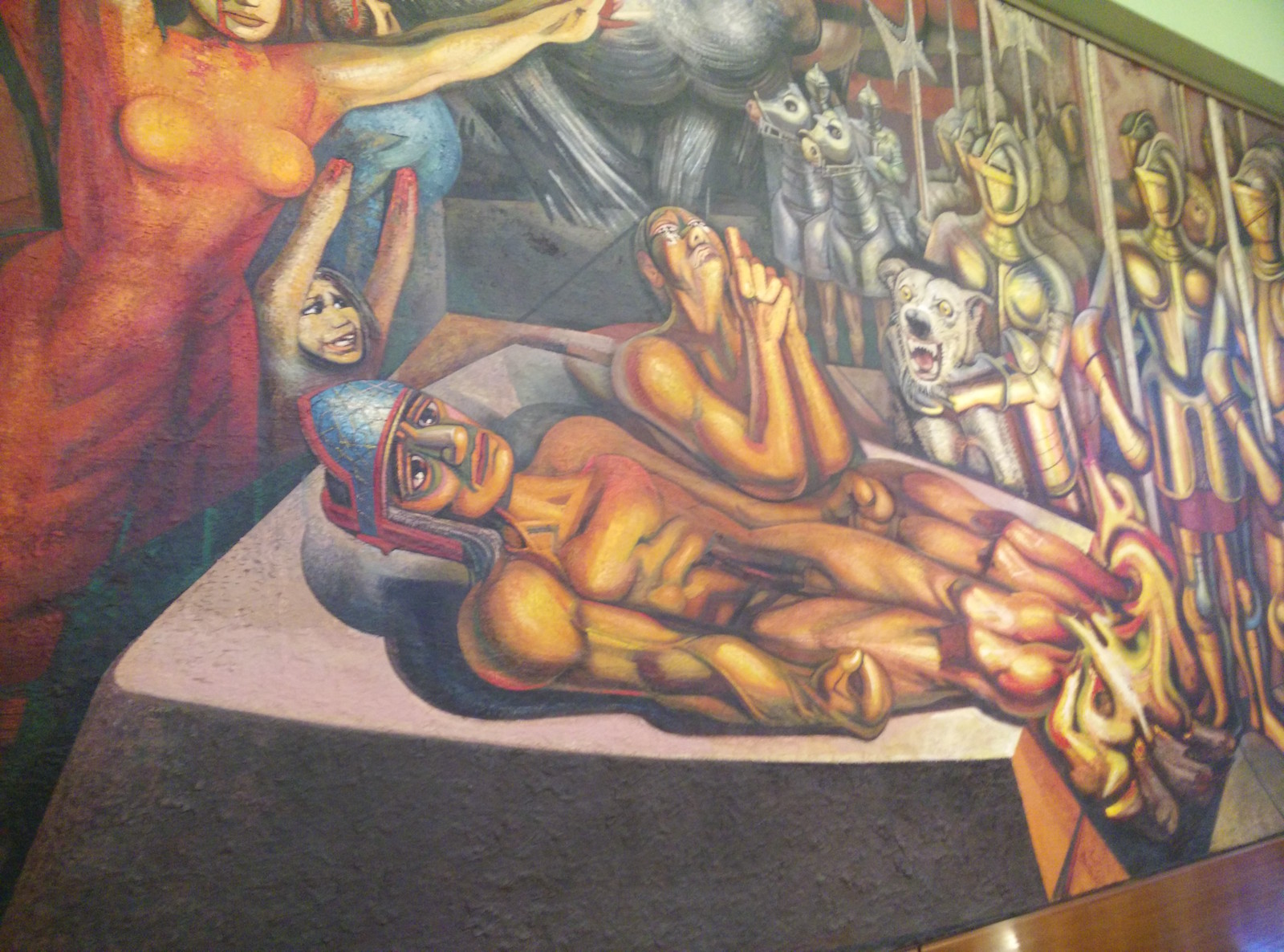
Detail view (click for the full image) of David Alfaro Siquieros‘s monumental 1950-51 mural, The Torment of Cuauhtemoc.

Boiling hot oil was then applied to their feet; upon which they confessed that, four days prior to Quauhtemoctzin’s capture, all the gold, with the cannon, crossbows, and muskets, which we had lost in the night of sorrows, when we retreated from Mexico, besides those which had been taken in Cortes’ last defeat on the causeway, had been thrown into the lake. A number of good swimmers were then sent to dive for the treasure in the spot they pointed out, but nothing was found. Yet there was some truth in the statement; for I was myself present when Quauhtemoctzin led us to a large and deep reservoir of water, built of stone, which lay near his palace. From this reservoir we fished up a sun of gold similar to the one sent us by Motecusuma, besides many jewels and other trinkets, though all of little value. The king of Tlacupa also informed us that he had hidden all manner of valuable things in some large houses, about twelve miles from Tlacupa, and he would accompany us there to point out the spot where he had buried them.

Alvarado was then despatched thither with six soldiers, among which number I also was; but when we arrived at the spot, this king assured us he had merely invented all this in the hopes that we would have killed him in a moment of anger at our disappointment.

(Diaz later added that “the suspicion was become pretty general that he [Cortes] had concealed the greater part of Quauhtemoctzin’s treasure,” and indeed some disgruntled companions — unsatisfied with the share they had been allotted for so magnificent a conquest — would come to lodge this charge against Cortes formally with Emperor Charles V.)

Cortes eventually brought both these hostages/puppet kings/torture victims along with him on a 1524-1525 expedition to Honduras, perhaps to deprive them of any opportunity to rebel in his absence.

On the evening of February 27, Cortes received a report or a rumor that the Indian kings had rebellion on their mind just the same. The timetable from this report to execution is uncertain from the records, but if it was not within 24 hours it cannot have been much longer. Diaz, a hostile-to-Cortes witness here whose narrative indicates his dismay at proceedings, describes it thus:

I have now to relate a circumstance of a very different nature, which occasioned much grief to us all. Quauhtemoctzin and other Mexican chiefs who accompanied our army had, it would appear, spoken among themselves, or secretly determined to put the whole of us to death, then march back to Mexico, and assemble the whole armed power of the country against the few remaining Spaniards, and raise an insurrection throughout the whole of New Spain. This circumstance was discovered to Cortes by two distinguished Mexican chiefs, one of whom was named Tapia, and the other Juan Velasquez. This latter personage had been Quauhtemoctzin’s captain-general during our war with Mexico, and his testimony was borne out by the investigation which Cortes made into the matter, and by the confession of several of the caziques themselves who were implicated in the conspiracy. These men fearlessly declared, that seeing how carelessly and dispiritedly we roamed about; that numbers of the men were ill from want of food; that four of our musicians, with the buffoon and five soldiers, had died of hunger; and that three other men had turned back, more willing to run the risk of reaching Mexico again than of moving forward, the thought struck them that they could not do better than fall suddenly upon us while we were crossing some river or marsh, particularly as they were upwards of 3000 in number, all armed with lances, and several of them with swords. Quauhtemoctzin did not hesitate to acknowledge that these men had spoken the truth, but added that the conspiracy did not emanate with him, and that he himself had never for a moment contemplated carrying it into effect, but had merely spoken about it with the other caziques. All the cazique of Tlacupa confessed was, his having declared to Quauhtemoctzin that it was better to die at once than daily to have death before their eyes on these fatiguing marches, and see their countrymen and relations perish with hunger.

These were sufficient proofs for Cortes, and without any further ceremony he sentenced Quauhtemoctzin and his cousin the king of Tlacupa to the gallows. Before, however, this sentence was executed, the Franciscan monks, with the assistance of Dona Marina, strove to comfort these unfortunate men, and commended their souls to God. When they were being led to the place of execution, Quauhtemoctzin turned to Cortes, and said: “Oh Malinche! I have for a long time perceived, from your false words, that you had destined me for such a death, because I did not lay violent hands on myself when you entered my city of Mexico! Why are you thus going to put me unjustly to death? God will one time ask this of you!”

The king of Tlacupa said, he could only rejoice in a death which he would be permitted to suffer with his monarch Quauhtemoctzin.

Previous to their being hung, both these unhappy caziques confessed to father Juan, who understood the Mexican language, and they begged of him to commend their souls to God. For Indians they were good Christians, and they died in the true faith, and fully believed in our holy religion.

The death of these two monarchs grieved me excessively, for I had known them in all their glory, and on our march they honoured me with their friendship, and showed me many little attentions; for instance, they would often order their servants to go in quest of fodder for my horse; besides which, they were innocent of the guilt imputed to them, and it was the opinion of all who accompanied this expedition that they were put to death unjustly.

But I will leave this miserable subject, and return to our march, on which we henceforth observed the utmost vigilance, for we greatly feared the Mexicans might rise up in arms against us, after they had thus beheld their monarch ignominiously hung by the neck from a tree. But hunger, fatigue, and sickness weighed heavier upon their minds than the misfortune of Quauhtemoctzin.


Detail view (click for the full image) of the “rebel” kings hanged from a tree.

Gomara and, of course, Cortes characterize the accusations against the Indian kings as true and the proceedings against them lawful. From the footnotes in this same Bernal Diaz volume, we have this from the later Jesuit historian and ethnographer Juan de Torquemada, who was fluent in Nahuatl:

I find it differently represented in a history written in the Mexican language, and which I believe to be perfectly correct. While Cortes (the Mexican author says) was quartered in a certain township, the Mexican chiefs one evening began to discourse among themselves about the recent hardships they had suffered, and Cohuanacotzin said to Quauhtemoctzin, to Tetlepanquetzaltzin, and to other distinguished Mexicans, ‘Thus you see, gentlemen, from kings we are become slaves, and we suffer ourselves to be led about by Cortes and this handful of Christians. If we were other people than we are, and would break through the promise we have made these Spaniards, we could play them a pretty trick here, and revenge ourselves upon them for all they have done to us, and the ill-treatment my cousin Quauhtemoctzin has suffered at their hands.’ To this the Mexican monarch replied, ‘I beg of you Cohuanacotzin to drop this subject, lest some one should overhear us, and imagine we were in earnest.’ It appears (continues Torquemada) that they were indeed overheard, for the whole of this discourse was reported to Cortes by a low-minded Mexican of the lower classes.

By law, Mexican flags fly at half-staff in his honor on February 28.

* These texts are cited throughout the post, but for ease of reference … Bernal Diaz: Memoirs of the Conquistador Bernal Diaz del Castillo, vol. 1, vol. 2 | Gomara: The Pleasant Historie of the Conquest of the West India; now called New Spaine | Cortes: History of New Spain, which is a Spanish text as I could not locate an English translation. However, even the Anglophone is liable to appreciate (from p. 225) the illustrations of Indian material culture observed by the Spaniards.

On this day..

1673: Kaelkompte and Keketamape, Albany milestones

On this date in 1673, Indians named Kaelkompte and Keketamape were sentenced to hanging and gibbeting for the murder of an English soldier near Albany, New York. (The date this sentence was executed, if it was not immediate, has been lost to history.)

This place had been known as Beverwijck up until a few years prior, when the English gave it its new and still-current christening* after taking it away New Netherland during the Second Anglo-Dutch War. The transition of its legal organs was a more gradual process — with a long survival of Dutch practices upon which the English were gradually overlaid.

The case at hand was a milestone in that jurisprudence: it appears to be the first documented jury trial (pdf) in Albany — a practice imported from England and reflective of the growing sway of the new boss.

Jury trials did not from that point become universal practice, however, and their use in this instance might have connected to the unusual nature of the prosecution.

Lying at the most northerly navigable point of the Hudson River, at the frontier of the powerful Mohawk and dependent upon they and other friendly indigenes to facilitate its fur trading, Albany kept a practiced blind eye when it came to Indian crimes. The 1665 murder of a Dutchman, the last previous documented homicide between the peoples, appears to have gone completely unpunished: in practice, intercultural grievances were settled privately, if at all.

But English law at least aspired to a more totalizing view and when one of the King’s subjects was murdered by natives who were not members of the powerful Iroquois confederation, it found its ideal test case — as we see in Courts Minutes of Albany, Rennselaerswyck and Schenectady, 1668-1673 (landing page | specific pdf volume). The ability of Albany to impose not only hanging but a potentially provocative gibbeting in this instance essentially confirmed the precedence of colonial jurisdiction over the smaller Hudson tribes. (The Iroquois were quite a different question and maintained expansive rights against the European encroach even into the post-colonial era.)

Kaelkompte, a northern Indian, from Narachtack castle, appearing in irons before the court, was asked whether he had any objection against any of the 12 jurymen standing before him?

Answered, that none of them had done him any harm.

Thereupon 12 jurors were sworn, as shown by the list, to do justice between the king and the prisoner.

As to the first point of the preliminary examination, as to conspiracy, etc., Kaelkompte answers that Keketamape asked him in the woods whether Stuart had any goods? To which he replied that some time ago he had seen three blankets and some coats there. Also, that Keketamape, sitting with him near the fire in the woods, said to him: “I shall kill Stuart.”

Whereupon Kaelkompte, saying that he did not quite understand, asked him: “W hat did you say? You wish to kill Stuart? If you kill him, you will kill yourself.”

Nota Bene. Here followed the further circumstances of the case. From the proceedings and the further documents it appears that Keketamape confessed that he was guilty of the murder.

Dirck Wessels, Meyndert Hermansz, Johannes Wendel, Willem Nottingam and Jan Jacobsz declare under oath that some time ago, being with the prisoners, listening to their caviling, [they heard] Keketamape say to Kaelkompe: “You killed Stuart and you say that I did it all.” Kaelkompe replied to this: “You did too.”

Kaelkompte acknowledges that he said it, but [declares] that it was longer ago than they say.

Indictment read to Keketamape and Kaelkompte

Keketamape admits that he had a hand in the murder and that he is guilty of having killed Stuart.

Kaelkompte admits that he consented by using these words: “There he is now. First kill him!” But he denies that he is guilty of the killing and says that he is not a bit afraid. He admits further, upon conviction by the interpreters, that he helped to kill Stuart by [the words of] his mouth.

The jury, having carefully weighed and considered the case according to the evidence, informations and confessions, conclude and decide that Keketamape and Kaelkompte are guilty of the murder of the person of Mr Stuart.

Sentence

Therefore, their honors sitting as this Special Court of Oyer and Terminer, having duly taken into account and considered the proceedings and also the verdict of the twelve jurymen that according to the documents placed into their hands the said Kaelkompte and Keketamape are guilty of the murder of the aforesaid Jan Stuart, condemn them both, as they condemn them hereby in the name of his Royal Majesty of Great Britain, under the government of the Right Honorable Colonel Francis Lovelace, to be brought together to the place of execution to be hanged by the neck until they are dead, dead, dead, and thereafter to hang in chains. Actum in Fort Albany, the 15th of February 1672/73.

By order of the honorable Court of Oyer and Terminer
Ludovicus Cobes, Secretary

One of the jurors in this trial, Willem Teller, might have been the same man at issue in a case five years later when “a certain squaw was shot dead at the house of Teller, burgher of this city.” The court found it an accident and ordered him to pay the Mahican nation fifty florins: laying aside any question of proportionality, this later case also demonstrates English courts successfully asserting their rights over violence between peoples that formerly would have been settled in private.

* The name “Albany” honored the Duke of Albany, the man who would eventually be King James II … until he was deposed by a Dutchman.

On this day..

1782: Jose Antonio Galan, for the Revolt of the Comuneros

Ni un paso atrás, siempre adelante, y lo que fuere menester … sea!

-Jose Antonio Galan

On this date in 1782, Comunero rebel Jose Antonio Galan was executed in Bogota, New Grenada (present-day Colombia).

Spain’s New World precincts had risen in response to intensified taxation exacted by the empire’s modernizing reforms and particularly accelerated when Spain went to war against Great Britain in 1779; similar pressures likewise helped to trigger the 1780-1781 Tupac Amaru insurrection in Peru.

In New Grenada, spontaneous resistance to new viceregal edicts coalesced into one of the most serious rebellions of the Spanish colonial era — albeit one that aimed at reform, not revolution.

Shouting demands for tax reductions and greater local autonomy, a force of 10,000-20,000 rebels marched on Bogota in the spring of 1781, routing a column of government soldiers sent to disperse them and forcing authorities to terms that the latter had no intention of honoring. This is one of the oldest ploys: offer concessions to end the rebellion, then declare the concessions null and void as obtained under duress when the rebels are safely out of arms.

An illiterate mestizo peasant, our man Galan (the cursory English Wikipedia entry | the much more satisfactory Spanish) was not the principal captain of this rebellion but he seems to have exceeded them in foresight — for Galan and his more radical followers continued the revolt even after the main body of Comuneros went home satisfied with the government’s specious pledges. North of Bogota, Galan threatened a more Tupac Amaru-like experience, attracting a multi-racial lower-class force* which he turned against hacienda landowners.

Captured in October of that same year after reinforcements arrived at Bogota to begin laying down imperial law, Galan was so popularly admired that no free blacksmith would accept the contract to forge his irons — all the more reason for his exemplary sentence:

We condemn José Antonio Galán to be removed from jail, dragged and taken to the place of execution, where he is hanged on the gallows until dead; when lowered, his head is to be cut off, his body divided into four parts and passed through the flames (for which a bonfire will be lit in front of the scaffold); his head will be taken to Guaduas, theater of his scandalous insults; the right hand placed in the Plaza del Socorro, the left in the town of San Gil; the right foot in Charalá, place of his birth, and the left foot in the place of Mogotes; his descendants are declared infamous, all his goods are confiscated to the treasury; his house is to be pulled down and sown with salt, so that his infamous name may be lost and consigned to such a vile reputation, such a detestable memory, that nothing remains of him but the hate and fright that ugliness and crime inspire.

Despite the sentence, it’s said that an unskillful executioner not knowing how to hang his man shot him dead instead, so that he could proceed to the butchery.

* The main insurrection that had so meekly disbanded itself was heavily led by Creole local elites with a clear inclination towards deal-making.

On this day..

2015: A man in al-Shaddadah, “I won’t forgive you”

On this date in 2015, Islamic State militants occupying the Syrian oil city of al-Shaddadah or al-Shaddadi horrifically beheaded a man on a public square.

Just what action was compassed in his alleged offense of “insulting Allah” is not known; neither so far as I can find was his name. But he fought his killers furiously, and four men were required to wrestle him into the dust and immobilize him for the executioner’s sword. “I won’t forgive you, I am not the one who did it but you did Arabs and civilians of al-Shadadi,” he cried out to townspeople unwilling or unable to lift a finger on his behalf against the butchers.

Al-Shaddadah was recaptured from ISIS in February 2016.

On this day..

1957: Geza Szivos

From the London Times, Jan. 5, 1957:

VIENNA, Jan. 4 — Budapest radio said to-day that the Budapest military court had sentenced a 25-year-old Budapest transport worker, Geza Szivos, to death for illegal possession of arms. The sentence had immediately been carried out. The report said that Szivos had obtained a machine pistol on October 30 and with this had taken part in the attacks on the Budapest Communist Party headquarters. He had confessed to firing more than 100 rounds. As a result of the attacks several people were killed.

Szivos was said to have hidden the weapon, and others he had found, when the group was broken up. On December 18 he was betrayed to the police and arrested. The weapons were found in his house.

The radio also said that a summary tribunal at Debrecen had sentenced Gyoergy Tajko to 15 years in prison and Kalman Koris, aged 19, to 10 years. They were said to have been carrying loaded pistols and ammunition when stopped by a street patrol.

The Government newspaper Nep Szabadsag said to-day that the Hungarian police had seized “great quantities” of arms at Var Palota, in west Hungary, and were searching for a band of “blackmailers.” The arms were hidden near a pit shaft entrance and included sub-machine guns, rifles, hand grenades, and about 500 cartridges.

The newspaper also reported that small armed groups had caused disturbances in Transdanubia, in west Hungary, after the Hungarian rising. -Reuters

From the Monroe (Louisiana) News-Star, Jan. 4, 1957:

VIENNA (AP) — Budapest Radio reported today that a 25-year-old Hungarian rebel against the Communist regime was executed for hiding arms.

This brought the admitted number of rebels executed to six, although the actual number is believed to be much higher.

The broadcast said Geza Szivos, a teamster, was convicted and sentenced by a military court in Budapest. The Red radio gave these details:

Szivos got hold of an automatic pistol Oct. 30 and joined the rebel group which stormed the Communist party headquarters in Budapest.

He admitted having fired 100 shots at the building, and “several persons were killed in the building.”

On Nov. 4, the day of the Russian assault on Budapest, Szivos obtained two more automatic pistols, ammunition, eight hand grenades and two incendiary bombs. Tenants in the house where he lived informed on him to the police, and he was arrested Dec. 18. The arms were found in his quarters the next day.

On this day..

1901: Massacre of Barrio la Nog

Corporal Richard O’Brien gave the following account of the summary execution (or simple mass murder) of Filipino villagers during the furious American backlash after Filipino insurgents’ Balangiga Massacre of American infantrymen.

It was on the 27th day of December, the anniversary of my birth, and I shall never forget the scenes I witnessed on that day. As we approached the town the word passed along the line that there would be no prisoners taken. It meant that we were to shoot every living thing in sight — man, woman, and child. The first shot was fired by the then first sergeant of our company. His target was a mere boy, who was coming down the mountain path into the town astride of a caribou. The boy was not struck by the bullet, but that was not the sergeant’s fault. The little Filipino boy slid from the back of his caribou and fled in terror up the mountain side. Half a dozen shots were fired after him. The shooting now had attracted the villagers, who came out of their homes in alarm, wondering what it all meant. They offered no offense, did not display a weapon, made no hostile movement whatsoever, but they were ruthlessly shot down in cold blood — men, women, and children. The poor natives huddled together or fled in terror. Many were pursued and killed on the spot.

Two old men, bearing between them a white flag and clasping hands like two brothers, approached the lines. Their hair was white. They fairly tottered, they were so feeble under the weight of years. To my horror and that of the other men in the command, the order was given to fire, and the two old men were shot down in their tracks. We entered the village. A man who had been on a sick-bed appeared at the doorway of his home. He received a bullet in the abdomen and fell dead in the doorway. Dum-dum bullets were used in that massacre, but we were not told the name of the bullets. We didn’t have to be told. We knew that they were.

In another part of the village a mother with a babe at her breast and two young children at her side pleaded for mercy. She feared to leave her home, which had just been fired — accidentally, I believe. She faced the flames with her children, and not a hand was raised to save her or the little ones. They perished miserably. It was sure death if she left the house — it was sure death if she remained. She feared the American soldiers, however, worse than the devouring flames.

On this day..

638: The garrison of Gaza, by their Muslim conquerors

By the early 600s, Roman and Persian armies had been trading blows for so many centuries that an eternal continuation of their Near East derby must have seemed a certainty. Here a raid into Mesopotamia, there a clash in the Taurus Mountains, border provinces shifting back and forth … countless dynasties had come and gone, world religions risen and fallen, and always there were the Romans and the Persians. It was the way of the cosmos ever since Carrhae.

Tribes boiling out of the Arabian desert were about to reorder the firmament.

After an exhausting and pointless struggle* stretching back generations, Byzantium under the emperor Heraclius had rallied in the late 620s to re-establish its formerly longstanding control of the Levant — incidentally pushing Persia’s Sassanid Empire to the brink of collapse.

Neither polity would enjoy much leave to lick its wounds.

The Byzantines’ first passing skirmish with Muslim warriors had occurred in 629, when the Prophet Muhammad was still alive. By the time of Muhammad’s death and the succession of the Caliphate in 632, Islam had all of Arabia firmly in hand and would begin the dazzling expansion destined within a single lifetime to carry the Quran from the Pillars of Hercules to the Indus valley — greatly facilitated by the scanty resistance offered by is battle-wearied neighbors in Constantinople and Ctesiphon.

You will come upon a people who live like hermits in monasteries, believing that they have given up all for God. Let them be and destroy not their monasteries. And you will meet other people who are partisans of Satan and worshippers of the Cross, who shave the centre of their heads so that you can see the scalp. Assail them with your swords until they submit to Islam or pay the Jizya.

-Words of Caliph Abu Bakr to his armies setting out for Syria in 634

After striking Mesopotamia (and crushing an internal rebellion), Caliphate armies pressed into Byzantine Syria and Palestine in 634 and soon controlled it — eventually delivering a decisive, nay world-altering, defeat to the Byzantine Christians at the Battle of Yarmouk in August 636.

The martyrology of Christians said to have been put to death on this date in 637 or 638 may be rated among the artifacts left to the shocked Romans; the victims would have numbered among the garrison in Gaza which would not fall to the Muslims until September 637.

The below is excerpted from Robert Hoyland‘s Seeing Islam as Others Saw It: A Survey and Evaluation of Christian, Jewish and Zoroastrian Writings on Early Islam. Although the author is skeptical of the account’s historicity — preserved as it was only by a centuries-later third-hand fragment — the traumatic cultural memory it speaks to can hardly be doubted.


A Vatican manuscript of the tenth or eleventh century preserves for us an account of the martyrdom of the Byzantine garrison of Gaza at the time of the Arab conquests. It is written in crude Latin, but many of its expressions reveal it to be a translation from Greek. It informs us that the incident occurred “in the Christ-beloved city of Gaza … in the twenty-seventh year of the God-crowned emperor Heraclius” (636-37), then continues:

It happened at that time regarding the godless Saracens that they besieged the Christ-beloved city of Gaza and, driven by necessity, the citizens sought a treaty. This was done. The Saracens indeed gave to them a pledge, except to the soldiers who were captured in that city. Rather, marching into the city and seizing the most Christian soldiers, they put them in prison. On the next day ‘Amr (Ambrus) ordered the Christ-holy soldiers to be presented. Once brought before him, he constrained them to desist from the confession of Christ and from the precious and life-giving cross of our Lord Jesus Christ. Since they would not consent, ‘Amr ordered their wives, children and weapons to be separated from them, and again to put them in prison.

Thirty days later they were transferred to a prison in Eleutheropolis for two months, then to a prison in “Theropolis” for three months before being taken to Jerusalem. There they are urged by the patriarch Sophronius to stand firm and accept martyrdom. After a further ten months incarceration ‘Amr wrote to “Ammiras who was commander in the holy city,” recommending that he execute a number of them if they still refused to deny Christ. Finding them obdurate, Ammiras has their chief Callinicus and nine others beheaded on 11 Novebember 638 “outside the city in front of the gates,” where they are buried by Sophronius. The rest are sent back a month or so later to ‘Amr in Eleutheropolis and given a final chance to comply. Unanimously, however, they witness that they are “servants of Christ, son of the living God” and “prepared to die for him who died and rose for us,” thus sealing their fate. Their bodies were bought for 3000 solidi and the church of the Holy Trinity was erected over their burial place at Eleutheropolis. The date given for their martyrdom is Thursday 17 December (which tallies for 638), indiction 13 (639-640), year 28 of Heraclius (September 637-September 638).

Since the choice of conversion or death seems mostly to have been reserved for Arab Christians and apostates from Islam, one is immediately suspicious of this account. It may be that these soldiers were made an example of for some particular cause, but there are other reasons for being wary of this text. In the first place, its provenance is unknown, since the Vatican manuscript containing it is our only witness. Secondly, it is very likely that we have merely a summary of a much longer piece. The changes of venue occur at a bewildering pace and with no explanation or elaboration, ‘Amr’s identity is not indicated, and the manner of death of the 50 remaining soldiers is not mentioned at all, even though this is usually a subject of much interest in martyrologies. Furthermore, one would expect the impassioned exhortation to martyrdom by the revered Sophronius and the emotive scene of him burying the martyrs to be accorded more than the paltry eight lines found in our version.

Perhaps most likely of all is that the garrison was put to death simply for resisting the Muslims, a fate meted out to Byzantine soldiers elsewhere, and that this was taken up by a later writer and recasted as a tale of martyrdom. So a kernel of truth may well lie behind the text, but later reworking and crude translation into Latin has obscured it beyond recognition. The only feature still clear in our epitome is the apologetic intent. For example, ‘Amr is labelled as “impious,” “devil,” “hateful to God” and “most cruel,” and the Arabs themselves described as “impious” and “godless.”

* Robin Pierson covers these years of backstory in depth in his History of Byzantium podcast; he’s interviewed for an overview of the Byzantine-Sassanid War(s) in a premium episode of the War Nerd podcast here.

On this day..

1947: Rawagede Massacre

On this date in 1947, Dutch troops fighting (vainly) to keep Indonesia under colonial sway perpetrated one of the most notorious massacres of the Indonesian War of Independence.

During a Dutch offensive, Royal Netherlands Army forces fell on the West Java town of Rawagede (today, Balongsari) on December 9, 1947 and demanded to know the whereabouts of an Indonesian rebel they were hunting.

The villagers didn’t know, but the Dutch were convinced that they did — and so they began marching men and boys as young as 13 years old to nearby fields. Squatting and kneeling row upon row, the men were shot one by one. The Rawagede Massacre claimed 431 victims, according to the villagers.

In 2011, the victim’s survivors — and there’s a stunning picture of a 93-year-old Javanese widow of the massacre in this NPR story — won a legal judgment against the Netherlands. In the ensuing settlement, the Dutch paid €20,000 apiece to plaintiffs and issued a formal apology.

“Today, Dec. 9,” the Dutch ambassador said in a ceremony at the village six years ago today, “we remember the members of your families and those of your fellow villagers who died 64 years ago through the actions of the Dutch military.

“On behalf of the Dutch government, I apologize for the tragedy that took place.”

On this day..

1799: Francesco Conforti, regalist and republican

On this date in 1799, the subversive priest Francesco Conforti was hanged in the Piazza Mercato for his role in the Naples Parthenopean Republic.

This scholar came on the scene in the 1770s penning apologias for the Enlightenment trend towards the secular authority supplanting the ecclesiastic. For Conforti, Christ had not claimed, and the Vatican ought not wield, civil power.

This was quite an annoyance to the church that had ordained him but Conforti was no red priest. His doctrine was so far from antithetical to sovereigns in the Age of Absolutism that it was known as regalism, and a notable 1771 work was dedicated to the Bourbons’ secular strongman in southern Italy and Sicily.

But clerical reaction after the French Revolution got Conforti run out of his university appointment and even thrown in prison which would drive him into the republican camp — and when those republicans took power in Naples in early 1799 he joined their government as Interior Minister, his duty to shape civil society for “the democratic and republican regime [which] is the most consistent with the Gospel.”

“Democracy is the greatest benefit God has given the human race,” Conforti once intoned. But in 1799 it was a gift to enjoy in small doses: after the Bourbons reconquered Naples that summer, executing 122 republican patriots into the bargain, the human race reverted to the second greatest benefit.

On this day..