1644: Goodwife Cornish

(Thanks to Meaghan Good of the Charley Project for the guest post. -ed.)

Sometime in December 1644 in Maine, one Goodwife Cornish was executed for the murder of her husband, Richard Cornish. Her first name has been lost to history.

The couple had married in the town of Weymouth in the Massachusetts Bay Colony in 1634. It was a match made in hell.

According to Daniel Allen Hearn, writing of this case in his book Legal Executions in New England, 1623-1960, Richard Cornish was “a tireless worker” but his wife as “a woman of loose habits.”

The couple moved north to the settlement York in modern-day Maine in 1646, and “Goodwife Cornish wasted no time in reestablishing her notoriety.”

In 1644, Goodman Cornish’s body was found floating in the York River. He’d been killed in an unusual way: impaled on a stake, then placed in his canoe, which was weighted with stones. As Hearn records:

A cry of murder was raised. The sensational news swept the town and surrounding countryside. Had hostile Indians killed Richard Cornish? Probably not. Although the man’s skull had been crushed as if by a war club no one could imagine an Indian being so wasteful as to purposefully sink a good canoe. Such a craft would have been desirable plunder to an Indian. Moreover, what Indian, it was asked, would squander precious time by weighting down a canoe when he could be making good his escape? For these reasons it was determined that the murder of Richard Cornish was the work of some crafty white person. Suspicion fell upon the wife of the decedent. She had openly despised her husband. She was also rumored to have committed adultery.

Goodwife Cornish, when questioned, denied having murdered her husband.

But she admitted to multiple extramarital affairs and named her latest boyfriend as Edward Johnson. The authorities subjected both of them to “trial by touch,” acting on the old superstition that a murdered person’s corpse would bleed if the killer touched it.

When Goodwife Cornish and Goodman Johnson were brought before Richard Cornish’s body and made to touch it, blood supposedly oozed from his wounds. The ensuing trial, Hearn says, was “a farce.”

Much was made of Goodwife Cornish’s infidelity, but the only actual “evidence” against either her or Johnson was the fact that they’d both flunked the touch test. “It was reputation more than anything else,” Hearn notes, “that counted against Goodwife Cornish.”

Johnson was ultimately acquitted, but Goodwife Cornish was convicted of murder and condemned to die. Having maintained her innocence to the end, she was hanged in York.

On this day..

1720: Edward Hunt, the first counterfeiter executed in colonial Pennsylvania

On November 19, 1720, Edward Hunt was hanged in Philadelphia. He was the only Pennsylvanian executed for treason prior to the American Revolution — that treason being not the betrayal of the state (in the sense we might think of it today), but counterfeiting.

In the bitterness of his scaffold speech, which disdains the customary acknowledge-my-guilt, pray-for-my-soul form of the genre to complain about his case, Hunt made plain that he was not reconciled to the justice men had rendered him.

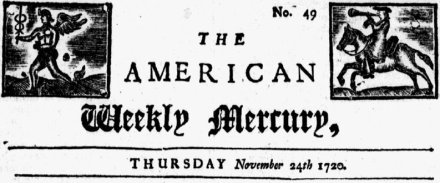
The American Weekly Mercury of Thursday, November 24 published “this extraordinary Piece” only with a preface complaining that “it is evident, that the following Speech was intended to misrepresent the Administration and Justice of this Government, as well as to infuse both ill Principles and Practices into the Minds of the People.”

The Dying Speech of Edward Hunt, formerly taken in Rebellion at Preston, and transported a bound Servant to the Island of Antigua, before his Execution upon the 19th Instant, at Philadelphia, where he had been legally convicted of High Treason, and most justly condemn’d for his Counterfeiting Spanish Silver Coin, made current* by Act of Parliament within all his Majesties Colonies in America.

It may be expected, that I should say some thing now concerning my Life and Conversation, which i must with Sorrow own to God and the Word has not been according to the Precepts and Principles of the Church, in which I was bred and educated: But with a sincere repentance and hearty Sorrow I do lament all the Errors of my past Life, firmly believing in my Saviour Jesus Christ, in whose Merits and ever flowing Mercy I do only trust for Salvation and Pardon, who has promised Eternal Life on no other Terms to the most Righteous upon Earth.

As to the Crime that now I suffer for in particular, I must own it is an Offence against the Laws, which I hope God will pardon me since he knows that I did not do it with any Design to cheat or defraud any one, or to make a Practice of Coining; but being ignorant of the Breach of any Laws of God or Man, I thought I might cut those Impressions as innocently as any other, or the Stamps that the Gentlemen of this place imploy’d me about, to make Farthings.** I am an English Subject, and desired to have the Privilege of the Laws of England, but it was not granted in any Point, except in Condemning me.

I am the first unhappy Instance of this kind that ever suffered in the King’s Dominions, pray God it may be a Warning to all, not to offend wilfully in the same that I did through Ignorance: For if I had known it, I would not have taken all the World to have done it. God give me a patient Resignation to submit to his blessed Will, in whatsoever he please.

I do heartily ask Forgiveness of all that I have offended in any manner of way, and do sincerely forgive all that have injured or offended me; particularly Mr. John Moore and Morris Birchfield, and the Evidence that swore against me in that Tryal. I do solemnly declare, That I know not any thing, or have been guilty of any one thing laid to my Charge in that Matter, or any of the other things laid to my Charge, by John Butler, either in England or Ireland.

I did petition the Honourable Governor for a Reprieve, until the King’s Pleasure was known concerning me, being I could not be tried by the Laws of England in all Points, as a Church of England Man ought to be: But it was a Privilege too great for me to obtain. Pray God to forgive them all, and every one that has a hand in taking away my Life any manner of way, and that my Blood be not required at their Hands, for they know not what they do. I am on Earth judged and condemned to die for the Breach of a Law of Man that was not duly published, which for that Reason I transgress’d it ignorantly, though the first that suffers for the Transgression of unknown Laws, or that was sentenced according to the Laws of England, without the Privilege of a Subject, which I desired of the Judge, which I know was not qualified by the same Laws to try me.

I do not know what Advantage there can be to any in my Death, and that I could not appeal to my King, neither before nor after my Tryal. I do not speak this because I am not in Charity with all the World, I do, from the Bottom of my Heart, forgive all in Obedience to my Saviour’s Command and Example, who suffered more for me, being innocent, and had not only done no Harm, but Good, and pray’d even for is cruel Persecutors and Murderers, and promised, That those that follow his Examples in this World by patiently enduring the Cross, shall reign with him to all Eternity: To Him therefore I commit all, an my poor Wife, beseeching him to help her, and be her Support and Comfort, and preserve her poor Soul free from the Polutions [sic] of the World, that through his precious Merits we may meet where we shall be both happy to all Eternity, in the merciful Arms of our dear Lord and Saviour Jesus, who I do beseech to receive my poor Soul.

According to Kenneth Scott’s Counterfeiting in Colonial America, Edward Hunt’s wife, Martha, got a £500 fine and a lifetime prison sentence for misprision of treason. (If that book is up your alley, Scott has an even more specific Counterfeiting in Colonial Pennsylvania.)

* Early colonial American commerce was severely hampered by a shortage of English/British currency. As a result, coins minted in Spain’s lucrative southern territories served as the colonies’ primary currency in the 17th and 18th centuries, particularly the iconic eight-real silver “pieces of eight”.

This is the reason why the currency of the present-day U.S. isn’t an “American pound sterling” but the almighty dollar: Dutch colonists had brought a coin called the leeuwendaalder to their former New Amsterdam (New York) province, the name deriving from the German thaler. As the pieces of eight corresponded to the thaler/daalder, it inherited the same name. Indeed, the “Spanish Dollar” remained legal tender in the post-colonial United States until 1857.

This is also the reason for reckoning of the eight constituent bits that comprised the dollar, and hence of the American colloquialism “two bits” to denote $0.25 … and, later, the adjective “two-bit” to man something cheap, mean, or small-time.

** They may have been Spain’s coins, but it’s wildly implausible that any Englishman could think he could counterfeit “innocently.”

On this day..

1922: Taffy Long, Herbert Hull, and David Lewis, Rand rebels

RAND MINING RECOVERY.

LOWER WORKING COSTS.

(From our correspondent.)

JOHANNESBURG, Oct. 28. The Rand Daily Mail, in an article dealing with the economic situation of the Union, gives striking figures illustrating the steady advance of the gold industry on the march towards prosperity.

Profits for the July-September quarter show an increase of £1,136,000 over the previous quarter. This has been accomplihed not only by lowering wages, but by all-round improvement in efficiency per unit, mining costs having fallen from 25s. 8d. in 1921 to 20s. 5d. in September, 1922 …

[T]he Rand Daily Mail says that these facts “represent unmistakable omens of coming prosperity which should steel the downhearted farmer to greater effort and encourage the suffering industrialist throughout the Union, and transform the pessimism of the merchant into healthy confident and hope.” (London Times, Oct. 30, 1922)


THREE RAND EXECUTIONS.

ANTI-GOVERNMENT RIOT.

(From our correspondent.)

JOHANNESBURG, Nov. 17. The bitterest feeling prevails among the workers over the refusal to reprieve the three men, Long, Hull, and Lewis, who were condemned to death for murder in connexion with the Rand revolt, and were executed at Pretoria to-day.

Appeals for mercy poured in till almost the last moment, and an open-air mass meeting was held, in which prominent Communists took part. At this meeting angry and threatening speeches were made; the names of General Smuts and Sir Lionel Phillips were boohed, and the crowd attempted to break into the Town Hall, severely injured a detective, and was finally dispersed by armed police. The public generally approves the Government’s firmness. The condemned men sang the Red Flag on the scaffold. (London Times, Nov. 18, 1922)


“Come dungeons dark or gallows grim the sun will be our parting hymn.”

FUNERAL OF RAND MURDERERS.

COMMUNIST APPEAL TO CHILDREN.

(From our correspondent.)

JOHANNESBURG, Nov. 19. Remarkable scenes recalling the funeral of the victims of the great strike of 1913 were witnessed at the burial of the remains of Long, Lewis, and Hull, who were executed on Friday. The coffins, in separate hearses, were followed by thousands of workers, with banners and regalia, representing every trade union. “The Red Flag” was sung at the graveside and addresses were delivered, in which members of Parliament, of the Provincial Council, and Town Councils participated.

…

The latest development of Communist propaganda in Johannesburg is the distribution broadcast among children and students as they are leaving their schools and colleges of a pamphlet denouncing as “legalized murder and a blot on history” the execution of the men convicted of murder at special treason courts. (London Times, Nov. 20, 1922)

On this day..

1806: Fra Diavolo, royalist guerrilla

On this date in 1806, the Neapolitan partisan Michele Pezza was hanged as a bandit.

Better known by his infernal nickname “Fra Diavolo” — “Brother Devil” — Pezza (English Wikipedia entry | Italian) was forced into the army of the Kingdom of Naples as punishment for manslaughter in 1797, just in time to experience its thrashing at the hands of the French Republicans rolling down the peninsula.

By 1799, Naples was no longer a kingdom at all, but a French-modeled and -backed republic, one of several in Italy.

Populist, Catholic resistance to these impositions commenced almost immediately. Fra Diavolo was destined to become the enduring legend of this sanfedismo movement.

Pezza’s band, which eventually numbered as much as 4,000, stalked the roads around Rome and Naples, terrorizing French soldiers and Republicans. They had a reputation for cruelty.

Francis Maceroni, a writer and an aide (and eventual biographer) for Napoleonic marshal Murat, charges that Fra Diavolo was merely “a well known assassin and highwayman [who] could not but be infamous, in any service. Brief, he was put upon his trial, — found guilty of as many horrid felonies as would fill a dozen volumes like that of ‘Rookwood,’ and hanged upon a gibbet of extraordinary height, at the Ponte della Maddalena at Naples.” The author is disgusted that the name Fra Diavolo “has not only been immortalized by his atrocious crimes, but by the appliances of fine music and operatic representation” for the outlaw “was a most unmitigated mass of evil, without one redeeming point.”

Actually, his effectiveness with irregulars was a very significant redeeming point in a dirty-war environment.

After Naples’ Parthenopean Republic was deposed by France’s foes, Pezza was retired with an aristocratic title, a substantial pension, and a trophy bride: just the Bourbons’ way to say thanks.

But he was recalled to the field when the French re-invaded Naples in 1806, briefly installing Napoleon’s brother Joseph Bonaparte as the new Neapolitan king, and again set to raiding with a mass of guerrillas. This time the French hunted him to ground, defeating his irregulars in an October 1806 engagement and capturing Fra Diavolo himself days later.

Pezza hanged as a brigand in Naples, but the city’s exiled royalty funded a funeral mass for their lost commander in the cathedral of Palermo.

Maceroni wasn’t kidding about the “fine music and operative representation,” by the way. Daniel Auber composed a hit 1830 debut, Fra Diavolo.

On this day..

1556: Hemu

This date in 1556 saw the Second Battle of Panipat in India … and the consequent beheading of the losing commander.

Hem Chandra Vikramaditya was the unfortunate object of this treatment, a remarkable Hindu who was born a commoner and died a king.

The early 16th century saw the birth of the Mughal Empire as Turkic Muslim tribes led by the conqueror Babur swept away the Pashtun sultanates in north India. The First Battle of Panipat back in 1526 cinched this conquest.

In this unsettled environment, an able man could rise. Few were abler than Hem Chandra, more familiarly known to posterity as Hemu.

Born to a family of Hindu priests in a time when Hindu kings had not ruled his homeland for centuries, Hemu first came to prominence as a merchant supplying provisions, and later armaments, for the imperial army. He proved so capable that Islam Shah took him on as an adviser.

Now, despite the Mughal conquest, Islam Shah was actually an Pashtun. A weak succession after Babur had thrown the Mughals into retreat, and most of their once and future territory was now under the temporary authority of the Sur Empire.

Following Islam Shah’s death in 1554, the political situation for the Sur Empire fell into confusion. A boy-emperor successor was murdered to give way to a drunk, and Hemu emerged as the de facto authority in the chaotic realm … which in practice meant racing around dealing with various military threats.

Hemu put down the many internal revolts that flowered after Islam Shah’s death, but his greater problem was the resurgent Mughals.

Babur’s heir Humayun had been driven into exile in Persia years ago. Now he returned at the head of an army to retake his patrimony. Even when Humayun himself died in the process (he fell down a flight of stairs*), he bequeathed Hemu a potent foe in the form of his teenage heir Akbar — the sovereign who would eventually be esteemed the Mughals’ greatest emperor.

Even so, Hemu was routing all who stood against him. The onetime merchant had proven himself “one of the greatest commanders of the age,” in the words of Victorian historian John Clark Marshman. “He never shrank away from the battlefield and when the fight was most fierce, he did not bother for his personal safety and always fought with his adversaries courageously along with his comrades.”

On October 7, 1556, Hemu whipped Akbar at the Battle of Delhi. Entering the ancient capital, Hemu proclaimed himself emperor under the regnal name Raja Vikramaditya. And why not, after all? The kingdom already only maintained itself by Hemu’s own brilliance; he’s reputed to have had an undefeated combat record at this point.

But sometimes a single loss is all that’s needed.

Hemu was the first Hindu emperor in 350 years, but he only held the position for a month.

The new emperor again met Akbar (and Akbar’s regent Bairam Khan) on the fifth of November at Panipat, and this time the Mughals won. Hemu’s valorous exposure to danger proved his undoing when he was struck in the face by an enemy arrow.

As his once-unconquerable army routed, the captured Hemu was taken as a prisoner to his rival ruler — unconscious, and already dying. Again, the accounts vary;** in the classical version, Akbar nobly refuses to put the captive to death. Elphinstone‘s History of India, glossing some earlier Muslim historians, writes that

Bairam was desirous that Akbar should give him the first wound, and thus, by inbruing his sword in the blood of so distinguished an infidel, should establish his right to the envied title of ‘Ghazi’ or ‘Champion of the Faith’; but the spirited boy refused to strike a wounded enemy, and Bairam, irritated by his scruples, himself cut off the captive’s head at a blow.

However, there are other versions of this story in which the 14-year-old Akbar is not so reticent.

Whoever chopped it, the severed head was sent to Kabul to cow Hemu’s Pashtun supporters, while the torso was publicly gibbeted outside Purana Quila. Hemu’s followers were massacred afterwards in numberless quantities sufficient, so it is said, to erect minarets of their skulls.

Akbar ruled the Mughal state until his death in 1605.

* Humayun’s monumental tomb is a UNESCO World Heritage Site today.

** See Vincent A. Smith, “The Death of Hemu in 1556, after the Battle of Panipat,” Journal of the Royal Asiatic Society of Great Britain and Ireland (July 1916). Smith’s opinion is that Akbar probably did cut off Hemu’s head personally, but might later have spun the incident in a less distasteful direction.

On this day..

1944: Six German POWs, for Stalingrad’s Dulag-205

On this date in 1944, Wehrmacht Oberst Rudolf Körpert, his deputy Hauptmann Carl Frister, and officers Fritz Müsenthin, Otto Mäder, Richard Seidlitz and Kurt Wohlfarth, were shot in the Soviet Union for their treatment of Russian prisoners of war at Stalingrad.

This was nearly two years on since the Germans had surrendered the eastern front’s horrific signature battle.

The six captured men were principals at the little-known Dulag-205, a transit camp the Wehrmacht erected at Stalingrad for Soviet prisoners of war pending westward deportation to less extemporaneous prisons. (And less extemporaneous mistreatment.)

A minuscule 10 acres, the camp was eventually crammed with up to 3,400 prisoners, triple its anticipated capacity. There was nowhere to send them once the Germans were fatally encircled, and as supplies failed in the last terrible weeks of the besieged Kessel (“cauldron”), the subsistence prisoner rations of putrefying-horseflesh soup were cut off entirely.

Several dozen dropped dead of starvation, overwork, and summary execution each day thence until the merciful end. When the Red Army finally took control of the camp on Jan. 22, 1943, it discovered corpses with obvious signs of cannibalism.

Frank Ellis has the definitive treatment of this affair in “Dulag-205: The German Army’s Death Camp for Soviet Prisoners at Stalingrad” (Journal of Slavic Military Studies, March 2006), and the facts in this posts are drawn from Ellis’s examination of the Dulag-205 interrogation and trial records.*

Our captured men enjoyed the company of NKVD and SMERSH interrogators for a number of months, under what duresses one shudders to imagine.

The rescued Soviet soldiers — who were themselves suspect in the eyes of Stalinist authorities merely for having been captured — provided ample firsthand corroboration of Dulag-205’s miserable conditions.

“The guards were allowed to shoot without any warning at prisoners who approached the barbed wire barrier, who tried to jump the queue for food and at prisoners who tried to have a piss in the wrong place,” one POW told his Soviet interrogators. “Hardly any water or bread was given to the prisoners. The prisoners slept in the dugouts without any bedding, jammed tight. The prisoners were never able to rest since they had to sleep standing and sitting. … There were no baths in the camp. During my whole time in the camp — about 5 months — I did not wash once.”

Moscow had by this time already begun rolling out war crimes trials relating to the German invasion. The guys who were captured with starving Red Army prisoners cannibalizing one another were going to be a prime target.

The subaltern officers, according to Ellis, generally tried to put the blame on Körpert and further up the chain of command, and understandably so. Mäder was a mere adjutant. Siedlitz was the director of camp construction. They weren’t the ones who got the Sixth Army encircled or cut prisoner rations or even made camp-specific decisions like when to set the dogs on a disobedient captive. They had no ability to transfer the prisoners back to the Soviets or to any less horrible detention on their side of the lines. Otto Mäder:

My service in the Dulag was a great spiritual torment for me. It was dreadful to see the terrible condition of Russian prisoners.

I stand before the court at that time when the main culprits responsible for the death of 3,000 Soviet prisoners — Field Marshall Paulus, the army’s chief-of-staff, General Schmidt, Lieutenant-Colonel Kunowski and the army quartermaster — do not stand before the court. They are not only guilty of the death of Soviet prisoners-of-war, but have put us on the accused’s bench!

You’d expect the guy to say that to a Soviet tribunal, certainly — especially a lawyer, which Mäder was also — but that doesn’t make it untrue. This case was actually evaluated in post-Soviet Russia for possible posthumous rehabilitation. (No dice.)

Intriguingly, the Wehrmacht officers were not tried for violations of the Geneva Conventions; indeed, the USSR had not ratified all of the Geneva Conventions, and this put Germany (which had ratified them) in an ambiguous position relative to its non-ratifying belligerent. (A less kind way to say it might be that the difference served to rationalize dreadfully inhumane treatment.)

Rather, Körpert et al were charged under Soviet laws promulgated only after the Battle of Stalingrad, a sketchy maneuver which Ellis thinks suggests that prosecutors hoped to avoid setting a precedent that could be cited by Germany relative to the USSR’s none-too-gentle treatment of its own prisoners of war.

* Ellis also has a topical recent book out, The Stalingrad Cauldron: Inside the Encirclement and Destruction of the 6th Army.

On this day..

1943: Yitskhok Rudahevski and family

(Thanks to Meaghan Good of the Charley Project for the guest post. -ed.)

Sometime in early October 1943, fifteen-year-old Yitskhok Rudashevski and his entire family were rousted out of their hiding place in the Vilna Ghetto, taken to nearby Ponary, shot to death and buried in a mass grave.

The Rudashevski family were among the last remnants of a once-vibrant Jewish community in the city once known as “the Jerusalem of the north” for its culture and scholarship. People came there from as far away as the United States to study in its highly regarded yeshivas.
After the start of World War II, Vilna was annexed by the Soviet Union. It became a sanctuary to Jews fleeing from the Nazis, who occupied western Poland.

All of that changed on June 22, 1941, when Operation Barbarossa began. On the day Germany invaded the USSR, there were approximately 80,000 Jews living in Vilna, many of them refugees from the Nazi terror. By the time the Red Army arrived and kicked the Nazis out three years later, Vilna’s Jewish population had been reduced –through starvation, disease, deportation and executions — to zero.

Yitskhok (also spelled Yitzhak, Yitzak, etc., or anglicized to Isaac), was thirteen years old at the time his city was occupied by the Germans.

An only child, he was the son of a typesetter and a seamstress. Talented in writing, history and languages, he was also a faithful Communist and a member of the Pioneers, the Communist youth organization.

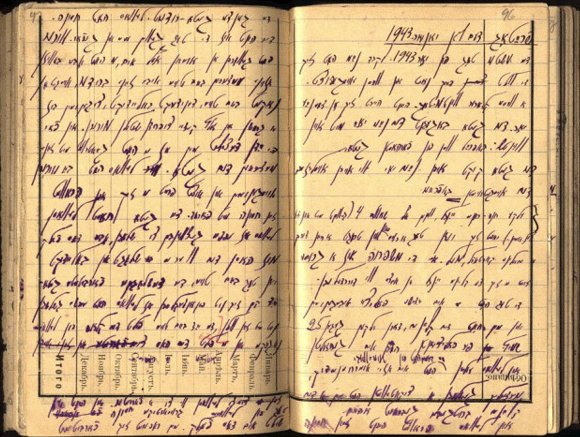
From June 1941 to April 1943 he kept a diary in Yiddish. Yitskhok had a sense of the significance of his account; at one point he wrote, “I consider that everything must be recorded and noted down, even the most gory, because everything will be taken into account.”

He not only wrote about his own life and his family and friends, but about the wider community events and the devastation the Germans wrought on his people. The historian Allan Gerald Levine called him “an astute and passionate observer of the times,” and compared him to Anne Frank.

Nor was the diary Yitskhok’s only writing project.

When one of his teachers, a beloved figure in the ghetto, died, he wrote a eulogy for the man and read it out before a large audience. He was a member of a literary group and was also attached to the ghetto’s history project, for which he interviewed ghetto residents about their lives:

I got a taste of the historian’s task. I sit at the table and ask questions and record the greatest sufferings with cold objectivity. I write, I probe into details, and I do not realize at all that I am probing into wounds … And this horror, this tragedy is formulated by me … coldly and dryly. I become absorbed in thought, and the words stare out of the paper crimson with blood.

The Vilna Ghetto, whose population initially numbered 40,000, had a rich cultural life, just like prewar Jewish Vilna had. There were theaters, cabarets, the symphony, art exhibits, a library, public lectures, and underground schools for both children and adults.

Vilna Jews saw art, music, literature and the pursuit of knowledge as a form of resistance. As Jacob Gens, head of the “ghetto’s Judenrat, put it, cultural activity gave a person “the opportunity to free himself from the ghetto for a few hours … We are passing through dark and difficult days. Our bodies are in the ghetto, but our spirit has not been enslaved.”

Reality intruded, however, and in the final analysis the Vilna Jews were doomed to extinction.

Yitskhok’s final diary entry was dated April 7, 1943, two days after five thousand Vilna Jews had been rounded up and shot at Ponary. He was understandably in a very grim mood. His prophetic last line was, “We may be fated for the worst.”

On September 23, 1943, the Nazis began the final liquidation of the Vilna Ghetto, which had by then been reduced to about 10,000 people. After a selection, those who could work were sent off to labor camps in Estonia and Latvia, where almost all of them died due to the brutal conditions there.

Children, the elderly, and the sick were shot at Ponary or sent to the extermination camp Sobibor and gassed.

Yitskhok, his parents and his uncle’s family chose to go into hiding rather than take their chances at the selection. In hiding he sank into apathy and said very little. After about two weeks in the hideout, they were discovered and taken to their deaths.

The only surviving member of Yitskhok’s family was his teenage cousin, Sarah “Sore” Voloshin. Somewhere on the route to Ponary she was able to escape. She joined a partisan group in the forest and survived until the Red Army liberated the area in the summer of 1944. After the war was over, she returned to the family’s hiding place and found Yitskhok’s diary. As of 2010, Sore Voloshin was still alive in Israel.

And the diary she retrieved had become one of the major sources on day-to-day life in the Vilna Ghetto.

Yitskhok Rudashevski suffered and died in just the same way as hundreds of thousands of others, but unlike them he did not remain anonymous: he is one of the ghetto’s most famous inhabitants. His writings have been published in their original Yiddish and in Hebrew, German and English translations. Extracts of his diary can be found in several anthologies, and it’s available in its entirety under the title The Diary of the Vilna Ghetto.

On this day..

1648: Alice Bishop

(Thanks to Meaghan Good of the Charley Project for the guest post. -ed.)

On this date in 1648, 32-year-old Alice Bishop was hanged on the gallows in Plymouth Colony, Massachusetts for the murder of her young daughter — an apparently motiveless crime which must have shocked her fellow settlers.

Almost nothing is known about Alice’s early life. She probably, although not definitely, came over on the Mayflower. The prevailing theory is that her parents were Mayflower passengers Christopher Martin and Marie Prower. They died within a week of each other in January 1621, before the actual settlement of Plymouth even began.

If that’s the case, Alice had been an orphan for the better part of a year by the time the first Thanksgiving rolled around. She was presumably raised by one of the other families. She would marry twice and have three daughters: Abigail, Martha and Damaris.

By 1648, Alice was living with her second husband, the Plymouth newcomer Richard Bishop, who was Damaris’s father. The family seems to have been unexceptional, just another household trying to eke out a living in a harsh and unforgiving environment.

Somewhere along the line, something went very wrong.

On July 22, 1648, while Richard Bishop was away from home, family friend Rachel Ramsden dropped by the Bishops’ residence and spent some time with Alice. Alice’s four-year-old middle child, Martha Clark, was asleep in bed in the loft, which was accessible by ladder. (Where the other two children were has not been recorded.)

At some point, Alice gave Rachel a kettle and asked her to go fetch some buttermilk from a neighbor’s house.

When Rachel returned, she noticed blood on the floor beneath the ladder. Alice was “sad and dumpish,” and when Rachel asked her what was going on, she wordlessly pointed up at the loft.

Rachel climbed up to have a look: there was blood everywhere; Martha’s mattress was drenched in it.

Rachel fled the house in a panic, found her parents and told them she thought Alice had murdered her daughter. Her father rushed to find the colonial governor. A posse of twelve armed men assembled and went to the Bishop house. By the time the men arrived, Alice was in hysterics.

Ascending to the loft, they found Martha’s body. The child was lying on her left side, “with her throat cut with divers gashes crose wayes, the wind pipe cut and stuke into the throat downward, and the bloody knife lying by the side.” Nothing could be done for her.

Alice freely admitted she had murdered her daughter and said she was sorry for it, but she claimed she had no recollection of the crime. When they asked her why she’d done it, she had no answer for them.

She was the fifth person hanged in the Plymouth Colony, and the first woman.

We will never know why Alice Bishop killed her daughter Martha, and why she did it in such a ferocious manner. One of her descendants has a website about her that attempts to answer that question.

Severe mental illness, perhaps post-partum psychosis, is an obvious answer, but not the only one. The site notes another potentially significant fact: both of Alice’s parents died when she was four years old, and she killed her daughter at the same age.

Richard Bishop survived his wife by nearly a quarter-century. As for the children: youngest child Damaris Bishop grew up, married and had three sons, but Abigail Clark, Alice’s oldest child, vanishes from history after her mother’s execution.

On this day..

1904: Herero prisoners, at the command of Lothar von Trotha

My initial plan for the operation, which I always adhered to, was to encircle the masses of Hereros at Waterberg, and to annihilate these masses with a simultaneous blow, then to establish various stations to hunt down and disarm the splinter groups who escaped, later to lay hands on the captains by putting prize money on their heads and finally to sentence them to death.

-German General Lothar von Trotha (pdf source)

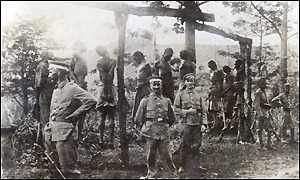
On this date in 1904, von Trotha did a little of that executing bit, further to doing a whole lot of genocide. It was the very day after von Trotha’s Vernichtungsbefehl, or extermination order, against the Herero people.

We give the narrative here to Jan-Bart Gewald’s “Colonization, Genocide and Resurgence: The Herero of Namibia 1890-1933”, from a collection of papers at a German symposium. Gewald’s complete text is available in scanned pdf form here.

Gewald:


Pocketed by the desert and the German patrols the Herero chiefs and their followers congregated along the Eiseb river. Around the first of October 1904, General Lothar von Trotha, who was actively taking part in the pursuit, and his retinue had reached the waterhole Osombo-Windimbe. During the afternoon of the following day, Sunday 2 October 1904, after the holding of a field service, General von Trotha, addressed his officers. In his address Trotha declared that the war against the Herero would be continued in all earnestness, and read out the following proclamation:

I the great General of the German troops send this letter to the Herero people.

The Herero are no longer German subjects. They have murdered and stolen, they have cut off the ears, noses and other bodyparts of wounded soldiers, now out of cowardice they no longer wish to fight. I say to the people anyone who delivers a captain will receive 1000 Mark, whoever delivers Samuel will receive 5000 Mark. The Herero people must however leave the land. If the populace does not do this I will force them with the Groot Rohr [cannon]. Within the German borders everyHerero, with or without a gun, with or without cattle, will be shot. I will no longer accept women and children, I will drive them back to their people or I will let them be shot at.* These are my words to the Herero people.

The great General of the mighty German Kaiser.

At dawn the following morning, Herero prisoners, who had been sentenced to death by a field court-martial, were hung in the presence of about 30 Herero prisoners, women and children amongst them. After the hanging, Trotha’s proclamation was read out to the prisoners in Otjiherero. Printed copies of the text in Otjiherero were distributed amongst the Herero prisoners. The prisoners were then turned loose and driven out into the Omaheke. [i.e., the western Kalahari desert -ed.]


In a letter the next day, Oct. 4, to the general staff, von Trotha reported on his order the day’s executions, in the context of a detailed tactical and philosophical justification of destroying the entire Herero nation. It’s quoted at length in Absolute Destruction: Military Culture and the Practices of War in Imperial Germany:

For me, it is merely a question of how to end the war with the Herero. My opinion is completely opposite to that of the governor and some “old Africans.” They have wanted to negotiate for a long time and describe the Herero nation as a necessary labor force for the future use of the colony. I am of an entirely different opinion. I believe that the nation mustbe destroyed as such, or since this was not possible using tactical blows, it must be expelled from the land operatively …

Because I neither can treat with these people, nor do I want to, without the express direction of His Majesty, a certain rigorous treatment of all parts of the nation is absolutely necessary, a treatment that I have for the present taken and executed on my own responsibility, and from which, as long as I have command, I shall not detour without a direct order. My detailed knowledge of many Central African tribes, Bantu and others, has taught me the convincing certainty that Negroes never submit to a contract but only to raw force. Yesterday before my departure, I had the warriors who were captured in the last several days [and who were] condemned by court-martial, hanged, and I have chased all the women and children who had gathered here back into the desert, taking with them the proclamation to the Herero people. This proclamation (enclosed), which will unavoidably bcome known, will be attacked … accepting women and children, who are mostly ill, is an eminent danger to the troops, and taking care of them is impossible. Therefore, I think it better that the nation perish rather than infect our troops and affect our water and food. In addition, the Herero would interpret any kindness on my side as weakness.They must now die in the desert or try to cross the Bechuanaland border. This uprising is and remains he beginning of a race war, which I already predicted in 1897 in my reports to the chancellor on East Africa … Whether this uprising was caused by poor treatment [of the Africans] remains irrelevant to its suppression.


It should be added that this explicitly genocidal policy was neither unique to German colonies, nor, as von Trotha himself notes, uncontested within Germany itself.

German Christian missionaries logged a piteous catalog of horrors, “skeletons with hollow eyes, powerless and hopeless,” and their reports of same to their home offices led to church pressure to brake the atrocities.

Gewald also quotes one of von Trotha’s subalterns, undisguisedly revolted at what he was involved in.

Cattle which had died of thirst lay scattered around the wells. These cattle had reached the wells but there had not been enough time to water them. The Herero led ahead of us into the Sandveld. Again and again this terrible scene kept repeating itself … the water became ever sparser, and wells evermore rare. They fled from one well to the next and lost virtually all their cattle and a large number of their people. The people shrunk into small remnants who continually fell into our hands, sections of the people escaped now and later throug the Sandveld into English territory. It was a policy which was equally gruesome as senseless, to hammer the people so much, we could have still saved many of them and their rich herds, if we had pardoned and taken them up again, they had been punished enough. I suggested this to General von Trotha but he wanted their total extermination.

Technically, complete destruction of the Herero was reversed as German policy a few months after von Trotha began implementing it, and the general himself recalled from South West Africa before the end of 1905 — leaving only a “softer” genocide of disease-ridden concentration camps through 1908. Although firm numbers are hard to come by, it’s thought that well over half the Herero population died during this period.

Yet neither was von Trotha a lone butcher. Diary entries of settlers and regular soldiers well before the extermination order record many instances (pdf) of the most cavalier slaying of Herero prisoners and noncombatants, abuses which continued long after von Trotha’s departure.

It’s difficult not to see in the racial ideology and the eliminationist military doctrine prefiguring (pdf) later and better-publicized brutalities. Indeed, even some of the personnel are the same:

  • Hermann Goering‘s father Heinrich was Germany’s first Reichskommissar in South West Africa, plopping his home down right on a Herero burial site.
  • Eugen Fischer, a eugenicist who availed the Namibian concentration camps’ ready supply of subjects to produce career-making research that would influence German race law and make Fischer a big brain in Nazi intellectual circles
  • Franz Ritter von Epp, one of von Trotha’s officers, formed in the aftermath of World War I one of the far-right Freikorps paramilitaries, with many subsequently-influential Nazis among its membership, including Ernst Roehm (who may have cribbed the SA “brown shirt” look from colonial Schutztruppe khakis) and Adolf Hitler himself

* He meant, shooting over their heads to run them off. “I assume absolutely that this proclamation will result in taking no more male prisoners, but will not degenerate into atrocities against women and children,” Lothar explained. “The latter will run away if one shoots at them a couple of times. The troops will remain conscious of the good reputation of the German soldier.”

On this day..

1803: Joseph Samuel survives three hangings

On this date in 1803, Joseph Samuel just wouldn’t hang.

Transported to Australia in 1801 for theft, Joseph Samuel was part of a cohort of Sydney Cove convicts who, on the night of August 25-26, burgled a house.

The band was surprised by constable Joseph Luker, himself a former convict. One or more of the thieves battered him to death on the spot with whatever was at hand: recovered with Luker’s broken body at morning’s light were a bloodied wheelbarrow wheel, and the hilt of Luker’s own cutlass, buried in his brains. Luker was the first policeman killed on duty in Australia, and his name can be found on the country’s National Police Memorial.

But the order of the day in 1803 was a different sort of memorial. “Avenging Heaven directs the Hand of Justice, and the Manes of the Deceased inspires us with Indignation and Resentment,” the Sydney Gazette fulminated. The need to cut a deal for crown’s evidence with one of Samuel’s compatriots eventually meant that Samuel was the only one to bear the vengeance of Luker’s Manes. (A third man, Isaac Simmonds, was acquitted at trial, but he was so heavily suspected that he was made to attend the execution.)

We’ll pick up the narration of the Sydney Gazette (Oct. 2, 1803):

James Hardwicke were brought, in pursuance of the sentence passed upon them on the preceding Friday.

Both prisoners conducted themselves with becoming decency; and when the Reverend Mr. MARSDEN had performed the duties of his function, and quitted Hardwicke, he turned to Samuels (who being a Jew, was prepared by a person of his own profession) and questioning him on the subject of the murder of Luker, he solemnly declared, that during the interval of his confinement in the cell with Isacc [sic] Simmonds, nicknamed Hikey Bull, they in the Hebrew tongue exchanged an oath, by which they bound themselves to secrecy and silence in whatever they might then disclose.

Conjured by that GOD before whom he was shortly to appear, not to advance any thing in his latter moments that would endanger his salvation, he now repeated with an air of firmness what he had before declared ; and appearing deeply imprest with a becoming sense of his approaching end, appealed to Heaven to bear him testimony that Simmonds had, under the influence of the oath by which they were reciprocally bound, acknowledged to him that Luker had accidentally surprised him … and that he, in consequence thereof, had “knocked him down, and given him a topper for luck!” … [and] that he would hang 500 Christians to save himself.

Simmonds, as we’ve noted, was right there in forced attendance at the public hanging, and as Samuel’s accusations started the audience murmuring, Simmonds tried to interject his denials. The very fact that the words were spoken by a man on the brink of death and presumably in fear for his soul made Samuel a credible accuser in the eyes of the populace, “in whose breasts a sentiment of abhorrence was universally awakened … and the feelings of the multitude burst forth into invective.” Yikes.

While the gendarmes moved to protect Simmonds from the possible wrath of his neighbors, and Hardwicke received a last-minute pardon,* Samuel commenced the inadvertently superlative finishing act of his persuasive performance.

at length the signal was given, and the cart drove from under him; but by the concussion the suspending cord was separated about the centre, and the culprit fell to the ground, on which he remained motionless with his face downwards. The cart returned, and the criminal was supported on each side until another rope was applied in lieu of the former: he was again launched off, but the line unrove, and, continued to flip until the legs of the sufferer trailed along the ground, the body being only half suspended.

All that beheld were also moved at his protracted sufferings; nor did some hesitate to declare that the invisible hand of Providence was at work in the behalf of him who had revealed the circumstances above related. To every appearance lifeless, the body was now raised, and supported on men’s shoulders, while the executioner prepared anew the work of death. The body was gently lowered, but when left alone, again fell prostrate to the earth, this rope having also snapped short, close to the neck.

Compassion could no longer bear restraint; winged with humanity, the Provost Marshal sped to His EXCELLENCY‘S presence, in which the success of his mission overcame him; A Reprieve was announced — and if Mercy be a fault, it is the dearest attribute of GOD, and surely in Heaven it may find extenuation!

Samuells when the Provost Marshal arrived with the tidings which diffused gladness throughout every heart, was incapable of participating in the general satisfaction. By what he had endured his reasonable faculties were totally impaired; and when his nerves recovered somewhat from their feebleness, he uttered many incoherences, and was alone ignorant of what had past. Surgical assistance has since restored him; And MAY THE GRATEFUL REMEMBRANCE OF THESE EVENTS DIRECT HIS FUTURE COURSES!

It didn’t.

In 1806, Samuel made an escape attempt with some other convicts by boat. It was swept away in a tempest, with all presumed lost at sea.

* A number of sources claim that Hardwicke did hang successfully while Samuel’s rope repeatedly broke. We think the eyewitness newspaper report days after the execution to the effect that Hardwicke was reprieved is by far the more credible report.

On this day..