1814: Vicente Salias, Venezuelan national anthem author

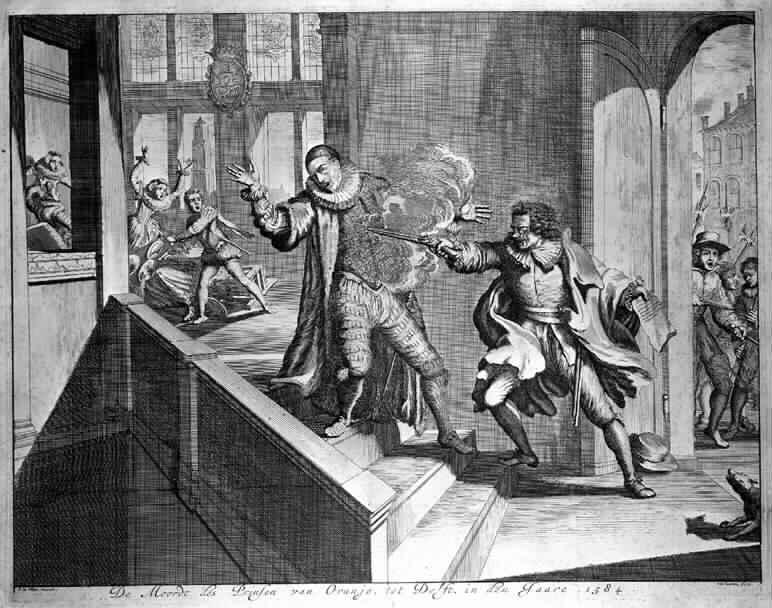
On this date in 1814, the Venezuelan doctor and writer Vicente Salias was shot in San Felipe castle at Puerto Cabello by the Spanish who meant to run the place.

Salias (English Wikipedia entry | Spanish) was a founding member of the Sociedad Patriotica de Caracas and editor of the nationalist publication El Patriota de Venezuela.

He worked for the First Republic of Venezuela, a short-lived (1810-1812) attempt to break away from a Spanish empire preoccupied by the Napoleonic Wars. In 1810, Salias is said to have* composed the lyrics for Gloria al Bravo Pueblo (Glory to the Brave People),

Captured attempting to escape the approaching royalist forces of Jose Tomas Boves, Salias was shot with the spectacularly defiant last cry of “God Almighty, if the Heavens admit Spaniards, then I renounce the Heavens!”

* There are some revisionist hypotheses postulating other authors.

On this day..

1931: Omar Mukhtar, Libyan revolutionary

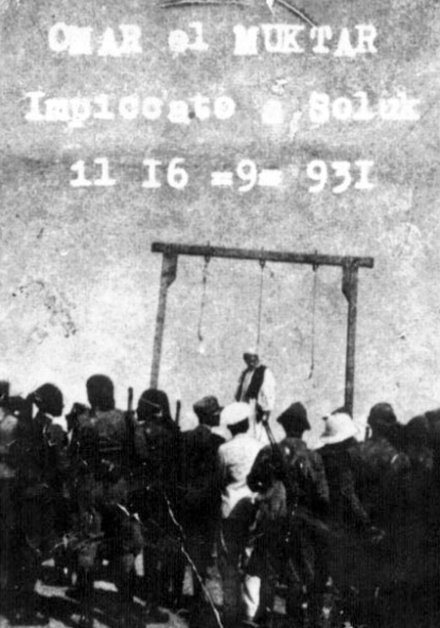
On this date in 1931, Libyan independence martyr Omar [al-]Mukhtar was publicly hanged by the Italians at their concentration camp in Suluq.

Mukhtar (English Wikipedia entry | Italian) was born an Ottoman subject back in 1858 and had lived long enough to see his native Libya seized in the 1911-12 Italo-Turkish War.

Mukhtar, a religious teacher and follower of the Senussi movement, became the leader of the Libyan resistance that dogged the Italian occupation. Mukhtar proved an energetic and successful desert guerrilla fighter, and he had to be given the Italians’ mechanized military.

The Italians executed an estimated 4,000 Libyans in the 1920s, and drove hundreds of thousands into concentration camps, and gradually, only gradually, gained the upper hand on their adversaries.

Captured in battle after he abandoned a 1929 truce, Mukhtar was denied prisoner-of-war status and subjected to a snap military tribunal in one of the small coastal enclaves actually controlled by Italy — “a regular trial and consequent sentence, which will surely be death,” as the Italian general directed. It surely was.

He’s played by Anthony Quinn in the 1981 film Lion of the Desert — a better movie than you might think given that it was bankrolled by Muammar Gaddafi.

A national hero for contemporary Libyans across any social divide you’d care to name, Omar Mukhtar was valorized by the rebels who recently overthrew the aforementioned Gaddafi (here’s Mukhtar on a billboard in rebel-held Benghazi). “The whole world knows what Omar al-Mukhtar did,” Mukhtar’s 90-year-old son told media during the civil war. “That’s where they get their energy from. Ask the youth, they’ll tell you they are all the grandsons of Omar al-Mukhtar.”

His steely profile can be seen on Libya’s 10 10 dinar note.

On this day..

1896: Chief Uwini of the Maholi

This date in 1896 during the Second Matabele War saw the execution by field court-martial of the rebellious Chief Uwini.

This war, in present-day Zimbabwe, featured a revolt of the Matabele (Ndebele) people against Cecil Rhodes’s* British South African Company.

In the field, it was a short-lived affair.

Ndebele rebels slew over 200 white settlers in Matabeleland and Mashonaland during the first week of the surprising rising in March 1896. But most settlers were able to hunker down in he town of Bulawayo behind makeshift breastworks.

Up to 15,000 Ndebele warriors menaced this little citadel, but were deterred from storming it by the settlers’ modern weapons — artillery and the legendary Maxim gun** — until relieved in May. (Rhodes himself led one of the relief columns.) At that point, the rebels retreated to their strongholds, fragmented from one another, and generally got picked off or bought off group by group over the ensuing months.

One of the men arriving with Rhodes’s relief column was Robert Baden-Powell, an army scout who will bring us to this date’s feature execution.

Baden-Powell was dispatched with a squadron of cavalry to pacify the area northeast of Bulwayo. When he arrived there, one of the main rebel chiefs in the Somabula Forest, Chief Uwini, had just been taken prisoner.

“He was badly wounded in the shoulder, but, enraged at being a prisoner, he would allow nothing to be done for him; no sooner had the surgeon bandaged hi than he tore the dressings off again. He was a fine, truculent-looking savage, and boasted that he had always been able to hold his own against any enemies in this stronghold of his, but now that he was captured he only wished to die.”

-Baden-Powell (Source)

This prisoner put Baden-Powell in a conundrum. He had written orders to turn prisoners over to the Native Commission for civil handling (whether trial or otherwise).

Uwini had been induced to surrender by another officer’s promise to spare his life. However, this wounded chief could not be escorted five days back to Bulawayo by a force large enough to protect against the likely rescue attempt by his followers without abandoning his mission. Neither could Uwini be brought along on the patrol.

Something had to give.

Baden-Powell decided it would be the safe-conduct promise.

“I have taken another step, which I hope you will not disapprove of — viz. — trying Uweena by Court Martial,” Baden-Powell wrote his superiors on September 13. “He is the big chief of this part, we have lots of evidence that he instigated rebellion and murders of whites, he is badly wounded, we cannot send him to Buluwayo, and I must be leaving this with some of the senior officers tonight. So if the court find him guilty and sentence him to be shot I shall take on myself the responsibility of confirming it. The effect too should be very good for being carried out promptly and at his own stronghold — and we have a good number of rebels, prisoners and refugees, here to witness it & report it to the remainder.”

Another letter dated later that same day confirmed that the expected sentence had indeed been rendered, and Uwini had been ceremoniously shot that evening at sunset before the walls of the enemy fortress, in the presence of as many witnesses as Baden-Powell could find.

This quasi-juridical field execution put Baden-Powell in front of a court of inquiry after the fact. The court exonerated him, citing the circumstances and the purported effect of the execution in cowing the local insurgents.

Despite leaving the court of inquiry “without a stain on my character,” in Baden-Powell’s own words, this incident can’t help but throw a morally questionable shade for later observers. And this agent of empire does have later observers — because Lord Baden-Powell (as he eventually became styled) would go on to found the Scout Movement.† His 1907 boys scouting camp and subsequent book laid the foundation for the ensuing decades’ Anglo scouting tradition.

And this very Matabele War contributed crucial parts of the scouting backstory. It was in the course of this campaign that Baden-Powell became acquainted with the American scout and adventurer Frederick Russell Burnham. The two struck up a lifelong friendship, and Baden-Powell cribbed notes from the ranger’s guile (like wood “scoutcraft”) his counterpart had picked up on the dwindling American frontier. It was also in Rhodesia that Baden-Powell first wore the Stetson hat and neckerchief combination that would become a distinctive look both for Baden-Powell himself, and for the scout movement he launched.

* As of this story’s setting, the place in question had just begun to be called Rhodesia.

** It is in the context of Great Britain’s colonial adventures in Africa in this period (though not specifically just those of Matabeleland) that Hilaire Belloc published his 1898 poem “The Modern Traveller”. In it, a character named “Blood” gave this early machine gun its definitive literary tribute: it’s the couplet highlighted below, but the larger excerpt may be illuminating.

Blood understood the Native mind.
He said: “We must be firm but kind.”

A Mutiny resulted.
I never shall forget the way
That Blood upon this awful day
Preserved us all from death.
He stood upon a little mound,
Cast his lethargic eyes around,
And said beneath his breath:

“Whatever happens we have got
The Maxim Gun, and they have not.”

He marked them in their rude advance,
He hushed their rebel cheers ;
With one extremely vulgar glance
He broke the Mutineers.
(I have a picture in my book
Of how he quelled them with a look.)
We shot and hanged a few, and then
The rest became devoted men.

And here I wish to say a word
Upon the way my heart was stirred
By those pathetic faces.
Surely our simple duty here
Is both imperative and clear;
While they support us, we should lend
Our every effort to defend,
And from a higher point of view
To give the full direction due
To all the native races.
And I, throughout the expedition,
Insisted upon this position.

† Baden-Powell also counseled scouts to be unflinching should the “duty” arise to hang a man.

On this day..

1951: King Abdullah’s assassins

AMMAN, Jordan, Sept. 4 — Four men sentenced to death here last week for complicity in the assassination of King Abdullah in July were hanged today in Amman prison. Regent Emire Naif had confirmed the sentences of the special tribunal.

Those put to death were Musa Abdulla el-Husseini, Abed Okkeh, Abdulkadir Farhat and Zakariya Okkeh.

Col. Abdulla el-Tell, former governor of Jerusalem, and Musa Ayyubi who were sentenced to death in absentia are reported to be living in Egypt.

–New York Times, September 5, 1951*

The men hanged this day were among the authors of “the most dastardly crime Jordan ever witnessed”: the July 20, 1951 assassination of independent Jordan’s first king.

The cagey Hashemite monarch Abdullah I had been emir of Transjordan, an artificial British mandate jigsaw-piece that Abdullah got by virtue of cutting a deal with Winston Churchill.

This sinecure came with the significant drawback of dependency on London’s reach and interests, and Abdullah’s great achievement was to set Transjordan-cum-Jordan** on firm enough footing to survive the postwar sunset of the British Empire.

Abdullah faced an early test of Jordan’s chops shortly after his country’s 1946 independence when the Arab-Israeli War erupted. For Abdullah, this was a state-building opportunity; indeed, his government had for years backed Palestinian-partition plans that other Arab states had opposed — with the expectation that Jordan could help itself to the eastern part of that partition.

Abdullah did just that in 1948, invading and annexing the Jordan River’s West Bank all the way to East Jerusalem … while willingly acceding to (some have said actively colluding in) the creation of a partitioned Jewish state that was theoretically anathema to Jordan’s allies.

Jordanian territorial aggrandizement, however, brought with it the West Bank’s Palestinian population, severely aggrieved at having seen their aspirations to statehood cynically sacrificed by Abdullah. They got, into the bargain, Jordanian citizenship and a severe suppression of independence agitation.

So when Abdullah came to visit Jerusalem’s Al-Aqsa Mosque, a Palestinian gunman murdered him.

While the assassin himself was immediately shot dead by the king’s bodyguards, ten allegedly in on the plot were very hastily tried in mid-August … eight in the Amman courtroom, and two overseas in Egypt tried in absentia. Dr. Musa Abdullah el Husseini, Abdel Kadir Farahat, and the brothers Abed and Zakariya Okka were condemned to die, along with the absconded Abdulla el Tel and Musa Ahmed el Ayoubi. (The latter two would never be executed.)

According to the London Times‘ Aug. 29, 1951 wrap of the legal proceedings,

The events leading up to the murder, as they were described during the hearing, began with two meetings in Egypt, in September and October [1950], between el Tel and el Ayoubi, who decided then that the king should die. El Tel then met el Husseini i Cairo, and henceforth directed and financed the plot with el Ayoubi as his chief lieutenant. Abed Okka acted as an intermediary, and Zachariya Okka and Farahat were later drawn into the plot, the latter ultimately providing the murderer with a revolver.

The remaining four men who faced trial — Dr. Daud el Husseini, Franciscan Father Ibrahim Ayyad, Tawfik el Husseini, and Kamil Kaluti — were acquitted.

This event, which might have been feared to prefigure a more terrible disruption within Jordan, within Palestine, even in the entire Middle East, did nothing of the sort. Power transitioned to the long reign of Abdullah’s grandson King Hussein, who was actually present at his grandfather’s assassination. (And might have shared his fate, save for a medal the teenaged Hussein had pinned to his breast that deflected a bullet.)

As Mary Cristina Wilson writes,

There was an element of cover-up in the conduct of the trial. The grievances and frustrations of the accused were not broached … The idea of an independent Palestine was, for the moment, dead. Abdullah’s assassination was a terrible revenge wreaked for the death of that idea, but it signified retribution for events that were already history, not the beginning of the new order … Though not without parallels in the future, it was without echoes.

Jordan would govern the West Bank, albeit absent virtually any internationally-recognized legitimacy there, until Israel attacked and occupied the territory in the Six-Day War in 1967. The legacy of this event will be familiar to the reader.

In 1988, Jordan officially resigned its own claims on the West Bank to the Palestine Liberation Organization, “the sole legitimate representative of the Palestinian people.”

* Any number of online sites say this hanging occurred on September 6. Given the existence of September 5 papers reporting the execution, I think it’s safe to rule those erroneous. Wikipedia sources this version to James Lunt’s Hussein of Jordan.

** “Transjordan” officially became simply “Jordan” in 1949. Events in this post span either side of that re-branding, so for the sake of clarity, we’re just going to use “Jordan” throughout.

On this day..

1942: Henryk Landsberg, Lvov Judenrat

[Adolf Eichmann] did not expect the Jews to share the general enthusiasm over their destruction, but he did expect more than compliance, he expected — and received, to a truly extraordinary degree — their cooperation. This was “of course the very cornerstone” of everything he did … Without Jewish help in administrative and police work — the final rounding up of Jews in Berlin was, as I have mentioned, done entirely by Jewish police — there would have been either complete chaos or an impossibly severe drain on German manpower …

To a Jew this role of the Jewish leaders in the destruction of their own people is undoubtedly the darkest chapter of the whole dark story.

-Hannah Arendt in Eichmann in Jerusalem

Among the many horrors of the Holocaust were the Judenräte, Jewish administrative councils set up under the aegis of Nazi Germany’s occupation of Eastern Europe.

Typically recruited from local elites and granted special privileges by the Germans, these collaborators managed the day-to-day operations of the ghettos, up to and including the horrible sharp end of Final Solution: confiscating Jewish property for the Germans, registering and organizing Jews destined for slave labor or extermination, and even managing deportations with the desperate hope that willingly engaging a sacrifice they could never prevent might enable them to save some others. Once all the deportations were done, the Judenrat itself would be executed or deported: Faust had nothing on this bargain.

Chaim Rumkowski, perhaps the most (in)famous Judenrat administrator, issued posterity the definitive howl of a collaborator’s agony when he was forced by the imminent Lodz Ghetto children’s action to implore Lodz’s families to peaceably surrender their young people to certain death: “I never imagined I would be forced to deliver this sacrifice to the altar with my own hands. In my old age, I must stretch out my hands and beg. Brothers and sisters: Hand them over to me! Fathers and mothers: Give me your children!”

Rumkowski, a deeply checkered figure who fended off liquidation of his ghetto until the very late date of 1944, well knew that Judenrat personnel were entirely disposable. After all, he delivered this plaintive speech on September 4, 1942 — just three days after his counterpart in the Lvov Ghetto had been publicly strung up on a balcony.


Six Jews (including Henryk Landsberg) hanged in the Lvov Ghetto, September 1, 1942 (via). The US Holocaust Memorial Museum also identifies this clearly distinct execution as a picture of Lvov Jewish Council members being hanged in September 1942.

The city of Lwow/Lvov (or to use its present-day Ukrainian spelling, Lviv) had had a centuries-old Jewish population when the Soviet Union seized it from Poland in consequence of the Molotov-Ribbentrop pact. That population almost immediately doubled as Jewish refugees fleeing the half of Poland that Germany got in the deal poured into the city.

Practically on the frontier of the German/Soviet border, Lvov was captured in the opening days of Germany’s June 1941 surprise invasion of the USSR. In November-December 1941, the 100,000-plus Jews* still surviving in Lvov (after several post-conquest massacres) were crammed cheek to jowl into the new Lvov Ghetto. There they endured the usual litany of privations for World War II ghettos: starvation rations, routine humiliation, periodic murders. forced labor at the nearby Janowska concentration camp.

The ghetto’s first chairman, Dr. Josef Parnas, didn’t live to see 1942 before he was killed in prison for non-cooperation. Dr. Adolf Rotfeld followed him, and died of “natural” causes in office a few months later.

Dr. Henryk Landsberg, a lawyer, succeeded Rotfeld. He had been a respected community figure before the war, but was disposable to the Nazis as his predecessors; during a large-scale Aktion to cull the camp and further reduce its boundaries, a Jewish butcher resisting the SS killed one of his persecutors. Landsberg and a number of the Jewish policemen employed by the Judenrat were summarily put to death.

“I have gladly accepted the nomination,” Landsberg’s successor remarked. “Maybe they will shoot me soon.” He was indeed shot (or perhaps committed suicide to avoid that fate) in the first week of January 1943. (All this from Judenrat: The Jewish Councils in Eastern Europe Under Nazi Occupation)

The Lvov Ghetto was liquidated June 1, 1943; a bare handful of its former inmates escaped into the sewers or managed to avoid death in the camps before the war ended. After the Red Army took back the city, a 1945 survey of the Jewish Provisional Committee in Lvov tallied just 823 Jews. Today, there are all of 5,000.

* Among the Lvov Ghetto residents was Simon Wiesenthal.

On this day..

1941: 534 Lithuanian Jewish intellectuals

(Thanks to Meaghan Good of the Charley Project for the guest post. -ed.)

On this date in 1941, 534 Jewish intellectuals were lured out of the Nazi ghetto in the city of Kovno, Lithuania (also known as Kaunas), taken to Ninth Fort, and shot to death.

Over 5,000 Jews would die there during the Nazi occupation.

The Nazis had captured these people using a very clever ruse: on August 14, they had advertised for 500 Jews to help sort out the archives at City Hall, which were in disarray due to the chaos that followed the Germans’ conquering the city in June.

The workers had to be intelligent, educated types and fluent in German and Russian. They would be treated well and given three solid meals a day, in order that they could do the work properly and make no mistakes.

Most of the other jobs available for Jews at that moment involved manual labor under brutal conditions, on starvation-level rations.

More than the requested 500 showed up. The Nazis happily took them all.

Vilius “Vulik” Mishelski (later anglicized to William Mishell), who was 22 and had studied engineering in Vytautas Magnus University [Lithuanian link], was nearly victim no. 535. His mother told him about the job offer, because it upset her when he home from working at the airfield, “my clothes torn, my face covered with dust and sweat, my fingers bleeding, and I myself so exhausted I could hardly speak.” The archives job seemed like a gift from heaven to her.

Vulik wasn’t so sure.

Why, he asked, had the archives not been sorted out sooner? After all, the Germans had conquered Kovno a full two months earlier.

And why not get Lithuanians to do the job? It certainly wasn’t necessary to employ Jews.

He debated with himself for the next four days, then finally decided to go. Many of his friends were going, he wrote later on, and “this put me at ease. All of them could not be crazy.”

When he actually arrived at the gate, however, what he saw made him profoundly uneasy. The size of the guard was unusually large, and he witnessed Jewish police and Lithuanian partisans mistreating and beating people. Because it was taking long for the quota of 500 people to arrive, the Lithuanians started dragging people from their homes by force.

This struck me as odd. This was supposed to be a job where we were to be treated in a civilized manner; was this the treatment awaiting us? Oh, no, I would not be caught in this mess! Without hesitation, I turned around and rushed back home.

My mother was astounded. “What happened, why are you back?” she asked.

“Don’t ask questions,” I said, “move the cabinet, I’m going into hiding.”

Vulik was right not to trust the Nazis’ promises. He stayed in his hideout, a little cubbyhole behind the kitchen cabinet, all day.

The chosen 534 didn’t return that night, or the next night either, and no one believed the assurances that the work was taking longer than they thought, and they had spent the night at City Hall. Before long, the truth leaked out.

That same day, the men had been lead away in several smaller groups to an area containing deeply excavated holes in the ground. Then the Lithuanian guard, known as the Third Operational Group, had shot them all. Several men who tried to escape were killed on the run. Almost the entire intelligentsia of Jewish Kovno had thus been liquidated in one mass execution.

Mishelski stayed in the Kovno Ghetto until 1944, when he was sent to Dachau. He survived the war: 95% of the Lithuanian Jews, including most of his family, did not.

Mishelski moved to America, changed his name to William Mishell, got a master’s degree in engineering from New York University, and settled in Chicago. Following his retirement in the 1980s, he wrote a memoir titled Kaddish for Kovno: Life and Death in a Lithuanian Ghetto, 1941 – 1945. Mishelski died in 1994, aged 75.

On this day..

1480: The Martyrs of Otranto

On this date in 1480, Ottomans invading Otranto, Italy conducted a mass execution of prisoners.

Landing at the southern Italian city on July 28, the Ottoman force quickly overwhelmed Otranto. (Otranto rashly slew the messenger come to offer a merciful capitulation, only to find that its garrison began deserting within days.) On August 11, the Turks took the city by storm. Thousands died on that day’s bloodbath, including the Archbishop of Otranto.

Surviving women and children were sold into slavery. Men over age 15 had the choice of conversion — or death.

“Now it is time for us to fight to save our souls for the Lord!” a Christian shoemaker is said to have exhorted his 800 fellow prisoners. “And since he died on the cross for us, it is fitting that we should die for him.”

The acclaim greeting this call signaled inflammation ahead for the Turkish headsmen’s rotator cuffs. They had 800 faithful souls to dispatch to their eternal reward this date at the place still known as the Hill of Martyrs. (When in Otranto, visit it by taking the via Ottocento Martiri, just off via Antonio Primaldo — that’s the name of the militant shoemaker.)


The remains of the Otranto martyrs, arrayed as relics in the Otranto cathedral. (cc) image from Laurent Massoptier.

Historical novel set during these vents.

This, at least, is the most pious version of the story. The mass execution certainly did occur, but some latter-day historians like Francesco Tateo have argued that martyrdom is not attested by any of the contemporaneous sources, and the specifically religious understanding of events was only read in after the fact.

On whatever grounds one likes, Italy’s fractious city-states were deeply alarmed by the appearance on their shores of the all-conquering Turks. “It will always seem as if the funeral cross is borne before me while these barbarians remain in the boundaries of Italy,” wrote the Florentine humanist Poliziano.* (Source, a nonfiction book which covers Otranto in some detail.)

In the ensuing months, they rallied together vowing to expel the invaders.

Fortunately for this coalition, the Ottoman sultan Mehmed the Conqueror died in May 1481, and a brief period of internal conflict within the Ottoman empire over the succession perhaps led it to allow its Otranto outpost to wither on the vine. The Turks made peace and withdrew from their potential beachhead not long after, having held the city for just over a year. The bodies of the martyrs were said to have been found uncorrupted by decay.

The Catholic church beatified the 800 martyrs in 1771, but their final elevation to sainthood occurred only in 2013, just three months ago as I write this. They were in the very first group canonized by the new Pope Francis — although the canonization was approved by his predecessor Benedict XVI on the same day that Benedict resigned his pontificate. Considering current relations between the respective faiths, it was seen as a potentially impolitic move.

“By venerating the martyrs of Otranto, we ask God to protect the many Christians who in these times, and in many parts of the world, are still victims of violence,” Pope Francis said at the canonization Mass, diplomatically not naming any of those parts of the world.

* At the same time, Florence (in common with other Italian polities) had trade and diplomatic relations with the Ottomans.

On this day..

1471: Dmitry Isakevich Boretsky, son of Marfa Boretskaya

Muscovy’s long march to supremacy among the early Russian polities reached a decisive turn on 14 July 1471 when it defeated longtime rival Novgorod at the Battle of Shelon.

Ten days after that defeat, Novgorod’s commander Dmitry Isakevich Boretsky was put to death by the will of Ivan III.

Novgorod the Great had been losing ground to its neighbor for generations. Matters came in the end to the “Mayoress” Marfa Boretskaya, the widow of Novgorod’s former mayor (posadnik) Isaac Boretsky; she emerged in the 1460s as the charismatic leader of the hardline anti-Muscovite types.

Struggling to find a political foothold upon which to resist burgeoning Moscow, Marfa Boretskaya intrigued with the friendly — and similarly Muscophobic — Polish-Lithuanian Commonwealth. This drew Ivan III into what would prove to be the decisive military showdown between these venerable cities.

Marfa’s son Dmitry, our date’s unfortunate executed, would have stood to garner the glory of it had he prevailed.

He didn’t.


Bummer: Klavdy Lebedev‘s 1889 panorama of Marfa Boretskaya surveying the destruction of Novgorod.

Marfa Boretskaya was not put to death herself, but taken prisoner to Moscow upon Novgorod’s formal annexation in 1478 and socked away in a convent.

On this day..

1813: Johann Christian Claudius Devaranne

Two centuries ago today, Johann Christian Claudius Devaranne got himself shot for resisting Napoleon’s draft in Germany.

The Corsican had fallen back following the debacle of occupying Moscow, but the attempts of Napoleon-allied forces to recoup dwindling numbers by conscription provoked fierce resistance in Solingen — where the draft board was driven out and recruiting materials destroyed.

This little flare-up goes by the excellent title of the “Russian Truncheon Insurgency,” but it soon ran into the bayonets of Napoleon’s German partners. On January 30, 1813, a week after draft riots first erupted, troops began suppressing it. Devaranne, a 29-year-old father of five, was seen as a leader in the resistance and a price put out on his head … a price his own maid collected when the fugitive innkeeper was reckless enough to sleep at home one night.

He was tried and shot at Dusseldorf months later, during a lull in the year’s bloody campaign season.

For the 120th anniversary of Devaranne’s execution — which was also six months into Adolf Hitler’s Chancellorship — Solingen dedicated a memorial plaque to Devaranne, claiming his nationalist martyrdom as its own.

“It is no accident that precisely the Third Reich celebrates the memory of this hero. The same spirit which animated Devaranne, animates our SA as well,” said the city’s Lord Mayor. (There was an SA honor guard on hand for the occasion.) “Then as now, we revolt against repression, then against the Corsican, today the SA’s revolution against the Marxists. We need the memory of our heroes to redirect us to their spirit in dark hours.”

The plaque went missing after the war, but Devaranne still has a street named after him in Solingen.

On this day..

1584: Balthasar Gerard, assassin of William the Silent

“If you succeed in your enterprise, the King will fulfill all his promises, and you will gain an immortal name besides.”

— Christoffel d’Assonleville, to Balthasar Gérard

After 4 days of torture, on this date in 1584, Balthasar Gérard (Geeraerts) finally met his end by beheading on the wheel.
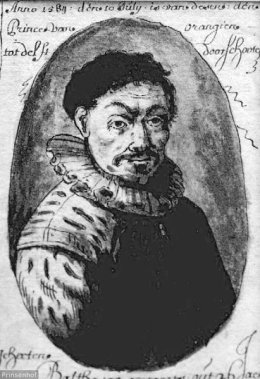
Gérard managed to be both historically important and wholly forgettable: an assassin working for Spain against the Netherlands, his regicide was met with a predictably stiff punishment. Then, no fault of his own, the subsequent course of history** pushed the assassin into obscurity while elevating his prey.

A lawyer by trade, Gérard was a fervent Catholic and supporter of the Spanish crown, which controlled the territory up the coast through the present-day Netherlands. At the peak of its power, Spain’s monarchy — led by King Philip II — had significant cause for concern at the rise in Protestantism.

The Spanish were Europe’s paladins of staunch Catholicism, and the sight of her troops did little to endear Spain to her colonized neighbors to the North.

For both religious reasons and political ones, the Dutch were looking for a way out from under the Spanish thumb, and a former noble named William, Duke of Orange, was a major instigator in the struggle. In his collected letters and addresses from the period, An apology or defence of William the First of Nassau, William states that, starting in 1559, he became increasingly concerned with plans against Protestants by the Spanish monarchy.

That also happens to be the year William was bestowed with stadtholdership of Holland, Zeeland, and Utrecht; in effect, he controlled the Dutch coast.

Though he was known as William the Silent, the Duke was endowed with both financial resources and widespread popularity, and he didn’t keep his mouth shut when it came to Inquisition courts in his realms.†

When the head enforcer of that policy, Cardinal Antoine Perrenot de Granvelle, left town, William got even noisier — declaring before the Council of State that Spanish policies were squelching religious freedom.

In 1566, the nobleman signed onto the Compromise of Nobles and began funding insurgencies across the northern provinces. As religious unrest grew, Calvinists and Protestants in the French and Germanic portions of Spain’s holdings quickly formed up behind William. An early attempt in 1568 to invade the Netherlands using German mercenaries and French Huguenots failed, but the resultant executions of Egmont and Hoorn put Spain on a long and winding road toward defeat.

The Dutch War was afoot, with William leading the way.

It would take and dozens of small-scale military victories over the next 15 years (during which William declared himself a Calvinist and fully broke his Spanish ties) for the Dutch to move to independence. The 1580 Union of Utrecht and 1581 Act of Abjuration officially ousted King Phillip II from the Netherlands and installed a new government.

Needless to say, Phillip reciprocated William’s love.

In 1580, Spain’s top man put a price on William’s head. Juan de Jáuregui tried to collect two years later by shooting the stadtholder, but the man holding the new title of Prince William I of Nassau recovered, while de Jáuregui was killed on the spot.

With 25,000 crowns at stake, there were bound to be other takers.

Our man Balthasar Gérard started looking for a close encounter with William the Target. At first, he joined the army in Luxembourg, which didn’t get him very far. It was time to gin up a real plot, which Gérard shopped to the Duke of Parma, Alessandro Farnese, in April 1584. Though the Duke offered no funding for the operation — Gérard ponied up the startup money he needed for the trip — and held out little hope that the lawyer would be successful, he gave Gérard assurances that his family would be taken care of in case of disaster.

Gérard first presented himself to William in June as the son of a martyred Calvinist from France. On 8 July, he returned and, badly in need of new clothes, managed to beg 50 crowns for a new set.

Instead, he bought a pair of pistols and, on 10 July, made history with a point-blank shot to William’s chest.
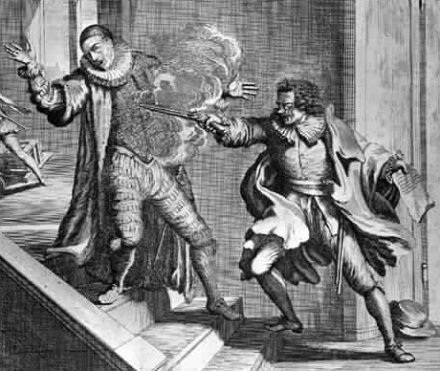

Detail view (click for the full image) of William the Silent’s 1585 assassination at the hands of Balthasar Gerard.

This assassination attempt didn’t fail. William became the second head of state to be killed by an assassin’s bullet,† — and his shooter the first such man to be juridically punished for the deed.

And, oh, how he was punished.

The regicide was beaten immediately after his capture, then subjected to a variety of cruelties, from wet leather boots which, when heated, both crushed and burned the feet, to daily floggings while hanging on a post outside the jail.

But on this day, his time of torture was up, and Gérard was finally put to death. You know, the usual:

It was decreed the right hand of Gerard should be burned off with a red-hot iron, that his flesh should be torn from his bones with pincers in six different places, that he should be quartered and disembowelled alive, that his heart should be torn from his bosom and flung in his face, and that, finally, his head should be taken off.


Gerard’s execution.

For all that he suffered as a regicide, Gérard left his family an impressive inheritance. Making good Parma’s assurances, King Phillip II gave them William’s former lands in three French provinces and took his siblings and their issue into his peerage.

Gérard’s cause carried on for another 60 years, until it was finally extinguished by the signing of the Peace of Münster by the Republic of the Seven United Netherlands and Spain.

* Foucault mistakenly identifies the torture as lasting 18 days, and the additional details he lays down for Gérard’s time on death row may be less-than-believable. However, all sources indicate that the tortures Gérard endured were quite spectacular, even by the standards of the day.

** See Dissident identities in the early modern Low Countries for a complete treatment of this period in The Netherlands and Belgium.

† For example, the city of Antwerp (Belgium), then under possession of the Spanish crown and considered the mercantile center of Europe for its vast sugar trade, featured over 100 executions for heresy from 1557-1562, twice as many as in all of Spain during that time.

‡ The first was James Stewart, 1st Earl of Moray, then Regent of Scotland. Stewart’s shooter, James Hamilton, escaped into exile, though others of the Hamilton clan answered for the murder.

On this day..