On this date in 1800, Rodaí Mac Corlaí — with due apologies for the imperial encroachment, we’re going to roll with the Anglicized “Roddy McCorley” — was hanged “near the Bridge of Toome” in Ireland
The actual nature and extent of his involvement in that rebellion is totally undocumented, but that doesn’t mean it’s not celebrated in an oft-covered patriotic song.
Post-rebellion, the (probably) Presbyterian McCorley was part of the so-called “Archer Gang”, men whom that newspaper account of McCorley’s execution calls “nefarious wretches who have kept this neighbourhood in the greatest misery for some time past.” That’s a hostile witness, obviously; the band in question looks to be Irish rebels turned outlaws, for whom plunder on the roads and vengeance on the rebellion’s enemies neatly coincided.
That coterie was gradually rounded up; its leader Tam Archer would also hang. But the national cause ran in the McCorley blood: the hanged man’s great-grandson Roger McCorley was a Republican insurgent during the Irish War of Independence in the early 1920s.
Thanks to @elongreen for bringing Roddy McCorley to our attention.
* Although even the execution date has been blurred by a later, martyr-making tradition claiming that McCorley died on Good Friday. He did not.
Having word of the burgeoning rebellion elsewhere on the subcontinent, Bareilly’s native troops mutinied on May 31, 1857. Three captured European civilians were shot that evening; three more followed the next day.
Though Bareilly did not furnish the most spectacular massacre of the rebellion, it was one of several** that became grist for industrial Britain’s burgeoning mass media … and reports of bloody deeds prepared the British public to respond in kind. One Englishman wrote the London Times on June 3 (it was published on July 14): “When this crisis shall have passed, stern and unflinching vengeance on those who have mutinied and been guilty of atrocities, tempered with judicious and gracious clemency to those who were only misled into a willingness to joining them, will, I fondly hope, tend greatly to create and consolidate a lasting loyalty throughout our native troops.”
Other Britons were far more interested in the unflinching vengeance than the lasting loyalty. Outraged at the news that the Governor-General of India was offering mutineers amnesty, one wrote in a private correspondence on October 4,
I wish I were Commander in Chief in India. The first thing I would do to strike that Oriental race with amazement (not in the least regarding them as if they lived in the Strand, London, or at Camden Town), would be to proclaim to them in their language, that I considered my Holding that appointment by the leave of God, to mean that I should do my utmost to exterminate the Race upon whom the stain of the late cruelties rested; and that I begged them to do me the favor to observe that I was there for that purpose and no other, and was now proceeding, with all convenient dispatch and merciful swiftness of execution, to blot it out of mankind and raze it off the face of the Earth.
That imperial genocide enthusiast was a liberal man of letters known to be downright softhearted when beholding his own countrymen condemned to death singly: Charles Dickens.
After the initial shock of the various risings, Great Britain set about methodically putting down the revolt.
In 1858, it was Bareilly’s turn. Fresh off defeating the most vigorous rebel commander Tantia Tope, the British commander Colin Campbell wrapped up the Indian campaign by marching his Highland regiments “in red coats, kilt, and feather bonnet, under a blazing sun, showing 112 degrees in the shade.”
That wished-for stern and unflinching vengeance marched with them.
Sergeant David McAusland of the 42nd Highland Regiment recalled that during his service in Bareilly during the Rebellion, “three scaffolds and six whipping posts stood outside of the town along side of the jail and there [took place] executions to the number of six every day.” The judge in charge of trials had lost his wife during the conflict, and had told McAusland, “if ever I get the chance of [judging] these Black rebels I will hang a man for every hair that was in my wife’s head.” McAusland responded by asking him how many men he had executed already, “he told me close on 700 well I said if you just continue you will have made good your work and turning to Sergt … Aden I said you mind what Sir Colin [Campbell] said to us at Cawnpore that every man that had a black face was our enemy and we could not do wrong in shooting him so you know how to act here.” (Source pdf, an essay eventually integrated into the author’s book-length study Martial Races: The Military, Race and Masculinity in British Imperial Culture, 1857-1914
As the man who had styled himself chief of Bareilly in opposition to British power could scarcely expect to escape such indiscriminate revenge.
“The complicity of this wretched man in the atrocities committed at Bareilly admits of no doubt whatever, and to allow him to escape from the gallows would be an outrage upon the memory of his unhappy victims,” the London Times reported on April 21, 1860, upon receiving (much belated) word of his execution.
* Great Britain’s initial seizure of Bareilly (Rohilkhand) from Khan Bahadur Khan’s ancestors in a 1774 war became part of the impeachment case Edmund Burke leveled against colonial official Warren Hastings. As we’ve seen elsewhere on this site, that remarkable charge also involved a shady execution.
** The largest and most inflammatory, of course, was Cawnpore/Kanpur.
The leaders of this movement were amply rewarded by Czechoslovakia’s new masters; for Kundt, this meant a transition from an MP in Prague to a seat in the Reichstag, a gig in the Luftwaffe, and various state posts around the Third Reich.
And of course, many of these Sudeten big wheels collected a different sort of reward after 1945. He was arrested in Czechoslovakia after the war and tried with a number of other Sudeten German leaders.
On this date in 1943, French resistance heroine France Bloch-Serazin was executed by the Germans in Hamburg.
Bloch-Serazin English Wikipedia entry | French) was a Jewish Communist who had supported the Spanish Republican cause, so she was right in line for some official persecution after the Germans blitzed France.
No longer employable as a chemist, she put her training to good use manufacturing explosives in her apartment. (Today, a plaque in the 19th arrondissement marks the building.)
Arrested by French police on May 16, 1942, she was condemned to death by a German military court but deported to Germany to suffer that punishment. Her husband, Fredo Serazin, was subsequently murdered by the Gestapo in prison.
As France Bloch-Serazin was born in 1913, she has recently enjoyed a renewed appreciation around the centennial of her birth, including the homage (French link) of her native city of Poitiers.
On an uncertain date in the winter of 416-415 B.C.E., the island of Melos surrendered to an Athenian siege during the ruinous Peloponnesian War.
Athens put all of Melos’s adult men to death, selling its women and children into slavery.
This ghastly event is covered by Thucydides‘ History. Thucydides’ account of the diplomatic negotiation between the mighty Athenians and the hopelessly outmuscled Melians is the subject of the Melian dialogue — a timeless classic of philosophy and statecraft.
The Athenians’ coldly realistic position — and their ultimate disposition of their conquest — is summed up in the wonderful epigraph, “the strong do what they will, and the weak suffer what they must.” (And numerous variations of this translation.)
As the reigning naval power, Athens (at war with a league led by its rival, the land power Sparta) had decided that an independent and neutral Melos would no longer be in the offing. The Melian dialogue pits Athens’ ultimatum to Melos to submit and save itself, against the Melians’ vain attempt to assert the justice of their cause; likewise, it is the dialogue of an imperial order against a holdover independent city-state from a fading era.
Athenians: Well, then, we Athenians will use no flue words; we will not go out of our way to prove at length that we have a right to rule, because we overthrew the Persians; or that we attack you now because we are suffering any injury at your hands. We should not convince you if we did; nor must you expect to convince us by arguing that, although a colony of the Lacedaemonians, you have taken no part in their expeditions, or that you have never done us any wrong. But you and we should say what we really think, and aim only at what is possible, for we both alike know that into the discussion of human affairs the question of justice only enters where the pressure of necessity is equal, and that the powerful exact what they can, and the weak grant what they must.
Melians: Well, then, since you set aside justice and invite us to speak of expediency, in our judgment it is certainly expedient that you should respect a principle which is for the common good; and that to every man when in peril a reasonable claim should be accounted a claim of right, and any plea which he is disposed to urge, even if failing of the point a little, should help his cause. Your interest in this principle is quite as great as ours, inasmuch as you, if you fall, will incur the heaviest vengeance, and will be the most terrible example to mankind.
Athenians: The fall of our empire, if it should fall, is not an event to which we look forward with dismay; for ruling states such as Lacedaemon are not cruel to their vanquished enemies. And we are fighting not so much against the Lacedaemonians, as against our own subjects who may some day rise up and overcome their former masters. But this is a danger which you may leave to us. And we will now endeavour to show that we have come in the interests of our empire, and that in what we are about to say we are only seeking the preservation of your city. For we want to make you ours with the least trouble to ourselves, and it is for the interests of us both that you should not be destroyed.
Melians: It may be your interest to be our masters, but how can it be ours to be your slaves?
Athenians: To you the gain will be that by submission you will avert the worst; and we shall be all the richer for your preservation.
Melians: But must we be your enemies? Will you not receive us as friends if we are neutral and remain at peace with you?
Athenians: No, your enmity is not half so mischievous to us as your friendship; for the one is in the eyes of our subjects an argument of our power, the other of our weakness.
Over and over the Melian envoy is dismayed by his visitors’ indifference to the moral high ground. Frustrated of any concession, he resolves his embattled city to embark upon the remote hope of resistance in preference to voluntary servitude — leading the Athenians to part with this chilly sentiment:
You told us that the safety of your city would be your first care, but we remark that, in this long discussion, not a word has been uttered by you which would give a reasonable man expectation of deliverance. Your strongest grounds are hopes deferred, and what power you have is not to be compared with that which is already arrayed against you. Unless after we have withdrawn you mean to come, as even now you may, to a wiser conclusion, you are showing a great want of sense. For surely you cannot dream of flying to that false sense of honour which has been the ruin of so many when danger and dishonour were staring them in the face. Many men with their eyes still open to the consequences have found the word honour too much for them, and have suffered a mere name to lure them on, until it has drawn down upon them real and irretrievable calamities; through their own folly they have incurred a worse dishonour than fortune would have inflicted upon them. If you are wise you will not run this risk; you ought to see that there can be no disgrace in yielding to a great city which invites you to become her ally on reasonable terms, keeping your own land, and merely paying tribute; and that you will certainly gain no honour if, having to choose between two alternatives, safety and war, you obstinately prefer the worse. To maintain our rights against equals, to be politic with superiors, and to be moderate towards inferiors is the path of safety. Reflect once more when we have withdrawn, and say to yourselves over and over again that you are deliberating about your one and only country, which may be saved or may be destroyed by a single decision,
Athens wasn’t kidding.
Finding no traction with the Melian delegation, the greater power immediately besieged Melos. Thucydides recounts the Melians’ subsequent fate:
So the summer ended.
In the following winter the Lacedaemonians had intended to make an expedition into the Argive territory, but finding that the sacrifices which they offered at the frontier were unfavourable they returned home … About the same time the Melians took another part of the Athenian wall; for the fortifications were insufficiently guarded. Whereupon the Athenians sent fresh troops, under the command of Philocrates the son of Demeas. The place was now closely invested, and there was treachery among the citizens themselves. So the Melians were induced to surrender at discretion. The Athenians thereupon put to death all who were of military age, and made slaves of the women and children. They then colonised the island, sending thither 500 settlers of their own.
On top of everything else, the Athenian sack put an end to the production of Melian reliefs. (The island still had the glory of the Venus de Milo to look forward to, however.)
If there was a consolation for the scattered remains of the ruined Melian polis, it was that Athens’ cruel imperial hubris led it just months later to launch a catastrophic invasion of Sicily.
That defeat helped turn the Peloponnesian War decisively against Athens. Just eleven years after overrunning Melos, haughty Athens itself surrendered to a Spartan siege.
Thucydides, an exiled former Athenian general, deploys the classical dialogue form to great effect; his own perspective on the various arguments advanced in the Melian debate is difficult to discern with confidence. Clearly, however, it’s a topic of great interest to Thucydides, as his account dwells repeatedly on the conundrums touching justice and international relations: he’s one of the first intellectuals to explore what’s now thought of as the “realist” view of foreign policy. Compare the Melian Dialogue, for instance, to the Athenian demos‘s Mytilenian Debate; or, to the Plataean speech making a Melos-like appeal to the powerful Spartans.* And in one early passage, private Athenians appeal to Sparta and Corinth not to commence on war against the hegemony of Athens with words similar to those later used at Melos: “It has always been a rule that the weak should be subject to the strong; and besides, we consider that we are worthy of our power. Up till the present moment you, too, used to think that we were; but now, after calculating your own interest, you are beginning to talk in terms of right and wrong. Considerations of this kind have never yet turned people aside from the opportunities of aggrandizement offered by superior strength.”
At any rate, Thucydides’ proud city-empire would never recover from the inglorious fall inflicted by this war. The result was a fourth-century power vacuum which the Macedonia of Philip II and Alexander the Great eventually rose to fill.
* Thucydides also reports the Athenians hoisted by their own realpolitik when, in the Sicilian invasion, they attempt to appeal to Camarina for support. That city spurns the appeal, fearing subjugation should expansionist Athens prevail, and the revenge of their overwhelmingly powerful neighbor Syracuse otherwise.
Two hundred years ago today, the Mexican revolutionary Mariano Matamoros was shot by the Spanish at Valladolid.
A Catholic priest (defrocked for the occasion of his execution) who had previously gone to prison for his nationalist sympathies, Matamoros joined the revolutionary army of fellow-clergyman Jose Maria Morelos as the Mexican War of Independence blossomed.
Matamoros proved to have the knack for martial leadership and was a lieutenant general and Morelos’s second-in-command within months.
The Spanish captured him in early January 1814 after the revolutionaries’ failed attempt to take Valladolid. His foes could not be moved to exchange him on any terms.
Though Morelos too would suffer this fate in time, their cause eventually prevailed. Post-independence, the martyred Matamoros became a Mexican national hero. He’s interred today at Mexico City’s iconic El Angel monumental column.
That physique got him turned away when he tried to volunteer to fight the Soviets in the Winter War, but it didn’t put the Gestapo off him after Germany occupied Norway in 1940. He formed an informants’ network known as the Rinnanbanden which infiltrated the resistance movement and entrapped anti-occupation Norwegians — a “game in the negative sector,” as Rinnan described it.
The “game” got more than a thousand people arrested and something like 100 killed, including one of the more notorious episodes of the occupation, the Majavatn affair. (Norwegian link) It also eventually got Rinnan a German rank and the opportunity to kill some people personally.
Twelve people in all from the Rinnanbanden were sentenced to death after the war, counting Rinnan. Ten of those did indeed pay the penalty.
There’s a Norwegian page about the Rinnanbandenhere.
On this date in 1942, Senitsa Vershovsky was shot in the city of Kremenchuk in the Soviet Union, in what is now the Ukraine.
Vershovsky was the mayor of Kremenchuk and was also a major in the Red Army. His executioners were members of Einsatzgruppe A, one of Nazi Germany’s mobile killing squads: they killed Vershovsky for “carry[ing] out his duties in gross defiance of German orders … [and] sabotaging the handling of the Jewish problem by having a great number of Jews baptized in order to remove them from German control.”
Approximately 30,000 Jews lived in Kremenchuk, constituting 40% of the city’s population and they had good cause to remove themselves as far as possible from German control. The Einsatzgruppen, as they did in countless other cities throughout the Soviet Union, rounded up the Jewish population, forced them to dig their own graves, and machine-gunned them by the thousands.
Vershovsky’s attempts to help the Jews under his charge, futile though his efforts may have been, nevertheless deserve a footnote in history. For, as historian Raul Hilberg noted, in all the situation reports filed by the Einsatzgruppen during their 22 months of operation,
This incident appears to be the only one of its kind. The counterpressure was evidently too great. Whoever attempted to aid the Jews acted alone and exposed himself as well as his family to the possibility of a death sentence from a German Kommando. There was no encouragement for a man with an awakened conscience.
In a time of great adversity, Senitsa Vershovsky showed himself to be a courageous and fundamentally decent human being, and he paid for it with his life. The least we can do is remember him.
LONDON, Jan. 4 (U.P.) — The Morocco radio tonight quoted an announcement from General Henri Honore Giraud’s headquarters that an unspecified number of “native” parachutists, dropped in North Africa from German planes, had been executed for trying to swing local populations to the Axis cause. [Vichy North Africa had only recently gone over to the Allies -ed.]
The “fifth column” chutists found “only rare complicity,” the announcement said.
“The natives and their accomplices have all been arrested and executed immediately after court-martial,” it continued. “Military authorities contributed efficiently to the arrest of these enemy agents.
“Large rewards have been distributed to all those who helped capture the culprits.”
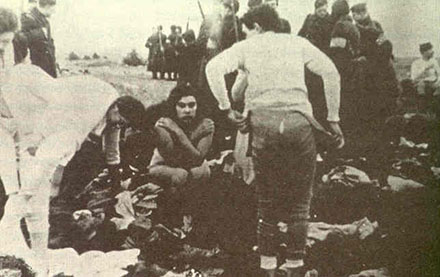
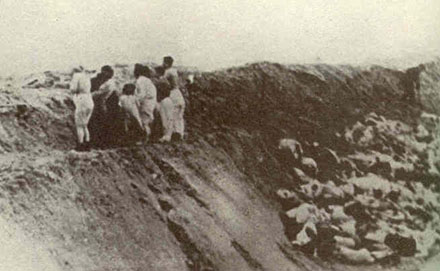
The World War II occupation of the Latvian town of Liepaja (Libau, to the Germans) produced mass executions throughout 1941.
This date in 1941 commenced one of the largest such actions: over 2,700 Jews as well as 23 Communists forced over the course of two-plus days to strip on the freezing Skede dunes overlooking the Baltic and there shot by German and Latvian teams into a vast pit. It’s one of the most recognizable Holocaust atrocities because it was extensively photographed.*
As one can see from the pictures, the victims here were mostly women.
Some of the women in this photographs can be identified by name (pdf). Left to right: (1) Sorella Epstein; (2) presumably Rosa Epstein, her mother; (3) unknown; (4) Mia Epstein; (5) unknown. Alternate identification makes Mia Epstein (5) instead of (4), and (2) Pauline Goldman.
* Germany’s Bundesarchiv (search on Libau 1941) confirms the precise December 15 dating for these images; it also has some other photographs of atrocities in Liepaja/Libau on other occasions.


 Bloch-Serazin
 A Catholic priest (defrocked for the occasion of his execution) who had previously gone to prison for his nationalist sympathies, Matamoros joined the revolutionary army of fellow-clergyman
  Standing just 5′ 3″ on tippytoe, Rinnan (