2013: A day in the death penalty around the world

United States

The first U.S. execution of 2013 was that of Robert Gleason, Jr. in Virginia last January 16.

Gleason was serving a life sentence for another murder when he conned a fellow-prisoner into letting him tie his hands as part of a supposed escape attempt. Instead, Gleason choked the poor bastard to death with a urine-soaked sponge.

The killer said he did this precisely in order to be executed.

“I murdered that man cold-bloodedly,” he told a reporter in 2010. “I planned it and I’m gonna do it again. Someone needs to stop it. The only way to stop me is to put me on death row.”

He was as good as his word. That summer, he got a necklace around the throat of a prisoner in a neighboring solitary pen and horribly throttled him to death. Virginia obliged Gleason’s heart’s desire with a death sentence that the killer did not contest.

Unusually, Gleason chose to die in the state’s 104-year-old oak electric chair, rather than by lethal injection. Virginia at the time was one of 10 states still allowing an inmate to choose electrocution, but Gleason was the first person to do so since 2010.

His last words: “Well, I hope Percy ain’t going to wet the sponge. Put me on the highway to Jackson and call my Irish buddies. Pog mo thoin. God bless.” As was widely reported after the fact, Pog mo thoin is Gaelic for “kiss my ass.”

His last words — and everything else about him — are remembered here by a reporter who got to know Gleason during his three-year journey to the death chamber.


Somalia

Dennis Allex, an agent of French intelligence held captive for over three years by al-Shabaab militants, was allegedly summarily executed on January 16 following an unsuccessful French raid to free him.

Allex, whose name is thought to be a pseudonym, had been seized in Mogadishu in 2009 and forced during his captivity to broadcast his captors’ demands.

Following the French intervention in Mali last January — an event potentially raising the danger for French hostages throughout the Islamic world — a commando unit attempted to free Allex on January 12.

The French suspect that Allex might have been killed during that operation. His captors, however, claimed that Allex survived it, and that they thereafter “reached a unanimous decision to execute the French intelligence officer, Dennis Allex.

“With the rescue attempt, France has voluntarily signed Allex’s death warrant”


Iran

On this date in 2013, Iran hanged a man in public in the city of Sabzevar.

Also in Sabzevar on the same day, another man suffered a spectacular public lashing.

Still another prisoner was reportedly hanged privately in Mashhad on January 16 in Iran.

On this day..

1876: Michael DeHay, in fire and maddened frenzy

(Thanks to Michael DeHay for the autobiographical guest post, originally published — too late for DeHay to see the byline — in the Prescott, Arizona Miner‘s January 21, 1876 edition. Prescott’s Sharlot Hall Museum unearthed this fascinating frontier confessional and posted it on its library archives site. The Prescott Daily Courier also published an abridged version, complete with an old photo of 1870s Cerbat (it’s a ghost town today). -ed.)

I, Michael DeHay, being fully aware of my approaching fate, and though recognizing the justice of my sentence, feel impelled to give to the world this, my dying statement, hoping that my fate may prove a warning to others similarly situated as I have been, and praying that the circumstances which have hurried me on to a disgraceful end may be avoided by others so situated.

I was born in Mongoup, Sullivan Co., N.Y., April 10, 1830, and am now 45 years of age. At 18 years of age, I went to Greenwood, McHenry Co., Ill., where my father and family had previously settled. In 1850 I went to California — crossing the plains. For three years I was mining and prospecting in different places there, and then returned to Illinois; afterwards going to Minnesota and thence to Wisconsin, where in 1856 I became acquainted with and married Esther Hemstock, near La Crosse.

In 1857 I returned to California with my family, where I remained for four years, working at mining and at my trade as a carpenter. These dates may not be correct, as I have only my memory to rely on, but they are as near as I can now remember.

In 1861 I removed to Nevada with my family; lived at Aurora in Esmerelda County, about seven years or until 1868, and then removed to White Pine, and the next Spring to Pioche, and thence to Parabnega Valley in Lincoln County, where my family resided, until in August 1875, at which time I was at work in Groom District (60 miles distant from my family), as there was no work nearer my home where I had a ranch.

I was working to get money ahead with which to remove my family to some place where I could educate my children, whom I deeply love. I was one of a Committee to get a school started, and had hired a teacher and made arrangements to remove my family to Hiko (NV). At this time, when I was filled with bright hopes for the future for my children, I was almost crazed to learn that my wife had left my home, taking with her my children, team and wagon and most of my household goods, and had started towards Arizona with a Mr. Suttonfield, an entire stranger to me, and who I learned had camped for a few weeks on my ranch. The man who gave me this information was a Constable, who at the same time served a summons on me in favor of Mr. Wilson, a store keeper, for $51, most of which my wife had obtained in supplies just before leaving for Arizona.

I immediately returned to my desolate home, and the next day started in pursuit. My first and great object in following was to get possession of my dear children. I passed them at Chloride, six miles from Mineral Park, where they had camped. Had I then followed the dictates of my almost crazed brain, I should have then and there stopped and shot both the man and woman who had, as I felt, brought ruin on both myself and children, but my better judgment prevailed and I went on to Mineral Park and laid my case before Mr. Davis, to whom I had been recommended to go for advice. Under his advice, I got out a process and had them brought into Mineral Park, but nothing came of it.

I then got a house for my family to live in, and went to work and got provisions for us to live on. I did all I could to make them comfortable, and tried by every means to induce my wife to live with me as before and was willing to forgive the past. To all my appeals she turned a deaf ear, continually declaring that she never would resume her marital relations with me.

During this time I was informed that she, from time to time, met Suttonfield at his house. This continued pressure upon my mind affected me both by day and night. I was troubled with horrid dreams, and at times was nearly crazed. The night the act was committed, I was completely weighed down with trouble and sorrow, and being suddenly awaked from my troubled sleep saw, or thought I saw, my wife standing over me with a butcher-knife in her hand. She had been sleeping in one room in our only bed with some of the children, and I in an adjoining room on the floor.

When I was thus suddenly awakened, I jumped up, clutching my revolver which was under my head and rushed after her into her room. She jumped into the bed and curled down, and I, in my frenzy, fired at her and drew her out on to the floor. When I saw the blood, and saw what I had done, I was horror-struck and rushed out of the house, determined to take my own life, and with this intent, placed my pistol to my breast and fired twice. I then ran down town and for hours have but a faint recollection of what occurred, except that I went up and down a ladder into a hay-loft. At the time I committed the deed, my brain seemed to be on fire and that my head was the center of fire and maddened frenzy.

During all the time after my arrival at Mineral Park, I had never thought or meditated on the murder of my wife, or to revenge myself on her for her act of desertion, but I had at times meditated on revenge upon Suttonfield, as I felt that he was the cause of all my misery. I had never had any serious difficulty with my wife more than a few hasty words such as are likely to occur between other husbands and wives.

I make this statement with a full knowledge that my end is drawing nigh, and that another day will launch me into eternity, where I shall meet my Maker face to face. I forgive all who have wronged me, as I hope myself to be forgiven by a kind and merciful God.

On this day..

1809: Seven Valladolid ruffians, by Napoleon

Upon this a question arises: whether it be better to be loved than feared or feared than loved? It may be answered that one should wish to be both, but, because it is difficult to unite them in one person, is much safer to be feared than loved, when, of the two, either must be dispensed with. Because this is to be asserted in general of men, that they are ungrateful, fickle, false, cowardly, covetous, and as long as you succeed they are yours entirely; they will offer you their blood, property, life and children, as is said above, when the need is far distant; but when it approaches they turn against you. And that prince who, relying entirely on their promises, has neglected other precautions, is ruined; because friendships that are obtained by payments, and not by greatness or nobility of mind, may indeed be earned, but they are not secured, and in time of need cannot be relied upon; and men have less scruple in offending one who is beloved than one who is feared, for love is preserved by the link of obligation which, owing to the baseness of men, is broken at every opportunity for their advantage; but fear preserves you by a dread of punishment which never fails.

–Machiavelli, The Prince

This date in 1809, Napoleon gave that dread of punishment to the Spanish with the execution of seven insurgents at Valladolid, where he had come to collect grudging oaths of loyalty from that conquered nation’s grandees to his brother and puppet king Joseph.

We get this entry from Adolphe Thiers‘ History of the consulate and the empire of France under Napoleon. We’ve added some paragraph breaks for readability.

Napoleon very distinctly discerned in the alleged devotion of the Spanish people for the house of Bourbon the demagogue passions that stirred them, and which took that strange way to manifest themselves; for it was the most violent democracy under the appearance of the purest royalism.

This people, extreme in all things, had in fact begun again the work of assassination in revenge for the disasters of the Spanish armies. Since the murders of the unfortunate marquis de Parales in Madrid, and of Don Juan Benito at Talavera, they had massacred in Ciudad Real Don Juan Duro, canon of Toledo, and a friend of the prince of the Peace; and at Malagon, the ex-minister of finance, Don Soler. Wherever there were no French armies, honest men trembled for their property and their lives.

Napoleon, resolving to make a severe example of the assassins, ordered the arrest in Valladolid of a dozen of ruffians known to have been concerned in all the massacres, particularly in that of the unfortunate governor of Segovia, Don Miguel Cevallos; and he had them executed, notwithstanding the apparent entreaties of the principal inhabitants of Valladolid.

“You must make yourself feared first, and loved afterwards,” was his frequent remark in his letters to his brother. “They have been soliciting me here for the pardon of some bandits who have committed murder and robbery, but they have been delighted not to obtain it, and subsequently everything has returned to its proper course.”

Our historian encloses as a footnote the text of a Napoleonic correspondence, documenting not only this date’s particular entry into the annals of execution but the Corsican’s methods generally.

The historian Thiers, it transpired, would soon be called upon to implement the sanguinary lessons of his study.

To the king of Spain

Valladolid, January 12, 1809 — noon.

The operation effected by Belliard is excellent. You must have a score of rascals hanged. To-morrow I hang seven here, notorious for having committed all sorts of atrocities, and whose presence was an affliction for the honest folks who secretly denounced them, and who are recovering courage since they are quit of them. You must do the same in Madrid. If a hundred incendiaries and brigands are not got rid of there, nothing is done. Of these hundred have a dozen or fifteen shot or hanged, and send the rest to France to the galleys. I have had quiet in France only in consequence of arresting 200 incendiaries, September murderers, and brigands, whom I sent off to the colonies. Since that time the tone of the capital changed as if at a whistle.

On this day..

1830: William Banks, housebreaker

On this date in 1830, William Banks, the leader of a gang of West Moulsey robbers was hanged at London’s Horsemonger Lane Gaol.

Despite a freezing day and a ferocious northerly wind that newsmen enhanced “almost to a hurricane” (London Morning Chronicle, January 12, 1830), a vast concourse of onlookers turned out to witness the execution.

The case attracted such enormous public interest for the boldness of the thieves in plundering the home of a Rev. William Warrington and his wife. That couple “had just undressed for bed,” explain the newspapers (this the Dec. 30, 1829 London Morning Chronicle), “when they were alarmed by the sound of several footsteps walking towards the door of their room.”

Mr. Warrington grabbed for a pistol he kept at the ready as the gang barged into the room, but couldn’t get a shot away before both were seized, trussed up, and deposited in the cellar with two tied-up maids.

Having the place at their disposal now, the robbers made a leisurely search of chests, drawers, cupboards, and the like and loaded up the domestic valuables on one of the house’s own gigs, finally driving it off under the locomotion of one of the house’s own horses at about 4 in the morning.

Though widely reported at the time it happened — way back in November 1828 — there was no break in the case until a year later when a gang member in prison on an unrelated case started informing against them in exchange for a remittance of his own punishment.

The gang’s leader, our man William Banks, “had repeatedly sworn that he would not be taken alive,” the Morning Chronicle reported in its January 12, 1830 account of the hanging. But with a gun literally to his head, he thought better of resistance and surrendered with the accurate prophecy, “I am a dead man.”

Even in 1830, housebreaking was among the two hundred-odd non-homicide crimes eligible for a capital sentence by the terms of England’s Bloody Code; indeed, Frank McLynn observes that it “was treated particularly harshly, as it violated privacy and exposed householders to assault.”

Banks, “a dark but handsome and very muscular man” of 35, dismayed the chaplain with his indifference to his spiritual salvation — for “all he cared about hanging was the pain it would give him, for he knew nothing about a hereafter.”

England in the early 1830s abolished the death penalty for a number of property crimes, including (in 1833) housebreaking.

On this day..

1430: Ten men beheaded, and an eleventh man married

(Thanks to Sabine Baring-Gould for the guest post, from this piece on Helene Gillet‘s miraculously surviving her beheading. -ed.)

In the Middle Ages there were two chances of life at the last moment accorded to a malefactor condemned to death, besides a free pardon from the sovereign. One of these was the accidental meeting of a cardinal with the procession to execution; the other was the offer of a maiden to marry the condemned man, or, in the case of a woman sentenced to death, the offer of a man to make her his wife.

The claim of the cardinals was a curious one. They pretended to have inherited the privileges with which the vestal virgins of old Rome were invested. In 1309 a man was condemned to be hung in Paris for some offence. As he was being led to execution down the street of Aubry-le-Boucher, he met the cardinal of Saint Eusebius, named Rochette, who was going up the street. The cardinal immediately took oath that the meeting was accidental, and demanded the release of the criminal. It was granted.

In 1376, Charles V was appealed to in a case of a man who was about to be hung, when a young girl in the crowd cried out that she would take him as her husband. Charles decreed that the man was to be given up to her.

In 1382, a similar case came before Charles VI, which we shall quote verbatim from the royal pardon.

Henrequin Dontart was condemned by the judges of our court in Peronne to be drawn to execution on a hurdle, and then hung by the neck till dead. In accordance with the which decree he was drawn and carried by the hangman to the gibbet, and when he had the rope round his neck, then one Jeanette Mourchon, a maiden of the town of Hamaincourt, presented herself before the provost and his lieutenant, and supplicated and required of the aforesaid provost and his lieutenant to deliver over to her the said Dontart, to be her husband. Wherefore the execution was interrupted, and he was led back to prison … and, by the tenor of these letters, it is our will that the said Dontart shall be pardoned and released.

Another instance we quote from the diary of a Parisian citizen of the year 1430.* He wrote:

On January 10, 1430, eleven men were taken to the Halles to be executed, and the heads of ten were cut off. The eleventh was a handsome young man of twenty-four; he was having his eyes bandaged, when a young girl born at the Halles came boldly forward and asked for him. And she stood to her point, and maintained her right so resolutely, that he was taken back to prison in the Chatelet, where they were married, and then he was discharged.

This custom has so stamped itself on the traditions of the peasantry, that all over France it is the subject of popular tales and anecdotes; with one of the latter we will conclude.

In Normandy a man was at the foot of the gibbet, the rope round his neck, when a sharp-featured woman came up and demanded him. The criminal looked hard at her, and turning to the hangman, said: —

A pointed nose, a bitter tongue!
Proceed, I’d rather far be hung.

* This would have been during the English occupation of Paris in the Hundred Years’ War, even as Joan of Arc was delivering the country from the hands of its antagonists.

On this day..

1865: Henry Regley and Charles King, General Sheridan’s deserters

On this date in 1865, two Union soldiers were shot as spies at Winchester, Virginia.

Union General Philip Sheridan and his famed Napoleon complex* were wintering in Winchester, Va. where he had recently clinched northern control of the Shenandoah Valley, and put its fertile farmlands to the torch to cripple the rebel army.

Sheridan, who had in the course of that campaign made his lasting fame by rallying his troops after an initially devastating Confederate surprise attack, was highly concerned at the prospect of rebel spies and infiltrators.

Our two poor fellows, Henry Regley and Charles King, were actually nothing of the sort — just bounty jumpers who donned the blue uniform to collect a cash reward for joining up, and then deserted at the first opportunity. Given the state’s primitive tools in the 1860s for monitoring individual citizens or verifying identity, many bounty jumpers simply repeated the enlistment-desertion cycle several times.

Being shot as a deserter was one of the occupational hazards — a small one, but a real one. But being shot as a spy? Well, General Sheridan was on the lookout.

These deserters on their way out of camp happened to bump into a patrol of “Confederates”: actually a Union detail Sheridan had uniformed like the enemy for sneaky reconnaissance. What ensued next was your basic comedy of mistaken identity … with a double execution at the end.

The following is a newspaper dispatch filed a few day later by one of their fellow soldiers writing under the pen name “Manatom” for the Newark Daily Advertiser; it comes from New Jersey Butterfly Boys in the Civil War: The Hussars of the Union Army

Henry Recli [sic] of Co. L and Christian A. Gross, alias Charles King of the same Company, a German by birth, left the regiment while at the present camp. A party of scouts led by Major [Young] of Gen. Sheridan’s staff, at their head, dressed in rebel uniforms met these men up the valley, a number of miles outside the picket lines. As they conversed with them, the deserters supposing them to be genuine rebels, gave them the contraband information, and stated that they had been trying to desert for some time. They assented to a proposal to exchange clothing, and then were arrested.

I am informed by Chaplain John L. Frazee, whose trying duty it was to be with the condemned during their last hours, that both persisted in their innocence to the last. When told by the Provost Marshall Lee, that they were to die at noon, they said they knew that the night before, when they were in Winchester, at which place Gross, who had always signed his name as Charles King, wrote a letter to friends in Philadelphia, signed Christian A. Gross, in which he expressed his doubts of the carrying out of the sentence. The chaplain believes this idea deceived them until the last moment, although they yielded a sort of mechanical compliance with the solemn services held with them in private, and kneeled in prayer before being taken from prison.


Private Friederich Jaeckel’s drawing in his diary of the two deserters, again via New Jersey Butterfly Boys. Though that book’s caption places this on January 6, 1864, context suggests this must in fact be our 1865 incident; there is no indication I can find of an executed pair in the army dating to exactly one year before.

The details of the execution of this kind are terribly formal and impressive. Fully three thousand cavalrymen were drawn upon three sides of a square upon a gentle slope a little way from headquarters. Each regimental and brigade staff was with its organization and centrally stationed was Gen. Custer and his staff and body guard. When the Division was arranged, Provost Marshall Lee gave orders that the condemned should be brought forth, and thoroughly unused as I was to seeing death in that shape, the memories clustering about that slow moving group, seem as if burned in my brain.

The Provost Marshall, preceded by the band, with a small body guard, led — then the firing party, made up of twelve picked men from our own regiment. A large open wagon, drawn by four white horses, came next — in which there were two coffins, upon each of which sat a doomed man riding backwards, with feet ironed and hands tied behind. Each had a long white scarf about the head. Besides these rode the Chaplain and a proper guard dismounted closed the rear.

The fine brigade band, which had marched in silence until near the Division, when the first side of the square was reached, began playing a Dead March, and thus did this little group march slowly around inside the whole army, and at last halt at an open grave — dug in the center.

The men were now lifted from the wagon, the Coffins duly placed, and the men seated as before facing the whole Division. Marshall Lee then, from his horse, read the order and warrant … brief religious services were held, the Chaplain reading a portion of the burial service, and offering prayer for the condemned. Neither had anything to say, and the Chaplain retired a few paces. The faces of the men were then covered, and the firing party quickly drawn up in line with pieces previously carefully loaded and placed in their hands. One of the twelve had, by a merciful regulation in the Articles of War, a blank cartridge, and each comrade had the hope that he should send no fatal ball.

More rapidly than I can trace this account was the preparation done. Ten paces off stood the line — each man sternly appreciative of his fearful duty.

“Attention” Ready! Aim! Fire! The report was almost as if one carbine had responded. Two bodies fallen backwards and dead were all that remained of Recli and Gross. The surgeon in a few moments pronounced life extinct; and the scene closed by marching the whole body of troops past their Coffins, lying as they fell — this most solemn warning one can imagine to the soldier — to be faithful to himself, his oath and his Country. MANATOM

* Abraham Lincoln’s hilarious description of the 1.65-meter (5′ 5″) “Little Phil”: “A brown, chunky little chap, with a long body, short legs, not enough neck to hang him, and such long arms that if his ankles itch he can scratch them without stooping.”


General Sheridan

On this day..

1568: Eighty-four Valenciennes iconoclasts

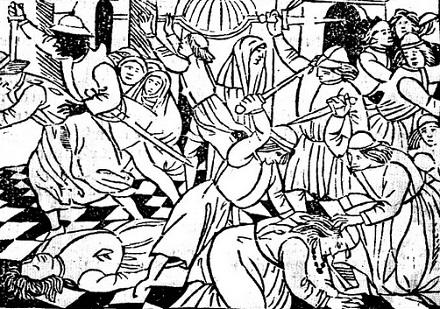
This date in 1568 saw the mass execution of 84 people in Valenciennes for participating in the Low Countries’ Calvinist movement against Catholicism’s longstanding use of images and icons to project its cosmology.

In his In Praise of Folly, the humanist Erasmus — a Dutchman, mark — jibed at those who

attribute strange virtues to the shrines and images of saints and martyrs, and so would make their credulous proselytes believe, that if they pay their devotion to St. Christopher in the morning, they shall be guarded and secured the day following from all dangers and misfortunes: if soldiers, when they first take arms, shall come and mumble over such a set prayer before the picture of St. Barbara, they shall return safe from all engagements: or if any pray to Erasmus on such particular holidays, with the ceremony of wax candles, and other fopperies, he shall in a short time be rewarded with a plentiful increase of wealth and riches.* The Christians have now their gigantic St. George, as well as the pagans had their Hercules; they paint the saint on horseback, and drawing the horse in splendid trappings, very gloriously accoutred, they scarce refrain in a literal sense from worshipping the very beast.

Those words were published just a few years before Martin Luther nailed his earthshaking theses to the church door in Wittenberg. Erasmus’s critique of the Catholic Church never extended so far as leaving its fold, but for observers who bent more towards revolution than reform, the adoration of these graven images could easily read as simple idolatry just this side of Golden Calf territory — and in this they harkened back to a venerable strain of iconoclasm within Christianity.

This was far from Luther’s own chief concern, but many other preachers and proselytizers thundered against the statues and paintings that stood in for the divine — and arguably, came to be venerated as if they were the divine. “[These] images are not to be endured, for all that God has forbidden, there can be no compromise,” said the Swiss theologian Huldrych Zwingli, under whose leadership icons were pulled down in Zurich churches as early as 1523.

Iconoclastic effusions followed elsewhere in Europe, tracking the spread of the various Protestant strains. John Calvin, himself driven to refuge in Switzerland, took a similar anti-icon line. It was Calvin’s theology that inspired the French Huguenots, and Huguenot iconoclastic demonstrations began occurring in the north and east of France from about 1560.

They soon spread to the neighboring Reformation-minded Habsburg possessions.

The so-called Beeldenstorm, or “Iconoclastic Fury”, broke in the town of Steenvorde near the southwestern fringe of the Low Countries. (In fact, it’s in France in the present day, as is Valenciennes, the site of our titular execution.) On St. Lawrence’s Day of 1566 — August 10 — a Calvinist mob invaded a church dedicated to that saint and stripped it of its idolatrous garnishes.

From Steenvorde, the storm raced north, gathering strength. Within days, it had deluged cities large and small throughout the Low Countries: formerly retiring heretics now bold and impious enough to assail Catholicism’s sacred emblems. They did not only pull down icons in churches — but in rectories, hospitals, universities. “We have had this night past a marvelous stir,” the Welsh cloth-merchant Richard Clough wrote on August 21 from Antwerp, the continent’s commercial capital. “All the churches, chapels and houses of religion utterly defaced, and no kind of thing left whole within them, but broken and utterly destroyed.”

In France, Catholic enragees mobilized in response, here repulsing an iconoclast raid and there sparking a street brawl. But in the Low Countries the iconoclasts faced much scantier resistance; even the authorities practically stood down — either enervated, or sympathetic.

This storm naturally shocked faithful Catholics. Rioters “defaced the painted images, not only of Our Lady but of all others in the town. They tore the curtains, dashed in pieces the carved work of brass and stone, brake the altars, spoilt the clothes and corporesses, wrested the irons, conveyed away or brake the chalices and vestiments, pulled up the brass of the gravestones … trod [the altar] under their feet and (horrible it is to say!) shed their stinking piss upon it,” an expatriate English theologian lamented from Louvian.


Frans Hogenberg‘s etching “The Calvinist Iconoclastic Riot of August 20, 1566” depicts iconoclasts attacking the Cathedral of Our Lady at Antwerp.

According to Carlos Eire there were some 400 iconoclast incidents in Flanders alone over the summer and fall of 1566.

Every prince in Europe was put to the test by the Reformation movements of the 16th century. Few answered with less finesse than Philip II, the fervently Catholic King of Spain who counted the Low Countries among his vast patrimony and viewed altar-pissing in Catholic churches as lese-majeste stacked upon sacrilege.

The iconoclastic disturbances led Philip to dispatch his best general, the Duke of Alba (or Alva) to suppress these rebellious subjects (and eventually, to lose his glasses). He replaced Philip’s half-sister Margaret of Parma in both position and approach: in vain did Margaret warn her successor against destroying the loyalty of these provinces with excess rigor. Alba’s mission was to handle the Low Countries roughly, and he did not fail to do it.


Simon Frisius‘s engraving of the Council of Troubles.

Setting up a drumhead tribunal known as the “Council of Troubles” — very soon popularly denoted the “Council of Blood” — the Iron Duke began wreaking havoc on enemies actual, perceived, potential, and in more than a few cases, not at all.

Through all these months the frightful cruelties of the blood-judges were continued. Every day the executions took a wider sweep. “I would have every man feel that any day his house may fall about his ears,” wrote Alva to the king. Of this benevolent wish he made a fact. Men of all creeds and of none felt equally insecure. The Romanists themselves, the most sturdy and devoted of them, shuddered and rubbed their necks, to be sure that their heads still rested upon their shoulders as they glanced towards Egmont‘s prison at Ghent. “The fury of the persecution spreads such horror throughout the nation,” said Orange at the time, “that thousands, and among them some of the principal papists, have fled the country where tyranny is direct against all.”

The blood-judges flooded the land with citations; but so certainly did conviction follow an appearance at their bar, that few responded, while such as did were not were condemned to exile and to suffer the confiscation of their estates for contumacy; or if caught, they were beheaded without trial. Those who, strong in innocence, ventured to brave an examination, were inevitably doomed.

Maybe the most outrageously illustrative case was a man named Peter De Witt** in Amsterdam. His crime was persuading a rioter not to shoot a magistrate — this being held to imply a level of esteem among the amok heretics incompatible with correct devotion to God and King.

In batches of forty, fifty, and even a hundred, men, women and children were led out to indiscriminate death. On one occasion, ninety-five miscellaneous individuals, collected from various parts of Flanders, were butchered in company. At another time forty-six of the citizens of Malines were decapitated. On the 4th of January, 1568, eighty-four persons, charged with participating in the tumults, were executed together in the public square at Valenciennes.

The (helpfully dated) bloodletting we mark with this date’s post was itself no more representative of the Council of Troubles than any other, collectively amounting to uncounted thousands whose martyrdom — to creed, country, or both — would stir the Dutch Revolt and, eventually, the independence of the Netherlands from Spain.

* A wry reference to the writer’s namesake saint: Erasmus the humanist was perpetually short of cash, and at one point forced into monastic vows by his penury. (Erasmus the saint is not actually the patron of anything related to wealth.)

** No kinship that I’m aware of with the Dutch Republic’s leader a century later, Johan de Witt.

On this day..

1945: An unfortunate woman, name and nationality unknown


AP caption: “The expression on the face of this Hun posing for the camera standing by the gallows from which a woman is hanging, Jan. 3, 1945 shows a lack of concern. The name and nationality of the unfortunate woman is unknown. One of the many victims of Nazi terror. The German soldiers seem to be quite used to this kind of sights for them a picture like this is just a souvenir.” (Via)

On this day..

1477: Gerolamo Olgiati, ducal assassin


Dramatization of events in this post for the video game-derived film Assassin’s Creed: Lineage.

On this date in 1477, the assassins of the Duke of Milan suffered bitter death for fame eternal.

Famous for both his astute political machinations and for cruelty verging on the sadistic, Galeazzo Maria Sforza inherited leadership of Milan in at the age of 22 with the passing of his father, the great condottiero Francesco Sforza.

Francesco, the founder of the Sforza dynasty, had dynastically married himself to one Bianca Maria Visconti, a daughter of Milan’s previous ruling house.* But not all of the Visconti were at home with the Sforza.

A brash young man of that noble family, Carlo Visconti, as full of humanistic idealism as he was of bile for the licentious Duke’s alleged violation of his sister, joined a conspiracy also compassing two other gentlemen, Giovanni Andrea Lampugnani and Gerolamo Olgiati, to do Galeazzo Sforza to death.

At a St. Stephen’s Day service in a basilica christened to Stephen Lampugnani approached the prince feigning supplication for some audience, then produced a hidden blade and stabbed Galeazzo Sforza. Visconti and Olgiati then rushed on Sforza as well and before anyone realized what was happening the Duke, croaking some half-heard invocation of Mary, was falling dead on the church floor.


Illustration of Galeazzo Sforza’s murder on the title page of a 1476 Lament for the Duke decrying the assassination.

Pandemonium ensued, and in the ensuing helter-skelter, Sforza’s bodyguards fell on Lampugnani and killed him on the spot, while Olgiati managed to escape.**

“It now only remains for us to consider those dangers which follow after the execution of a plot,” Machiavelli mused in his “Of Conspiracies” typology of his Discourses. “These in fact resolve themselves into one, namely, that some should survive who will avenge the death of the murdered prince. The part of avenger is likely to be assumed by a son, a brother, or other kinsman of the deceased.”

Well, yeah.

The assassins of the Duke of Milan appear not to have burdened themselves overmuch with advance consideration of this danger, possibly indulging the dream of Brutus that by a dagger’s stroke alone they could restore the lost republic.

Needless to say, this beautiful hope vanished in the bloody revenge carnival that actually ensued the murder. Just a few days after the assassination, having taken refuge with a priest — his justly frightened family had closed its door on him and needed to make theatrical denunciations of his treason for their own safety — Olgiati was captured, put to a torturous interrogation, and publicly butchered. He had outlived the Duke by only a week, and his gashed carcass was hung up in sections around town by way of warning. The rotting heads of the conspirators remained impaled on lances on the city’s bell tower well into the 1490s.

According once again to Machiavelli, Olgiati “exhibited no less composure at his death than resolution in his previous conduct, for being stripped of his apparel, and in the hands of the executioner, who stood by with the sword unsheathed, ready to deprive him of life, he repeated the following words, in the Latin tongue, in which he was well versed

“‘Mors acerba, fama perpetua, stabit vetus memoria facti.'”

That is,

‘Death is bitter but fame is eternal, and the memory of the deed will endure.’

This attempt, quixotic and doomed, to depose an Italian tyrant by murdering him in church might well have formed the blueprint for a similar plot in Florence in 1478, the Pazzi conspiracy. That version was even less successful than its Milanese predecessor: at least Olgiati and company could say that they actually managed to kill their target before everything else hit the fan.

And republic or not, Sforza’s murder did shake up the polity. It put the Duchy of Milan in the hands of his wife, as the unsteady regent of a seven-year-old heir. A few years later, the late duke’s brother Ludovico displaced the regent and effectively bossed Milan until the French imprisoned him in 1500 during the Italian Wars.

While he had the run of the place, Ludovico Sforza commissioned of Leonardo da Vinci a monumental equestrian statue in memory of his brother that da Vinci never finished.† Quite strangely, the master’s notes were plumbed by a 20th century Pennsylvania airline pilot who dedicated the latter part of his life to actually casting “Leonardo’s Horse”.

* The names Visconti and Sforza are also associated with some of the earliest tarot decks and among the first to introduce to playing cards the use of trionfi, or “triumph” cards — that is, “trumps”. One can readily purchase present-day reprints of this historic pack.

** There is a positively maddening inconsistency, thus far irresolvable for this author, between accounts (here’s one example | and another) asserting that Carlo Visconti was slain by Sforza’s bodyguards directly after the assassination, and other accounts (like Gregory Lubkin’s 1994 history of Sforza’s Milan) that put Visconti on the scaffold beside Olgiati.

† Da Vinci’s ponderously slow progress on this high-profile project led Michelangelo to cattily impugn the rival artist’s bronze-casting aptitude.

On this day..

1868: Thomas Jones, bad uncle

(Thanks to Meaghan Good of the Charley Project for the guest post. -ed.)

Four days after Christmas in 1868, Thomas Jones was executed in London, Ontario for one of the most sensational murders perpetrated in the region at the time. He had brutally slaughtered his twelve-year-old niece in the town of Delaware.

Early that year, according to this article on the case, Jones had tried to rob his own brother’s house while wearing a false beard to disguise his identity. Unfortunately for him, young Mary Jones recognized her uncle and subsequently testified against him in the ensuing trial. Thomas Jones held this against her, as did Thomas’s daughter Elizabeth, who was thirteen.

On June 11, 1868, Mary’s mother sent her to Uncle Thomas’s house to fetch a cup of flour. (One wonders why she did so, given the history of bad blood between uncle and niece.) Mary never returned.

Suspicion inevitably fell on Thomas, who insisted she’d come and gotten the flour and left his home alive and well. Forty-eight hours after Mary’s disappearance, the search party got fed up, grabbed Thomas’s ten-year-old son and threatened to kill him if he didn’t tell what happened to his cousin.

The boy led them to her body, hidden in the woods under a fallen tree. Her skull had been fractured.

According to the child, both his father and his sister Elizabeth had participated in Mary’s murder. Public feeling ran high against the accused and the entire family had to be taken into custody and transported from Delaware to London to avoid a possible lynching. Only Thomas and Elizabeth faced murder charges, but according to this account, Thomas’s wife and younger son were kept in jail for four months and his two older sons, both in their teens, remained there until well after their father’s death.

The prosecution’s theory was that either Thomas had murdered his niece after Elizabeth lured her into the woods at his direction, or Thomas talked Elizabeth into committing the murder.

At trial, Elizabeth tried to take the rap for her father, claiming she’d beaten Mary to death entirely on her own and Thomas had only helped her hide the body. Thomas’s youngest son testified in support of this, saying he’d witnessed his sister striking Mary with a club.

Thomas used his underaged daughter’s statements like a shield — he would maintain his innocence to his dying breath — but in the end the jury convicted him of murder. What may have tipped the balance was the medical evidence, which indicated Mary had been dealt some powerful blows, stronger than a child could have inflicted.

Elizabeth was convicted of manslaughter and sentenced to ten years for her role in the crime, in spite of her youth. The older two of Thomas’s three sons, ages seventeen and fifteen, were finally released without charge in the spring of 1869. Elizabeth served seven years before she was freed.

In spite of the bitter cold many residents of Delaware came to watch Thomas hang at the Middlesex County Gaol. Around six thousand people were in the crowd — approximately half the population of London. This would be the last hanging in Middlesex county.

On this day..