1307: Fra Dolcino, Apostle

On this date in 1307, radical preacher Fra Dolcino was gruesomely put to death in a daylong public torture at the Piedmontese town of Vercelli.

Dolcino was the millenarian successor of Gerard Segarelli, whose itinerant commune of impoverished penitents — Apostles, they called themselves, to the chagrin of the Church hierarchy — had attracted followers for near half a century before the powers that be smashed it.

The shade of the burned firebrand (and the corporeality of his refugee onetime followers) haunt the murderous monastery of Umberto Eco’s The Name of the Rose. Here, the paternal Franciscan unraveling the novel’s mystery explains Fra Dolcino’s illicit movement to his naive protege.

We were talking about those excluded from the flock of sheep. For centuries, as pope and emperor tore each other apart in their quarrels over power, the excluded went on living on the fringe, like lepers … all of them were ready to hear, or to produce, every sermon that, harking back to the word of Christ, would condemn the behavior of the dogs and shepherds and would promise their punishment one day. The powerful always realized this. The recovery of the outcasts demanded reduction of the privileges of the powerful, so the excluded who became aware of their exclusion had to be branded as heretics, whatever their doctrine …

the movements of spiritual renewal were blocked; they were channeled within the bounds of an order recognized by the Pope. But what circulated underneath was not channeled. It flowed, on the one hand, into the movements of the flagellants, who endanger no one, or into the armed bands like Fra Dolcino’s …

From the cinematic adaptation of The Name of the Rose. The monk’s semi-coherent summons to “penitenziagite” is significant because it marks him as a former adherent of the penance-focused movement. An Italian metal band called Dolcinian had a song (and album) of that exact title.

But were they really an “armed band”?

Executed Today is pleased to mark this portentous anniversary in conversation with historian Dr. Jerry Pierce, currently working on a book about the outlaw movement.

ET: Who were the Dolcinians?

JP: A lot of people get kind of caught up in the Dolcino part. It’s not about him until the very end.

The group itself originated in 1260, and it lasted 40-some years before it ran into any trouble. Their whole goal when they start is essentially, live a life of poverty like the original Apostles. And apparently that’s a problem for people later.

That’s really all it was about. It’s communal living, it’s not owning things at all, including houses. By 1260, they were better Franciscans than the Franciscans were.

And the Franciscans had a big presence in the city of Parma, where this thing got started, so they were slightly peeved.

So it’s a challenge to the Franciscans?

It’s not trying to show up the Franciscans, but it becomes a challenge.

The “Apostles” wander around, they beg for their food, they tell people to do penance.

The early Franciscans started off the same way, all about poverty, but once they became established, the order became all about money.

And the Apostles are not the only ones mounting this challenge.

Right. Waldensians in France predate the Franciscans by about 30 years or so.* You just have a guy in France who’s a businessman who hears a reading of the gospel saying to give up your possessions and follow Christ. And that’s what he does. He even pays someone to translate the Bible into vernacular French, which is a big no-no.

His group and Segarelli’s group are not an issue as long as they don’t say anything about the doctrine. So long as they don’t say anything about the Trinity or the Eucharist, they’re just calling people to penance — they’re okay.

But the reason these groups come along is that in that period, around 1150 — Europe is experiencing a big economic change. The haves are on the side of the church. This is the core of all of them, and it’s the core of the Dolcino philosophy as well — the church is preaching poverty, but it’s living wealthy.

So they were doing something within the practice of the Church’s community for decades. How did they get so dangerously on the outs?

The bishop of Parma actually patronizes the Apostles and grants indulgences to people who give money to them. They’re not just some kooky group that’s out there even though the main writings about them are by their opponents.**

But what happens is they become really, really popular, and people start following them, and the Franciscans get the hierarchy involved.

There’s nothing doctrinal about them until Dolcino that becomes heresy.

And what specifically is that?

You take Segarelli’s stuff about poverty and radical egalitarianism, and you have Dolcino either witness or know about the execution of Segarelli, and that sort of crystallizes for him that members of the Church are forces of evil.

Basically, Dolcino says that if they would kill this guy for preaching nothing other than poverty, which is their own message, then there’s something wrong.

Because of the persecution — Segarelli’s execution, the Inquisition moving in and questioning people — that kind of pressure is what spurs Dolcino to take off to the northern mountains. That’s sort of the catalyst for him to become apocalyptic.

But even suppressing that takes the Church years.

The chronology is muddy because we only have about three sources, but we think he joined the order before Segarelli was executed. And between 1300 and 1302 or 1303, he’s off in the northeast of Italy near Trento.

He’s from Valsesia, a river valley in the Piedmont, and he eventually returns with a bunch of followers across the mountains — between Novara and Vercelli. It’s an important area because the bishops of the two cities have been fighting each other for access to the valleys, and fighting the local feudal lords, the Biandrate.

This family that’s been controlling the region, they’ve been extending their influence far up the river valley and the farther you go up the valley, the more independent the people are up there; they hate people who encroach on their autonomy and they’ve recently rebelled and kicked them out.

Essentially, Dolcino enters this sovereign territory, and he’s saying to the inhabitants, the wealthy church and the people who live down on the plain are wicked and they’re going to assault you, and sure enough …

And that’s the rebellion that takes place, it’s these farmers and families who live up there against the Crusader army.

A Crusade?

The Pope† allowed a papal indulgence for people going on Crusade up there. They essentially recruit a mercenary army.

The irony of it is that the things that Dolcino and his followers are accused of is raiding people’s houses and stealing all their stuff, and raiding churches and stealing all the gold. Well, guess who actually did that? And all the mercenaries needed to say when they plundered was, “uh, yeah, Dolcino did that.”

You have these non-Valsesian Crusaders and mercenaries who sort of move into these territories and basically get beat by the locals several times.

We know there was this final pitched battle. The Dolcinians flee to a mountaintop awaiting the End Times. Essentially what the Crusader army did was they starved them into submission, basically just blockaded the whole area, and then overran a bunch of starving women and children.

“On that day more than a thousand of the heretics perished in the flames, or in the river, or by the sword, in the cruellest of deaths. Thus they who made sport of God the Eternal Father and of the Catholic faith came, on the day of the Last Supper, through hunger, steel, fire, pestilence, and all wretchedness, to shame and disgraceful death, as they deserved.” (Source)

Dolcino also had a female opposite number, and the sect preached egalitarianism. Did they have an egalitarian gender politics as well?

The woman, Margaret or Margherita, it’s hard to tell exactly who she is — there’s all this embellishment. She’s sometimes called the “wife” of Dolcino, or sources call her the “mistress”, which makes it sound seedier. But we don’t actually know if they were involved or not involved. She was a former nun, and we know a little bit about her family, but there’s just not much about her.†

As to gender generally, the sources will say, these Apostles believed that nobody should own any property so they shared all their things and even their women.

So you’re meant to think that they just pass them around, but that wasn’t the case at all; there weren’t orgies and such. In this case, they did stress radical egalitarianism.

This is actually the ideology of the Christians in the first century: they also say, the world we live in is wrong, and it’s about to end — one of the things about the world they live in is, it’s patriarchal, and they come up with radical egalitarianism because there’s not supposed to be any distinctions in heaven and they’re looking forward to that.

We don’t exactly know if, in the end, it was the Dolcinians themselves fighting or the inhabitants of the area who protected them. But whoever it was, the [anti-Dolcino] sources on the battles also say, basically, “oh my God, the women are wearing pants and fighting next to the men.”

What’s the legacy of this whole movement?

In its own time, there were remnants of the Order of the Apostles still in Parma and the area for the next 20 or 30 years. It’s not heresy to be part of the group per se. There are references to sort of straggler parts of the group in France, in Spain, for the next 100 to 200 years, but it’s really hard to tell.

We do know they spread out pretty far. At one point under Segarelli they sent people to Jerusalem.

The people who live in Valsesia still today totally revere Dolcino. You can go on Dolcino hiking tours!

And there’s been this long history of appropriating his meaning.

“Thou, who perchance
Shalt shortly view the sun, this warning thou
Bear to Dolcino: bid him, if he wish not
Here soon to follow me, that with good store
Of food he arm him, lest impris’ning snows
Yield him a victim to Novara’s power,
No easy conquest else.”

-Mohammed, in Dante’s Inferno (He sounds prophetic, but Dante wrote after Dolcino’s death, with the action set while the heresiarch was still alive.)

In 1407, members of the Church went out and built a church consecrated to the fight aganist the heretics near the site where the Dolcinians were wiped out, and the local populace was outraged.

In 1907, Dolcino was appropriated by the Italian socialists. There was a workers’ group that planted a big red flag, and then they built a monument to him, with a plaque on it with the lines from Dante‘s Inferno.

There’s pictures of this monument, with tons of people up on the mountainside and they’re all dressed in their best.

And the monument lasted until the mid-1920s when the fascists blew it up with pro-fascist clerics. It was rebuilt in 1974, and you can see the old Catholic church from it — two opposing claims on Fra Dolcino.

Obviously you’re pretty sympathetic to this movement. What do you think we ought to make of them?

I think for me the key to understanding the whole order is not just to say, “well, everyone understands it wrong.” There’s a sort of willful wrongness to it, that whenever you put apocalypticism in it, it immediately puts people in the crazy category.

But in this period, when people talked about the end of the world, it didn’t necessarily mean they were nuts.

And then the other thing is, they’re not as violent and threatening as they appear on first read. I’m not even sure that they ever lifted a finger against the Crusaders, they may have just fled. Which in a sense means that they hold true to their values to the end.

More reading: A Historical Memoir of Fra Dolcino and His Times -ed.

* The Waldensians hung around into the Protestant Reformation, and still exist today.

** e.g., about Segarelli, by a Franciscan — who calls them something that translates loosely to “ribald bumpkins”.

† Pope Clement V: he would prove more effective crushing the Templars.

‡ Margaret was also executed — allegedly turning down several smitten suitors’ offers to marry her if she would abjure. (Margaret was rich.) Although she’s most picturesquely shown burnt to death in front of Fra Dolcino during or before the latter’s torture, the sources seem to be unreliable as to whether she was in fact also executed on June 1, or on some other date.

On this day..

1841: Marius Darmes, frustrated regicide

Louis-Philippe, the affable, ovate monarch of France’s bourgeoisie from 1830 until the revolutionary year of 1848, was a popular guy for radicals to take a shot at.

By one expansive reckoning, there were no fewer than 19 assassination attempts against the Pear King, and five executions of intended regicides.

This date in 1841 saw the beheading of one Ennemond Marius Darmès for attempting to gun down the French king the previous October.

There was no mystery as to the shooter’s identity; the enthusiastic regicide had overstuffed his weapon with powder, and when he took his potshot it simply blew up in his hands. “I had him!” Darmes fumed as he was being arrested. “I was sure of my aim!” The only guy he had actually injured was himself. (Source)

Though it didn’t harm the king, the alarming incident did help precipitate the fall of a precarious and self-dealing government led by Adolphe Thiers, whose most illustrious appearance in these executioners’ annals was yet thirty years away.

With Thiers out of the way and a foe more doctrinaire animating the government, the ensuing months’ investigation were dedicated to tracing a connection between Darmes and alleged co-conspirators among revolutionary Parisians … a lot increasingly disaffected by the July Monarchy’s extreme oligarchical outlook.

And in a performance familiar in our own day, the terroristic extremity provided convenient pretext upon which to shush the much wider portion of the populace dissatisfied with the state. You’re either with us or you’re against us!

These desperate assailants of the King’s life are goaded on by the more cautious and even more unprincipled party who assail his character [Louis-Philippe himself made this same claim -ed.] … It is impossible, indeed, to foresee what the secret arts of calumny and the secret daring of their bloodthirsty illuminati may not effect; but we may say, with hearty English respect, when we look out upon these dangers, “God save the King!” (London Times editorial, May 31, 1841)

Out of solidarity or pride of ownership, Darmes denied those connections all the way to the shadow of the blade: two men who went on trial for their lives with him were acquitted.

According to a report filed by the London Times‘ Paris correspondent (printed June 2, 1841),

At half-past 5 o’clock this morning he was called down from his cell to the greffe, where the fatal toilette was to be performed previous to the execution. He quietly submitted to the operation, and when it was over, he mounted with his confessor into a vehicle, commonly called ponier a salade, which is used for the conveyance of prisoners. This carriage, escorted by municipal guards, cuirassiers, and chasseurs, proceeded up the Rue de l’Ouest, Rue d’Enfer and the adjoining Boulevard, down to the Barriere St. Jacques, where the scaffold had been erected during the night. Few spectators were in attendance. At 5 o’clock all the avenues leading to the Barriere had been occupied by the military, all traffic interrupted, and the people, who had congregated near the scaffold, were driven back a considerable distance. After he had alighted from the carriage his sentence was again read to him. The clergyman then took leave of him, and he ascended the steps of the ladder with a steady pace, followed by the executioner’s aids. It was only when he reached the platform that he came within view of the people; his head was still covered with a black veil, and a white shirt enveloped his whole body down to the feet, which were bare. The executioner having placed him with his back to the guillotine, a dialogue appeared to pass between them; and, from the negative shake of the head which Darmes occasionally gave, it was supposed that the executioner had held out to him a hope of salvation if he would make revelations. The conversation occupied between three and four minutes; the aids then seized him, and having placed him with his face towards the knife removed the black veil from his eyes, and took off his shirt. The sight of the instrument of execution appeared to strike him with awe; he started, and, feeling rather unsteady of his legs, he made a stride in order to maintain his equilibrium, and then looked on with calmness, surrendered himself into the hands of the executioner, and an instant before the knife dropped he was heard to exclaim — Vive la France. The body and head were then placed in a basket, and conveyed to the cemetery of Mont-Parnasse, where they were interred in the enclosure exclusively reserved for regicides.

Our favorite part of that is that the cemetery had a special VIP section set aside for regicides. Only in France.


Francophones can enjoy this French-language report on the investigation.

On this day..

1872: Franks survives Fiji’s first hanging

On this date in 1872, the Melanesian realm of Fiji was favored with its first official public hanging.

It’s not as easy as it looks.

Enjoy this comprehensive botch from the firsthand account relayed by the New York Times:


A Fiji Execution.

The first attempt made in Fiji to carry a capital sentence into effect brought about one of the most remarkable incidents to be found in the annals of public executions. The Fiji Times of June 1 furnishes the following account:

“A horrible and brutalizing scene was witnessed last Tuesday morning by a number of persons who went to see the execution of the man Franks for the murder of Mr. Thomas Muir on board the Marion Rennie. He had been sentenced to suffer the extreme penalty of the law, and was to have been hanged on Monday, the 27th ult., but a gross miscarriage of justice was allowed to occur.

“The time appointed came and went, but the execution did not take place, for the simple reason that it did not suit the private convenience of the Sheriff. The poor wretch, who had by anticipation suffered the horrors of death, was then left in all the harrowing and unimaginable anxiety and uncertainty as to his fate from hour to hour until late in the evening, when he was informed that he must be hanged in the morning at 6 o’clock.

“Every preparation was made the previous night, the rope was fixed, and the noose adjusted. Rain fell, however, and wetted the rope, which was a very thick one, and in the morning it had to be dried before a fire. The time came, the rope was again fixed, the culprit and the hangman were on the scaffold, and before slipping the noose over the wretched man’s head the hangman had to sit down and place one of his feet in and pull with all his might to make the knot run; then after placing it over Frank’s head he had the utmost difficulty in making it fit anything like tight, but not nearly so tight as it should have been.

“Then the drop fell, and when the rope tightened with a slow dull thud, Franks was apparently dead for about three minutes, when his limbs began to move and he gave several groans, and then spoke. He prayed of those around him to put him out of his agony, to ‘let him meet his Maker in peace.’

“Then, through being improperly pinioned, he raised one arm and got hold of the rope, and so partly relieved himself from the fearful strain upon his neck. He still continued to beg to be put out of his misery, telling them he forgave them for the ‘black job’ they had made of it.

“But the frightful scene was not yet over.

“One of the officials, (the deputy was not to be found,) on the impulse of the moment, ran and cut the man down, when he fell heavily to the ground, there not being any attempt to catch him in his fall. Franks was then removed to the prison.

“Thus ended this ‘black job,’ which for horror is almost unparalleled. Its effect upon the spectators was such that one strong man actually fainted away.

“Thus the majesty of the law in Fiji has been asserted. Its most terrible sentence, death, has been attempted to be inflicted, and signally failed.

“The wretched man, after the terrible ordeal through which he passed, has been reprieved. Had another attempt been made to hang him, so strong was the feeling of indignation on the beach, we fully believe there would have been a riot.

“The question arises as to what should be done with the man. He has to all intents and purposes suffered the penalty of the law. Twice he has experienced horrors the like of which no man can imagine, and after being hanged and cut down by the officials, surely his punishment has ceased.

“The sentence was that he be hanged until ‘dead,’ but instead of being so hanged the officers of the law cut him down before death. The man should be free, for it must be clear that the law cannot punish him twice for the same offense.

“The best way to do now would be to pay his passage out of the country, and be rid of such a fellow from among us.

“Franks states that when the bolt was drawn and he fell, he thought he felt something break at the back of his neck, and he was praying and thinking of God and heaven. Then the memory of a wreck from which he was rescued passed before his mind. He saw himself cling to the chains till washed away; then seizing a rope attached to a floating spar, and clinging to it until washed back again on deck by a heavy sea. All the details of the wreck passed through his mind, and then came the thought, ‘Why do I not die?’ And finding he could breathe he suspected foul play and an intention to torture him by prolonging his sufferings. Then he spoke and clutched the rope, willing and wishing to die, but not a prolonged death.”

On this day..

1647: Alse Young, the first witchcraft execution in New England

On this date in 1647, the state of Connecticut carried out the first recorded execution of a witch in the American colonies.

A good half-century before the more renowned Salem witch trials, Alse Young — about whom little is recorded safe her infernal affiliations — hanged at Windsor for her devilry.

She was the first of several in Connecticut to suffer that penalty over the generation to come.

And though we’d be happy to blather on about it, we think you’ll find that Tim Abbott’s peripatetic Walking the Berkshires blog — still a font of compelling and original content in its sixth year on the beat — has Alse Young (and early Connecticut witchery) covered.

On this day..

1911: Laura and Lawrence Nelson lynched

A century ago today* Laura Nelson and her son Lawrence were lynched outside Okemah, Oklahoma.

“Two weeks ago,” mused the May 26, 1911 Tulsa World “Deputy Sheriff George H. Loney went to the Nelson home in search of some stolen meat. He found it and started to make an arrest when he was shot and killed. Both the Nelson woman and her son at first claimed to have fired the fatal shot, but it was later admitted that it was the son who fired it.”

So Laura found her way into the annals of lynched women by that most quintessentially maternal act: attempting to protect her child.

The bodies were posted partway down the road to a nearby all-black township — one little incendiary signpost en route to Oklahoma’s coming racial explosion.

As is typical in lynchings, the perpetrators remained permanently wink-wink “unknown”; indeed, the resulting investigation contributed some outstanding exemplars of racist patronizing — like the investigating judge’s charge to his grand jury of “the duty devolv[ing] upon us of a superior race and of greater intelligence to protect this weaker race from unjustifiable and lawless attacks.”

Thanks?

At least that compared favorably on the sympathy scale to the state’s governor, who slated the NAACP for stoking mob violence when the latter pressed for more vigorous anti-lynching action.

If your organization would interest itself to the extent of seeing that such outrages as this [i.e., the appointment of black federal officials in the state] are not perpetrated against our people, there would be fewer lynchings in the South than at this time, and you can do a great deal more to aid the Negro by seeing that other people of our section of the country are considered in these matters than you can issuing abusive statements against this country when a crime of this kind is committed.

Actually, a tweak here and there and that paragraph could go right into a present-day stump speech. The past, as they say, is not even past.


View Larger Map
The site of the lynching: present-day Route 56 where it crosses the North Canadian River west of Okemah.

One face in the crowd — his exact role in the lynching seems to be unknown — was a local real estate hustler by the name of Charley Guthrie.

This blustery conservative southern Democrat would, the next year, name his third child for the Confederate-friendly academic Woodrow Wilson, who was then making a run for the White House that would see the U.S. to the nadir of its race relations.

Young Woodrow Wilson Guthrie — you know him as Woody — grew up with some different principles from dad; the counterculture folk troubadour was sufficiently haunted by his father’s proximity to this horrific exercise of mob justice to expiate it in song.

* Many web sites give the date as May 23, but the primary sources are unequivocal; the correct date is May 25.

On this day..

1673: Thomas Cornell, on spectral evidence

(Thanks to Meaghan Good of the Charley Project for the guest post. -ed.)

On this day in 1673, alleged mother-slayer and arsonist Thomas Cornell was hanged in Portsmouth in the colony of Rhode Island.

The death of his elderly mother, Rebecca, and the subsequent homicide investigation have got to be one of the strangest murder stories in American colonial history.

The Cornells were a respectable and prosperous Quaker family, the ancestors of the man who founded Cornell University. (Their descendants also included Lizzie Borden of the “forty whacks” fame, but that’s another story.)

Rebecca, a 73-year-old widow, was the legal owner of the family’s hundred-acre spread by Narragansett Bay. Her oldest son, Thomas, and his wife and six children lived there with her, along with one lodger and one male servant, a Narragansett Indian named Wickopash.

Crowded as the house was, Rebecca had the master bedroom all to herself. It was well known that Rebecca and Thomas didn’t get along. For some time, both parties had been complaining bitterly about each other to anyone who would listen. Thomas resented the fact that, at 46, he was still financially dependent on his mother, who had made generous gifts from her late husband’s estate to her other children but not to him. Rebecca, for her part, said Thomas was “a Terror to her” and that she was neglected and had to fetch her own firewood.

None of her complaints were taken seriously until after her mysterious death, which is chronicled in Elaine Forman Crane’s 2002 book Killed Strangely: The Death of Rebecca Cornell.

Rebecca died on the evening of February 8, 1673.

That night, she refused to join the family for dinner because she didn’t like what was being served. After the meal was over, her grandson came to her room to check on her and found her charred body lying on the floor by the fireplace, burnt “to a cole.” She was recognizable only by her shoes.

Her death was originally ruled “an unhappie accident.”

It could have been spontaneous human combustion, but a more likely explanation is that embers from the fireplace or from the pipe Rebecca smoked landed on her dress.


An alleged victim of spontaneous human combustion.

No one heard her scream, no one smelled smoke, and somehow the fire didn’t spread to the rest of the house. No one seems to have suspected foul play at that time.

Two nights later, however, Rebecca’s younger brother, John Briggs, received a spiritual visitation from his sister as she slept. “See how I was burned with fire,” she said. He inferred that someone had intentionally burned her.

Briggs didn’t report his experience for a week, but when he did his account was taken seriously by the superstitious colonials. Rebecca’s body was exhumed and given a thorough inspection, and this time a wound was found on her upper abdomen. The authorities decided she had been stabbed by something like “the iron spyndell of a spinning whelle.” No murder weapon was ever produced, however.

Thomas quickly became the prime suspect: he was the last person to see Rebecca alive, and the whole town knew of the enmity between them. After Rebecca’s death, Thomas and his wife Sarah reportedly made some incredibly crass remarks; Sarah said her mother-in-law’s demise was “a wonderfull thing,” and Thomas said that his mother had always liked a good fire, and “God had answered her ends, for now shee had it.”

This hearsay was presented as evidence at Thomas’s trial, along with John Briggs’s dream.

Thomas was convicted and, although many of the townspeople had doubts about the verdict and death sentence, he chose not to appeal. He was hung before a crowd of over one thousand people.

Did Thomas Cornell murder his mother?

Certainly he wasn’t the only one who had the opportunity to do so; the house was full of people that night. In fact, a year after Thomas’s death, the servant Wickopash was tried as an accomplice to the murder. Nothing is known about the case against him, but he was acquitted.

In 1675, Rebecca’s son William tried to make a case against Thomas’s wife for the murder, but he failed to produce any witnesses or evidence against her.

Was this even a murder at all?

The fire, as noted above, could have been accidental; as for the “suspicious wound” the authorities found after they dug up the body, Rebecca could have stabbed herself in her struggles after her dress caught fire, or perhaps those who performed the exhumation saw only what they expected to see.

And there is yet a third possibility: prior to her death, Rebecca told her daughter she had contemplated suicide on several occasions, but her religious beliefs prohibited such action.

One final note: Thomas’s wife, Sarah, was pregnant at the time of his execution and later gave birth to a daughter.

She named the baby Innocent.

On this day..

1894: Six anarchists in Barcelona

On this date in 1894, on the very day that anarchist terrorist par excellence Emile Henry was guillotined in Paris, six more anarchists were executed by firing squad outside Barcelona’s Montjuich Fortress.

Mariano Cerezuela, Bernat Siveval, Jaime Sogas, Jose Codina, Villarubbia, and Manuel Archs were condemned just weeks prior by a military court for complicity in the attempted assassination earlier that year of Spanish Marshal Arsenio Martinez Campos. Some had originally been rounded up in the general anti-anarchist crackdown after the bombing of the Liceu theater … although another man would be put to death for authoring that crime later in 1894.

Only one of their number, Sogas, died penitent.

In the report of the London Times (May 22, 1894),

[t]he condemned men were conveyed from the chapel, where they had spent the night, to the place of execution by an underground passage, the first two to appear being Sogas and Cerezuela. The former, who confessed last night, joined in the prayers offered by the priest, and he and Cerezuela walked quietly to their doom. The other prisoners, however, shouted all kinds of revolutionary cries. The convicts were placed in line, and at the first shot they all fell to the ground. It was found, however, that in the case of Sogas and Codina the bullets had not taken effect, and a second shot was necessary.

On this day..

1965: Eli Cohen, Israel’s man in Damascus

On this date in 1965, Israel’s greatest spy suffered an ignominious public hanging in Martyrs Square, Damascus.


The signage swaddling the body denounces his crimes.

Eliahu Ben Saul Cohen — you can call him Eli(e) — was an Egyptian Jew who got recruited by Israeli intelligence to put his Arabic credentials to use in the cloak and dagger game.

You could say he’d found his calling.

After a spell establishing his cover story credentials in Argentina, he “returned” to Syria posing as a prodigal returning emigrant. There, he became the Zionist Richard Sorge.

Brazenly infiltrating the ascendant Ba’ath party and Syrian elite circles as wealthy businessman “Kamel Amin Thaabet”, Cohen piped years of high-quality intelligence to Israel from the very pinnacle of its enemy’s power structure.

(As described in this account, Eli’s own brother, another Mossad agent, was at one point charged with deciphering the spy’s communiques — thereby accidentally catching up with the family business.)


The trusted Eli Cohen in a snapshot with Syrian officials in the Golan Heights, overlooking Israel.

Cohen’s information on Syrian positions in the Golan has been credited with helping Israel win the Six-Day War in 1967.

But he wasn’t around to see it.

By that time, Syrian and Soviet intelligence had finally traced the damaging radio transmissions to “Kamel’s” apartment. He was purportedly — the matter is disputed, and smacks of hagiography — so influential and well-trusted at that point that he was on the verge of being named Deputy Minister of Defense.

Instead, he had a future in the martyr business.

A few books about Eli Cohen

After Cohen’s January 1965 arrest, events moved with implacable dispatch, and neither spy swaps nor diplomatic arm-twisting would avail an agent so embarrassingly, damagingly accomplished. Thousands turned out to cheer the spy’s public hanging, or gawk at the body as it remained hanging throughout the morning. Thousands more watched the live telecast of the execution.

(Six Syrians drew prison sentences for their parts in Cohen’s spy ring.)

Israel is still on about getting his body back from the Syrians. Whether or not that ever happens, the man lives on as a hero for his side. His story is the subject of the 1987 TV movie The Impossible Spy.

On this day..

1691: Jacob Leisler, “a Walloon who has sett at the head of the Rable”

On this date in 1691, Jacob Leisler was executed in New York, a New World casualty of the Glorious Revolution back in the mother country.

In an era when transatlantic communication moved at the speed of a galleon, the 1688 overthrow of England’s Stuart monarchy initiated an agonizing period of political uncertainty in Albion’s far-flung American provinces.

And to the question of who was really in charge were appended the many local political issues of the colonies — religious, economic, political.

One of the empire’s dominant fault political fault lines in the foregoing years had been the succession to follow England’s last Catholic monarch, James II. For Calvinists whose dynastic champion was the House of Orange, the marriage of their guy William III to James’s daughter raised the prospect of an eventual claim on the English throne. Those hopes seemed dashed when James fathered a son, to the elation of Catholics who now aspired to a lasting Catholic line.

When word reached New York, still a majority-Dutch city thanks to its original mother country, of the ascent of that their countryman William III and England’s Protestant establishment had forcibly disinherited the infant prince and his dad, it did not take long for local Dutch factions to run off the former King James’s plenipotentiaries. (An irony, since New York was named for that very same now-deposed King James: he’d been the Duke of York when it was seized for the Dutch in the 1660s.)

That ex-monarch’s brief reign had seen the establishment of a much-resented Dominion of New England, welding together everything from New Jersey to Maine into a super-colony whose high-handed boss was arrested by a Boston mob. (He sailed for England.) That gentleman’s lieutenant, in New York, likewise absconded as his own authority crumbled … a sort of American Glorious Revolution shadowing the one across the pond.

The Frankfurt-born Leisler was a colonial mercantile magnate, one of the 17th century’s wealthiest New Yorkers, notable for his Orangist sympathies and Calvinist religious inclination. It was to this important private citizen (who was also a militia captain) that de facto executive power fell in the New York colony — and it was indeed the New York colony specifically, since the reassertion of local prerogatives and pre-1685 administrative units had been one of the immediate consequences of the shakeout in America.


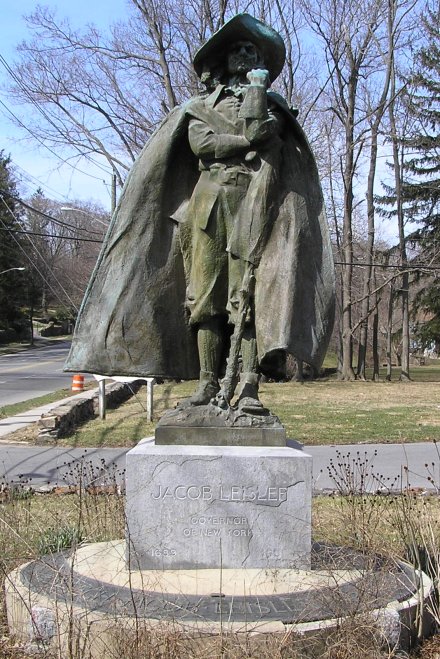
Statue of Jacob Leisler in New Rochelle, N.Y. — which Leisler helped create as a settlement for refugee Huguenots.

And once in the saddle, the Dutch Calvinist Leisler essentially ran a populist administration against the colonial oligarchy, which replied by vilifying him as a “usurper” and “rebel”.

Internal politics in New York and its neighbors during those months make fascinating reading.* Quakers and Catholics aligned against Protestants. Albany aligned against New York, until Leisler brought the former to heel. Clergy chose up sides. Leisler summoned a sort of proto-continental congress of colonial representatives (all the way to the West Indies) to hash out their situation.

And what was that situation? There had been a revolution, after all, and there was no agreed-upon representative of the royal authority present in New York. An assembly of militia leaders had asked Leisler to assume leadership, so was he really outside his rights to treat as his the London dispatches addressed to “such as, for the time being, take care for preserving the public peace and administering the law in New York”?

It’s a moment whose ferment of democratic energy can be read to presage the next century’s (proper) revolution.

Yet it was also not a revolution in the Cromwellian, world-turned-upside-down sense. For the English polity, and certainly for the conduct it preferred in its frontier possessions, continuity was the order of the day. Even in England herself, William and Mary were more than pleased to govern with Tories who could see their way to releasing their fealty to the Stuarts.

There was an empire to run, after all.

From that standpoint, Leisler’s anti-oligarchical policies and fractious disputes with other colonial elites were a bad business. There’s no sense in letting France make inroads because your governors are bickering over predestination or some such.

So formally, the realm’s new rulers continued all non-Catholic personnel in their posts. With the Dominion governors ejected, it was just a matter of dispatching fresh executives to take over. It’s just that this process required months … during which Leisler was managing New York the way he figured it ought to be managed, and his enemies were consequently painting him as a rebel.

Leisler pronounced himself, this whole time, anxious to submit his authority to the new governor upon the production of proper credentials. If he was surprised that the new monarchs tendered appointees of the very same factions recently expelled,** Leisler showed it only in his exactitude for procedure: because of a logistical cock-up, an aide to the new colonial governor arrived first, and when Leisler refused to hand over his fort without the royal warrant, a tense standoff ensued. It was resolved when the real governor, Henry Sloughter of ominous name, finally showed up.

Sloughter had his “predecessor” immediately arrested, along with others of his circle and harshly tried for treason and murder by a court stacked with anti-Leisler political enemies.†

Ultimately Leisler was condemned to die along with his secretary and son-in-law Jacob Milborne, but even Sloughter was loath to enforce the sentence. The story goes that Leisler’s most implacable foes had to get Sloughter drunk to put his signature on the death-warrant. (Sloughter died a couple of months later himself, for maximum operatic effect.)

On Saturday morning, May 16, 1691, the largest crowd ever gathered in New York City stood, rain soaked and weeping, all eyes fixed as a limp body was cut from the gallows and placed on the block. With a clean blow, the executioner’s ax cut off the head of the “halfe dead” Jacob Leisler — loyal lieutenant governor or rebel tyrant, depending on one’s point of view. Amid the “shrieks of the people,” fainting women (some “taken in labour”), and tumultuous jostling for “pieces of his garments” and strands of his hair, as “for a martyr,” the newly arrived and unfortunately named royal governor, Henry Sloughter, worried that his decision to execute Leisler might not, after all, end the “diseases and troubles of this Government.” Indeed, for years afterward New Yorkers bitterly divided over Leisler and the 1689 uprising that, in the wake of England’s Glorious Revolution, had led to his assumption of power in the provincial government.

-David Voorhees, who elsewhere contends that these divisions “continue to inform American politics to the present day.”*

A few years later, a more Leisler-friendly Parliament restored the dead man’s estate to his heirs, a sort of implicit admission that the whole head-chopping thing might have been a bit much.

This character figures to bear more historical consideration than he has heretofore enjoyed; further to that end, there’s a Jacob Leisler Papers Project devoted to marshaling at New York University the primary documents connected with Leisler.

* See, for instance, David Voorhees in “‘to assert our Right before it be quite lost’: The Leisler Rebellion in the Delaware River Valley” in Pennsylvania History, Winter 1997 — and, Voorhees again in “The ‘fervent Zeale’ of Jacob Leisler,” The William and Mary Quarterly, July 1994.

** Literally so: Francis Nicholson, whom Leisler ousted from New York, tried to get himself appointed governor; he was instead sent to Virginia and continued in royal service in the colonies for decades to come.

† e.g., Joseph Dudley, one of Leisler’s judges, whose penchant for authoritarian justice has been noted elsewhere in these pages.

On this day..

1730: James Dalton, Hogarth allusion

On this date in 1730, career criminal James Dalton was executed at Tyburn.

Detail view (click for full image) of James Dalton’s wig box depicted in the boudoir of prostitute Moll Hackabout in Hogarth’s A Harlot’s Progress.

Crime ran in the family for young master Dalton; his father hanged upon the information of notorious (and himself eventual gallows-bird) Jonathan Wild. According to the Ordinary of Newgate’s report, our day’s principal “went between his Father’s Legs in the Cart, to his fatal Exit at Tyburn.”*

Who knows but what naughty urchins (or parents) in the throng were deterred by that affecting spectacle. For the Daltons, it was more like Take Your Child to Work Day.

While the elder Dalton’s skills ran towards card-sharping, young master James went in for the more conventional varieties of larceny — both those practiced by stealth, and those practiced by force.

These pursuits saw him twice transported to America, for which we have to thank the English judiciary on account of Dalton’s resultant biography at Early American Crime.

(In)famous for his many dalliances, Dalton’s exploits could move copy in their day — and their author transgress the lines between the underworld and “legitimate” celebrity.

“In the height of all our Robberies” [Dalton] and his companions “used to go to the Playhouse, dressed like Gentlemen,” and that once, while watching The Beggar’s Opera, “Captain Macheath’s Fetters happening to be loose,” one of them “call’d out, Captain, Captain, your Bazzel is undone.” The real thieves, having shown up the actors with their superior knowledge of both irons and cant, then retired in style to an alehouse, “in four Chairs, with six Lights before each Chair.”**

Just another hanged thief.

Except, also not — because while his career in malefaction would undoubtedly have added up to a death sentence, his condemnation was secured upon the word of a perjurer upon a very doubtful charge.

A character named John Waller, an “affidavit man” whose profession was supplying bogus testimony to hang whomever could be hanged where a reward was available, insisted that Dalton had robbed him upon the roads. Dalton vigorously denied (and even rebutted with evidence) this charge even while admitting his general life of crime, but it was upon this dubious offense against Waller that he stretched his neck. Dalton died at Tyburn with three others, though a fifth member of their party, one Hugh Norton or Haughton, managed to cheat the executioner by hanging himself in his cell.†

It was the rough justice of the 18th century, a time frequently admitting opportunity to repay tit for tat.

In this case, the professional perjurer who hanged Dalton was two years later convicted himself after making a bogus accusation of highway robbery. Waller was condemned by the court to stand in the pillory at the Seven Dials — a dangerous punishment cousin to the era’s death penalty, inasmuch as the mob violence thereby invited not infrequently proved fatal.


John Waller bombarded with refuse in the pillory.

Waller had quite a reputation, but the fury of the crowd was nothing next to that of James Dalton’s brother, Edward — who, with a confederate, brazenly climbed onto the platform, wrenched the “assize man” out of his pillory, and savagely beat him to death.

* Cited in this impressive compendium of Dalton-related primary sources.

** Andrea McKenzie, “The Real Macheath: Social Satire, Appropriation, and Eighteenth-Century Criminal Biography,” Huntington Library Quarterly, Vol. 69, No. 4 (December 2006), with the quotes supplied by a 1730 publication called “The Life and Actions of James Dalton (the Noted Street-Robber)”

† Norton/Haughton was posthumously hanged in chains the next day.

On this day..