1778: Abraham Carlisle and John Roberts, triggering Benedict Arnold’s betrayal?

On this date in 1778, the hanging in Philadelphia of two elderly Quakers for treason perhaps set in motion Benedict Arnold’s notorious defection from the American Revolution.

Brotherly love was a little scarce on the ground in Philly after Gen. William Howe occupied it for the British in 1777-1778.*

British control of the cradle of liberty exacerbated the social tensions swirling around the revolution, most particularly between radical revolutionaries and those of a more go-along, get-along variety. Plenty of North Americans, after all, were British loyalists. Plenty of others were fine with political independence but horrified at the more radically democratic ideas of, say, Tom Paine.

Pennsylvania had proven a relative bastion for militants, who authored its progressive 1776 constitution and imposed loyalty tests to disenfranchise Tories and neutrals. When Howe withdrew from Philadelphia, these elements returned, loaded for bear. Or in this case, Quakers.

Members of this sect were suspect to begin with for pacifism, which is the sort of ideology that would fail a loyalty test. Spurning a Moravian pitch for exemption from the oath, the authorities complained of

persons among us, preferring a slavish dependence on the British King, from prejudice, expectation from lucrative offices, or the most unworthy motives, and screening themselves from the notice of Government, by a professed neutrality, have, nevertheless, as soon as opportunity offered declared themselves in favour of our Enemies, and became active against the Liberties of America

Abraham Carlisle and John Roberts, Quakers of an advanced age who had collaborated with the British, were thought to have done precisely this perfidious thing. In the sentence delivered to Roberts (the men had separate trials), the judge insisted his defendant was either with liberty, or against it.

Treason is a crime of the most dangerous and fatal consequence to society; it is of a most malignant nature; it is of a crimson colour and of a scarlet dye. Maliciously to deprive one man of life, merits the punishment of death, and blood for blood is a just restitution. What punishment, then, must he deserve, who joins the enemies of his country, and endeavours the total destruction of the lives, liberties, and property of all his fellow citizens; who wilfully aids and assists in so impious a cause; a cause which has been complicated with the horrid and crying sin of murdering thousands, who were not only innocent, but meritorious; and aggravated by burning some of them alive, and starving others to death. It is in vain to plead, that you have not personally acted in this wicked business; for all who countenance and assist, are partakers in the guilt.**

The wholesale purge such a logic would license was thankfully not forthcoming, because even revolutionary sentiment was uncomfortable with the treatment of these exemplars. Roberts’s own jury had to be cajoled into a conviction, and most of its members joined thousands of Philadelphians of different political stripes petitioning for mercy.

The post-Howe military governor of Philadelphia at this time was none other than Benedict Arnold, still an American general but putting himself ostentatiously into the tug-of-war over the proper revolutionary line with his profligate living and his courtship of a British-friendly merchant‘s daughter.

Arnold stuck his thumb in the radicals’ eye by hosting a party on the eve of this date’s hanging for society ladies of doubtful [revolutionary] virtue … prompting a fulsome protest by Joseph Reed

Treason, disaffection to the interests of America, and even assistance to the British interest, is called openly only error of judgment, which candour and liberality will overlook … it would astonish you to observe the weight of interest excited to pardon [Carlisle and Roberts] … will you not think it extraordinary that General Arnold made a public entertainment the night before last, of which not only common Tory ladies, but the wives and daughters of persons proscribed by the State, and now with the enemy at New York, formed a very considerable number. The fact is literally true.

Left- and right-wing factions of the revolution crystallized around Reed and Arnold, and the abuse of the more-patriotic-than-thou set soon wore on Gen. Arnold. The latter put his contacts with un-revolutionary Philadelphia to work — specifically, that merchant’s daughter’s former suitor, British Major John Andre. Arnold and Andre began their correspondence six months after Carlisle and Roberts hanged; little more than a year later, Arnold ditched the American revolution … and entered the American lexicon.

* This was the winter George Washington famously spent at Valley Forge, 20 miles from Philly.

** The sentence is as printed in in the Pennsylvania Evening Post, Nov. 6, 1778. The magistrate concludes the sentence by pointing out that in Pennsylvania’s “leniency,” treason was punished “only” with hanging … while in the mother country, it could still get you drawn and quartered.

On this day..

1659: The first two Boston Martyrs

October 27 is International Religious Freedom Day, dating to the execution this date in 1659 of Quakers Marmaduke Stephenson and William Robinson on Boston Commons. They were two of the four Boston Martyrs, Quakers whose necks were stretched in Massachusetts for failing to either keep quiet or stay out of town.

(Fellow Quaker Mary Dyer, perhaps the more famous martyr, was led out to execution with Stephenson and Robinson but reprieved at the last moment. Her time was still some months away.)

As Puritans had fled C-of-E persecution earlier in the 17th century, Quakers migrated to the New World with Cromwell‘s Puritan ascendancy.

And in the Massachusetts Bay Colony, the old dissidence had become the new orthodoxy — as described by the (obviously partisan) Horatio Rogers. (Via)

In June, 1659, William Robinson, a merchant of London, and Marmaduke Stephenson, a countryman of the east pan of Yorkshire, “were moved by the Lord,” in Quaker phrase, to go from Rhode Island to Massachusetts to bear witness against the persecuting spirit existing there; and with them went Nicholas Davis of Plymouth Colony, and Patience Scott of Providence, Rhode Island, a girl of about eleven years of age … During their incarceration Mary Dyer was moved of the Lord to go from Rhode Island to visit the prisoners, and she too was arrested and imprisoned. On September 12, 1659, the Court banished the four adults from Massachusetts upon pain of death

… On October 8, within thirty days of her banishment, Mary Dyer with other Rhode Island Quakers went to Boston, …where she was again arrested and held for the action of the authorities. Five days later William Robinson and Marmaduke Stephenson, who had been travelling about spreading their doctrines through Massachusetts and Rhode Island since their release from prison, also went to Boston to look the bloody laws in the face, in the words of the Quaker chronicler; and they too were arrested and cast into prison. …

The issue was now clearly made between Quaker and Puritan. The Quaker defied the unjust Puritan laws, and dared martyrdom. Dare the Puritan authorities inflict it?

On October 19 the three prisoners were brought before Governor Endicott and the Assistants, and demand having been made of them — Why they came again into that jurisdiction after having been banished from it upon pain of death if they returned? — they severally declared that the cause of their coming was of the Lord and in obedience to him. The next day they were again brought before the magistrates, when the Governor called to the keeper of the prison to pull off their hats, which having been done, he addressed them substantially as follows: “We have made many laws and endeavored in several ways to keep you from among us, but neither whipping nor imprisonment, nor cutting off ears, nor banishment upon pain of death, will keep you from among us. We desire not your death.” Notwithstanding which, he immediately added: “Hearken now to your sentence of death.” … When the Governor ceased speaking, however, Stephenson lifted up his voice in this wise: “Give ear, ye magistrates, and all who are guilty, for this the Lord hath said concerning you, who will perform this promise upon you, that the same day that you put his servants to death shall the day of your visitation pass over your heads, and you shall be cursed forevermore, the Lord of Hosts hath spoken it; therefore in love to you all take warning before it be too late, that so the curse might be removed; for assuredly if you put us to death, you will bring innocent blood upon your own heads, and swift destruction will come upon you.” …

Great influence was brought to bear to prevent the execution of the sentences. Governor Winthrop of Connecticut appeared before the Massachusetts authorities, urging that the condemned be not put to death. He said that he would beg it of them on his bare knees that they would not do it. … Governor Endicott, the Rev. John Wilson, and the whole pack of persecutors, however, seemed to thirst for blood; and it was determined that somebody must die.

The 27th of October, 1659, was fixed for the triple execution and elaborate preparations, for those days, were made for it. Popular excitement ran high, and the people resorted to the prison windows to hold communication with the condemned, so male prisoners were put in irons, and a force was detailed, in words of the order, “to watch with great care the towne, especially the prison.”…

The eventful day having arrived, Captain Oliver and his military guard attended to receive the prisoners. The marshal and the jailer brought them forth, the men from the jail, and Mary Dyer from the House of Correction. They parted from their friends at the prison full of joy, thanking the Lord that he accounted them worthy to suffer for his name and had kept them faithful to the end. The condemned came forth hand in hand, Mary Dyer between the other two, and when the marshal asked, “Whether she was not ashamed to walk hand in hand between two young men,” for her companions were much younger than she, she replied, “It is an hour of the greatest joy I can enjoy in this world. No eye can see, no ear can hear, no tongue can speak, no heart can understand, the sweet incomes and refreshings of the spirit of the Lord which now I enjoy.” The concourse of people was immense, the guard was strong and strict, and when the prisoners sought to speak the drums were caused to be beaten.

The method of execution was extremely simple in those days. A great elm upon Boston Common constituted the gallows. The halter having been adjusted round the prisoner’s neck, he was forced to ascend a ladder affording an approach to the limb to be used for the fatal purpose, to which limb the other end of the halter was attached. Then the ladder was pulled away, and the execution, though rude, was complete.

The prisoners took a tender leave of one another, and William Robinson, who was the first to suffer, said, as he was about to be turned off by the executioner, ‘I suffer for Christ, in whom I lived, and for whom I will die.” Marmaduke Stephenson came next, and, being on the ladder, he said to the people, “Be it known unto all this day, that we suffer not as evil-doers, but for conscience sake.”

Next came Mary Dyer’s turn. Expecting immediate death, she had been forced to wait at the foot of the fatal tree, with a rope about her neck, and witness the violent taking off of her friends. With their lifeless bodies hanging before her, she was made ready to be suspended beside them. Her arms and legs were bound, and her skirts secured about her feet; her face was covered with a handkerchief which the Rev. Mr. Wilson, who had been her pastor when she lived in Boston, had loaned the hangman. And there, made ready for death, with the halter round her neck, she stood upon the fatal ladder in calm serenity, expecting to die….

Just then an order for a reprieve, upon the petition of her son all unknown to her, arrives. The halter is loosed from her neck and she is unbound and told to come down the ladder. She neither answered nor moved. In the words of the Quaker chronicler, “she was waiting on the Lord to know his pleasure in so sudden a change, having given herself up to dye.” The people cried, “Pull her down.” So earnest were they that she tried to prevail upon them to wait a little whilst she might consider and know of the Lord what to do. The people were pulling her and the ladder down together, when they were stopped, and the marshal took her down in his arms, and she was carried back to prison. . .

It was a mere prearranged scheme, for before she set forth from the prison it had been determined that she was not to be executed, as shown by the reprieve itself, which reads as follows: “Whereas Mary Dyer is condemned by the Generall Court to be executed for hir offences, on the petition of William Dier, hir sonne, it is ordered that the sajd Mary Dyer shall have liberty for forty-eight howers after this day to depart out of this jurisdiction, after which time, being found therein, she is forthwith to be executed, and in the meane time that she be kept a close prisoner till hir sonne or some other be ready to carry hir away within the aforesajd tyme; and it is further ordered, that she shall he carrjed to the place of execution, and there to stand upon the gallowes, with a rope about her necke, till the rest be executed, and then to returne to the prison and remajne as aforesaid.“

Mary Dyer once again returned from exile the following year, and was hanged in June 1660.

The hours were numbered, however, for New England Puritans in their most cartoonishly obnoxious form. Upon the restoration of the monarchy in the mother country, an edict forbidding the death penalty for Quakerism closed the doors to the Boston Martyrs club.

An Account of the Sufferings of Marmaduke Stephenson is available free on Google books.

On this day..

1978: Seventeen officers in Somalia

Seventeen army officers were shot this day on the outskirts of Mogadishu for attempting to overthrow Somali dictator Siad Barre.

“The executions were carried out by by a firing squad formed of soldiers of the armed forces and were witnessed by thousands of people from all areas of Mogadishu,” said Mogadishu radio.

The abortive April 9 coup attempt seems to have been precipitated by Somalia’s ill-fated intervention in neighboring Ethiopia’s Ogaden region, a bloody little Cold War sideshow that saw both the U.S. (from Ethiopia, to Somalia) and Soviet Union (from Somalia, to Ethiopia) switch sides. Some of the officers concerned feared that Siad would come a-purgin’ after the last Somali forces slunk home on March 15, 1978.

The condemned (per this source) were:

  • Col Mohamed Sheikh Osman “Cirro”
  • Maj Siad Mohamed Jama
  • Maj Ibrahim Mohamed Hersi
  • Maj Siad Jama Nur
  • Capt Mohamed Ahmed Yusuf Aganeh
  • Capt Abdisalan Elmi Warsame
  • Capt Bashir Abshir Isa
  • Capt Abdillahi Hasan Nur
  • Lt Abdi Osman Ugas
  • Lt Abdirahman Maalin Bashir
  • Lt Adan Warsame Abdillahi
  • Lt Abdillahi Mahamud Guled
  • Lt Mohamed Abdullahi Husein (Gorod)
  • Lt Abdulwahab Ahmed Hashim
  • Lt Abdulqadir Gelle Omar
  • Sgt Farah Mohamed Halwo
  • Director Abdulqafar Warsame Abdilleh

But they’re perhaps most memorable for a coup participant not among their number, Abdullahi Yusuf Ahmed, who fled to Kenya and founded from exile the Somali Salvation Democratic Front, eventually one of the principal entities resisting the Barre regime. Ahmed served as President of Somalia from 2004 to 2008, but his government was unable to gain control of the notoriously fractious state or to end Somalia’s ongoing civil war.

On this day..

1769: Nicolas de Lafreniere and four others for the Louisiana Rebellion

On this date in 1769, five French Creoles were shot in New Orleans for a revolt the previous year against a Spanish takeover.

This date’s story begins with the French King Louis XV getting his French clock cleaned in the French and Indian War. This conflict blew an ill wind all over Francophone North America, much of which was taken by the British. Result: a quarter-millennium later, this blog is in English.

Even what France kept, she did not keep. In a secret pact, France ceded to wartime ally Spain “the country known as Louisiana, as well as New Orleans and the island in which the city is situated.”

This projection onto New World colonists of Old World diplomatic horse-trading was rife with potential hostility among the traded horses. In this instance, Louisianans were widely dismayed when they were finally informed that they’d become Spaniards.

When they did get the memo — and Louis XV declined to reconsider — they launched the Louisiana Rebellion of 1768, expelling the new Spanish govenror Antonio de Ulloa.*

These weren’t mere rabble who showed Ulloa “insubordination … a sense of liberty and independence,” but elites of French New Orleans. Nicolas de Lafreniere was the attorney general.

“The name of Lafreniere deserves rank with those of foremost American patriots,” Americans later reckoned. O’Reilly’s reputation did not fare as well in the patriotic literature, but he perhaps had the best of the law.

Between a rock and a hard place, the leftover French adjutant Charles-Philippe Aubry refused to support the rebels, but also refused to fire on fellow Frenchmen. Meanwhile, Ulloa refused to provide his credentials to the uppity colonists. Louis XV refused to receive the delegations sent to implore him to keep Louisiana.

All these refuseniks found the matter adjudicated by immigrant Irish officer Alejandro O’Reilly, plucked out of Cuba to replace Ulloa and lay down the law. He spoke softly when he landed, but the amnesty he offered was followed a few months later by the surprise arrest of the chief rebels.

Lafreniere, Joseph Milhet, Jean-Baptiste Noyan, Pierre Caresse, and Pierre Marquis were ordered hanged on this date. Noyan, nephew of the city’s founder and a young man just married, was offered his pardon, but melodramatically refused.

It was found that there was no hangman in the colony, so the condemned prisoners were ordered to be shot. When the day of execution came, hundreds of people left the city. Those who could not leave went into their houses, closed the doors and windows and waited in an agony of sickening dread to hear the fatal shots. Only the tramping of soldiers broke the deathlike stillness which brooded over the crushed and helpless city. At three o’clock on a perfect October afternoon in 1769, the condemned men were led to the Spanish barracks. Lafreniere, it is said, gave the order to fire. A volley of muskets broke out on the still air, and five patriots went to their death, — the first Louisianians to give their blood for the cause of freedom.

–A History of Louisiana

The details and historiography of this event are the subject of this 146-page master’s thesis. (pdf)

Whether or not all that stuff about Louisiana planters as freedom-loving patriots trod down by the barbarous Spanish has any real merit to it, that’s the way they’ve been memorialized.

Lafreniere Park in Metairie, La. — home of anti-death penalty VIP Sister Helen Prejean — is named for Nick Lafreniere.

When next visiting the Louisiana State House, keep an eye out for this day’s victims on the frieze to the right of the main entrance. And when next visiting New Orleans, keep an ear out for the ghost of the priest that buried them.

* Ulloa was also a scientist and gave his name to the Ulloa Halo, a “physical illusion consisting of a white luminous ring or arch that can sometimes be seen in mountainous regions, typically in foggy weather, while facing an area opposite the Sun.”

On this day..

1869: Charles Carpentier

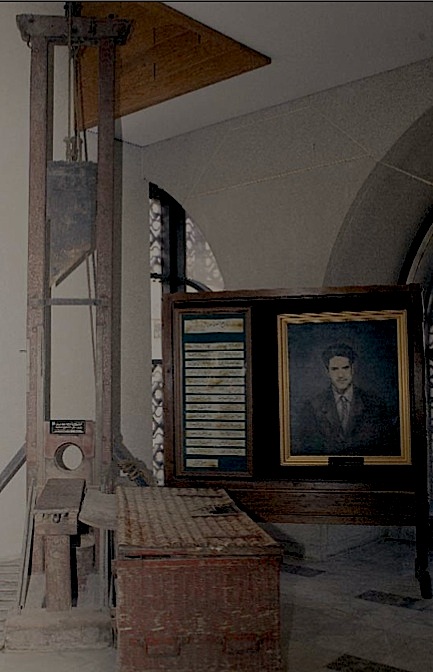
On this date in 1869, an impressive crowd packed Arras’s Grande Place for the beheading of Charles Carpentier.*


Photo believed to have been taken shortly before Carpentier’s execution.

According to Bois de Justice, whose collection of guillotine arcana is second to none, this is one of the rare photographs extant of the guillotine in its more classically inspired public-scaffold setup.

Its construction is lovingly detailed in this New York Times report on the following year’s execution of Jean Baptiste Troppmann:

… a square-shaped scaffold, thirteen feet long by about twelve feet six inches wide, supported on four posts six feet in height, and reached by a flight of ten steps. This scaffold is railed in on all sides, with an open balustrade, and at two-thirds of its length are fixed two upright parallel posts, surmounted by a cross-beam which goes by the name of the “chapeau.” They are thirteen feet high, and have a space of about fifteen inches between them. The knife, which is attached to the chapeau, is composed of a triangular blade of steel, fixed by means of three iron pins into a leaden haft, called the “mouton,” which gives it great weight. This mouton is nearly fourteen inches broad and the blade at its greatest width hardly a foot … The criminal, having mounted the scaffold, finds himself in front of the vertical bascule, which extends from just above his ankles to the middle of his breat, and facing him also is the lunette, with its movable portion raised. The executioner pushes the bascule, which falls into the horizontal position, and then pushes it along the table; the head of the victim seems, as it were, to throw itself into the semi-circular opening of the lunette, and an assistant immediately seizes hold of the hair. Two things now remain to be done — one is to press the button which acts upon the mechanism of the upper portion of the lunette, causing it to fall and secure the head of the criminal — the other is to set loose the knife which is to cut the head off. On decapitation taking place the head is thrown into the basket while the executioner, by a single motion slides the body down the inclined plane. The rapidity of the motion is almost inconceivable …

With the best part of a century under its lunette, the guillotine at this point had been improved from the revolutionary original that Marie Antoinette or Robespierre died upon. But it had the same theatrical concept.

However, an assistant executioner and carpenter by the name of Leon Berger was even then in the process of designing a more compact, less monumental version of the device. This technical advance met evolving French social mores with the 1870 abolition of the scaffold and its towering thirteen-foot chapeau in favor of “the Algerian model.”

From then on, the business was to be conducted by a traveling executioner with a portable guillotine at ground level, meant to reduce the carnival atmosphere and centralize administration of justice.

This concession to an age’s liberalism might well have led to an abolition on public executions full stop, had the French state not simultaneously fallen apart.

The upshot was that the French public beheading — sans scaffold — would persist for seven more decades, long enough not only for photography but for film.

* For murder and robbery on the highway, as reported by the September 16, 1869 Le Figaro. Noting the contrast with some recent acquittals of other criminals, the paper remarked apropos its skeptical stand on the death penalty that “though Carpentier is very unattractive at least from what we know of his case, we confess sincerely that his conviction was not sufficient to convince us [of capital punishment], because it proves once again how juries in different places arrive at different verdicts for the same types of crimes.” Le Figaro anticipated that regional inconsistencies in sentencing would contribute to ending the death penalty.

On this day..

1401: Klaus Stortebeker, Victual Brother pirate

On this date in 1401,* “Victual Brother” Klaus Störtebeker was beheaded in Hamburg.

Statue of Klaus Stortebeker. (cc) image from blariog

This legendary freebooter terrorized the Hanseatic League‘s trading channels from Novgorod to London in the 1390s.

He was the most famous of a company of privateers who’d been hired out in 1392 to place their thumb on the scale of Scandinavian dynastic politics** — notably, supplying Stockholm during a siege, from which service they obtained† the nickname Victual Brothers. It stuck, even when operations had moved far beyond the larder.

In the mid-1390s, the “brothers” turned against Danes and Hanse alike, raiding coasts and plundering sea trade from their base in the shattered port of Visby.

Klaus, the most famous of them, is still remembered today “like Che Guevara, a freedom fighter, but also like Robin Hood, because he fights the rich in the name of the poor”:‡ folk hero-outlaws, men of the pirate utopia.

Whatever debunking that legend might invite, its existence speaks to that timeless romance of the road. And then there’s that kernel of truth, or so one hopes: after Stortebeker’s death, the remnants would persist as the Likedeelers, “those who share equally.”

The buccaneer’s end, after capture by Simon of Utrecht, was equally legendary: he’s supposed to have made a scaffold pact with the headsman to spare any of his mates he could walk past once decapitated.

Rising from the chop like St. Denis, the headless trunk of Stortebeker lurched past 11 of them before the executioner himself tripped it up. (In the most embroidered version of this story, Hamburg not only didn’t honor the promise, it executed the executioner when all was said and done. But we’re pretty comfortable saying that once we reach the headless zombie pirate part of the story, the reader has carte blanche to rewrite anything not to liking.)

Drink up me hearties yo ho! “Stortebeker” itself just means, “quaff the mug.”

Klaus Störtebecker is our master
advised by Godeke Michels!
Shoot through the waves like storm, just faster
The Flying Dutchman’s godfather
Gaffer is the ships goblin
Let’s tackle, crew!
Life is bauble!
We are the hell of Helgoland

Our bloody flag is cracking the mast
Rats scurrying on the floor
A skeleton is our guest
On the sail there are strange shadows
The mermaid is swimming in our wake
Laugh, crew!
Life is bauble!
Still ruling is the hell of Helgoland

And when our ship makes its last run
Laugh while like a coffin she goes down
We die an ancient pirate’s way
Today we fight, tomorrow we drown
In green algae and white sand
Land ho, crew, land!
Life is bauble!
Such dies the hell of Helgoland

-Folk song honoring Klaus Stortebeker
(translated here)

* As often for events at this distance of time, the dates are a little bit shaky; 1400, rather than 1401, has been proposed for the actual year of Stortebeker’s execution; October 21 rather than October 20 is also given on some sites. Folklore more so than almanac blogs has the luxury of indifference to such particulars.

** The Victual Brothers were initially retained to oppose the adroit Danish Queen Margaret. She would face (and brush aside) even weirder challenges to her rule en route to lashing together the Kalmar Union under Danish regional hegemony.

† Alternate explanation: food-based euphemisms for piracy trace to armies’ victual officers, and their unscrupulous methods of filling the mess hall.

‡ In a continuing spirit of democratic larceny — or as a gang symbol for the local Hell’s Angels, whatever — our man’s alleged skull was stolen from a Hamburg museum earlier this year.

On this day..

1470: John Tiptoft, Butcher of England

On this date in 1470, cultured and bloodthirsty* English noble John Tiptoft, Earl of Worcester was beheaded at Tower Hill during the War of the Roses.

Tiptoft’s calling card says he’s one of England’s first Renaissance men — literally so, because after cutting his teeth at Oxford, he spent several years in Padua, Ferrara, Rome and Florence, brushing up on Latin and law.

Besides culture and erudition, Tiptoft is supposed to have picked up from his Italianate exposure a taste for that fragmented peninsula’s barbarous political jockeying.*

Back in Britain from the start of the 1460s, Worcester aligned with the Yorkists during the War of the Roses, and made liberal use in both England and Ireland of his continental savvy in matters of torture, earning that unflattering sobriquet Butcher.

Tiptoft gave them the material, exercising,” in his constabulary post, “more extreme crueltie (as the fame wet) then princely pity.” For instance, when putting down one revolt,

the Kynge Edwarde came to Southamptone, and commawndede the Erle of Worcetere to sitt and juge suche menne as were taken … and so xx. persones of gentylmen and yomenne were hangede, drawne, and quartered, and hedede; and after that thei hanged uppe by the leggys, and a stake made scharpe at bothe endes, whereof one ende was putt in att bottokys, and the other ende ther heddes were putt uppe one; for whiche the peple of the londe were gretely displesyd; and evere afterwarde the Erle of Worcestre was gretely behatede emonge the peple, for ther dysordinate dethe that he used, contrarye to the lawe of the londe.

Too bad for the gretely behatede Erle of Worcestre that this was an era when anyone‘s uppance could be coming at any time.

This last, well, butchery was effected against supporters of the Earl of Warwick, the “kingmaker” whose fluid alliances shaped the royal jostle in the mid-15th century.

And the trouble for Tiptoft was that Warwick’s 1470 revolt against Tiptoft’s ally and kin Edward IV … worked. Okay, only temporarily, but it was long enough to do in John Tiptoft.

For a brief moment, the Yorkist cause waned and the Lancastrian waxed; during the brief moment, the Butcher of England was haled before the Lancastrian Earl of Oxford, a man who occupied that office because Tiptoft had executed his father and elder brother.

The wheel of fortune had turned. A massive, jeering crowd turned out to see Tiptoft de-topfed. He asked the executioner to do it in three strokes rather than one, in honor of the Trinity.


Prayerful: John Tiptoft’s tomb at Ely Cathedral. (He’s flanked by two of his three wives, one of whom is in the foreground.) Image used with permission.

Tiptoft [wrote Henry Pancoast] was the most learned man among the English nobility of his time … [he] reflects his age at its best and worst. He was set at a confluence of evil influences, when civil strife following the Hundred years War [sic] had debauched the English nobility. Abroad he came close to that Italy which Machiavelli called “the corrupter of the world.” Yet a new intellectual life was growing, and Tiptoft’s career alternates between scholarship and political intrigues. He shows us how early the new spirit was astir in England, and how it was retarded; is is the “butcher” and “the first fruits of the Italian Renaissance.”

You can explore a bit more about John Tiptoft in the first third of this BBC radio 4 program, with author Alison Weir. (Her Tudor books burn up the bestseller lists, but she’s also written about the War of the Roses.) Or, look up the Household of Worcester, a medieval re-enactment society that takes name and inspiration from our day’s butchered butcher.

* This supposed southern influence on our friend the Earl might well be true, but it also strikes this author as an answer in search of a question. It’s hardly necessary to posit foreign influence to explain brutality in 15th century England, nor to explain educated men with a taste for cruelty.

But Tiptoft’s “wanton ferocity,” says Pancoast, “brings to mind the Italian proverb, quoted by Ascham in proof of the brutalizing effect of Italy upon the English nature: Inglese Itilianato e un diabolo incarnato.”

Since oiled stakes up buttocks were no more characteristic of Italian jurisprudence than English, the obvious place one might inquire for an outside influence would be that better-known diabolo incarnato, Vlad the Impaler: stories of Vlad Dracula’s then-contemporary skewerings were even then circulating and magnifying in the 15th century’s fresh new media channel, the printing press.

On this day..

1999: Zein al-Abidine al-Mihdar, Yemeni terrorist

On this date in 1999, Yemen executed (in its own inimitable style) terrorist Zein al-Abidine al-Mihdar, for orchestrating a kidnapping of western tourists.

A Xerox executive among the party of kidnapped tourists relates her post-captivity search to understand her ordeal.

The drama had unfolded in December of 1998, when a convoy of 16 (mostly British) foreign tourists spending the traditional Christmas in Yemen was seized by the Islamic terrorist group Islamic Army of Aden-Abyan.

The very next day, a massive Yemeni army raid busted up the kidnappers and freed the hostages — all, except for the four who were killed in the affray.

Tried for the kidnapping (a capital crime itself) and those resulting deaths — although some victims slated the army and its aggressive response for those lost souls — three men were condemned death.

“The only dialogue,” al-Mihdar told his judges, “should be with bullets.” And so for him, a bullet had the last word. (The other two condemned men drew commutations.)


Al-Mihdar’s followers promised revenge were he executed. Given that the Islamic Army of Aden claimed responsibility for the 2000 bombing of the American warship USS Cole while it refueled at Aden — Khalid Almihdhar, one of the 9/11 hijackers allegedly affiliated with the IAA, participated — it might well have done just that. (However, the IAA as a distinct terrorist entity petered out in the 2000s.)

By the by, the U.S. is basically at war in Yemen now. Better still: that tribal country is also a proving-grounds for brave new assertions of heretofore undiscovered American presidential prerogatives, like the right to assassinate other Americans.

On this day..

Unspecified Year: The Last Day of a Condemned Man

On an unspecified date around this time in the late 1820s, the narrator of Victor Hugo’s Last Day of a Condemned Man leaves off his diary — bound for the guillotine.

An illustration from The Last Day of a Condemned Man.

The young Hugo‘s first major work of fiction, this 1829 story dramatizes the torment of an unnamed man doomed for an unstated crime. By abstracting its central character, Hugo generalizes its unabashed anti-death penalty message … but one of the few morsels of specificity places the man’s conviction on “a beautiful morning at the close of August,” with the action unfolding over the ensuing six weeks until his date with the guillotine.

If not exactly Hugo’s greatest work, this emotional rendering of a man’s anguish awaiting death well befits an artist deeply sensitive to the passion of the scaffold — and a period when many writers witnessed, critiqued, contested, and even faced the phenomenon of public execution.

They say that it is nothing,–that one does not suffer; that it is an easy death. Ah! then, what do they call this agony of six weeks,–this summing-up in one day? What, then, is the anguish of this irreparable day, which is passing so slowly and yet so fast? What is this ladder of tortures which terminates in the scaffold? Are they not the same convulsions whether life is taken away drop by drop, or intellect extinguished thought by thought?

…

Now I must fortify myself, and think firmly of the Executioner, the cart, the gendarmes, the crowd in the street and the windows.

I have still an hour to familiarize myself with these ideas. All the people will laugh and clap their hands, and applaud; yet among those men, now free, unknown to jailors, and who run with joy to an execution,–in that throng there is more than one man destined to follow me sooner or later, on the scaffold.

More than one who is here to-day on my account, will come hereafter on his own.


Hungarian painter Mihaly Munkacsy‘s The Last Day of a Condemned Man has no relationship to Hugo’s book, but deals in a similar mood. It won an award from the Paris salon in 1870.

The Last Day of a Condemned Man is available free online (English | French), or in throwback print form from Amazon.com.

* The prisoner finds in his cell the names of then-notable criminals who previously occupied it — a concession to period specificity. The last of these names is Castaing, meaning our man’s story takes place after that poisoner’s 1823 beheading. A subsequent reference to Louis-Auguste Papavoine, executed in 1825, would push the execution to the even narrower window of October 1825, 1826, 1827, or 1828.

On this day..

1800: Prosser’s Gabriel, slave rebel

On this date* in 1800,** the Virginia slave Gabriel — sometimes remembered as Gabriel Prosser after his owner’s surname, although that wasn’t what his contemporaries called him — was hanged in Richmond, along with a number of his confederates in a planned slave rising.

Decades before Virginia’s more famed Nat Turner rebellion, Gabriel was plenty frightening for the growing little burg of Richmond in 1800. (The incident would result in a clampdown on education and mobility for slave and free blacks alike.)

Gabriel and company conceived a daring revolution to seize the city of Richmond, take hostage Governor (and future U.S. President) James Monroe, and rearrange the state’s power structure.

This scheme, in which the rebels actually stay in Virginia, depended on an optimistic assessment for the prospects of a multiracial alliance — with Richmond’s own poor whites, and also, according to testimony given by conspirators, with Indians and with the French in opposition to a pro-British American policy tilt.

But if ever the time might have been right for such a plot, it was in 1800. A bitter presidential contest adjudicating the Republic’s most fundamental issues was unfolding; there were rumors that the governing Federalists would not voluntarily relinquish power, and the matter might fall to civil war between by the factions.

Gabriel unabashedly attempted to leverage this division between whites; working as he and many other urban blacks did side-by-side with white Republican laborers — whose own interests vis-a-vis Federalist merchants were being so bitterly contested — he must have had a good vibe about the situation on the ground to gamble his life on it. Though the hope was that the white working class would join the revolt after it broke out, there were at least a few whites already initiated into the conspiracy beforehand.

Alas, what broke out was not rebellion but a storm: a downpour that rained out the first planned rising, washing out bridges and roads that the conspirators were counting on to assemble. Before the makeup date could be scheduled, some slaves taking a care for their own necks had betrayed it.

The public mind has been much involved in dangerous apprehensions, concerning an insurrection of the negroes in several of the adjacent counties. Such a thing has been in agitation among the blacks, principally instigated by an ambitious and insidious fellow, a slave, by the name of GABRIEL, the property of Mr. Thomas Prosser, of the county of Henrico. This villain, assuming to himself the appellation of General, through his artfulness, has caused some disturbance, having induced many poor, ignorant, and unfortunate creatures to share in his nefarious and horrid design.

The plot has been entirely exploded, which was shallow; and had the attempt even been made to carry it into execution, but little resistance would have been required, to render their scheme entirely abortive. Thirty or forty of the party have been arrested and confined in jail for trial. Yesterday a called court was held for that purpose, at the court house in this city when six of them were convicted and condemned to suffer death this day at 12 o’clock. It is said that the evidence which has been procured, will go to prove nearly this whole of them guilty. To-day the court will proceed to go thro’ with the rest of the trials.

[The Governor has issued his Proclamation, offering a reward of THREE HUNDRED DOLLARS† for the apprehension of the above “GENERAL,” who has thought proper to take himself off. Exclusive of this sum, he likewise promises “to any number not exceeding five of the said accomplices, who shall apprehend the said GABRIEL, and deliver him up so that he be brought to justice, a FULL PARDON for their offences.” ]

–Columbian Mirror, Tuesday, Sep. 16, 1800, quoting “a Richmond paper”

It would be interesting counterfactual history to know the world in which the insurrection was actually launched — whether “but little resistance” would have sufficed to put it down. Gabriel might have reckoned naively on the prospective balance of forces,‡ but his read of the fractious alliance against him was spot-on. Maybe with a modern communications infrastructure, the affair could have become a full-blown October Surprise.

The Jeffersonian party, desperate not to give its plantation supporters cause to rethink its partisan alignment, took pains to downplay what was really quite a bold conspiracy. Not for the last time, wealthy merchants (here backing the Federalists) sought their own advantage pressing the racial wedge issue — for the slaves’ prospective lower-class white allies were also part of Jefferson’s coalition.

“If any thing will correct & bring to repentance old hardened sinners in Jacobinism, it must be an insurrection of their slaves,” editorialized the Boston Gazette — ex cathedra, as it were, from 18th century America’s very temple of Mammon. (The quote comes from this tome.)

One thing all right-thinking whites could agree on was a heaping serving of scorn for “General” Gabriel.


Columbian Mirror, Saturday, October 4, 1800.

But then, that personal interview with Monroe also gives a lie to Gabriel’s insignificance. (Gabriel told Monroe nothing of any use to the latter; Monroe sent him away with orders to keep him nearly incommunicado from the sort of working stiffs who would figure to be his jailers.)

A few years later, an English visitor captured at second hand this indefatigable portrait of the doomed slave in his masters’ courts.

I passed by a field in which several poor slaves had lately been executed, on the charge of having an intention to rise against their masters. A lawyer who was present at their trials at Richmond, informed me that on one of them being asked, what he had to say to the court in his defence, he replied, in a manly tone of voice: “I have nothing more to offer than what General Washington would have had to offer, had he been taken by the British and put to trial by them. I have adventured my life in endeavouring to obtain the liberty of my countrymen, and am a willing sacrifice to their cause: and I beg, as a favour, that I may be immediately led to execution. I know that you have pre-determined to shed my blood, why then all this mockery of a trial?”

In 2007, James Monroe’s (distant) successor as governor of the Old Dominion (informally) posthumously pardoned Prosser’s Gabriel. Gov. Tim Kaine’s statement on the occasion validated Gabriel’s own defense of himself.

“Gabriel and his colleagues were freedom fighters and deserve their rightful place in history as women and men of integrity who fought for freedom.”

And the site of his martyrdom? Well, it’s … a good place to park.

* Some sources give Oct. 7 as the date of execution; this apparently was the initial sentence of the court but delayed a few days to hang the ringleader along with others in a variety of spots around town.


Virginia Argus, Tuesday, Oct. 14, 1800.

** A pregnant year in the history of slave rebellion: Denmark Vesey bought his freedom in 1800; Nat Turner and John Brown were both born in 1800. (Noted here.)

† It was a slave who eventually turned in Prosser’s Gabriel … but Virginia stiffed him on the reward, handing over only $50 instead of the promised $300.

‡ Or maybe that’s just hindsight talking. In 1800, the Haitian Revolution was underway — so who could blame slaves for thinking big?

On this day..