1401: Llywelyn ap Gruffydd Fychan, an army marching on his stomach

(Thanks to Jonathan Shipley of A Writer’s Desk for the guest post. -ed.)

It was on this day that a Welsh squire, Llywelyn ap Gruffydd Fychan, was gruesomely executed for thwarting the efforts of King Henry IV’s forces to squelch Welsh resistance to English rule.

First, the man’s stomach was cut out and cooked in front of him. Then, he was hanged, drawn and quartered.

The torturous execution took several hours before he succumbed to death. Then, a grisly postscript: his salted remains were sent to other Welsh towns to deter Welshmen from opposing the king.

Rewind to October, 1399.

Henry IV has been crowned King of England after overcoming the unpopular Richard II. Henry had his predecessor imprisoned and killed, then displayed at St. Paul’s Cathedral to prove to his supporters that he was gone.

Little surprise much of Henry’s reign was spent defending himself against plots, rebellions and assassination attempts. One rebellion? That of Owain Glydwr, who declared himself Prince of Wales in 1400.

This didn’t sit well with the new king. Armed men were sent out to find this treasonous Welshman. Found them they did, though perhaps they wished they hadn’t. In the summer of 1401, on the slopes of Pumlumon, Owain Glydwr crushed Henry’s army. This, too, did not sit well with the king.

Give me leave
To tell you once again that at my birth
The front of heaven was full of fiery shapes,
The goats ran from the mountains, and the herds
Were strangely clamorous to the frighted fields.
These signs have mark’d me extraordinary;
And all the courses of my life do show
I am not in the roll of common men.
Where is he living, clipp’d in with the sea
That chides the banks of England, Scotland, Wales,
Which calls me pupil, or hath read to me?

-Glendower (Glyndwr) in Shakespeare’s Henry IV, Part I

Henry then led a huge army, arriving in Llandovery, to capture this meddling countryman prince.

It was here that the English military met a 60-year-old man. A land owner from Caeo, his name was Llywelyn ap Gruffydd Fychan and the English army strongly suggested he assist them in helping locate Owain Glydwr. Llywelyn agreed.

Little did the English know, as they chased Glyndwr, that Llywelyn was taking them in the wrong direction.

He had two sons, did this Llywelyn, in Owain’s army. Though he knew he’d undoubtedly pay the ultimate sacrifice, he would not betray the Welsh people and his own family but leading the English king to the insurrectionists.

And so he led the English army on a wild goose chase.

For weeks Llywelyn lead the king and his forces through the uplands of Deheubarth. All the while Owain and his men made their escape the opposite direction to consolidate, grow, and fortify.

The king’s patience became taxed. He began to see that Llywelyn was not taking them to their man.

Angrily, the king drug Llywelyn to the town of Llandovery. In front of the castle gates, there in the town square, he was disemboweled and dismembered. Though Glyndwr’s war of liberation fizzled out, Owain was never captured nor betrayed.

Fast forward to the year 2001.

600 years after Llywelyn’s execution, a sculpture is erected. Standing 16 feet tall, erected by the castle he died in front of, is a statue of a cloaked figure, spear and shield in hand, atop a stone base inscribed with Welsh verse.

It is he, Llywelyn, commemorating his ultimate sacrifice.


Llywelyn’s striking steel statue stands watch over Llandovery. Images (c) Canis Major and stused with permission.

On this day..

1689: Quirinus Kuhlmann, mystic poet

“Seldom is a poet burned alive, no matter how critics may roast his work!”

-Robert Beale

On this date in 1689, German poet and mystic Quirinus Kuhlmann was roasted in Moscow for heresy.

This Silesian millenarian (English Wikipedia entry | German) experienced a mystical conversion and spent his law school hours instead scribbling visionary poetry and devouring visionary texts.

Inflamed with Bohmian fire, I read Bohme with fiery eagerness and capacity. I did not know the Bohmian texts and I knew them the same day. What an admiration (o Jesus!) overcame me when I heard Bohme tell his revelations which I had learned from the universe of nature, with God as my teacher, it were the revelations the first outlines of which I just had begun to delineate in my own works.

-Quoted in Toward the Millennium: Messianic Expectations from the Bible to Waco

Quirinus’s particular vibe was an end-times kingdom of Jesus thing with the Catholic Church as the Antichrist. He cast about Europe vainly imploring princes to ally — Protestants with Orthodox with Mussulmen — to destroy the papal whore of Babylon. This

Prince of Fanatics … wrote a book, entitled Prodromus Quinquennii Mirabilis, and published at Leyden in 1674, in which he set forth his peculiar views. He stated that in that same year the Fifth Monarchy or the Christian Kingdom was about to commence, that he himself would bring forth a son from his own wife, that this son by many miracles would found the kingdom, and that he himself was the Son of God. On account of these mad ravings he was exiled by the Chief of the United Provinces of the Netherlands, and expelled with infamy from the University of Leyden. But his strange mission did not cease. He wandered for some time in France and England … He then proceeded to Turkey on his mission, and presented himself to the Sultan. Although ignorant of the language of the country, he persuaded himself that he could speak in any tongue; but when they led him into the presence of the Sultan he waited in vain for the burning words of eloquence to flow. The Turks dealt with him according to his folly, and bestowed on him a sound thrashing. Thence he proceeded to Russia …

Kuhlmann could have picked a better time to evangelize Russia than the reign of Peter the Great. This progressive despot did indeed look west for Russia’s future: in industry, in law, in war, even in fashion. But certainly not in holy alliances.

It was a fellow-German in Moscow, a Lutheran pastor, who denounced Kuhlmann as a dangerous heretic. He and a follower were duly burned as such.

On this day..

2008: A son, all in the family

On this date in 2008, Abura Apalalu of Longorinyangai village, Namalu Sub-county, in Nakapiripirit District of Uganda convened a traditional (but illegal) tribunal to try his two sons for raping their sister.

Apalalu found the youths guilty and condemned his own flesh and blood to death … after which they were both beaten by fellow-villagers, one of them fatally.

The incident illustrates the challenge of getting people in the Karamoja region, where traditional systems are used to serve justice, to conform to the rule of law as enshrined in Uganda’s constitution.

Last year alone, according to the UPDF 3rd Division spokesman, Capt. Henry Obbo, five people were hanged on orders of the Karimojong traditional clan court sitting at Namalu in Nakapiripirit District.

Nakapiripirit District Community Development Officer Michael Edikoi says under the traditional justice system, a person who kills is supposed to be killed. “You are told to dig two graves, one for the person you have killed and the other for yourself. Then you are forced to bury the dead before being stoned to death and buried in the other grave next to your victim,” he said.

On this day..

1471: Thomas Neville, the Bastard Faulconbridge

On this date in 1471, Lancastrian commander Thomas Neville was beheaded in the War of the Roses.

“The bastard Faulconbridge” (Fauconberg, Falconbridge) got his illegitimacy from dad, the Earl of Kent, and like William Neville, young Thomas played both sides of the aisle during the decades-long dynastic struggle.

Thomas made his most famous mark in May of 1471, leading a Lancastrian column to meet up at London with another led by Margaret of Anjou. Unfortunately for Neville, Margaret’s army was trounced at the Battle of Tewkesbury, leaving the Bastard on his own.

Still, he made a solo go of attacking London — “stirring of coles & proud port,” in the judgment of Holinshed, “with hautinesse of hart & violence of hand thin|king to beare downe the people, as an innudation or flowing of water streams dooth all before it: yet he came short of his purpose, & pulled vpon his owne pate finall destruction: though he thought himselfe a man ordeined to glorie.”

Thomas Neuill, bastard sonne to that valiant cap|teine the lord Thomas Fauconbridge (who had late|lie before beene sent to the sea by the earle of War|wike, and after fallen to practise pirasie) had spoiled diuerse merchants ships, Portingals and others, in breach of the ancient amitie that long had continued betwixt the realms of England and Portingale; and furthermore, had now got to him a great number of mariners, out of all parts of the land, and manie traitors and misgouerned people from each quarter of the realme, beside diuerse also foorth of other coun|tries that delighted in theft and robberies, meaning to worke some exploit against the king.

And verelie, his puissance increased dailie, for ha|uing béene at Calis, and brought from thence into Kent manie euill disposed persons, he began to ga|ther his power in that countrie, meaning (as was thought) to attempt some great and wicked enter|prise. After the kings comming to Couentrie, he receiued aduertisements, that this bastard was come before London, with manie thousands of men by land, and also in ships by water, purposing to rob and spoile the citie. Manie Kentishmen were willing to assist him in this mischieuous enterprise, and other were forced against their wils to go with him, or else to aid him with their substance and monie, insomuch that within a short time, he had got togither sixtéene or seuentene thousand men, as they accompted them|selues.

With these he came before the citie of London the twelfe of Maie, in the quarrell (as he pretended) of king Henrie, whome he also meant to haue out of the Tower, & to restore him againe vnto his crowne & roiall dignitie …

The attack gave London a fright, but was eventually repelled; the Bastard fled town as King Edward IV, fresh from Tewkesbury, approached.* He seems to have copped a pardon, but he was beheaded in unclear circumstances (Holinshed says, after resuming his career in piracy — but royal perfidy seems equally likely), and his head shipped to London Bridge for pike-topping duty.


A distant spinoff of the dynasty is rumored to have founded the Falcon Crest estate.

There’s a bastard Faulconbridge in the Shakespeare canon; oddly enough he’s not found in the Henry VI series … but as the central character in the rarely-performed King John. Apart from the name, this fictional Bastard Philip Faulconbridge doesn’t seem to have a lot in common with our man.

* Just hours after resuming London, Edward’s party murdered the theretofore imprisoned Yorkist claimant that Neville had meant to liberate, Henry VI. Henry was wed to Margaret of Anjou, truly an ill-starred marriage.

On this day..

1913: Joe Richardson lynched

Shortly after midnight on this date in 1913, Joe Richardson was hauled out of jail in Leitchfield, Kentucky, and lynched on the town square for attempting to assault an 11-year-old girl (white, of course).

“The little girl was on her way to school about 8 o’clock in the morning,” reported the Crittenden Record-Press (Oct. 9, 1913) “when, it is said, she was attacked by the negro who was frightened away by approach of the neighbors.”

According to Lynching and Spectacle: Witnessing Racial Violence in America, 1890-1940,

photographs rendered the violence of a lynching visible and accessible to a wider audience. Although, as will be shown, the public for these images was imagined as relatively narrow or contained, they nevertheless seemed to punctuate the lynching as a public spectacle. Small posses that quickly lynched their victims outside town but paused long enough to take pictures intended their actions to be witnessed … ‘the [Richardson] mob worked quietly and most of the citizens of Leitchfield knew nothing of it until the body was found hanging from a tree early this morning … A large crowd congregated … after the hanging was reported.’ A photograph of Richardson’s hanging body was mounted on a card and peddled door-to-door by an unknown photographer.
This lynching site claims that it was only after the work was done that townspeople realized the hanged man was the local drunk, and had “merely stumbled into the child, and not even torn her dress.”

On this day..

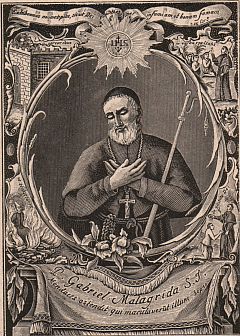
1761: Gabriel Malagrida, Jesuit nutter

On this date in 1761,* the Jesuit Gabriel Malagrida became a late casualty of the Tavora Affair and the Lisbon earthquake when he was garroted for heresy.

Malagrida (English Wikipedia entry | Portuguese) was a 72-year-old Italian with decades of missionary service to the Portuguese New World colonies under his belt.

He had, in his time, been a prominent exponent of the Jesuits missions’ policy in the Amazon, which amounted to asserting their own jurisdiction against the secular government’s attempt to order its overseas territories. (There’s more on that conflict here.)

And this only exacerbated his principal sin of being a Jesuit — an order whose diminution was eagerly sought by the rising statesman of Enlightenment Portugal, the Marquis of Pombal.

The shock of the 1755 Lisbon earthquake would deal Pombal the trump hand he needed to start reshaping both city and society to his liking.

Malagrida, meanwhile, carped that the earthquake’s causes

“are not comets, are not stars, are not vapors or exhalations,** are not phenomena, they are not natural contingencies or causes; but they are solely our intolerable sins … I do not know how a Catholic subject dares to attribute the present calamity of this tragic earthquake to causes and natural contingencies. Do not these Catholics understand this world is not a house without an owner?”

This published pamphlet merely echoed what many of the order were saying in the pulpits, and Pombal was not about to let the backwards, superstitious crowd** own the catastrophe.

Malagrida was banished from Lisbon: and, when the Tavora family was implicated in an attempt to assassinate the Portuguese king, Malagrida, their confessor, found himself clapped in prison.

Though the now-septuagenarian priest did not share the Tavoras’ grisly public butchery, he was left to molder. A couple years in a dungeon saw him go a bit strange, and supposedly he published treatises with such eccentric features as God’s personal instructions to Malagrida, and Malagrida’s fascination with St. Anne’s uterus. Catholic sources, which consider Malagrida a martyr, doubt that he ever published any such thing; if he did, it seems apparent that it was dementia rather than heresy that afflicted the old man.

But Pombal had installed his own brother as judge of the tribunal, so the matter was prearranged. The execution itself was

staged in a dramatic way, even to the point of Malagrida’s appearing on the scaffold in Jesuit habit, to impress upon the Portuguese and the world at large that an old order had come to an end and a new one was to be established … one might say that … symbolism at the cost of one human life was a relatively humane procedure in comparison with the symbolic elimination of whole classes of society in the twentieth century.


Detail view (click for the full image) of Malagrida executed at a Lisbon auto de fe. CC image from Ricardo Mealha, original provenance unknown.

Pitying the superstitious Jesuit at the stake, Enlightenment secularist Voltaire inveighed against Enlightenment secularist Pombal for conducting the execution … just part of Voltaire’s queer ideas about not killing people over their religious beliefs.

“It is all pity and horror,” Voltaire wrote in a private correspondence. “The Inquisition has found the secret to inspire compassion for the Jesuits.”

Voltaire’s appraisal in Candide (already published by this time) of a country in the grip of religious superstition unjustly stands as one of the lasting literary monuments to an event that actually rolled back clerical influence: “the sages of [Portugal] could think of no means more effectual to prevent utter ruin than to give the people a beautiful auto-da-fé; for … the burning of a few people alive by a slow fire, and with great ceremony, is an infallible secret to hinder the earth from quaking.” That the philosophe who penned those words waxed so immoderately outraged at the demonstrative chastisement of a man who preached precisely all that hocus-pocus — that Voltaire ascribed his execution to “the Inquisition” — plants the cherry on the irony sundae.‡

But Pombal’s expedient use of the Inquisition’s medieval machinery to make an example of Father Malagrida would not be the start of a pattern; the Pombaline reforms of the years to come brought the Inquisition sharply to heel, and it was Malagrida himself who was its last victim (pdf) in Portugal in its classical ecclesiastic form.


The house where Malagrida was born in Menaggio, Italy is marked with a plaque. Image (c) kallipyg and used with permission.

* Some sources give September 20 as the date.

** The “God is pissed” hypothesis was posited against theories of earth’s vapors promulgated by the Pombal-sponsored scientist Ribeiro Sanches.

† Anti-Jesuit sentiment was widely abroad in Europe at this time; increasingly resented as political manipulators, the Society would be suppressed by papal order in 1773, only to revive during the post-Napoleonic reaction.

‡ Malagrida was well-known to contemporaries in Europe, but that does not mean sympathy for him was universal. The British pol Lord Shelburne was satirized as “Malagrida” for his putative duplicity.

On this day..

1586: Anthony Babington and fellow plotters, Walsingham’d

The recently completed papal visit to England has summoned many a recollection of that country’s traumatic break from the Church. (As well as more recent embarrassments.)

While we know the schism from the comfort of retrospection, those present for its 16th century inception (and long afterward) had the task of sorting out winners and losers on blood-soaked scaffolds.

So we pause this date to note the extirpation September 20 and 21 of the Babington Plot, a half-baked scheme to re-establish the Old Faith that turned into one of history’s signature achievements of espionage.

Its namesake, young Sir Anthony Babington, was a secret Catholic with more money than sense; like many a Catholic of this time, he bristled under the rule of Elizabeth I, the daughter of the very woman who started all this English Reformation trouble.

Besotted with fellow-Catholic Mary Queen of Scots after having served as her page in his youth, Babington was easy prey for the fellow invariably described as Elizabeth’s “spymaster” — Francis Walsingham.

Not one for scruples where his own security or his sovereign’s was concerned, Walsingham had long considered Mary Queen of Scots too dangerous to be left alive: every Catholic plot against Elizabeth intended to replace her on the throne with this Catholic cousin.

Trying to overcome Elizabeth’s reluctance to off fellow royalty — dangerous precedent, in these dangerous times — Walsingham entrapped Babington and a coterie of other Catholics into designing and documenting a scheme to assassinate Elizabeth and support a Spanish invasion.

And most importantly to Walsingham, they got Mary to sign off on it.

Though the design was grandiose, the real danger was pretty much nil — since Walsingham, a Renaissance reconnaissance man famous for his continent-spanning intelligence network, had penetrated the circle months before.* Walsingham let the conspiracy ripen long after he had the goods on the likes of Babington, intending to make it the instrument of Mary’s destruction. He succeeded.

Coded correspondence that Mary thought she was smuggling in and out of her cell was in fact being intercepted and decrypted.

When Babington wrote to her, alluding to his intent with “six noble gentlemen” to murder Queen Elizabeth, Mary doomed herself with a favorable reply:

The affair being thus prepared, and forces in readiness both within and without the realm, then shall it be time to set the six gentlemen to work; taking order upon the accomplishment of their design, I may be suddenly transported out of this place.

Within days, all — Mary, Babington, six gentlemen, and more — were in chains, and the commoners were being tortured into confessions and implications.**

The reckoning for Mary Queen of Scots would not arrive for some months yet.

But those of lesser breeding were dispatched with dispatch. Tried in two bunches, there were 14 in all condemned; on this date, Babington, was hanged, drawn and quartered for treason, along with accomplices John Ballard, Thomas Salisbury, Robert Barnewell, John Savage, Henry Donn and Chidiock Tichborne — the last of these leaving behind this doleful poetic adieu:

Elegy

My prime of youth is but a frost of cares,
My feast of joy is but a dish of pain,
My crop of corn is but a field of tares,
And all my good is but vain hope of gain;
The day is past, and yet I saw no sun,
And now I live, and now my life is done.
The spring is past, and yet it hath not sprung;
The fruit is dead, and yet the leaves be green,
My youth is gone and yet I am but young,
I saw the world and yet I was not seen;
My thread is cut and yet it is not spun,
And now I live, and now my life is done.
I sought my death and found it in my womb,
I looked for life and saw it was a shade,
I trod the earth and knew it was my tomb,
And now I die, and now I am but made;
My glass is full, and now my glass is run,
And now I live, and now my life is done.

-Chidiock Tichborne

(Hear this bummer of a verse read aloud here and here.)

The torture these first seven unfortunates endured as their entrails were ripped from their still-living bodies was so horrible that Elizabeth ordered the seven others awaiting execution the next day simply to be hanged to death before all the disemboweling business.†

A few books about spymaster Francis Walsingham

* Walsingham had plenty of plots to contend with, but did Elizabeth even greater service keeping tabs on the buildup of the Spanish Armada through a spy network in Italy — even using it to delay the invasion by a crucial extra year by drying up Spain’s credit line with Italian bankers. (Source, via (pdf))

Incidentally, and completely off topic: the subversive, forward-thinking philosopher Giordano Bruno — an Italian who was eventually executed by the Inquisition — has been alleged to be one in Walsingham’s employ.

** Luckily for Elizabeth, the treasonous Protestants who supported her back when she was at the mercy of her Catholic half-sister Mary Tudor were better able to hold their tongues under duress.

† One of those executed on September 21, Charles Tilney, has an oblique Shakespeare connection: he’s one possible author of the play Locrine, which Shakespeare might have revised and/or staged; Locrine is in the Shakespeare Apocrypha.

On this day..

1773: David Reynolds, colonial counterfeiter

On Friday the 17th Instant at Morris Town in East New Jersey, was executed, David Reynolds, a Native of Ireland, about 32 years of age, for counterfeiting the money Bills of Credit of that Colony. He arrived there about ten Years ago, and chiefly followed the farming business, till getting acquainted with one Rosecrans (executed some time ago for the like Crime, but without declaring his Accomplices) he was by him led into the Scheme of making and passing counterfeit Money; after the Execution of Rosecrans, Reynolds accidentally met with Capt. Richardson (of Philadelphia, who is fled) and getting acquainted with each other’s Characters, was by him introduced to Ford, Haynes, Cooper, Budd, King, and the rest of the Gang. Ford the Principal, termed by the Rest, the Treasurer of the three Provinces, had counterfeited the Money Bills of New York, New-Jersey, and Pennsylvania, in so Masterly a manner as not to be distinguished from the true Bills without the nicest Inspection, and also several of the Gold and Silver Coins current in the British Colonies: and in passing these, Reynolds and the Rest of the Accomplices continued, till Ford and King were apprehended and imprisoned in Morris County Gaol, from whence they soon made their escape, as mentioned in the Papers.


Paper currency of colonial New Jersey.

One of the Gang being convicted of aiding them in their Escape and other high Misdemeanors, to mitigate the Punishment, made some Confessions tending to the Discovery of the Rest, which alarmed another, who made an ample confession of the whole, in Consequence of which Reynolds, Haynes, Cooper, and Budd, were tried, confessed their Guilt, and were condemned to be hanged. Their Execution was ordered to be on the 17th Instant; before that Time, Budd and Haynes were respited for a Month, but Reynolds and Cooper were ordered to prepare for Execution at the Time appointed. A few Minutes before the Time, Cooper confessed himself privy to the Robbery of the Treasury at Amboy, and that he received Three Hundred Pounds of the Money; on which he was also respited till he should make further Discoveries. Reynolds was therefore ordered for Execution alone, at which he seemed much affected and burst into Tears, but thro’ the Assistance of a Minister who attended him, he grew Calm, and resigned to his Fate. His Behaviour during his Confinement and after his Sentence, was penitent and submissive; he shewed a proper Sensibility of his unhappy Situation, and earnestly exhorted his Companions in Guilt, to a sincere Repentance. On the fatal Day, he took an affecting Leave of them; and they all discovered the most lively Expressions of that Distress to which their Crimes and Follies had reduced them, which drew Tears from the Eyes of the Spectators. At the Place of Execution, Reynolds sung and prayed very earnestly, and in a short but pathetic Speech, warned the People to avoid the Vices that had undone him, and earnestly requested them not to reflect on his innocent Wife and helpless Infants.

–The New-York Gazette; and The Weekly Mercury, September 27, 1773

All the other three reprieved ultimately escaped hanging, owing to influential connections.

On this day..

1870: Jacob Wallace, Henry Coston, and Moses and Peter Newby

The Daily Cleveland Herald, September 22 1870

THE VIRGINIA GALLOWS HORROR.

Tortured by a Bungling Hangman — Half Executed with a Rotten Rope — A Monster under the Gibbet.

The four negroes who were hanged on Friday last at the Court House of Isle of Wight county, Virginia, were convicted of the murder, under most brutal circumstances, of Josiah P. Grey, a citizen of that country, in December last. Six negroes were implicated in the crime, named respectively, Guyanetta Mears, Alfred Bunckley, Moses and Peter Newby, alias Lawrence, Jacob Wallace, and Henry Coston, alias East. The last five were immediately arrested, Mears having either effected his escape in a somewhat miraculous manner, or, as it is rumored, having been lynched by his captors. The five taken were tried at the August term of Isle of Wight county. Bunckley having turned State’s evidence, escaped, but by their own confession of complicity in the killing, four of them were condemned to be hanged. The Norfolk Virginian gives this account of the execution:

About 12 1/2 o’clock the officers entered the cell in which the prisoners were confined, and striking off their iron shackles, tied their hands behind their backs, at the same time telling them they could make any communication which they wished. To this no satisfactory answer was returned, and the condemned continued chanting their prayers for mercy from on high. As soon as the pinioning was performed, the condemned were marched out of the jail on the steps and upon the scaffold.

They walked firmly and undoubtedly, with one exception, Moses Newby, who shook as if in an ague fit, and were ranged in the following order: Peter Newby, Henry Coston, Moses Newby, and Jacob Wallace. The fatal nooses were then adjusted, when the Sheriff read the death warrant and sentence of death. The prisoners were informed that they could have an opportunity of saying a few words each.

The feet of the condemned having been pinioned upon their first taking their stand upon the scaffold, as each one ceased to speak the black cap was drawn over his head, and when all had finished, the scaffold was cleared of all but the condemned and at exactly 1 o’clock, at a signal from Deputy Sheriff Ely, the prop was pulled violently away, and the drop fell.

Then ensued a scene the recital of which we would willingly spare our readers, and a repetition of which we earnestly hope it may never be our lot to witness. As the bodies fell in the drop, the two end men, Peter Newby and Jacob Wallace, both large, athletic men, snapped the rope like pack-thread, and fell heavily to the earth, apparently insensible.

The other two remained suspended; but one was hanging by only one strand of the rope, the other two having been broken by the fall. Moses Newby died instantly, his neck being broken, but Henry Coston lived for nearly ten minutes, gasping for breath, and his limbs working convulsively.

The two men on the ground lay still for a few minutes, when Jacob Wallace rose to a sitting posture and broke into prayers and supplications. Peter Newby lay a while longer, when he also sat up, but kept silent, except groans extorted by pain. Their feet were then untied, when both stood up, Newby leaning heavily against the steps of the gallows, while Wallace walked back and forth, praying intently. New ropes were procured and adjusted to the beam, the two men hanging preventing the drop being raised. At the expiration of seventeen minutes the physicians in attendance, Drs. Jordan and Chapman, examined the bodies and pronounced them both dead, when another horror was enacted which made strong men shudder and turn pale.

Instead of lowering the bodies as is always customary, the ropes were cut, allowing the ghastly corpses to fall with a horrible thud at the very feet of the two half-hanged men standing below. Not content with this, the brutal monster who officiated as hangman, an occupation which he dishonored, and who rejoices in the name of the name of [sic] John J. Murphy, descended from the scaffold, and taking hold of the rope attached to the neck of one of the dead men, drew the body by it across the yard, and tumbled it into the coffin, as if it had been a dead dog. He repeated the operation on the next one, and seemed to think that by his disgusting brutality he had done some meritorious action.

During the whole of the time this disgusting scene was transpiring, Wallace and Peter Newby, although suffering horribly from the effects of the rope around their necks, in their fall, betrayed no emotion, save that Wallace used the time in praying loud and fast. Newby looked on apparently as unconcerned as if he was not an actor in the dreadful drama.

The new ropes, which were of stout cotton cord, having been fixed, the drop was replaced and the miserable men mounted the scaffold the second time, this time never to return alive.

The condemned both spoke to the crowd around in the same strain as before, at the conclusion of which the black caps were again drawn over their heads, and at half past one o’clock the drop again fell, and the ropes proving strong enough, they were left struggling in the air. Neither of their necks were broken, and for several minutes they gave painful evidence of life by their forced breathing and the convulsive jerking of their arms and legs. They were allowed to hang for half an hour, when they too were cut down, placed in their coffins, and taken to the court-house graveyard for interment.

[editor’s note: here’s the perfunctory and much less colorful New York Times report of the incident.]

On this day..

1772: The Marquis de Sade and his servant, in effigy

On this date in 1772, straw effigies of the (in)famous French libertine Marquis de Sade and his servant Latour were executed in Marseilles for sodomy.

“It is always by way of pain one arrives at pleasure.”

The aristocrat christened Donatien Alphonse François (even the name would become taboo for later use among his family) was at this point just 32 years old, but already cultivating the reputation that would make his name a byword for violent sex. He had in 1768 got the boot from Paris in view of the many courtesans who complained of his mistreatment.

Five more would do so for the incident that triggered his “execution”: de Sade took his baroque pleasure from these “very young girls” obtained by his manservant Latour (who also took part in the bisexual debauch). The whole scene was spiced with liberal dosage of the poison/aphrodisiac* spanish fly.

“Cruelty, very far from being a vice, is the first sentiment Nature injects in us all.”

One of these working girls seriously overindulged on the the love potion and spent the next week puking up “a black and fetid substance.” The authorities got interested, and de Sade and Latour bolted to Italy.**

Back in Marseilles, proceedings against the fugitives saw them sentenced for (non-fatal) poisoning and sodomy

for the said Sade to be decapitated … and the said Latour to be hanged by the neck and strangled … then the body of the said Sade and that of the said Latour to be burned and their ashes strewn to the wind.

This was duly carried out against straw effigies of de Sade and Latour on September 12, 1772.

“Lust is to the other passions what the nervous fluid is to life; it supports them all, lends strength to them all: ambition, cruelty, avarice, revenge, are all founded on lust.”

Although the Marquis eventually got this sentence overturned, it did in a sense mark an end to his life as it had been. Later in 1772, he’d be arrested in Italy; though he escaped and went back on the orgy circuit, most of the four-plus decades left to his life would be spent imprisoned or on the run — an ironic situation for the man Guillaume Apollinaire would celebrate as “the freest spirit that has yet existed.”

(Astonishingly, de Sade also avoided execution during the French Revolution: he was supposed to have been in the last batch guillotined before Robespierre fell; either through bureaucratic bungling or efficacious bribery, he avoided the tumbril.† De Sade also cheated death when a man whose daughter the marquis had outraged attempted to shoot him point-blank … only to have the gun misfire.)

“My manner of thinking, so you say, cannot be approved. Do you suppose I care? A poor fool indeed is he who adopts a manner of thinking for others!”

From this latter half of the infamous satyr’s life — when he often had time on his hands not available to dispose in more corporal pursuits — date the pornographic/philosophic writings that would stake de Sade’s disputed reputation for posterity.

* Alleged aphrodisiac.

** With another lover, his sister-in-law Anne … who was also a Benedictine canoness.

† It was on some firsthand authority, then, that de Sade took a dim view of capital punishment: “‘Til the infallibility of human judgements shall have been proved to me, I shall demand the abolition of the penalty of death.” This and other pithy de Sade quotes in this entry are from here.

Part of the Themed Set: Executions in Effigy.

On this day..