1764: The Sirven family, in effigy

On this date in 1764, Pierre-Paul Sirven and his wife — who lay beyond the reach of the law, in Switzerland — were burned in effigy at Mazamet, France, for murdering their daughter.

The Sirvens actually had three daughters; the purported victim, Elisabeth, was mentally unbalanced. The Protestant Pierre-Paul Sirven had had a recent run-in with the Catholic hierarchy in his native Castres, when Elisabeth was shanghaied to a convent for Catholic indoctrination under a lettre de cachet.

The Sirvens moved away to Saint Alby, near Mazamet, but when Elisabeth turned up dead in a well there early in 1762, the official presumption was that her schismatic parents had done her in to prevent her returning to the true church. It could have been that she just fell down the well accidentally, or went and committed suicide; as often in such cases, investigations commencing from a suspicion of foul play are liable to find that suspicion self-affirming.

To make matters worse, all this transpired during the dangerous run-up to the execution of Jean Calas in Toulouse, another instance where a doubtful criminal case was pursued against a Protestant.

Wisely, the Sirvens (parents and two remaining daughters) blew town.

They made it to Switzerland, where they holed up with Voltaire. Back in Mamazet, the parents were condemned to death and the other two children to exile for participating in the purported murder of Elisabeth. “This judgment was equally absurd and abominable,” Voltaire wrote.

If the father, in concert with his wife, had strangled his daughter, he ought to have been broken on the wheel, like Calas, and the mother to have been burned — at least, after having been strangled — because the practice of breaking women on the wheel is not yet the custom in the country of this judge. To limit the punishment to hanging in such a case, was an acknowledgment that the crime was not proved, and that in the doubt the halter was adopted to compromise for want of evidence.

The death sentences — further compromised by the absence of their objects — were nevertheless carried out in effigy on September 11, 1764.

Meanwhile, Voltaire turned his pen to the service of the Sirven cause; a French pamphlet he wrote vindicating both the Sirvens and Calas can be perused here. (Deadly religious persecution in France kept Voltaire quite preoccupied in the 1760s.)

After spending the decade trying to clear the family name from abroad, Pierre-Paul Sirven sensed an opening to return and gave himself up in 1769. The anti-Protestant hostility of the early 1760s had cooled by this time; the Calas execution was widely regretted.

Pierre-Paul Sirven was officially tried and exonerated in 1771, leading Voltaire to remark,

It only took two hours to sentence a virtuous family to death and it took us nine years to give them justice.

Part of the Themed Set: Executions in Effigy.

On this day..

1661: Kaj Lykke, in effigy

On an uncertain date in 1661, the Danish noble Kaj Lykke (sometimes Kai Lykke) — safely but penuriously absconded to exile — was “executed” in effigy.

This wealthy roue (Danish Wikipedia page) was famous for his affairs innumerable.

To one of these maids, Lykke addressed a love-note remarking that the unpopular queen consort Sophie Amalie enjoyed queen consorting with her servants.

The sort of salacious rumor-mongering that constitutes many a blogger’s daily bread (and no doubt many a debauched noble’s pillow-talk) was, in Denmark at the dawn of its absolute monarchy, lese-majesty, and a good excuse once it became known to seize the naughty noble’s riches for the crown.

Lykke got himself abroad and didn’t have to face the music in the flesh — though the forfeited estates were no mean loss — and a doll representing the dirty-minded fugitive had its hands and head lopped off in Lykke’s stead in Copenhagen.

Kaj Lykke returned from exile (Swedish link) and died in Denmark in 1699. Centuries later, his skull was unearthed pursuant to eugenics research: the theory was that this bad boy’s sloping forehead showed him to be a primitive Neanderthal-descended type.

Though that particular bit of pseudo-science has long since been buried, Lykke’s skull never has been — and given that it’s out and about anyway, it’s been used to reconstruct the noble’s appearance. (I’ve been unable to locate an image of this reconstruction online.)

Part of the Themed Set: Executions in Effigy.

On this day..

1437: Jan Rohác z Dubé, Hussite marshal

On this date in 1437, Hussite marshal Jan Rohác z Dubé was hanged in Prague.

The Bohemian commander had upheld throughout the Hussite Wars the cause of its namesake heretical priest. (There’s a Czech biography of Rohac here.)

The Hussites had a nice run in the 1420s — no less a personage than Joan of Arc took time out from French battlefields to dictate an anti-Hussite jeremiad threatening to “remove your madness and foul superstition, taking away either your heresy or your lives” — but eventually succumbed to repeated papal onslaughts.

They were decisively crushed at the 1434 Battle of Lipany … but Rohac survived it, and “emerg[ed] from the ashes” like “a phoenix”, the last champion of the forbidden sect.

Rohac rallied the remnants of his partisans to a fortress named Sion* near Kutna Hora, where they were besieged and ultimately overwhelmed.

Days later, he was demonstratively executed in Prague, where all this Hussite trouble had started.

The people of Prague, as an act of intimidation directed at dissenters, were forced … to watch the gruesome display. Clad in his red baronial robes, with a sign draped around his neck stating his condemnation, Rohac was hung by a gold chain from the top of a three-story gallows. Beneath him hung the bodies of the Sion garrison.

Present-day Jan Rohac appreciation is best done Czech.

This bio is available reprinted from a public domain source. There’s also a 1947 Czechoslovakian film (appropriately titled Jan Rohác z Dubé, but also known in English as Warriors of Faith) celebrating Rohac’s exploits.

* No truth to the rumor that the Hussites’ doings in doomed Sion inspired the techno rave scene in the city of the same name in The Matrix.

On this day..

1635: Francisco de Nava, precipitating a church-state conflict

[S]trife* [between Manila archbishop Hernando Guerrero and the Spanish governor Don Sebastián Hurtado de Corcuera] being greatly inflamed … became entangled with one of the most memorable disputes that have occurred in the islands — a necessary occasion for the sharpest encounter between the two jurisdictions, and one from which Don Fray Hernando Guerrero could not excuse himself, as it concerned the most sacred part of the ecclesiastical immunity. That was a matter in which the archbishop could not neglect to sally out with all his might, in order to comply with the obligation of a true prelate. The case was as follows: There was an artilleryman in Manila, named Francisco de Nava, who had a female slave with whom he had illicit communication, as came to the ears of the archbishop. The archbishop ordered him to remove from himself this occasion [for sin] by selling the slave-girl to another person; and had the latter placed, for that purpose, in the house of a lady who was related to Doña María de Francia, who became fond of her and arranged to buy her from the artilleryman. The latter was so beside himself over the loss of the said slave that he refused to sell her at any price, saying that he wished, on the contrary, to marry her. But Doña María de Francia so arranged matters that the slave was sold, and came into her possession with very slight effort. The artilleryman, grieved and regretful for what had happened, almost became mad, and, it having been given out that he was mad, certain violence was shown him; and on one occasion he had received a sound beating at the house of Doña María de Francia, because he had gone there to request that they should give him the slave, as he had resolved to make her his wife.

Aggrieved and rendered desperate in this way, he saw the girl pass one day in a carriage with Doña María de Francia. Going to her he asked her whether she knew him, who was her master. The slave answered him with some independence, whereupon he, blind with anger, drew his dagger in the middle of the street and killed her by stabbing her, before anyone could prevent it. All the people, both those in the carriage and those in the street, ran tumultuously [after him]; but the artilleryman escaped them all, and took refuge in the church of our convent in Manila. The governor heard of what had happened, and ordered Don Pedro de Corcuera, his nephew (who was then sargento-mayor of the camp), to take the artilleryman from the church, saying that he could not avail himself of the sanctuary of the church, as he had committed a treacherous act — although it was only a homicide, and the settlement of this question did not concern the governor. However, his action arose mainly from the anger that he felt that what had happened was in the presence of his nephew, Don Pedro de Corcuera — who, also being angered at what concerned his wife, made use of his commission with less prudence than he ought to exercise in executing such orders from his superiors. He caused the church and convent to be surrounded; and, going inside, examined everything, not excepting even the sacristy; and it is even said that he declared that, if he found the artilleryman there, he would take him out a prisoner. But not having been able to find him then, Don Pedro left the church and convent surrounded by a double guard. The governor added to that that he would not allow the religious to enter or leave, until he had hold of the refugee. The latter was finally found, and taken from the sacristy, and surrendered to the commander of artillery, in order that he might proceed with the trial as his competent judge; and he, either carried away by flattery, or in obedience to the commands of the governor, proceeded so hastily that in a very short time he condemned the artilleryman to death.

The archbishop’s provisor, Don Pedro Monroy,** bore himself on this occasion with the prudence that was fitting, and proceeded against the commander of artillery, requesting him to deliver his prisoner and return him to the church. Having been informed that the commander of artillery was a mere instrument, and that all his actions were according to the impulses of the governor, he sent three lay priests to the palace to intimate to the latter that the judge should deliver the refugee to him. The priests entered, without anyone hindering them; and finding that the governor had already retired, as it was then an advanced hour of the night, they started to withdraw in order to return next morning; but the soldiers of the guard would not permit them to leave, saying that such was the order of the governor.

The sentence against the artilleryman having been given — which it is said that the governor sent ready made out to the judge, to sign — they proceeded to execute it,† notwithstanding that the provisor proceeded to threaten censures, and to impose an interdict and suspension from religious functions [cessatio de divinis]. The governor ordered a gallows to be erected in front of the very church of St. Augustine, and the criminal was hanged thereon — to the contempt of the ecclesiastical immunity, for the [proper] place assigned for such punishments was very distant from there. The governor, seeing that the sentence was already executed, and that he had now obtained the chief object of his desire, wrote to the archbishop, requesting him to have the censures removed and the interdict raised, and the churches opened on the day of the nativity of our Lady. The archbishop, recognizing the duplicity of the governor, refused to answer that letter without first consulting the orders; and, after consulting with some of them, decided that he would not raise the interdict, since there was less inconvenience in having it imposed [even] on so festive a day, than there would be in his yielding on an occasion so inimical to the ecclesiastical immunity. However, the requests of the Recollect fathers of our father St. Augustine, who had charge of the advocacy of the nativity, had so much influence that the archbishop ordered the interdict to be removed, and it was done.


Manila’s historic St. Augustine church. (cc) image from Jun Acullador

The commander of artillery was condemned to some pecuniary fines, from which he appealed to the judge of appeals, who was the bishop of Camarines. The ecclesiastical judge refusing to admit the appeal, he threatened the royal aid of fuerza; and this question having been examined in the royal Audiencia (which at that time consisted of but the governor and only one auditor, Don Marcos Zapata), it was declared in his favor, and the appeal went to the bishop of Camarines. The latter — namely, Don Francisco Zamudio, of the order of our father St. Augustine, and a son of the province of Méjico — declared the commander of artillery to be free from the sentence given by the ecclesiastical judge. The trial of the commander of artillery had its second hearing. On that account there did not fail to result certain charges against the governor, such as his having ordered the secular priests to be detained in the guard-house; his declaration that he could not be excommunicated by anyone except the pope; and that if an order were given to him to arrest the pontiff, he would arrest him, and even drag him along by one foot (which he was proved to have said by several persons). The governor freed himself from all these charges by excuses in a manifesto which he published; but as it is not a part of my duty to examine their adequacy, I shall not do so. I shall refer the reader to the reply made to him by a learned ecclesiastic of the university of Méjico; for there is no liberty in Filipinas to enable any one to complain, or to speak his mind against what the government manipulates

–The Philippine Islands, 1493-1898 — Volume 25 of 55

* “The underlying reason for this public dissension was racial,” says this source.

The rivalry between Spaniards born in the peninsula and those born in the colonies, the creoles or americanos, affected not only the clergy but also the lay population. The Augustinians, and the Hospitaller Orders of San Juan de Ojos, San Hipolito and Guadalupe, whose members were creoles, were opposed by the Carmelites and the apostolic colleges in that country. “While legally they [both factions] were on complete equality,” writes Dr. Domingo Abella, Philippine ecclesiastical historian, “class distinctions were apparently encouraged as much as possible by the Spanish colonial policy, because the principle of divide et impera of every aristocratic system was the leading idea for the permanent subjection of the colonies.”

The rivalry reached such an extent that in 1627 the Dominican Order in Mexico refused to admit creoles into its ranks, an act which the Spanish king disapproved. In the Philippines the situation had not openly reached that extreme. The insular hierarchy managed to keep the number of creoles, mestizos and indios who were embracing the religious life down to a minimum. But the racial discrimination rankled among those born in the colonies. Archbishop Guerrero and Bishop Zamudio were both Augustinians, but the former was a peninsular, while the latter was a creole, and this was probably the reason for their taking opposite sides.

** Later exiled to Formosa.

† A letter quoted elsewhere in the same text confirms “the execution of the sentence on the night of Thursday, September six”

On this day..

1736: Both John Vernham and Joshua Harding survive a hanging

Bristol, September 4.

Yesterday at 12 o’Clock, Vernham and Harding, were carry’d from Newgate to the Place of Execution on St. Michael’s hill, attended by the Under-Sheriff, and his Officers, and the Constables of the City, (in a Cart, with Halters about their Necks;) the Divine who attended them, having finish’d his last Office, the Cart drew away: But to the Surprize of every one, after hanging the usual Time, and being cut down, Vernham was perceived to have Life in him, when put into the Coffin; and some Lightermen and others, who promis’d to save his Body from the Surgeons, carried him away to a House; and a Surgeon being sent for, immediately open’d a Vein, which to recovered his Senses, that he had the Use of Speech, far up, robb’d his knees, shook Hands with divers persons that he knew, and to all seeming Appearance, a perfect Recovery was expected.


Appropriately metaphorical image of a gateway on St. Michael’s Hill in Bristol, (cc) Daniele Sartori.

The Rumour of this, soon came to the Under-Sherif’s Ears, who, with Mr. Legg, and several Officers armed, went to know the Truth, and finding it certain, were about to remove him to a proper Place, in order to have him again under their Care for a second Execution,and finishing the Law; which we hear would have been done in a private Manner, without any Ceremony: But whether any secret Method was used to dispatch him, or not, he died about Eleven o’ Clock, in great Agony of Pain, his Bowels being very much convls’d, as appeared by his rolling from one Side to the other, and often on his Belly.

{He was bout 20 Years of Age; while [under] Sentence of Death he behaved very penitent, laying the whole of his Misfortune upon a fatal Companion,* particularly as to the breaking open Mrs. Atherton’s House. Harding behaved very unconcerned, charging his Wife with being the chief Inset to his Misfortunes, and even curs’d her just before he received the Sacrament that Morning.}

And to our second Surprize, Joshua Harding is also come to Life again, and is actually now in Bride-well, where great Numbers of People resort to see him, Particularly Surgeons, curious of Observations. He lies in his Coffin, covered with a Rug, has Pulsation, breathes freely, and has a regular Look with his Eyes; but he has not been heard to speak, only motions with his Hand where his Pain lies. ‘Twas thought he would be executed a second Time {to the finishing his unhappy Fate by a private Execution, at the same Tree he was cut down from}; but we are now told, he is to be provided for in some convenient House of Charity, with Restraint, he being to all Appearance defective in his Intellects. Two such Resurrections happening at one Instant in the World, was never heard of in the Memory of man.**

–The Virginia Gazette, Dec. 24, 1736. {Curly-braces portions from an otherwise largely identical report in The South Carolina Gazette, Jan. 15, 1737.}

Coverage from The Daily Gazetteer is available here. The London Magazine adds the detail that all those curiosity-seekers visiting Harding “give him Money” and “are very inquisitive whether he remembers the Manner of his Execution: to which he says, he only can remember his being at the Gallows, and knows nothing of Vernham’s being with him.”

* This Annals of Bristol says that Vernham nearly refused to plead until the prospect of judicial pressing caused him to chicken out. (And ironically, to the extent it forwarded his execution date to this evidently felicitous occasion, almost saved his life.)

** Two hanged men reviving at once is remarkable indeed, but it was not so strange at this time for individual prisoners to survive their executions.

On this day..

1714: Maria Mouton and her slave Titus, lovers

On this date in 1714, a slave and his mistress — “mistress” in both senses of the word — were put to death in the Dutch Cape Colony for murdering her husband.

Marie or Maria Mouton had arrived in South Africa in 1699 as a nine-year-old with a refugee Huguenot family.

A decade and a half’s passage finds her a young woman wed to one Franz or Frans Joost/Jooste/Joostens, to whom she bore two sons … and, evidently, a homicidal grudge.

Early in 1714, Maria and her lover, a slave named Titus Bengale, murdered Frans, in consequence of which crime,

[s]he [Maria] is sentenced to be half strangled, after that to be scorched,* and after that strangled unto death. Titus to be empaled and to remain so, until death. After that his head and right hand are to be cut off and fixed on a pole, beyond the limits of his late master’s property. Fortuin, an accomplice, is also to have his right hand cut off, and without receiving the coup de grace, is to be broken on the wheel. After that he is to be placed on a grating until death takes place. After that his head is to be cut off, and with his hand placed on a pole, together with the head and hand of Titus. After that the bodies are to be taken to the outside place of execution, and there left exposed to the air and the vultures.

She’s the only white woman to be executed in 18th century South Africa.

Our Precise of the Archives of the Cape of Good Hope** notices that Titus, despite enduring his grotesque execution for two full days before succumbing, remained terribly jocund amid his public torture. (Not unlike other slaves tortured to death in Dutch colonies):

September 3 — The slave Titus, above mentioned, died about midday, having lived in his misery about 48 hours; something horrible to think of, to say nothing of personally beholding the misery. It is said that 4 hours after his empalement he received a bottle of arrack from which he drank freely and heartily. When advised not to take too much, lest he should get drunk, he answered that it did not matter, as he sat fast enough, and that there was no fear of his falling. It is true that whilst sitting in that deplorable state, he often joked, and scoffingly said that he would never again believe a woman. A way of dying, lauded by the Romans, but damnable among the Christians.

This case is discussed in more detail by Nigel Penn in “The wife, the farmer and the farmer’s slaves: adultery and murder on a frontier farm in the early eighteenth century Cape,” Kronos, vol. 28 (2002) — here’s an excerpt — and by the same author in Rogues, Rebels and Runaways: Eighteenth-Century Cape Characters.

* Literally, blaker. “To ‘blaker’ someone,” notes Nigel Penn in “The wife, the farmer and the farmer’s slaves: adultery and murder on a frontier farm in the early eighteenth century Cape,” Kronos, vol. 28 (2002), “was to hold burning straw to their face and to blacken it … a reference to the earlier practice of burning at the stake victims found guilty of heresy, witchcraft and sodomy. Surely we may also see, in the case of the blackening of Maria Mouton, a reference to her crime of cohabiting with slaves.”

** After another slaveowner was murdered later in the year, the chronicle laments that “crime is rapidly assuming large dimensions, in spite of the means used to prevent or suppress it. A clear proof that this Colony mainly consists of evil disposed, head-strong slaves and the refuse of convicts.”

On this day..

1923: Nathan Lee, the last public hanging in Texas

This date in 1923 was the passing of an era: the last legal public hanging in Texas.

The Texas of legend — the rough and vast frontier — fits the public hanging tableau (and its dark cousin, the lynching) like a hemp necktie.

And up until 1922-23, Texas executions had indeed been hangings administered by county sheriffs. But that newfangled killing technology, the electric chair, beguiled the legislature here as elsewhere. Oil wells popping up all over the state were rewriting its economic future … so why not a futuristic way of killing wrongdoers, too?

A 1923 bill centralized future executions in Huntsville, where they still remain today.

Denouncing countyseat [sic] executions as a barbaric relic of the frontier past, L.K. Irwin launched a one-man campaign to bring Texas in tune with the times. The state legislator converted many to his cause with the argument that public hangings harmed society almost as much as the condemned.

Irwin insisted executions usually degenerated into bloodthirsty carnivals that did nothing to instill in spectators a respect for the law. All too often untrained local officials made the spectacle even more gruesome, when the drop failed to snap the victim’s neck. On those occasions, he slowly strangled in full view of females and impressionable children.

In the 1923 session of the Lone Star legislature, Irwin introduced the Electric Chair Bill. In addition to doing away with the gallows, the proposal relieved county sheriffs of the responsibility of the carrying out death sentences. Future executions would be held behind closed-doors inside the Texas Department of Corrections.

That law took effect on Aug. 14, even though the electric chair hadn’t even been built yet. The hanging of one Roy Mitchell in Waco on July 30 figured to be the last, and thousands packed the public square to witness it. It’s still sometimes cited as the Lone Star State’s last hanging.

Grandfather Clause

But on that very same date in the Gulf town of Angleton, Nathan Lee, an illiterate middle-aged black sharecropper, was condemned to die for shooting his white employer dead in a dispute over money. (The Ku Klux Klan sent flowers to the funeral.)

A month later, he did so — albeit in an area whose public access had intentionally been curtailed, to chill out any potential carnival scene.

“I did it,” Lee said on the scaffold. “I am to blame, and no one else.”

On this day..

1793: Adam Philippe, Comte de Custine

The best defense would have been a good offense for French General Adam Philippe, Comte de Custine — guillotined in Paris this date in 1793 for inadequacy in command of the French revolutionary armies fighting continental monarchist armies.

You must be this tall to go on the General Moustache* ride, and poor results in the field at this time could leave you shorter. Losing to the enemy looked an awful lot like conspiring with the enemy, especially when there was a “Comte” in your name.

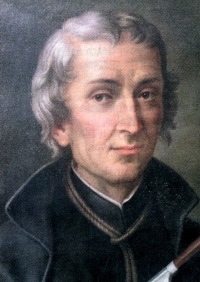
Custine spent the winter of 1792-1793 coughing up French conquests across the Rhine. (In his defense, several of them were things that he’d previously conquered himself.)

Recalled once to Paris to justify himself, the bewhiskered general was defended by no less than Robespierre, and thereafter returned to the field. Given this background, it was not wise of him to resume the losing streak — but he did.*

The resultant second recall saw the moustache — and its associated head — permanently shaved for treacherously throwing battles like the 1919 White Sox. This met with the great approval** of Hebert‘s Pere Duchesne :

“Epitaph on General Custine”

Here lies an headless General—(I’ll say dead)
As many living Generals want an head.

You have just done something worthy of me by denouncing Custine. You have brought into broad daylight his plots and his treason. If we had waited a few more days to recall him freedom would have been fucked. This infamous rascal, after having had the French in Frankfurt massacred, after having abandoned Mainz, after having allowed Valenciennes to be encircled, after having delivered Condé, only awaited the right moment to lead his army into a slaughter and to deliver the coup de grace to the republic by sacrificing its last resources. Fortunately, the bugger has been put to the side. His crimes have been proved, let his head promptly fall under the national razor, but let his not be the only one! Let all the scoundrels who compose his headquarters also be shortened. Pursue, denounce without rest the infamous Tourville, who was the right arm of Lameth, and who will deliver Maubeuge if we leave him in command. Make known the swindler Lapallière, and especially the ci-devant marquis de Verigni, known in all the gaming houses under the name of Debrulis. Tell the Sans Culottes in the army that this rat has emigrated twice. Don’t forget Leveneur, the intimate friend of Lafayette, and the henchman of Custine. Don’t allow these bandits a moments rest until they’ve been chased and punished as traitors.

Custine’s son also got the chop for defending his old man.

Surviving the purge: Adam Philippe’s then-three-year-old grandson, Astolphe Custine. Custine would become famous as “the de Tocqueville of Russia,” and for his aphoristic and still-current travelogue La Russie en 1839.

* Actual nickname.

** And characteristically profane. Pere Duchesne would not have had a lot of patience for coy little cunnilingus references where a salty sans-culotte f-bomb would do instead.

On this day..

1679: St. David Lewis, the last Welsh martyr

On this date in 1679, the Jesuit David Lewis was hanged, drawn and quartered.

Lewis suffered just days after a fellow priest and fellow victim of Titus Oates’ “Popish Plot” concoctions, John Kemble.

Lewis was arrested at the Wales town of Llantarnam where he was Tad y Tlodion, “father of the poor”; hauled to London’s Newgate Prison, he was returned to Usk, also in Wales, for execution.

As with Kemble, Lewis “discover the plot I could not, as I knew of none; and conform I would not, for it was against my conscience.” Where terroristic plotting could not be established, taking Holy Orders in the church would do just as well.

Lewis is not actually the last Catholic martyr in Britain* — Oliver Plunkett earned that distinction in 1681 — but at this late date he goes down as the last Welsh martyr, which is also the title of an energetic Catholic blog all about the man and his milieu.

Seems that site has a virtual pilgrimage to go along with the annual meatspace tradition that takes place this year on Sunday, August 29. The faithful might also enjoy friendsofsaintdavidlewis.co.uk.

* An inventory of martyrs for the faith in the Isles is here.

On this day..

1460: The residents of Amlas, impaled by Vlad Dracula

This date is the 550th anniversary of (in)famous Wallachian dictator/vampire prototype Vlad III Tepes‘s destruction of the town of Amlas, impaling all its surviving citizens.

The signature execution form of “Vlad the Impaler” was as nasty as it sounds: still-living victim mounted on a long, oiled stake driven through the rectum and emerging through the mouth to expire agonizingly over a period of hours or days. Or, alternatively, stuck through the midsection, leaving the subject horizontally mounted like a flopping fish.

And he had frequent recourse to it during his long struggle for power in the treacherous 1450s and 1460s, the period* when Vlad III became famous for the iron-willed cruelty required to exercise power in a Wallachia squeezed between the expanding Ottoman Empire and Hungary.

It was this terrifying period from the late 1450s that made Vlad Dracula — the titular second name inherited from his father‘s investment into the Order of the Dragon, Draco in Latin — the namesake for Bram Stoker‘s famous bloodthirsty Transylvanian noble, and the granddaddy of all its lucrative latter-day offspring.

(Bram Stoker didn’t invent the vampire myth, and the notion that Vlad Dracula “is” Count Dracula is one of those bits of popular folklore that’s become academically unfashionable. But still.)

The historical Vlad has his latter-day defenders, who see him as a nation-builder. Certainly, both the man himself and his vulnerable frontier principality were menaced by innumerable threats both foreign and domestic.

This date’s massacre was to deal with one such, Germans in the territory of Transylvania, which lay to the north of Vlad’s own Wallachia. Both realms are part of present-day Romania, and they were closely connected in Vlad’s time as well; the young Dracula himself was born in Transylvania, and Transylvanian towns had helped him take the Wallachian throne with the support of Hungary.

So far, everyone was on the same page. But when a power struggle erupted for the Hungarian throne in 1457, the “Saxon” emigres who formed the upper crust of merchants in Transylvania (supported by a vast sea of Romanian peasants) backed the Holy Roman Emperor while Vlad supported the usurping Hunyadi family that had so ably patronized him.** It’s quite a bit more dizzyingly complex than that, but the bottom line is that commercial and political conflicts soon saw Vlad Dracula mounting a campaign of Transylvanian terror from 1458 onward.

During the summer of 1460 Dracula organized his final raid on Transylvania. This time he attacked townships and villages in the district of Amlas known as the “Land of the Forest” or Unterwald … The meistersinger Beheim gives the exact date of the attack as falling on the feast day of Saint Bartholomew in the year 1460: August 24. Dracula struck in the early morning after “passing through the great forest” with his cavalry force. He burned the town of Amlas and impaled all the citizens, a priest having led the procession to the burial scene …

Dracula’s raid on Amlas was aimed at eliminating any remaining dissident resistance and at killing rival contenders to his throne … Dracula knew, for instance, that … the boyar Bogdan Doboca, was hiding in the village of Sercaia, in the Fagaras district. So he had the entire village razed to the ground; it had to be completely repopulated in the following century. Similar was the fat of the village of Mica. The narrator Beheim tells us that Dracula burned or destroyed half the communities in the Amlas district, including the capital city by that name. He “assembled all the citizens and all those he could find” from other villages and hanged them on hooks and pitchforks, after having had his men hack them to pieces with knives, swords, and sabers. Amlas was reduced to a ghost town, as it still is today, and other villages such as Saliste, Apodul de Sus, and Tilisca were similarly destroyed. Beheim claims that altogether some 30,000 Germans were killed during this Dracula raid on the district of Amlas.

Impressive as this date’s butchery would have been — although we know it from German propagandists who figure to have made the most of it — it was simply of a piece with Vlad’s Transylvanian campaign. To this campaign, Florescu and McNally attribute an impressive catalogue of atrocities, such as:

  • Slaughtering all the inhabitants of a village named Bod
  • Impaling one of his own captains who reported an inability to take an enemy position “for the inhabitants are brave and well fortified”
  • Boiling alive 600 Saxon merchants
  • Impaling as spies 41 Saxons who came to Wallachia to learn the Romanian language
  • Forcing one captured rival claimant with Saxon support to go through a Mass for the dead clothed in funerary vestments before personally beheading him

Fleeing Germans carrying spine-tingling eyewitness accounts and rumors of even worse made a happy match with that new media technology, the printing press, giving Dracula continental infamy and a purchase on future literary immortality.

“The horror genre conformed to the tastes of the fifteenth-century reading public as much as it does today,” observe those same authors Florescu and McNally in another volume. “No fewer than thirteen different fiteenth- and sixteenth-century Dracula stories have been discovered thus far in the various German states.”

The St. Bartholomew’s Day 1460 events are seemingly sometimes conflated† with a more famous bloodbath during the spring of 1459, when Vlad arranged a demonstrative mass impaling on the outskirts of Brasov.‡

All those whom he had taken captive, men and women, young and old, chlidren, he had impaled on the hill by the chapel and all around the hill, and under them he proceeded to eat at table and enjoyed himself in that way.

It’s this 1459 event that provides us the most horribly recognizable images of Dracula’s reign, with the insouciant Wallachian prince enjoying his repast amid a thicket of impaled wretches.

* 1456 to 1462, specifically, which was the second (and most consequential) of the three different periods Vlad III was Prince of Wallachia. The Ottomans drove him out in 1462, and he took refuge in Hungary before a return bid in 1476, which ended in his own death in battle.

** And specifically, Mihaly Szilagy (Hungarian link), the uncle of the ascendant king Matthias Corvinus. The latter would seek to woo Saxon support, and he had an on-again, off-again relationship with Vlad Dracula. Wallachia was a small buffer state from the standpoint of a greater power like Hungary, and Wallachia’s ruler a political instrument no matter how much impaling he might do.

† Perhaps because Brasov’s Church of St. Bartholomew was among the targets ravaged by Dracula’s force?

‡ Attack staged from picturesquely vampiric Castle Bran.

On this day..