On this date in 1679, 80-year-old Catholic priest John Kemble was martyred for the faith at Hereford.
Kemble had been discreetly performing the offices of his faith — still illicit, but less liable to get you killed at this late date — for over five decades since ordination.
Unhappily, Titus Oates and his tall tales of a Popish Plot to assassinate King Charles II came along at the end of that run. In the ensuing anti-Catholic spasm, Kemble was one of the unlucky ones rousted.
Even in the hysteria of the times, nobody could make an actual conspiracy charge stick against this ancient cleric, but in the hands of a sufficiently hostile judiciary, his demonstrable exercise of the priesthood could be enough to make him a traitor. And at his age, the opportunity to buy his life at the cost of his conscience didn’t look the bargain:
According to the course of nature I have but a few years to live. It will be an advantage to suffer for my religion and therefore I will not abscond.
He got the mild consolation of hanging to death before the unpleasant drawing-and-quartering bits were executed upon him, and calmly puffed a pipe and shared a bowl of wine with the sympathetic representatives of the law before it all happened. As a result, Herefordshire long called the comforts enjoyed before a parting a “Kemble pipe” and “Kemble cup”.
He’s been elevated to sainthood on the strength of his posthumous miracles, like healing the jailer’s daughter of throat cancer; the holy man’s severed hand, held at St. Francis Xavier’s in Hereford, is supposed to have saved a man from death as recently as 1995.
(The rest of St. John Kemble reposes at Welsh Newton, and is venerated at an annual pilgrimage.)
Kemble was among the last of the Forty Martyrs of England to die for the Catholic faith; a fellow-inmate, David Lewis, paid his own penalty just five days later.
On the 20th of August, 1672, the city of the Hague, always so lively, so neat, and so trim that one might believe every day to be Sunday, with its shady park, with its tall trees, spreading over its Gothic houses, with its canals like large mirrors, in which its steeples and its almost Eastern cupolas are reflected,–the city of the Hague, the capital of the Seven United Provinces, was swelling in all its arteries with a black and red stream of hurried, panting, and restless citizens, who, with their knives in their girdles, muskets on their shoulders, or sticks in their hands, were pushing on to the Buytenhof, a terrible prison, the grated windows of which are still shown, where, on the charge of attempted murder preferred against him by the surgeon Tyckelaer, Cornelius de Witt, the brother of the Grand Pensionary of Holland was confined.
…
the whole town was crowding towards the Buytenhof, to witness the departure of Cornelius de Witt from prison, as he was going to exile; and to see what traces the torture of the rack had left on the noble frame of the man who knew his Horace so well.
Yet all this multitude was not crowding to the Buytenhof with the innocent view of merely feasting their eyes with the spectacle; there were many who went there to play an active part in it, and to take upon themselves an office which they conceived had been badly filled,–that of the executioner.
There were, indeed, others with less hostile intentions. All that they cared for was the spectacle, always so attractive to the mob, whose instinctive pride is flattered by it,–the sight of greatness hurled down into the dust.
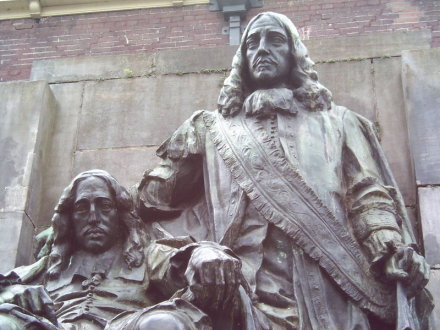
That ominous mob got its spectacle this date in 1672, lynching the Dutch Republic’s longtime de facto head of state, Johan de Witt along with his brother Cornelis/Cornelius.
A statue of Johan (standing) and Cornelis de Witt in their native Dordrecht.
The mercantile powerhouse that was the 17th century Dutch Republic was the stage for a long-running conflict between the Orange monarchists (hence the soccer uniforms) and the Republican merchant class.
With the sudden death of the young William II, Prince of Orange in 1650, leaving the (non-hereditary) executive office of stadtholder vacant, the Republicans became ascendant.
And the outstanding figure of the First Stadtholderless Period was Johan de Witt, scion of a Dordrecht merchant family powerful enough that William II had imprisoned de Witt’s own father during a power struggle.
While all these guys were landing themselves in their respective canons, Johan de Witt was trying to keep the age Golden.
Having only relatively recently broken free of Spain, the small country was an up-and-comer on the horns of a serious security dilemma: its leading commercial position put it into maritime competition with England, while its continental location made it vulnerable to the enormous army of the neighboring continental hegemon, France. Ultimately, even with its trade wealth, it did not have the resources to keep up with both of western Europe’s leading powers.
For a generation, de Witt’s statecraft kept the men of the Low Countries out of that predicament, while his brother Cornelis chipped in with a couple of timely naval victories. (Actually authored by Michiel de Ruyter, but Cornelis rode shotgun.)
In 1654, Johan brought the First Anglo-Dutch War to a close, making with Oliver Cromwell a secret pact he was only too happy to enforce never to allow William II’s son, the eventual William III, to be named stadtholder. Reason being: William III was the grandson of the Stuart king Cromwell beheaded, Charles I, and thus a potential claimant to the English throne. Both Protestant Republics had a distinct interest in keeping this monarchist well away from power. (Both would be sorely disappointed.)
A decade and a Stuart Restoration later, de Witt maintained (mostly) Dutch dominance of the seas in the Second Anglo-Dutch War, then held off France (with the help of a timely alliance with the recent adversary, England) in the War of Devolution.
In each case, he kept at least one of England or France on the sideline, or in his own camp.
But the Third Anglo-Dutch War was the charm — as it was also the Franco-Dutch War, and therefore 1672 was Rampjaar: disaster year. While the Dutch were aces on the waves, a massive French invasion easily overwhelmed them on terra firma.
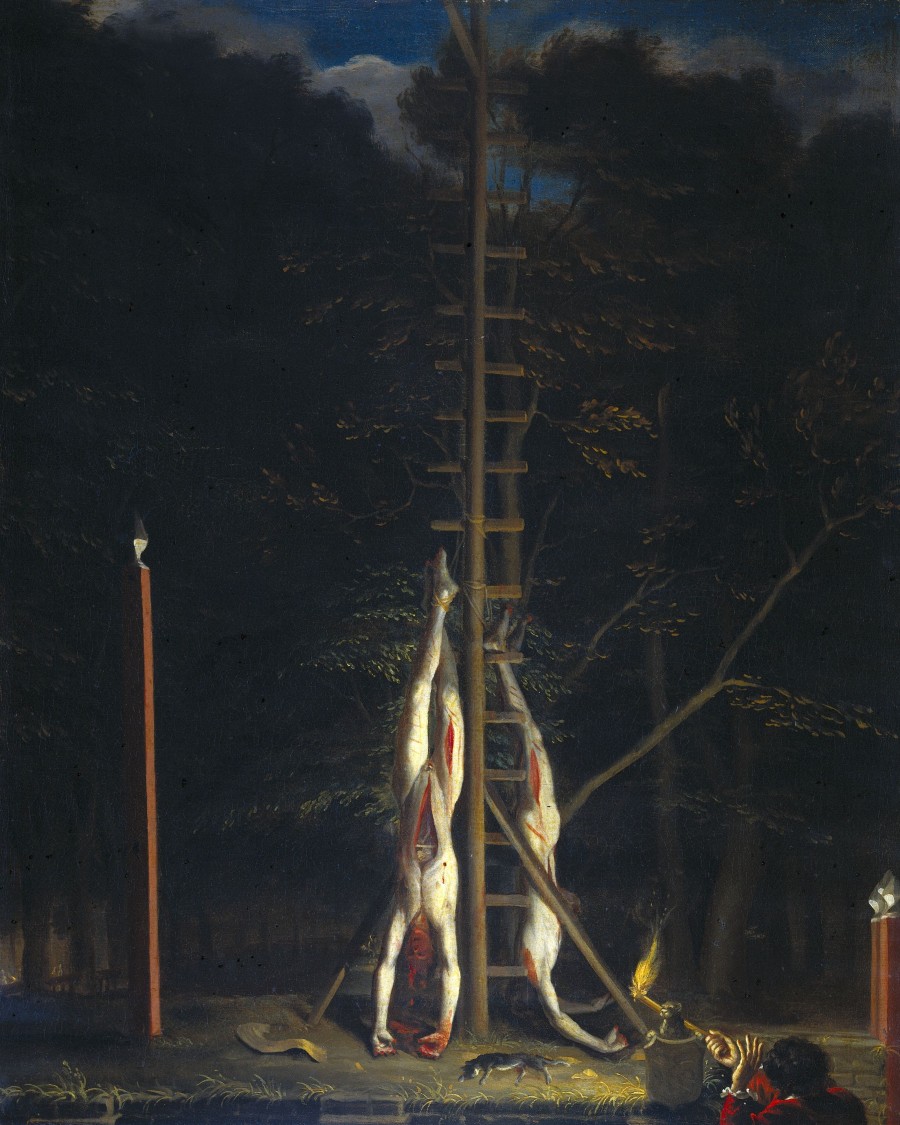
Detail view (click for the full image) of a grisly painting of the mutilated de Witt brothers strung up at The Hague. It’s attributed to Jan de Baen, who in better times took Johan de Witt’s portrait.
De Witt’s never-beloved mercantile oligarchy speedily collapsed with the military reverses, and the now all-grown-up William III was there to pick up the pieces to popular acclaim. Arrested for treason, Cornelis sustained torture without confessing, but when Johan visited him in prison — and William III incriminatingly withdrew the cavalry protecting the brothers — the mob quenched its fury with the de Witts’ blood.
every one of the miscreants, emboldened by his [Johan’s] fall, wanted to fire his gun at him, or strike him with blows of the sledge-hammer, or stab him with a knife or swords, every one wanted to draw a drop of blood from the fallen hero, and tear off a shred from his garments.
And after having mangled, and torn, and completely stripped the two brothers, the mob dragged their naked and bloody bodies to an extemporised gibbet, where amateur executioners hung them up by the feet.
Then came the most dastardly scoundrels of all, who not having dared to strike the living flesh, cut the dead in pieces, and then went about the town selling small slices of the bodies of John and Cornelius at ten sous a piece.
-Dumas
The word “ungrateful” comes to mind.
De Witt stood altogether on a lower plane than Cromwell. We regard him rather as a man of rare and singular talent, than as one of the chosen great ones of the earth, which Cromwell was. He stands far above the common run of men; and he was head and shoulders above nearly all the notable men of his time. He would have been greater if the movement of his limbs had been less burdened with the Dutch governing apparatus … He is not one whom the world can ever greatly admire or love.
(Here’s another, and here’s a 17th century volume de Witt himself coauthored.)
The rise of William III came with the decline of that Dutch Golden Age: the country fended off the immediate military threat, but it increasingly slipped behind its larger neighbors. Costly as was the Franco-Dutch War, it is a step on the path towards the present-day Europe, and this gives us enough excuse to notice that the Eurovision lead-in tune is actually from a Te Deum composed to mark its end.
But William’s own ascent to this wealthy sovereignty was just the beginning for him. Sixteen years later, the House of Orange’s champion vindicated Cromwell’s trepidation about him and gained a far more satisfactory position from which to do battle with his Gallic rival Louis XIV by stunningly overthrowing the Stuart dynasty and becoming King of England in the Glorious Revolution.**
* The Dutch remained the sole western contact of closed Japan until 1854, which is why Japan’s eventual period of scientific advancement became known as ‘Dutch Learning’.
** Albion did not forget the de Witts, either: according to this 1785 cant dictionary, the term “dewitted” had a 17th-18th century run in English to denote — well, exactly what happened to Cornelis and Johan.
The Admiralty’s most notorious mutiny this side of the Bounty was actually a far bloodier affair. Dig the description from one of the conspirators who later turned state’s evidence.
“The captain,” said he, “was very severe with the men, who were all good seamen, and they were determined to either run the ship on shore and desert, or else take her by force. This had been in their minds for months before it happened. At last,” said he, “on a dark night, when the young lieutenant had the watch, our minds were made up. A party went to the cabin-door, knocked down the sentry, and entered it. The captain was in his cot, and he was soon overpowered. We threw him out of the cabin-window. Another party threw the officer of the watch over the larboard quarter, but he, being young and active, caught hold of the hammock-stanchion, when one of the men cut his hands off, and he soon dropped astern. The first lieutenant had been ill and keeping his cot, but on hearing the noise, he came up the hatchway in his shirt, when one of the carpenter’s crew cut him down with an axe, and he was sent overboard with several others.”
(There’s a fine audio lecture about this mutiny in the context of maritime class violence at the Bristol Radical History Group, which reminds that in a context where most of a ship’s manpower was marshaled with the violence of involuntary conscription, mutiny bids were a regular feature of Old Blighty’s maritime empire. London Times archives are available from 1785, and searches on the word “mutiny” in those early years reveal dozens of episodes — and those were just the reported ones.)
After making sharkmeat of that tyrannical captain, 27-year-old Hugh Pigot, the Hermione mutineers got drunk, and then delivered the frigate to the Spanish.
A Royal Navy vessel aptly named the Surprise* was able to surprise the wayward warship and cut her out of the Venezuelan harbor Puerto Cabello. The Hermione was then aptly renamed the Retaliation (and later, Retribution). Then, the British put the ominous word into action with a global manhunt for the mutineers.
Nearly thirty men ultimately hanged for the affair, though that meant that most of those involved escaped the noose.
And so we come at last to our day’s protagonist, one of the Hermione mutineers who was at length recognized in the breakaway former British colonies now constituting themselves the United States of America.
Upon catching this intelligence, British envoys demanded the extradition of this character — who now claimed to be an American citizen by the name of “Jonathan Robbins” — under the terms of the recent and controversial Jay Treaty. After several months under lock and key without any American charge against him, Robbins/Nash eventually had a habeas corpus hearing before Judge Thomas Bee, who decided† that this “American citizen” was no such thing. With an okay from the Adams administration, Bee had the man delivered to the crown.
Nash was immediately shipped down to the British colony of Jamaica, put on trial on Aug. 15 (he had no defense), and hanged on Aug. 19.
Little could the Waterford-born seaman imagine the legacy he bequeathed his fake-adopted country.
I know my rights, man
The Nash extradition became a political firestorm in the U.S., with anti-British Jeffersonian Democratic-Republicans decrying the Federalist administration’s handling of the case. For the infant republic, formulating juridical precedent on the fly, this played as a separation-of-powers issue: was it within the president’s power to fulfill the treaty unilaterally, absent executing legislation passed by Congress? Was it within a judge’s purview to approve an extradition request without the constitutionally assured right to trial by jury?
Sounding eerily contemporary, New York Rep. Robert Livingston denounced a system whereby “a citizen of the United States might be dragged from his country, his connections and his friends, and subjected to the judgment of an unrelenting military tribunal.” Less measured, a Philadelphia Aurora headline announced: “BRITISH INFLUENCE threatens destruction of these United States!” (Source of both quotes)
Though it was surely not decisive, this issue provided great fodder in the 1800 elections swept by the Democratic-Republicans and standard-bearer Thomas Jefferson. Jefferson’s home state of
Virginia, the stronghold of inimical feeling to Great Britain … passed a law forbidding under heavy punishment a magistrate to be instrumental in extraditing any person out of the state. Thus desertions from British ships in a Virginian port became a regular event. Captains of British vessels sailing to United States ports in no long time would meet their men strolling in the streets, furnished with naturalization papers, who set them at defiance, for their arrest was impossible.
“This passage of history,” the otherwise hostile-to-Nash source is obliged to concede, “tells unfavourably on the character of the treatment of British seamen … the Discipline was harsh and oppressive, one of pure repression. The consideration of others, enforced by benevolence and duty, was often regarded as weakness.”
Hard to imagine why anyone would want to mutiny! It calls to mind, at the end of this passion play as at its start, the words supposed to have been hurled at the Hermione‘s doomed Captain Pigot as he pled with his assailants for mercy: “You’ve shown no mercy yourself and therefore deserve none.”
A real reactionary
Despite the electoral slam dunk, the real last word on the case ultimately belonged to the administration’s defenders.
Among these rose in Congress a first-term — for he would only serve a single such term — member of the House of Representatives also from the Old Dominion, John Marshall.
Just months later, Marshall would be one of outgoing President Adams’s “midnight judges” appointed to the federal courts: in Marshall’s case, to the U.S. Supreme Court, where his epochal 34-year term as Chief Justice would shape the future evolution of American jurisprudence.
Rising on March 7, 1800, in defense of President Adams’s conduct in the Nash case, Representative Marshall gave a preview of the strong federalist perspective that would define his time on the bench. (Read it in full here.)
The President is the sole organ of the nation in its external relations, and its sole representative with foreign nations … He possesses the whole Executive power. He holds and directs the force of the nation. Of consequence, any act to be performed by the force of the nation is to be performed through him.
This passage was exhumed from Congressional archives for citation in a 1936 Supreme Court case on federal supremacy, and has proceeded thence into a go-to bullet point for every latter-day defender of any arbitrary executive authority.
Of consequence (as Marshall might put it), Marshall’s speech about Nash gets an approving reference in Bush administration lawyer — and possible future extradition subject? — John Yoo‘s September 25, 2001 memorandum on “The President’s Constitutional Authority to Conduct Military Operations Against Terrorists and Nations Supporting Them”.
Supreme Court Justice Clarence Thomas, too, quotes this phrase in his Hamdi v. Rumsfeld dissent, further to the doctrine that a man consigned to a presidential oubliette has no recourse to the courts; Justice John Harlan used it (with the rather grandiosely exaggerated qualifier that “from that time, shortly after the founding of the Nation, to this, there has been no substantial challenge to this description”) in his dissent in the Pentagon Papers case to claim that Richard Nixon could prevent the New York Times and Washington Post from publishing the embarrassing classified history of the Vietnam War.‡
So in this imperial age, Thomas Nash is more with us than ever he was. Who knows but what noxious monarchical theories are even now being buttressed with footnotes resolving to the vindictive execution of that obscure mariner two centuries past?
Given the vessel’s centrality in this popular series, there’s a book all about the colorful history of the Surprise. In reality, the Surprise — actually a captured French ship herself — was sold out of the service in 1802, prior to the notional 1805 setting of both the cinematic Master and Commander: The Far Side of the World and the book in the series when Jack Aubrey first commands her.
† Rightly, it’s generally presumed; “Robbins” is alleged (albeit by his self-interested executioners) to have confessed to being Nash before his execution. This entry garners the Wrongful Execution tag on the basis of its contested American jurisprudence.
‡ The limited aim of Marshall’s speech in context, and its subsequent (mis)appropriation, is the subject of an interesting and accessible-to-laypersons law review article here. (pdf) This tome gets a bit more into the weeds on the way the separation of powers operated practically as the Nash case unfolded in Judge Bee’s court.
On this day in 1775, Thomas Jeremiah, a free black man in the then-colony of South Carolina, was hung after being convicted of attempting to a slave insurrection.
The case against him was extremely weak, but he was tried/framed under the Negro Act of 1740 (in a slave court, although he was not a slave), wherein the defendant was considered guilty until proven innocent. South Carolina’s own royal governor, William Campbell, called it a case of “judicial murder.”
Very little is known about Jeremiah. He left no diary or letters behind, and most of his trial records have been lost. We know he was married but we know nothing about his wife, whether she was a slave or a free black like himself, or whether they had any children. We don’t know how he became free or how he learned his trade. He is, in fact, so obscure that he doesn’t even have his own Wikipedia entry.
What little we do know, however, suggests that he was a most extraordinary man: a fisherman and ship’s pilot, one of less than 500 free blacks in the city of Charles Town (now called Charleston), Jeremiah had somehow managed to claw his way up and amassed a net worth of £1,000, or about $200,000 in today’s money. He was one of the wealthiest free black men in North America, and certainly the wealthiest self-made one.
Jeremiah was basically a victim of his own success. He had risen too high; he made the local white elites uncomfortable. As Harris noted, Jeremiah “did not need to gather arms or preach revolution to undermine slavery, because his whole life was a refutation of whites’ basic justification for slavery.”
Henry Laurens, a wealthy businessman, future Continental Congressman, slaveowner, and contemporary of Jeremiah’s, stated he was “a forward fellow, puffed up by prosperity, ruined by Luxury & debauchery & grown to amazing pitch of vanity & ambition.” He needed to be smacked down and he was, most severely.
In the spring and summer of 1775, revolution was fomenting everywhere. White “Patriots” wanted an opportunity to get out from under England, but they feared their slaves would use the conflict to try and get out from under them.
Nat Turner and Charleston’s own Denmark Vesey — these immortal rebels lay years into the future, but their very prospect made slave rebellions an omnipresent fear among the white populace. It was jumpy. And when two slaves accused Jeremiah of trying to persuade them to rebel, it jumped.
Only a few months passed between Jeremiah’s arrest and his execution. By that time he was a broken man, welcoming death. After he was hung, his body was cut down and burned to ashes.
On this date in 1951, the first two foreigners — Italian merchant Antonio Riva and Japanese bookseller Ruichi Yamaguchi — were convicted and immediately executed in Beijing for a supposed plot to assassinate Mao Zedong.
“the streets they passed through [en route to execution] were thronged with people who expressed their feelings .. . with shouts of ‘Down with imperialism! Suppress counterrevolutionaries! Long live Chairman Mao!'”
No relation.
Riva (English Wikipedia entry | Italian) was a World War I fighter ace who had relocated to Beijing/Peking in the 1920s to peddle aircraft and training the Chinese Koumintang.
(In 1936, Riva married Catherine Lum, the daughter of American wood block artist Bertha Lum and sister of Eleanor Peter Lum, who took after mom.)
When the guys those planes were being used against won the Chinese Civil War, Riva mulled an expedient departure, but reportedly declared (Spanish link) that he could do business under any regime type.
The Communist government decided he had a different sort of business in mind. Citing Chinese state media, the London Times (Aug. 18, 1951) described the plot thus:
the conspirators planned to fire mortar shells at a reviewing stand outside the Tien An gate of the forbidden city in Peking during a procession to celebrate China’s national day on October 1 last year.
Several others, both Chinese and foreigners, drew long prison sentences as part of the “conspiracy” uncovered in a one-hour trial. The most illustrious of those was the Italian bishop Tarcisio Martina.*
Though Riva and Yamaguchi were the first foreigners officially executed by the new Chinese government, they were far from the last. All the more remarkable, then, that in a country that carries out thousands of executions per annum, Antonio Riva is thought to have been the last European citizen put to death there until Akmal Shaikh in 2009.
The Shaikh case helped rekindle interest in Riva’s execution — a timely confluence, since a recent book, L’ uomo che doveva uccidere Mao, critiqued the case against the Italian aviator.
* American diplomat Col. David Barrett, safely beyond the reach of the Maoists at Formosa, was a supposed ringleader.
On this day in 2004, a sixteen-year-old Iranian schoolgirl, Atefah Salaaleh, was publicly hanged from a truck-mounted crane for adultery and “crimes against chastity.”
In a classic example of a miscarriage of justice, the same person, Haji Rezai, served as prosecutor, witness, judge and hangman against this young girl. In violation of Iranian law, Atefah did not have legal representation at her trial.
Iran, when it signed the International Covenant on Civil and Political Rights, had promised not to execute minors, but according to Amnesty International, Atefah has been at least the tenth person under 18 to be executed in Iran since 1990. Her family says they gave her 1988 birth certificate to the court, but Judge Rezai just looked at her and decided she was at least 22. Because it’s so easy to determine a person’s exact age just based on their appearance.
Atefah appears to be a good example of a problem child: her mother was killed in a car accident when she was very young and her father was a drug addict, so she was given to the inadequate care of her elderly grandparents. Although she was described as “lively and intelligent,” she often roamed the streets and became a delinquent.
In the years prior to the arrest that lead to Atefah’s death, she had already been arrested multiple times by Iran’s Morals Police for crimes including being in a car alone with a boy (her cousin) and having sex with unmarried men. According to friends quoted in Iran Focus, she may have been sexually abused by a close relative, and she also alleged abuse by the Morals Police.
For the arrest that lead to her death, Atefah was not charged with committing any specific offenses; rather, she was arrested after an unsigned petition named her as a “bad influence” on the community and a “source of immorality.”
Under torture she admitted she had had sex with a 51-year-old married taxi driver, whom she claimed had repeatedly raped her. In court, she defiantly removed her hijab, threw her shoes at judge Rezai, and said the taxi driver should be punished rather than herself. (Reportedly, he was given about 100 lashes and then released.) Atefah’s death sentence was upheld by the Supreme Court of Iran and she was hung three months after her trial.
Atefah’s life and death have been the subject of a BBC documentary which you can see in six parts on YouTube. Keep a hanky handy.
Dutch-born and of Scottish descent, Stedman was a soldier who volunteered to serve in the West Indies and found himself in Suriname fighting those “revolted negroes” — Maroons fled from slavery who had established independent communities and episodically (most of the 1770s were one such episode) fought the white colonies.
Maroon settlements in Suriname still pesist to this day.
Though that was Stedman’s business on the Caribbean coast of South America, the culprits whose deaths he witnessed today were not among the “revolted”, but more prosaic criminal fare. Prosaic, that is, until Neptune’s insouciantly comedic discourse in the midst of the most appalling torture.
Stedman sets the scene for us with the more everyday depravities prevailing in the colonial capital, Paramaribo
If, as I have just mentioned, cruelties were become less common in the rivers by the rebels, barbarities still continued in a shocking degree in the metropolis; where my ears were deafened with the clang of the whip, and the shrieks of the negroes. Among the most eminent of these tyrants was a Miss Sp—n,who lived next door to Mr. de Graav, and who I saw with horror from my window give orders that a young black woman should be flogged principally across the breasts, at which she seemed to enjoy peculiar satisfaction. To dissipate the impression this scene had left on my mind, I got into a whiskey, and rode out; when the first thing I saw was a negro girl fall naked from a garret window on a heap of broken bottles: this was indeed an accident, but she was so mangled, though not dead, that she exhibited a spectacle nearly as wretched as the other.—Cursing my unlucky fate, I turned the horses, and drove to the beach, as the only place to avoid every scene of cruelty and misery; but here I had the mortification to see two Philadelphia sailors (while they were fighting on the forecastle of their vessel) both fall over the ship’s bow into the stream, where they sunk, and were no more seen. On board another American brig, I discovered a little tar defending himself from the cross-trees with a hatchet, against a serjeant and four armed men, for a considerable time; till they threatening to shoot him out of the rigging, he at last surrendered, and being brought ashore, was dragged to Fort Zelandia, in company with two others, by a file of musketeers, where, for having been drunk on duty, they received a fire-cant each, at the captain’s request; that is, they were bastinadoed or beaten on the shoulders by two corporals with bamboo canes, till their backs were black, and swelled like a cushion. However arbitrary this mode of correction, the captain endeavoured to explain the necessity of it; the private American sailors being of a turbulent spirit indeed when drunk, although when sober they may be fairly classed among the best seamen in the world.
But the narrator is just getting warmed up, and after a good night’s sleep …
Early the next morning, while musing on all the different dangers and chastisements to which the lower class of people are exposed, I heard a crowd pass under my window. Curiosity made me start up, dress in a hurry, and follow them: when I discovered three negroes in chains, surrounded by a guard, going to be executed in the savannah. Their undaunted look, however averse I may be to the sight of cruelties, so attracted my attention, as to determine me to see the result, which was thus:— The sentence being read in Low Dutch (which they did not understand) one was condemned to be flogged below the gallows, and his accomplice to have his head struck off with an axe, for having shot a slave who had come to steal plantains on the estate of his mistress. The truth however was, that this had been done by that lady’s absolute command; but the murder being discovered, she, in the hopes of saving her character, besides the expence of paying the penalties, gave up her valuable slave, and permitted the unhappy man to be thus sacrificed. He laid his head upon the block with great indifference, stretching out his neck; when, with one blow of the axe, it was severed from his body.
The third negro, whose name was Neptune, was no slave, but his own master, and a carpenter by trade; he was young and handsome, but having killed the overseer of the estate Altona, in the Para Creek, in consequence of some dispute, he justly forfeited his life. The particulars, however, are worth relating: This man having stolen a sheep, to entertain a favourite young woman, the overseer, who burnt with jealousy, had determined to see him hanged; to prevent which, the negro shot him dead among the sugar canes; for these offences of course he was sentenced to be broken alive upon the rack, without the benefit of the coup de grace or mercy-stroke. Informed of the dreadful sentence, he composedly laid himself down on his back on a strong cross, on which, with arms and legs expanded, he was fastened by ropes: the executioner, also a black man, having now with a hatchet chopped off his left hand, next took up a heavy iron bar, with which, by repeated blows, he broke his bones to shivers, till the marrow, blood, and splinters flew about the field; but the prisoner never uttered a groan nor a sigh. The ropes being next unlashed, I imagined him dead, and felt happy; till the magistrates stirring to depart, he writhed himself from the cross, when he fell on the grass, and damned them all, as a set of barbarous rascals; at the same time removing his right hand by the help of his” teeth, he rested his head on part of the timber, and asked the by-standers for a pipe of tobacco, which was infamously answered by kicking and spitting on him; till I, with some American seamen, thought proper to prevent it. He then begged that his head might be chopped off; but to no purpose. At last, seeing no end to his misery, he declared, “that though he had deserved death, he had “not expected to die so many deaths: however, (said he) you christians have missed your aim at last, and I now care not, were I to remain thus one month longer.” After which he sung two extempore songs (with a clear voice) the subjects of which were, to bid adieu to his living friends, and to acquaint his deceased relations that in a very little time he should be with them, to enjoy their company for ever in a better place. This done, he calmly entered into conversation with some gentlemen concerning his trial; relating every particular with uncommon tranquillity—”But,” said he abruptly, “by the sun it must be eight o’clock; and by any longer discourse I should be sorry to be the cause of your losing your breakfast.” Then, casting his eyes on a Jew, whose name was De Vries, “A-propos, sir,” said he, “won’t you please to pay me the ten shillings you owe me ?” — “For what to do ?” — “To buy meat and drink, to be sure—don’t you perceive I am to be kept alive?” Which speech, on seeing the Jew stare like a fool, this mangled wretch accompanied with a loud and hearty laugh. Next, observing the soldier that stood sentinel over him biting occasionally on a piece of dry bread, he asked him ” how it came to pass, that he, a white man, should have no meat to eat along with it ?” — ” Because I am not so rich,” answered the soldier. — “Then I will make you a present, sir,” said the negro; “first, pick my hand that was chopped off clean to the bones, next begin to devour my body, till you are glutted; when you will have both bread and meat, as best becomes you;” which piece of humour was followed by a second laugh; and thus he continued, until I left him, which was about three hours after the dreadful execution.
Wonderful it is indeed, that human nature should be able to endure so much torture, which assuredly could only be supported by a mixture of rage, contempt, pride, and the glory of braving his tormentors, from whom he was so soon to escape. [ here a footnote is marked in the original text, whose content is: “At Demerary, so late as October, 1789, thirty-two wretches were executed in three days, sixteen of whom suffered in the manner just described, with no less fortitude, and without uttering one single complaint.” -ed. ]
Though I never recal to my remembrance, without the most painful sensation, this horrid scene, which must revolt the feelings of all who have one spark of humanity, I cannot forbear exhibiting to the public the dreadful spectacle in the annexed drawing.
Detail view of William Blake‘s illustration of Neptune’s breaking on the rack. (Click for full image.)
If the reader, however, should be offended with this shocking exhibition, and my dwelling so long on this unpleasant subject, let it be some relief to his reflection, to consider this punishment not inflicted as a wanton and unprovoked act of cruelty, but as the extreme severity of the Surinam laws, on a desperate wretch, suffering as an example to others for complicated crimes; while at the same time it cannot but give me, and I hope many others, some consolation to reflect that the above barbarous mode of punishment was hitherto never put in practice in the British colonies.
I must now relate an incident, which, as it had a momentary effect on my imagination, might have had a lasting one on some who had not investigated the real cause of it, and which it gave me no small satisfaction to discover. About three in the afternoon, walking towards the place of execution, with my thoughts full of the affecting scene, and the image of the sufferer fresh in my mind, the first object I saw was his head at some distance, placed on a stake, nodding to me backwards and forwards, as if he had really been alive. I instantly stopped short, and seeing no person in the savannah, nor a breath of wind sufficient to move a leaf or a feather, I acknowledge that I was rivetted to the ground, where I stood without having the resolution of advancing one step for some time; till reflecting that I must be weak indeed not to approach this dead skull, and find out the wonderful phenomenon, if possible, I boldly walked up, and instantly discovered the natural cause, by the return of a vulture to the gallows, who perched upon it, as if he meant to dispute with me for this feast of carrion ; which bird, having already picked out one of the eyes, had fled at my first approach, and striking the skull with his talons, as he took his sudden flight, occasioned the motion already described. I shall now only add, that this poor wretch, after living near six hours, had been knocked on the head by the commiserating sentinel, the marks of whose musket were perfectly visible by a large open fracture in the skull.
Stedman’s work details a number of other atrocities against Suriname’s African (primarily slave) population, many of them powerfully illustrated by William Blake with near pornographic effect. These sorts of things were of ancient vintage in the realm.
The Narrative itself became both an important anti-slavery text, and an invaluable historical reference. (Where I have clipped the text, Stedman is about to segue into a discourse on the local vulture population, just the sort of detail that present-day researchers might have a hard time sourcing for 18th century Suriname.)
But even though contemporary abolitionists made use of the Narrative, Stedman’s 18th century publisher actually played down the author’s tone on the subject. A version much more overtly critical of slavery and the savage corporal punishments that upheld it has recently been published from the original manuscripts. (An abridged version of that original is also available.)
* Stedman’s narrative mingles chronological journal-style entries with general observations about his environs. The text is slightly ambiguous as to the date, but the chapter in question begins by situating the action on Aug. 12, digresses into a description of the regional landscape, then returns to the narrative where this blog entry picks it up. It’s not completely explicit that the metropolitan atrocities he witnesses also occur on the 12th, but the text invites that inference — with the execution taking place the next morning after.
The next date explicitly named is Aug. 24, the birthday of the Prince of Orange, so if Neptune did not die on Aug. 13, it was within only a very few days after.
On this date* in 1527, Jacques de Beaune was hanged on the gallows of Montfaucon for peculation.
Beaune (French Wikipedia entry) was an aged man well into his 70s or 80s, and had served four kings’ treasuries, rising to become Superintendent of Finance for Francis I.
His slow-motion ruin began with France’s military involvement in Italy earlier that decade, in which capacity the French commander near Milan suffered a grievious reverse and had to abandon Lombardy.
Furious buck-passing ensued:
The commander blamed the defeat on a lack of pay for his Swiss mercenaries;
The paymaster — Beaune — blamed the lack of funds for the mercs on the Queen Mother, Louise of Savoy‘s calling in a debt
The ensuing investigation revealed this story to be true, but Beaune was obliged to retire from the court because of the Queen Mother’s fury at him.
And that might have been that, but for the further French misadventures in Italy.
In 1525, Francis himself contrived to be captured at the Battle of Pavia, elevating Louise of Savoy to regent in his absence. By the time the spendthrift king had been ransomed back, his treasury was nigh empty and Louise knew just the person to blame.
An audit of Semblancay’s accounts intended to turn up some loose ducats embarrassingly showed that the noble was actually a creditor of the king, but
on 13 January 1527, after Semblancay had returned to Paris on business, he was arrested and thrown in the Bastille … the king and his council … had been looking for ways of raising within five days 370,000 livres needed for the payment of troops. Semblancay was known to be a very rich man and the prospect of confiscating his property must have been tempting. (Source)
Semblancay was tried by a handpicked favorite of the court, with the predictable result on a somewhat nebulous embezzlement/corruption thing; a jailhouse snitch once in the great lord’s employ gave evidence against him. The doomed man, perhaps untroubled to be relieved of the infirmities of his advanced age, was supposed to have been downright chill walking through Paris to his death, and he was met with respect by a citizenry that could hardly help sympathizing with this wizened but serene victim of the royal wrath.
Lorsque Maillart, juge d’Enfer, menoit
À Monfaulcon Samblançay l’ame rendre,
À votre advis, lequel des deux tenoit
Meilleur maintien ? Pour le vous faire entendre,
Maillard sembloit homme qui mort va prendre
Et Samblançay fut si ferme vieillart
Que l’on cuydoit, pour vray, qu’il menast pendre
À Montfaulcon le lieutenant Maillart.
When Maillart, judge of Hell,
To Montfaucon led Samblançay to give up his soul,
Which of the two, in your mind,
Had the better demeanour? To enlighten you,
Maillart seemed the man whome death would take
And so sturdy an old man was Samblançay,
That one truly believed that it was he who led
Lieutenant Maillart to be hanged at Montaucon.
This case is less well-remembered today than it ought to be; to contemporaries, the hanging of France’s treasurer for corruption was an awfully noteworthy event.† (Opinions at the time seemed to be split on the justice of the matter, even though Semblancay was posthumously rehabilitated; later generations have more strongly gravitated to the understanding that he was railroaded.)
And it launched an ensuing, decade-long project of Francis’s, to squeeze wealthy financiers through the commission de la Tour Carree and thereby get in the good graces of the early modern bond markets unsettled by France’s 1520s fiscal faceplant.
We noticed in a great Press from twenty to twenty-five huge Gallows-birds round a great Table [bourreau, punning bureau] covered with green Cloth, staring at each other, with their Hands as long as Crane’s Legs and their Nails two Feet long at least, — for they are forbidden ever to pare them, so that they become as crooked as Bills or Boat-hooks — and just at that time was brought in a great Bunch of Grapes which they gather in that Country, from the Vine called Extraordinaire, the Grapes from which often hang on Poles. As soon as the Bunch was laid there, they put it under the Press, and there was not a Berry from which they did not squeeze Oil of Gold, insomuch that the poor Bunch was carried off so drained and stripped, that there was not a Drop of Juice or Liquor left.
Most of those Tour Carree prosecutions didn’t result in executions — “merely” confiscations of lands and titles which could be re-sold, and sentences which could be commuted for a fine. R.J. Knecht, in The Rise and Fall of Renaissance France, 1483-1610, puts the king’s profit on such confiscations into the millions of livres.
But to make those shakedowns seem a small price to pay, the threat of Semblancay’s example must have lurked in the background for targeted nobles.
(Semblancay himself had been reckless enough not to accept an initial mostly-exoneration in the inquiry that preceded his arrest and trial, since part of it required him to “repay” supposed debts to Louise of Savoy. His appeal against that part of the judgment might have set him up to be the cautionary example for everyone else.)
The Beaune name would scintillate to posterity through such illustrious descendants as Renaud de Beaune (French link), a notable archbishop; and, more salaciously, Escadron Volant all-star Charlotte de Beaune Semblançay, who seduced powerful nobles at Catherine de’ Medici’s behest.
A lengthy French history of our day’s early modern moneybags can be perused here; when visiting Tours, you can revisit the days when he was in the chips by crashing at one of the many buildings he put, the Hotel de Beaune-Semblancay.
** There’s another (translated to English) meditation Marot wrote on Semblancay here, in the first-person voice of the hanged man. Marot was a friend of the eventually-executed French linguist and translator Etienne Dolet, and his own unorthodox opinions would eventually require him to flee the realm for his life.
We do note that in this era of combative pamphleteering, the geezer who made himself a tycoon by administering the taxes wasn’t universally supported by the literary set. Roger de Collerye (cited here) hooted Jacques de Beaune into the hereafter with the verses,
Tremblez, tremblez, larrons gros & petiz!
Retirez vous, gens trop fins et subtilz!
Absentez vous bientost & prenez terre,
Gens de finances et tresoriers gentilz
Qui d’attrapper estes tant ententifz.
Sur vous surviegne tempeste & tonerre!
Craignez la court qui vous donna la guerre
Bien asprement, quant je l’ay pance,
Souvieigne vous de la mort Sant Blancey!
† It happened yet again in September 1535, to Jean Poncher. Historically, proximity to the French crown’s revenues was also proximity to the gallows.
On this date in 1858, an “unusual incident” occurred in the life of then 18-year-old architect’s apprentice Thomas Hardy, as related by Hardy’s second wife, Florence.
One summer morning at Bockhampton, just before he sat down to breakfast, he remembered that a man was to be hanged at eight o’clock at Dorchester. He took up the big brass telescope that had been handed on in the family, and hastened to a hill on the heath a quarter of a mile from the house, whence he looked towards the town. The sun behind his back shone straight on the white stone facade of the gaol, the gallows upon it, and the form of the murderer in white fustian, the executioner and officials in dark clothing and the crowd below being invisible at this distance of nearly three miles. At the moment of his placing the glass to his eye the white figure dropped downwards, and the faint note of the town clock struck eight.
The whole thing had been so sudden that the glass nearly fell from Hardy’s hands. He seemed alone on the heath with the hanged man, and crept homeward wishing he had not been so curious. It was the second and last execution he witnessed, the first having been that of a woman two or three years earlier, when he stood close to the gallows.
The man in question was James Seale (or Searle), and this was not only to be the last hanging Hardy witnessed — it was the last in Dorset full stop.
The London Times‘ Aug. 11 blurb of the hanging noticed that
the wretched culprit was tried … for the wilful murder of a young woman named Sarah Ann Griffy, at Stoke Abbotts, on the 30th of April last, and also for having set fire to the house in which his victim resided. The prisoner is a very young man, not having reached his 20th year, and had been working as a labourer for some time past in the vicinity … On the day of the murder … when all the parties, who were farm labourers, were at work, excepting the deceased, the prisoner entered the house, and, after maltreating her, inflicted a most fearful gash in her throat, nearly five inches long, with a clasped cheese knife, and other injuries on the hands, arms, and breast, and then set fire to the house.
As implied by Hardy’s ability to remember the hanging at breakfast, find the telescope, and get to his observation point before the trap dropped at 8 a.m., the youth was an early riser. Michael Millgate’s biography of Thomas Hardy notes that
[b]y eight o’clock in the morning, the time when Seale’s execution took place, Hardy would have been up reading for two or three hours before setting off for Dorchester and Hicks’s office: when only candles were available for indoor illumination it was necessary to keep a countryman’s hours and take advantage of all the available daylight. He had now added the study of Greek to his continuing study of Latin: the signature in his first copy of the Iliad is dated 1858, and he seems to have worked persistently through it until some time in 1860, marking the passages that he had read — and that Jude Fawley, much later, would be described as reading in Jude the Obscure.
On a drizzly morning this date in 1856, Elizabeth Martha Brown (or Browne) was hanged for murder as a young and fascinated Thomas Hardy looked on.
Brown was born Clark(e), but she took the name of a husband 20 years younger than she, which is how she got into this mess.
Said John Brown was rumored to have made the match for money, though his older wife sure seems to have held her own in the looks department. (More on that in a bit.)
In due time, John afflicted their already-tempestuous wedded life with an affair — courtesy of one Mary Davis, a young woman stuck in her own unhappy May-December marriage.
According to the confession Elizabeth provided two days before her own death, she had a fantastic row with her drunken husband when he came home at 2 a.m. one night and Elizabeth accused him of being
“to Mary Davis’s?”
He then kicked out the bottom of the chair on which I had been sitting, and we continued quarrelling until 3 o’clock, when he struck me a severe blow on the side of the head, which confused me so much I was obliged to sit down.
He then said (supper being on the table at the time) “Eat it yourself and be damned,” and reached down from the mantelpiece a heavy hand whip, with a plaited head and struck me across the shoulders with it 3 times, and every time I screamed out I said “if you strike me again, I will cry murder” He replied “if you do I will knock your brains through the window,” and said hoped he should find me dead in the morning, and then kicked me on the left side, which caused me much pain.
He immediately stooped down to unbuckle his boots, and being much enraged, and in an ungovernable passion at being so abused and struck, I seized a hatchet that was lying close to where I sat, and which I had been making use of to break coal for keeping up the fire to keep his supper warm, and struck him several violent blows on the head – I could not say how many – and he fell at the first blow on his side, with his face to the fireplace and he never spoke or moved afterwards.
Unfortunately, this confession broke a protracted* attempt to stick to an implausible “the horse kicked him dead” story whose maintenance seriously complicated any bid to secure clemency for the woman.
She received, instead, a different kind of life: literary immortality that hardly any in Dorchester that gray morning could have aspired to.
Thomas Hardy, not yet the canonical novelist famous enough for his own Monty Python sketch but a 16-year-old architectural apprentice, was among the three or four thousand who braved the inclement weather to witness Brown’s hanging** — the mandatory sentence then for a circumstance the courts would handle differently today.
Even seven decades later, Hardy could recall the vividly sensual effect of this macabre scene.
I saw — they had put a cloth over the face — how, as the cloth got wet, her features came through it. That was extraordinary.
and
I remember what a fine figure she showed against the sky as she hung in the misty rain and how the tight black silk gown set off her shape as she wheeled half round and back.
Recent film adaptations of Tess of the D’Urbervilles. The book is available free from Gutenberg.org.
In both her tragic life and her hempen death, Brown is thought to have informed Hardy’s title character in the 1891 novel Tess of the D’Urbervilles, slyly subtitled “A Pure Woman Faithfully Presented.”
“Justice” was done, and the President of the Immortals, in Aeschylean phrase, had ended his sport with Tess.
* Everything is relative, of course. In Brown’s instance, less than five weeks separated murder from execution, so she had scarcely had time to be obstinate about withholding the confession.
** Brown was said to have died with great firmness, and the report from the scaffold brings us the classically Victorian detail that executioner William Calcraft, having departed the platform to spring the trap after pinioning his prisoner, was obliged to make a return trip when he realized he’d forgotten to tie down her dress against any immodest billowing.
An ironic precaution, given that we remember this hanging precisely because of Hardy’s captivation with the more refined eroticism of the “wet hanging gown contest” tableau.

 Kemble had been discreetly performing the offices of his faith — still illicit, but less liable to get you killed at this late date — for over five decades since ordination.