1936: The Sacred Heart, by Spanish leftists

On this date in 1936, anticlerical leftists in the Spanish Civil War allegedly subjected a monumental statue of Christ to a ritual “execution”.


“This picture, taken by a Paramount News-reel representative and received by air from Madrid yesterday, illustrates an outrage which has no parallel in the photographs published by “The Daily Mail” of the Spanish Reds’ war on religion. It shows a Communist firing squad aiming at the colossal Monument of the Sacred Heart on the Cerro de los Angeles, a hill a few miles south of Madrid which is regarded as the exact centre of Spain.” (Source)

This outstandingly incendiary image made for great recruiting for the Francoist enemies of the “firing squad” and gave credence to a “crusade” lexicology that insured the devout would break overwhelmingly against the Republic. (Nearly 7,000 men and women in religious orders whose deaths during the war are charged to the Republican account also helped.)

Maybe that was inevitable, anyway.

George Orwell, the English leftist who volunteered for the Spanish Republicans, noted in his Homage to Catalonia that

the people in this part of Spain must be genuinely without religious feeling — religious feeling, I mean, in the orthodox sense. It is curious that all the time I was in Spain I never once saw a person cross himself; yet you would think such a movement would become instinctive, revolution or no revolution. Obviously the Spanish Church will come back (as the saying goes, night and the Jesuits always return), but there is no doubt that at the outbreak of the revolution it collapsed and was smashed up to an extent that would be unthinkable even for the moribund C. of E. in like circumstances. To the Spanish people, at any rate in Catalonia and Aragon, the Church was a racket pure and simple. And possibly Christian belief was replaced to some extent by Anarchism, whose influence is widely spread and which undoubtedly has a religious tinge.

Be that as it may, Republican types suspected photographic fakery.

Just like its inspiration is reported to have done, this statue survived its “execution” in fine shapewas resurrected by public subscription, and can still be seen at Cerro de los Angeles outside Madrid.


The “executed” statue today. (cc) image from bigchus.

On this day..

1795: Pomp, a Negro

On this date in 1795, an African-American near-slave (slavery’s official 1783 abolition in the state seems not to have constituted a completely bright line) was hanged in Ipswich, Mass. for murdering his master-slash-employer.

Thanks to Laura James at CLEWS, we are drawn to this story reproduced here at the University of North Carolina-Chapel Hill’s Documenting the American South site. Pomp was perhaps mentally “touched”; he was certainly physically “touched” for any perceived inadequacy at his labors, and eventually chopped off his master’s head while the latter slept beside his wife. (The wife summoned the police, without molestation from Pomp.)

The victim, Captain Charles Furbush, was a minuteman who fought at Lexington, one of the opening skirmishes of the Revolutionary War.

Reprinted in full below (complete with breaks in the text where the original document is damaged) is the “Dying Confession of Pomp,” a broadsheet produced by a local merchant — who does not scruple to append some classified ads to the end of the text.*


I POMP now under sentence of death in Ipswich Jail, was born in [illegible], and brought from that place, so soon after I began my existence, that together with my Parents, I arrived at Boston when I was about three months old. My Father died soon after and my Mother has since had two husbands, and is now a widow. I have three sisters and three brothers now living in Boston, for whom a well as for my Mother I have a great regard.

My Mother soon after our arrival in this Country gave me away to Mr. Abbot of Andover. With this Gentleman I lived till I was sixteen years of age, but he being then on the point of moving back into the country some distance, told me if I chose it that I might then live with one of his sons, who was still to reside in Andover. I took up with his offer: choosing rather to continue in Andover, than to accompany my old master, to his new abode.

With young Mr. Abbot I lived not long, before I grew uneasy with the place. I told him that I meant to leave him soon, but he informed me that I was not free. About this time I was seized with convulsion fits which continued to oppress me at times ever after, to the fatal night that I murdered Capt. Furbush. Continuing still unreconciled to the new place, I went to the Select men of Andover to know whether I had not a right to leave it, and by their advice continued there a considerable time longer. But after a while it came to pass that Capt. Furbush took a notion to have a black man; and applying to the Select men, obtained their consent that I should be his servant. In compliance with the wishes [illegible] him; but soon found that I did not like him any better than the man with whom I had last lived. Furbush had a considerable farm and when I first began to live with him did some work himself, but I did not like the way he carried on his business, and after a while he left off work entirely, and by my desire left the whole management of the farm to me. I performed nearly all the work that was done on the place, cut all the hay, and with a trifle of help from the boy, whom my master desired to asist me a few days in a season, raised an hundred and seventy bushels of corn in a year. But my master still continued unkind to me, never letting me go to meeting on Sundays, and forcing me to clear out the cattle on those sacred days. When I asked him for money, he commonly gave me no more than four pence half peny, at a time: and even on Election day he gave me no more, nor would he suffer me on those days to go to frolicing till after one o’clock in the afternoon.

Though I did the best that I was able to do on the farm, my master was so far from seconding my endeavors, that he often brought whole droves of horses home with him in the night, and turned them in among the standing corn, that I had taken so much pains to plant, and hoe, and on the succeeding mornings he would charge me with the guilt of turning these horses into the corn field. In this way he often caused corn enough to be broken down in one night to fat a hog, and keep him fat a whole winter. I thought I found that he was a bad man, and a cheating horse jockey, and finally being unable to like him, I ran away from him, but was pursued, found, brought back, and severely flogged, by him for my pains. I afterwards ran off again but again met with the same fate. In this manner I went on ten or a dozen years, not liking my place, and not able to get away from it. I was frequently troubled with convulsion fits and sometimes crazy in such a degree, that I was generally bolted in to a chamber every night, in order to hinder me from getting into the chamber where my masters daughters slept. I worked very hard all the time. My master had one weakle son who was unable to work, and who often shed tears while he saw me labor and told me that he wished he was able to help me. I told him that perhaps I should contrive something after a while but did not explain myself. Continuing still uneasy I thought I would try once more the benefit of my legs. I accordingly ran off, but after a weeks absence, I was again brought back by my master, stripped naked, tied up by both hands, and unmercifully flogged. This was in the evening, and though it was late in the fall, and cold, frosty, icy weather, my master left me thus naked, and tied up, till the morning. My sufferings during the tedious hours of this lengthy night, by reason of cold and nakedness, a sore back and wounded spirits, were extremely great, and while under this torture, I thought it likely that my master would sometime or other feell the effect of his cruelty. My conjectures were so far right that it was the last time, that Furbush ever struck me.

My master used to tell me I might stay as long as I pleased at his house, adding that he should not stay in the world forever. From this I entertained an idea that Mrs. Furbush and the farm would be mine, after the death of my master. The hopes of being master, husband and owner, on one hand, and the cruel treatment I had received from Furbush on the other, prompted me to wish for his death and produced an idea of hastening [illegible] by [illegible] him myself.

In this state of mind the morning of the fatal day arrived. I arose considerably disordered having a great singing noise in the ears, and something whispering strange things to me I however went about my work as usual, cut up bushes all the day, near where there was another man to work but revealed nothing concerning my designs to him, at night went home, eat a beef steak for supper, and went to bed. Soon after I was seized with a fit, bit my tongue almost through, and after coming out of the fit, was delirious. I continued not long after this in bed, being impressed with an idea that I must get up and kill Capt. Furbush. The Lord a massy! said I to myself what is a going to take place now! The door of my chamber not being bolted as usual, I left my apartment and went down to the fire place. I was struck with horror by my reflections; but something still kept whispering in my ear, that now is your time! kill him now! now or never! now! now! I took an axe and went softly into the bed room of my master, and the moon shining bright, distinguished him from my mistress, I raised the ax before he awaked and at two blows, I so effectually did the job for him, that he never after even stretched himself.

My mistress being roused from sleep by the sound of the blows, said are you dead you? But receiving no answer she immediately left the bed, and called in a near neighbor. I did not try to escape not knowing that there was any necessity of it. I was told that I had but to go up to my chamber, I went there and perceived that somebody had bolted the door after me. Company soon began to croud into the house, and I was soon told that I should certainly be hanged. I was now very much frighted, nnd expected to be hung immediately, but my grief wore off considerably w [illegible] found that I was not to be hung there. I [illegible] soon brought to this Jail, and here enjoy mys [illegible] considerable well, though at Court time I [illegible] ry unhappy, and now some times, the idea [illegible] I have no friends, makes me dull.

The Ministers have been kind to me here, and I believe they are clever people: Mr. Stanniford too the Ja [illegible] keeper is kind and humane, and his wife and daughters clever people and pretty women. ([illegible] ndantly amiable ladies he ought to have said [illegible] whole family are clever folks.) The Ministers have told me to pray to God, and to the blood of Christ, for a new heart. I approve of [illegible] advice, and spend great part of my time in prayer, even ten or twenty times in a day I pray though I find it hard work, I do not however find fault with the hardness of the task, for [illegible] ieve it has been attended with great success. I have good hopes that I have got a new hear [illegible] the one that I used to have, used to ache [illegible] d, but the one I now have feels easy. I never [illegible] so well and hearty in my life as I now am, [illegible] fits and lunacy have left me entirely [illegible] hope to behave cleverly and graciously in this world.

I have prayed so much, that I have got all the minister’s [illegible] of praying and am not afraid to pray with [illegible] black coated man on the Continent. I [illegible] d make a very extraordinary priest, and inde [illegible] am turning very fast into one. When I [illegible] here, I was as black as any negro in the country, but now I have scarcely a drop of negro blood left in me, my blood having so far [illegible] ed into the blood of a Minister, that I am a [illegible] y nearly as white as a Mulatto. Minist [illegible] people and they can turn [illegible]

Some acc [illegible] the hapless POMP with some reflections [illegible] fate by J. PLUMMER, Jun.

Illustration of Pomp's hanging from the broadsheet

POOR POMP was a well made, considerable large, likely looking Negro. [illegible] e was very capable of contriving business on a farm, and such was his strength and industry, that besides the [illegible] which he received for his labour, Capt. Furbush could very well have afforded him 50 dollars per year–With such wages, or even with half that salary he might soon have acquired money enough to purchase 50 acres of excellent [illegible] land, and to have enabled him to clear and improve the same–In that situation some unfortunate white woman might possibly have sought [illegible] assylum in his arms, or at least the likelie [illegible] to girl that fell within the line of his ac [illegible] nce would have sprung like nimble doe [illegible] his marriage bed–The animating sweets of freedom, and of domestic life, had then been all his own–He would neither have sullied his hands with innocent blood, nor have been forced with unutterable woe, to breathe his last in a h [illegible] . But alas! instead of running this happy course, for want of understanding, and skill [illegible] him, to wife and laudable pursuits, we have seen him experience the sad reverse.

I ha [illegible] endeavored to preserve the ideas of poor Pomp, in the above speech, though I have taken the liberty to arrange the matter in my own way, [illegible] to word his thoughts more elegantly and [illegible] than he was able to express them. As to [illegible] said of something telling him to kill his [illegible] er, I believe it to be a falsehood of his ow [illegible] hing contrived by him to excuse his conduct, but as to the rest of his speech, I fancy that he believed it himself; though in several particulars he was pretty much mistaken. His [illegible] capacity was below the common pitch, and his understanding was undoubtedly considerably injured by convulsion fits, though his parts were vastly superior to those of an ideot. But for a rational being his mental improvements were extremely small; though when we consider the situation that he has lived in, this is not so very strange as we at first should think it. He lived either alone in the field, in bed, or in the kitchen of some people, who were too much above him to be his associates: and probably was never learned to read–There were few Negroes in Andover or any where near him, and all there was were unlearned people. From whom then or in what manner was it in his power to gain knowledge? ‘Tis true that he had some intercourse with his white neighbours, but very little that was profitable for instruction;– the discourse generally turning on domestic business, the raising country produce, the age, and strength, of oxen, and horses, the bulling of cows, or the lambing of sheep.– Of knowledge like this Pomp had a large stock. He knew all his master’s cattle, sheep, and hogs, and pretty exactly the age of each creature: and likewise the horses and oxen of many of his neighbours: could tell when such a particular cow of a certain neighbour had been bulled, and when his sow had pigged; but no man thought it worth his while to talk much upon other matters with him, nor would he have been much pleased with the discourse had it been otherwise. He knew not the names of the Seven Sciences, nor even that there were such things or names–knew nothing of ancient or modern history, nor even the late revolution in France, or the consequences of it so often rung through the universe–So little [illegible] ears–Of philosophy [illegible] , geography, good breeding, honor, politics, [illegible] he never heard, or heard with little attention, and less improvement– To crown his ignorance he lost his life by not knowing that murder was a sin: he expecting that he should immediately rise to a good estate and great felicity whenever he should be fortunate enough to kill his master. He knew nothing of the Laws of the United States or of this Commonwealth; and after the murder when he was told that he would be hung, he dreamed nothing of any previous imprisonment or trial: when he heard the sentence of death in Court, he expected to be hung the same hour but finding he was not to be executed that day, he conceived hopes that he never should be. He had seen others and been himself corrected in anger. He had observed that whenever his master was angry with him he either flogged immediately, or he for that time escaped correction, and that after the wrath of his master had subsided there was no danger. He thought the People of Andover and the Court at Ipswich would hang him in the same angry frame of mind, that his master used to flog him in, or that they would not hang him at all: he having no idea of the calm, but irrefutable ire, the deliberate, but vindictive, vengeance of the offended Justice, and of Heaven.

N. B. The reader will take notice that I do not attest to the truth of Pomp’s dying speech, but I affirm that he related to me as matters of fact the particulars [illegible] ted in this speech– Unfortunately for me [illegible] Jail keeper was absent when I visited the prisoner, [illegible] on his name does not appear a [illegible] tness: his lady was present, but perceiving that she was rather timorous, I did not trouble her with a request to be a witness; though I believe she will readly, orally attest to the truth of it.

Printed for and sold by JONATHAN PLUMMER, JUN. price 6d, who still continues to [illegible] various branches of trifling business–Underbeds filled with straw and wheeled to the ladies doors — Any person wanting a few dollars at any time may be supplied by leaving a proper adequate in pawn–Wanted 1000 junk bottles.

A certain secret disorder cured privately and expeditiously– Love-letters in prose and verse furnished on the shortest notice–The art of gaining the object beloved reasonably taught–

Nymphs and swains bow’d down with care
By cupid wounded to the heart,
Quick, O quick to me repair
For soon I ease the dreadful smart.


To Tell a Free Story: The First Century of Afro-American Autobiography, 1760-1865 characterizes the dueling interpretations of Pomp and his white interlocutor as “[pitting] two explanations of black criminal behavior against each other for the first time in Afro-American autobiography. Plummer’s argument is based on the notion of the Negro as absence. His lack of remorse for murder shows that he has no moral sense, and in justifying his crime with the “whispering” voices, he proves that he lacks truthfulness. Pomp’s narrative, on the other hand, insists that there was something at work in the black man’s psyche, a dynamic whose manifestations in the actions and language of Pomp resisted Furbush’s methods of control and Plummer’s system of reference.”

* By the way, click on my sidebar ads, why don’t you?

On this day..

1781: Isaac Hayne, paroled prisoner of war

On this date in 1781, South Carolina patriot Isaac Hayne was hanged for breaking his conditional British parole and re-enlisting in the American Revolution.

Though Hayne is not, to us, the most famous revolutionary executed by the British, he might have been considered by his contemporaries as the most prominent individual to go to the scaffold for the cause.

A wealthy planter (lots of slaves!) whose home and grave can still be toured in Jacksonboro, Hayne was among 5,000 to surrender to the British when the latter captured Charleston in 1780.

These prisoners were required to swear an oath of allegiance to the crown in exchange for their parole, which Hayne reluctantly agreed to do because his family had been hit with smallpox.

He declared to a friend that,

as they [the British] allow no other alternative than submission, or confinement in the capital, at a distance from my wife and family, at a time when they are in the most pressing need of my presence and support, I must, for the present, yield to the demands of the conquerors. I request you to bear in mind, that previous to my taking this step, I declare that it is contrary to my inclination, and forced on me by hard necessity. I will never bear arms against my country … I do not mean to desert the cause of America.

But as the British southern campaign foundered over the year ahead, the mother country eventually attempted to call him up to do just that: bear arms against his country.

Hayne thought his parole terms protected him from ever having to serve against the colonies, so he simply got back into the fight on the revolutionary side instead. He was captured in that capacity.

The British commander Francis Rawdon handled his relapsed prisoner with uncommon severity, putting him to a drumhead military tribunal with a preordained outcome and refusing the many public pleas for leniency.

The irregular and vengeful nature of these proceedings, and Hayne’s seemingly honorable conduct, raised hackles on both sides of the Atlantic; shortly after hanging Hayne, Rawdon returned to the British Isles to find a good deal of pointed criticism of his behavior. (Parliament quashed any damaging official inquiry, and Lord Rawdon actually extracted an apology from the peer who had the temerity to motion the investigation — an intolerable impeachment on Rawdon’s honor.)

The Hayne incident was widely understood to have been conditioned by British frustration at its failing fortunes in the war. By the time of the execution, the redcoats held nothing of South Carolina save Charleston itself. General Cornwallis had recently marched north from the Palmetto State; in a few weeks’ time, he would surrender his sword and the British cause alike after the decisive British defeat at Yorktown, Virginia.

And though the commandants at Charleston scarcely anticipated that stunning reversal, they had only a few months before suffered the upsetting (but more legally tenable) hanging of the honorable British Major John Andre as a result of the Benedict Arnold affair. British forces were reputedly on the lookout for any opportunity to trade tit for tat.

Continental Gen. Nathaniel Greene alleged that the British officer who received the petition for Hayne’s life simply wrote on it John Andre — and sent it back.


Isaac Hayne was the great-uncle of South Carolina pol Robert Y. Hayne, best remembered for a hot sectional debate with Massachusetts Sen. Daniel Webster. (Read it all here, if you must.)

It was during this exchange of Senatorial disquisitions that Webster delivered one of the noted orations of the antebellum era, the aptly-named Second Reply to Hayne:

I have not allowed myself, Sir, to look beyond the Union, to see what might lie hidden in the dark recess behind. I have not coolly weighed the chances of preserving liberty when the bonds that unite us together shall be broken asunder. I have not accustomed myself to hang over the precipice of disunion, to see whether, with my short sight, I can fathom the depth of the abyss below; nor could I regard him as a safe counselor in the affairs of this government, whose thoughts should be mainly bent on considering, not how the Union may be best preserved, but how tolerable might be the condition of the people when it should be broken up and destroyed. While the Union lasts, we have high, exciting, gratifying prospects spread out before us and our children. Beyond that I seek not to penetrate the veil. God grant that in my day, at least, that curtain may not rise! God grant that on my vision never may be opened what lies behind! When my eyes shall be turned to behold for the last time the sun in heaven, may I not see him shine on the broken and dishonored fragments of a once glorious Union; on States dissevered, discordant, belligerent; on a land rent with civil feuds, or drenched, it may be, in fraternal blood! Let their last feeble and lingering glance rather behold the gorgeous ensign of the republic, now known and honored throughout the earth, still full high advanced, its arms and trophies streaming in their original lustre, not a stripe erased or polluted, not a single star obscured, bearing for its motto, no such miserable interrogatory as “What is all this worth?” nor those other words of delusion and folly, “Liberty first and Union afterwards”; but everywhere, spread all over in characters of living light, blazing on all it sample folds, as they float over the sea and over the land, and in every wind under the whole heavens, that other sentiment, dear to every true American heart, – Liberty and Union, now and for ever, one and inseperable!

When not being rhetorically posterized by New England gasbags, Robert Hayne made time to pen a justification for his famous forebear’s conduct for the Southern Review in 1828 — comparing the British behavior of executing rather than detaining a prisoner who broke parole to the massacre at Jaffa Napoleon notoriously ordered in 1799.

(Actually, Isaac Hayne’s old nemesis Francis Rawdon had only died in 1826; Robert Hayne wrote his piece to confute a vindication of himself that Lord Rawdon — also recognized by his subsequent titles, Earl of Moira and Marquess of Hastings — had authored, decades after the fact, of his conduct in the Hayne matter.)

Though this 37-page slog of Robert Hayne’s is obviously in the public domain by now, it appears it is not yet freely available online. However, it’s the source of the otherwise unattributed quotes in this article.

Part of the Themed Set: The Empire Strikes Back.

On this day..

1608: Jean Duval, for plotting against Champlain

On or about this date in 1608, explorer Samuel de Champlain judged guilty and had executed for plotting his own murder a Norman locksmith among his host of men establishing the Quebec settlement.

Though there were previous European forts on the site, Quebec City had been formally founded by Champlain just a month earlier, on July 3, and we here join the exposition of the public-domain Pioneers of France in the New World.

Hanging judge: Samuel de Champlain monument in Ottawa. Creative Commons image from dugspr.

They were pioneers of an advancing host, — advancing, it is true, with feeble and uncertain progress, — priests, soldiers, peasants, feudal scutcheons, royal insignia: not the Middle Age, but engendered of it by the stronger life of modern centralization, sharply stamped with a parental likeness, heir to parental weakness and parental force.

In a few weeks a pile of wooden buildings rose on the brink of the St. Lawrence, on or near the site of the market-place of the Lower Town of Quebec. The pencil of Champlain, always regardless of proportion and perspective, has preserved its likeness. A strong wooden wall, surmounted by a gallery loopholed for musketry, enclosed three buildings, containing quarters for himself and his men, together with a courtyard, from one side of which rose a tall dove-cot, like a belfry. A moat surrounded the whole, and two or three small cannon were planted on salient platforms towards the river. There was a large storehouse near at hand, and a part of the adjacent ground was laid out as a garden.

In this garden Champlain was one morning directing his laborers, when Tetu, his pilot, approached him with an anxious countenance, and muttered a request to speak with him in private. Champlain assenting, they withdrew to the neighboring woods, when the pilot disburdened himself of his secret. One Antoine Natel, a locksmith, smitten by conscience or fear, had revealed to him a conspiracy to murder his commander and deliver Quebec into the hands of the Basques and Spaniards then at Tadoussac. Another locksmith, named Duval, was author of the plot, and, with the aid of three accomplices, had befooled or frightened nearly all the company into taking part in it. Each was assured that he should make his fortune, and all were mutually pledged to poniard the first betrayer of the secret. The critical point of their enterprise was the killing of Champlain. Some were for strangling him, some for raising a false alarm in the night and shooting him as he came out from his quarters.

Having heard the pilot’s story, Champlain, remaining in the woods, desired his informant to find Antoine Natel, and bring him to the spot. Natel soon appeared, trembling with excitement and fear, and a close examination left no doubt of the truth of his statement. A small vessel, built by [Francois] Pontgrave at Tadoussac, had lately arrived, and orders were now given that it should anchor close at hand. On board was a young man in whom confidence could be placed. Champlain sent him two bottles of wine, with a direction to tell the four ringleaders that they had been given him by his Basque friends at Tadoussac, and to invite them to share the good cheer. They came aboard in the evening, and were seized and secured. “Voyla donc mes galants bien estonnez,” writes Champlain.

It was ten o’clock, and most of the men on shore were asleep. They were wakened suddenly, and told of the discovery of the plot and the arrest of the ringleaders. Pardon was then promised them, and they were dismissed again to their beds, greatly relieved; for they had lived in trepidation, each fearing the other. Duval’s body, swinging from a gibbet, gave wholesome warning to those he had seduced; and his head was displayed on a pike, from the highest roof of the buildings, food for birds and a lesson in sedition. His three accomplices were carried by Pontgrave to France, where they made their atonement in the galleys.

More about Champlain in this podcast, by the author of Champlain’s Dream: the Visionary Adventurer Who Made a New World in Canada.

On this day..

1419: The (first) Defenestration of Prague

(Thanks to Meaghan Good of the Charley Project for the guest post. -ed.)

On this day in 1419, an angry mob of Hussite peasant rebels stormed the town hall on Charles Square in Prague and threw the judge, the mayor and several city council members (either seven or thirteen; accounts differ) out the window. They all either died in the fall or were killed by the crowd outside.

The event has been the subject of several paintings, as well as being beautifully illustrated in Lego form and also reenacted.

Hussites followed a Christian reformer, Jan Hus, who was one of the forerunners of the Protestant Reformation. Hus was eventually excommunicated and burned as a heretic. The cause of the July 30 riot was the city council’s refusal to release from custody several Hussite prisoners.

The mob, led by the Hussite priest Jan Želivský and future general Jan Žižka, marched to the town hall, but they only became violent after someone inside the building threw a stone at them. After that there was no stopping them.

The riot had far-reaching consequences, inasmuch as it is seen as the start of the Hussite Wars, which lasted until 1434 or so and involved government-sponsored military action against the Hussites as well as Hussites fighting amongst themselves.

This event has come to be known as the First Defenestration of Prague. That is, I’m sure we all can agree, an AWESOME name, and probably the principal reason the riot is still remembered today. The word “defenestration” comes from Latin: de-, meaning “out of,” and fenestra, “window.”

The Czechs have a habit of throwing people out of windows at critical junctures in history; since 1419 there has been at least one more (nonfatal, but more famous) Defenestration of Prague, in 1618. A couple of similar events since then have sometimes been called the Third Defenestration of Prague, though this is not universally agreed upon.

On this day..

1570: Ivan Viskovaty among hundreds on Red Square during the Oprichnina

On this date in 1570, Russian tsar Ivan IV Grozny — Ivan the Terrible — carried out one of his most infamous and horrible atrocities with hundreds executed on Red Square.

Ivan the Terrible, by Viktor Vasnetsov. (Cropped image; click for the full painting.)

We find ourselves in 1570 almost a quarter-century into the reign of this complicated, frightening figure. It is the oprichnina, the bloodiest spell of Ivan’s authority: years of torture, purges, and political violence vividly symbolized by the tsar’s black-clad personal Gestapo, the oprichniki.

“Children of darkness,” the exiled noble Kurbsky called these dreadful Praetorians. “Hundreds and thousands of times worse than hangmen.”

A dangerous time to draw breath, but a particularly dangerous time for any boyar, men of the feudal nobility whom Ivan set his iron hand to mastering. This, after all, was the historical task of monarchs at this time, and it was everywhere accomplished with bloodshed.

For Ivan, having come of age an orphan at the mercy of rival boyars, it was a vengeful personal obsession.

Already stung by the defection — and subsequent nasty correspondence — of one such noble, Andrei Kurbsky, Ivan was downright paranoid about disloyalty during the long-running Livonian War against Muscovy’s western neighbors, Poland, Lithuania and Sweden.

Ivan became ever readier to equate dissent with treason and to ascribe his military reverses to conspiracies on the part of his aristocratic commanders, rather than to the shortcomings of his war-machine in general. A vicious circle thus emerged – of military failures; suspected treachery; the suspects’ fear of condemnation and liquidation, and flight abroad.*


The innocent have nothing to fear!

Taking it into his head that the ancient, rival city of Novgorod — one of the cradles of Russian civilization — was scheming to deliver itself to the newly-formed Polish-Lithuanian Commonwealth, Ivan led an army there that in early 1570 massacred thousands of Novgorodians.**

He wasn’t done yet.

Returning to Moscow with his blood up, Ivan subjected his numerous Novgorodian prisoners to a savage regimen meant to uncover the extent of their nefarious doings. And it wasn’t long before the locals (who were, after all, just as suspect in Ivan’s eyes) got swept up in it, too. Politically-motivated magistrates with torture-induced confessions and denunciations did the dreadful things they always do.

This date in 1570 turned out to be the affair’s crowning carnival of barbarism.

“The Russian capital had seen many horrors in its time,” wrote Soviet-era historian A.A. Zimin (cited in this biography of Ivan IV). “But what happened in Moscow on 25 July, in all its cruelty and sadistic refinement, outdid all that had gone before and can perhaps be explained only by the cruel temperament and the sick imagination of Ivan the Terrible.”

Ivan Viskovaty (English Wikipedia link | French) had been one of Russia’s leading men on foreign affairs for a generation, as well as a longstanding ally of the tsar.

Nevertheless, he would be the first and most prominent victim on Red Square this date. Viskovaty’s rival Andrei Shchelkalov, who succeeded Viskovaty as the foreign affairs minister, neatly stitched up the senior diplomat for being in on the Novgorod “plot” as well as more exotic schemes to hand over southern cities to Turkey and the Khanate.

Historian Nikolai Karamzin related the scene (quoted here):

On July 25, in the middle of the market-place, eighteen scaffolds were erected, a number of instruments of torture were fixed in position, a large stack of wood was lighted, and over it an enormous cauldron of water was placed. Seeing these terrible preparations, the people hurried away and hid themselves wherever they could, abandoning their opened shops, their goods and their money. Soon the place was void but for the band of opritchniks gathered round the gibbets, and the blazing fire. Then was heard the sound of drums: the Tsar appeared on horseback, accompanied by his dutiful son, the boyards, some princes, and quite a legion of hangmen. Behind these came some hundreds of the condemned, many like spectres; others torn, bleeding, and so feeble they scarce could walk. Ivan halted near the scaffolds and looked around, then at once commanded the opritchniks to find where the people were and drag them into the light of day. In his impatience he even himself ran about here and there, calling the Muscovites to come forward and see the spectacle he had prepared for them, promising all who came safety and pardon. The inhabitants, fearing to disobey, crept out of their hiding-place, and, trembling with fright, stood round the scaffold. Some having climbed on to the walls, and even showing themselves on the roofs, Ivan shouted: “People, ye are about to witness executions and a massacre, but these are traitors whom I thus punish. Answer me: Is this just?” And on all sides the people shouted approval. “Long live our glorious King! Down with traitors! Goiesi, Goida!”

Ivan separated 180 of the prisoners from the crowd and pardoned them. Then the first Clerk of the Council unrolled a scroll and called upon the condemned to answer. The first to be brought before him was Viskovati, and to him he read out: “Ivan Mikhailovich, formerly a Counsellor of State, thou hast been found faithless to his Imperial Highness. Thou has written to the King Sigismund offering him Novgorod; there thy first crime!” He paused to strike Viskovati on the head, then continued reading: “And this thy second crime, not less heinous than thy first, O ungrateful and perfidious one! Thou hast written to the Sultan of Turkey, that he may take Astrakhan and Kazan,” whereupon he struck the condemned wretch twice, and continued: “Also thou hast called upon the Khan of the Krim Tartars to enter and devastate Russia:† this thy third crime.” Viskovati called God to witness that he was innocent, that he had always served faithfully his Tsar and his country: “My earthly judges will not recognize the truth; but the Heavenly Judge knows my innocence! Thou also, O Prince, thou wilt recognise it before that tribunal on high!” Here the executioners interrupted, gagging him. He was then suspended, head downwards, his clothes torn off, and, Maluta Skutarov, the first to dismount from his horse and lead the attack, cut off an ear, then, little by little, his body was hacked to pieces.

The next victim was the treasurer, Funikov-Kartsef, a friend of Viskovati, accused with him of the same treason, and as unjustly. He in his turn said to Ivan, “I pray God will give thee in eternity a fitting reward for thy actions here!” He was drenched with boiling and cold water alternately, until he expired after enduring the most horrible torments. Then others were hanged, strangled, tortured, cut to pieces, killed slowly, quickly, by whatever means fancy suggested. Ivan himself took a part, stabbing and slaying without dismounting from his horse. In four hours two hundred and been put to death, and then, the carnage over, the hangmen, their clothes covered with blood, and their gory, steaming knives in their hands, surrounded the Tsar and shouted huzzah. “Goida! Goida! Long live the Tsar! Ivan for ever! Goida! Goida!” and so shouting they went round the market-place that Ivan might examine the mutilated remains, the piled-up corpses, the actual evidences of the slaughter. Enough of bloodshed for the one day? Not a bit of it. Ivan, satiated for the moment with the slaughter, would gloat over the grief of the survivors. Wishing to see the unhapy wives of Funikov-Kartsef and of Viskovati, he forced a way into their apartments and made merry over their grief! The wife of Funikov-Kartsef he put to the torture, that he might have from her whatever treasures she possessed. Equally he wished to torture her fifteen-year-old daughter, who was groaning and lamenting at their ill fortune, but contented himself with handing her over to the by no means tender mercies of the Tsarevich Ivan. Taken afterwards to a convent, these unhappy beings shortly died of grief — it is said.

Thanks to this sort of wholesale purging, Ivan the Terrible became in the 20th century something of an allegorical shorthand for Joseph Stalin, whose own reign of terror was a touchier subject for direct commentary. By that same token, and capturing the multifaceted meaning of the word Grozny, (both awful and awe-inspiring) Soviet patriotic mythology co-opted Ivan and his allegedly farsighted cruelty as a state- and nation-builder.

Sergei Eisenstein’s Ivan the Terrible — a planned trilogy of films of which only two were completed, due to Stalin’s distaste for his greatest director’s interpretation — captures a view of Ivan IV Grozny from the shadow of wartime Stalinist Russia. (The two extant films can be seen in their entirety on YouTube, and are well worth the watching.)

The more conventional take is that, especially by his later years, the guy’s tyrannical paranoia had metastasized enough to send him plum off his rocker. In 1581, that favorite son who had accompanied Tsar Ivan to Novgorod, and to Red Square on this date, piqued his father’s rage during an argument — and in a fury, Ivan struck him dead.


Detail view (click for the full, gorgeous canvas) of Ilya Repin‘s emotional painting of Ivan the moment after he has mortally wounded his son. Incited to his own act of lunacy by the tsar’s riveting madman expression, iconographer and Old Believer Abram Balashov slashed these faces with a knife (image) in the Tretyakov Gallery in 1913.

The capable young heir’s senseless death effectively spelled the end for Russia’s Rurikid Dynasty descended from the half-mythical Norse founder of Rus’, Rurik. That argument from order and progress in favor of Ivan’s ferocity inconveniently runs up against the fact that what he actually bequeathed to the next generations of Russians was the rudderless, war-torn Time of Troubles, when rival claimants struggled for the throne.

Ivan IV is sure to remain a controversial, compelling figure for many a year to come. Released just a few months ago as of this writing, and in a time when Ivan comparisons are coming back into vogue for the ominous contemporary Russian state, Pavel Lungin’s Tsar (review) mounts a gory critique of its subject.

* Jonathan Shepard, book review in The Historical Journal, vol. 25, no. 2 (June 1982).

** Novgorod by 1570 was not as important as it had once been, but Ivan’s sack massively depopulated the city, essentially destroying its remaining strength as an independent commercial center.

† The allied Ottoman Turks and Crimean Khanate did in fact devastate Russia (and pillage Moscow) the very next year.

On this day..

1892: Ruggles brothers lynched

On this date in 1892, highway robbers John and Charles Ruggles were shanghaied from a Redding, Calif. jail and lynched.


John and Charles Ruggles, lynched in Redding, Calif.

These two charmers knocked over the Redding & Weaverville stage on May 14, 1892, killing the coach’s guard when he fired back.

Charles Ruggles was wounded in the exchange and soon captured, but John Ruggles got away with the lockbox.

With a price on his head, John secreted the stolen loot somewhere and was not arrested until June 19.

Reunited in jail, the handsome outlaws were evidently a big hit with the ladies. As the Los Angeles Times reported on July 25, 1892,

The recent sentimental attitude of a number of women toward the prisoners as well as the line of defense adopted by their counsel, who has been evidently endeavoring to implicate Messenger [Amos “Buck”] Montgomery [the dead victim] as a party to the crime, had been denounced by a number of persons in the county and it is believed the lynching was due to those causes.

When the vigilantes came for him, John tried to buy the boys’ way out of trouble — or at least, buy Charley’s way out — by offering to reveal the location of his treasure.

The mob wasn’t interested, and the cache has never been found since. On the other hand …

The lynching of a brace of stage-robbers at Redding a few nights ago was not at all in accordance with law and order; but that it will have a discouraging effect on the “hold-up” industry, there is little question. It will be perfectly safe to indulge in stage rides in Shasta county, no doubt, for some time to come.

–Los Angeles Times, July 27, 1892

On this day..

1756: Four members of the Swedish Hovpartiet

This date in 1756 saw the decapitation in Stockholm of four nobles tight with Queen Louisa Ulrika for an attempted coup d’etat.

Louisa Ulrika was a sister to Prussia’s Frederick the Great, married off to the Swedish crown for reasons of statecraft. Old Fritz had, all the same, suggested a different sibling to the Scandinavians inasmuch as Louisa was “an arrogant, temperamental intriguer.”

They probably should have taken the hint. Instead, they were taken with the beauty and the brains.

As Frederick predicted, Louisa found the Swedish setup during its 18th century Age of Liberty quite unsatisfactory: the monarchy played second fiddle to a powerful parliament, the Riksdag.

Before long, she commenced her temperamental intriguing.

Some well-placed bakhsheesh among the parliamentarians enabled Louisa to exercise some pull behind the scenes. But overall, the Queen thought much better of that Prussian system she had left behind: enlightened despotism, with an accent on the despotism. Wasn’t this supposed to be the Age of Absolutism?

Comely and charismatic, she soon began gathering supporters of this idea around her court, the so-called Hovpartiet (Swedish link) of strong-monarchy types. And eventually, Louisa felt strong enough herself to throw off the shackles of the estates — dragging along in this scheme the king, Adolf Frederick.

To finance this ambitious project, Louisa literally pawned the crown jewels.

Naturally, putting the crown jewels in hock is a slightly different matter from fencing a hot Rolex. The bankers who obtained this impressive debt security started making their own inquiries, and diplomatic rumors started circulating. That obnoxious Riksdag started demanding to see and inventory the royal hoard on the presumptuous grounds that it was state property.

Stalling for time against these persistent auditors, Louisa managed to gather some of the armaments intended for her project and set about hiring Stockholm criminals for a false flag operation which would enable the crown to restore order against some manufactured civic disturbances and thereby seize state power.

Erik Brahe (the one who was executed on this date). Image from this public domain German text; German speakers can get more on this day’s doing here.

These henchmen, notably bastard noble son Ernst Angel, indiscreetly boasted about the coming royal putsch down at the local watering-hole, and pretty soon the whole embarrassing thing had been blown wide open.

Embarrassing to Louisa, that is. The royals got to keep their jobs — though Adolf Frederick had feared he might go the way of Charles Stuart.

But for the less pedigreed members of the plot, there was a heavier price to pay than shame: eight men in the Hovpartiet lost their heads.

This date saw the end of Erik Brahe (Swedish Wikipedia link), Johan Puke (and his), Jakob Gustav Horn and Magnus Stålsvärd.

Three days later, the loose-lipped Ernst Angel joined them, along with Gabriel Mozelius, Per Christernin and Israel Escholin. (Names-to-dates associations from this Swedish article.)

A Genealogical Digression…

One is caught up by the distinguished name “Brahe”, one of those among the first batch of beheadings on July 23, 1756. This aristocratic cavalryman was indeed a member of the redoubtable Brahe family (more Swedish) whose most illustrious offspring was Danish astronomer Tycho Brahe. (Although there was also a Brahe among the casualties of the Stockholm Bloodbath: they go way back.)

At any rate, this date’s Erik was a distant relative to Tycho, and a relative as well of Tycho’s Swedish cousin also named Erik Brahe, who was at Tycho Brahe’s deathbed in 1601. That other, older Erik Brahe has lately come in for some suspicion as a guy who might have murdered Tycho Brahe. Growing misgivings about the circumstances of the astronomer’s sudden death have just this year caused Tycho Brahe’s remains to be exhumed for further study. (But so far, no smoking gun.)

On this day..

1501: Antonio Rinaldeschi, bad gambler

This date in 1501,* the Italian city-state of Florence celebrated a “double feast”: that of St. Mary Magdalene, which marked a civic carnival every July 22; and, the hanging of sacrilegious gambler Antonio Rinaldeschi on the walls of the Bargello.

Eleven days prior, Rinaldeschi was having a bad run of wagering at The Fig Tree tavern.

Like Jesus is some people’s co-pilot, the Virgin Mary must have been Rinaldeschi’s card-counter — for, stalking out of the premises much the poorer, our doomed punter blasphemously uttered “words that are better kept silent” about her. Then, passing an image of Holy Mother at the piazza Santa Maria de Alberighi, he gathered up some nearby dung and flung it at the sacred pic.

This dry poo maybe should have just slid right off, but the Lord works in mysterious ways.

Write William Connell and Giles Constable in “Sacrilege and Redemption in Renaissance Florence: The Case of Antonio Rinaldeschi” (Journal of the Warburg and Courtauld Institutes, vol. 61 (1998), and the source of most of this entry’s narrative),

a portion of it, resembling a rosette (‘quasi pareva una rosetta secha’), stuck to the Virgin’s diadem, above the nape of her neck. The dirtied image drew much attention. The archbishop came to look. Candles and votive images were brought before the fresco, which quickly became an object of popular devotion.

Someone saw something and the trail led back to the ill-tempered cardsharp within days, who tried to stab himself to death when he realized what was about to go down. He copped to the crime pretty quickly (at least one source says it was so that he could be executed in preference to being lynched), and his corpse dangling out the Bargello window decorated the other Mary’s regularly-scheduled homage of parades and horse-races.

(And, now that it was no longer needed as evidence, the miraculous ordure was cleaned off the statue.)

Florence at the dawn of the 16th century was truly a place where religion could get you killed. This was the city that had elevated severe Dominican friar Savonarola to dictator and morals enforcer in the 1490s (Savonarola especially hated gambling), then overthrew and burned him in 1498.

Our authors think there’s some evidence that the first couple years of the 1500s were a period when the populist religious fanatics who once grooved on Savonarola’s violent party pooper act were back on the march as against, say, the more out-of-touch syphilitic reckless gambling blasphemer element that was now, post-Savonarola, enjoying free run of the town. Having one of the latter excrement-ize a Marian monument is the sort of thing that would have led the Florentine Fox News: naturally, he had to be made an example of.

To help you bear that example in mind, a nine-panel painting, “The History of Antonio Rinaldeschi”, attributed to the hanged man’s contemporary Filippo Dolciati, can be seen in Firenze’s Stibbert Museum.

Madonna + manure, meanwhile, has its own art legacy … and the combination is still good for raising a ruckus to this day.


The Holy Virgin Mary, by Chris Ofili: a black Mary smeared with elephant dung.

* The primary sourcing on the chronology of the execution is sketchy enough that it’s possible Rinaldeschi was hanged on July 21, before midnight — rather than in the dark early hours of July 22.

On this day..

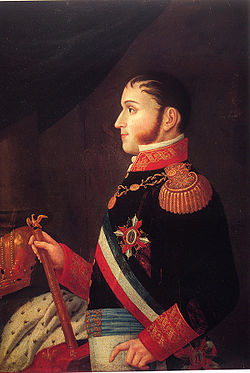
1824: Agustin de Iturbide, Emperor of Mexico

On this date in 1824, the Mexican officer who had made himself emperor was shot at the village of Padilla.

Iturbide‘s military acumen saw him through a meteoric rise in the service of what was then New Spain.

Iturbide rejected an early offer of generalship from the pro-independence leader Hidalgo in favor of spending the 1810s ably quashing the insurgency.

In a bizarre twist of fate, however, it would be Iturbide who would himself cement Mexican independence.

En route to try to finish off the last major rebel leader, Vicente Guerrero, Iturbide caught wind of the recent del Riego liberal revolt back in the mother country,* which had triggered civil war in Spain.

For the conservative royalist general, heir himself to a Basque noble lineage, the potential collapse of Bourbon authority in Spain raised the frightening specter of social upheaval.

All Iturbide’s work killing guerrillas for the sake of public order could come to naught if the Spanish monarchy collapsed or ceased projecting its power overseas … and then who knew what would emerge from the resulting power vacuum in Mexico?

So Iturbide cut a deal with Guerrero to consummate the Mexican War of Independence by separating from Madrid on an essentially conservative basis — a political breakaway without a social revolution. Independent Mexico would make nice with the Spaniards already living there, keep Catholicism as the official state religion, and get itself a constitutional monarchy of its own to insulate itself from the chance outcomes of continental politics across the ocean.

And when Iturbide marched into Mexico City and encountered a crowd conveniently imploring him to take the throne, well, who was he to deny them?

And so Iturbide transitioned smoothly from scourge of the revolution to its man on horseback,** immediately splintering the coalition that lifted him to power.


Contrary to this allegorical take on Iturbide’s coronation, he crowned himself — Bonaparte-like.

Only months after his July 1822 coronation, Iturbide shuttered Congress and began arresting the opposition. Meanwhile, Ferdinand VII had emerged from the Spanish fray as the (momentary) winner, leaving his upstart former subjects without international support.

A general that the freshly-minted emperor had himself had promoted, one Antonio Lopez de Santa Anna — yes, the Alamo guy — declared against Iturbide by the end of 1822, and come the following spring, Agustin I was a European exile, in the paradoxical position of drawing a pension from Mexico while also officially considered a traitor and outlaw.

In Tuscany and then England, Iturbide published an autobiographical justification — Statement of Some of the Principal Events in the Public Life of Agustín de Iturbide — then finally took up a much-asked-for invitation from Mexican conservatives to return and become the savior of his country against internal breakdown and a potential Spanish attack.

Founded on vainglory, this expedition was destined for fiasco; within five days of touching Mexican soil, Iturbide was serenading a firing squad with the last words, “Mexicans! I die with honor, not as a traitor; do not leave this stain on my children and my legacy. I am not a traitor, no.” Apparently they were serious about that injunction never to return.

When in Mexico City, relive happier times for our day’s subject at the Palace of Iturbide where he briefly maintained himself in the purple.


Iturbide’s palace. Creative Commons image from patricio00.

And do think twice about styling yourself Emperor of Mexico, since the only other person to claim that title also ended his reign in front of a firing squad.

* Ironically, it was a body of soldiers assembled for a reconquista of Spain’s independence–minded New World possessions that enabled del Riego to mutiny.

** Iturbide paused in the revolution’s good graces just long enough to design the Mexican flag.

On this day..