1943: Eight from the Krasnodar Trials

On July 18, 1943, eight Soviet citizens who were among 11 tried for collaboration with the recently expelled German occupiers were hanged before tens of thousands in the main square Krasnodar.

The proceedings from July 14-17 were the first major, open war crimes tribunals of World War II … which, of course, was still ongoing at this point.

But the previous winter, the Soviet Union had turned the tide by winning the Battle of Stalingrad, which victory presaged the liberation of the nearby north Caucasus city where we lay our scene.

The Russians proceeded to put the murderous Nazi occupation on trial, but did so not by trying Germans or their allies — but by trying eleven Soviet citizens for collaboration. Indeed, until the end of the war, thousands of Russians were prosecuted for crimes of collaboration, but only a relative handful of Germans for actually authoring those crimes.

These eleven were mostly* men who had served the Sonderkommando 10a (part of Einsatzgruppe D) in “guarding Gestapo buildings that held arrested Soviet citizens, executing arrests, going on military searches and expeditions against the partisans and peaceful Soviet citizens, [and] exterminating Soviet citizens by hanging, mass shootings, and use of poison gases.”

That “Soviet citizen” stuff, technically accurate, soft-pedaled the Einsatzgruppe‘s predictable primary target: local Jewry.

Sonderkommando 10a arrived in the town of Krasnodar when it fell to the Germans on August 12, 1942. On August 21 and 22, all the Jews were ordered to report for transfer to a certain neighborhood in the city. They were taken to the Pervomaisk woods, where they were shot. Many of the city’s Jews did not obey the order, but they, too, were eventually caught and shot. According to a Soviet committee of inquiry report, the number of civilians — women, old people, and children — murdered in Krasnodar was in excess of 13,000. Almost all were Jews. (Source)

This in a city that was occupied for only six months.

Under any description of the victims, these depredations were plenty to condemn collaborators with even the vaguest of associations. Only a few of the men had specific acts charged against them; evidence establishing frightful Nazi atrocities in the region (not hard to find) plus confessions to having worked for the Nazis (not hard to wring out) forged a sufficient evidentiary chain without getting lost in the weeds of such minutiae as: was the collaboration really voluntary? did these collaborators themselves actually carry out war crimes? was that confession actually reliable? (good luck with that one.)

In this military tribunal, the public prosecutor had a free hand for grandstanding, the defense had almost no scope of action, and (the USSR being an old hand at the show trial game) the accused knew their own part to play with craven self-denunciations and pleas for the “mercy” of being sent to the most dangerous part of the front. This made great headlines in Pravda and Izvestia (and update memos straight to the Kremlin) about Nazi bestiality,** and great copy with inquisitorial slam dunks like,

Today Soviet law will mete out justice to the traitors, fascist hirelings, and boot-lickers now in the prisoners’ dock. Tomorrow the court of history, the court of freedom-loving nations of the world, will pronounce its inexorable verdict on the bloodthirsty rulers of Hitlerite Germany and all its associates — on the enemies of mankind who have plunged the world into the welter of the present war. Not one of them will escape stern retribution! Blood for blood, death for death!

All were convicted; three drew long prison sentences and eight hanging, and since the tribunal permitted no appeal, those sentences were executed the day after the court finished its business.

The period quotes, and much of the information about this otherwise somewhat inaccessible trial, comes from Ilya Bourtman’s 2008 article for Holocaust and Genocide Studies, “‘Blood for Blood, Death for Death’: The Soviet Military Tribunal in Krasnodar, 1943.”


It may have been a first, but one need hardly add that it was hardly the last such prosecution.

Several others war crimes show trials took place in other Soviet cities over the next few months, and these would obviously continue after the war.

Long, long after the war.

* The one exception was a 60-year-old former kulak who had illicitly escaped the deportation prescribed for this class in the 1930s. His “collaboration” consisted of having been a doorman whom a German soldier asked a question of.

** e.g., “Death to Hitler’s Butchers and Their Vile Accomplices”

On this day..

1749: Samuel Henzi, excluded

What happens to a dream deferred?

Does it dry up
like a raisin in the sun?
Or fester like a sore–
And then run?
Does it stink like rotten meat?
Or crust and sugar over–
like a syrupy sweet?

Maybe it just sags
like a heavy load.

Or does it explode?

–Langston Hughes

Those lines, written for 20th century America’s struggle with racism, are rooted in the timeless conflict between the haves and the have-nots, and those “exploding” dreams deferred have provided more than a few subjects for these morbid pages.

This date in 1749 saw the beheading of writer and reluctant revolutionary Samuel Henzi (German Wikipedia page), along with two fellow-conspirators in a plot to overthrow the aristocratic government of Bern(e).

Still operating off a 13th century constitution, Berne had ossified into an oligarchic society with privilege derived from heredity and the capable but low-born frustratingly locked out. This arrangement had provoked intermittent uprisings and challenges, but as of the mid-18th century, it was still going strong, and “patricians mockingly observed that the citizens must be stripped of their feathers, that they might not want to fly.” (Source)

Henzi was a man with the ambition and the talent to soar above his place.

Eloquent, cultured, a guy to bang out some French poetry on the side, Henzi had been among a group of lower gentry who in 1744 petitioned for a change to Bern’s governing council, which at that time had become a privately held dynastic trust among a few top burghers.

For a suggestion as incendiary as allocating council seats by lot the better to represent the class, Henzi was treated as a rebel and exiled to Neuchatel.

dass ein eingewurzelter Staatskrebs mit Demuth nicht geheilt werden kann; nein! man muss den Degen in die Faust nehmen, wenn man die verlorne Freiheit wieder erobern will.*

Returning on a pardon, he found that not much had changed. The doors to employment in the civil administration shut tight against him, and not being bought off with a minor sinecure he fell in with a circle of malcontents dreamily conspiring to blow the whole thing up.

These plotters were exposed and three considered ringleaders — merchant Samuel Niklaus Wernier, Stadtlieutenant Emanuel Fueter, and Henzi — were beheaded on this date, each reputedly requiring more than one stroke of the sword.

On embarking with their two sons to quit the Helvetic territory, the wife of Henzi exclaimed, “I would rather see these children sink in the Rhine-stream than they should not one day learn to avenge the murder of their father.” However, when the sons came to manhood, they displayed more magnanimity than their mother; and one of them, who rose to distinction in the service of the Netherlands, requited with good offices to the burghers of his native town the unmerited misfortunes which they had brought upon his family. (Source)


Henzi’s fate greatly excited German dramaturg (and original Conehead) Gotthold Lessing — indeed, he would remark that no other event moved him so deeply.

Almost immediately after Henzi’s decapitation, Lessing wrote his first tragedy, the never-finished but aptly-titled Samuel Henzi, which is available in the original German here.**

Wann man des Staates Flehn, der sie aus Gunst erkoren,
Der nur aus Nachsicht fleht, empfängt mit tauben Ohren;
Wann wer der Freiheit sich das Wort zu reden traut,
Zum Lohn für seine Müh ein schimpflich Elend baut;
Freiheit! wann uns von dir, du aller Tugend Same,
Du aller Laster Gift, nichts bleibet als der Name:
Und dann mein weichlich Herz gerechten Zorn nicht hört,
So bin ich meines Bluts –– ich bin des Tags nicht wert.

* That is, “humility cannot cure the cancer of the state; one must take the sword in fist.” The comment is cited in Edward M. Batley, “‘Tu executes comme tes maitres jugent!’ – The Henzi Affair and the question of Lessing’s political judgment”, German Life and Letters, July 1984.

** Lessing’s next stab at stagecraft in the key of seria produced what’s generally described as the German theater’s first domestic or bourgeois tragedy, Miss Sara Sampson (German Wikipedia entry).

On this day..

1676: Marie-Madeleine-Marguerite d’Aubray, Marquise de Brinvilliers

This date’s story is amply but succinctly conveyed by the public-domain entry in the 19th century tome Biography, or Third Division of the “English Encyclopedia”.

(Paragraph breaks have been added for readability.)


Brinvilliers, Marie Marguerite, Marquise de (English Wikipedia entry | French) who obtained infamy as a poisoner in the time of Louis XIV, was a daughter of the Dreux d’Aubrai, a lieutenant civil, or judge having a certain limited jurisdiction, at whose hands she received a careful education.

In 1651, whilst still very young, she became the wife of the Marquis de Brinvilliers, with whom she resided at her father’s house, in Paris. Her husband, who was the colonel of the Regiment de Normandie, entertained at his house a young officer of cavalry of the Regiment de Tracy, named Gaudin de Sainte-Croix, a native of Montauban, and the illegitimate member of an illustrious family. He was unprincipled enough to encourage the unlawful passion which the marchioness conceived for him; and her father, in consequence, procured in 1663 a lettre de cachet against Sainte-Croix, who underwent a year’s incarceration in the Bastille.

During his confinement he learned from a fellow-prisoner, an Italian named Exili, the art of preparing subtle poisons; a secret which, upon his enlargement, he communicated to his mistress, who determined to poison her father and the other members of her family. Having first wantonly essayed her art upon the patients of the Hotel-Dieu, she proceeded, with the aid of a servant named Jean Amelin, or La Chaussee, to take the lives of her father, her two brothers, and her sister.

This feat she accomplished gradually between the years 1666 and 1670. More than once she poisoned her husband; but Sainte-Croix, whose prudence shrank from the obligation of marrying the terrible widow, each time preserved the life of the Marquis by the administration of an antidote.

Sainte-Croix died suddenly in July, 1672, in the act, it is said, of compounding a subtle poison, against the effects of which he was left unprotected by the accidental fracture of a glass mask which he wore as a defence against the fumes of his deadly drugs.*

As no relative came forward to claim his property, it was taken possession of by the public authorities, who, instead of complying with the written instructions of Sainte-Croix,** dated May 25th, 1672, that a particular casket should be delivered to Madame de Brinvilliers, examined it, together with above thirty letters which he had received from her. There was also found a promise on her part to pay Sainte-Croix a sum of 30,000 libres, bearing the date of June 20th, 1670, eight days after the poisoning of the “lieutenant civil,” her father. The casket proved to be full of packets of various poisons, to each of which was affixed a label indicating the peculiar effects it was calculated to produce.

The Marchioness, fatally compromised by these and other circumstances, sought safety in flight, repairing first to England, then to Germany, and finally to Liege, where she was apprehended.

Being taken to Paris, she denied her guilt; but after her condemnation made a confession, in which, and in a kind of autobiography, she charged herself with more and greater horrors than had seemed possible to rumour or suspicion.


The Marquise de Brinvilliers, shortly before her execution, by Charles LeBrun

She was executed at seven o’clock on the evening of the 16th of July, 1676, being first beheaded and afterwards burnt. As her application and use of poison, which went by the name of poudre de succession, seemed to be growing prevalent, Louis XIV instituted a special court for the investigation and punishment of this species of crime.


This tale, uniting the attractions of bodice-ripper, true crime, and costume drama, has been adapted to stage and literature numerous times.

Alexandre Dumas pere, a true aficionado of historical crime and scandal, turned it into a much lengthier piece, from which we morbidly excerpt his description of the water torture the criminal endured prior to beheading — beginning with the sentence of the court.


“That by the finding of the court, d’Aubray de Brinvilliers is convicted of causing the death by poison of Maitre Dreux d’Aubray, her father, and of the two Maitres d’Aubray, her brothers, one a civil lieutenant, the other a councillor to the Parliament, also of attempting the life of Therese d’Aubray, her sister; in punishment whereof the court has condemned and does condemn the said d’Aubray de Brinvilliers to make the rightful atonement before the great gate of the church of Paris, whither she shall be conveyed in a tumbril, barefoot, a rope on her neck, holding in her hands a burning torch two pounds in weight; and there on her knees she shall say and declare that maliciously, with desire for revenge and seeking their goods, she did poison her father, cause to be poisoned her two brothers, and attempt the life of her sister, whereof she doth repent, asking pardon of God, of the king, and of the judges; and when this is done, she shall be conveyed and carried in the same tumbril to the Place de Greve of this town, there to have her head cut off on a scaffold to be set up for the purpose at that place; afterwards her body to be burnt and the ashes scattered; and first she is to be subjected to the question ordinary and extraordinary, that she may reveal the names of her accomplices. She is declared to be deprived of all successions from her said father, brothers, and sister, from the date of the several crimes; and all her goods are confiscated to the proper persons; and the sum of 4000 livres shall be paid out of her estate to the king, and 400 livres to the Church for prayers to be said on behalf of the poisoned persons; and all the costs shall be paid, including those of Amelin called Lachaussee. In Parliament, 16th July 1676.

The marquise heard her sentence without showing any sign of fear or weakness. When it was finished, she said to the registrar, “Will you, sir, be so kind as to read it again? I had not expected the tumbril, and I was so much struck by that that I lost the thread of what followed.”

The registrar read the sentence again. From that moment she was the property of the executioner, who approached her. She knew him by the cord he held in his hands, and extended her own, looking him over coolly from head to foot without a word. The judges then filed out, disclosing as they did so the various apparatus of the question. The marquise firmly gazed upon the racks and ghastly rings, on which so many had been stretched crying and screaming. She noticed the three buckets of water prepared for her, and turned to the registrar — for she would not address the executioner — saying, with a smile, “No doubt all this water is to drown me in? I hope you don’t suppose that a person of my size could swallow it all.” The executioner said not a word, but began taking off her cloak and all her other garments, until she was completely naked. He then led her up to the wall and made her sit on the rack of the ordinary question, two feet from the ground. There she was again asked to give the names of her accomplices, the composition of the poison and its antidote; but she made the same reply as to the doctor [namely, that she had no accomplices besides Sainte-Croix and did not know how to make the poison or its antidote], only adding, “If you do not believe me, you have my body in your hands, and you can torture me.”

The registrar signed to the executioner to do his duty. He first fastened the feet of the marquise to two rings close together fixed to a board; then making her lie down, he fastened her wrists to two other rings in the wall, distant about three feet from each other. The head was at the same height as the feet, and the body, held up on a trestle, described a half-curve, as though lying over a wheel. To increase the stretch of the limbs, the man gave two turns to a crank, which pushed the feet, at first about twelve inches from the rings, to a distance of six inches. And here we may leave our narrative to reproduce the official report.

“On the small trestle, while she was being stretched, she said several times, ‘My God! you are killing me! And I only spoke the truth.’

“The water was given: she turned and twisted, saying, ‘You are killing me!’


The torture of the Marquise de Brinvilliers. (Click for a larger image.)

“The water was again given.

“Admonished to name her accomplices, she said there was only one man, who had asked her for poison to get rid of his wife, but he was dead.

“The water was given; she moved a little, but would not say anything.

“Admonished to say why, if she had no accomplice, she had written from the Conciergerie to Penautier, begging him to do all he could for her, and to remember that his interests in this matter were the same as her own, she said that she never knew Penautier had had any understanding with Sainte-Croix about the poisons, and it would be a lie to say otherwise; but when a paper was found in Sainte-Croix’s box that concerned Penautier, she remembered how often she had seen him at the house, and thought it possible that the friendship might have included some business about the poisons; that, being in doubt on the point, she risked writing a letter as though she were sure, for by doing so she was not prejudicing her own case; for either Penautier was an accomplice of Sainte-Croix or he was not. If he was, he would suppose the marquise knew enough to accuse him, and would accordingly do his best to save her; if he was not, the letter was a letter wasted, and that was all.

“The water was again given; she turned and twisted much, but said that on this subject she had said all she possibly could; if she said anything else, it would be untrue.”

* According to Anne Somerset in The Affair of the Poisons: Murder, Infanticide, and Satanism at the Court of Louis XIV, this story of Sainte-Croix’s death by accidental exposure to his own toxins is “a myth” that developed in view of subsequent events.

“In fact,” writes Somerset, “his end was far more prosaic. He died after a long illness, having received the last rites and performed his final devotions with terrible piety.”

** Because Sainte-Croix died in debt, and his possessions were inventoried for his creditors.

On this day..

1926: Ziya Hursit and others for a plot against Ataturk

On this date in 1926, 15 people who had been sentenced to death only the day before for attempting to assassinate Turkish statesman Atatürk were hanged in Constantinople.

Ziya Hursit (English Wikipedia entry | Turkish), a former National Assembly delegate who didn’t see eye to eye with Atatürk, generally goes down as the ringleader in this affair.

Their object? To gun down the President during a visit to Izmir a few weeks previous. When interrogated, Hursit “admitted at the outset his intention to kill the President of the Republic.” (London Times, June 29, 1926)

Frictions with said President had been growing over the preceding months, as Atatürk broke the eggs to make the Turkish Republic’s omelet.

In early 1926, Mustafa Kemal also sought to bring the manner in which Turkish society was regulated into line with European countries. On 17 February 1926, the Turkish parliament approved a new civil code which was translated almost verbatim from the civil code in the Swiss canton of Neuchatel. The changes it introduced included: granting Turkish citizens the right to choose their own religion, thus abolishing the previous prohibition on apostasy from Islam; officially recognizing only civil marriage ceremonies conducted by representatives of the civil authorities … outlawing polygamy; making divorce dependent on a decision of the courts; lifting the ban on Muslim women marrying non-Muslims; and granting men and women equal inheritance rights.

The new Civil Code was followed by a battery of further legal reforms to try to bring Turkey into line with contemporary Europe. On 1 March 1926, parliament approved a new Penal Code, which was translated from the Italian Penal Code of 1889. A Code of Obligations was introduced on 22 April 1926, again based on the one in Swiss canton of Neuchatel. On 9 May 1926, parliament approved a new Commercial Code, which was largely based on German law.

(Source)

This first of the Turkish Republic’s political assassination attempts and arguably its last serious bid to reverse secularism licensed an efficient purge and further consolidation of power by Atatürk, who over the weeks ahead shattered the remnants of the Unionists and Progressive Republicans and settled in for essentially secure autocratic governance for the balance of his life.

The alleged conspirators in the hit — not all of them as eager as Hursit to avow responsibility over the two-plus weeks’ trial — were hanged at a couple different locations in the former capital this date, bearing placards damning them for “attempting to assassinate our President, Mustapha Kemal Pasha, who is the saviour of Turkey’s honour.” One of them had a botched execution with a broken rope and a do-over.

(The quote is from the London Times dispatch about the executions, printed July 15, 1926. This story gives the figure of 15 hanged; it appears to me that the correct number that date was either 13 or 14, with two additional death sentences handed down in absentia. It was, in any event, more death sentences than the public prosecutor himself had demanded (11) in the case.)

* The city wasn’t renamed Istanbul until 1930.

On this day..

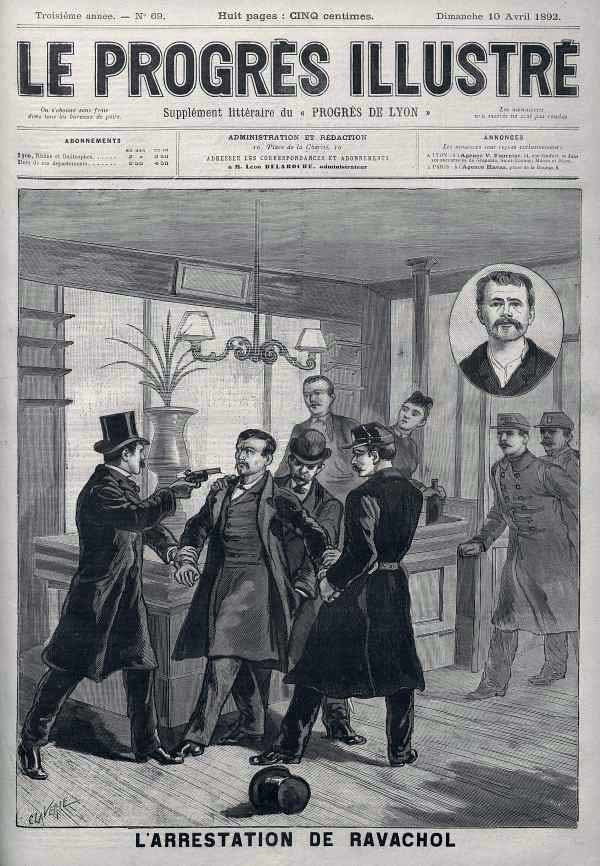
1892: Ravachol, anarchist terrorist

On this date in 1892, French anarchist François Claudius Koenigstein — better known as Ravachol — was guillotined at Montbrison for a series of bomb attacks on right-wing judges.

He took the name “Ravachol”, his mother’s, after his Dutch father ditched his mom, leaving the family in poverty.

Young Ravachol supported himself as best he could in proletarian labor and crime, as he attempted to observe* at his trial.

Ravachol, as painted by Charles Maurin.

There are many people who will feel sorry for the victims, but who’ll tell you they can’t do anything about it. Let everyone scrape by as he can! What can he who lacks the necessities when he’s working do when he loses his job? He has only to let himself die of hunger. Then they’ll throw a few pious words on his corpse. This is what I wanted to leave to others. I preferred to make of myself a trafficker in contraband, a counterfeiter, a murderer and assassin. I could have begged, but it’s degrading and cowardly and even punished by your laws, which make poverty a crime. If all those in need, instead of waiting took, wherever and by whatever means, the self-satisfied would understand perhaps a bit more quickly that it’s dangerous to want to consecrate the existing social state, where worry is permanent and life threatened at every moment.

Personal want segued into political conviction for Ravachol, whose crimes were justified by the principle of reprise individuelle.

And the political led him to reprisals of a less individual nature, when French state violence against radicals caused him to dynamite several magistrates’ homes.

He was caught in a restaurant,** brought to trial, and let off with penal servitude for life. Then another jury, intimidated by public outcry, reversed the decision and sent him to the guillotine.

–The Banquet Years: The Origins of the Avant-Garde in France 1885 to World War I, which argues that anarchists “unsettle[d] the political smugness of the Third Republic … [and] challenge[d] any formulated aesthetic. The dynamism of prewar artistic activity ran a close parallel to anarchism; postwar Dada and surrealism look like its artistic parodies†.”

Anarchism, that revolutionary specter stalking fin-de-siecle Europe, burnt its fuse at both ends, but Ravachol’s falling head‡ left a legacy for his fellow-travelers. The next year, Auguste Vaillant tossed a bomb into the French Chamber of Deputies to avenge Ravachol. (Vaillant was himself guillotined, and himself avenged by Emile Henry and Sante Geronimo Caserio.)

Ravachol was also honored in a song, La Ravachole — set to the jauntily menacing tune of La Carmagnole, it cheers, “Long live the sound of the explosion!”

* This incendiary speech was cut off by the court.

** The table where the terrorist was nabbed got its own inscription: “Here ate Ravachol the day of his arrest.”

† e.g., Dadaist Marcel Janco‘s recollection:

We had lost confidence in our culture. Everything had to be demolished. We would begin again after the ‘tabula rasa’. At the Cabaret Voltaire we began by shocking common sense, public opinion, education, institutions, museums, good taste, in short, the whole prevailing order.

‡ Ravachol was guillotined midway through a parting exclamation, “Vive la Re-“. Initial newspaper reports implausibly rendered this as the patriotic classic “Vive la Republique!” rather than a much more in-character word like, oh, “Revolution”.

Weeks of controversy ensued over some witnesses’ claims that the head post-severing had actually completed the word “-publique”, a notion of a piece with the idea that the severed head survives decapitation by a few seconds. Scienticians countered that obviously excited witnesses were maybe hearing air escaping from the headless trunk and filling in the rest of the scene in their heads.

On this day..

1538: Diego de Almagro, explorer of Chile

On this date in 1538, Spanish conquistador Diego de Almagro was executed* at Cuzco by his vengeful rivals, the Pizarro brothers.

Conquistadoring with the rapacious Pizarros was a good way to get rich, get dead, or possibly both.

Almagro, a soldier, got to the New World in 1514 and soon fell in with alpha male Pizarro Francisco.** He’d become an adjunct to the latter’s conquest of the Incan Empire in the 1520s and 1530s; sent to capture the Incan city of Quito, Almagro found it razed by its defenders, and he sycophantically re-founded it as San Francisco de Quito.†

Things weren’t buddy-buddy for long.

The Iberian mothership divided Spain’s putative New World possessions north and south, putting Almagro in command of the southern cone. Great news … now all he had to do was actually take control of it.

Personally financing an expedition on the expectation of fabulous riches to be seized, Almagro instead foundered in Chile’s northern valleys in a frustrating environment of natives equally hostile and impecunious. After a couple years, he gave up and returned to Peru, angrier and poorer for his trouble — and there found that he could exploit the Spanish preoccupation with intransigent Incan chief Manco Inca to nick the capital city of Cuzco for himself.

Almagro actually had the lesser Pizarros — Gonzalo and Hernando — prisoner for a while, but he bartered them away to Francisco for a hill of beans (that is, a promise not to attack), and the Pizarros took their city back by routing Almagro at the Battle of Las Salinas.

The sentence of death against as august a personage as the appointed ruler of Nueva Toledo shocked many, and it was carried out against Almagro’s own entreaties for an appeal to the crown.


Detail view of a print of Almagro’s capture and execution. (Click for the full image.)

Francisco Pizarro would redeem his want of clemency towards his former partner in his own blood: in 1541, Almagro’s son, Diego de Almagro II or el Mozo, murdered Pizarro in an attempted coup d’etat. (Almagro the Younger, too, would be executed for his trouble.)

Although he was an important conquistador who spent most of his time at points further north, Almagro is best remembered today not in Peru but in Chile — for his abortive and disappointing expedition made him that land’s first European “discoverer”.

* Either beheaded or garroted.

** Almagro also rubbed shoulders with Vasco Nunez de Balboa.

† He pulled a similar trick with Trujillo, naming it after Francisco Pizarro’s birthplace.

On this day..

1285: Tile Kolup, pretender

On this date in 1285, a pretender to the Holy Roman Empire* throne was burned at the stake in Wetzlar, Germany.

Kolup (English Wikipedia page | German) found room to perpetrate his fraud via the “King in the mountain” legend.

This myth of a past hero who sleeps out of sight, awaiting the opportune moment for return, has a wide cultural currency; King Arthur would be the readiest example for most Anglos.

In Germany from the 13th century, a similar myth attached to Emperor Frederick I “Barbarossa”, who had suddenly drowned during the Third Crusade in 1190 after reigning as Holy Roman Emperor for nearly 40 years. It’s a myth with enough resonance for this poem by 19th century German romantic Friedrich Rückert:

The ancient Barbarossa,
Frederich, the Kaiser great,
Within the castle-cavern
Sits in enchanted state.

He did not die; but ever
Waits in the chamber deep,
Where hidden under the castle
He sat himself to sleep.

The splendor of the Empire
He took with him away,
And back to earth will bring it
When dawns the promised day.

The chair is ivory purest
Whereof he makes his bed;
The table is of marble
Whereon he props his head.

His beard, not flax, but burning
With fierce and fiery glow
Right through the marble table
Beneath his chair does grow.

He nods in dreams and winketh
With dull, half-open eyes,
And once an age he beckons
A page that standeth by.

He bids the boy in slumber:
“O dwarf, go up this hour,
And see if still the ravens
Are flying round the tower.

“And if the ancient ravens
Still wheel above us here,
Then must I sleep enchanted
For many a hundred year.”

(To say nothing of the resonance for the Nazis who codenamed their invasion of the Soviet Union Barbarossa.)

Anyway, by the time we lay our scene late in the 13th century, when the Hohenstaufen line has tragically vanished, a version of this myth — the “Emperor of Peace” (German link) — has attached itself to Barbarossa’s grandson, Frederick II. Like Frederick I, he was a great and long-lived consolidator of the Empire; unfortunately, he’s been dead since 1250. Or has he?!

Tile Kolup appears in 1284 claiming to be this Frederick, who would have been going on 90 years old at this time. The good citizens of Cologne are his first audience, and he totally bombs with them; only their conviction that he’s more madman than usurper gets him run out of town with only a taunting.

But he finds a more receptive crowd in Neuss, and for a time keeps a court there and issues documents on Frederick II’s authority. Rudolph I, King of the Romans and butt of reindeer jokes, eventually nabs him in nearby Wetzlar and tortures him into admitting his imposture.

There are some succinct German biographies of this falsche Friedrich here and here.

* “This agglomeration which was called and which still calls itself the Holy Roman Empire was neither holy, nor Roman, nor an empire.” -Voltaire. (And the coffee talk lady.)

On this day..

1917: Gasim, by Lawrence of Arabia

“With Major Lawrence, mercy is a passion. With me, it is merely good manners. You may judge which motive is the more reliable.”

-Alec Guinness as Prince Faisal in Lawrence of Arabia

This date in 1917 was the eve of the Battle of Aqaba, wherein a force of Arabs with famous British officer T.E. Lawrence emerged from the desert to surprise and capture the Ottoman Red Sea port today located in Jordan.*

And that makes this, in the cinematic masterpiece Lawrence of Arabia, the date on which the titular character kept the peace within his fragile coalition by personally executing a malefactor to prevent a tribal blood feud.

The victim, Gasim, is a real figure described in the real T.E. Lawrence’s memoirs —

a gap-toothed, grumbling fellow, skrimshank in all our marches, bad-tempered, suspicious, brutal, a man whose engagement I regretted, and of whom I had promised to rid myself as soon as we reached a discharging-place.

Gasim is most famous as the beneficiary of the movie scene in which Lawrence boldly turns back into the desert to rescue this worthless retainer when Gasim’s camel is found riderless in the caravan. This, too, is based on an actual incident in Lawrence’s memoir, albeit heavily dramatized on celluloid.

In the film, Lawrence’s godlike power to give Gasim life is soon mirrored by the godlike power to deprive it.

Effectively exploiting dramatic license, Lawrence of Arabia portrays the Englishman surveying the scene of the coming triumph when a disturbance breaks out in his camp. Hastening thither, he discovers clan lining up against clan over the destructive right of blood vengeance because of a murder in the camp — a murder committed by the man he has saved.

To forestall a “tribal bloodbath” on the very eve of victory, Lawrence himself volunteers to execute the culprit. Having once risked everything to save Gasim, Lawrence sacrifices him ruthlessly when the occasion demands.** This act underscores the chameleon-like other-ness of the character, one of the film’s principal leitmotifs: “I have no tribe, and no one is offended!”

Though the real Lawrence did no such thing to the real Gasim, this astonishing scene is also related in the memoirs — just at an earlier point, and with a different, less dramatically integral character.

My followers had been quarrelling all day; and while I was lying near the rocks a shot was fired. I paid no attention; for there were hares and birds in the valley; but a little later Suleiman roused me and made me follow him across the valley to an opposite bay in the rocks, where one of the Ageyl, a Boreida man, was lying stone dead with a bullet through his temples. The shot must have been fired from close by; because the skin was burnt about one wound. The remaining Ageyl were running frantically about; and when I asked what it was Ali, their head man, said that Hamed the Moor had done the murder. I suspected Suleiman, because of the feud between the Atban and Ageyl which had burned up in Yenbo and Wejh; but Ali assured me that Suleiman had been with him three hundred yards further up the valley gathering sticks when the shot was fired. I sent all out to search for Hamed, and crawled back to the baggage, feeling that it need not have happened this day of all days when I was in pain.

As I lay there I heard a rustle, and opened my eyes slowly upon Hamed’s back as he stooped over his saddle-bags, which lay just beyond my rock. I covered him with a pistol and then spoke. He had put down his rifle to lift the gear; and was at my mercy till the others came. We held a court at once; and after a while Hamed confessed that, he and Salem having had words, he had seen red and shot him suddenly. Our inquiry ended. The Ageyl, as relatives of the dead man, demanded blood for blood. The others supported them; and I tried vainly to talk the gentle Ali round. My head was aching with fever and I could not think; but hardly even in health, with all eloquence, could I have begged Hamed off; for Salem had been a friendly fellow and his sudden murder a wanton crime.

Then rose up the horror which would make civilized man shun justice like a plague if he had not the needy to serve him as hangmen for wages. There were other Moroccans in our army; and to let the Ageyl kill one in feud meant reprisals by which our unity would have been endangered. It must be a formal execution, and at last, desperately, I told Hamed that he must die for punishment, and laid the burden of his killing on myself. Perhaps they would count me not qualified for feud. At least no revenge could lie against my followers; for I was a stranger and kinless.

I made him enter a narrow gully of the spur, a dank twilight place overgrown with weeds. Its sandy bed had been pitted by trickles of water down the cliffs in the late rain. At the end it shrank to a crack a few inches wide. The walls were vertical. I stood in the entrance and gave him a few moments’ delay which he spent crying on the ground. Then I made him rise and shot him through the chest. He fell down on the weeds shrieking, with the blood coming out in spurts over his clothes, and jerked about till he rolled nearly to where I was. I fired again, but was shaking so that I only broke his wrist. He went on calling out, less loudly, now lying on his back with his feet towards me, and I leant forward and shot him for the last time in the thick of his neck under the jaw. His body shivered a little, and I called the Ageyl, who buried him in the gully where he was. Afterwards the wakeful night dragged over me, till, hours before dawn, I had the men up and made them load, in my longing to be set free of Wadi Kitan. They had to lift me into the saddle.

Peter O’Toole’s Lawrence almost palpably manifests the conflicting aspects of his character as he shoots Gasim to death — and he confirms the transformative effect of his first homicide in subsequent dialogue with Gen. Edmund Allenby.

Lawrence: I killed two people. One was … yesterday? He was just a boy and I led him into quicksand. The other was … well, before Aqaba. I had to execute him with my pistol, and there was something about it that I didn’t like.
Allenby: That’s to be expected.
Lawrence: No, something else.
Allenby: Well, then let it be a lesson.
Lawrence: No … something else.
Allenby: What then?
Lawrence: I enjoyed it.

* Actually, Aqaba is Jordan’s only port. This battle was not so epic as the film depicts.

** In a bit of complex foreshadowing, the cinematic Gasim has told Lawrence at the outset of the expedition that “Allah favors the compassionate.”

On this day..

1533: John Frith and Andrew Hewet, Protestants

Life is all about timing.

Death too.

This date in 1533 saw John Frith and Andrew Hewet burned to ashes at Smithfield for Protestantism … just a week before Henry VIII himself was excommunicated from the Catholic Church.

A Cambridge man who’d picked up some heresy in Lutheran Germany, Frith was a friend of William Tyndale and did a couple of turns in English prisons for his various transgressions of orthodoxy.

He was finally nabbed by a warrant of then-Chancellor Thomas More before he could escape to the continent, and hailed before a doctrinal court for sacramentarianism.

During his examination by the bishops, Frith stated that he could not agree with them that it was an article of faith that he must believe, under pain of damnation, that when a priest prayed during the mass, the substance of the bread and wine were changed into the actual body and blood of our Savior Jesus Christ, even though their appearance remained the same. And even if this was so, which he did not believe it was, it should not be an article of faith.

–Foxe’s Book of Martyrs

(Said transubstantiation hypothesis remains Catholic doctrine to this day, but at least it’s no longer worth your life to dispute it.)

All the pieces were in place for this radical theology to become orthodoxy over the succeeding generation. The newly-designated Archbishop of Canterbury — still for the moment within the Catholic fold — was reformer Thomas Cranmer. Despite his sympathy for a shared evangelical cause, Cranmer passed a guilty verdict after trying to talk Frith out of his belief. In the event, however, it was the Inquisitor who was converted: Cranmer over the course of the 1530s adopted Frith’s own view. He would eventually enshrine it in the Book of Common Prayer.

All of which, of course, was made possible by Henry’s insistence on ditching his first wife in favor of Anne Boleyn, and Cranmer’s support for that action. On July 11, both the king and his pliant prelate were excommunicated by Pope Clement VII.

Still, it must be allowed that this fact scarcely gave carte blanche to Protestant reformers in England. Maybe Frith was made for the flames regardless: as timing goes, the 1530s were great for religious martyrdom.

Andrew Hewet, our poor footnote, had no part in these august affairs save the victim’s. Hewet was a tailor’s apprentice who was just caught up with an anti-heretical accusation at the wrong time. In prison, he too refused to acknowledge transubstantiation — saying, “I believe as John Frith believes.” For so believing, he burned as Frith burned.

On this day..

1972: Three Somali officers for an attempted coup

On this date in 1972, Somali Generals Muhammad Ainanshe Gulaid and Salad Gaveir, along with Col. Abdulkadir bin Abdulla,* were publicly shot in Mogadishu by a 90-man** (!) firing detail for attempting a coup the previous year.

Forged from the decolonized territories formerly known as British Somaliland and Italian Somaliland, Somalia had weathered a rocky 1960s before Siad Barre seized control in a 1969 military coup.

Muhammad Ainanshe Guleid had been Barre’s second vice-president (the first was also arrested for another supposed plot, though not executed), so the alleged conspiracy would have been treason at the very highest level. It’s obscure at this point to what extent the arrests might be attributed to an actual intended coup as against internecine politics within the ruling Supreme Revolutionary Council, or even whether those categories were wholly distinct.

“They were charged,” according to An Encyclopedic Dictionary of Conflict and Conflict Resolution, 1945-1966 (it makes great bathroom reading) “with treason in a plot to assassinate the president … and other high officials and to return the socialist country to capitalism.”

The Soviet-backed Barre had plenty of problems over the next two decades, but actually managed to hold the tumultuous country until 1991. Then rebels finally deposed the dictatorship. Neither those rebels nor anyone else, however, was able to establish an effective central government — leaving Somalia to become the anarchy/libertarian paradise it’s famous as today.

(Juxtapose: the Barre regime’s attempts (pdf) at establishing a more conventional tourist profile.)

* Each of these names have several possible transliterations. Actually, later this same year, Barre would announce an official choice of Latin script for the heretofore unwritten Somali language; schoolchildren at this time had to learn English, Italian, Arabic, and Somali.

** The source for the 90-man firing squad figure is I.M. Lewis, “The Politics of the 1969 Somali Coup” in The Journal of Modern African Studies, Vol. 10, No. 3 (Oct., 1972). As the title indicates, our day’s principals are not the author’s chief concern, but he adds apropos of Barre’s doomed efforts to shift loyalties away from tribes and towards the state that the massive fusillade party “was anti-tribal in composition, and that the Government would see to the funeral arrangements — traditionally a lineage responsibility.”

On this day..