1692: Bridget Bishop, the first Salem witch hanging

On this date in 1692, the pious folk of Salem, Mass., hanged their first witch.

Local bawd Bridget Bishop, pushing 60 and onto her third husband, was a natural target for the emergent civic insanity.

She liked living it up down at the tavern with a red bodice and the occasional game of shuffleboard. When she entered the courtroom, all the little brats with the sorcery stories (strangers to the accused before all this started) fell down and howled. When the Salem goodwives were tasked with groping her for bodily disfigurements that might be a witches’ mark, they

discovered a preternathurall Excresence of flesh between the pudendum and Anus much like to Tetts & not usuall in women

Bishop was obstinate in repelling the charges against her, even uppity enough to question her persecutors’ categorical assumptions.

I am innocent I know nothing of it I am no witch I know not what a witch is.

(Both the above excerpts can be found in the proceedings against Bishop — and other witchcraft defendants — lodged here.)

The local respectable citizens certainly weren’t about to entertain any wisecracking about the whole “witch” construct from the likes of Bishop. (She’d already been accused once before, in 1680.) In Puritan Bible-basher Cotton Mather’s embarrassing 1693 defense of the proceedings, he’s got Bishop’s WMDsdaemonic influences confidently sussed out.

There was little Occasion to prove the Witchcraft, it being Evident and Notorious to all Beholders. Now to fix the Witchcraft on the Prisoner at the Bar, the first thing used, was the Testimony of the Bewitched; whereof several Testify’d, That the Shape of the Prisoner did oftentimes very grievously pinch them, choak them, Bite them, and Afflict them; urging them to write their Names in a Book, which the said Spectre called, Ours. One of them did further Testify, that it was the Shape of this Prisoner, with another, which one Day took her from her Wheel, and carrying her to the River side, threatned there to Drown her, if she did not Sign to the Book mentioned: which yet she refused. Others of them did also Testify, that the said Shape did in her Threats brag to them that she had been the Death of sundry persons, then by her Named; that she had Ridden a man then likewise Named. Another Testify’d the Apparition of Ghosts unto the Spectre of Bishop, crying out, You Murdered us! About the Truth whereof, there was in the matter of Fact but too much Suspicion.

With this kind of slam-dunk evidence, Puritan New England wasn’t the sort of place to suffer a condemned enchantress a lot of dilatory appeals. Victims demanded closure, and two days after Bridget Bishop heard her sentence, she was strung up at Salem’s aptly named Gallows Hill.

There is at this point in the timeline of the Salem hysteria a slight pause in the proceedings as, having crossed the Rubicon and actually begun stretching necks, colonial elites consulted one another as regards the unfolding tragedy (and in the case of one of the judges, resigned).

The remainder finding themselves still committed to the crazy, Salem fired up its witch trials in earnest at the end of the month and greased the hanging rope for 18 more noosings, plus the nasty pressing to death of Giles Corey, over the months ahead.

On this day..

1716: Banda Singh Bahadur

On this date in 1716, legendary Sikh warrior Banda Singh Bahadur attained his martyrdom.

Born Lakshman Dev, the man who would become Banda Bahadur went on a spiritual wandering jag as a young man and chanced to be plucked out of hermitage by Sikh guru Gobind Singh.

When this guru’s efforts to make inroads for Sikh interests with the new Mughal Emperor Bahadur Shah foundered, the converted hermit (now returned to the martial exercises of his caste) was tasked with a punitive expedition against one of the more obnoxious governors.

The zealous general did his mentor one better, attracting thousands of sympathetic followers and carving out a Sikh kingdom in Punjab in the early 1710s.

This proto-state (forerunner of an actual state in the next century) was in due time outmuscled by the Mughals, capturing the rebels’ last redoubt by means of a perfidious assurance of leniency that would not be forthcoming. Not at all.

The captured were marched back to Delhi, along with the pike-mounted heads of their fallen comrades, and there subjected to grisly mass executions.

British diplomats making nice with the Mughal court at the time recorded the scene.

The great rebel Guru (Bandu, the Sikh) who has been for these twenty years so troublesome in the province of Lahore, is at length taken with all his family and attendance by the Subahdar, or Viceroy, of that province. Some days ago they entered the city laden with fetters, his whole attendants which were left alive being about 780,* all severally mounted on camels, which were sent out of the city for that purpose, besides about 2,000 heads stuck upon poles, being those who died by the sword inb attle. He was carried into the presence of the King, and from thence to a close prison. He at present has his life prolonged with most of his officers, in hopes to get an account of his treasure in several parts of his kingdom, and of those that assisted him, when afterwards he will be executed for the rest. There are one hundred each day beheaded. It is not a little remarkable with what patience they undergo their fate, and to the last it has not been found that one has apostatised from the new formed religion.

Their captain’s turn finally came this date when — spurning conversion to Islam, as had his fellows — he saw his son slaughtered before his eyes, then was hacked limb from limb.

On this day..

1671: Stenka Razin, Cossack rebel

On this date* in 1671, famed rebel Stepan (Stenka) Razin was publicly butchered in Moscow.


On that day, following four days of torture, he was led to an executioner’s scaffold in Red Square in the company of his younger brother, Frol. The list of Razin’s crimes and then his sentence were read out to him. The punishment was to be “an evil death befitting the wicked — by quartering.” According to eyewitness accounts, Razin then crossed himself and submitted to the executioner. Normally, death by quartering requires that the executioner first chop off the right arm of the convicted man at the elbow, then his left leg at the knee, then the left arm at the elbow, then the right leg at the knee, ending the whole gruesome process by decapitation. In the case of Razin, the executioner made only the first two cuts when, for some reason — perhaps for fear of Razin’s power over the assembled multitude — he was told to end it all and chop off the head. To complete the sentence, the executioner then went back and severed the remaining limbs of the already headless Razin. The limbs and the severed head were taken to Bolotnaia ploshchad’ across the Moscow River and displayed on spikes. The body was thrown to the dogs. Frol, who was supposed to be executed in a similar manner, began screaming his willingness to cooperate with the authorities midway through his brother’s execution. He was led back to prison, interrogated further, and executed on 26 May 1676.

–Playing Robin Hood: The Legend as Performance in Five Centuries

Stenka Razin’s unpleasant end came with the consolation of a ticket to immortality as Russia’s go-to folklore bandit.

In life, Razin led the most renowned internal rising against the Romanovs, lasting from 1667 to 1671.

Marshaling the underclasses (literally, the “naked ones”: the Cossacks had class issues) in the semi-lawless southern reaches of the realm, Razin segued smoothly from from a career of brigandage into suzerainty over a quasi-state around the Volga with the help of a sympathetic peasant uprising.


Stepan Razin on the Volga (1918), by Boris Kustodiev.

Throw back a frosty glass of Stepan Razin beer, brewed in St. Petersburg since 1795.

Razin’s revolt had scope and duration enough to trounce a Persian expedition against him. He bestrode the Volga — sailed the Caspian — raided foreign lands — established a Cossack republic.

It was an impressive run while it lasted. But like most peasant revolts, it was ultimately on the receiving end of the trouncing.

Captured and hailed to Moscow for his demonstrative end, Razin’s story lives strong in Russian culture and folklore even though his body ended up in bits and pieces.

Razin is the subject, for instance, of the first Russian feature film, a 1908 silent.

According to the Russian Wikipedia, Razin was even the subject of the first foreign dissertation about a Russian figure.

During the late 19th century’s reactionary period, Boris Glazunov put Razin’s capture to symphony.

In the Soviet era, poet Yevgeny Yevtushenko wrote about Razin’s execution, and so did Dmitri Shostakovich.

Best-recognized and most universally beloved is the folk tune “Ponizovaya Volnitsa”, which celebrates Stenka and the mighty waterway that bore him to posterity, the Volga.

* June 6, 1671 per the Julian calendar. It was June 16 in those countries that had already adopted the Gregorian calendar.

On this day..

1723: Margaret Fleck, with a fresh dempster

On this date in 1723, Margaret Fleck was hanged in Glasgow for murdering her infant child.

According to “The Last Speech and Confession of Margaret fleck who was Executed at the Howgate-Head of Glasgow on the 5th of June for the Murdering of her Own Child”* (it does what it says on the tin):

I am brought this day, and that justly, to suffer for the murder of my own child, and I doubt not but that it will be expected, and I think it most proper and my indispensable duty, that as I have sinned so heinously against God, so I should glorify him by repenting my unnatural, atrocious and bloody fact — the murder of mine own child … For which crime, and all my other sins I desire heartily to mourn, and to fly to the fountain that is opened to the House of David and the Inhabitants of Jerusalem for sin and uncleanness; and I desire to take shame and confusion of face to my self for my sins and iniquities, especially for the bad entertainment I gave to the gospel of Christ.

At the time, death sentences in Scotland had to be pronounced not only by the judges but by the dempster, a juridical office responsible for the actual execution.

Major League Baseball pitcher Ryan Dempster: would he hang Margaret Fleck?

In this case, dempster Thomas Cochran refused to join the sentence, evidently partaking in a popular discomfort with Fleck’s hanging. Nothing daunted,

their Lordships having desired the Sheriff Depute to provide another Dempster instantly, or else to do it himself, he craved their lordships might delay the same till the next day, against which time he should have one provided. Which being condescended to by their Lordships, they continued pronouncing of sentence against the said Margaret Fleck till to-morrow at nyne o’clock; with certification that if the Sheriff Depute did not provide a Dempster against that time, they would oblige him to do it himself …

The Sheriff Depute wriggled off the hook when a guy named Robert Yeats stepped up and did the Dempstering.

* As cited by Anne-Marie Kilday in “‘Monsters of the Vilest Kind’: Infanticidal Women and Attitudes to their Criminality in Eighteenth-Century Scotland,” Family & Community History, Nov. 2008.

Kilday observes that “pamphlet material relating to deviant behaviour … became popular sooner [in Scotland than in England], with publications beginning in earnest in and around 1702, nearly three quarters of a century ahead of publishers south of the Tweed. In addition, it was unquestionably infanticide (and latterly child killing in general), more than any other crime, which became the focus for the pamphlet literature produced.”

On this day..

1916: Robert Digby in Villeret

On this date in 1916, Private Robert Digby was shot by a German firing squad in the tiny northern France village of Villeret.

Digby was the last of a quartet of English soldiers who had been part of the British Expeditionary Force who met the Hun’s first foray into France in 1914.

Digby and his mates, Thomas Donohoe, David Martin and William Thorpe, were stranded behind lines.

Villeret took them in and changed their uniforms for peasant clothes while they worked the fields and tried to keep their heads down.

“Every inhabitant of Villeret knew of the British soldiers in their midst but none breathed a word, although the Germans had threatened to execute anyone harbouring enemy fugitives,” writes Ben McIntyre, who wrote the book on these men. “Even when food ran low and German troops were billeted on every house, the secret was kept safe. It was an astonishing act of collective bravery.”

To the west, in trenches the men could not pass, the war ground uncounted souls into horsemeat.

Digby became the lover of a village girl, and fathered a daughter by her.

This perilous idyll under the very bowers of hell could not last long. The Brits were mysteriously betrayed, and arrested by the Germans in May 1916 — all save Digby, who escaped out the window of a barn.

Donohoe, Martin and Thorpe were shot as spies on May 27.

After a week on the run in the nearby woods, the mayor of Villeret found Digby, and told him that the Germans were threatening to execute the villagers unless he turned himself in to face his comrades’ fate. Digby did so.

McIntyre’s book, A Foreign Field: A True Story of Love and Betrayal in the Great War, explored the village of Villeret and the life of Digby’s daughter Hélène Cornaille-Digby — an infant when her father was shot; an octogenarian when McIntyre met her.

The enduring mystery of the place, at least to McIntyre as an outsider, was the unanswered question of who betrayed the English. Was it a jealous lover? A disapproving family? A fearful neighbor?

Years after the publication of the book, McIntyre (so he thinks) accidentally solved the mystery.

On this day..

1529: Jacob Kaiser, launching the First War of Kappel

On this date in 1529, Zwinglian missionary Jacob Kaiser was burnt at the stake in the Catholic Swiss canton of Schwyz.

His Protestant evangelizing was a violation of the unwritten Cuius regio, eius religio policy keeping peace among the cantons. (Later, it would become written.)

This otherwise routine Reformation martyrdom led Ulrich Zwingli, then Grossmünster of Zurich, to make war on the Catholic cantons, seeking to pry them open for further Protestant inroads.

Let us be firm and fear not to take up arms. This peace, which some desire so much, is not peace, but war; while the war that we call for, is not war, but peace. We thirst for no man’s blood, but we will cut the nerves of the oligarchy. If we shun it, the truth of the gospel and the ministers’ lives will never be secure among us.

–Zwingli, channeling Orwell

The short-lived Erster Kappelerkrieg — the First War of Kappel — was won within weeks, swiftly concluded by a truce favorable to Zwingli’s Protestant alliance.

(Legend has it that the treaty was concluded over a shared pot of milk soup picturesquely resting on the Catholic-Protestant border, the Kappeler Milchsuppe.)

Die Kappeler Milchsuppe (1869) by Gemälde von Albert Anker.

But this initially favorable return on poor Jacob Kaiser’s sacrifice was soon squandered.

Hostilities between the two camps continued, eventually flaring into the Second War of Kappel. Zwingli was again spoiling for the fight, but his under-prepared Protestants were trounced by a Catholic league in October 1531. Zwingli himself died on the battlefield.

On this day..

1797: Gracchus Babeuf, for the Conspiracy of Equals

If the “revolutionary extremist” exists at all as an identifiable type, he exists in purest incarnation in Gracchus Babeuf. No revolutionary better fits the description “narrowminded to the point of genius”; few have defined their heaven more clearly or crusaded so fanatically, ascetically, so religiously to bring it to earth.

–Gracchus Babeuf: The First Revolutionary Communist

On this date in 1797, Francois-Noel Babeuf lost his head for the Conspiracy of Equals — the last Jacobin upheaval of the French Revolution, or the first Communist upheaval of post-Revolution modernity.

Francois-Noel — he styled himself “Gracchus” after the populist Roman tribunes — was a young man of Desmoulins‘ generation but from a considerably more hardscrabble background. Like the starry-eyed Dantonist scribbler, Babeuf discovered himself a brilliant journalist and pamphleteer with the onset of the Revolution; he did several prison stints during various revolutionary phases of the early 1790s for his too-radical-for-school opinions.

He did another in 1795 under the French Directory for his firebreathing rag Le Tribun du Peuple, which was particularly unfashionable stuff during the post-Robespierre Thermidorian regime.

Nothing daunted, Babeuf emerged from prison the leading apostle of the Parisian proletariat which had by then been decisively separated from power.

The order of the day was class consolidation with the spoils of the aristocracy apportioned among a new oligarchy of wealth. As France rushed headlong towards Bonaparte and Bourbon restoration, Babeuf was the man left to rally “the party which desires the reign of pure equality.”

The French Revolution was nothing but a precursor of another revolution, one that will be bigger, more solemn, and which will be the last.

The people marched over the bodies of kings and priests who were in league against it: it will do the same to the new tyrants, the new political Tartuffes seated in the place of the old.

–Manifesto of the Equals, 1796

One can see why later revolutionaries — Marx included; Babeuf makes a cameo in the Communist Manifesto — would adopt this sort of thing as a harbinger of the next century’s revolutions.

And if the Directory had known who Nicholas II would be, it would have had no intention of going the way of his family.

Instead, it shut him down in February, 1796: Napoleon Bonaparte personally carried out the operation, just days before he wed Josephine.


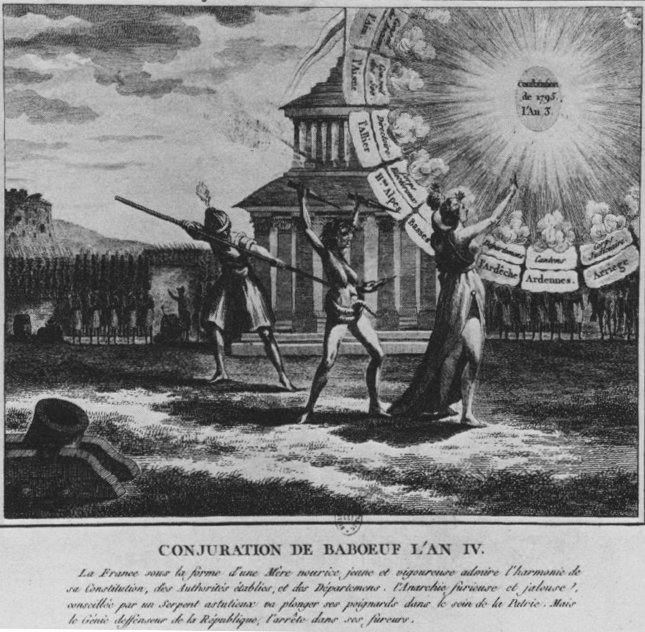
The Babeuf Conspiracy. Anonymous French print.

Babeuf’s party comes down to us as a “conspiracy,” under which word the state would charge him and which his follower Philippe Buonarroti would later rebrand the “Conspiracy of Equals”. It was not so much a grassy-knoll type of conspiracy as it was an underground organization.

When its adherents placarded Paris with the seditious “Analysis of the Doctrine of Babeuf” as the city endured a potentially dangerous economic crisis in April 1796, the government was put to a test of its strength.

It passed.

Having infiltrated Babeuf’s network, it arrested the principals on the eve of the Conspiracy’s intended insurrection. They were hailed out of Paris (a safeguard against sympathetic risings) to the commune of Vendome and there put on trial.* Babeuf and his associate Augustin Alexandre Darthe were condemned to death on May 26th and guillotined the very next day.

The last gasp of the French Revolution dropped with their heads into the basket.

Revolutionary Babeuvism, however, had scarcely just begun.

I don’t know what will become of the republicans, their families, and even the babies still at their mothers’ breasts, in the midst of the royalist fury that the counter-revolution will bring. O my friends! How heart-rending these thoughts are in my final moments! … To die for the fatherland, to leave a family, children, a beloved wife, all would be bearable if at the end of this I didn’t see liberty lost and all that belongs to sincere republicans wrapped in a horrible proscription.

-Babeuf’s last letter to his family

* The trial of Babeuf was itself a jurisprudential milestone: it was the first French trial to be transcribed verbatim.

What might look today like a nifty little advance for efficient judicature was bitterly controversial in 1797. The French Revolution had overturned an ancien regime practice of professional magistrates accepting legal testimony by written deposition and deciding matters behind closed doors. The liberte, egalite, fraternite way would instead demand that testimony be given live in the courtroom where citizen jurors could weigh its credibility.

Babeuf’s lawyer, Pierre-Francois Real, protested against the court stenographers, arguing that “The law insists that the system of written depositions not be restored in any way. That system will undoubtedly return if any means are used to save testimony given orally.”

There’s a fascinating disquisition on the curious and contradictory development of this issue and the way it “violates … common assumptions about the advance of textuality in the West” during the French Revolution in Laura Mason, “The ‘Bosom of Proof’: Criminal Justice and the Renewal of Oral Culture during the French Revolution” The Journal of Modern History, March 2004.

On this day..

1871: Hostages of the Paris Commune

The fall of the Paris Commune on May 28, 1871 launched many a leftist insurrectionary into the martyrs’ firmament.

But the last semaine sanglante that engulfed the Commune there was blood enough for many martyrdoms.

On this date in 1871, just days before the Commune gave way, it executed a clutch of hostages (French link) in desperate reprisal for the Versailles army’s cruelties. For the Commune, it was too little ruthlessness and much too late. For the 52 who stood up against the wall this date, they were just as dead.

These unfortunates were marched from La Roquette prison — whose inmates by dint of timely resistance only narrowly avoided a more extensive massacre — to Rue Haxo and slaughtered.

A number of them were men of the cloth. In 1938, the Catholic church of Notre Dame des Otages was erected on the site and dedicated to the victims’ memory.


A crucifix at Notre Dame des Otages. Copyrighted image used with permission.

(The markers on the spot have settled on 52 as the number of the victims, which might be the historically authoritative count; different sources, however, provide slightly different numbers.)

On this day..

1725: Jonathan Wild, Thief-Taker General and Receiver of Stolen Goods

(Thanks to Anthony Vaver, author and publisher of EarlyAmericanCrime.com for the guest post. Vaver is the author of Bound With An Iron Chain: The Untold Story of How the British Transported 50,000 Convicts to Colonial America. -ed.)

A buzz filled the air as people stood on their toes and filled every window in an attempt to get a glimpse of the great Jonathan Wild as he was paraded through the London streets on Monday, May 24, 1725. Despite the festive atmosphere surrounding the procession, Wild appeared to be unmoved by the shouts of the crowd, his attention focused instead on the Bible held open in his hands. After traveling about a third of the way to his destination, the procession stopped at the Griffin Tavern, so that Wild could drink a glass of wine.

Not long after leaving the Griffin Tavern, a rock thrown from a window hit Wild in the head, and blood began to pour down his face. The crowd roared with approval and people started to hurl insults at him, along with more stones and dirt. The cart stopped twice more before reaching its final destination: first at the White Lion, where Wild drank another glass of wine, and once again at the Oxford Arms, home of the bare-knuckle boxing champion James Figg, where Wild drank a tankard of beer and even more wine. His next and final stop was Tyburn Hill, where he was scheduled to be executed.

Convicts often stopped for drinks at various taverns during their march from Newgate Prison to Tyburn to be executed, so the fact that Wild stopped at three along the way to his execution was not unusual. What was unusual, however, was the fact that he was able to hold down his liquor, given that the previous night at two in the morning he had tried to kill himself in his jail cell by drinking a large dose of laudanum, a concoction of opium dissolved in alcohol. Wild was already in a half-stupefied state before his slow journey to the gallows and his wine drinking had even begun.

Wild’s dramatic execution marked a precipitous fall for a man who was perhaps the most influential person in England’s criminal justice system, even though he never held an official government position. As the self proclaimed “Thief-Taker General of Great Britain and Ireland,” Wild was instrumental in capturing and bringing to justice scores of petty thieves that plagued the London streets. He consulted the government on the passage of laws intended to encourage the capture of criminals. He also oversaw a vast criminal empire, the likes of which has never been duplicated.

Wild ran an Office for the Recovery of Lost and Stolen Property where people could apply to him for help in recovering their possessions for a fee that fell below what it would cost them to replace the objects. Wild would then use his connections in the criminal underworld to recover the goods and return them to the owner. His business proved to be extremely popular.

In addition to recovering lost and stolen property, Wild was particularly adept at catching and prosecuting criminals, a public service that enhanced his general reputation and gained the approval of the authorities. In the absence of a true police force, the government relied on rewards to encourage people to police the streets themselves. Anyone who could capture a thief and convict him or her with evidence received a reward of £40, far more than what most people in England could earn in a year. Wild benefited from this policy by collecting a fee every time he was able to prosecute a criminal. His office, then, essentially served as the de facto “Scotland Yard” of the day.

Wild’s knack for catching criminals brought him great renown. He often appeared at trials to give evidence against the criminals he helped to capture. He got to know the bailiffs of the prisons and could be seen socializing in the local taverns with Justices of the Peace. He entertained government officials in his house.

The public remained blissfully unaware that there was another, more sinister, side to Wild.

In point of fact, the man supposedly responsible for clearing the streets of criminals was also the head of a vast criminal empire and a well-oiled criminal machine. Wild’s Lost Property Office turned out to be a clearinghouse for stolen goods that members of his own organized gang had themselves acquired. The thieves he apprehended, supposedly for the good of the community, were fall guys; they either belonged to rival gangs, or were members of his own gang who tried to double-cross him, quit his business, or had ceased to be more valuable than the £40 reward given by the government for capturing and convicting a criminal. Wild sent many of these criminals to the gallows by appearing in court to give evidence — real or otherwise — against them. The unofficial head of crime prevention was in actuality the foremost perpetrator of crime and organizer of criminals in London and throughout Great Britain.

Wild’s downfall began when he helped prosecute the thief and burglar Jack Sheppard, whose daring and dramatic escapes from the notorious Newgate Prison turned him into a folk hero. Public opinion soured on the “Thief-Taker General” and his involvement with Sheppard’s execution … and when details of Wild’s criminal operation emerged after his arrest for receiving stolen goods, the public was furious.

When Wild finally reached the gallows at Tyburn, the noise from the crowd was so loud that the Ordinary of Newgate found it almost impossible to say his prayers with Wild and the three other criminals scheduled to die. The hangman, Richard Arnet, who years before had been a guest at Wild’s wedding, tried to give Wild as much time as he needed before preparing him for execution. The crowd, however, grew restless and threatened to tear Arnet to pieces if he did not proceed in carrying out his duties immediately. Reluctantly, Arnet placed a noose around Wild’s neck.

A great shout went up from the crowd as the cart drove away leaving the convicts dangling from the ropes tied around their necks. After the drop, Wild desperately grabbed onto Robert Harpham, who was being executed for coining, in an attempt to lift himself up and slacken the rope connected to his neck. Arnet intervened and separated the two, and after a few minutes, the life of Jonathan Wild came to an end at the age of about 42.

Almost as soon as Wild’s body was cut down, a rumor began to circulate that it was being carried off to the Surgeon’s Hall for dissection. The bodies of executed criminals were often used for such a medical purpose, but the practice usually led to a struggle between the surgeons, who were trying to take the body of the criminal away, and the disapproving crowd. In this case, Jonathan’s wife, Mary Wild, had arranged to circulate the rumor that he had been turned over to the surgeons as a ruse, so that his body could be properly buried without interference. Her plan didn’t work. Three or four days after it was buried Wild’s body was dug up from the St. Pancras churchyard by the surgeons.

Today, Jonathan Wild’s skeleton can be seen on display at the Hunterian Museum at the Royal College of Surgeons in Lincoln’s Inn Fields.


The skeleton of Jonathan Wild at the Hunterian Museum at the Royal College of Surgeons in Lincoln’s Inn Fields.

On this day..

1879: Three botches in three states

America’s weird love-affair with Frankenstein execution technology has been an occasional theme on this blog, but the fact is that the old-school execution methods these ghastly machines replaced were unpleasantly hit-and-miss.

On this date in 1879, three different U.S. states produced botched executions, each blurbed this New York Times article. (pdf)


One is attracted most readily to the firing-squad execution of murderer Wallace Wilkerson in Utah.

Wilkerson appealed the constitutionality of this method of execution, and in 1879’s Wilkerson v. Utah, the U.S. Supreme Court held that “the punishment of shooting as a mode of executing the death penalty for the crime of murder in the first degree is not” cruel and unusual punishment.

This legal precedent has actually been cited* by the present-day Supreme Court in rejecting legal challenges to lethal injection. Which is ironic, because a couple of months after the high court issued Wilkerson v. Utah, Wilkerson suffered a very cruel execution indeed.

The doomed man talked the officials conducting his execution into allowing him to die without being strapped down. With the resultant range of motion, Wilkerson at the last breath before the fusillade hit him drew his shoulders up as he braced for the impact — and pulled the white target pinned to his shirt above his heart.

The volley didn’t kill him — it just knocked him out of his chair to the ground, screaming “Oh, my God! My God! They have missed!”

He bled to death in 27 minutes, prompting the tongue-in-cheek observation by the Ogden Junction that “the French guillotine never fails.”


Meanwhile, on the very same day in Missouri …

ST. LOUIS, Mo., May 16.–A special dispatch from Booneville, Mo., says: “John I. West, who murdered a tramp last October, was to-day hanged at the Old Fair Ground near this city. When the trap was sprung, at 11:41 A.M., the rope broke, and the culprit fell to the ground on his back, but was too weak to rise. His groans and the gurgling sounds of strangulation were terrible to hear. He was picked up and speedily raised to the trap again, and, while being held by four or five men, was dropped a second time. This time he swung, and in 11 minutes was pronounced dead.

After reaching the platform of the gallows, West spoke nearly half an hour to the crowd present, reiterating his confession of the murder of Shinn, reviewing his past life, and appealing to young men and women to take his fate as a warning. There were about 8,000 people present, among whom was the father of West, who had come from Chapin, Ill.

(There’s a great deal more about West’s crime in the Times article, but it’s pretty dull reading for all the column-inches. He was a tramp who committed a semi-random murder, seemingly activating all the crime-freakout circuits so familiar to cable news programmers.)


Hillsboro, North Carolina, held a first-ever triple hanging — of the “Chapel Hill burglars”. As you might guess, these gentlemen burgled, and said burgling occurred in Chapel Hill. It was for housebreaking, not murder, that they were condemned, with the help of a confederate who turned state’s-evidence against them as soon as the lot was arrested.

Each of the culprits proclaimed his innocence to the last moment. [Lewis] Carlton spoke for an hour, and said his salvation was sure. The parting between [Henry] Andrews and his sister on the scaffold was most affecting, and moved the crowd of witnesses to tears. All the doomed men bore themselves firmly, and showed no signs of wavering. The hanging took place at 2:30 P.M., and was very badly conducted. The ropes around the necks of [Henry Alphonso] Davis and Carlton were too long, and their feet rested on the ground. They were raised up and the ropes retied, causing death by strangulation.

(According to this “history of the University of North Carolina” page, one of the burglars’ victims was writer Cornelia Phillips Spencer. Famous as the woman who rang the bell re-opening UNC in 1875, her role in closing the university in the first place in 1870 and her retrograde racial politics have recently been in Tar Heel news. The linked article suggests that her brush with the Chapel Hill burglars might have given Spencer an appreciation for the Ku Klux Klan’s version of order. After all, a white supremacist vigilante is just a liberal who’s been burgled.)

The St. Louis Globe-Democrat of May 17, 1879 adds of our men’s exit (in an addendum to a report primarily about the aforementioned West) that

[t]he execution was romantic in the extreme. Just as the doomed men ascended the platform a murky cloud, which had been drifting around, hung over the crowd and the instrument of death. Alfonso Davis began to speak, and as he opened his mouth the thunder began to peal, and the rain came down in torrents. Not a man, woman or child in the vast crowd moved or seemed to be aware that the rain was falling, so wrapped up in the death scene were they. At times the cloud threw such a dense shadow over the scene that it seemed as though night had enveloped the place. Then the lightning, vivid and intense, lit up the field of blood and cast forward, in bold and statuesque relief, the figures of the doomed and their executor as he stood like an artilleryman, lanyard in hand, ready to send the signal of death forward … the souls of three burglars went out and beyond, forked lightning illuminating their way and the wildest of thunder pealing their requiem.


The Bayou State redeemed this black day for the executioner’s craft by the uneventful hanging one Robert Cheney (black, of course) “for ravishing Amelia Voight in June, 1878.”

All told, four states killed six men on May 16, 1879, but only two of them died “cleanly.”

* The author of the New York Times opinion piece cited here, Gilbert King, has guest-blogged on this site:

On this day..