On this date in 1679, a spurned lover laid her head on the block in Edinburgh and began her career as a spook.
Decadent widower James Forrester (or Forester), having run through his cash, was marking his time at the pub and in the arms of Lady Christian Nimmo.
She was a great deal younger than himself, and a niece of his first wife’s. This near relationship greatly increased the scandal, which was aggravated by Lord Forester having always professed to be a religious man, and a rigid Presbyterian. [Edinburgh’s rigid Presbyterians had a recurring misconduct problem. -ed.] Mrs. Nimmo, besides being a very beautiful woman, was of a violent and impulsive nature. She was believed always to carry a sword under her petticoats, and so was not a person to be treated lightly, especially by those who reflected what blood ran in her veins, — Mrs. Bedford, who had murdered her husband a few years before, being her cousin-german. She was also related to the unhappy Lady Warriston, who suffered death for the same crime in 1600. Lord Forester’s passion for her appears to have cooled; and, shutting his eyes to possible consequences, he permitted himself in one of his carouses to speak more than lightly of her. This came to her ears, and, seized with fury, she went at once to his castle at Corstorphine … a violent altercation took place between them. In the midst of it, she snatched the sword from his side, ran him through the body, and killed him.
… She confessed her crime, but pleaded that Lord Forester, being ferocious and intoxicated with drink, had drawn his sword; that, to save herself, she had snatched it from him, and that in the struggle he had fallen upon it, and so killed himself. In spite of this defence, sentence of death was passed upon her … [she was] beheaded at the Market Cross on the 12th November 1679. At her execution she appeared dressed in deep mourning, with a long veil, which, before laying her head on the block, she took off, and replaced with a white taffeta hood. She met her fate with great courage. It was said at the time that, in spite of his professed Presbyterianism, a dispensation from the Pope to marry Mrs. Nimmo was found among Lord Forester’s papers, and that his delay in using it had caused her fury. (Source)
An apparition known as “the white lady” is supposed to haunt the site of the murder with a melodramatic bloody sword.
One hundred years ago today, Will James was lynched as a murderer in Cairo, Illinois.
“The Frog” or “The Froggie” was a black man implicated in the murder of a white girl, captured in nearby Belknap and
taken to the most prominent square in the city and strung up. The rope broke and the man was riddled with bullets. The body was then dragged by the rope for a mile to the scene of the crime and burned in the presence of at least 10,000 rejoicing persons. Many women were in the crowd, and some helped to hang the negro and to drag the body.
Part of the mob then sought other negroes. Another part, at 11:15 o’clock, after battering down a steel cell in the county jail, took out Henry Salzner, a white man charged with the murder of his wife last August, and lynched him.* (New York Times, Nov. 12, 1912)
Other pictures related to the Will James lynching are at the Without Sanctuary site here (images 41 through 47).
The grey lady’s dim view of this jubilant scene prompted a letter to the editor in defense — the author’s disclaimer notwithstanding — of the lynching, which paints a grim and striking portrait of the town where it occurred.
CAIRO’S NEGROES.
Former Resident Says They Are Spoiled by Coddling and Are a Menace.
As a former resident of Cairo, Ill., where I was the editor of a daily newspaper for three years, I crave a word, not in defense of the double lynching which occurred there a few days ago, but in explanation of it. Cairo, at the extreme southern point of Illinois, at the junction of the Ohio and Mississippi Rivers, is peculiarly located. Across one river is Missouri; across the other is Kentucky, and Tennessee is only fifty miles away. Cairo thus becomes a buffer between the North and the South. It is probably the only town in the North which has a true race problem to deal with. … Out of a population of 13,000 in 1900, 5,000 of the inhabitants of Cairo were negroes. Of the 100,000 negroes in the State of Illinois 5 per cent are massed in this one little town. Aside from this, the floating colored population is unusually large, and Cairo, at some time or other, harbors most of the “bad niggers” from St. Louis, Cincinnati, Louisville, Memphis, Vicksburg, and New Orleans. It is these whom citizens fear the most, and for whom the police are constantly alert. Murders by negroes either of white men or negroes are alarmingly frequent, but the murderer usually escapes either to Kentucky or Missouri, and is never heard of again. Thus crime after crime is recorded against the name of Cairo, with no recompense in the name of the law. On the other hand, there is hardly a time when there are not forty or fifty Cairo negroes in the Southern Illinois Penitentiary, all convicted of theft or burglary.
The white people of Cairo have always dealt indulgently with the negro. For years it has been the policy to keep two negroes on the small police force, and there have been negro Justices of the Peace. A negro physician once came near being elected a member of the Board of Education. While they pay but little taxes, the negroes are provided with three public schools. The Sumner was the first colored High School ever established in the United States. Yet this negro population, coddled as it is, is a constant menace to the town. No white woman dare venture outside of the house at night alone for fear of assault. Many outrages of which the world has never heard have been attempted. This is why, as Mayor Parsons says, the effect of the recent lynching will be “salutary.”
Altogether it is not surprising that a lynching took place in Cairo. The only wonder is that one did not take place long ago.
W.L. CLANAHAN
New York, Nov. 14, 1909
That electric arch and celebratory mob are now long gone from Cairo: in the century since Will James was butchered, Cairo, Ill., has withered — striken in part by its own poisonous legacy of racism. (Also by flooding from the adjacent rivers, the routing of transportation corridors elsewhere, and the general deindustrialization of the heartland.)
During the civil rights struggle as played out in Cairo in the 1960’s and 1970’s (more in this pdf), the town’s white business owners made a name for themselves by refusing to integrate their workforces in response to black boycotts … preferring to go out of business and/or leave town.
On this date in 1780, Incan-Peruvian indigenous leader Tupac Amaru launched his insurrection against the Spanish with the public execution of a Spanish corregidor.
Antonio de Arriaga, as Spain’s man in Tungasuca, had as part of his job description forcing curacas to extract the crown’s tribute from the natives. This put some tension between him and the likes of the strong-willed Tupac Amaru, who advocated fiercely enough for his people’s rights that Arriaga threatened him with death.
It also made Arriaga’s death an invitingly emblematic scene to open the indigenous revolt.
On Nov. 4, 1780, Tupac Amaru kidnapped Arriaga returning from a dinner party, then forced him to sign letters summoning Spaniards and curacas alike to Tungasuca.
Account of the Most Horrible Crime Committed by Jose Gabriel Tupac Amaru, Cacique of Pampamarca
On the morning of Friday, November 10th, Tupac Amaru ordered that three columns … be organized from all the people from his Province that were already there. Two were composed of Spaniards and Mestizos armed with muskets, sabers, and sticks; and one of Indians with slings. In the middle of this, he brought out the Corregidor, dressed in his military uniform, and publicly started taking his uniform off, stripping him of his rank following the rituals he had understood and seen in other occasions, until he was left in his shirt. He then put a shroud on him … that had the title of La Caridad on it. He then gave the order to take him to the gallows, accompanied by the Priest and two other clergymen, where he went with a resignation and patience worthy of somebody who was already touching the portals of eternity.
Once on the gallows the Corregidor was forced by the tyrant to publicly declare that he deserved to die in that way. A black slave of the Corregidor [named Antonio Oblitas -ed.] served as his executioner, but the ropes snapped and both fell to the ground. But they suspended them again with a lariat around their necks, and thus they completed the execution in clear sight and tolerance of all his Province. [“they” is as rendered in the book; I have no indication that more than one person was executed. -ed.] Not one voice was raised that would disturb the operation. And most surprising of all was that those same Collectors and those close to the Corregidor were the ones who (oh, what an awful spectacle of perfidy!) sped his way to the ignominious place of execution, and who pulled on his feet so he could die even more violently.
Among all the strange and pathetic love-stories of the Revolution, when hearts were won within prison walls and wedded by the guillotine, is there another as fantastic and wonderful as that of Adam Luchs? (Source)
Adam Lux (as he’s better known, and a fitter name to his character could hardly be invented), German Republican turned French Revolution representative, was so lovestruck by the arresting figure of Charlotte Corday that it was downright … mortifying.
Many were men to whom the Norman maid played muse, like the poet Andre Chenier.
But Lux was something else.
Thrilled by this chaste heroine’s sacrificial blow against the Revolution’s monster, Lux was supposed to have fallen madly in love with the murderess the one time he actually saw her, on her serene way to the scaffold.
Eros thus yoked to Thanatos, the besotted fellow promptly hurled himself after the exaltation of death. Imitation, after all, is the sincerest form of flattery.
Certainly knowing it to be fatal, Adam Lux published under his own name a vindication of Ms. Public Enemy #1 and her “tyrannicide,” and generally went extravagantly mooning about in this sort of vein as he prepared to get his head cut off this date in 1793:
The guillotine is no longer a disgrace. It has become a sacred altar, from which every taint has been removed by the innocent blood shed there on the 17th of July. Forgive me, my divine Charlotte, if I find it impossible at the last moment to show the courage and the gentleness that were yours! I glory because you are superior to me, for it is right that she who is adored should be higher and more glorious than her adorer!
Adam came off a little needy, you’d have to say.
Not surprisingly, he didn’t get the girl in the end.
Red is the garb thou wearest, red is the deed thou hast done,
And red on a land of blood rises the morning sun.
Kings have ridden this road, conquerors mailed in gold,
But none in such red triumph as this that we behold.
Rose, thro’ a rose-red dawn, go to thy valourous fate,
Queen of all roses thou, splendid and passionate.
And lo ! at thy feet I fling, here, in the gallows-cart,
Passionate even as thine, the rose-flower of my heart.
Turn but a moment toward me, stoop in thy raiment red,
I answer thee look for look, I am warmed and comforted.
Twins are we of one womb, fated sister and brother,
Nursed on the bare bruised breasts of Freedom our great Mother!
Thou, whom none could master, proud and glorious head,
Come, O Rose, to my bosom, come when thou art dead!
They have shorn the beautiful hair, they have bound the strong fair hands,
Signal me with your eyes that love still understands!
Signal, and I will follow : I dwell where thou must dwell,
I shall know thy blood-red raiment either in heaven or hell!
Lo! at thy feet I fling, here, in the gallows-cart,
Passionate even as thine, the red rose of my heart!
On this date* in 1796, France enacted what was long held to be one of its most notorious miscarriages of criminal justice by cutting off the head of Joseph Lesurques.
Lesurques was taken for the one of a gang who had sensationally robbed and murdered a mail courier early in 1796, and on the basis of slight eyewitness testimony condemned to die. The only reason he was associated with the crime in the first place was because his friend had been mistakenly accused, and then released, and Lesurques accompanied him to the court to retrieve the friend’s papers where he was “recognized.”
Eyewitness testimony having juridical pull far in excess of its dependability,** this “recognition” was worth the man’s life.
The famous French Revolution executioner Sanson was still in the game at this point, and his grandson (not yet born at this time) used the family notes to pull together this quasi-firsthand account in Memoirs of the Sansons. It’s a tale familiar to any present-day wrongful conviction scenario, of bad evidence snowballing, a blinkered prosecutor intent on conviction, pettifogging appellate authorities, and grim, relentless bureaucratic momentum.
(The names the Memoirs render as “Courriol” and “Dubosc” are also given as “Couriol” and “Dubosc” in other sources.)
the instructing magistrate … instead of imitating the prudence of his Parisian colleague and trying to discover the truth, applied himself to the collection of proofs of the guilt of the prisoners …
Fifteen witnesses on behalf of the defence proved an alibi in favour of Lesurques, eighty-three others spoke highly of his well-known respectability; but their evidence went for nothing in opposition to those who, with singular pertinacity, maintained that Lesurques was one of those who had been seen lurking near the scene of the murder on the night when it was committed …
On hearing his condemnation, Lesurques, who had been firm and collected throughout the trial, lost his self-possession, and raising his hands to heaven he exclaimed:
“The crime which is imputed to me is indeed atrocious and deserves death; but if it is horrible to murder on the high road it is not less so to abuse the law and convict an innocent man. A day will come when my innocence will be recognised, and then may my blood fall upon the jurors who have so lightly convicted me, and on the judges who have influenced their decision!”
…
On the 9th of Brumaire, year 5 (October 30, 1796), my grandfather and father proceeded to the Conciergerie, and found the convicts in the hall, through which so many had passed during the Reign of Terror. David Bernard† was in a state of utter prostration; Courriol, on the contrary, was excited. As to Lesurques, he was as calm and fearless as ever. When he saw my grandfather, whose white hair sufficiently designated him as the chief executioner, he stepped up to him, and said, holding out a sealed letter:
“Citizen, I hope for the honour of human justice that your functions do not often compel you to shed the blood of a guiltless man; I hope, therefore, that you will grant the last request of a man who is about to suffer for what he has not done. Be good enough to keep this letter, which may hereafter contribute to the restoration of the honour of my wife and poor children, whereof they have been so unjustly deprived.”
While one of his assistants was cutting the unfortunate man’s hair, my grandfather read the paper Lesurques had just given him. It was a letter addressed to Dubosc, the man in whose place he was condemned. It ran as follows:
“To Citizen Dubosc.
“Citizen Dubosc, — I do not even know you, and I am going to suffer the death which was reserved for you. Be satisfied with the sacrifice of my life. Should you ever be brought to account, remember my three children and their mother, who are disgraced for ever, and do not prolong their agony. Confess that you are the man.”
…
All preparations were now concluded. Lesurques, of his own choice, was dressed in spotless white, symbol of his innocence. He was the first to take his place in the cart; Courriol followed him, and Bernard, who had fainted, was deposited on the straw. Then began the most dismal and extraordinary journey that ever was made from the Conciergerie to the Place de Greve. Lesurques and Courriol stood in front. At every turn of the wheel, Courriol exclaimed in a piercing voice:
“I am guilty! Lesurques is innocent!”
And for twenty minutes, that is during the whole way to the guillotine, he perseveringly repeated his awful protest against justice. The crowd was horrified, and there were few who did not believe the murderer who confessed his crime, but who proclaimed his companion’s innocence. Courriol again repeated his words at the foot of the scaffold with extraordinary energy and vehemence, and the thump of the knife but just covered his supreme shriek:
“Lesurques is innocent!”
…
The judicial authorities have perseveringly refused to recognise this flagrant miscarriage of justice. And yet the innocence of Lesurques was amply demonstrated a short time after his execution: all the real murderers of the courier of Lyons designated by Courriol were captured; Dubosc himself, whose fatal resemblance to Lesurques was the cause of the latter’s death, was taken and tried … he was executed just four years after Lesurques …
The Lesurques heirs were left paupers by the state’s punitive confiscation of the “bandit’s” effects; after a quarter-century (during which the widow died in a madhouse), they were at least able to recoup their material loss, but although repeatedly challenged, the conviction itself was never reversed.
Judicial and literary skirmishing over the Lesurques matter continued for decades, gradually forming into a general consensus (whatever the courts might admit) that the man was wrongly accused.
As a result, Lesurques remained a potent symbol of capricious criminal justice overreach throughout the 19th century and into the 20th: this 1874 reader, Famous Cases of Circumstantial Evidence, has a full chapter on the case; a popular Victorian play titled The Lyons Mail was translated into a now-lost 1915 silent film and a 1931 talkie … albeit with a happy ending.
To a certain, inevitably well-represented, authoritarian demographic, any credence given to the self-evident proposition that wrongful convictions happen smacks of effrontery towards betters, and the Lesurques case was no exception … especially when paired with the coincident low ebb of public esteem for Power during the Dreyfus affair, which hit while The Lyons Mail was in vogue.
An advert insert in an unrelated 1903 book plumps a “Lesurques was guilty” position, riffing on the then-current Dreyfus controversy (“recent efforts in France to bring about the revision of a celebrated case”). This book is listed, but unavailable, on Amazon.com.
L’ affaire Lesurques never (so far as I can determine) reached a resolution; it simply faded away, 140 years or so after its namesake lost his head.
A late (1930) review of its particulars in the Journal of the American Institute of Criminal Law and Criminology (“The Moving Story of the Lyons Stage,” by Max Radin of UC-Berkeley, May 1930) proceeds with ingenuousness embarrassingly unbecoming a professor of the law.
Judicial errors do not occur in the United States. [!!!] Under these circumstances, we can look with some satisfaction on times and places in which this happy condition did not prevail. If in the cycle of existences our perfection should ever become visibly tainted, it may happen that we shall hang men or electrocute them and subsequently regret the fact. Perhaps some one will then recall the moving story of the Lyons stage.
Sounds like it’s ready for a revival.
* A few sources say March 10, 1797, but the most and best clearly lean to October 30, 1796.
** “Juries have an unfortunate faith in the accuracy of eyewitnesses,” William Davis Gross observes. “The propensity for blunder is so great that it is nearly equal to all other forms of error combined.” (“The Unfortunate Faith: A Solution to the Unwarranted Reliance Upon Eyewitness Testimony,” Texas Wesleyan Law Review, spring 1999)
† Bernard is a footnote in the story, but he seems to have received a raw deal himself: he was the liveryman who procured the horses for the highwaymen, but did not participate in the crime. Sanson passingly refers to Bernard as “but slightly guilty.”
On this date in 1666, a hapless French watchmaker was hanged at Tyburn for starting the Great Fire of London — his obstinate confession in the face of all other evidence making him the convenient fall guy for an accidental cataclysm.
though the Chief Justice told the King, ‘that all his discourse was so disjointed that he did not believe him guilty;’ nor was there one man who prosecuted or accused him: yet upon his own confession … the jury found him guilty, and he was executed accordingly. And though no man could imagine any reason why a man should so desperately throw away his life, which he might have saved, though he had been guilty, since he was only accused upon his own confession; yet neither the judges, nor any present at the trial, did believe him guilty, but that he was a poor distracted wretch weary of his life, and chose to part with it this way. Certain it is, that upon the strictest examination that could be afterwards made by the King’s command, and then by the diligence of Parliament, that upon the jealousy and rumour made a Committee, who were very diligent and solicitous to make that discovery, there was never any probable evidence, (that poor creature’s only excepted,) that there was any other cause of that woeful Fire, than the displeasure of God Almighty.
More Great Fire images, including a map of the destroyed area, here.
Was London lucky to have the Great Fire?
Yes, I suppose so. Lots of people have sort of argued that London missed an opportunity to make more changes, but they just didn’t have the money to do them at the time.
There were a lot of improvements made. They widened the streets. The city was rebuilt in brick instead of wood, although that rule was in place from before 1666. The regulations were restated and extra ones were added in; a lot of people think that it was because of the Great Fire that people started building in brick, but that regulation already existed from earlier in the 17th century.
You’ve got acres and acres and acres of land that have been reduced to rubble during the Great Fire, and en masse, all these new buildings are going up. But yes, it made life more healthy & more pleasant in the city. You had pavement put in for the first time. All these little things you wouldn’t think of, like the houses had to have gassers for the first time, as opposed to just spouts that would spray water on you if you walked down the street. The Great Fire gave people the opportunity to get rid of all those inconveniences.
And they were able to do other things, like the slope down to the River Thames was quite steep, and they were able because of all the rubble to ease the slope.
How did it reshape London? What might have been different about the subsequent life of the city if it had never occurred?
Within days of the fire going out, various architects like Christopher Wren were supplying architectural plans to rebuild London, perhaps around an American grid plan, or European-looking piazzas.
What they really wanted to do was get people moving back into London and rebuilding their houses as quickly as possible, so they kept the medieval street plan and instituted new regulations, like the streets had to be widened, and they could no longer build the houses hanging into the street. The size of the house you could build was proportional to the size of the street you were on, so if you lived on a main boulevard instead of a small lane
Where’s the best place in London to catch a glimpse of that world, as it looked then?
It’s kind of a hidden thing because of course we were bombed in the Second World War, but there are places, like behind St. Paul’s Cathedral, in Amen Court.
So who is Robert Hubert?
He’s a French watchmaker from Rouen, and he was seized in Essex apparently attempting to flee the country. There were various other foreign people who were seized as well, but Hubert confessed to starting the fire.
But his evidence* was very conflicting; he kept changing his mind of what he’d done. He said he’d been part of 23 conspirators and put a fireball through the window of the bakery where the fire started. The baker himself said there wasn’t a window there.
The jury really thought that Robert Hubert was mad, but he was so insistent that he’d done it.
The following year, they discovered that he hadn’t actually arrived in London until two days after the fire started.
Lucky for the baker! He didn’t end up catching any blame for burning down the city?
Hubert was a very convenient scapegoat, and Thomas Farynor** of the bakery was incredibly relieved. Right from the start, Farynor had said “I put my oven out that night, it can’t possibly be me, it must be arson.”
I’ve had a little look at the records of Pudding Lane to see whether he rebuilt his house, and he did.
One of the interesting resources on your site deals with the going fear of “Catholic incendiarism” (pdf), and the use of the Great Fire as a touchstone for the succession conflicts of the 1680’s. Would it have been conventional wisdom by that time, a generation or so after the event, that the Great Fire was a Catholic plot?
It becomes all caught up in the contemporary politics of the time, so it’s really got nothing to do with the fire. It’s people not liking James II for being a Catholic. It’s the fictional Popish Plot, completely fabricated. It’s probably not a coincidence that at the height of the Popish plot that they put up the plaque on the side of the bakery saying that the Fire came from “the malicious hearts of barbarous Papists.”†
Given the combustible material all about, why wasn’t something like the Great Fire a more regular occurrence?
There were six serious fires in the 17th century before the Great Fire happened; one of them was a great explosion of gunpowder.
Fires were sort of a common hazard. The thing about the Great Fire was that there was sort of a whole load of circumstances. There was a drought, so it was dry; there were storm winds coming in from the east, so it blew the fire on faster than it would have; it started at 1 o’clock in the morning, so people were in bed. I think the problem is that it’s all these circumstances combining together. Maybe if it happened at 3 o’clock on Monday when it was raining, it wouldn’t have gone beyond the block.
Logistically, how did the society and the state handle the mass homelessness and unemployment that followed? Where did all these people live right after the fire, and how smoothly were they reintegrated?
People were camping out in the fields outside of London; others were moving into areas that were unburnt but having to pay hugely inflated rents. Some people had to move into other towns. There was evidence that people were still living in shantytown tented accommodations up to eight years after the fire, because there’s another rebuilding regulation in the 1670s that addresses that.
In the first year after the fire, only 150 houses are rebuilt; the rebuilding happens over 10 years, though some houses took up to 30 years. Some people were in very desperate circumstances, so formerly very wealthy people who had lived off their rents might now be working as servants. People coped, a lot of times in reduced circumstances from what they were used to.
There was a particular man you can read about in Samuel Pepys’ diary, and he threw himself into a pond in an attempt to commit suicide because he was so indebted.‡
As curator of an exhibit, what do you hope visitors take away from London’s Burning?
One thing that I really wanted people to understand as they go around the exhibition is the effect on people. You learn about it at school, but you don’t really focus on how people cope and how they rebuild.
There’s also a lot of urban myths about the Great Fire, like the ‘fact’ that the fire is supposed to have ended the Great Plague, which is not the case (pdf); those are things we wanted to dispel.
* There’s some original documentation from the examination of Hubert and others after the Fire here.
** Also spelled Thomas Farriner — or Faryner, or Farryner.
Christopher Wren’s monument to the Great Fire of London.
† An inscription on the base of the Great Fire monument itself (only chiseled out in 1830), once read:
This pillar was set up in perpetual remembrance of the most dreadful burning of this protestant city, begun and carried on by the treachery and malice of the popish faction, in the beginning of September, in the year of our Lord, 1666, in order to the carrying on their horrid plot for extirpating the protestant religion, and old English liberty, and introducing popery and slavery. (Source)
Alexander Pope savaged this civic pamphleteering with the couplet,
Where London’s column, pointing at the skies,
Like a tall bully, lifts the head and lies.
Poets and elites might think what they like, but Lord Clarendon recorded a popular anti-foreigner freakout as England reached
a universal conclusion, that this Fire came not by chance … the wicked authors … were concluded to be all the Dutch and all the French in the town, though they had inhabited the same places above twenty years. All of that kind, or, if they were strangers, of what nation soever, were laid hold of; and after all the ill usage that can consist in words, and some blows and kicks, they were thrown into prison. And shortly after, the same conclusion comprehended all the Roman Catholics, who were in the same predicament of guilt and danger … In the mean time, even they [the King’s Privy Councilors], or any other person, thought it not safe to declare ‘that they believed that the Fire came by accident, or that it was not a plot of the Dutch and the French and Papists, to burn the City;’ which was so generally believed, and in the best company, that he who said the contrary was suspected for a conspirator, or at best a favourer of them. (Source)
the story is that it seems on Thursday last he went sober and quiet out of doors in the morning to Islington, and behind one of the inns, the White Lion, did fling himself into a pond, was spied by a poor woman and got out by some people binding up hay in a barn there, and set on his head and got to life, and known by a woman coming that way; and so his wife and friends sent for. He confessed his doing the thing, being led by the Devil; and do declare his reason to be, his trouble that he found in having forgot to serve God as he ought, since he come to this new employment: and I believe that, and the sense of his great loss by the fire, did bring him to it, and so everybody concludes.
Although the man survived the drowning, he caught his death from the attempt and died in bed; Pepys intervened to see that the desperate suicide’s remaining estate would not be confiscated from his widow for his “self-murder.”
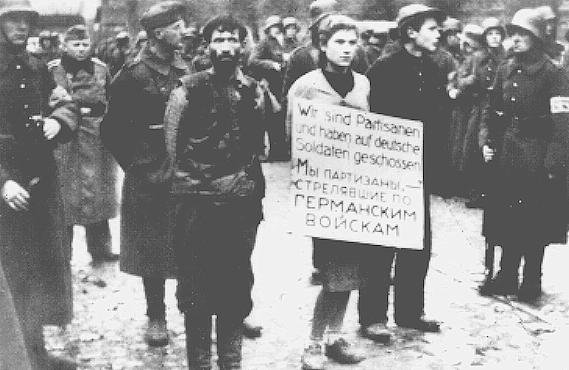
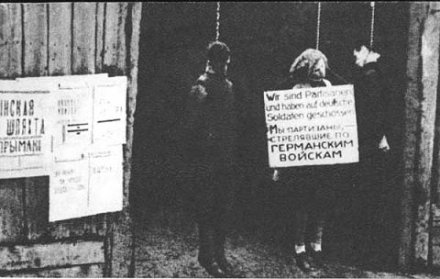
On this date in 1941, the German occupiers of Minsk conducted an infamous public hanging of partisans — perhaps the first such salutary public execution of resistance members of the war.
Jewish* 17-year-old Maria (Masha) Bruskina was the central figure of the grim tableau, and wore the placard announcing “We are partisans and have shot at German soldiers.” Evidently, she also attracted the most attention** from the onlookers to whom the scene was addressed.
Before noon, I saw the armed German and Lithuanian soldiers appear on the street. From over the bridge they escorted three people with their arms tied behind their backs. In the middle there was a girl with a sign-board on her chest. They were led up to the yeast factory gate. I noticed how calmly these people walked. The girl did not look around … The first one led to the gallows was the girl.
She was hanged with bewhiskered World War I vet Kiril Trus and the 16-year-old Volodia Shcherbatsevich. The men were members of a partisan cell organizing anti-fascist resistance; Masha Bruskina was a nurse who had been caught aiding the partisans by providing civilian clothes and papers for wounded Red Army soldiers under her care to smuggle them back to the resistance.
The scene of their deaths was captured in a series of powerful photographs taken by one of the Lithuanian Wehrmacht collaborators.
* Phototextualities: Intersections of Photography and Narrative claims that Bruskina lightened her hair and changed her name to prevent her Jewishness affecting her resistance work; even though she was a Minsk native, her initial identification didn’t happen until 1968. The men who suffered with her were named almost immediately after the war.
** Despite the eye-catching place of the girl, she was officially unidentified for decades even after the name Masha Bruskina surfaced. In “A Historical Injustice: The Case of Masha Bruskina,” (Holocaust Genocide Studies 1997, 11:3) Nechama Tec and Daniel Weiss argued that Soviet authorities, and later Belarusian ones, found her Jewishness problematic and resisted identifying her because of it — while an ethnically Russian female partisan like Zoya Kosmodemyanskaya could be more conveniently accepted as a heroine. Maybe, but bureaucratic inertia and simple precedence (since Zoya Kosmodemyanskaya was known immediately while Masha Bruskina was not) are also plausible contributing factors.
A plaque unveiled at the Minsk yeast factory in 2009 finally called her Maria Bruskina.
On this date in 1415, on the eve of the Battle of Agincourt, the young English King Henry V approved the execution of his onetime boon companion Bardolph in William Shakespeare’s Henry V.
The fictional Bardolph had been the ruddy-nosed friend of Henry’s in the Henry IV plays (Part 1, Part 2), where the hard-drinking, rabble-rousing young prince is a disappointment to the father who fears his heir will never merit the throne.
By Henry V, the boy has become the ruler, and launched an audacious incursion into France during the Hundred Years’ War.
Hal’s willingness to own the rough decisions of statecraft — in this case having his friend put to death further to his win-French-hearts-and-minds policy — is part of his coming of age as Henry V.
Whether that means Hal’s maturation into regal dignity or the corruption of his humanity by power is up to the reader.
KING
How now Fluellen, cam’st thou from the Bridge?
FLUELLEN
I, so please your Maiestie: The Duke of Exeter
ha’s very gallantly maintain’d the Pridge; the French is
gone off, looke you, and there is gallant and most praue
passages: marry, th’ athuersarie was haue possession of
the Pridge, but he is enforced to retyre, and the Duke of
Exeter is Master of the Pridge: I can tell your Maiestie,
the Duke is a praue man
KING
What men haue you lost, Fluellen?
FLUELLEN
The perdition of th’ athuersarie hath beene very
great, reasonnable great: marry for my part, I thinke the
Duke hath lost neuer a man, but one that is like to be executed
for robbing a Church, one Bardolph, if your Maiestie
know the man: his face is all bubukles and whelkes,
and knobs, and flames a fire, and his lippes blowes at his
nose, and it is like a coale of fire, sometimes plew, and
sometimes red, but his nose is executed, and his fire’s
out
KING
Wee would haue all such offendors so cut off:
and we giue expresse charge, that in our Marches through
the Countrey, there be nothing compell’d from the Villages;
nothing taken, but pay’d for: none of the French
vpbrayded or abused in disdainefull Language; for when
Leuitie and Crueltie play for a Kingdome, the gentler
Gamester is the soonest winner.
This is Laurence Olivier’s 1944 version of the scene, with the commoner Bardolph well off-camera:
… and Kenneth Branagh’s more pathos-laden 1989 interpretation, with the king wavering a moment as he locks eyes with his doomed subject, and flashing back to bygone scenes of conviviality before delivering his troop the stern lesson of his friend’s strangling:
Although Bardolph himself and his prior relationship with his sovereign are fiction, the action of the scene actually proceeds from reality. Shakespeare has (as is his wont) cribbed Holinshed, who relates that Henry’s army was under strict orders not to pillage the countryside, and observed that discipline to a man —
except one, which was, that a souldiour tooke a pix out of a church, for which he was apprehended, and the king not once remooved [i.e., he halted] till the box was restored, and the offendor strangled. The people of the countries thereabout, hearing of such zeale in him, to the maintenance of justice, ministered to his armie victuals, and other necessaries, although by open proclamation so to doo they were prohibited.*
* As quoted in the very apt 1992 “Shakespeare’s Henry the Fifth and the Law of War” by Theodor Meron, American Journal of International Law, vol. 86, no. 1.
On this date in 1789, two working stiffs literally became stiffs for a noteworthy bread riot during the French Revolution’s early days.
Ah, 1789.
It was the best of times, it was the worst of times … it was the season of Light, it was the season of Darkness; it was the spring of hope, it was the winter of despair. And we know how all that ends.
Just three months after the Bastille was stormed, France was merely pregnant with its coming Terrors. The Revolution was in its “moderate stage”.
Some moderation.
“Events of the 22nd of October, 1789: The hanging of a man named Francois, a baker”. Despite the title, sources (like this French-language study in the Annales historiques de la Revolution francaise, overwhelmingly date the baker’s murder to the 21st.
The tumbrils may not have been running (actually, the Revolution’s iconic execution device had not yet even been created), but the “October Days” had enough to scare you, especially if you were a sensible constitutionalist type like the Marquis de Lafayette.*
Like a mob dragging the King back to Paris from Versailles, with the heads of his royal guards on pikestaffs.
A drought had created a calamitous bread shortage, which in turn helped stir the Revolutionary pot. The mob that invaded Louis XVI‘s palace a couple of weeks before had celebrated his return to Paris singing “We Have the Baker, the Baker’s Wife, and the Baker’s Son. We Shall Have Bread.” When the king’s presence failed to ease the shortage, fresh disturbances followed.
On October 21, 1789,** the baker Denis Francois became the unfortunate focus of one such, when a famished woman spuriously denounced him a monopolist. A frenzied crowd lynched the hapless boulanger before he could get a word in edgewise.
This event occasioned the Constituent Assembly to pass a martial law decree, permitting a municipality to signal martial law by raising a red flag, whereupon anyone failing to disperse made him- or herself liable to summary military execution.
During the disturbance stirred up against the baker Francois, another one broke out in the Faubourg Saint-Antoine, the object of which was to unite with the Faubourg Saint-Marcel for purposes of reducing the price of bread, and for getting into the convents under the pretext of taking the muskets stored there. The National Guard, in breaking up these seditions, arrested the assassin of the baker [a dock porter named Blin] and the principal instigator of the faubourg [i.e., the Faubourg Saint-Antoine, namely a laborer named Michel Adrien†]. Both were judged and hanged the next day.
* We meet Lafayette here as captain of the National Guard; in a few years, the progress of the Revolution that he struggled to contain and direct will make him persona non grata in his country.
** Six Thousand Years of Bread: Its Holy and Unholy History gives the date as Oct. 20, though it’s not clear upon what authority. Archibald Alison placed it on the 19th. Whenever the murder of Francois occurred, the martial law decree’s passage on the 21st appears to be firmly dependable, which would mean the supposed malefactors’ deaths on this date should be as well.
† Revolutionary propagandist Camille Desmoulins later seized on the very skimpily justified Adrien execution — he “was judged and hanged in twenty-four hours for circulating a seditious flyer, although he didn’t know how to read” — to contrast with the outsized tenderheartedness shown for aristocrats who have “different weights on the scales of justice.” (Revolutionary Justice in Paris: 1789-1790)
On this date in 1865, two Republican generals, four colonels, and various other officers captured earlier in the month were executed on the authority of Mexico’s notorious Bando Negro — the “Black Decree.”
Halfway into his ill-fated three-year reign as “Emperor,” Maximilian I was in a bad way against Mexican president-turned-guerrilla Benito Juarez.
On October 3, 1865, he authorized summary execution for captured Republicans … and for anyone else who ran afoul of a nearby military official without having speedy proof of his or her political bona fides.
All individuals forming a part of armed bands or bodies existing without legal authority, whether or not proclaiming a political pretext, whatever the number of those forming such band, or its organization, character, and denomination, shall be judged militarily by the courts martial. If found guilty, even though only of the fact of belonging to an armed band, they shall be condemned to capital punishment, and the sentence shall be executed within twenty-four hours.*
But more immediately, of course, he signed a lot of other people’s death warrants.
Republican General José María Arteaga Magallanes (Spanish link), a man of famous chivalry (once, recovering the body of the Belgian Foreign Minister’s son, he returned the boy’s watch home to dad), and fellow General Carlos Salazar Ruiz (Spanish again) were the biggest fish; they and the others are honored today as the Martyrs of Uruapan. (Spanish yet again)
The square in Uruapan where this day’s victims were shot … now known as Plaza Mártires.
* The excerpted text is Article I of the Black Decree, whose entire (taken from here) follows:
THE BANDO NEGRO (BLACK DECREE) PROCLAMATION
OF EMPEROR MAXIMILIAN, OCTOBER 3, 1865
MEXICANS: The cause sustained by D. Benito Juarez with so much valor and constancy had already succumbed, not only before the national will, but before the very law invoked by him in support of his claims. To-day this cause, having degenerated into a faction, is abandoned by the fact of the removal of its leaders from the country’s territory.
The national government has long been indulgent, and has lavished its clemency in order that men led astray or ignorant of the true condition of things might still unite with the majority of the nation and return to the path of duty. The desired result has been obtained. Men of honor have rallied around the flag and have accepted the just and liberal principles which guide its policy. Disorder is now only kept up by a few leaders swayed by their unpatriotic passions, by demoralized individuals unable to rise to the height of political principle, and by an unruly soldiery such as ever remains the last and sad vestige of civil wars.
Henceforth the struggle must be between the honorable men of the nation and bands of brigands and evil-doers. The time for indulgence has gone by: it would only encourage the despotism of bands of incendiaries, of thieves, of highwaymen, and of murderers of old men and defenseless women.
The government, strong in its power, will henceforth be inflexible in meting ont punishment when the laws of civilization, humanity, or morality demand it.
Mexico, October 2, 1865.
Maximilian, Emperor Of Mexico : Our Council of Ministers and our Council of State having been heard, we decree:
Article I. All individuals forming a part of armed bands or bodies existing without legal authority, whether or not proclaiming a political pretext, whatever the number of those forming such band, or its organization, character, and denomination, shall be judged militarily by the courts martial. If found guilty, even though only of the fact of belonging to an armed band, they shall be condemned to capital punishment, and the sentence shall be executed within twenty-four hours.
Article II. Those who, forming part of the bands mentioned in the above article, shall have been taken prisoners in combat shall be judged by the officer commanding the force into the power of which they have fallen. It shall become the duty of said officer within the twenty-four hours following to institute an inquest, hearing the accused in his own behalf. Upon this inquest a report shall be drawn and sentence shall be passed. The pain of death shall be pronounced against offenders even if only found guilty of belonging to an armed band. The chief shall have the sentence carried into execution within twenty-four hours,—being careful to secure to the condemned spiritual aid,—after which he will address the report to the Minister of War.
Article III. Sentence of death shall not be imposed upon those who, although forming part of a band, can prove that they were coerced into its ranks, or upon those who, without belonging to a band, are accidentally found there.
Article IV. If from the inquest mentioned in Article II facts should appear calculated to induce the chief to believe that the accused has been enrolled by force, or that, although forming part of the band, he was there accidentally, he shall abstain from pronouncing a sentence, and will consign the prisoner, with the corresponding report, to the court martial, to be judged in accordance with Article I.
Article V. There shall be judged and sentenced under the terms of Article I of the present law:
I. All individuals who voluntarily have procured money or any other succor to guerrilleros.
II. Those who have given them advice, news, or counsel.
III. Those who voluntarily and with knowledge of the position of said guerrilleros have sold them or procured for them arms, horses, ammunition, provisions, or any other materials of war.
Article VI. There shall be judged and sentenced in accordance with Article I:
I. Those who have entertained with guerrilleros relations constituting the fact of connivance.
II. Those who of their own free will and knowingly have given them shelter in their houses or on their estate.
III. Those who have spread orally or in writing false or alarming news calculated to disturb order, or who have made any demonstration against the public peace.
IV. The owners or agents of rural property who have not at once given notice to the nearest authority of the passage of a band upon their estate.
The persons included in the first and second sections of this article shall be liable to an imprisonment of from six months to two years, or from one to three years’ hard labor, according to the gravity of the offense.
Those who, placed in the second category, are connected with the individual concealed by them by ties of relationship, whether as parents, consorts, or brothers, shall not be liable to the penalty above prescribed, but they shall be subject to surveillance by the authorities during such time as may be prescribed by the court martial.
Those included in the third category shall be sentenced to a fine of from twenty-five to one thousand piasters or to one year’s imprisonment, according to the gravity of the offense.
Article VII. When the authorities have not given notice to their immediate superior of the passage of an armed force in their locality, the superior authority shall inflict a fine of from two hundred to two thousand piasters or from three months’ to two years’ imprisonment.
Article VIII. Every inhabitant who, having knowledge of the passage of an armed band in a village or of its approach, has not notified the authorities shall be liable to a fine of from five to five hundred piasters.
Article IX. All inhabitants between the ages of eighteen and fifty-five years of age not physically incapacitated shall, when the locality inhabited by them is threatened by a band, take part in the defense of the place, under penalty of a fine of from five to two hundred piasters or of from fifteen days’ to four months’ imprisonment. If the authorities deem it proper to punish the village for nonresistance, they may impose a fine of from two hundred to two thousand piasters, which shall be payable by all those who have not taken part in the defense.
Article X. The owners or agents of country property who, being able to defend themselves, have not kept guerrillas and other evil-doers away from their estates or have not notified the nearest military authority of their presence, or who have received the tired or wounded horses of the guerrillas without advising the said authority, shall be punished by said authority by a fine of from one hundred to two thousand piasters, according to the gravity of the offense. In cases of extreme gravity they shall be arrested and brought before the court martial, to be judged in conformity with the rules laid down by the present law. The fine shall be paid to the principal administrator of the revenue of the district where the estate is situated. The provisions of the first part of the present article are applicable to the populations.
Article XI. All authorities, whether political, military, or municipal, who have not acted in accordance with the provisions of the present law against those who are suspected of or recognized as being guilty of the offenses with which it deals, shall be liable to a fine of from fifty to one thousand piasters; and when the omission implies acquaintance with the guilty, the delinquent shall be brought before the court martial, who shall judge him and inflict a penalty in proportion to the offense.
Article XTT. Plagiarios [kidnappers] shall be judged and sentenced under the provisions of Article I of the present law, without regard to the circumstances under which the abduction shall have been committed.
Article XIII. Sentence of death passed upon those guilty of the offenses enumerated by the present law shall be executed in the time fixed, and the benefit of appeal for mercy shall be refused to the condemned. When the accused has not been condemned to death, and is a stranger, the government, after he shall have undergone punishment, may make use with regard to him of its right to expel from its territory pernicious strangers.
i Kidnappers. The Minister of Foreign Affairs, intrusted with the Department
Article XIV. Amnesty is proclaimed in favor of all who, having belonged or still belonging to armed bands and having committed no other offense, shall present themselves to the authorities before the 15th of next November. The authorities shall take possession of the arms of those so surrendering themselves.
Akticle XV. The government reserves unto itself the right to fix the time when the provisions of the present law shall cease to be enforced. Each of our ministers is bound, as far as his department is concerned, to enforce the present law and to issue such orders as will secure its strict observance.


 Lesurques was taken for the one of a gang who had sensationally robbed and murdered a mail courier early in 1796, and on the basis of


 So who is Robert Hubert?