1672: Thomas Rood, the only incest execution in America

On this date in 1672, Thomas Rood (or Rhood, or Roode, or even Rude) achieved in Norwich, Conn., the distinction of being the only person executed in the future United States of America for incest.

The native of Glastonbury, England got in a bad way for, in the words of the indictment,

not haveing the feare of God before thine eyes thou hast committed that abominable sin of incest haveing carnall copulation with Sarah Rhood thy reputed daughter for which according to the law of God & the law of this colony thou deservest to dye …

Actually, the laws of the colony said nothing about incest, requiring the Hartford Court of Assistants to ask around the local clergy whether this sort of thing should be a hanging offense.

Hey, what do you think they’re going to say? Antonin Scalia would call this originalism.

Thomas Rhood thou art to goe from here to the place from whence thou camest & in due time to be carryed from thence to the place of execution & there to be hanged by the neck till thou art dead & then cut down & buried.

Of course, it takes two to make the beast with two backs; daughter/lover Sarah was in some fear for her neck as well, until the court took

notice of a great appearance of force layd up upon her spirit by her father overaweing & Tiranical abuse of his parentall authority besides his bodily striveings which not onely at first brought her into the snare but allso in after yeilding to his Temptation.

Having seemingly found her to be a rape victim, the court extended leniency.

[T]he sentence of the court is that shee be severly whipt on the naked body once at Hartford & once at Norwich that others may heare & fear & do no more such abominable wickednesse.

17th century texts from this pdf on a site selling an 820-page genealogy of the Rood lineage in America … to which the randy old man contributed to the tune of at least nine children.

On this day..

1896: Rainandriamampandry and Prince Ratsimamanga

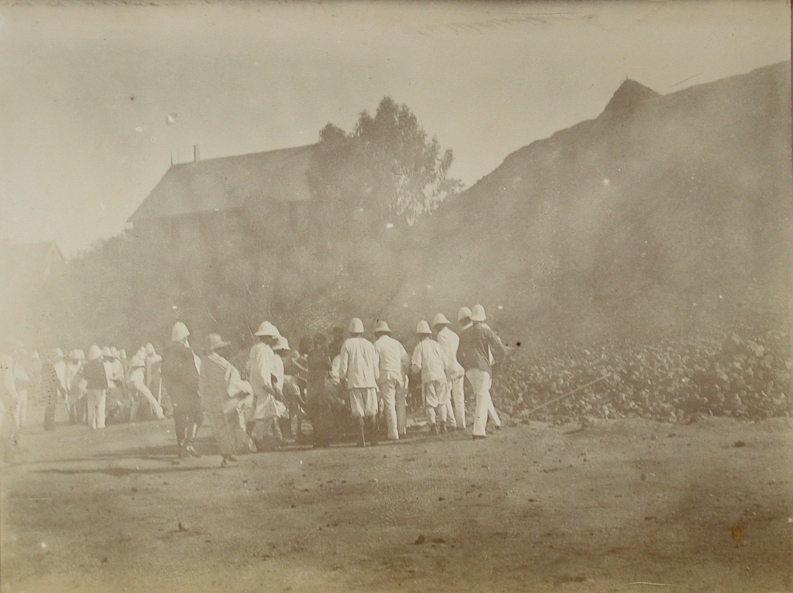
On this date in 1896, two Malagasy movers and shakers were shot to help cement French colonial control of Madagascar.

Interior Minister Rainandriamampandry

Having conquered the island militarily by 1895, France immediately faced indigenous resistance.

According to Stephen Ellis*

One of the most puzzling and fascinating of all resistance movements is that known as the revolt of the menalamba. It occurred over a wide area of central Madagascar, mostly in the kingdom of Imerina, in the two years following the French invasion of Madagascar in 1895. The most mysterious aspect of the rising has always been the question of who, if anyone, was its leader. The official version, that reported by the French government in Madagascar, was that the movement was inspired or directed by a number of magnates at the old Merina court. The published evidence is so ambiguous as to have obliged every subsequent author to accept this version, although there was considerable doubt expressed as to its truth at that time.

Managing this drumhead tribunal was just-arrived “Resident-General” Joseph Simon Gallieni, who seems to have alit (fresh from an assignment in Indochina) with the certain conviction that examples must be made.

While more wholesale bloodletting was deployed in the field, Gallieni selected some suitably high-profile exemplars from the supine state’s ruling elite — “Ratsimamanga, a nobleman who had been unpopular for many years because of his financial extortions,” says Ellis, and “Rainandriamampandry because … he had no close political friends and might therefore be considered dispensable.”

The convenient loss of the tribunal paperwork, which renders evaluation impossible and colonial motivation suspect, hardly would have been well beside the point. As one periodical in Paris (where Gallieni’s pacification project received enthusiastic greeting) approvingly put it,

As a lesson to the rebels, two great figures who had sided with them, Prince Ratsimamanga and Minister of the Interior Rainandriamampandry have both been tried, convicted and shot, all with such rapidity as to inspire their accomplices to salutary reflections.

Below: Selected photographs of the execution from the University of Southern California Digital Library. Click for larger images.

An aside: Madagascar was also the scene of intensely sectarian competition in the soul-saving business, resulting in an execution-day travesty reported in An Empire Divided: Religion, Republicanism, and the Making of French Colonialism, 1880-1914:

Gallieni gave permission to both the cure of the Antananarivo cathedral and a local French pastor to be with [Rainandriamampandry] during his last hours. But … the two started quarreling almost at once. Gallieni was deeply disturbed by the image of two religious men fighting during “the final minutes of a condemned man.”

* “The Political Elite of Imerina and the Revolt of the Menalamba. The Creation of a Colonial Myth in Madagascar, 1895-1898,” The Journal of African History, vol. 21, no. 2 (1980).

On this day..

1789: Rachel Wall, female pirate

(Thanks to Jonathan Shipley of A Writer’s Desk for the guest post. -ed.)

“Into the hands of the Almighty God I commit my soul, relying on his mercy … and die an unworthy member of the Presbyterian Church, in the 29th year of my age.”

These were the last words of Rachel Wall, on this date in 1789. It was she, whom the Presbyterians must have frowned upon mightily, who was the last woman hanged in Massachusetts and, further, the first noted American-born female pirate.

No walking the plank for her. She was hanged, proven guilty of robbery, by Sheriff Joe Robinson on a beautiful fall day. Her downfall after a brief career with her husband of piracy, thievery and murder? A pretty bonnet.

Rachel, around the age of 16, loved the water. The boats and dockyards always spoke to her. Born on a farm outside of Carlisle, Pennsylvania, it bored her; so, while in Harrisburg, she went to the docks. She was harassed, harangued and attacked by a group of girls. Enter George Wall –- a fisherman and former privateer who served in the Revolutionary War. He saved Rachel from the girls and Rachel, against her devout Presbyterian parents, eloped with him.

They went to Boston where she stayed on as a servant girl while George plundered. He convinced her to join him and his cohorts in piracy. It proved successful, for a time.

Their plan was this: anchor near an island during a storm. When it passed, make their boat appear damaged. When another boat came, Rachel would shout for help. Help would come. They’d then murder the would-be rescuers, steal their valuables, and sink their ship. Those awaiting the unfortunate sailors would think simply that the storm had taken them away, not Mr. and Mrs. Wall. Between 1781 and 1782 they captured 12 boats, murdered 24 sailors and kept around $6,000 in booty for themselves.

Another Brick in the Wall

This plan worked quite well, until September of 1782 when one storm proved too powerful. George Wall and his motley crew drowned. The only survivor was Rachel. She returned to Boston and in the remaining years of her life she became a maid, a petty thief, and possibly a prostitute, stealing from johns as they slept.

Then, the bonnet incident.

One day Margaret Bender, a 17-year-old Bostonian, was minding her own business, walking down the street, a pretty bonnet affixed to her head. Wall, seeing said bonnet, pushed Bender down, stole the bonnet and then tried to rip out the girl’s tongue. Wall ran from the police when they were summoned. She was caught, put in jail and tried on September 10, 1789 for robbery (she copped to her piratical career, but claimed she had never killed anyone). Less than a month later, she hung from the gallows.

Part of the Themed Set: Women Who Kill.

On this day..

2007: Five women in Hoiryeong Public Stadium

On this date in 2007, according to the Daily NK, five women were publicly tried, then immediately shot, in Hoiryeong Public Stadium in North Korea’s North Hamkyung province.

Their crime, “prostitution”, is supposed to be a euphemism for aiding refugees escaping to China in the area that also generated an infamous execution film broadcast on Japanese television in 2005. (And other death sentences earlier in 2007. North Korea is not enthusiastic about escapees.)

As usual with the insular state, details are hard to come by. The North Korean Human Rights Infringement Center claimed Pyongyang carried out 901 public executions in 2007; that figure would potentially make it the world’s #2 (after China) death penalty user, though Amnesty International doesn’t even venture a tally of North Korean executions.

On this day..

1536: William Tyndale, English Bible translator

“Lord, open the King of England’s eyes!” cried William Tyndale at the stake this date in 1536 … just before he was strangled and burned.

“Translated the Bible into English,” reads Tyndale‘s epigraph; in the Protestant blossoming, this Herculean academic labor was also of itself a dangerous religious and political manifesto.

As with Martin Luther’s translation of the Bible into German, Tyndale’s English version threatened, and was intended to threaten, papal ecclesiastical authority. In undertaking the work, Tyndale defied the 1408 “Constitutions of Oxford”, an English clerical pact further to the suppression of the Lollards and kindred post-John Wycliffe heresies which expressly prohibited rendering scripture in the vernacular.

In Protestant hagiographer John Foxe‘s Book of Martyrs, a young Tyndale exasperated with a Romish divine memorably declared,

“I defy the pope, and all his laws;” and added, “If God spared him life, ere many years he would cause a boy that driveth the plough to know more of the Scripture than he did.”

Tyndale would give his life to, and for, that ploughboy.

On the lam in Protestant Germany, Tyndale produced an English New Testament, and then an Old Testament, of startling poetry.

The scholar also kept a reformist voice in the day’s robust theological pamphleteering — trading fire, for instance, with Sir Thomas More.

Even when the once-staunch Catholic Henry VIII broke with Rome over Anne Boleyn, the English manhunt for Tyndale continued: Henry’s reformation did not share radical Protestant objectives like scriptural authority, and the king was not shy about enforcing his version of orthodoxy.

Tyndale was equally stubborn in defense of his life’s mission to put a Bible in the hands of the English ploughboy. Offered the king’s mercy to return and submit, Tyndale countered by offering his silence and martyrdom if Henry would but publish the Good Book in English.

I assure you, if it would stand with the King’s most gracious pleasure to grant only a bare text of the Scripture to be put forth among his people, like as is put forth among the subjects of the emperor in these parts, and of other Christian princes, be it of the translation of what person soever shall please his Majesty, I shall immediately make faithful promise never to write more, not abide two days in these parts after the same: but immediately to repair unto his realm, and there most humbly submit myself at the feet of his royal majesty, offering my body to suffer what pain or torture, yea, what death his grace will, so this [translation] be obtained. Until that time, I will abide the asperity of all chances, whatsoever shall come, and endure my life in as many pains as it is able to bear and suffer.

Luckily for posterity, the English crown wasn’t biting, leaving Tyndale’s mellifluous rendering of Holy Writ to enter the English tongue.

And leaving Tyndale, eventually, to enter the martyrs’ ranks.

In 1536, an English bounty hunter befriended the fugitive translator and betrayed him to the authorities in Vilvoorde, near Brussels. It was the Catholic Church and the Holy Roman Empire that did the dirty work of their rivals in the Isles.

And — the Lord works in the mysterious ways, they say — Tyndale’s dying prayer was indeed answered.

By the end of the decade, a Bible in English drawn from Tyndale’s version (revised by former Tyndale assistant Myles Coverdale under Thomas Cromwell‘s direction; prefaced by Thomas Cranmer) was by regal authority placed in every parish of the Church of England.

The Tyndale Bible became the basis for the King James Bible that remains for many authoritative to this day … and Tyndale’s work lodged in the textual DNA of the evolving English Bible(s) in the five centuries since his death. (The wonderful site The King’s English deals with the linguistic legacy of the King James Version; many of the examples in fact trace back to Tyndale.)

Works by and about William Tyndale

Audiophiles should consider this podcast from a Protestant perspective, located here.

[audio:http://www.bethanybaptist.co.uk/mp3/2008-05-09-pm-Brian-Edwards.mp3]

On this day..

1283: Dafydd ap Gruffydd, Prince of Wales

(Thanks to Jonathan Shipley of A Writer’s Desk for the guest post. -ed.)

Do not cross King Edward I.

If you cross “Longshanks,” as the regal man was called, you’re in for some serious pain. And then, eventually, you’ll die, like Dafydd ap Gruffydd did this day in 1283.

It is Dafydd, a Prince of Wales, who became the first prominent person in recorded history to have been hanged, drawn and quartered.

Yes, Dafydd’s death was particularly gruesome. Having fought alongside King Edward against Dafydd’s own brother and then returning to his brother’s side attacking King Edward’s Englishmen at Hawarden Castle, made the king rather peeved.

The English conquest of Wales: end of an era.

When Longshanks got the better of him, Dafydd was dragged through the streets of Shrewsbury attached to a horse’s tail. He was then hanged, but not enough to kill him, just enough to make it awfully uncomfortable.

More uncomfortable was the emasculation.

Perhaps more uncomfortable than being emasculated was when Dafydd was disemboweled and his entrails burned before his eyes.

Then they cut off his head, which must have been a relief.

Then they cut off his limbs.

Then they parboiled his head for later viewing.

(William Wallace met the same fate from the same king a couple of decades later.)

It wasn’t always so gruesome for Dafydd ap Gruffydd, the well-to-do Welshman. Things were going quite well there for a time -– as good as a bloody power struggle with your brother can be. Prince of Gwynedd, son of Gruffudd ap Llywelyn, grandson of the mightly Llweyln the Great, Dafydd ap Gruffydd was born in 1238 under the English King Henry III. In his teens, that wily rebel, Dafydd joined one brother (Owain Goch ap Gruffydd) to challenge another brother (Llywelyn ap Gruffydd) for power. Llwelyn won at the Battle of Bryn Derwin. In 1263 Dafydd tried again, joining King Henry against his brother. In 1274 he tried once again. This time with the new king, “Longshanks.”

Things were great. Dafydd was favored by the king. He married Lady Elizabeth Ferrers, daughter of the 5th Earl of Derby. He enjoyed a manor in Norfolk, before exchanging it for another in Northampton. Indeed, it was high society living for the Welshman.

But Wales wanted independence from England. In the spring of 1282 Dafydd, with his brother (the one he tried to defeat many times before, Llywelyn) attacked an English castle. Foolish. Compelled to help his brother yet not being prepared for all-out war, Dafydd crossed the king and the king, angered, pursued him with a vengeance. Troops marched out. Fortifications (Caernarfon Castle, Conwy Castle, Harlech Castle, etc.) were thrown up to squash any thoughts of any further Welsh rebellion, and seed the future Welsh tourist industry.

Come December of 1282, Llywelyn, Dafydd’s dear brother, was lured into a trap and killed. Dafydd became prince, for a brief and stressful span, what the pursuit of the Enligh army, and a king behind it all still fuming over being backstabbed by a Welshman.

Whenever the English caught up with him, he escaped. In April he went north to Dolbadarn Castle. In May he moved to Garth Celyn. Then to a bog. It was by Bera Mountain, in said bog, that Dafydd and his younger brother Owain were captured on June 22, 1284. Dafydd’s wife was taken prisoner, as were their seven daughters, and one niece. About a week later Edward proclaimed the last of the ‘treacherous lineage’ were now his. Dafydd’s fate was then discussed by parliament.

He was condemned to death, the first person known to have been tried and executed for what, from that time onwards, would be described as high treason against the King. And treasonous blokes don’t get off very easily when it comes to a peaceful execution. No, his entrails were burned before him for “his sacrilege in committing his crimes in the week of Christ’s passion.” His body was chopped up “for plotting the king’s death.” A gentlemen by the name of Geoffrey carried out the execution of the last native Prince of Wales. His payment? 20 shillings.

On this day..

1788: William “Deacon” Brodie, Dr. Jekyll and Mr. Hyde inspiration

On this date in 1788, the real-life Dr. Jekyll and Mr. Hyde was hanged at Edinburgh.


The Execution of Deacon Brodie, by Alexander Hay Ritchie.

William Brodie, respectable burgher by day, Deacon of the Guild of Wrights, wasn’t the type for the gallows. Actually, the upright citizen is said to have proposed an improvement in the old Tolbooth gallows, replacing the old-school ladders with a forward-thinking drop mechanism.

“Brodie,” says Traditions of Edinburgh, “was the first who proved the excellence of [the] improvement … He inspected the thing with a professional air, and seemed to view the result of his ingenuity with a smile of satisfaction.”*

Insouciance in the face of mortality … but Brodie had plenty of practice in compartmentalization.

With a gambling habit, a couple of mistresses, and five kids, Brodie the oleaginous society man had a double life, or treble, or more. By and by, the well-known tendency of such profligate pastimes to lead a man to venture his neck in order to keep up appearances worked its will upon Brodie, who began using his contracts with Edinburgh’s upper crust to case their houses and copy their keys … returning at night to burgle his employers.

It was taking on partners that did in the budding master thief; inevitably, someone flipped to dodge the gallows himself. Brodie’s cover was blown, and he hanged with his confederate George Smith, keeping up appearances to the very end.

A century later, native Edinburgher Robert Louis Stevenson would tap this extraordinary local history (and maybe some similar predecessors) as inspiration for that classic novelistic exploration of the soul’s duality, The Strange Case of Dr. Jekyll and Mr. Hyde.

In fact, prior to that work’s 1886 publication, Stevenson (who grew up with Brodie furniture in the house) co-wrote a play called Deacon Brodie, or The Double Life.

That earlier composition hasn’t been entrusted to celluloid, to my knowledge (though there is a Deacon Brodie film of recent vintage). But Jekyll and Hyde has been.

Brodie’s striking case does not live on only through his literary doppleganger(s); you can enjoy the company of the hanged criminal to this day on Edinburgh’s Royal Mile at Deacon Brodie’s Tavern.

Brodie himself is supposed to have made his own bid to live on by surviving the hanging. William Roughead in Classic Crimes describes these machinations whose generally attested failure is now and again disputed anew.

Of the plans, various and futile, formed for the resuscitation of the Deacon there are two contemporary and competing versions. One is that the hangman was bribed to tamper with the rope, so as to give a short fall and avoid dislocation of the vertebrae. But by an excess of caution that officer first made it too short and then too long. The body, when cut down, was placed in a cart and driven furiously round the back of the Castle to the Deacon’s woodyard at the foot of Brodie’s Close, so that animation might be restored as in the historic case of “half-hangit Maggie Dickson,” a lady whose departed spirit was recalled by similar Jehu methods. In his own workshop his veins were opened by a French surgeon, whose services had been retained to that end; but all the resources of science could not bring the Deacon back to life. According to another account, he had, before leaving his cell for the last time, been supplied with a small silver tube for insertion in his throat at the final ceremony in order to prevent suffocation, and wires were carried down both his sides from head to foot to counteract the jerk of the fall. In spite of these precautions and of subsequent bleeding by a surgeon, his friends had reluctantly to admit that “Brodie was fairly gone.”

* This “tradition” of Edinburgh is kin to a folkloric subgenre and should not at all be presumed dependable. Roughead:

Of the many picturesque legends of old Edinburgh which, in defiance of truth, cling like ivy about her vanished past, one of the most persistent is that Deacon Brodie was the first to suffer upon the new drop which he himself designed. This myth, upon research, I found myself reluctantly compelled to disprove. He may have planned the “moveable platform for the execution of criminals,” which the Town Council caused to be erected in 1786 at the west end of the Tolbooth; but it was certainly not of his construction, nor was he the first to benefit by its ingenuity. The place of execution was the roof of a low building which projected from the west gable of the prison — roughly where the Buccleuch statue now stands. A beam was drawn out from an aperture in the wall above the platform and from this depended the fatal rope.

On this day..

1630: John Billington, signer of the Mayflower Compact

On this date in 1630, Massachusetts’ Plymouth Colony held its first hanging — of a guy who’d come over on the Mayflower.

In this unfinished epic poem of the American experience by Stephen Vincent Benet, Billington is mourned at the foot of his gallows as “a man who came with the first and should have thriven.”

John Billington‘s John Hancock is on the Mayflower Compact, but he and his progeny had an ill reputation from the start.

Billington’s son almost torched the Mayflower while the pilgrims were still living in it; the old man himself achieved the distinction of “the first offence since our arrival … for his contempt of the captain’s lawful command with opprobrious speeches, for which he is adjudged to have his neck and heels tied together; but upon humbling himself and craving pardon, and it being the first offence, he is forgiven.”

(It wasn’t all bad. Another Billington kid gave the family name to an inland pond. (pdf))

Billington was condemned for shooting a neighbor.

This year John Billington the elder, one that came over with the first, was arraigned, and both by grand and petty jury found guilty of wilful murder, by plain and notorious evidence. And was for the same accordingly executed. This, as it was the first execution amongst them, so was it a matter of great sadness unto them. They used all due means about his trial and took the advice of Mr. Winthrop and other the ablest gentlemen in Bay of the Massachusetts, that were then newly come over, who concurred with them that he ought to die, and the land to be purged from blood. He and some of his had been often punished for miscarriages before, being one of the profanest families amongst them ; they came from London, and I know not by what friends shuffled into their company. His fact was that he waylaid a young man, one John Newcomen, about a former quarrel and shot him with a gun, whereof he died.
-Plymouth Gov. William Bradford (Source)

Billington is supposed to be a distant ancestor to American President James Garfield.

On this day..

1898: The Six Gentlemen of the Hundred Days’ Reform

This afternoon in 1898, six liberals got the chop for their hopeless attempt to give a tottering empire the reforms it desperately needed.

The Hundred Days’ Reform — actually 103 days, from June 11 to September 21 — marked the attempt by China’s Guangxu Emperor to implement a far-reaching modernization programme backed by forward-thinking officials with a mind to correct China’s supine position vis-a-vis the West, and even vis-a-vis its neighbors.

“Reform has never come about in any country without the flow of blood. No one in China in modern times has sacrificed himself for the cause of reform, and because of this China is still a poor and backward country. Therefore, I request that the sacrifices begin with myself.” –Tan Sitong

The Wuxu Constitutional Reform still stands as the great attempt made by Chinese progressives who tried to follow the example of the modern powers in order to save China from extinction. Represented by Kang Youwei and Liang Qichao, the bourgeois reformists were imbued with the spirit of national salvation; they carefully set about designing a blueprint for a constitutional monarchy based on the example of Western countries. They advocated the establishment of parliament and a national conference, and wanted to see honest and fair-minded people with the courage to criticize authority installed in a position of power. National policies should be discussed by the monarch and the people. They also wanted a constitution to stipulate the rights and obligations of the monarch, officials, and the people. The constitution was to be the highest code for all people in the country. They also wanted to establish a system featuring a tripartite balance of forces: parliament was to legislate, the magistracy to deal with issues of justice, the government with administration. All of these would be under the monarch.

The constitutional reform was to take place with radical intellectuals submitting their memoranda to Emperor Guang Xu, who alone had the power to promulgate them. The feudal diehards being in a position of strength and the national bourgeoisie being weak, however, the new politics survived no more than 100 days or so. When the forces of reaction inevitably clamped down on the movement, the six reformists who had inspired the movement for constitutional reform met their deaths like heroes.

Although sincere in its aspirations, the reform movement was bound to fail, as it depended on a reform “from top to bottom”, which ultimately had to be enacted by the emperor. The Hundred Days’ Constitutional Reform, however, remains a landmark event in the modern history of China, its failure notwithstanding. The Chinese bourgeoisie in fact succeeded in spreading democratic and constitutionalist ideas widely, and this had a significant effect on future generations. The political and legal theory of the Western bourgeoisie could now take root in the soil of China.*

The emperor’s Machiavellian conservative aunt, the Empress Dowager Cixi, who had been the power behind the Chinese throne since 1861, made the sure reform didn’t see two hundred days with a “coup” that didn’t formally overthrow the Emperor — just made him irrelevant.

Troublemakers further down the food chain didn’t get off so easily.

Kang Youwei, the reform movement’s chief exponent, escaped to Japan. Six others suffered the wrath of the Dowager Empress: Kang Guangren (Kang Youwei’s brother), Lin Xu, Yang Shenxiu, Yang Rui and Liu Guangdi … along with the young reformer Tan Sitong, who notably refused imprecations to flee arrest.

The sword’s blade across my neck,
I look toward heaven — laughing.
-Etched on a prison wall, allegedly by Tan Sitong


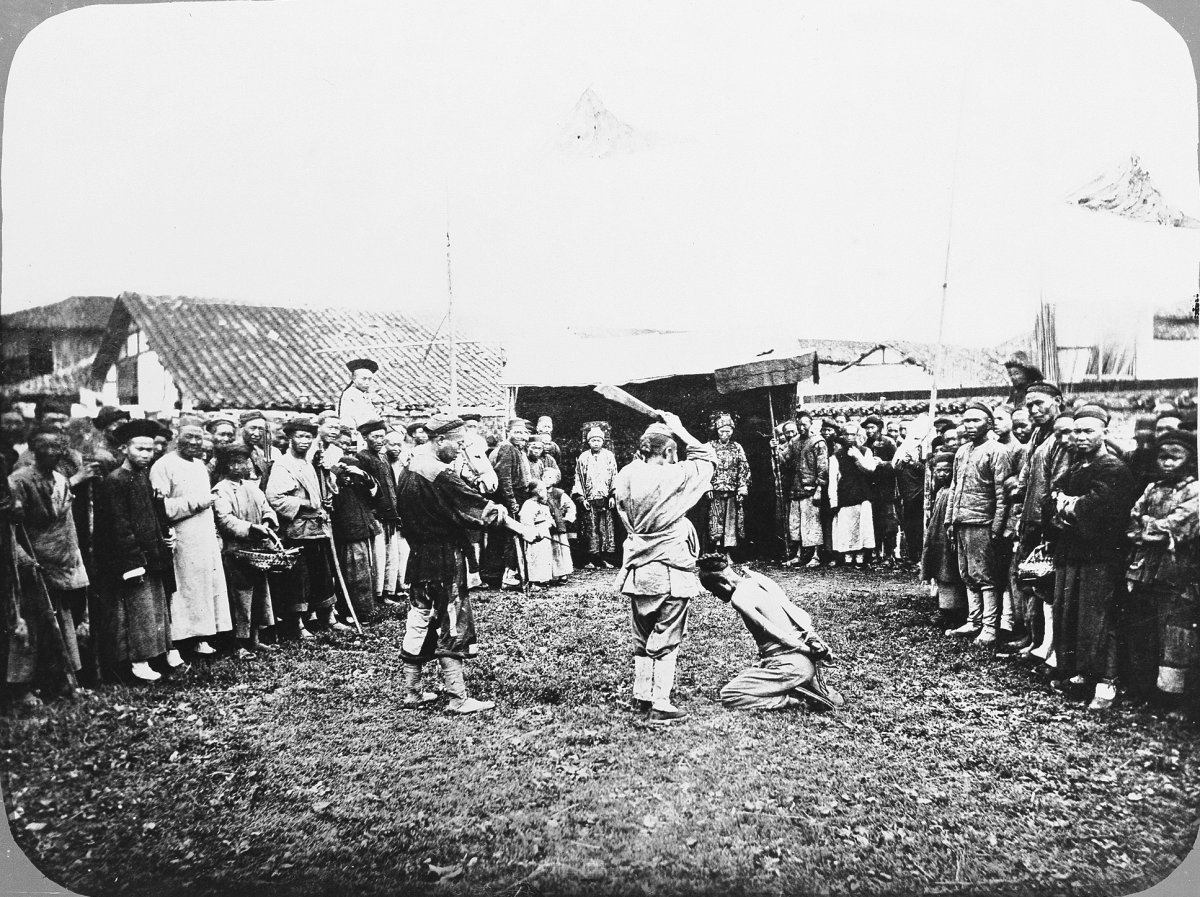
Photo of an unspecified 1867 Qing beheading in Canton.

* “The Chinese Legal Tradition and the European View of the Rule of Law” by Wu Shu-Chen in The Rule of Law History, Theory and Criticism, Part VI.

On this day..

1996: Dr. Mohammad Najibullah

On this date in 1996, the man who once ruled ruled Afghanistan under the aegis of a superpower succumbed to the tender mercies of his country’s fundamentalist insurgency.

Mohammad Najibullah was the last president of the Soviet-backed Democratic Republic of Afghanistan. Unfortunately for Najibullah, he was on the job when Moscow decided to throw in the towel on the Soviet-Afghan War.

After losing the subsequent civil war, the former President was trapped for a nervous few years in Kabul — blocked from joining his family in flight to India by the offices of former Soviet client and present-day American client Abdul Rashid Dostum.

When Kabul finally surrendered to the Taliban in 1996, the hated onetime Communist viceroy — whose stepping-stone to that post was heading the hated Afghan secret police — had a problem.

At the instigation of future Taliban second-in-command Mohammad Rabbani, Najibullah and his brother were hauled out of the U.N. compound where they had taken refuge, publicly beaten, tortured and castrated, and strung up on a traffic barricade.

There was a new sheriff in town.


On this day..