1740: Not William Duell

On this date in 1740, five criminals were hanged at Tyburn.

Sixteen-year-old William Duell was among them. He was hanged — but he did not die. As recounted in The Newgate Calendar:

WILLIAM DUELL was convicted of occasioning the death of Sarah Griffin, at Acton, by robbing and ill-treating her. Having suffered, 24th of November, 1740, at Tyburn, with Thomas Clock, William Meers, Margery Stanton and Eleanor Munoman (who had been convicted of several burglaries and felonies), his body was brought to Surgeons’ Hall to be anatomised; but after it was stripped and laid on the board, and one of the servants was washing it, in order to be cut, he perceived life in him, and found his breath to come quicker and quicker, on which a surgeon took some ounces of blood from him; in two hours he was able to sit up in his chair, and in the evening was again committed to Newgate, and his sentence, which might be again inflicted, was changed to transportation.

Failed hangings were not unheard-of at this time … and if transportation was no mean sentence, the young criminal must have reflected that matters certainly could have gone much worse for him.

On this day..

1799: Judith van Dorth

On this date in 1799, Judith van Dorth was shot on the outskirts of Winterswijk for supporting an attempted restoration of the House of Orange to the Dutch throne against the Batavian Republic.

Although the Netherlands had been a Republic for two centuries, it was torn by revolutionary conflict from the mid-1780’s — predating the French Revolution, but finally coming to power in 1795 when its neighbor’s mass conscript armies drove William V of Orange to England.

The 52-year-old van Dorth, an impoverished noble of Orangist sympathies, recklessly tried to raise an internal revolt [linked page in Dutch] backing an English-Russian invasion to restore William in 1799.

The uprising came to nothing, and after the invasion — a footnote in the sweep of Revolutionary Wars — was repelled, van Dorth was condemned for treason by a military tribunal to set an example. [linked page in Dutch]

She was shot within 24 hours near Winterswijk’s Jewish cemetery, and apparently survived the barrage. One of the firing squad had to shoot again when he saw her move — legend has it that this occurred when she had already been packed into her coffin.

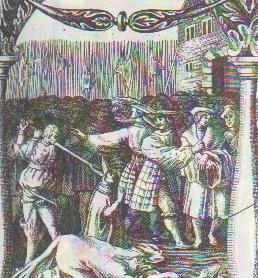
She remains the only woman in history executed by a Dutch military court. A biography of her life is available in Dutch.

The House of Orange, one of the most successful of European dynasties, regained power in the Netherlands following the Napoleonic Wars. William V’s great-great-great-great-granddaughter Queen Beatrix reigns there today.

On this day..

1577: Soulmother of Kussnacht

On an uncertain date in November of 1577, a popular medium whose given name is lost to history was burned to death in a lakeside town for claiming to speak with the dead.

The Soulmother of Kussnacht ran a successful enterprise channeling spirits for those who survived them. Though her persecution by a Church ill-disposed to “wise women” seems a given in retrospect, she evidently ran this business openly for well over a decade, and was at least once before brought to the attention of authorities who found her harmless.


Kussnacht as seen in an old postcard. Image reproduced with permission.

Historian Carlo Ginzburg locates Die Seelenmutter within the cosmos of pre-Christian “shamanism” that persisted in Christendom under varying degrees of toleration. In Ginzburg’s Night Battles: Witchcraft and Agrarian Cults in the Sixteenth and Seventeenth Century, which chronicles the Inquisition’s crackdown on a sect of northern Italian occultists, the contemporaneous execution of the Soulmother is both barometer and precedent for Rome’s rising intolerance of heresy.

On this day..

1720: Captain John “Calico Jack” Rackham

On this date in 1720Nov. 18, 1720, the pirate captain “Calico Jack” Rackham was hanged together with his crew by the British governor of Jamaica.

Nicknamed for his flamboyant clothing, the Bristol-born buccaneer plundered the West Indies during the “Golden Age of Piracy”, having ousted his former captain Charles Vane. Rackham is chiefly remembered to history for two who were not hanged with the rest of his crew: Anne Bonny and Mary Read, rare female pirates who served aboard Rackham’s ship.

Immortalized by Daniel Defoe in his pseudonymous A General History of the Pyrates, Bonny and Read came to piracy by different paths but were both every bit the part and leaders aboard their ship — “very profligate, cursing, and swearing much, and very ready and willing to do any Thing on board.” Bonny, at least, was Rackham’s lover — having eloped with him from her husband.

Upon capture, both women “pleaded their bellies” to escape the gallows, and though it’s unclear whether either really was pregnant, it seems the gambit spared both from execution.

Read died in prison shortly after, while Bonny vanished from history — prompting speculation that she had escaped, secured a pardon, been ransomed by her wealthy father, and/or returned again to piracy under a different guise. Reportedly, she castigated Rackham at their last meeting in prison for lying drunk below decks while only the women resisted the capture of their ship: “I am sorry to see you here Jack, but if you had fought like a man, you need not be hanged like a dog.”

As the world’s best-known women pirates, Bonny and Read are recalled as anything from sexualized historical curios to action heroines to proto-feminists.

They feature in Disneyland’s “Pirates of the Caribbean” ride, the Witchblade comic book series, utopian theorizing, popular history … and the occasional action figure.

Update: A much more detailed foray into the lives of these daring women is at Scandalous Women.

Also, I posted this under the wrong date: it should be Nov. 18. Balls.

On this day..

1491: Eight current and converted Jews at an auto de fe

On this date in 1491, the murder of the Holy Child of La Guardia was punished with an auto de fe and the public execution of eight Jews — some practicing, some converted to Christianity (who enjoyed the mercy of strangulation before being burnt) — and three others already dead but exhumed for the occasion.

The auto de fe — literally, “act of faith” — was a public ritual of religious penance for the condemned. Though its performance did not always precede the execution of its participants, it became closely associated with the savagery of the Spanish Inquisition.

In the hysteria of the Holy Child of La Guardia case — one of history’s better-remembered instances of “blood libel” implicating Jews in the ritual murder of Christian children — the result was foreordained.

Knitting together (inconsistent) confessions obtained under torture, the famed Inquisitor Torquemada proved a conspiracy of Jews had kidnapped and crucified a child further to the concoction of a magic potion that depended on the heart of an innocent Christian — despite a fruitless high-and-low search for some missing child who might have been the actual victim.

After this day’s gaudy public slaughter, a cult sprang up around the supposed martyr, adored in a chapel erected where one of the prisoners had once had a home — the very spot, it was said, where the Jews conspired. The Holy Child was a staple of Spanish literature down to the 20th century and is still venerated in La Guardia.

But Torquemada aimed for results well beyond Christendom’s martyrology, and the wretches at the stake would not be this day’s only victims.

John Edward Longhurst argues in The Age of Torquemada that the Inquisitor seized on the Holy Child case to orchestrate “his heart’s desire — the expulsion of all Jews from Spain.”*

Early the next year, the Spanish monarchy obliged, permanently remaking Spain:

If Ferdinand and Isabella were hesitating over expelling the Jews from Spain, the discovery of this latest Jewish plot would surely resolve all doubts. The Auto de Fe of November, 1491, exploited the affair to its fullest, emphasizing not only all the gruesome details of the Murder but the Jewish menace to Christians intended by it. The sentence against the Jew Juce Franco, read aloud to the great crowd at the Auto de Fe, identifies him as a seducer of Christians to the Law of Moses in language that clearly foreshadows the Edict of Expulsion four months later

…

We may be sure that Ferdinand and Isabella were treated to a lengthy account of this case. It also is clear, from their own observations in the Edict of Expulsion, that Torquemada impressed on them the determination of the Jews to persist in their efforts to seduce Christians to Judaism. As long as they were permitted to remain, the danger of infection would never be eliminated, no matter how harsh the measures employed against them.

* Or, their forcible conversion … which would then keep the Inquisition in business for years to come.

On this day..

1226: Frederick of Isenberg

On this date in 1226, Count — although he had been stripped of this title — Frederick of Isenberg, a German noble, was broken on the wheel for the murder of his cousin, the Archbishop of Cologne.

The proximate cause of the dispute between the two was said to have been Frederick‘s exploitation for his own benefit of an abbey he administered, to which the Archbishop, Engelbert of Berg, took exception. Underlying the conflict are the the outlines of power politics in fractious medieval Germany.

Engelbert was an aggressive and effective Archbishop, and the power he won for his diocese came at the expense of other claimants. Frederick was not likely the only noble menaced by the inroads of the vigorous bishop. One theory has it that, despite the 47 wounds found on the cleric’s body, the ambush Frederick laid for him aimed only to capture him as a hostage — a not unheard-of negotiating strategem of the period.

No matter Frederick’s intent, what he achieved was excommunication and the loss of all lands, title and wealth — including his castle, razed by the Archbishop’s successor. A year after the murder Frederick was captured returning from Rome, where he had sought to have his excommunication lifted. He suffered one of the more excrutiating forms of execution, his shattered body lingering alive overnight displayed atop a stone pillar.

Engelbert, who in life had been no stranger to worldly politics and himself had been excommunicated in his youth for backing an anti-papal power, was incorporated into the Catholic Church’s martyrology for his death in defense of the abbey and (though never formally canonized) has sometimes been venerated as a saint.

On this day..

1755: Rowley Hanson

On this date in 1755, a young soldier named Rowley Hanson was hanged at Tyburn.

Though the hanging, like many of its era, was for a trifling theft, the account of the Newgate ordinary (chaplain) did not dwell overmuch on the watch he stole from a London barrister.

What wrought his ruin was, the company he fell into, when a drummer [in the army]; and shocking delusion from the most abandoned, and unnatural crew of wretches, that ever the world knew, called Sodomites, first led him into that damnable violation of all laws, natural, civil, and religious.

…

all he had besides his pay arose from the advantages which he received from those worse than brutes, whom St. Paul has complimented with the name of men, who leaving the natural use of the woman, burned in their lust one towards another; men with men working that which is unseemly, and receiving in themselves that recompense of their error which was meet.

…

This unfortunate youth, who laid open the way to these short observations, declared himself much more affected with sorrow, for that he had been among so vile a set of wretches, than that he was to suffer death for the robbery … He thanked God, who had thus afflicted him, and given him time to repent; and generally when we conversed he wept very bitterly.

On this day..

1831: Nat Turner

On this date in 1831, the slave Nat — remembered to history as Nat Turner after the surname of his original owner — was hanged, flayed and dismembered for leading the most notorious slave rebellion in antebellum America.

A deeply religious man known to other slaves as “The Prophet”, Nat followed what he took to be divine directive to launch a bloody uprising on the night of August 21-22 in Southampton County, Virginia. Using (at first) axes, knives and clubs to avoid attracting attention to gunfire, Nat’s band slaughtered whites from house to house, freeing slaves as they went. At least 55 whites were killed, and a like number of slaves by white militias that mobilized to put down the revolt … and then hundreds more slaves as far away as North Carolina suspected of some tangential involvement or simmering disloyalty.

The uprising was suppressed within two days, but it rooted so deeply in the conscience of the South that it persists to this day.

“I have not slept without anxiety in three months. Our nights are sometimes spent listening to noises.”
-Slaveowner after the rebellion

Nat Turner embodied slaveowners’ terror of the subject population living about them, outnumbering them, resentfully supporting Southern gentility at the end of a whip — the conundrum Jefferson had described barely a decade before as “we have the wolf by the ear, and we can neither hold him, nor safely let him go.” Arguably, the revolt hardened southern whites against moderating slavery; some legislatures tightened restrictions against teaching slaves to read, thinking that literate slaves like Nat were more liable to uprisings.

Conversely, he was a powerful martyr of resistance in the slave quarters, a symbol of scores of other lesser-known uprisings and of the countless more that lurked in dreams and fantasies, awaiting some spark of outrage, some sudden opportunity, some wild carelessness of death.

He was a figure of literature even before his death — The Confessions of Nat Turner, dictated to a white interrogator, left Nat’s own riveting testimony from the shadow of the gallows; the Virginia-born white novelist William Styron used the same title for a controversial 1967 historical novel which earned a Pulitzer but drew a critical rebuttal from many black writers. (Nat Turner also stalks the memory of Styron’s semi-autobiographical narrator in Sophie’s Choice.) More recently, Nat has received graphic novel treatment.

Historians of every stripe, meanwhile, have struggled over the meaning of the man’s deeds and — especially — his paradoxical legacy as symbol.

Update: The occasion received a tribute in Alabama about the time this post went up.

On this day..

1520: Stockholm Bloodbath

On this date in 1520, four days after the Danish King Christian II gained the Swedish throne, nearly 100 prominent supporters of Swedish independence were executed en masse as a civil war’s apparent victors purged their enemies.

The Stockholm Bloodbath followed years of conflict between supporters of the Danish-dominated Kalmar Union and independence advocates under the banner of Sten Sture the Younger. With Sture’s death in battle earlier in 1520, the unionists had gained the upper hand. Stockholm, the last outpost of resistance, had held against four months’ siege before accepting a general amnesty in exchange for capitulation.

But with the city in hand, Christian — known to Swedish history as “Christian the Tyrant” — had its leaders charged for having deposed during the conflict the pro-union Archbishop Gustav Trolle, construed as an offense against the Church not in the temporal authority’s power to reprieve. Less than 24 hours after this legal maneuver was sprung, public beheadings of prelates, merchants and burgomasters were underway at Stortorget* — and Sture’s remains were exhumed and posthumously burnt at the stake.

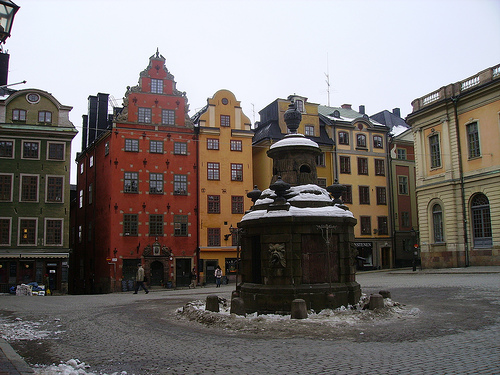
Stortorget

It proved a Pyrrhic victory for the Danish party.

Inside of three years, Christian himself had been deposed with multiple lands and factions throughout his realm in open revolt. Gustav Vasa, whose father had been one of the Stockholm Bloodbath’s victims, would not only decisively break Denmark’s hold on Sweden but found the Vasa Dynasty under which Sweden would burgeon into one of Europe’s great powers.

*One Hans Brask survived the purge despite having endorsed the removal of Archbishop Trolle. Brask supposedly placed a note under his seal on this document saying “To this I am forced and compelled.” This cunning device gave the Swedish tongue the word Brasklapp — a secret reservation.

On this day..

1783: John Austin

On this date in 1783, highwayman John Austin was hanged at Tyburn for robbing and murdering John Spicer on the road to London.

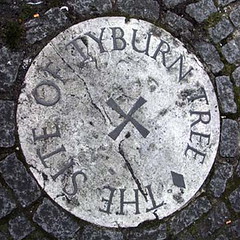
The village Tyburn on the outskirts of London had been used for public hangings dating to the 12th century. Though not the only site of executions in London, it was the iconic one. Situated at the modern intersection of Edgware and Bayswater Roads on the northeast corner of Hyde Park, the distinctive “Tyburn tree” — a triangular gallows capable of hanging over twenty prisoners simultaneously — made a foreboding landmark round which teemed thousands of spectators on execution days. Some 1,200 people were executed on this singular device.

Public executions typically began four kilometers away at Newgate Prison, where the condemned were loaded into ox carts for a two-to-three-hour procession through public streets now at the very core of London, perhaps including stops at public ale houses.


View Larger Map

While Tyburn carved its niche during England’s age of religious bloodletting, its social role had changed significantly by the 18th century. Most of the doomed were offenders against property, often executed for stealing negligible sums or else reprieved for transport to the New World or, later, Australia. Peter Linebaugh’s The London Hanged intriguingly suggests that hangings of this era were an assertion of nascent capitalism, violently throwing off the remains of feudal labor relations. (Summarized more thoroughly in this friendly review.)

Even that formative age was receding. Once a neighboring village, Tyburn had been swallowed up by the city; a generation before Austin’s death, residents of the now-upscale neighborhood had successfully pushed for the removal of the macabre “Tyburn tree”.

Austin was hanged, instead, on a portable gallows, a typical penitent imploring heavenly mercy and taking 10 minutes to strangle to death — the very last execution at that somber and storied crossroads.

Here’s the story of the Tyburn hangings from London writer Peter Ackroyd:

On this day..