1739: Penelope Kenny and Sarah Simpson

On this date in 1739, Penelope Kenny and Sarah Simpson were publicly hanged in colonial New Hampshire for “feloniously concealing the death of a[n] … infant bastard child.”

The first people — male or female — executed in New Hampshire history had separately disposed in August 1739 of their respective newborns. Unluckily for them, some never-discovered third woman did the same thing around the same time much less adroitly … and her dead infant was found in a well.

The ensuing investigation uncovered (in one case by the forcible ministrations of a midwife team) the recent pregnancies of this day’s victims, and though Simpson claimed her child was miscarried, she still fell under a law making a capital crime of covering up the death of a baby.

Today, Executed Today interviews New Hampshire historian Christopher Benedetto, whose research situates Kenny and Simpson in the context of their times:

In provincial New Hampshire, as was common across colonial America, the punishment of fornication and bastardy was harsh, and the stigma that followed could cost a working class woman her livelihood. When Penelope Kenny and Sarah Simpson gave birth in August 1739, they both knew that the physical product of their sexual improprieties must be concealed. It was an awful decision to have to make, but in their minds “infanticide might have seemed a matter of survival.” The discarding of illegitimate children, however, seems to have been an issue in New Hampshire long before 1739. In 1714, the General Assembly passed “An Act to Prevent the Destroying and Murdering of Bastard Children,” which declared

Whereas many lewd women that have been delivered of Bastard children, to avoid shame and escape punishment, do secretly bury or conceal the death of their children…Be it therefore enacted…that if any woman be delivered of any Issue of her body, male or female, which if it were born alive should by law be a Bastard; and that she endeavor privately either by drowning or secret burying thereof…so to conceal the death thereof that it may not come to light, whether it were born alive or not but be concealed. In every such case the Mother soe offending shall suffer Death…except such Mother cann make proof by one witness at least, the Child whose death was by her so intended to be concealed was born dead.

Executed Today: The first hanging in New Hampshire didn’t happen until 1739?!

Christopher Benedetto: There were plenty of capital laws and there definitely were cases where people were tried for their lives, but why it took so long … they had crossed some sort of a boundary. I’m sure the loss of so many children only a few years before [in a diphtheria epidemic] made these crimes that much more shocking.

ET: You’re working on a book on crime in New Hampshire.*

CB: The criminal history of Massachusetts has been studied for so long, but there’s really nothing like this for New Hampshire at all. And there’s so much there. There’s a whole chapter in the book on infanticide and child murder.

ET: What’s the perspective you get working deeply in a local milieu?

CB: I think having grown up here, my own family I’ve been able to trace back to the 1650’s in Massachusetts … it’s always been a big part of my life.

I like being able to go to different sites where these things actually happened. I think that’s true for any historian — you’re drawn to the specific places. The town I grew up in, Ipswich, they have plaques of people who lived there. Anne Bradstreet‘s house is still there.

I could walk on a lot of the streets or at least go to some of the places where these things took place.

But to me, history is about people. It’s about passions. To me, these people are so much like us today. Human nature has not changed a lot over the years.

ET: Does that lead to any conclusions on the death penalty in general?

CB: It’s one of the few things that’s as controversial now as it was two, three hundred years ago. I don’t think capital punishment prevents crime. I do think there are certain instances where the crime is so heinous, so bad — I don’t know, I’m sort of in the middle on it. I think we should reserve the right to do it, but does it improve our society at all?

ET: What advice would you have for a young person about being a historian? What’s the historical method for you?

CB: I would say, just be curious. You’ve got to be relentless. You’ve got to go after what you’re passionate about — nobody wants to do research about something they’re just not interested in.

To me, I love writing, but I think one of the most thrilling parts can be when you’re sort of on the hunt. I kind of see being a historian — and not just professionally; anyone who’s researching a family history — you’re almost like a quilter. You’re taking all these little pieces of fabric and just trying to create a whole picture. That might be my favorite part, taking all those pieces of information and just putting them together.

It’s not that nobody had ever written about that execution [of Kenny and Simpson] before, but maybe nobody had taken all that information and just kind of put it together in that way. You’re not always going to have something 100% new to say, but you might present it in a way that casts a new light or makes somebody think about it differently.

* Tentatively titled Gruesome Stories from the Granite State with an anticipated release in 2009 through regional press Commonwealth Editions.

Part of the Themed Set: The Spectacle of Public Hanging in America.

On this day..

1862: 38 Sioux

On this date in 1862, 38 rebellious Sioux were hanged in Mankato, Minnesota, in the largest mass execution in U.S. history.

Fully 303 had been condemned to die in drumhead trials after the five-week Dakota War, one of the numerous native conflicts sparked by the march of European settlers across North America.

Abraham Lincoln — in a political risk — commuted all but 39 sentences* adjudged “to have participated in massacres, as distinguished from participation in battles,” essentially defining a special category for what today might be considered “war crimes.”

Lincoln had more pressing business on his hands, to be sure, but seems to have been affected by the plight of the natives that drove them to wage hopeless war on encroaching settlers:

“[Bishop Henry Whipple] came here the other day and talked with me about the rascality of this Indian business until I felt it down to my boots. If we get through this war, and I live, this Indian system shall be reformed!”

Fateful “if” — but politicians say many things, after all, and it was long before Lincoln went to Ford’s Theater that the tribes had been forced out of Minnesota, scattered to wasteland reservations and subsequent clashes with the American army.

On this day, all that doleful future was prefigured in the 38 who hanged together in what is now Mankato’s Reconciliation Park, an event that after a century’s time has become a moment for commemoration.

Two academics’ pages on the Dakota War and its aftermath are here and here.

*One of those was subsequently spared over uncertainty of the evidence against him.

Part of the Themed Set: The Spectacle of Public Hanging in America.

On this day..

1684: Baillie of Jerviswood

On this date in 1684, the Scottish patriot Baillie of Jerviswood was convicted of treason and immediately executed, for his part in the Rye House Plot against the Stuart King Charles II.

Baillie was a lesser player in the Protestant scheme — whose nature and extent, or even existence, are matters of historical debate — supposedly to do away with the Catholic-leaning ruler and his outright catechumen brother and heir James. Baillie was implicated under torture, and while disowning any part of a conspiracy declined — “with striking truthfulness” — to deny a design on Scottish rebellion.

His summary hanging would enter the pantheon of English depravities in the north country, but he achieved another sort of immortality as well.

During an earlier stint in prison, a proscribed fellow patriot’s 12-year-old daughter had smuggled him messages — becoming acquainted with Baillie’s own son, whom she would eventually wed. The girl gained fame in adulthood as Lady Grizel (or Grisel, or Griselle) Baillie.

“Werena my Heart’s licht I wad dee”
-Lady Baillie

THERE ance was a may, and she lo’ed na men;
She biggit her bonnie bow’r doun in yon glen;
But now she cries, Dool and a well-a-day!
Come doun the green gait and come here away!

When bonnie young Johnnie cam owre the sea,
He said he saw naething sae lovely as me;
He hecht me baith rings and mony braw things—
And werena my heart’s licht, I wad dee.

…

The legendary tableau of intrigue between Baillie and his future daughter-in-law was itself fruit for literature, given time enough to ripen into legend. Kinswoman Joanna Baillie, one of the great litterateurs of the early 19th century, made use of the episode to open a lengthy ballad to Lady Grizel in Metrical Legends of Exalted Characters:

I.
Within a prison’s hateful cell,
Where, from the lofty window fell,
Thro’ grated bars, the sloping beam,
Defin’d, but faint, on couch of stone,
There sat a pris’ner sad and lone,
Like the dim tenant of a dismal dream.
Deep in the shade, by low-arch’d door,
With iron nails thick studded o’er,
Whose threshold black is cross’d by those
Who here their earthly being close,
Or issue to the light again
A scaffold with their blood to stain,–
Moved something softly. Wistful ears
Are quick of sense, and from his book
The pris’ner rais’d his eyes with eager look,–
“Is it a real form that thro’ the gloom appears?”

II
It was indeed of flesh and blood,
The form that quickly by him stood;
Of stature low, of figure light,
In motion like some happy sprite;
Yet meaning eyes and varying cheek,
Now red, now pale, seem’d to bespeak
Of riper years the cares and feeling
Which with a gentle heart were dealing.
“Such sense in eyes so simply mild!
“Is it a woman or a child?
“Who art thou, damsel sweet? are not mine eyes beguiled?”

III
“No; from the Redbraes’ tower I come;
“My father is Sir Patrick Hume;
“And he has sent me for thy good,
“His dearly honour’d Jerviswood.
“Long have I round these walls been straying,
“As if with other children playing;
“Long near the gate have kept my watch
“The sentry’s changing-time to catch.
“With stealthy steps I gain’d the shade
“By the close-winding staircase made,
“And when the surly turnkey enter’d,
“But little dreaming in his mind
“Who follow’d him so close behind,
“Into this darken’d cell, with beating heart, I ventured.”

IV
Then from the simple vest that braced
Her gentle breast, a letter traced
With well-known characters, she took,
And with an eager, joyful look,
Her eyes up to his visage cast,
His changing countenance to scan,
As o’er the lines his keen glance past.
She saw a faint glow tinge the sicky wan;
She saw his eyes thro’ tear-drops raise
To heaven their look of silent praise,
And hope’s fresh touch undoing lines of care
Which stress of evil times had deeply graven there.
Meanwhile, the joy of sympathy to trace
Upon her innocent and lovely face
Had to the sternest, darkest sceptic given
Some love of human kind, some faith in righteous Heaven.

V
What blessings on her youthful head
Were by the grateful patriot shed,
(For such he was, good and devoted,
And had at risk of life promoted
His country’s freedom and her faith,
Nor reck’ning made of worldly skathe)
How warm, confiding, and sincere,
He gave to her attentive ear
The answer which her cautious sire
Did to his secret note require;–
How after this with ‘quiries kind,
He ask’d for all she left behind
In Redbraes’ tower, her native dwelling,
And set her artless tongue a-telling,
Which urchin dear had tallest grown,
And which the greatest learning shown,
Of lesson, sermon, psalm, and note,
And Sabbath questions learnt by rote,
And merry tricks and gambols play’d
By ev’ning fire, and forfeits paid,–
I will not here rehears, nor will I say,
How, on that bless’d and long-remember’d day,
The pris’ner’s son, deserving such a sire,
First saw the tiny maid, and did admire,
That one so young and wise and good and fair
Should be an earthly thing that breath’d this nether air.

…

On this day..

1559: Anne du Bourg

On this date in 1559, Protestant parliamentarian Anne du Bourg was publicly strung up and burned for his uncompromising defense of Calvinism.

All France burned, figuratively, with the Protestant Reformation — and literally, with Henri II‘s ruthless reaction against it. But that flame tempered and honed the Huguenots’ steel.

With the dissolute crowned head before him to attend a seating of Parlement considering the matter of the heretics’ suppression, Anne du Bourg delivered himself of a rebuke of “more courage than prudence” (Batiffol and Bodley):

While men are conducted to the stake for the sole crime of praying for their prince, a shameful license encourages and multiplies blasphemies, perjuries, debaucheries, and adulteries. (Martyn)

Incensed, the king had du Bourg and others of the “moderate” party arrested in Parlement and drug to the dungeon. And though his compatriots were satisfied to recant what imperiled them, du Bourg remained obdurate and even provocative, smuggling a pamphlet against the monarch out of prison.

Henri would not make good his vow to see du Bourg burnt, having been slain by a freak jousting accident. But it little availed du Bourg inasmuch as Henri’s untimely demise put the Catholic faction even more firmly in the saddle. The agitation of Protestants for du Bourg’s release went for naught, and the sharp-tongued minister of state had occasion to speak to posterity from the scaffold. “My friends, I am not here as a thief or a martyr, but for the evangelium.”

“His one speech did more harm to the Catholic Church than a hundred ministers could have done.”
-Eyewitness Florimond de Roemond, quoted in The Cambridge Modern History

The religious conflict that made an end of du Bourg soon exploded into civil war. Many more, like du Bourg, would find their triumph in death — until, after three bloody decades, a Protestant prince accepted triumph in apostasy by deciding that “Paris is worth a Mass.”

On this day..

1849: Not Fyodor Dostoyevsky

“Brother, I am not dejected or crestfallen. Life, life is everywhere, life is in us ourselves, not outside. Near me will be people, and to be a person among persons and stay him forever, to not be cast down or despondent no matter what the misfortunes are – therein lies life, therein lies its purpose. I realized that. This idea entered my flesh and blood. Yes! It’s true! The head that created and got accustomed to the higher demands of the spirit, that head is cut off from my shoulders. What’s left are the memories and images created and not reified by me. They will ulcerate me, indeed! What I have left is my heart and the same flesh and blood, which can love, suffer, pity, and remember, and this is life, after all …” (quote — in Russian; the translation is mine)

The square — now named Pionerskaya Ploschad’ — where Dostoyevsky faced a mock execution. Image used with permission.

This slightly rambling epistle is authored by a titan of the world literature, a schizophrenic, a gambler, a true believer, a sufferer, a humanitarian, an epileptic, a Russian, a philosopher, a St. Petersburger, the Writer. Let us forgive him a certain incongruity of thought, since that letter was his first salute to a newly acquired chance to live.

On this date in 1849, Dostoevsky, along with some 20 other condemned, was brought out to St. Petersburg’s Semyonovsky platz. They were meant to be shot for affiliation with the Petrashevsky circle, a group of idealistic young intellectuals, apologists of Fourier and fervent advocates of socialism. Just like the generation of aristocrats (alas, some of them will be featured on this macabre blog) before them and generations of intelligentsia (whose destiny is equally unenviable) after them, Petrashevtsy gathered at Petersburg’s flats, read articles and concerned themselves with the fate of the permanently-rising-from-the-knees Motherland.

The formal charges brought upon Dostoevsky were quite bizarre: he listened to a story that criticized the army; had in his possession an illegal printing press; read an open letter to the circle from Belinsky to Gogol which excoriated the church and government; and participated in a regicide plot. The latter accusation Fyodor Mikhailovich vehemently denied, for indeed he was not a bloodthirsty revolutionary, but a proponent of the peaceful Christ’s teaching (this affliction with Christian philosophy was incidentally somewhat of a mauvais ton among the predominantly atheistic circle).

It always seemed to me that Dostoevsky’s participation in the Petrashevky circle was a tribute to the epoch’s fad. It was the imperfections of human nature, not the peculiarities of a hypothetical social structure, that concerned him greatly. The world’s wrongdoings result from something rotten in a man’s soul, and once those internal blemishes are erased, the external harmony emerges. “Beauty will save the world”, a cliché instilled in every Russian by a literature teacher in 10th grade, a phrase attributed to Christ-like kniaz’ Myshkin, and one of Dostoevsky’s most important statements: inner beauty is vital, the rest is a consequence.

The military court condemned Dostoevsky to death. The general-auditor amended this decision and recommended a lighter punishment: “… deprive of all fortune and send to hard labor in fortresses for eight years”. The final resolution of Nicholas I reduced the sentence to four years, “and then [relegate] to [the rank of] private … declare clemency only at the moment when everything is ready for execution”.

“Life is a gift, life is happiness, every minute could be a century of happiness …” continued Dostoevsky his letter. In three days, he received a prisoner’s dress, a fur coat, and valenki. He was put in shackles and dispatched to Siberia …

Novels and Short Stories by Dostoyevsky

On this day..

1594: Alison Balfour

On this date in 1594, Alison Balfour was burned as a witch on the strength of a confession extracted under the hideous torture of her family.

Balfour had been implicated in a plot — probably entirely fictitious — to poison the tyrannical young Earl of Orkney, with some misshapen blob of wax appearing as evidence of her communion with the infernal.

She was tortured, but she denied the charges.

Her 81-year-old husband was tortured in front of her, but she denied the charges.

Her son’s feet were crushed in front of her, but she denied the charges.

When at last her seven-year-old daughter was put to thumbscrews in front of her, she broke down and “confessed.”

Before her execution, she renounced her confession in heartbreaking words to be read in the original records:

sche … declarit and tuik upoun hir saull and conscience, as sche wald ansuer att the day of judgement … that sche wes als innocent and wald die als innocent on ony point of Wichcraft as ane barne new borne … the tyme of hir first Depositioun sche wes tortourit diverse and severall tymes in the Caschielawis, and sindrie tymis takin out of thame deid,* … as lykewyis hir guidman being in the stokis, hir sone tortourit in the Buitis, and hir dochtir put in the Pilliewinkis, quhairwith sche and thay wer swa vexit and tormentit, that pairtlie to eschew ane gretar torment and pwneischement, and upoun promeis of hir lyffe, and guid deid be the said Personne, falslie, aganis hir saull and conscience, sche maid that Confessioun, and na uthirwyis.

Just two years later, another supposed perpetrator of this same plot was acquitted in Edinburgh — the evidence of Balfour’s case thrown out as unreliably obtained under torture.

* “taken out of them dead” — i.e., unconscious

On this day..

1793: Sydney Carton posing as Charles Darnay

On an unspecified date in December 1793 is set one of literature’s immortal execution scenes, when ne’er-do-well Sydney Carton heroically goes to the guillotine in the place of his aristocratic doppleganger Charles Darnay at the climax of A Tale of Two Cities.

In Charles Dickens‘ classic 1859 novel of the French Revolution, Darnay, the good-hearted scion of the cruel Evremonde line, falls prey to the Revolutionary Terror.

The dissolute, tormented Carton is the respectable Darnay’s literary dark twin, whose appearance he also happens to strikingly resemble. Driven by an unrequited love for Darnay’s wife, who stands in danger not only of losing her husband but of following him to the scaffold, Carton contrives to switch places with the doomed noble.

While those saved by his sacrifice flee for England, Carton goes to the guillotine in a batch of 52 condemned prisoners,* one of them a sweet and frightened girl he comforts tenderly.

His prophetic thoughts as he awaits the blade form the conclusion of the novel, and the last sentence ranks among literature’s most recognizable lines.

“I see that I hold a sanctuary in their hearts, and in the hearts of their descendants, generations hence. I see her, an old woman, weeping for me on the anniversary of this day. I see her and her husband, their course done, lying side by side in their last earthly bed, and I know that each was not more honoured and held sacred in the other’s soul, than I was in the souls of both.

“I see that child who lay upon her bosom and who bore my name, a man winning his way up in that path of life which once was mine. I see him winning it so well, that my name is made illustrious there by the light of his. I see the blots I threw upon it, faded away. I see him, fore-most of just judges and honoured men, bringing a boy of my name, with a forehead that I know and golden hair, to this place — then fair to look upon, with not a trace of this day’s disfigurement — and I hear him tell the child my story, with a tender and a faltering voice.

“It is a far, far better thing that I do, than I have ever done; it is a far, far better rest that I go to than I have ever known.”

A Tale of Two Cities is one of thousands of public-domain books available for free at Project Gutenberg. Stanford’s “Discovering Dickens” community reading project guide annotates the novel here.

* Never one for understatement, Dickens crowds his mass execution tableau with far too many extras. “The Terror” is usually dated from September 1793 through July 1794, but only during its bloodiest last two months would so many as 52 have been guillotined together; at the time of Carton’s execution, half as many would have constituted a large group.

On this day..

1596: Francisca Nunez de Carvajal, her children, and four other crypto-Jews of her family

On this date in 1596, the Inquisition sent nine Jewish converts to Christianity to the stake in Mexico City for Judaizing — a cruel fate offering a window into a secret history of New World settlement.

When Spain expelled its Jews (and subsequently its Muslims), those who did not flee had to convert. Conversions at swordpoint being of suspect sincerity, the Inquisition spent much of the following centuries hunting Conversos — so-called “New Christians” — who secretly preserved their outlawed faiths.

For some crypto-Jews, the New World held an appeal akin to that which would draw later generations of northern Europe’s religious minorities.

Latin America in particular attracted considerable numbers of New Christians. The advantage of these territories was that they offered the New Christians a familiar culture and the possiblity of direct — even if infrequent — contact with the mother countries … These factors also helped permit [crypto-Jews] to practice Judaism.

The Carvajals (or Carabajals) were just such a family, settling in Monterrey under the aegis of their kinsman, Spanish governor Luis de Carvajal y Cueva.

But in 1590, the governor’s sister Francisa was tortured by the Inquisition into implicating her entire family in Judaism.

They got off with a humiliating public recantation, but evidence of a relapse a few years later resulted in Francisca being burned at the stake at an auto de fe — along with her children Isabel, Catalina, Leonor and Luis, and four of their in-laws. The 30-year-old Luis left a testimonial to his faith and his tortures.

A headstone in New Mexico, USA, suggests crypto-Jewish descent. Image used with permission.

Despite the grisly doings of this day, however, the Inquisition never could extirpate Jews from its American territory.

These hidden communities filtered into Mexico and north to the present-day United States, keeping adapted versions of Jewish traditions secretly alive.

Still, crypto-Jews produced scant potentially self-incriminating documentary evidence. Although DNA testing has latterly entered the scene, the true extent and nature of these populations has been the subject of lively scholarly controversy.

But the Carvajals and others like them, seemingly lost to the Inquisition’s depredations, are coming alive again. This day’s executions are the subject of a modern opera and a spring 2008 Texas A&M symposium.

And the wider community of crypto-Jews have their own umbrella organization and a burgeoning body of historical literature.

Books about crypto-Jews

On this day..

1581: Edmund Campion, Ralph Sherwin and Alexander Briant

On this date in 1581, three English Catholic martyrs were hanged, drawn and quartered at Tyburn, casualties of the bloody confrontation between religious and secular power of the English Reformation.

Edmund Campion — later sainted — was the towering figure among them and the great attraction for those that thronged the Tyburn scaffold on a rain-drenched Friday.

A brilliant Oxford scholar once tipped as a possible future Archibishop of Canterbury, Campion abjured his Anglican holy orders in favor of Rome — a mortal peril in Elizabethan England.

He slipped away to Ireland, then to the continent and safety. But at age 40, after nearly a decade abroad, the missionary zeal of the converted called him back to Albion as part of a secret Jesuit mission. Hunted from the day he set foot back in Britain, he survived a year on the run, an underground minister to an illicit faith.

Though priestly investiture alone technically made him capitally liable, a government with millions of Catholic citizens grappled for some firmer ground upon which to condemn the renowned intellectual. Since Campion succumbed neither to torture nor to blandishments, nor to the surreal interludes when he was hauled out of his dungeon and made to debate with the Crown’s theologians, he was finally convicted on the strength of made-to-order witness testimony to the effect that his mission had some vague upshot of undermining Queen Elizabeth’s hold on her subjects.

In effect, it was very much like convicting him for his faith: the Anglican-Catholic conflict had crystallized, and dozens of priests would follow the route of Campion in the years to come. Between a mutually implacable state and church, either flesh or soul must burn.

Not a few of those who trod the martyr’s path would take inspiration from the beatific Jesuit — as young Henry Walpole, whose own route to Calvary is said to have begun when he was spattered by Campion’s blood this day and come full circle to his own execution 15 years later. Walpole’s embrace of martyrdom fairly glows from his proscribed tribute to Campion:

Hys fare was hard, yet mylde & sweete his cheere,
his pryson close, yet free & loose his mynde,
his torture great, yet small or none his feare,
his offers lardge, yet nothing coulde him blynde.
O constant man, oh mynde, oh vyrtue straunge,
whome want, nor woe, nor feare, nor hope coulde chaunge.

…

Yee thought perhapps, when learned Campion dyes,
his pen must cease, his sugred townge be still.
But yow forget how lowd his deathe yt cryes,
how farre beyond the sownd of tounge or quill.
yow did not know how rare and great a good
yt was to write those precious guiftes in bloode.

That famous eloquence was Campion’s legacy, so overwhelmingly so that he presents in the lineup of men who might have written Shakespeare.

His best-know work was “Campion’s Brag”, the scornful nickname his foes gave to an apologia he produced while underground in England … and to whose steady words Edmund Campion proved true this day:

[B]e it known to you that we have made a league — all the Jesuits in the world, whose succession and multitude must overreach all the practices of England — cheerfully to carry the cross you shall lay upon us, and never to despair your recovery [to Catholicism], while we have a man left to enjoy your Tyburn, or to be racked with your torments, or consumed with your prisons. The expense is reckoned, the enterprise is begun; it is of God, it cannot be withstood. So the Faith was planted: so it must be restored.

But Protestant England did withstand the enterprise. The generation to come saw Catholic ideas and writing put to withering siege, Campion’s not least among them. For all the tribute of history to the man of Christlike fortitude, it is by no means apparent that the enjoyments of Tyburn and the kindred “practices of England” did not, after all, lay a cross heavier than English Catholics could bear.

On this day..

1941: Zoya Kosmodemyanskaya

On this date in 1941, Soviet partisan Zoya Kosmodemyanskaya was hanged by the Wehrmacht for sabotaging buildings behind German lines near Moscow.

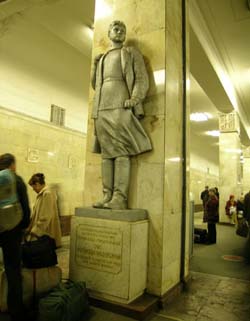
A statue of Zoya Kosmodemyanskaya stands vigil over Moscow’s World War II-era Partizanskaya metro station. Image used with permission.

One of the most famous Soviet war heroines and the first woman decorated as Hero of the Soviet Union during World War II, the 18-year-old had quit school to volunteer for a partisan unit only a few weeks before her hanging as Russia mobilized against Hitler’s race towards Moscow.

Known simply as “Tanya”, the nom de guerre which was the only information she volunteered during two days of torture, the power of the press offered her apotheosis into a propaganda coup for the Kremlin, and a symbol of courage that would long outlive Stalin. Before the public execution, the Nazis paused to photograph the scene; Kosmodemyanskaya availed the lull to harangue the Germans — “you can’t hang all 190 million of us!” — and call on the Russian villagers present to resist occupation.

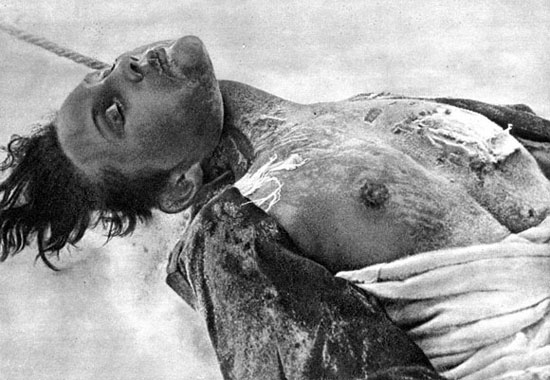
Her bayoneted, mutilated body hung on the gibbet until the Red Army recaptured the village; witnesses related the tale of her dying heroism to a newsman.

It was only after the story of “Tanya” hit the press in January 1942 that her identity was established … and then promulgated widely. Anonymous and obscure in death, Zoya Kosmodemyanskaya would inspire millions and become the heroic emblem of other women partisans.


Soviet propaganda poster unabashedly modeled on the already-iconic image of Zoya Kosmodemyanskaya’s abused corpse.

Zoya, a 1944 Soviet film, was scored by Dmitri Shostakovich.

Part of the Themed Set: Women Against Fascism.

On this day..