1793: Louis XVI

On this date in 1793, citizen Louis Capet — King Louis XVI, before the French Revolution — heard a morning mass, then took a closed carriage with his confessor two hours through the city to the Place de la Révolution, where the guillotine struck off his head.

Among the august company of executed monarchs, none command more historical portent in the West than Louis XVI. He overawes the confines of a blog post, less due to any merit of his own — for its conspicuous want during his kingship had seen him to this day’s straits — than for his baggage of symbolism.


Louis XVI’s head displayed to the crowd. In the right background stands a pedestal that, until the Revolution, upheld an equestrian statue of the beheaded man’s father grandfather, Louis XV.

The French Revolution rates, arguably, as little less than the forge of modernity: this day’s stroke, the Revolution’s signature event, could be said with melodrama but not injustice to have separated the era we still inhabit from that of the ancien regime as surely as it separated a head from its shoulders.

How did it come to happen? Let us turn our focus a few days back, when the question of the king’s fate was put to the newly formed National Convention.

Among the least of the Bourbon legacies is a legend holding it was by a single vote the king was condemned, an object lesson in the reputed power of the ballot.

It would be a great story … if it were true.

But it’s false on two different and equally important planes: first, the plain allegation that Louis really died by a one-vote difference; and second, the upshot that the individual votes were therefore historically decisive.

To begin with the mathematics: 721 delegates cast votes on the former king’s fate, making 361 the simple majority. It happened that exactly 361 voted for the death penalty without reservation, and this is the source of the claim that a one-vote margin decided the matter.

But there were other votes than aye or nay: every member voted one by one, many with short speeches into the bargain — a roll call lasting nearly a full 24 hours. Twenty-six more had voted for death but suggested a further appeal to the people. That curlicue, which had already been rejected, did not alter their ballot, so the vote is more properly reported 387-334, and often is. (Still others voted for death subject to various conditions; Adolphe Thiers gives a full ledger of the votes.)

More important than the tally was the overall context. There is something touching about the idea that a king was killed by some orderly parliamentary channel as readily as a school bond might be.

In fact, the freshly-constituted National Convention, spinning ad hoc rules for the treatment of its royal prisoner all along, was an arena for savage power struggles likewise contested at arms throughout the country. Louis’ death was the blow struck by the Convention’s radical Mountain — Robespierre* and Marat‘s base — against the divided opposition of the Gironde.

And the Mountain had the upper hand. It forced a public vote, and mobilized its mobs and militias in Paris. Just four months removed from an orgy of slaughter in the Paris prisons, these cutthroats prowled the byways outside and inside the Convention, noticeably armed, marking the delegates who resisted their will.

Louis Madelin:

One of the regicides, La Revelliere, says, “I must acknowledge that it involved more courage, at that particular moment, to absolve than to condemn.” The Clubs, the Sections, the Commune, were all in full cry. Barere had decided that the members’ names were to be called out as they voted at the rostrum, thus the spectators in the galleries would be able to mark the “pure and the impure.” Buzot, Gensonne, and Kersaint all made complaints to the Chamber of the manoeuvres practised by the Commune. The “assassins of September” were swarming in the Tuileries. A delegate from the department of the Loire-Inferieure, Sotin, writes on the 8th [of January] that the Assembly is “about to vote at the dagger’s point.”

As occurs in history more often than one might care to admit, the dagger’s point struck its target: the situation compelled a vote for death even from some delegates who had vowed they would stand with the king, and the taint of regicide irrevocably committed many to a path more radical than they might have chosen in the course of ordinary logrolling — or too defenselessness in the path of the Convention’s subsequent purges. As one wrote in a personal letter, “The roads are broken up behind us: we must go forward now whether we will or not, and at this moment we may truly choose to live in freedom or die!”

Regardless, it was not the balance of ballots but the balance of force in Paris as 1793 began that sealed the king’s demise: if not under the blade, it might have come about at pikestaffs. The votes cast by candlelight and the monumental blow of the guillotine this day merely ratified that underlying reality.

* Robespierre made a striking case for executing Louis rooted in his — Robespierre’s — opposition to the death penalty.

On this day..

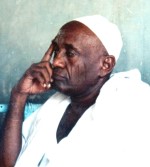
1985: Mahmoud Mohamed Taha, progressive Islamic theologian

On this date in 1985 progressive Islamic theologian Mahmoud Mohamed Taha was publicly hanged at a prison in Khartoum North, Sudan.

Seventy-five years old at his death, Taha spent his youth in the nationalist movement against British control of Sudan where he emerged as the standard-bearer of the liberal/secular Republican Party.

After Sudan won independence in 1956, both Taha and his party maintained — in the face of official hostility that waxed and waned with the changing regimes — nonviolent support for political openness, national unity between Muslims and non-Muslims, and a theology pointing to reform within Islam. Specifically, Taha embraced a women’s movement and opposed the imposition of sharia, at least in the absence of a radical modernization of the Islamic religious law.

The introduction of sharia in 1983 brought matters to a head, and not only with Taha: civil war broke out — the conflict between the Muslim north and the Christian and animist south only recently and imperfectly abated.

Taha and four other Republicans were tried for their intransigence in a two-hour trial under a seemingly muddled mixture of secular and religious law.

Among the hundreds of attendees of Taha’s hanging this day were his four “co-conspirators.” They were themselves under sentence of death to be carried out January 20th, unless they should recant. All four recanted. Hundreds of other Republicans were held around the country on lesser charges until they did likewise.

The next year, with a new government in place, the Sudanese Supreme Court declared the proceedings against the Republicans to have been in error.

Little of Taha’s work has been translated, but his Second Message of Islam is available in English and presents a conception of the faith so unfamiliar in the west that one reviewer mitigates his praise with the regret that “it is nonsensical to talk of reforming Islam, a religion which is doctrinally irreformable.”

Taha’s thought also has a scholarly evaluation in Quest for Divinity: A Critical Examination of the Thought of Mahmud Muhammad Taha. More information by and about Taha and the Republicans is here.

On this day..

2005: Nguyen Van Van

On this date in 2005, Nguyen Van Van, the onetime coach of Vietnam’s national taekwondo team, was shot for murder in Ho Chi Minh City.

The wire story does not appear to be available in a current archive but was secondhandedly cited here and here. Here’s how it ran:

Martial arts master executed

From correspondents in Hanoi
January 14, 2005

A FORMER coach of the Vietnamese national tae kwon do team was executed by firing squad in Vietnam for murder, a court official said today. Nguyen Van Van was put to death today at Long Binh execution ground in the southern Ho Chi Minh City, an official from the city People’s Court said.

A municipal appeal court handed down in June 2004 the death sentence to Van, who was only sentenced to life imprisonment at his first trial in March of the same year, for murdering a man in an ambush on December 19, 1996.

The incident took place at a cafe after one of Van’s sons got involved in a brawl with a customer. Accompanied by family members, Van stormed into the cafe where he injured the cafe owner and stabbed to death his brother-in-law, Le Hong Quan.

On this day..

1871: Kawakami Gensai

On this date in 1871, the shadowy but legendary swordsman Kawakami Gensai was beheaded on a pretext — his use to the Meiji government at an end.

The Hitokiri — “mankiller” — Gensai came to manhood during the confusing death throes of the shogunate leading into the Meiji Restoration.

That Japan’s feudal stagnation would give way to the Meiji era’s centralization and modernization may well be accounted an inevitability of history. The particular form of its birth superimposed upon the epochal conflict a bitter internal division over openness to foreigners vis-a-vis the centuries-old isolation.

The Tokugawa Shogunate had been forced to accept trading pacts dictated by better-armed western nations, and the resulting cultural and economic shockwaves carried many to the camp of a long-slumbering imperial house ready to assert its authority. Power in Japan was a prize worth killing for.

Gensai did so. Physically small and even effeminate, he was justly among the most feared warriors of his day. He became an elite imperial assassin renowned for the speed of his blade; he was famous for murdering pro-western shogunate politician Sakuma Shozan in broad daylight in 1864 — only one of scores of Tokugawa retainers assassinated during the period, although the only one that can be definitively attributed to Gensai.

It was not for any of this that Gensai was put to death, for his side won the war.

But the legendary killer was really in it for the immigration policy — “Revere the Emperor, Expel the Barbarians” — and the Meiji government sensibly dropped the second plank of that platform as soon as it was in the saddle. That volte-face didn’t push Gensai into anything so drastic as revolt, but with modern police forces elbowing aside old-school samurai and outward-facing engagement still the political order of the day, the true believer had become a liability.

The character Himura Kenshin from the Japanese manga and anime series Samurai X is loosely based on Gensai. He’s the one helpfully marked with an “X” on his cheek:

On this day..

1775: Yemelyan Pugachev

On this date in 1775, the Russian Empress Catherine the Great had Cossack rebel Yemelyan Pugachev chopped to pieces in Moscow for sustaining a major insurrection whose effects would haunt Russia for decades to come.

Pugachev’s Rebellion was the most spectacular specimen in populous family tree of 18th century peasant uprisings.

Most such disturbances were local and fundamentally unthreatening. Pugachev’s was neither.

The Cossack commander raised a revolt in the Urals in 1773, styling himself the long-lost tsar Catherine had overthrown a decade before.

Catherine was slow to see the import, but this hinterlands pretender set up a state-like bureaucracy and began issuing ukases as tsar — and one can readily discern from their content why he attracted a following:

We bestow on all those who formerly were peasants and in subjugation to the landowners, along with Our monarchic and paternal compassion … tenure of the land and the forests and the hay meadows and the fisheries and the salt lakes, without purchase and without obrok, and we liberate all the aforementioned from the villainous nobles and from the bribe takers in the city–the officials who imposed taxes and other burdens on the peasants and the whole people … [T]hose who formerly were nobles living on estates are enemies to Our power and disrupters of the empire and oppressors of the peasantry, and they should be caught, executed and hanged, they should be treated just as they, who have no Christianity, dealt with you peasants.

The insurrection speedily metastasized, and by the time a force sufficient to quash it was deployed, it had stretched itself from the Urals to the Volga.

Alexander Pushkin used the story of Pugachev’s rebellion for The Captain’s Daughter (text in English | Russian), which has been adapted to film several times — most recently in 2000.

Catherine the Great, for her part, was deeply shaken by the affair, and the “enlightened despot”, while maintaining traffic with the era’s liberal intellectual ferment, decisively turned against any reform to serfdom. Catherine’s choice, reinforced by her successors, to uphold their security with nothing but repression maintained Russian serfdom until 1861 on a staggering scale — an anchor dragging down the economy just as industrializing western Europe opened a development gap whose effects persist to this day.

On this day..

1697: Thomas Aikenhead

On this date in 1697, Scottish medical student Thomas Aikenhead was hanged on the road from Edinburgh to Leith for blasphemy, an already-archaic punishment inflicted for what reads like headstrong youthful atheism of a decidedly garden variety.

Aikenhead partook of the times’ emerging (albeit forbidden) store of humanist and skeptical literature, and chatted most unguardedly with University of Edinburgh “friends” who tattled to authorities to the extent that, not content with testifying against him, one published a pamphlet demanding the offender “atone with blood, the affronts of heaven’s offended throne.”

Said authorities scarcely elevated the dignity of the temporal throne in their own eagerness to swing a sledgehammer against a fly, trying the young hothead for his life under a Restoration law which by its own letter should not have lodged him in mortal peril until his third offense.

Thou Aikenhead, the indictment thundered in the second person:

shakeing off all fear of God and regaird to his majesties lawes, have now for more than a twelvemoneth by past…[vented] your wicked blasphemies against God and our Saviour Jesus Christ, and against the holy Scriptures, and all revealled religione…you said and affirmed, that divinity or the doctrine of theologie was a rapsidie of faigned and ill-invented nonsense, patched up partly of the morall doctrine of philosophers, and pairtly of poeticall fictions and extravagant chimeras

He called the Old Testament “Ezra’s fables”, Jesus the “Imposter Christ” (preferring Mahomet), and anticipated the extirpation of Christianity.

It was a bare two weeks from conviction to execution. Accounts of Aikenhead’s last days seem inconsistent; the prisoner recanted, possibly sincerely, but the Church — explicitly handed the power to at least reprieve him by its intervention — demanded hurried and “vigorous execution.”

Macaulay disgustedly pictured the scene:

The preachers who were the boy’s murderers crowded round him at the gallows, and, while he was struggling in the last agony, insulted Heaven with prayers more blasphemous than any thing that [Aikenhead] had ever uttered.

The singular punishment meted out this day — the last hanging for blasphemy throughout what was soon to become the United Kingdom — cast a long shadow into the coming century’s remarkable Scottish renaissance and lingers even today as a suggestion to some just how near the menace of theocracy might yet remain.

And Britain’s blasphemy laws? They’re only now facing repeal.

On this day..

2007: 23 Shia hostages

On this date in 2007, during Iraq’s sectarian civil war, Sunni gunmen avenged the execution of Saddam Hussein by hanging 23 Shia hostages in Baghdad’s Haifa Street.

It was but one instance of retaliatory violence ensuing upon the former dictator’s hanging Dec. 30, with scores killed around the country — many in a similar fashion.

London’s Telegraph reports:

The residents of the city’s Haifa Street will long remember the events of Sunday morning. As shop owners raised their shutters and stall holders set out their stock, three minibuses roared to a halt.

Gunmen jumped out and pulled blindfolded prisoners on to the street. Ropes were tied to lampposts and electricity poles. Those hostages who resisted were shot. Others who were still alive had nooses tied around their necks and were then suspended in mid air to choke to death.

All were left hanging, and the victims received little sympathy from those who witnessed the events.

“We watched as all these blindfolded men were hung up and some were shot in the head,” Imad Atwan, a supermarket worker said.

“Altogether there were 23 bodies. We are all Sunni people here so we supported the gunmen. Some of them are the guards of our neighbourhood.”

…

The discoveries were not limited to Haifa Street. People murdered in the same way had been found in Al Doura district and Amriya, in western Baghdad.

The interior ministry estimates that 200 Iraqis were taken hostage after Saddam was sentenced to death.

On this day..

2002: ‘Ali bin Hittan bin Sa’id, Muhammad bin Suleyman bin Muhammad, and Muhammad bin Khalil bin ‘Abdullah

On this date in 2002, three homosexual men were beheaded with a sword in the resort city of Abha, Saudi Arabia.

The Saudi Interior Ministry announced that the men had “committed acts of sodomy, married each other, seduced young men and attacked those who rebuked them” — suggesting, despite the allusion to molestation, that homosexuality might have been the primary basis for their execution.

The incident created a ripple of worldwide attention and some pungent speculation, but the particulars remain shadowy — not unlike the ambiguous position of gays in Saudi Arabia even in the face of draconian sodomy laws.

On this day..

1874: John Murphy

On this date in 1874, John Murphy was publicly hanged at the foot of Carson City’s Lone Mountain for murder.

The New York Times (.pdf) story, reprinted here in its entirety, suggests the tenor of the affair in the young western state:

John Murphy, who was executed at Carson, Nevada, yesterday, for the murder of J.R. McCallum, was a native of Scotland, and at one time traveled with John C. Heenan, giving sparring exhibitions. On the scaffold he made some remarks professing his belief in spiritualism, and at the same time uttering horrible blasphemy.

He had been temporarily reprieved December 18 to determine his sanity.

This appears to be the only historically identifiable execution in Carson City from the Nevada Territory’s creation in 1861 until the legislature in 1903 removed all Nevada executions to that city’s state prison — where they still take place to this day.

On this day..

1827: Levi Kelley

On this date in 1827, Levi Kelley suffered the last public hanging in Cooperstown, N.Y., for the September murder of his tenant Abraham Spafard.

The front of a pamphlet covering the Kelley trial. Courtesy of the Library of the New York State Historical Association, Cooperstown, N.Y., and its collection of murder pamphlets, “Man or Monster?”

Some malignant spirit determined to reduce the man to a grim irony or object lesson seemingly attended Kelley’s every step towards the gallows. His story, according to The Story of Cooperstown, begins 10 days prior to the capital crime at another public execution.

Among the spectators at this hanging was Levi Kelley of Cooperstown, who, in order to witness the spectacle, had covered a distance of 75 miles, drawn by his favorite team of black horses, a noble span, of which he was very proud. Kelley was much depressed in spirit by the dreadful scene at the gallows, and to a friend who accompanied him on the homeward journey remarked that no one who had ever witnessed such a melancholy spectacle could ever be guilty of the crime of murder.

Undoubtedly, many killers besides Levi Kelley through the annals of time also underestimated the violence of their own temper. We do not know whether he also labored under any expectation of preferential treatment, as the nephew of Cooperstown founder Judge William Cooper — which also made him the first cousin of author James Fenimore Cooper.

But what occurred at Kelley’s hanging, to which that same team of proud black horses drew him this day, made a niche in history all his own, and made both the murderer and his executioners unwitting instruments of at least two more deaths. A local balladeer described the scene:

December on the twenty-eighth
Did Levi Kelley meet his fate;
This awful scene I now relate
Caused thousands there to fear and quake.

Though wet and rainy was the day,
The people thronged from every way;
With anxious thought each came to see
The unhappy fate of poor Kelley.

The day was come, the time drew near,
When the poor prisoner must appear;
The officers they did prepare,
And round him formed a hollow square,

That they with safety might convey
Him to the place of destiny;
The music made a solemn sound
While they marched slowly to the ground.

A scaffold was erected there,
And hundreds on it did repair,
That all thereon might plainly see
The unhappy fate of poor Kelley.

Before they bid this scene adieu,
An awful sight appeared in view.
See, hundreds with the scaffold* fall!
And some to rise no more at all

Till the great day when all shall rise,
To their great joy or sad surprise,
And hear their sentence “Doomed to Hell,”
Or, “With the saints in glory dwell.”

The wounded here in numbers lie,
And loud for help now some do cry
While others are too faint to speak,
And some in death’s cold arms asleep.

One man’s skull was crushed. Another spectator was carted away alive, but mortally injured.

Nineteenth century homo Americanus might count it a credit to pragmatism, even to consistency, that the spectacle of grisly public death was not the sort of thing to interrupt a hanging.

The fatal collapse of the spectators’ grandstand only delayed the execution by the space of time necessary to restore order. The disturbance may even have offered the condemned man some relief from his own fright in compassion for the woe beneath him.

“Who are killed and how many are injured?” the shaken man asked, surveying the wreckage from his gibbet as the noose was readied for his throat.

* The audience’s “scaffold” — not that of Kelley.

Part of the Themed Set: The Spectacle of Public Hanging in America.

On this day..