On this date in 1683, the commander who just months before had brought the Turkish army to the gates of Vienna was executed in Belgrade for losing one of the pivotal battles in European history.
 The Battle of Vienna saw the Ottoman Empire’s high tide and its last great bid to capture control of the strategic Danube city.
Despite an army of well over 100,000 that had besieged a frightened garrison numbering fewer than 20,000 soldiers and civilians, Kara Mustafa Pasha had been unable to reduce the city, and then decisively beaten after the timely arrival of a 70,000-strong relief force under the command of the Polish monarch Jan Sobieski. Here’s a great Italian map of the battle, with Mustafa himself hanging out in the lower corner; apparently, you can buy the original.
For both contemporaries and posterity, the “miraculous” defeat of an overwhelming Turkish threat by a coalition of Christian forces — a sort of earthbound equivalent to the previous century’s Battle of Lepanto — has appeared as a signal clash-of-civilizations event. In the right audience, a knowing 1683 reference is a sort of dominionist gang handshake.
So, anyway: big win.
If the blame for the defeat — Sobieski’s intervention apart — lay at Kara Mustafa’s door, it was due less to his decision to march straight for Vienna than to a number of technical miscalculations on his part, such as failing to bring heavy artillery to the siege but relying instead on light guns … inadequate to breach Vienna’s strongly fortified walls …
Merzifonlu Kara Mustafa Pasha had long been a close adviser of the Sultan, but any doubts Mehmed IV might have harboured about him were given substance during his absence on campaign as plotters fabricated reports of disorder in the empire. On hearing of the defeat at Vienna, one of the plotters … announced, in the words of Silahdar Findiklih Mehmed Agha, that ‘our enemy is finished with; the time is ripe for revenge’ …
Mehmed succumbed to the pressure from Kara Mustafa’s detractors, and the Grand Vezir was executed in Belgrade on Christmas Day 1683 while engaged in planning a new advance for the following spring … a skull in Vienna’s city museum is commonly believed to be his.
The Austrian victory at Vienna cost the Turks more than Mustafa’s service, which was quite a lot in itself. (Twelve different viziers held the post in the two decades after Kara Mustafa Pasha was strangled.)
The empire’s longstanding (and to Christendom, terrifying) expansionist posture towards Europe was at an end; in the future, the Musulman would have to ward off the Christian.
Ensuing Holy League victories wrested central Europe away from Constantinople, inaugurating a long Ottoman stagnation that would culminate in the empire’s destruction after World War I.
The Hapsburgs — though likewise marked for calamity in the War to End All Wars — for their part won hegemony in central Europe … and, it is said, the literal coffee beans captured as war booty with which to brew the famous Viennese cafe scene.
On this day..
- 1943: Four Aussie escapees, at the Hotel Tacloban
- 1973: Five for an Afghanistan coup
- 820: Not Michael the Amorian, conquer or die
- 2014: Ismai Khan Sayed, a Pakistani heroin smuggler in Saudi Arabia
- 1553: Pedro de Valdivia, founder of Santiago
- 1204: Alexios V, precipitated Byzantine emperor
- 2010: An Iranian crack trafficker
- 1017: Eadric Streona, traitorous
- Feast Day of St. Anastasia
- 317 B.C.E.: Philip III Arrhidaeus, who succeeded Alexander the Great
- 2006: Three old men and a taxi driver
- 1989: Nicolae and Elena Ceausescu
1971: Martyred Intellectuals’ Day in Bangladesh
This date’s observance marks the systematic execution by (West) Pakistani forces of the intellectual class of East Pakistan at the end of the civil war which would detach the east as the independent nation Bangladesh — an unavenged war crime as cynical as it was brutal.
Executed intellectuals in the Dhaka Rayerbazar, 1971.This was not a single discrete massacre, but a continuing policy during the March-December 1971 war. December 14, just two days before the Pakistani army surrendered, was the peak date of a dreadful endgame paroxysm that saw hundreds of scholars, teachers, lawyers, doctors, artists, writers, engineers, and the like rounded up and summarily executed in a bid to decapitate the new Bengali state’s intelligentsia.
Though the martyrs were subsequently venerated in Bangladesh, the higher-stakes regional geopolitics have always made effective redress a nonstarter.
On this day..
- 1981: Gheorghe Stefanescu, the Walter White of wine
- 1931: Fatma Demir, the first woman hanged in Turkey
- 1650: Not Anne Greene, miraculously delivered
- 1661: Murad Bakhsh, son of the Taj Mahal builder
- 1556: A canon's servant
- 1793: A Lyon mitraillade
- 1759: William Davis, St. Croix slave revolt suicide
- 1761: Jacinto Canek, Mayan revolutionary
- 1417: The Falstaffian John Oldcastle
- 1930: Captains Fermin Galan and Angel Garcia Hernandez
- 10 executions that defined the 2000s
- 1903: William Ennis, wife-murdering cop
- 1974: Charles Dean and Neal Sharman
1831: Gen. Jose Maria Torrijos y Uriarte and his liberal followers
On this date in 1831, one of the great Spanish liberal officers was shot along with dozens of comrades attempting to spark a revolution.
It was a dark time for Spanish liberals under the autocratic rule of Ferdinand VII.
Jose Maria Torrijos y Uriarte (Spanish Wikipedia page) was one of the heroes of that downtrodden cause from way back, a noble-born officer who had been made a captain at the precocious age of 13 and been around for all of Spanish liberalism’s greatest early 19th century tragedies.
He was in Madrid for the ill-fated uprising against its French occupiers in 1808, and was captured en route to aid Pedro Velarde‘s last stand.
Lucky for Torrijos, and luckier still: as a prisoner, he might have been in line for the ensuing mass execution, but an aide-de-camp of General Murat let him go in gratitude for chivalrously preserving a French officer from the Spanish mob.
A few years after the Peninsular War, with independent Spain yoked to a reactionary Bourbon-backed monarchy, Torrijos’ dangerous opinions made him a prisoner once more.
This time, he was liberated by the brief ascendancy of fellow-traveler Rafael del Riego. This effusion, too, was destined for grief upon the scaffold; once more, Torrijos escaped, this time to exile.
The execution of Rafael del RiegoPushing forty and a bit emptyhanded for all his strivings, Torrijos’ restless soul was not satisfied knocking about the shores of England. He soon assembled a company of like-minded folk (such as Robert Boyd) to make another bid at liberating Iberia. But he was induced to put ashore under the misapprehension of support, and promptly rounded up.
The Malaga governor’s message to Madrid requesting instruction returned the simple order: shoot them all.* (Spanish link)
“A la muerte de Torrijos y sus compañeros”
by José de Espronceda (from here (pdf))Helos allí: junto a la mar bravía
cadáveres están ¡ay! los que fueron
honra del libre, y con su muerte dieron
almas al cielo, a España nombradía.Ansia de patria y libertad henchía
sus nobles pechos que jamás temieron,
y las costas de Málaga los vieron
cual sol de gloria en desdichado día.Españoles, llorad; mas vuestro llanto
lágrimas de dolor y sangre sean,
sangre que ahogue a siervos y opresores,y los viles tiranos con espanto
siempre delante amenazando vean
alzarse sus espectros vengadores.
Monument to Torrijos at Malaga’s Plaza de la Merced.* Around 50 or so were shot. The exact figure is differently accounted by various sources; I have been unable to determine if any among them are authoritative.
On this day..
- 1994: Raymond Carl Kinnamon, filibusterer
- 1903: A day in the death penalty around the U.S. (and Canada)
- 1747: Serjeant Smith, deserter
- 1981: El Mozote Massacre
- 1812: John Rickey but not Benjamin Jackson
- 1895: Harry Hayward, the Minneapolis Svengali
- 1876: Basilio Bondietto
- 1861: Christopher Haun, potter and incendiarist
- 1970: Akira Nishiguchi, Vengeance Is Mine inspiration
- 2006: Two Egyptians who just wanted to watch the game
- 1917: Thirteen black soldiers of the 24th U.S. Infantry Regiment
- 1962: Arthur Lucas and Ronald Turpin
2007: Seven Tuareg and Arab civilians
On this date two years ago, seven civilians were apparently summarily executed by Niger security forces in that country’s long-running internal conflict with its Tuareg population.
Extrajudicial executions have been a recurring event (among the other usual charms of warfare) in Niger’s fight against the Mouvement des Nigériens pour la Justice (MNJ).
Amnesty International charged that these were among 13 civilians executed in a four-week span, possibly in retaliation for MNJ armed attacks.
A close relative of one of the dead told Amnesty International: “We were waiting for our relatives in Agadez when we saw their vehicles arrive driven by soldiers. We asked them where our relatives were. They refused to answer and then, as we insisted, they agreed to drive us to the place where the seven were buried.”
The people who identified the bodies said that they saw numerous signs on the victims of cigarette burns and whipping as well as many bullet wounds to the face and chest.
The nomadic Tuareg people of Niger’s (and neighboring Mali’s) northern Sahara territories have a long-running history of rebellion against the southerly federal government stretching back into the colonial period. (There’s a very detailed pdf paper on the subject here.)
These executions, which also swept up Arab businessmen, were part of the most recent (as of this writing) incarnation, a 2007-2009 campaign that seems ostensibly to have simmered down for now.
But the lucrative, contentious, and damaging (to the Tuareg) uranium mining industry that fuels the conflict (and that put Niger in the American news for the Bush administration’s duplicitous attempt to impute nuclear ambitions to Iraq in order to justify invading) still remains … and that fact seems to promise more bloodshed yet to come.
On this day..
- 1920: Joseph Usefof
- 1988: Sek Kim Wah, thriller
- 1947: Rawagede Massacre
- 2014: Robert Wayne Holsey, despite a drunk lawyer
- 1754: Eleanor Connor, rogue
- 1578: Kort Kamphues, outlaw judge
- 1937: Douglas Van Vlack
- 1727: An Irish deserter at Gibraltar
- 1999: James Beathard, on the word of a known liar
- 1603: The men of the Bye Plot, but not those of the Main Plot
- 1783: The first hangings at Newgate Prison
- 1793: Sydney Carton posing as Charles Darnay
1982: Suriname’s “December murders”
This was the date in 1982 of the “December murders” (“Decembermoorden”), when 15 opponents of Suriname’s military dictatorship were shot at Fort Zeelandia.
(The 15 people shot each have an entry on the Dutch Wikipedia, accessible through its Decembermoorden entry.)
Though the killings weren’t secret at the time, their circumstances have always been murky, beyond the plain fact of being murders of political dissidents — “counterrevolutionaries,” in the parlance of the “Socialist Republic”.
President Desi Bouterse had seized power in a coup in early 1980, and some of the casualties this day might have been suspected of plotting to pull the same trick on him: at least, several were made to read statements to that effect. Others were regime opponents of a less existential menace: dissident university professors; critical journalists; a prominent former footballer. (When in Paramaribo, take in a match at Andre Kamperveen Stadion, which is named for him.)
Bouterse took political responsibility for the slaughter while claiming not to have ordered it. But it’s long been said that Bouterse was actually present for the shootings, personally interviewing/interrogating/”judging” the prisoners. (That’s what the massacre’s lone survivor, the since-deceased Fred Derby, said. (Dutch link))
Decades later, Bouterse — now an ex-dictator — is finally facing trial for the December murders, including fresh evidence of his involvement in the day’s notorious affair.
On this day..
- 1452: Antonio Rizzo, cannonaded
- 1718: Avram Lopukhin, Peter the Great's brother-in-law
- 1905: Mary Rogers, chloroformer
- 1915: Cordella Stevenson lynched
- 1746: Charles Radclyffe, twice Jacobite rebel
- 1975: Isobel Lobato, wife of East Timor's Prime Minister
- 1934: John and Betty Stam, China missionaries
- 1922: Four anti-Treaty Irish Republicans
- Hand of Glory: 1,500 days and counting
- 2009: Yang Yanming, hedge fund manager
- 1828: Joseph Hunton, forger
- Themed Set: Reputation
- 1793: Madame du Barry, who hated to go
- 1596: Francisca Nunez de Carvajal, her children, and four other crypto-Jews of her family
1781: The slaves of the Zong, for the insurance
Beginning this day in 1781, the captain of the slave ship Zong began throwing his cargo overboard in a still-notorious case combining the horrors of the Middle Passage with the cruel rapacity of capital.
The Liverpool-based ship was en route from Africa to Jamaica, there to exchange its human chattel for New World produce bound for the European market.
Characteristically for slave ships, it was inhumanly packed: more economical for a slaver to overcrowd its captives and write off the ones who died than to maximize slaves’ chances of survival. And on this particular ship, malnutrition and disease claimed more than 60 slaves (as well as seven crew members).
Underwater sculpture off Grenada commemorating slaves thrown overboard during the Middle Passage.With many more in danger of expiring, Captain Luke Collingwood reasoned that the cargo would be a loss if it succumbed, but that shippers’ insurance would reimburse the firm “when slaves are killed, or thrown into thrown into the sea in order to quell an insurrection.” Over a three-day span beginning Nov. 29, 1781, Collingwood had 133 still-living but sick slaves cast overboard;* “the last ten victims sprang disdainfully from the grasp of their executioners, and leaped into the sea triumphantly embracing death.” (Source)
This gave the ship’s owners — the good captain himself was not among them — the chance to attempt an insurance scam.
This historical-philosophical book (review, a pdf) analyzes the Zong affair as the emblematic “inauguration of a long twentieth century underwritten by the development of an Atlantic cycle of capital accumulation.”When the Zong landed having lost in total more than half of its original 440 slaves (and Collingwood himself, that fastidious servant of his shareholders), its owners did indeed attempt to recoup the many who had been intentionally killed. Smelling fraud, the insurer refused to pay.
There followed the signal case of Gregson v. Gilbert, a dry insurance trial that also became a beacon of the slave system’s blood-chilling jurisprudential logic.
After a jury sided with the claimant shippers against the insurers, the matter hit a wide public on appeal before Lord Chief Justice Mansfield when abolitionist activists Granville Sharp and Olaudah Equiano seized upon its conscience-shocking quality.
While Sharp and Equiano agitated unavailingly for a homicide investigation, the insurer — which was itself in the very same business of human bondage as the shipper — self-righteously posed “as counsel for millions of mankind, and the cause of humanity in general.” (Source) Its interests, after all, would be served by the least possible indemnity for slaves murdered in passage.
Solicitor-General John Lee — “the learned advocate for Liverpool iniquity,” in Sharp’s estimation — successfully insisted upon limiting the case to its commercial considerations.
What is this claim that human people have been thrown overboard? This is a case of chattels or goods. Blacks are goods and property; it is madness to accuse these well serving honourable men of murder. They acted out of necessity and in the most appropriate manner for the cause. The late Captain Collingwood acted in the interest of his ship to protect the safety of his crew. To question the judgment of an experienced, well-travelled captain held in the highest regard is one of folly, especially when talking of slaves. The case is the same as if horses had been thrown overboard. (Quoted here; Wikipedia has it “as if wood had been thrown overboard.”)
Lord Mansfield agreed, “(though it shocks one very much) that the case of slaves was the same as … horses,” and simply found with the insurers that no liability attached them since the killings were voluntary rather than necessary.
Nobody was ever prosecuted.
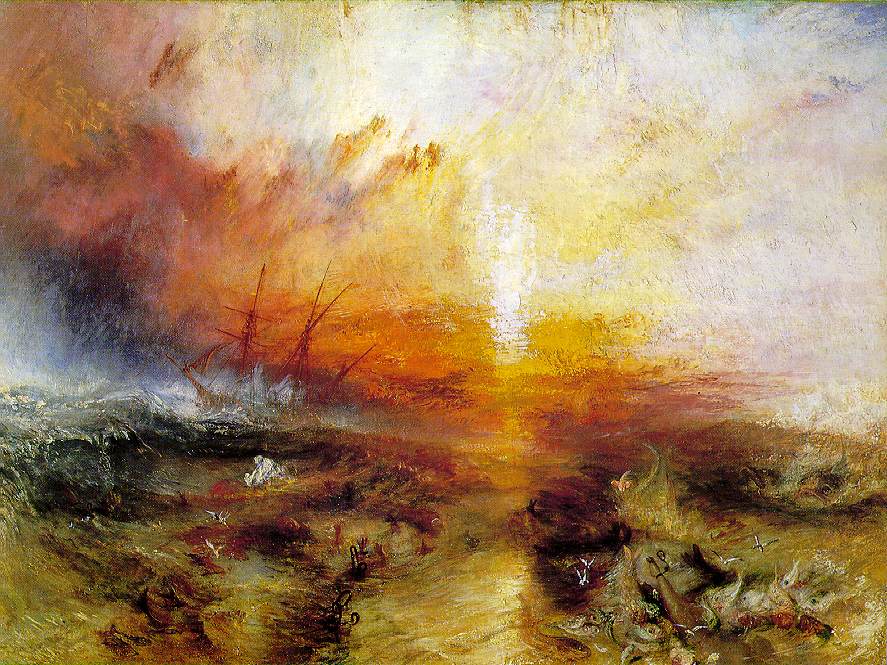
The disturbing 1840 Turner seascape “Slavers throwing overboard the Dead and Dying – Typon [sic] coming on”, also known simply as “The Slave Ship”, is widely thought to have been inspired by the Zong episode. The allusion would have been well-known to his contemporaries.* One of the 133 survived by climbing back aboard the ship.
On this day..
- 1881: Percy Lefroy Mapleton, police sketch milestone
- 1937: Vincenzo Baccala
- 1343: A dozen Breton nobles
- 1740: Edward Shuel, for a Catholic-Protestant marriage
- 1986: The Moiwana Massacre
- 1793: Antoine Barnave, constitutional monarchist
- 1284: Alice Bowe and her friends
- 1938: Branislaw Tarashkyevich, Belarusian linguist
- 1330: Roger Mortimer, usurper
- 1957: Adolfas Ramanauskas-Vanagas
- 1517: Torben Oxe
- 1941: Zoya Kosmodemyanskaya
- Themed Set: Women Against Fascism
1911: Ah Q
On this date in 1911, the fictional title character of Lu Xun’s The True Story of Ah Q was shot in “Weichuang village,” China.
 Ah Q wins another victory. Image from the Marxist Internet Archive.
A modern masterpiece that remains standard reading in China, The True Story of Ah Q was also one of the first literary pieces in the vernacular. Published in 1921 and set in the events of the Xinhai Revolution ten years prior, the novella/short story acidly satirizes China through the biography of the absurdly hapless Ah Q.
Lu Xun (or Lu Hsun) presents the reader a peasant whose real name is literally unknown — an everyman, and no man at all — and proceeds to characterize this discomfiting allegory: a weakling, a bully, a chauvinist, a fool, whose pluck is all folly born of a bottomless capacity for convincing himself that each new failure and humiliation of his abject life is a victory. (In 1933, the American journalist Edgar Snow asked Lu Xun if there were still manh Ah Qs in China. “It’s worse now,” Lu Xun replied. “Now it’s Ah Qs who are running the country.”)
The second and third chapters detail many such “victories.” Through them, the Chinese tongue gained the phrase “the spirit of Ah Q” to indicate determined self-deception.
This story is well worth reading, which can be done for free here.
Though specific calendar dates are scarcely at all alluded to in the narrative itself, the timing of the “climactic” execution — it is an empty death tragic only in its dearth of tragedy, for a revolution that from the author’s standpoint of hindsight was still struggling with the country’s colonial legacy of weakness and backwardness — can be deduced from the text.
Its action takes place in the confused days immediately following the town’s going over to the revolution, which swept through the Chinese provinces in late October and early November of 1911.*
The robbery that precipitates Ah Q’s execution takes place on a night with “no moon”; according to the year’s lunar chart, there was a new moon on the night of Nov. 20. (The December new moon is much too late to make sense.) In the story, it is “four days later” that Ah Q is arrested at night, then drug out for interrogation the next morning (the 25th); returned to his cell and recalled the morning after (the 26th) to sign a confession;** and after one more night in custody,&dagger hauled to an execution he does not even realize is taking place until the last moment.
Suddenly it occurred to him — “Can I be going to have my head cut off?” Panic seized him and everything turned dark before his eyes, while there was a humming in his ears as if he had fainted. But he did not really faint. Although he felt frightened some of the time, the rest of the time he was quite calm. It seemed to him that in this world probably it was the fate of everybody at some time to have his head cut off.
He still recognized the road and felt rather surprised: why were they not going to the execution ground? He did not know that he was being paraded round the streets as a public example. But if he had known, it would have been the same; he would only have thought that in this world probably it was the fate of everybody at some time to be made a public example of.
…
Ah Q suddenly became ashamed of his lack of spirit, because he had not sung any lines from an opera. His thoughts revolved like a whirlwind: The Young Widow at Her Husband’s Grave was not heroic enough. The words of “I regret to have killed” in The Battle of Dragon and Tiger were too poor. I’ll thrash you with a steel mace was still the best. But when he wanted to raise his hands, he remembered that they were bound together; so he did not sing I’ll thrash you either.
“In twenty years I shall be another …”‡ In his agitation Ah Q uttered half a saying which he had picked up himself but never used before. The crowd’s roar “Good!!!” sounded like the growl of a wolf.
…
At that instant his thoughts revolved again like a whirlwind. Four years before, at the foot of the mountain, he had met a hungry wolf which had followed him at a set distance, wanting to eat him. He had nearly died of fright, but luckily he happened to have an axe in his hand, which gave him the courage to get back to Weichuang. He had never forgotten that wolf’s eyes, fierce yet cowardly, gleaming like two will-o’-the-wisps, as if boring into him from a distance. Now he saw eyes more terrible even than the wolf’s: dull yet penetrating eyes that, having devoured his words, still seemed eager to devour something beyond his flesh and blood. And these eyes kept following him at a set distance.
These eyes seemed to have merged into one, biting into his soul.
“Help, help!”
But Ah Q never uttered these words. All had turned black before his eyes, there was a buzzing in his ears, and he felt as if his whole body were being scattered like so much light dust.
…
As for any discussion of the event, no question was raised in Weichuang. Naturally all agreed that Ah Q had been a bad man, the proof being that he had been shot; for if he had not been bad, how could he have been shot? But the consensus of opinion in town was unfavourable. Most people were dissatisfied, because a shooting was not such a fine spectacle as a decapitation; and what a ridiculous culprit he had been too, to pass through so many streets without singing a single line from an opera. They had followed him for nothing.
* According to this footnote, it can be more specifically dated to the fall of Shaoxing, which would have been early November.
** Ah Q has no idea he is signing a confession; an illiterate, he makes his mark with a circle — fixated only on making it a perfect circle, at which endeavor he naturally fails “victoriously.”
† During Ah Q’s last night on earth, the scene cuts to two local officials arguing about the prisoner’s fate, where the man’s life is forfeit in some other mean contest of the municipal pecking order — “Punish one to awe one hundred! See now, I have been a member of the revolutionary party for less than twenty days, but there have been a dozen cases of robbery, none of them solved yet; and think how badly that reflects on me. Now this one has been solved, you come and argue like a pedant. It won’t do!”
‡ According to this footnote, “‘In twenty years I shall be another stout young fellow’ was a phrase often used by criminals before execution, to show their scorn of death.”
On this day..
- 1620: Michal Piekarski, warhammer wielder
- 1943: Floyd McKinney
- 1927: Three Saragossa robbers
- Themed Set: Sexual Deviance
- 1702: David Myles, incestuous
- 1512: Five young Ottoman princes
- 1802: Captain William Codlin, maritime insurance scammer
- 602: Emperor Maurice and all his heirs
- 1835: John Smith and James Pratt, the last hanged for sodomy in Great Britain
- 1937: Eero Haapalainen, former Finnish Red Guard commander
- 1674: The Chevalier de Rohan and Franciscus van den Enden
- 1871: Eight Cuban medical students
- 1987: Jacek Lazar condemned
2008: Amoudou Samassa, to quell a lynch mob
Last year on this date, a Central African Republic presidential guard summarily executed a man in a hospital to satisfy a lynch mob pursuing him for murdering his wife.
Amoudou Samassa was supposed to have stabbed his estranged wife to death, provoking an armed mob intent on dispensing street justice. After gendarmes pried him away unkilled, the incensed crowd jammed the streets of the capital Bangui.
Reuters reported that when negotiations to disperse them proved fruitless,
one guard officer, Lt. Jean-Claude Ngaikoisset, finally told the crowd: “If the death of this criminal is the only thing you’re asking for to clear these avenues, then I see no objection”.
File it under “Creative solutions to gridlock.”
On this day..
- 1939: Manuel Molina, Valencia socialist
- Corpses Strewn: The Aiken Party Massacre
- 1857: Two members of the Aiken Party
- 1679: Five Covenanter prisoners from the Battle of Bothwell Bridge
- 1944: Victor Gough, of Operation Jedburgh
- 1836: Six Creek rebels, amid removal
- 1730: Patrona Halil, Ottoman rebel
- 1881: Four Black Friday hangings
- 1977: Benigno Aquino condemned
- 1988: Adrian Lim and his two wives
- 1838: Tsali, Cherokee
- 1780: David Dawson and Ralph Morden, Quaker "traitors"
- Feast Day of St. Catherine of the Wheel
1974: Black Saturday in Ethiopia
November 23, 1974 was “Bloody Saturday” in Ethiopia for that day’s* surprise purge of some threescore politicians and soldiers by the ruling Derg.
It was barely ten weeks since the Derg — an Amharic word meaning “committee”, in this case a leftist military junta — had formally overthrown Emperor Haile Selassie, so ancient that he was already middle-aged back when he’d been leading Ethiopia’s resistance against Mussolini.
It’s strange to say in retrospect, but having spent the best part of a year systematically supplanting the political authority of the decrepit ancien regime with widespread public support, the Derg had engendered hope that its revolution would be accomplished without slaughter.
“Ityopiya tikdem/yala mimin dem” — “Let Ethiopia progress/Without any bloodshed” — became the popular slogan of that heady time. (pdf source)
Black Saturday turned the leaf on all that, and opened the sanguinary chapter of Ethiopian history today evoked by the name of the Derg.
“The prospect,” concluded the analysis that appeared under this headline in the Nov. 29, 1974 London Times, “is that the mass executions will be followed by further drastic action aimed at consolidating the control of the new military rulers.” The same author, Michael Knipe, had written on Nov. 16 that “the firmness of [the military’s] control appears to be matched by an overall moderation of approach, which holds promise for Ethiopia’s future.”The Derg long remained a shadowy body, its members largely unknown and its internecine factional politics only guessed-at. The executions this date are generally read as the consolidation of the coup’s “radical” elements as against its “moderates” and the first signal event in Derg member Mengistu Haile Mariam‘s eventual conquest of supreme authority.
The crucial issue that separated radicals from moderates at the revolution’s early stage appears to be their approach to the ongoing struggle of coastal Eritrea — then still a province of Ethiopia.
Ethnically Eritrean officer Aman Michael Andom, the first titular head of the Derg who had been deposed from his position only a week ago, was a noteworthy advocate of negotiating a peacable settlement with Eritrean agitators. He was among the casualties of Black Saturday. (Aman was later reported to have been killed resisting arrest, rather than actually executed; many of the available accounts of this massacre have slightly varying numbers and particulars.) Henceforth, military force would be Addis Ababa’s only approach to the Eritrean problem.
A few other Aman supporters in the Derg shared his fate in a political wipeout. But more numerous among the 29 civilian and 31 military men announced as casualties the next morning — and there had been no prior warning that executions were imminent — were aristocrats and officials of the Haile Selassie government, including:
Two former Prime Ministers, Endelkachew Makonnen and Aklilu Habte-Wold (or Aklilou Wold), both of whom had been slated for trial for the recent famine in Wollo (London Times, Nov. 14, 1974);** Solomon Abrahami, the former governor of Wollo; Selassie’s own grandsom, Rear Adm. Iskender (Alexander) Desta; 16 generals, including Selassie’s son-in-law (and former Defense Minister) Abiye Abebe.
(This Nov. 25, 1974 New York Times article — behind the paper’s pay wall — lists all 60 vicitms.)
These were a selection of some 200 political prisoners held by the Derg; how hard to come down on these officials was another point of contention between radicals and moderates. It emerged later that the Derg had met earlier on the 23rd to vote, name by name, which among its prisoners deserved execution.
So if you look at it right, summarily machine-gunning only 30% of your political prisoners is a moderate policy. Alas: these would hardly be the last.
After the Derg government was itself finally overthrown in 1991 — and the troubled province of Eritrea finally won its independence from Ethiopia — some of the perpetrators of its genocidal atrocities were themselves put on trial.
* It’s obscure — perhaps permanently so — whether the nighttime killings transpired before or after the end of the day, and both the 23rd and 24th are variously cited as the date of death. “Reliable sources said the executions were by machine gun at midnight,” the unhelpfully breezy New York Times reported on Nov. 25. This account (pdf) has the shootings occupying several batches with midnight passing during the process. We give precedence to Saturday the 23rd here because that’s the day that earned the “Bloody” appellation.
** According to Marxist Modern: An Ethnographic History of the Ethiopian Revolution, Mengistu was rumored to have disposed of Aklilu personally.
On this day..
- 1789: Ann Davis, the first woman hanged at Sydney Cove
- 1763: Charles Brown, security consultant
- 1901: Willie Louw, Boer commando
- 1910: Johan Alfred Ander, the last executed in Sweden
- 1825: Angelo Targhini and Leonidas Montanari, carbonari
- Feast of St. Clement
- 1955: Elli Barczatis and Karl Laurenz, East Berlin spies
- 1739: Seven of nine Williamsburg malefactors
- 1867: The Manchester Martyrs
- 1499: Perkin Warbeck, Princes in the Tower pretender
- 1927: Father Miguel Pro, "Viva Cristo Rey!"
- 1910: Hawley Harvey Crippen
1909: Will James, “the Froggie”, lynched in Cairo
One hundred years ago today, Will James was lynched as a murderer in Cairo, Illinois.
“The Frog” or “The Froggie” was a black man implicated in the murder of a white girl, captured in nearby Belknap and
taken to the most prominent square in the city and strung up. The rope broke and the man was riddled with bullets. The body was then dragged by the rope for a mile to the scene of the crime and burned in the presence of at least 10,000 rejoicing persons. Many women were in the crowd, and some helped to hang the negro and to drag the body.
Part of the mob then sought other negroes. Another part, at 11:15 o’clock, after battering down a steel cell in the county jail, took out Henry Salzner, a white man charged with the murder of his wife last August, and lynched him.* (New York Times, Nov. 12, 1912)
Other pictures related to the Will James lynching are at the Without Sanctuary site here (images 41 through 47).The grey lady’s dim view of this jubilant scene prompted a letter to the editor in defense — the author’s disclaimer notwithstanding — of the lynching, which paints a grim and striking portrait of the town where it occurred.
CAIRO’S NEGROES.
Former Resident Says They Are Spoiled by Coddling and Are a Menace.
As a former resident of Cairo, Ill., where I was the editor of a daily newspaper for three years, I crave a word, not in defense of the double lynching which occurred there a few days ago, but in explanation of it. Cairo, at the extreme southern point of Illinois, at the junction of the Ohio and Mississippi Rivers, is peculiarly located. Across one river is Missouri; across the other is Kentucky, and Tennessee is only fifty miles away. Cairo thus becomes a buffer between the North and the South. It is probably the only town in the North which has a true race problem to deal with. … Out of a population of 13,000 in 1900, 5,000 of the inhabitants of Cairo were negroes. Of the 100,000 negroes in the State of Illinois 5 per cent are massed in this one little town. Aside from this, the floating colored population is unusually large, and Cairo, at some time or other, harbors most of the “bad niggers” from St. Louis, Cincinnati, Louisville, Memphis, Vicksburg, and New Orleans. It is these whom citizens fear the most, and for whom the police are constantly alert. Murders by negroes either of white men or negroes are alarmingly frequent, but the murderer usually escapes either to Kentucky or Missouri, and is never heard of again. Thus crime after crime is recorded against the name of Cairo, with no recompense in the name of the law. On the other hand, there is hardly a time when there are not forty or fifty Cairo negroes in the Southern Illinois Penitentiary, all convicted of theft or burglary.
The white people of Cairo have always dealt indulgently with the negro. For years it has been the policy to keep two negroes on the small police force, and there have been negro Justices of the Peace. A negro physician once came near being elected a member of the Board of Education. While they pay but little taxes, the negroes are provided with three public schools. The Sumner was the first colored High School ever established in the United States. Yet this negro population, coddled as it is, is a constant menace to the town. No white woman dare venture outside of the house at night alone for fear of assault. Many outrages of which the world has never heard have been attempted. This is why, as Mayor Parsons says, the effect of the recent lynching will be “salutary.”
Altogether it is not surprising that a lynching took place in Cairo. The only wonder is that one did not take place long ago.
W.L. CLANAHAN
New York, Nov. 14, 1909That electric arch and celebratory mob are now long gone from Cairo: in the century since Will James was butchered, Cairo, Ill., has withered — striken in part by its own poisonous legacy of racism. (Also by flooding from the adjacent rivers, the routing of transportation corridors elsewhere, and the general deindustrialization of the heartland.)
During the civil rights struggle as played out in Cairo in the 1960’s and 1970’s (more in this pdf), the town’s white business owners made a name for themselves by refusing to integrate their workforces in response to black boycotts … preferring to go out of business and/or leave town.
Cairo today is a near ghost town at one-quarter of its previous population, and generally appalling quality-of-life indicators.
* Salzner’s lynching occurred after midnight, according to the same article; hence, his absence from this article’s marquee.
On this day..
- 2009: Ehsan Fatahian, Iranian Kurdish activist
- 1919: Wesley Everest lynched during the Centralia Massacre
- 1779: Robert Young
- 1942: Ernst Schrämli, Swiss traitor
- 1807: Ephraim Blackburn, low roller
- 1954: Karli Bandelow and Ewald Misera, in the Gehlen-Prozess
- 1674: Guru Tegh Bahadur
- 1806: Fra Diavolo, royalist guerrilla
- 1328: Na Prous Boneta, Beguine heresiarch
- 1880: Ned Kelly
- 1761: John Perrott, bankrupt debtor
- 1887: Parsons, Spies, Fischer and Engel, the Haymarket Martyrs
- 1831: Nat Turner