1525: Cuauhtémoc, the last Aztec emperor

Although the primary accounts — those by conquistadors Hernán Cortés and Bernal Díaz del Castillo, and historian Francisco Lopez de Gomara* — did not explicitly record the date, February 28 is the traditionally recognized anniversary of the execution of the last Aztec emperor, Cuauhtémoc.

A monument to Cuauhtemoc in Mexico City. (Author’s photo; public domain)

Cuauhtemoc (English Wikipedia entry | Spanish) was enthroned early in 1521, in a Tenochtitlan already in the train of devastation brought by the Spanish, which had over the preceding months laid low the Emperor Moctezuma II (by violence) and his brother Cuitlahuac (by smallpox, a disease that halved the city’s population within a year).

He was about 23 or 24 years old, a nobleman who must have distinguished himself in war — “a handsome man, both as regards his countenance and his figure,” in Bernal Diaz’s estimation; “a valiant man and a good warrior” by Gomara’s account.

And it would fall to him to bear his proud kingdom’s ruin.

Having previously been welcomed to Tenochtitlan as guests, Cortes and the Spanish had fought their way out and now returned as besiegers, joined by most of the Aztecs’ resentful former subject kingdoms. They soon had Tenochtitlan in a stranglehold, undaunted by the frightening sacrifice of captured prisoners.

all in a moment the large drum of Huitzilopochtli again resounded from the summit of the temple, accompanied by all the hellish music of shell trumpets, horns, and other instruments. The sound was truly dismal and terrifying, but still more agonizing was all this to us when we looked up and beheld how the Mexicans were mercilessly sacrificing to their idols our unfortunate companions, who had been captured in Cortes’ flight across the opening.

We could plainly see the platform, with the chapel in which those cursed idols stood; how the Mexicans had adorned the heads of the Spaniards with feathers, and compelled their victims to dance round the god Huitzilopochtli; we saw how they stretched them out at full length on a large stone, ripped open their breasts with flint knives, tore out the palpitating heart, and offered it to their idols. Alas! we were forced to be spectators of all this, and how they then seized hold of the dead bodies by the legs and threw them headlong down the steps of the temple, at the bottom of which other executioners stood ready to receive them, who severed the arms, legs, and heads from the bodies, drew the skin off the faces, which were tanned with the beards still adhering to them, and produced as spectacles of mockery and derision at their feasts ; the legs, arms, and other parts of the body being cut up and devoured!

In this way the Mexicans served all the Spaniards they took prisoners; and the entrails alone were thrown to the tigers, lions, otters, and serpents, which were kept in cages. These abominable barbarities we were forced to witness with our own eyes from our very camp; and the reader may easily imagine our feelings, how excessively agonizing! the more so as we were so near our unfortunate companions without being able to assist them. Every one of us thanked God from the bottom of his soul for His great mercy in having rescued us from such a horrible death!

Bernal Diaz

Wracked by famine after Cortes successfully cut off its food and water, Tenochtitlan succumbed that August. (The conquistadors found they could barely endure the stench of countless rotting bodies as they took control of the famished city.) When captured, Cuauhtemoc implored Cortes through tears (again according to Bernal Diaz),

I have done what I was bound to do in the defence of my metropolis, and of my subjects. My resources have now become entirely exhausted. I have succumbed to superior power, and stand a prisoner before you. Now draw the dagger which hangs at your belt, and plunge it into my bosom.

There would be no bosom-daggering. Cortes had a much worse fate in mind.

He saluted Cuauhtemoc for his intrepidity in defense, vowing to maintain the latter as the ruler of Mexico … Cortes’s ruler, to ratify the dictates of the conquerors, beginning with commanding his remaining loyalists to surrender. Cuauhtemoc obeyed, with what posterity can only guess must have been fathomless shame and sorrow.

Upon humiliation, Cortes heaped physical torture when the invaders’ ransack of their captured city turned up far less lesser quantities of material loot than they had anticipated — torture which Cuauhtemoc and a cousin-king of a loyal Aztec ally both endured heroically without augmenting the Spanish bottom line. Bernal Diaz once again:

The next thing which Cortes did was to collect all the gold, silver, and jewels that had been found in Mexico, of which, however, there was very little; for Quauhtemoctzin, it was said, had ordered all the treasures to be thrown into the lake four days previous to his capture. A great quantity had likewise been purloined by the Tlascallans, Tezcucans, Huexotzincans, Cholullans, and other auxiliary troops which had assisted us in the siege, besides what had fallen into the hands of the troops on board the brigantines.

The crown officials were positive that Quauhtemoctzin had concealed the greater part, and asserted that Cortes was very pleased that the monarch refused to say a word where it was hidden; for he would then be able to get the whole treasure into his own possession.

The officers then proposed that Quauhtemoctzin and the king of Tlacupa, his most intimate friend and cousin, should be put to the torture, in order to extort from them a confession as to what had become of the treasures: but Cortes could not make up his mind to insult so great a monarch as Quauhtemoctzin, whose territory more than trebled that of Spain, and that for mere lust after gold. Moreover, the monarch’s household assured us they had given up all the gold they possessed to the officers of the crown, which, it was well known, amounted to 380,000 pesos, the whole of which had been melted into bars; and one thing is certain, that the emperor’s and Cortes’ fifths were deducted from that sum; but the conquistadores were not at all satisfied, and considered this sum much below the real amount, and several expressed their suspicion to Alderete, the royal treasurer, that Cortes’ only reason for not wishing to put the monarch to the torture was, that he might secretly take possession of all his riches. Cortes, not willing that such a suspicion should any longer he upon him, or that he should afterwards be called to an account on this score, at last consented that both should be put to the torture.
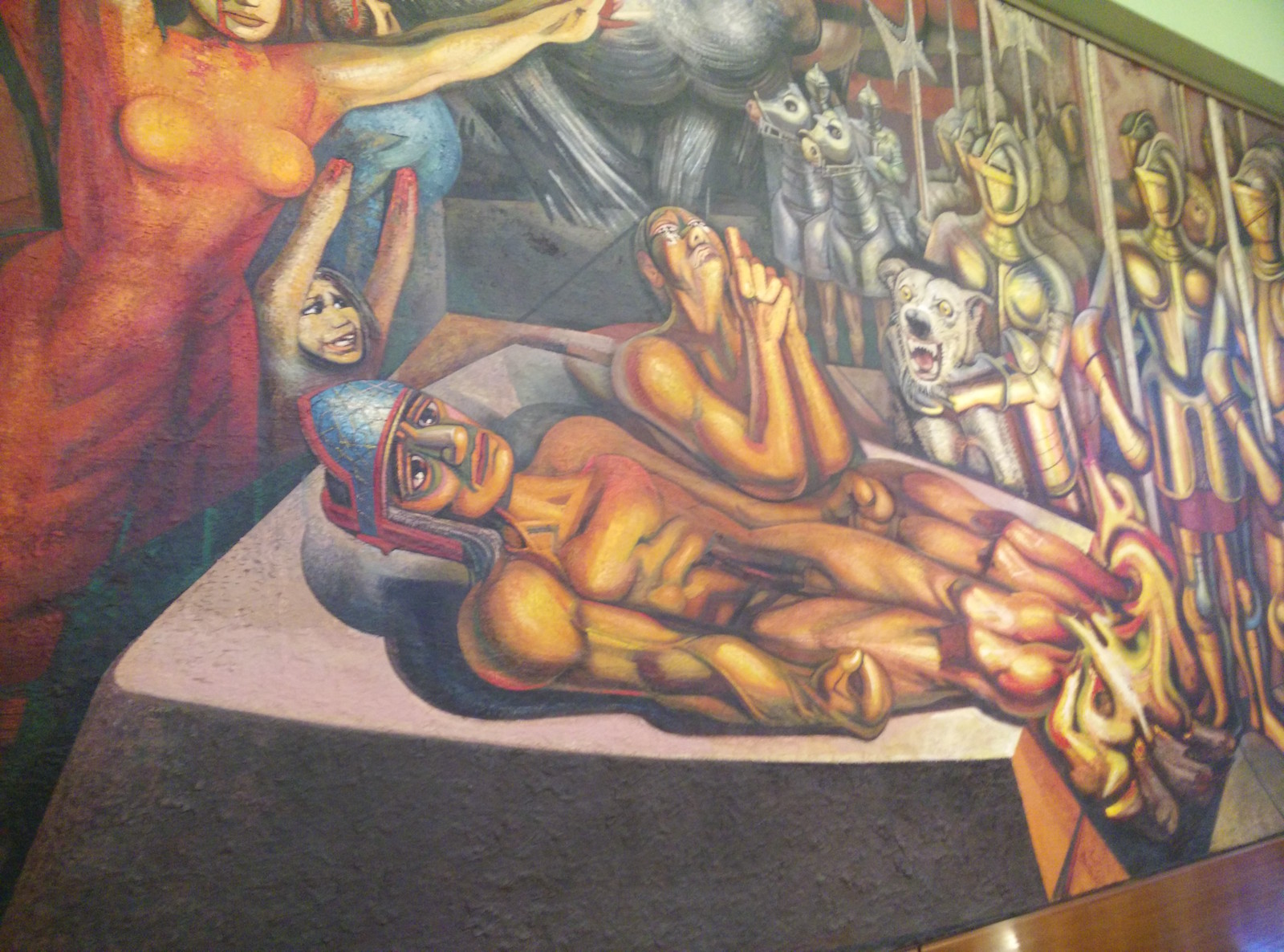

Detail view (click for the full image) of David Alfaro Siquieros‘s monumental 1950-51 mural, The Torment of Cuauhtemoc.

Boiling hot oil was then applied to their feet; upon which they confessed that, four days prior to Quauhtemoctzin’s capture, all the gold, with the cannon, crossbows, and muskets, which we had lost in the night of sorrows, when we retreated from Mexico, besides those which had been taken in Cortes’ last defeat on the causeway, had been thrown into the lake. A number of good swimmers were then sent to dive for the treasure in the spot they pointed out, but nothing was found. Yet there was some truth in the statement; for I was myself present when Quauhtemoctzin led us to a large and deep reservoir of water, built of stone, which lay near his palace. From this reservoir we fished up a sun of gold similar to the one sent us by Motecusuma, besides many jewels and other trinkets, though all of little value. The king of Tlacupa also informed us that he had hidden all manner of valuable things in some large houses, about twelve miles from Tlacupa, and he would accompany us there to point out the spot where he had buried them.

Alvarado was then despatched thither with six soldiers, among which number I also was; but when we arrived at the spot, this king assured us he had merely invented all this in the hopes that we would have killed him in a moment of anger at our disappointment.

(Diaz later added that “the suspicion was become pretty general that he [Cortes] had concealed the greater part of Quauhtemoctzin’s treasure,” and indeed some disgruntled companions — unsatisfied with the share they had been allotted for so magnificent a conquest — would come to lodge this charge against Cortes formally with Emperor Charles V.)

Cortes eventually brought both these hostages/puppet kings/torture victims along with him on a 1524-1525 expedition to Honduras, perhaps to deprive them of any opportunity to rebel in his absence.

On the evening of February 27, Cortes received a report or a rumor that the Indian kings had rebellion on their mind just the same. The timetable from this report to execution is uncertain from the records, but if it was not within 24 hours it cannot have been much longer. Diaz, a hostile-to-Cortes witness here whose narrative indicates his dismay at proceedings, describes it thus:

I have now to relate a circumstance of a very different nature, which occasioned much grief to us all. Quauhtemoctzin and other Mexican chiefs who accompanied our army had, it would appear, spoken among themselves, or secretly determined to put the whole of us to death, then march back to Mexico, and assemble the whole armed power of the country against the few remaining Spaniards, and raise an insurrection throughout the whole of New Spain. This circumstance was discovered to Cortes by two distinguished Mexican chiefs, one of whom was named Tapia, and the other Juan Velasquez. This latter personage had been Quauhtemoctzin’s captain-general during our war with Mexico, and his testimony was borne out by the investigation which Cortes made into the matter, and by the confession of several of the caziques themselves who were implicated in the conspiracy. These men fearlessly declared, that seeing how carelessly and dispiritedly we roamed about; that numbers of the men were ill from want of food; that four of our musicians, with the buffoon and five soldiers, had died of hunger; and that three other men had turned back, more willing to run the risk of reaching Mexico again than of moving forward, the thought struck them that they could not do better than fall suddenly upon us while we were crossing some river or marsh, particularly as they were upwards of 3000 in number, all armed with lances, and several of them with swords. Quauhtemoctzin did not hesitate to acknowledge that these men had spoken the truth, but added that the conspiracy did not emanate with him, and that he himself had never for a moment contemplated carrying it into effect, but had merely spoken about it with the other caziques. All the cazique of Tlacupa confessed was, his having declared to Quauhtemoctzin that it was better to die at once than daily to have death before their eyes on these fatiguing marches, and see their countrymen and relations perish with hunger.

These were sufficient proofs for Cortes, and without any further ceremony he sentenced Quauhtemoctzin and his cousin the king of Tlacupa to the gallows. Before, however, this sentence was executed, the Franciscan monks, with the assistance of Dona Marina, strove to comfort these unfortunate men, and commended their souls to God. When they were being led to the place of execution, Quauhtemoctzin turned to Cortes, and said: “Oh Malinche! I have for a long time perceived, from your false words, that you had destined me for such a death, because I did not lay violent hands on myself when you entered my city of Mexico! Why are you thus going to put me unjustly to death? God will one time ask this of you!”

The king of Tlacupa said, he could only rejoice in a death which he would be permitted to suffer with his monarch Quauhtemoctzin.

Previous to their being hung, both these unhappy caziques confessed to father Juan, who understood the Mexican language, and they begged of him to commend their souls to God. For Indians they were good Christians, and they died in the true faith, and fully believed in our holy religion.

The death of these two monarchs grieved me excessively, for I had known them in all their glory, and on our march they honoured me with their friendship, and showed me many little attentions; for instance, they would often order their servants to go in quest of fodder for my horse; besides which, they were innocent of the guilt imputed to them, and it was the opinion of all who accompanied this expedition that they were put to death unjustly.

But I will leave this miserable subject, and return to our march, on which we henceforth observed the utmost vigilance, for we greatly feared the Mexicans might rise up in arms against us, after they had thus beheld their monarch ignominiously hung by the neck from a tree. But hunger, fatigue, and sickness weighed heavier upon their minds than the misfortune of Quauhtemoctzin.


Detail view (click for the full image) of the “rebel” kings hanged from a tree.

Gomara and, of course, Cortes characterize the accusations against the Indian kings as true and the proceedings against them lawful. From the footnotes in this same Bernal Diaz volume, we have this from the later Jesuit historian and ethnographer Juan de Torquemada, who was fluent in Nahuatl:

I find it differently represented in a history written in the Mexican language, and which I believe to be perfectly correct. While Cortes (the Mexican author says) was quartered in a certain township, the Mexican chiefs one evening began to discourse among themselves about the recent hardships they had suffered, and Cohuanacotzin said to Quauhtemoctzin, to Tetlepanquetzaltzin, and to other distinguished Mexicans, ‘Thus you see, gentlemen, from kings we are become slaves, and we suffer ourselves to be led about by Cortes and this handful of Christians. If we were other people than we are, and would break through the promise we have made these Spaniards, we could play them a pretty trick here, and revenge ourselves upon them for all they have done to us, and the ill-treatment my cousin Quauhtemoctzin has suffered at their hands.’ To this the Mexican monarch replied, ‘I beg of you Cohuanacotzin to drop this subject, lest some one should overhear us, and imagine we were in earnest.’ It appears (continues Torquemada) that they were indeed overheard, for the whole of this discourse was reported to Cortes by a low-minded Mexican of the lower classes.

By law, Mexican flags fly at half-staff in his honor on February 28.

* These texts are cited throughout the post, but for ease of reference … Bernal Diaz: Memoirs of the Conquistador Bernal Diaz del Castillo, vol. 1, vol. 2 | Gomara: The Pleasant Historie of the Conquest of the West India; now called New Spaine | Cortes: History of New Spain, which is a Spanish text as I could not locate an English translation. However, even the Anglophone is liable to appreciate (from p. 225) the illustrations of Indian material culture observed by the Spaniards.

On this day..

1584: Five Catholic priests

John Hungerford Pollen collected and translated this document in Unpublished Documents Relating to the English Martyrs. It comprises the testimony of a friendly Catholic witness to the martyrdom of five priests at Tyburn on this date in 1584, as conveyed to another priest, the future martyr Robert Southwell. The historical moment for these martyrdoms was the weeks following the exposure of the Catholic Throckmorton Plot; most of the priests had been in prison many months, but appear to have their martyrdoms catalyzed by a seemingly perilous security situation.

The Martyrdome of Mr Haddock, Emerford, Fenn, Mutter, priests.

The 6 day of February Mr Heywood and five other priests were brought to the Kings-bench barre, indited of high treason for conspiring at Rhemes and Rome, as it was surmised against F. Campian. They all pleaded not guilty and so were conveyed to the Tower. F. Haywood was in Jesuit’s weed, so grave a man as ever I sett my eyes upon, he wore a coate of black very low and upon the same a cloke of black, downe almost to the grownde. He had in his hand a black staff and upon his head a velvet coyfe and there upon a broade seemly black felt.

The 9 [sic] of February the five priests were brought againe to the barre, and arrained upon the former endightment: they pleaded and protested innocency. Their old friend [Charles] Sledd [an informer noted, like George Eliot, for turning in Catholic priests -ed.] gave in evidence against them: The Jury found them out of hand Guilty, and the Judge gave sentence of death. Whereupon the priests soung Te Deum and such like godly verses.

Upon Wednesday being the last day of the Terme, these five priests were drawen from the Tower to Tyborne upon hurdles; the first that was brought into the cart under the gibbet was Mr Haddock, a man in complexion fayre, of countenance milde, and in professing of his faith passing stoute. One of the Sherifs called Spencer much incensed against them, together with certaine ministers bad Mr Haddock confesse the fact and ask the Queen forgivenesse. Whereupon Mr Haddock calling God to witnesse, protested upon his soule that he was not guilty of the treason, and therfore would not aske the Queen forgivenesse: and further sayd, ‘I take her for my lawfull Queen, I have seyd this morning these many paternosters for her, and I pray God she may raigne long Queene. If I had her in the wildernesse I would not for all the world putt a pinn towards her with intent to hurt her.’

Then seyd the Sherif Spenser, ‘There is since thy arrainment worse matter found against thee [by Munday the spye]’: Whereunto answered Mr Haddock, ‘You have found nothing since; and soe belyke I was wrongfully arrained.’

Then Antony Munday was brought in, who uttered these speeches, ‘Upon a time you and I, with another whose name I have forgotten, walking together at Rome, the other wished the harts [Munday actually said ‘heads’ -ed.] of 3 of the nobility being of her counsell. Whereupon you sayd, M. Haddock, To make up a masse, I would we had the hart [head] of the Queen.’

Then sayd Spenser and other of his officers, ‘Away with the villaine traytor.’

But Mr Haddock, moved with these foresaid talke and speeches sayd as followeth. ‘I am presently to give an account [of all that I have done during life before the tribunal of God]; and as before God I shal answer, I never spake nor intended any such thing. And Munday, if thou didst heare me speak any such thing, how chanced it thou camest not to the barre to give this in against me upon thy othe.’ ‘Why,’ sayd Munday, ‘I never heard of your arraingement.’

Then said Spencer, ‘Didst not thou call the Queen heretick?’ ‘I confesse,’ sayd Haddock, ‘I did.’ Whereupon Spencer together with the ministers and other of his officers used the aforesaid speeches of treason, traytor, and villaine.

Mr Haddock sayd secretly a hymne in latin and that within my hearing, for I stood under the gibbet. A minister being on the cart with him, requested him to pray in English that the people might pray with him. Where upon Mr Haddock put the minister away with his hand, saying, ‘Away, away, I wil have nothing to doe with thee.’ But he requested all Catholics to pray with him and for his country. Where upon sayd one of the standers-by, ‘Here be noe Catholicks’: ‘Yes,’ sayd another, ‘we be all Catholics.’ Then sayd Mr Haddock, ‘I meane Catholicks of the Catholick Roman Church, and I pray God that my bloud may encrease the Catholick faith in England’: whereunto sayd Spenser: ‘The Catholic faith, the devel’s faith. Away with the traytor Drive away the cartel’ And so Mr Haddock ended his life, as constantly as could be required.

When the cart was dryven away, this Spenser presently commanded the rope to be cut, but notwithstanding the officer strock at the rope sundry times before he fell downe; and the reporte of them that stood by the block was that at what time the tormenter was in pulling out of his bowells, Mr Haddock was in life. By his own confession he was 28 yeares of age.

After Mr Haddock was taken to the block Mr Hemerford was brought unto the cart; he was very milde, and sometime a scholler of St John’s College in Oxford. Spenser bad him confesse and aske forgivenesse as before: but he protested innocency as Mr Haddock had done; yet sayd, ‘Where in I have offended her, I ask her forgivenesse, but in this fact of treason alleaged against me, I never offended.’

Then sayd a minister, master of art of St John’s College of Oxford, ‘You and I ware of old acquaintance in Oxford, by which I request you to pray openly and in English, that the people may pray with you.’ Then said M Hemerford, ‘I understand latin well enough, and am not to be taught of you. I request only Catholicks to pray with me.’ Where upon answered the minister, ‘I acknowledge that in Oxford you were alwaies by farre my better. Yet many times it pleaseth God, that the learned should be taught by the simple.’ One Risse termed a Doctor of Divinity, asked Mr Hemerford whither he would hold with the Pope or the Queen, in case the Pope should send an army into England. Whereunto Mr Hemerford answered, That in case they were sent in respect of the Pope’s own person, then he would holde with the Queen; but if it were sent to suppresse heresy or to restore the land to the catholick faith, then he would holde with the Pope. His speech was short being not permitted to speak much, and in substance the rest of his speech, not here sett down verbatim, was to the same effect that Mr [Haddock’s] was. He was cutt downe half dead: when the tormentor did cutt off his membres, he did cry ‘Oh! A!’ I heard my self standing under the gibbet.

Mr Fenn was the third that suffred, being bidd to doe as before, answered as his fellows did & sayd. ‘I am condemned for that I with Ms Haddock at Rome did conspire, & at which time Mr Haddock was a student at Rome and I a prisoner in the Marshalsea, or at the lest I am sure that I was in England, but to my remembrance, I was a prisoner in the Marshalsea. Therefore good people judge you whether I am guilty of this fact or noe.’

A minister called Hene avouched a place of St Paul whereunto Mr Fenn said: ‘I am not to be taught my duty by you.’

The rest of his speeches were to the same effect his fellows were. Before the cart was driven away, he was stripped of all his apparell saving his shirt only and presently after the cart was driven away his shirt was pulled of his back, so that he hung stark naked, where at the people muttered greatly, and the other sherif, called Massam, sayd to the officers, ‘You play the knaves. They be men. Let them be used like men,’ and alwaies commanded that they should hang until they were dead. Notwithstanding the other sherif commanded that they should be cut downe presently, and soe was Mo Fenn, but his companions following him were permitted to hang longer.

Mr Nutter was the 4th man, sometime schollar of St John’s College in Cambridge, and Mr Munden was the fifth & last: they denyed the fact, acknowledged the Queen Majesty to be their Queene and prayed for her, as the former had done, and soe in most milde and constant manner ended their life. Many a one in my hearing sayd, ‘God be with their sweet soules.’

What I have putt downe I hard myself, and therefore I may boldly speake it. If you please, you may shew it to your friends, provyded alwaies you tell not my name.


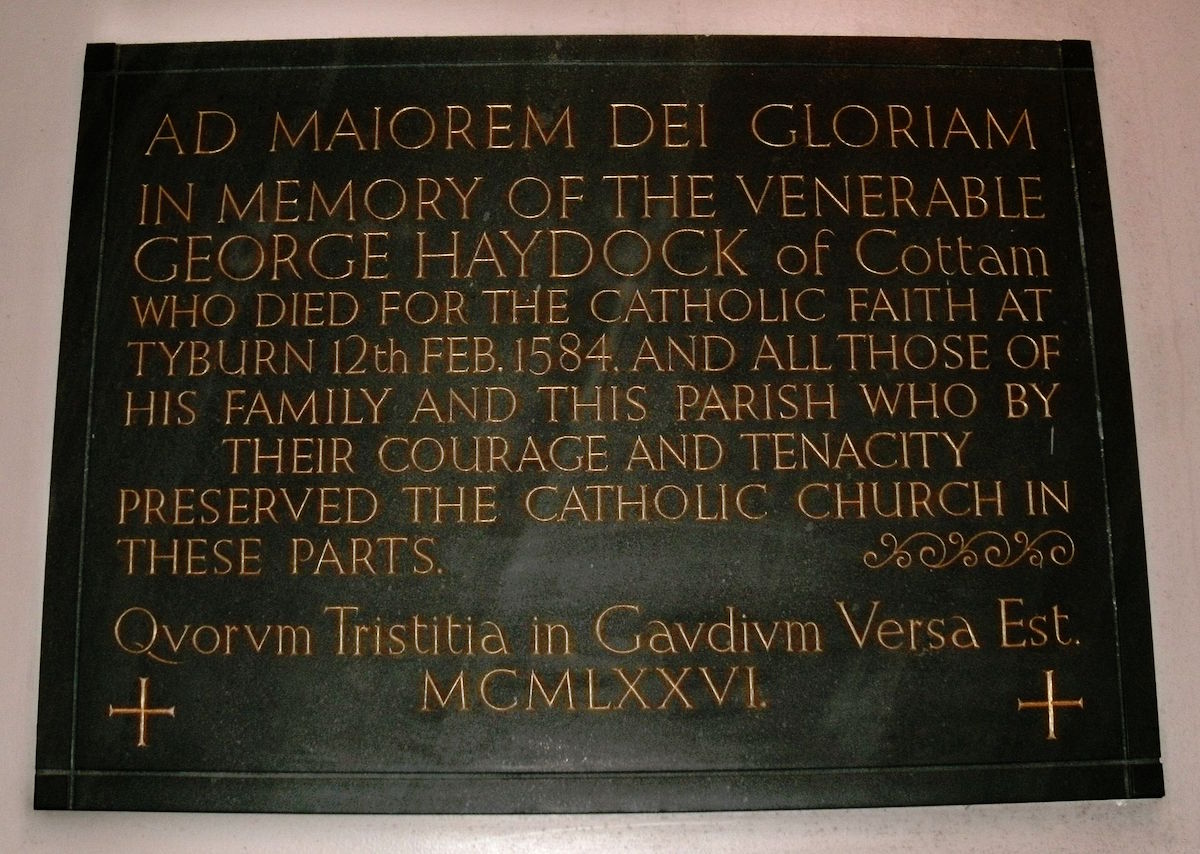
Plaque honoring George Haddock/Haydock at St. Andrew’s & Blessed George Haydock’s Catholic Church, Cottam, Lancashire. (cc) image by Skodoway.

On this day..

1591: Agnes Sampson, North Berwick witch

On this date in 1591, Agnes Sampson, the “Wise Wife of Keith”, went to the stake at Edinburgh during the North Berwick Witch Trials.

Perhaps Scotland’s most notorious witch hunt, the 1590-1591 sweep caught up something approaching 70 supposed sorcerers thanks to the king’s security panic after dangerous North Sea storms had beset the sea voyages uniting King James VI of Scotland and his new wife Queen Anne of Denmark. An inquisition in Denmark had made witches the culprit, and the young James — amusingly described by one commenter as “a superstitious and distrustful poltroon”* — opened an inquiry of his own as soon as he returned to native heather. His subsequent obsession with witchcraft is one of the signal characteristics of his reign, immortalized in literature via Shakespeare’s Macbeth.

James turned 24 in the summer of 1590, his short life already buffeted by fratricidal court politics (his mother, Mary Queen of Scots, lost her head; the regents who subsequently jostled over control of James had a frightening tendency to violent death). However misplaced upon magicians, his fear was well-founded; James’s cousin Lord Bothwell, himself escaped from arrest during the North Berwick scare, openly plotted against James throughout the early 1590s — one occasion coming “with fire to the king’s door, with hammers to the queen’s door” and on another surprising him in a vulnerable position during his morning toilet, causing the king to exclaim, “Came they to seek his life? let them take it — they would not get his soul.”

Peril to life and soul everywhere stretched into James’s world from the world beyond. “Our enemie is over craftie, and we over weake,” James would write in his remarkable 1597 disquisition on black magic, Daemonologie: Satan’s earthly minions so mighty that “They can rayse stormes and tempestes in the aire, either upon Sea or land.”


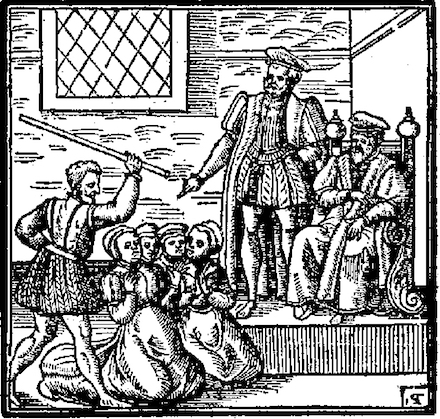
In an illustration from Daemonologie, James personally interrogates witches.

A woman named Geillis Duncan, maid to the deputy mayor of a small town near Edinburgh, was the fountainhead of the the North Berwick trials, when her suspicious master tortured her into admitting to witchcraft. King James personally joined the ensuing interrogations which saw her denounce several dozen Edinburghers as fellow necromancers, among them our day’s principal — a matronly widow named Agnes Sampson, who was a respected “wise woman” and folk healer much in demand among Edinburgh’s elites.

In Duncan’s involuntary narration, this woman “was the elder Witch” and when she “stood stiffely in the deniall of all that was laide to her charge” they dragged her to prison and put her to torture, also shaving her hairless in search of the inevitable small disfigurement that would be prejudicially construed her witches’ mark — “and forasmuch as by due examination of witchcraft and witches in Scotland, it hath latelye beene found that the Deuill dooth generallye marke them with a priuie marke, by reason the Witches haue confessed themselues, that the Diuell dooth lick them with his tung in some priuy part of their bodie, before hee dooth receiue them to be his seruants, which marke commonly is giuen them vnder the haire in some part of their bodye.”

We’re quoting here the 1591 pamphlet Newes from Scotland, one of the key primary sources (and justifications) of the witch trials which was issued from a pen very near to the king’s own hand. Having endured the cruel torture of having her hair wrenched (“thrawn”) by ropes for an hour, Newes from Scotland reports, Sampson broke down when an incriminating wart was discovered upon her bared pudenda.

the said Agnis Tompson confessed that the Divell being then at North Barrick Kerke attending their comming in the habit or likenes of a man, and seeing that they tarried over long, he at their comming enjoyned them all to a pennance, which was, that they should kisse his Buttockes, in signe of duetye to him: which being put over the Pulpit barre, everye one did as he had enjoyned them: and having made his ungodly exhortations, wherein he did greatlye enveighe against the King of Scotland, he received their oathes for their good and true service towards him, and departed: which doone, they returned to Sea, and so home againe.

At which time the witches demaunded of the Divel why he did beare such hatred to the King, who answered, by reason the King is the greatest enemy he hath in the worlde: all which their confessions and depositions are still extant upon record.

Item, the saide Agnis Sampson confessed before the Kings Majestie sundrye thinges which were so miraculous and strange, as that his Maiestie saide they were all extreame lyars, wherat she answered, she would not wishe his Maiestie to suppose her woords to be false, but rather to beleeve them, in that she would discover such matter unto him as his majestie should not any way doubt off.

And therupon taking his Majestie a little aside, she declared unto him the verye woordes which passed betweene the Kings Majestie and his Queene at Upslo in Norway the first night of their mariage, with their answere eache to other: whereat the Kinges Majestie wondered greatlye, and swore by the living God, that he beleeved that all the Divels in hell could not have discovered the same: acknowledging her woords to be most true, and therefore gave the more credit to the rest which is before declared.

One can see the work this tract — circulated as its title implies in England, where James was already being set up to inherit rule from the aging Queen Elizabeth — effects as propaganda: James as “the greatest enemy [the Devil] hath in the worlde”; James as the savvy and thorough interrogator too worldly to be taken by Agnes Sampson’s crazy stories until she proved them with a conveniently unfalsifiable private conference. Definitely no superstitious poltroon! Why, it was only by his superlative faith that James earned the divine favor required to overcome his adversaries’ weather machinations.

She confessed that she tooke a blacke Toade, and did hang the same up by the heeles, three daies, and collected and gathered the venome as it dropped and fell from it in an Oister shell, and kept the same venome close covered, untill she should obtaine any parte or peece of foule linnen cloth, that had appertained to the Kings Majestie, as shirt, handkercher, napkin or any other thing which she practised to obtaine by meanes of one John Kers, who being attendant in his Majesties Chamber, desired him for olde acquaintance betweene them, to helpe her to one or a peece of such a cloth as is aforesaide, which thing the said John Kers denyed to helpe her too, saying he could not help her too it.

And the said Agnis Tompson** by her depositions since her apprehension saith, that if she had obtained any one peece of linnen cloth which the King had worne and fouled, she had bewitched him to death, and put him to such extraordinary paines, as if he had beene lying upon sharp thornes and endes of Needles.

Moreover she confessed that at the time when his Majestie was in Denmarke, she being accompanied with the parties before specially named, tooke a Cat and christened it, and afterward bound to each parte of that Cat, the cheefest partes of a dead man, and severall joynts of his bodie, and that in the night following the saide Cat was conveied into the midst of the sea by all these witches sayling in their riddles or Cities as is aforesaide, and so left the saide Cat right before the Towne of Lieth in Scotland: this doone, there did arise such a tempest in the Sea, as a greater hath not beene scene: which tempest was the cause of the perrishing of a Boate or vessell comming over from the towne of Brunt Iland to the towne of Lieth, wherein was sundrye Jewelles and riche giftes, which should have been presented to the now Queen of Scotland, at her Majesties comming to Lieth.

Againe it is confessed, that the said christened Cat was the cause that the Kinges Majesties Ship at his comming foorth of Denmarke, had a contrary winde to the rest of his Ships, then being in his companye, which thing was most strange and true, as the Kings Majestie acknowledgeth, for when the rest of the Shippes had a faire and good winde, then was the winde contrarye and altogither against his Majestie: and further the saide witche declared, that his Majestie had never come safelye from the Sea, if his faith had not prevailed above their ententions.

Moreouer the said Witches being demaunded how the Divell would use them when he was in their company, they confessed that when the Divell did receive them for his servants, and that they had vowed themselues unto him, then he would Carnallye use them, albeit to their little pleasure, in respect of his colde nature: and would doo the like at sundry other times.

The History of Witchcraft podcast does a deep dive on the North Berwick trials in episode 9 which indulges detail (from about 25:40) on the logistics of witch-burning executions. This episode is part of a whole series on witchy King James that also compasses episodes 7, 8, and 10.

* Ray Defalque and A.J Wright, “In the Name of God: Why Agnes Sampson and Eufame McCalyean were burned at the stake” in Bulletin of Anesthesia History, July 2004. The interest in the case from this unusual-to-Executed Today source is that the charges against Sampson included those of witcherous midwifery, to wit, “remov[ing] Lady Hirmestone’s pain and sickness the night of her labor” and doing the same for Eufame McCalyean. As a result, “several authors have suggested that obstetrical analgesia started in Edinburgh in 1591,” an interpretation that Defalque and Wright, both anesthesiologists, reject.

** Newes from Scotland puts this part of the confession into the mouth of a more historically elusive woman called “Agnis Thompson”: many scholars believe that Sampson and Thompson are the same person.

On this day..

1528: Augustin and Christoph Perwanger

On this date in 1528, brothers Augustin and Christoph Perwanger were beheaded as heretical Anabaptists — “a third baptism, with blood,” in the record of the humanist chronicler Kilian Leib. (A German link, as are most in this entry.)

The noble Hofmarkherr at the Bavarian town of Günzlhofen, Augustin beefed with the district’s pastor over Augustin’s asserted right to appoint the vicar of his choosing to a vacant township. The lord lost that fight and vented about it in that novel medium of movable type.

In 1526 he and his younger brother Christoph joined the Anabaptist movement that was burgeoning in Upper Bavaria. There’s no direct indication of precisely who converted them and how, but Günzlhofen, small though it was, seems to have been a stronghold … just not nearly so strong as to withstand the general persecution of early adult baptism adherents.

Chronicles indicate that an unnamed miller suffered martyrdom with them.

On this day..

1588: Two Nuremberg highwaymen

Nuremberg executioner Franz Schmidt on this date in 1588 broke on the wheel two of the countless violent thieves that haunted the byways of early modernity. As the meticulous Nachrichter did for all his clientele, Schmidt noted the occasion in his diary:

January 2nd. George Hörnlein of Bruck, Jobst Knau of Bamberg, a potter, both of them murderers and robbers. Two years ago Hörnlein and a companion attacked a carrier on the Remareuth, stabbed him four times so that he died, and took 32 florins. Six weeks ago he and Knau were consorting with a whore. She bore a male child in the house, where Knau baptised it, then cut off its hand while alive. Then a companion, called Schwarz, tossed the child in the air, so that it fell upon the table, and said: “Hark how the devil whines!” then cut its throat and buried it in the little garden belonging to the house.

A week later the above-mentioned Hörnlein and Knau, when the whore of the aforesaid Schwarz bore a child, wrung its neck; then Hörnlein, cutting off its right hand, buried it in the yard of the house. Six weeks ago Hörnlein and Knau with a companion, a certain Weisskopf, attacked a man between Herzog and Frauen Aurach. Knau shot him dead, took 13 florins, dragged the body into the wood and covered it with brushwood.

[A long list of murders and highway robberies follows here. Schmidt adds:]

To conclude it would require another half sheet to write down all the people they attacked … The two murderers were led out on a tumbril. Both their arms were twice nipped with red-hot tongs, and their right arms and legs broken; lastly they were executed on the wheel.

On this day..

1591: Edmund Geninges

Catholic priest Edmund Geninges (also Gennings, or Jennings) was executed on this date in 1592, along with the layman Swithburne Welles, whose home played host to Geninges’s final Mass. At least, that’s according to The life and death of Mr. Edmund Geninges priest, crowned with martyrdome at London, the 10. day of November, in the yeare M.D.XCI., by .

Despite the title, the text within that volume correctly places events on “fryday the 10 day of December” — per the Julian calendar still in use in England at that time. The book was even by the priest’s brother, John Gennings: m must have just been a typeset-o on the frontispiece.

As merchants of the grim we excerpt the portion of that tract focusing on Geninges’ death. A fuller summary of the hagiography can be enjoyed on Early Modern Whale.

When the happy houre of his passion was come being 8 of the clocke on fryday the 10 day of December, M. Plasden, M. White, and the rest were carryed to Tyborne, & there executed. Mistresse Welles to her great grief was reprived, and died in prison. M. Edmund Geninges, and M. Swythune Welles, as is aforesayd, were condemned to be executed in Grayes Inne fieldes on the North side of Holborne, over agaynst his owne dore: When they were brought thither, after a few speaches of a Minister or two that were there present, M. Geninges was taken of the sledd, whereon he lay. In the meane time he cryed out with holy S. Andrew: O bona Crux diu desiderata, & iam concupiscenti animo preparata, securus & gaudens venio ad te; ita & tu exultans suspicias me discipulum eius qui pependit in te! O good gibbet long desired, and now prepared for my hart much desiring thee, being secure and ioyfull I come unto thee, so thou also with ioy, I beseech thee receyue me the disciple of him that suffered on the Crosse.

Being put upon the ladder naked to his shirte, many questions were asked him by some standers by, wherto he answered still directly. At length M. Topliffe being present cryed out with a loud voyce, Geninges, Geninges, confesse thy fault, thy Popish treason, and the Queene by submission (no doubt) will grant thee pardon. To which he mildly answered, I knowe not M. Topliffe in what I have offended my deare annoynted Princesse, for if I had offended her, or any other in any thing, I would willingly aske her, and all the world forgivenesse. If she bee offended with me without a cause, for professing my fayth and religion, because I am a Priest, or because I will not turne Minister agaynst my conscience, I shalbe I trust excused and innocent before God: Obedire (sayth S. Peter) oportet Deo magis quam hominibus, I must obey God rather than men, and must not in this case acknowledge a fault where none is. If to returne into England Priest, or to say Masse be Popish treason, I heere confesse I am a traytour; but I thinke not so. And therefore I acknowledge my selfe guilty of these thinges, not with repentance or sorrow of hart, but with an open protestation of inward ioy, that I have done so good deedes, which if they were to do agayne, I would by the permission and assistance of Almighty God accomplish the same, although with the hazard of a thousand lives.

Which wordes M. Topliffe hearing, being much troubled therwith, scarce giving him leave to say a Pater noster, bad the Hangman turne the ladder, which in an instant being done, presently he caused him to be cut downe, the Blessed martyr in the sight of all the beholders, being yet able to stand on his feete, & casting his eyes towardes heaven, his senses were very little astonished, in so much that the Hangman was forced to trippe up his heeles from under him to make him fall on the blocke. And being dismembred, through very payne, in the hearing of many, with a lowde voyce he uttered these wordes, Oh it smartes, which M. Welles hearing, replyed thus: Alas sweete soule thy payne is great indeed, but almost past, pray for me now most holy Saynt, that mine may come. He being ripped up, & his bowelles cast into the fire, if credit may be given to hundreds of People standing by, and to the Hangman himselfe, the blessed Martyr uttered (his hart being in the executioners hand) these words, Sancte Gregori ora pro me, which the Hangman hearing, with open mouth swore this damnable oath, Gods woundes, See his hart is in my hand, and yet Gregory in his mouth, o egregious Papist! Thus the afflicted Martyr even to the last of his torments cryed for the ayde & succour of Saynts, and especially of S. Gregory his devoted patron, and our countries Apostle that by his intercession he might passe the sharpnes of that torment.

And thus with barbarons [sic] cruelty our thirce [sic] happy Martyr finished the course of his mortall life, and purchased no doubt a crowne of immortality in the glorious Court of heaven. Wherfore now he triumpheth with all unspeakeable ioy, and [b]eatitude amongst the number of those blessed martyrs who have in this world suffered all torments of persecution, and have withstood Princes and Potentates, lawes and lawmakers, for the honour and glory of theyr Lord and Saviour, and therfore have found true the confortable saying of holy David, Qui seminant in lachrymis, in exultatione metent: They who sow in teares, shall reape in ioy. Now so much the more is our Saynt glorifyed, by how much the more he was tormented, according to that saying of S. Cyprian: Quo longior vestra pugna hic, corona sublimior, presens tamen confessio quanto in passione fortior, tanto clarior & maior in honore. By how much your combat is the longer, by so much your crowne shall be the higher, so that by how much stronger the present confession is in suffering, so much more glorious and greater it shall be in honour.

On this day..

1531: Rhys ap Gruffydd

On this date in 1531, a Welsh nobleman whose grandfather had been instrumental in raising the Tudor dynasty up caught the downswing of the Tudor dynasty’s axe.

Gruffydd ap Rhys ap Thomas (“son of Rhys, son of Thomas”) was the Welsh patriarch of an illustrious house who had taken the Lancastrian side during the English Wars of the Roses.

When the Lancastrians lost, he took the necessary oaths to the likes of Richard III but his reputed promise to defend Wales for his king with such ferocity that an invader must needs “make his entrance and irruption over my belly” was discharged in a ceremony equally literary and lawyerly — when he stood under a bridge while his invading ally, the Welsh-descended Henry Tudor, marched over it.


There’s always a loophole when one fails to insist on direct language.

Together the two would win the crown for Henry — and in a sense very much win it for Wales — at Bosworth Field, where Gruffydd is sometimes credited personally with the blow that felled King Richard.

He lived on to 1525, a loyal supporter of Henry VII and his son Henry VIII. But the reciprocal gratitude of the kings did not outlive Gruffydd’s passing, for the Welsh offices that he designed to pass to his grandson Rhys ap Gruffydd were instead foisted on Water Devereux, Baron Ferrers.*

The consequent hostility would set Rhys on his way to the block. In 1529, our man drew a blade on Devereux, and their respective bands of retainers skirmished violently with each other over succeeding months.

Attempting to elevate his frustrated political claim by assuming the name “Fitz Urien” — in reference to a half-legendary ancient Welsh king — finally got him clapped in the Tower. His subsequent trial on a fanciful charge of conspiring with Scotland to form a Celtic league against the English asserted the central royal authority against a noble loose cannon who also happened to be part of the Catholic, anti-Anne Boleyn faction; at a stretch it could arguably** be read to make him one of the earliest victims of the still-nascent English Reformation. Be that as it may, his countrymen did not much mourn the fall of a vaunting and greedy line, however spurious the grounds.

And indeed many men regarded his [Rhys’s] death as Divine retribution for the falsehoods of his ancestors, his grandfather, and great-grandfather, and for their oppressions and wrongs. They had many a deep curse from the poor people who were their neighbours, for depriving them of their homes, lands and riches. For I heard the conversations of folk from that part of the country that no common people owned land within twenty miles from the dwelling of Sir Rhys ap Thomas, that if he desired such lands, he would appropriate them without payment or thanks, and the disinherited doubtless cursed him, his children and his grandchildren, which curses in the opinion of many men fell on the family, according to the old proverb which says — the children of Lies are uprooted, and after oppression comes a long death to the oppressors. (Source)

* An ancestor of Elizabethan loverboy Robert Devereux, Earl of Essex.

** That argument is made by Ralph Griffiths in Sir Rhys ap Thomas and his Family: A Study in the Wars of the Roses and Early Tudor Politics.

On this day..

1575: Archbishop Leonid of Novgorod

Jack Culpepper’s “The Kremlin Executions of 1575 and the Enthronement of Simeon Bekbulatovich” (Slavic Review, September, 1965) notes a single anonymous chronicle dating to the early 17th century alluding to a mysterious Kremlin purge … several years after the notorious Oprichnina.

Regarding the other executions of the same year in Moscow on the square near the Uspensky Cathedral, the Tsar disgraced many individuals, ordering the execution within the Kremlin and in his presence, on the square near the Uspensky Cathedral, of the following: the boyar Prince Petr Kurakin, Protasii Iur’ev, the archbishop of Novgorod, the protopope of the Arkhangel’sky Cathedral, Ivan Buturlin, Nikita Borozdin, the archimandrite of the Chudov Monastery, and many others. Their heads were thrown before the residences of Prince Ivan Mstislavsky, the metropolitan, Ivan Sheremetev, Andrei Shchelkalov, and others.

According to Culpepper that Archbishop of Novgorod, Leonid by name, faced the executioner on October 20, 1575 after being summoned to a sobor — but no records preserve the conclave’s deliberations or the proceedings against Archbishop Leonid. Others both secular and ecclesiastical shared his fate throughout that autumn. (Ivan had no compunctions when it came to burdening his soul with the death of a clergyman.)

A Holy Roman Empire courtier who reached Moscow late that year would record by way of explanation for the bloodbath that the perennially paranoid Ivan had put to death some forty nobles for a suspected interest in his assassination.

This supposed plot against him is one possible reason for Ivan’s strange decision around the same time to faux-abdicate the throne. In September or October of 1575, Ivan plucked the ruler of a vestigial khanate dependency and made this gentleman, Simeon Bekbulatovich, Grand Prince of Rus’.

Ivan, of course, maintained the real power; he would claim to an English visitor that it was a ruse to throw off his murderers, telling him:

we highlye forsawe the varyable and dungerous estate of princes and that as well as the meanest they are subiect unto chaunge which caused us to suspect oure owne magnificence and that which nowe inded ys chaunced unto us for we have resyned the estate of our government which heathertoo hath bene so royally maynteyned into the hands of a straunger whoe is nothinge alyed unto us our lande or crowne. The occasion whereof is the perverse and evill dealinge of our subiects who mourmour and repine at us for gettinge loyaull obedience they practice againste our person. The which to prevent we have gyvene them over unto an other prince to governe them but have reserved in our custodye all the treasure of the lande withe sufficient trayne and place for their and our relyefe.

Ivan did indeed relieve his proxy tsar the very next year, demoting him to Prince of Tver and Torzhok. Despite the approaching “Time of Troubles” crisis following Ivan’s death when nobles would struggle for the right to sire the next Muscovite dynasty, the still-living former Grand Prince was such an absurd character that he never figured as a contender for the crown. (He would be forced into a monastery, however.) Bekbulatovich died naturally in 1616.

On this day..

1586: John Lowe, John Adams, and Robert Dibdale, English Catholics

(Thanks to Richard Stanton for his guest post, originally published in A menology of England and Wales, or, Brief memorials of the ancient British and English saints arranged according to the calendar, together with the martyrs of the 16th and 17th centuries. Writing in the 19th century, Stanton calls these English martyrs “Venerable” but at present they are “Blessed” — having been advanced further along the path to sainthood in 1987. -ed.)

The Venerable John Lowe was born in London, and for some time was a Protestant minister. On his conversion he went to the College at Douay, and from thence to Rome, where he was ordained priest. In due time he returned to England and laboured on the Mission, till he was arrested and condemned and executed for high treason, on account of his priestly character and the exercise of its functions.

The Venerable John Adams was a native of Dorsetshire, and went to Rheims for his theological studies. He returned to England as a priest in 1581, and after some time was seized and banished, with a number of others, in the year 1585. After a few months’ stay at the College, he contrived to return to his labours on the Mission, but was once more apprehended and condemned to death, barely for being a priest. Few particulars are known relative to this Martyr, but it is recorded in one of the catalogues that his constancy was proof against all the artifices and promises, used to divert him from his generous resolution to sacrifice his life for the Faith.

The Venerable Richard, or, as he is called in some catalogues, Robert Dibdale, was born in Worcestershire. He became a student, and in due time a priest, of the English College at Rheims. In the year 1584 he was sent on the Mission, which he diligently served for some time. He was however arrested by the persecutors, tried and condemned for high treason, on account of his priestly character and functions. This Martyr, like a number of other missioners of that time, was remarkable for the gift he possessed of exorcising evil spirits. A fellow-missioner has left an account of several wonderful instances of this kind, of which he was himself witness, and others are recorded by Yepez, Bishop of Tarrasona, in his account of the English persecution. These wonderful occurrences were said to be the cause of numerous conversions to the faith.

The three Martyrs, Lowe, Adams, and Dibdale, all suffered at Tyburn on the same day, the 8th October, and on the mere charge of their priesthood, which by the recent statute was declared to be high treason.

On this day..

1517: Konrad Breuning, Tübingen Vogt

On this date in 1517, aged magistrate Konrad Breuning was beheaded as a traitor for helping negotiate a landmark limitation of the Duke of Württemberg’s powers.

Fruit of a wealthy Tübingen family — one can still see in the church there the donative Breuning BellKonrad Breuning was a Vogt, one of the Holy Roman Empire’s important municipal administrators.

In 1514, crushed by taxation and written out of political power, commoners both urban and rural mounted a rebellion known as “Poor Konrad”. (Its title had nothing to do with our post’s star character; “Konrad” was just a common name that had come to denote the everyman.)

Wealthy elites were able to leverage the rebellion’s pressure,* and Duke Ulrich‘s increasingly desperate need for revenues that only they could authorize, into a sort of Magna Carta for the duchy: the Treaty of Tübingen. As the name implies, it was negotiated right in Konrad Breuning’s stomping-ground; the site was his own suggestion.

This great coup was attained at a great cost, for Duke Ulrich was a mercurial fellow who would eventually be run out of Württemberg altogether after he outright murdered a guy. That murder, in 1515, perhaps drove Ulrich to an attempted (and backfiring) show of authority with the 1516 arrest of Bruening, his brother Sebastian (who was Vogt of a different town), and Konrad Vaut (yet another Vogt, and see what we mean about the popularity of the name?). Their rank did not protect them from the torture necessary to extract confessions.

All three were condemned to death for treason in a stacked trial in December 1516. For reasons that are not self-evident to me from the mostly-German sources that I have found, the other two Vogts lost their heads more or less promptly after their conviction but Konrad Bruening was maintained as Ulrich’s most unwilling guest for most of a year before he finally followed them. Maybe it was the duke protracting the savor of his revenge upon Tübingen’s bourgeoisie for that treaty.

* Despite the role of Poor Konrad in catalyzing the Treaty of Tübingen, the urban lower orders got much less out of the deal than the 1% types, and the peasantry was shut out altogether. It would not be long before the frustration of the latter class again conjured an insurrection: the devastating 1524-1525 Peasants War.

On this day..