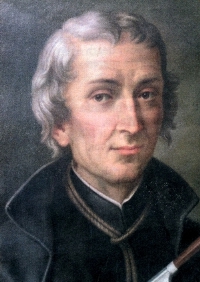
1676: Col. Thomas Hansford, the first American independence martyr

Col. Thomas Hansford was hanged “a loyal subject and a lover of my country” on this date in 1676 — America’s first executed political martyr, since that “country” was not England, but Virginia.

Robert Beverly‘s 1705 History of Virginia recalls the genesis of that milestone dispute between settlers and mother England.

The occasion of this rebellion is not easy to be discovered: but ’tis certain there were many things that concurred towards it. For it cannot be imagined, that upon the instigation of two or three traders only, who aimed at a monopoly of the Indian trade, as some pretend to say, the whole country would have fallen into so much distraction; in which people did not only hazard their necks by rebellion, but endeavored to ruin a governor, whom they all entirely loved, and had unanimously chosen; a gentleman who had devoted his whole life and estate to the service of the country, and against whom in thirty-five years experience there had never been one single complaint. Neither can it be supposed, that upon so slight grounds, they would make choice of a leader they hardly knew, to oppose a gentleman that had been so long and so deservedly the darling of the people. So that in all probability there was something else in the wind, without which the body of the country had never been engaged in that insurrection.

Four things may be reckoned to have been the main ingredients towards this intestine commotion, viz., First, The extreme low price of tobacco, and the ill usage of the planters in the exchange of goods for it, which the country, with all their earnest endeavors, could not remedy. Secondly, The splitting the colony into proprieties, contrary to the original charters; and the extravagant taxes they were forced to undergo, to relieve themselves from those grants. Thirdly, The heavy restraints and burdens laid upon their trade by act of Parliament in England. Fourthly, The disturbance given by the Indians.

Tobacco aside, these are grievances straight from the next century’s Declaration of Independence at the outset of the (more successful) American Revolution:

cutting off our Trade with all parts of the world:

… imposing Taxes on us without our Consent:

endeavoured to bring on the inhabitants of our frontiers, the merciless Indian Savages whose known rule of warfare, is an undistinguished destruction of all ages, sexes and conditions.

So, tax revolt + political self-determination + impatience about arrangements with Indians who could be wiped out instead. Eventually, this would germinate a mighty empire.

In 1676, it germinated a colonial rebellion against the mighty empire — Bacon’s Rebellion, an unsuccessful rising that is easily read in retrospect as a prototype for the more illustrious revolt one century later.

The suppression of Bacon’s Rebellion also involved a rash of executions, which we’ve touched on before. King Charles II would complain that his Virginia governor’s severity “has taken more lives in that naked country than I have taken for the murder of my father.”

The man dignified to be the first of these executions — and therefore, if you like, the first man put to death in the service of American liberty — was actually nabbed by our historian’s father, also named Robert Beverly, “a parson calculated to the Lattitude of the Servis, which required descretion, Curage, & Celerity, as qualetys wholly subservant to military affares.” (source)

snapt up one Coll: Hansford, and his party … It is saide that Hansford, at (or a little before) the onslaut, had forsaken the Capitole of Marss, to pay his oblations in the Temple of Venus; which made him the easere preay to his enemies; but this I have onely upon report, and must not aver it upon my historicall reputation: But if it was soe, it was the last Sacryfize he ever after offered at the Shrine of that Luxurious Diety, for presently after that he came to Accomack, he had the ill luck to be the first Berginian borne that dyed upon a paire of Gallows. When that he came to the place of Execution (which was about a Mile removed from his prisson) he seemed very well resalved to undergo the utmost mallize of his not over kinde Destinie, onely Complaineing of the manner of his death: Being observed neather at the time of his tryall (which was by a Court Martiall) nor afterwards, to suplicate any other faviour, then that he might be shot like a Soulder, and not to be hang’d like a Dog. But it was tould him, that whwat he so passionately petitioned for could not be granted, in that he was not condem’d as he was merely a Soulder, but as a Rebell, taken in Arms against the King, whose Laws had ordained him that death. Dureing the short time he had to live, after his sentance, he approved to his best advantage for the well fare of his soule, by repentance and contrition for all his Sinns, in generall, excepting his Rebelellion, which he would not acknowledg; desireing the People, at the place of execution, to take notis that he dyed a Loyall Subject, and a lover of his Countrey; and that he had never taken up arms, but for the destruction of the Indians, who had murthered so many Christians.

(A modernized, and less atmospheric, version of the same passage can be read here.)

Hansford’s story and the larger one of Bacon’s Rebellion are treated at second hand in several public-domain histories available online — see here, here, and here.

It also seems that, besides being the first martyr to American liberty, Hansford also had the distinction of being the first native-born Virginian (white Virginian, we presume) ever executed.

On this day..

1610: Blessed George Napier

On this date in 1610, the Catholic priest George Napier (or Napper, or Nappier) was hanged, drawn, and quartered at Oxford, having said Mass that very morning.

A son of Oxford himself who went abroad to France for ordination in his outlawed faith, Napier cut a fairly typical martyrology for the Catholic clergy. He was caught red-handed with the implements of the Roman church, refused to avow the supremacy of the English crown, and aggravated his offense by converting a fellow-prisoner to Catholicism.

This unfortunate has made headlines recently around the fourth centennial of his martyrdom, for which occasion a pilgrimage of Catholic faithful unveiled a plaque in Nappier’s honor at Oxford Castle.


Archbishop Bernard Longley blessing on Oct. 23, 2010 the marker honoring George Napier. Images on this page (cc) Joseph Shaw.

On this day..

1659: The first two Boston Martyrs

October 27 is International Religious Freedom Day, dating to the execution this date in 1659 of Quakers Marmaduke Stephenson and William Robinson on Boston Commons. They were two of the four Boston Martyrs, Quakers whose necks were stretched in Massachusetts for failing to either keep quiet or stay out of town.

(Fellow Quaker Mary Dyer, perhaps the more famous martyr, was led out to execution with Stephenson and Robinson but reprieved at the last moment. Her time was still some months away.)

As Puritans had fled C-of-E persecution earlier in the 17th century, Quakers migrated to the New World with Cromwell‘s Puritan ascendancy.

And in the Massachusetts Bay Colony, the old dissidence had become the new orthodoxy — as described by the (obviously partisan) Horatio Rogers. (Via)

In June, 1659, William Robinson, a merchant of London, and Marmaduke Stephenson, a countryman of the east pan of Yorkshire, “were moved by the Lord,” in Quaker phrase, to go from Rhode Island to Massachusetts to bear witness against the persecuting spirit existing there; and with them went Nicholas Davis of Plymouth Colony, and Patience Scott of Providence, Rhode Island, a girl of about eleven years of age … During their incarceration Mary Dyer was moved of the Lord to go from Rhode Island to visit the prisoners, and she too was arrested and imprisoned. On September 12, 1659, the Court banished the four adults from Massachusetts upon pain of death

… On October 8, within thirty days of her banishment, Mary Dyer with other Rhode Island Quakers went to Boston, …where she was again arrested and held for the action of the authorities. Five days later William Robinson and Marmaduke Stephenson, who had been travelling about spreading their doctrines through Massachusetts and Rhode Island since their release from prison, also went to Boston to look the bloody laws in the face, in the words of the Quaker chronicler; and they too were arrested and cast into prison. …

The issue was now clearly made between Quaker and Puritan. The Quaker defied the unjust Puritan laws, and dared martyrdom. Dare the Puritan authorities inflict it?

On October 19 the three prisoners were brought before Governor Endicott and the Assistants, and demand having been made of them — Why they came again into that jurisdiction after having been banished from it upon pain of death if they returned? — they severally declared that the cause of their coming was of the Lord and in obedience to him. The next day they were again brought before the magistrates, when the Governor called to the keeper of the prison to pull off their hats, which having been done, he addressed them substantially as follows: “We have made many laws and endeavored in several ways to keep you from among us, but neither whipping nor imprisonment, nor cutting off ears, nor banishment upon pain of death, will keep you from among us. We desire not your death.” Notwithstanding which, he immediately added: “Hearken now to your sentence of death.” … When the Governor ceased speaking, however, Stephenson lifted up his voice in this wise: “Give ear, ye magistrates, and all who are guilty, for this the Lord hath said concerning you, who will perform this promise upon you, that the same day that you put his servants to death shall the day of your visitation pass over your heads, and you shall be cursed forevermore, the Lord of Hosts hath spoken it; therefore in love to you all take warning before it be too late, that so the curse might be removed; for assuredly if you put us to death, you will bring innocent blood upon your own heads, and swift destruction will come upon you.” …

Great influence was brought to bear to prevent the execution of the sentences. Governor Winthrop of Connecticut appeared before the Massachusetts authorities, urging that the condemned be not put to death. He said that he would beg it of them on his bare knees that they would not do it. … Governor Endicott, the Rev. John Wilson, and the whole pack of persecutors, however, seemed to thirst for blood; and it was determined that somebody must die.

The 27th of October, 1659, was fixed for the triple execution and elaborate preparations, for those days, were made for it. Popular excitement ran high, and the people resorted to the prison windows to hold communication with the condemned, so male prisoners were put in irons, and a force was detailed, in words of the order, “to watch with great care the towne, especially the prison.”…

The eventful day having arrived, Captain Oliver and his military guard attended to receive the prisoners. The marshal and the jailer brought them forth, the men from the jail, and Mary Dyer from the House of Correction. They parted from their friends at the prison full of joy, thanking the Lord that he accounted them worthy to suffer for his name and had kept them faithful to the end. The condemned came forth hand in hand, Mary Dyer between the other two, and when the marshal asked, “Whether she was not ashamed to walk hand in hand between two young men,” for her companions were much younger than she, she replied, “It is an hour of the greatest joy I can enjoy in this world. No eye can see, no ear can hear, no tongue can speak, no heart can understand, the sweet incomes and refreshings of the spirit of the Lord which now I enjoy.” The concourse of people was immense, the guard was strong and strict, and when the prisoners sought to speak the drums were caused to be beaten.

The method of execution was extremely simple in those days. A great elm upon Boston Common constituted the gallows. The halter having been adjusted round the prisoner’s neck, he was forced to ascend a ladder affording an approach to the limb to be used for the fatal purpose, to which limb the other end of the halter was attached. Then the ladder was pulled away, and the execution, though rude, was complete.

The prisoners took a tender leave of one another, and William Robinson, who was the first to suffer, said, as he was about to be turned off by the executioner, ‘I suffer for Christ, in whom I lived, and for whom I will die.” Marmaduke Stephenson came next, and, being on the ladder, he said to the people, “Be it known unto all this day, that we suffer not as evil-doers, but for conscience sake.”

Next came Mary Dyer’s turn. Expecting immediate death, she had been forced to wait at the foot of the fatal tree, with a rope about her neck, and witness the violent taking off of her friends. With their lifeless bodies hanging before her, she was made ready to be suspended beside them. Her arms and legs were bound, and her skirts secured about her feet; her face was covered with a handkerchief which the Rev. Mr. Wilson, who had been her pastor when she lived in Boston, had loaned the hangman. And there, made ready for death, with the halter round her neck, she stood upon the fatal ladder in calm serenity, expecting to die….

Just then an order for a reprieve, upon the petition of her son all unknown to her, arrives. The halter is loosed from her neck and she is unbound and told to come down the ladder. She neither answered nor moved. In the words of the Quaker chronicler, “she was waiting on the Lord to know his pleasure in so sudden a change, having given herself up to dye.” The people cried, “Pull her down.” So earnest were they that she tried to prevail upon them to wait a little whilst she might consider and know of the Lord what to do. The people were pulling her and the ladder down together, when they were stopped, and the marshal took her down in his arms, and she was carried back to prison. . .

It was a mere prearranged scheme, for before she set forth from the prison it had been determined that she was not to be executed, as shown by the reprieve itself, which reads as follows: “Whereas Mary Dyer is condemned by the Generall Court to be executed for hir offences, on the petition of William Dier, hir sonne, it is ordered that the sajd Mary Dyer shall have liberty for forty-eight howers after this day to depart out of this jurisdiction, after which time, being found therein, she is forthwith to be executed, and in the meane time that she be kept a close prisoner till hir sonne or some other be ready to carry hir away within the aforesajd tyme; and it is further ordered, that she shall he carrjed to the place of execution, and there to stand upon the gallowes, with a rope about her necke, till the rest be executed, and then to returne to the prison and remajne as aforesaid.

Mary Dyer once again returned from exile the following year, and was hanged in June 1660.

The hours were numbered, however, for New England Puritans in their most cartoonishly obnoxious form. Upon the restoration of the monarchy in the mother country, an edict forbidding the death penalty for Quakerism closed the doors to the Boston Martyrs club.

An Account of the Sufferings of Marmaduke Stephenson is available free on Google books.

On this day..

1689: Quirinus Kuhlmann, mystic poet

“Seldom is a poet burned alive, no matter how critics may roast his work!”

-Robert Beale

On this date in 1689, German poet and mystic Quirinus Kuhlmann was roasted in Moscow for heresy.

This Silesian millenarian (English Wikipedia entry | German) experienced a mystical conversion and spent his law school hours instead scribbling visionary poetry and devouring visionary texts.

Inflamed with Bohmian fire, I read Bohme with fiery eagerness and capacity. I did not know the Bohmian texts and I knew them the same day. What an admiration (o Jesus!) overcame me when I heard Bohme tell his revelations which I had learned from the universe of nature, with God as my teacher, it were the revelations the first outlines of which I just had begun to delineate in my own works.

-Quoted in Toward the Millennium: Messianic Expectations from the Bible to Waco

Quirinus’s particular vibe was an end-times kingdom of Jesus thing with the Catholic Church as the Antichrist. He cast about Europe vainly imploring princes to ally — Protestants with Orthodox with Mussulmen — to destroy the papal whore of Babylon. This

Prince of Fanatics … wrote a book, entitled Prodromus Quinquennii Mirabilis, and published at Leyden in 1674, in which he set forth his peculiar views. He stated that in that same year the Fifth Monarchy or the Christian Kingdom was about to commence, that he himself would bring forth a son from his own wife, that this son by many miracles would found the kingdom, and that he himself was the Son of God. On account of these mad ravings he was exiled by the Chief of the United Provinces of the Netherlands, and expelled with infamy from the University of Leyden. But his strange mission did not cease. He wandered for some time in France and England … He then proceeded to Turkey on his mission, and presented himself to the Sultan. Although ignorant of the language of the country, he persuaded himself that he could speak in any tongue; but when they led him into the presence of the Sultan he waited in vain for the burning words of eloquence to flow. The Turks dealt with him according to his folly, and bestowed on him a sound thrashing. Thence he proceeded to Russia …

Kuhlmann could have picked a better time to evangelize Russia than the reign of Peter the Great. This progressive despot did indeed look west for Russia’s future: in industry, in law, in war, even in fashion. But certainly not in holy alliances.

It was a fellow-German in Moscow, a Lutheran pastor, who denounced Kuhlmann as a dangerous heretic. He and a follower were duly burned as such.

On this day..

1661: Kaj Lykke, in effigy

On an uncertain date in 1661, the Danish noble Kaj Lykke (sometimes Kai Lykke) — safely but penuriously absconded to exile — was “executed” in effigy.

This wealthy roue (Danish Wikipedia page) was famous for his affairs innumerable.

To one of these maids, Lykke addressed a love-note remarking that the unpopular queen consort Sophie Amalie enjoyed queen consorting with her servants.

The sort of salacious rumor-mongering that constitutes many a blogger’s daily bread (and no doubt many a debauched noble’s pillow-talk) was, in Denmark at the dawn of its absolute monarchy, lese-majesty, and a good excuse once it became known to seize the naughty noble’s riches for the crown.

Lykke got himself abroad and didn’t have to face the music in the flesh — though the forfeited estates were no mean loss — and a doll representing the dirty-minded fugitive had its hands and head lopped off in Lykke’s stead in Copenhagen.

Kaj Lykke returned from exile (Swedish link) and died in Denmark in 1699. Centuries later, his skull was unearthed pursuant to eugenics research: the theory was that this bad boy’s sloping forehead showed him to be a primitive Neanderthal-descended type.

Though that particular bit of pseudo-science has long since been buried, Lykke’s skull never has been — and given that it’s out and about anyway, it’s been used to reconstruct the noble’s appearance. (I’ve been unable to locate an image of this reconstruction online.)

Part of the Themed Set: Executions in Effigy.

On this day..

1635: Francisco de Nava, precipitating a church-state conflict

[S]trife* [between Manila archbishop Hernando Guerrero and the Spanish governor Don Sebastián Hurtado de Corcuera] being greatly inflamed … became entangled with one of the most memorable disputes that have occurred in the islands — a necessary occasion for the sharpest encounter between the two jurisdictions, and one from which Don Fray Hernando Guerrero could not excuse himself, as it concerned the most sacred part of the ecclesiastical immunity. That was a matter in which the archbishop could not neglect to sally out with all his might, in order to comply with the obligation of a true prelate. The case was as follows: There was an artilleryman in Manila, named Francisco de Nava, who had a female slave with whom he had illicit communication, as came to the ears of the archbishop. The archbishop ordered him to remove from himself this occasion [for sin] by selling the slave-girl to another person; and had the latter placed, for that purpose, in the house of a lady who was related to Doña María de Francia, who became fond of her and arranged to buy her from the artilleryman. The latter was so beside himself over the loss of the said slave that he refused to sell her at any price, saying that he wished, on the contrary, to marry her. But Doña María de Francia so arranged matters that the slave was sold, and came into her possession with very slight effort. The artilleryman, grieved and regretful for what had happened, almost became mad, and, it having been given out that he was mad, certain violence was shown him; and on one occasion he had received a sound beating at the house of Doña María de Francia, because he had gone there to request that they should give him the slave, as he had resolved to make her his wife.

Aggrieved and rendered desperate in this way, he saw the girl pass one day in a carriage with Doña María de Francia. Going to her he asked her whether she knew him, who was her master. The slave answered him with some independence, whereupon he, blind with anger, drew his dagger in the middle of the street and killed her by stabbing her, before anyone could prevent it. All the people, both those in the carriage and those in the street, ran tumultuously [after him]; but the artilleryman escaped them all, and took refuge in the church of our convent in Manila. The governor heard of what had happened, and ordered Don Pedro de Corcuera, his nephew (who was then sargento-mayor of the camp), to take the artilleryman from the church, saying that he could not avail himself of the sanctuary of the church, as he had committed a treacherous act — although it was only a homicide, and the settlement of this question did not concern the governor. However, his action arose mainly from the anger that he felt that what had happened was in the presence of his nephew, Don Pedro de Corcuera — who, also being angered at what concerned his wife, made use of his commission with less prudence than he ought to exercise in executing such orders from his superiors. He caused the church and convent to be surrounded; and, going inside, examined everything, not excepting even the sacristy; and it is even said that he declared that, if he found the artilleryman there, he would take him out a prisoner. But not having been able to find him then, Don Pedro left the church and convent surrounded by a double guard. The governor added to that that he would not allow the religious to enter or leave, until he had hold of the refugee. The latter was finally found, and taken from the sacristy, and surrendered to the commander of artillery, in order that he might proceed with the trial as his competent judge; and he, either carried away by flattery, or in obedience to the commands of the governor, proceeded so hastily that in a very short time he condemned the artilleryman to death.

The archbishop’s provisor, Don Pedro Monroy,** bore himself on this occasion with the prudence that was fitting, and proceeded against the commander of artillery, requesting him to deliver his prisoner and return him to the church. Having been informed that the commander of artillery was a mere instrument, and that all his actions were according to the impulses of the governor, he sent three lay priests to the palace to intimate to the latter that the judge should deliver the refugee to him. The priests entered, without anyone hindering them; and finding that the governor had already retired, as it was then an advanced hour of the night, they started to withdraw in order to return next morning; but the soldiers of the guard would not permit them to leave, saying that such was the order of the governor.

The sentence against the artilleryman having been given — which it is said that the governor sent ready made out to the judge, to sign — they proceeded to execute it,† notwithstanding that the provisor proceeded to threaten censures, and to impose an interdict and suspension from religious functions [cessatio de divinis]. The governor ordered a gallows to be erected in front of the very church of St. Augustine, and the criminal was hanged thereon — to the contempt of the ecclesiastical immunity, for the [proper] place assigned for such punishments was very distant from there. The governor, seeing that the sentence was already executed, and that he had now obtained the chief object of his desire, wrote to the archbishop, requesting him to have the censures removed and the interdict raised, and the churches opened on the day of the nativity of our Lady. The archbishop, recognizing the duplicity of the governor, refused to answer that letter without first consulting the orders; and, after consulting with some of them, decided that he would not raise the interdict, since there was less inconvenience in having it imposed [even] on so festive a day, than there would be in his yielding on an occasion so inimical to the ecclesiastical immunity. However, the requests of the Recollect fathers of our father St. Augustine, who had charge of the advocacy of the nativity, had so much influence that the archbishop ordered the interdict to be removed, and it was done.


Manila’s historic St. Augustine church. (cc) image from Jun Acullador

The commander of artillery was condemned to some pecuniary fines, from which he appealed to the judge of appeals, who was the bishop of Camarines. The ecclesiastical judge refusing to admit the appeal, he threatened the royal aid of fuerza; and this question having been examined in the royal Audiencia (which at that time consisted of but the governor and only one auditor, Don Marcos Zapata), it was declared in his favor, and the appeal went to the bishop of Camarines. The latter — namely, Don Francisco Zamudio, of the order of our father St. Augustine, and a son of the province of Méjico — declared the commander of artillery to be free from the sentence given by the ecclesiastical judge. The trial of the commander of artillery had its second hearing. On that account there did not fail to result certain charges against the governor, such as his having ordered the secular priests to be detained in the guard-house; his declaration that he could not be excommunicated by anyone except the pope; and that if an order were given to him to arrest the pontiff, he would arrest him, and even drag him along by one foot (which he was proved to have said by several persons). The governor freed himself from all these charges by excuses in a manifesto which he published; but as it is not a part of my duty to examine their adequacy, I shall not do so. I shall refer the reader to the reply made to him by a learned ecclesiastic of the university of Méjico; for there is no liberty in Filipinas to enable any one to complain, or to speak his mind against what the government manipulates

The Philippine Islands, 1493-1898 — Volume 25 of 55

* “The underlying reason for this public dissension was racial,” says this source.

The rivalry between Spaniards born in the peninsula and those born in the colonies, the creoles or americanos, affected not only the clergy but also the lay population. The Augustinians, and the Hospitaller Orders of San Juan de Ojos, San Hipolito and Guadalupe, whose members were creoles, were opposed by the Carmelites and the apostolic colleges in that country. “While legally they [both factions] were on complete equality,” writes Dr. Domingo Abella, Philippine ecclesiastical historian, “class distinctions were apparently encouraged as much as possible by the Spanish colonial policy, because the principle of divide et impera of every aristocratic system was the leading idea for the permanent subjection of the colonies.”

The rivalry reached such an extent that in 1627 the Dominican Order in Mexico refused to admit creoles into its ranks, an act which the Spanish king disapproved. In the Philippines the situation had not openly reached that extreme. The insular hierarchy managed to keep the number of creoles, mestizos and indios who were embracing the religious life down to a minimum. But the racial discrimination rankled among those born in the colonies. Archbishop Guerrero and Bishop Zamudio were both Augustinians, but the former was a peninsular, while the latter was a creole, and this was probably the reason for their taking opposite sides.

** Later exiled to Formosa.

† A letter quoted elsewhere in the same text confirms “the execution of the sentence on the night of Thursday, September six”

On this day..

1679: St. David Lewis, the last Welsh martyr

On this date in 1679, the Jesuit David Lewis was hanged, drawn and quartered.

Lewis suffered just days after a fellow priest and fellow victim of Titus Oates’ “Popish Plot” concoctions, John Kemble.

Lewis was arrested at the Wales town of Llantarnam where he was Tad y Tlodion, “father of the poor”; hauled to London’s Newgate Prison, he was returned to Usk, also in Wales, for execution.

As with Kemble, Lewis “discover the plot I could not, as I knew of none; and conform I would not, for it was against my conscience.” Where terroristic plotting could not be established, taking Holy Orders in the church would do just as well.

Lewis is not actually the last Catholic martyr in Britain* — Oliver Plunkett earned that distinction in 1681 — but at this late date he goes down as the last Welsh martyr, which is also the title of an energetic Catholic blog all about the man and his milieu.

Seems that site has a virtual pilgrimage to go along with the annual meatspace tradition that takes place this year on Sunday, August 29. The faithful might also enjoy friendsofsaintdavidlewis.co.uk.

* An inventory of martyrs for the faith in the Isles is here.

On this day..

1679: St. John Kemble, 80-year-old priest

On this date in 1679, 80-year-old Catholic priest John Kemble was martyred for the faith at Hereford.

Kemble had been discreetly performing the offices of his faith — still illicit, but less liable to get you killed at this late date — for over five decades since ordination.
Unhappily, Titus Oates and his tall tales of a Popish Plot to assassinate King Charles II came along at the end of that run. In the ensuing anti-Catholic spasm, Kemble was one of the unlucky ones rousted.

Even in the hysteria of the times, nobody could make an actual conspiracy charge stick against this ancient cleric, but in the hands of a sufficiently hostile judiciary, his demonstrable exercise of the priesthood could be enough to make him a traitor. And at his age, the opportunity to buy his life at the cost of his conscience didn’t look the bargain:

According to the course of nature I have but a few years to live. It will be an advantage to suffer for my religion and therefore I will not abscond.

He got the mild consolation of hanging to death before the unpleasant drawing-and-quartering bits were executed upon him, and calmly puffed a pipe and shared a bowl of wine with the sympathetic representatives of the law before it all happened. As a result, Herefordshire long called the comforts enjoyed before a parting a “Kemble pipe” and “Kemble cup”.

He’s been elevated to sainthood on the strength of his posthumous miracles, like healing the jailer’s daughter of throat cancer; the holy man’s severed hand, held at St. Francis Xavier’s in Hereford, is supposed to have saved a man from death as recently as 1995.

(The rest of St. John Kemble reposes at Welsh Newton, and is venerated at an annual pilgrimage.)

Kemble was among the last of the Forty Martyrs of England to die for the Catholic faith; a fellow-inmate, David Lewis, paid his own penalty just five days later.

On this day..

1672: Cornelis and Johan de Witt lynched

Chapter 1. A Grateful People

On the 20th of August, 1672, the city of the Hague, always so lively, so neat, and so trim that one might believe every day to be Sunday, with its shady park, with its tall trees, spreading over its Gothic houses, with its canals like large mirrors, in which its steeples and its almost Eastern cupolas are reflected,–the city of the Hague, the capital of the Seven United Provinces, was swelling in all its arteries with a black and red stream of hurried, panting, and restless citizens, who, with their knives in their girdles, muskets on their shoulders, or sticks in their hands, were pushing on to the Buytenhof, a terrible prison, the grated windows of which are still shown, where, on the charge of attempted murder preferred against him by the surgeon Tyckelaer, Cornelius de Witt, the brother of the Grand Pensionary of Holland was confined.

the whole town was crowding towards the Buytenhof, to witness the departure of Cornelius de Witt from prison, as he was going to exile; and to see what traces the torture of the rack had left on the noble frame of the man who knew his Horace so well.

Yet all this multitude was not crowding to the Buytenhof with the innocent view of merely feasting their eyes with the spectacle; there were many who went there to play an active part in it, and to take upon themselves an office which they conceived had been badly filled,–that of the executioner.

There were, indeed, others with less hostile intentions. All that they cared for was the spectacle, always so attractive to the mob, whose instinctive pride is flattered by it,–the sight of greatness hurled down into the dust.

-Alexandre Dumas, pere, The Black Tulip

That ominous mob got its spectacle this date in 1672, lynching the Dutch Republic’s longtime de facto head of state, Johan de Witt along with his brother Cornelis/Cornelius.


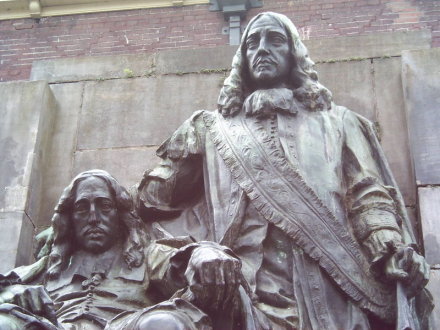
A statue of Johan (standing) and Cornelis de Witt in their native Dordrecht.

The mercantile powerhouse that was the 17th century Dutch Republic was the stage for a long-running conflict between the Orange monarchists (hence the soccer uniforms) and the Republican merchant class.

With the sudden death of the young William II, Prince of Orange in 1650, leaving the (non-hereditary) executive office of stadtholder vacant, the Republicans became ascendant.

And the outstanding figure of the First Stadtholderless Period was Johan de Witt, scion of a Dordrecht merchant family powerful enough that William II had imprisoned de Witt’s own father during a power struggle.

Elevated in 1653 and at the tender age of 28 to the leadership position of Grand Pensionary, Johan de Witt’s “eloquence, sagacity and business talents” guided the Dutch ship of state for essentially the remainder of his life.

This was the apex of the Dutch Golden Age. The Dutch East India Company dominated Asian trade routes,* and the Low Countries’ culture thrived on the wealth: Rembrandt and Vermeer were at the height of their talents; Spinoza revolutionized philosophy; van Leeuwenhoek invented the microscope.

While all these guys were landing themselves in their respective canons, Johan de Witt was trying to keep the age Golden.

Having only relatively recently broken free of Spain, the small country was an up-and-comer on the horns of a serious security dilemma: its leading commercial position put it into maritime competition with England, while its continental location made it vulnerable to the enormous army of the neighboring continental hegemon, France. Ultimately, even with its trade wealth, it did not have the resources to keep up with both of western Europe’s leading powers.

For a generation, de Witt’s statecraft kept the men of the Low Countries out of that predicament, while his brother Cornelis chipped in with a couple of timely naval victories. (Actually authored by Michiel de Ruyter, but Cornelis rode shotgun.)

In 1654, Johan brought the First Anglo-Dutch War to a close, making with Oliver Cromwell a secret pact he was only too happy to enforce never to allow William II’s son, the eventual William III, to be named stadtholder. Reason being: William III was the grandson of the Stuart king Cromwell beheaded, Charles I, and thus a potential claimant to the English throne. Both Protestant Republics had a distinct interest in keeping this monarchist well away from power. (Both would be sorely disappointed.)

A decade and a Stuart Restoration later, de Witt maintained (mostly) Dutch dominance of the seas in the Second Anglo-Dutch War, then held off France (with the help of a timely alliance with the recent adversary, England) in the War of Devolution.

In each case, he kept at least one of England or France on the sideline, or in his own camp.

But the Third Anglo-Dutch War was the charm — as it was also the Franco-Dutch War, and therefore 1672 was Rampjaar: disaster year. While the Dutch were aces on the waves, a massive French invasion easily overwhelmed them on terra firma.

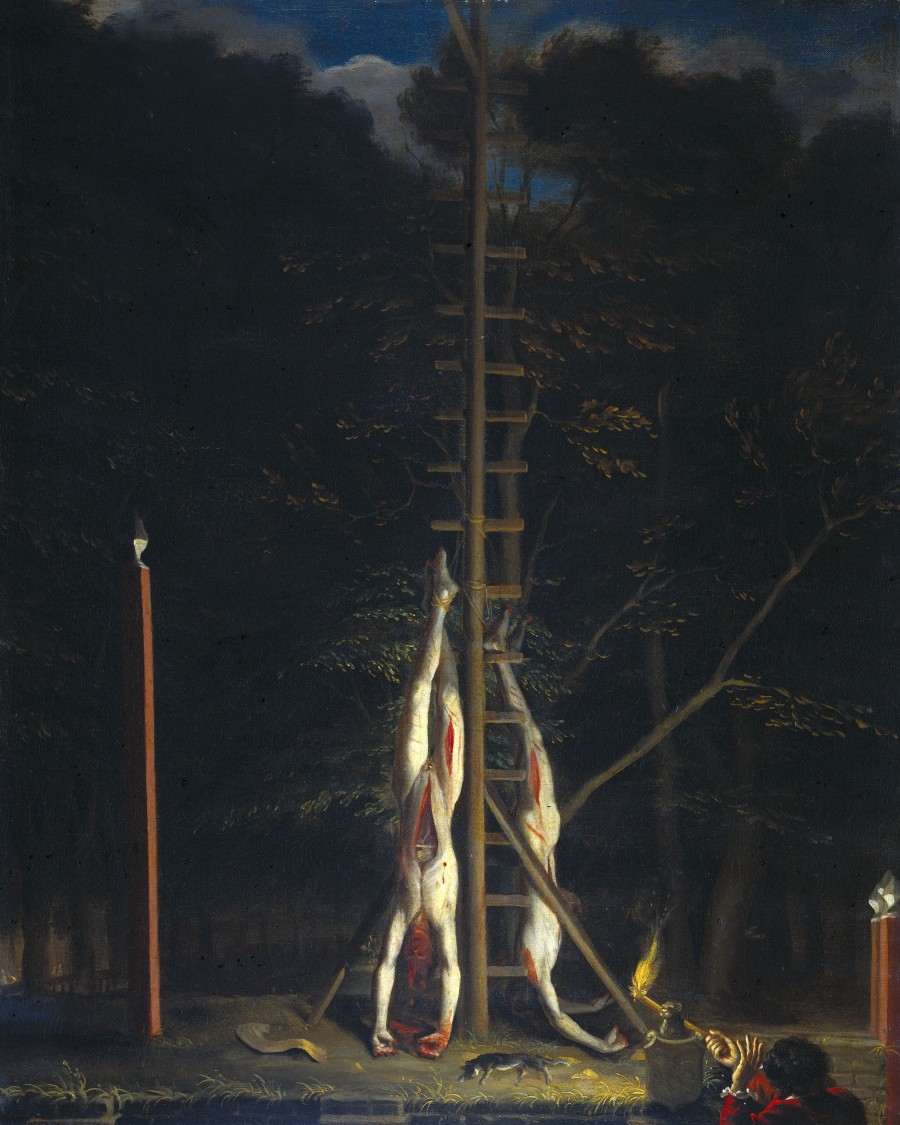
Detail view (click for the full image) of a grisly painting of the mutilated de Witt brothers strung up at The Hague. It’s attributed to Jan de Baen, who in better times took Johan de Witt’s portrait.

De Witt’s never-beloved mercantile oligarchy speedily collapsed with the military reverses, and the now all-grown-up William III was there to pick up the pieces to popular acclaim. Arrested for treason, Cornelis sustained torture without confessing, but when Johan visited him in prison — and William III incriminatingly withdrew the cavalry protecting the brothers — the mob quenched its fury with the de Witts’ blood.

every one of the miscreants, emboldened by his [Johan’s] fall, wanted to fire his gun at him, or strike him with blows of the sledge-hammer, or stab him with a knife or swords, every one wanted to draw a drop of blood from the fallen hero, and tear off a shred from his garments.

And after having mangled, and torn, and completely stripped the two brothers, the mob dragged their naked and bloody bodies to an extemporised gibbet, where amateur executioners hung them up by the feet.

Then came the most dastardly scoundrels of all, who not having dared to strike the living flesh, cut the dead in pieces, and then went about the town selling small slices of the bodies of John and Cornelius at ten sous a piece.

-Dumas

The word “ungrateful” comes to mind.

De Witt stood altogether on a lower plane than Cromwell. We regard him rather as a man of rare and singular talent, than as one of the chosen great ones of the earth, which Cromwell was. He stands far above the common run of men; and he was head and shoulders above nearly all the notable men of his time. He would have been greater if the movement of his limbs had been less burdened with the Dutch governing apparatus … He is not one whom the world can ever greatly admire or love.

History of the administration of John De Witt, grand pensionary of Holland, a Google books freebie.

(Here’s another, and here’s a 17th century volume de Witt himself coauthored.)

The rise of William III came with the decline of that Dutch Golden Age: the country fended off the immediate military threat, but it increasingly slipped behind its larger neighbors. Costly as was the Franco-Dutch War, it is a step on the path towards the present-day Europe, and this gives us enough excuse to notice that the Eurovision lead-in tune is actually from a Te Deum composed to mark its end.

But William’s own ascent to this wealthy sovereignty was just the beginning for him. Sixteen years later, the House of Orange’s champion vindicated Cromwell’s trepidation about him and gained a far more satisfactory position from which to do battle with his Gallic rival Louis XIV by stunningly overthrowing the Stuart dynasty and becoming King of England in the Glorious Revolution.**

* The Dutch remained the sole western contact of closed Japan until 1854, which is why Japan’s eventual period of scientific advancement became known as ‘Dutch Learning’.

** Albion did not forget the de Witts, either: according to this 1785 cant dictionary, the term “dewitted” had a 17th-18th century run in English to denote — well, exactly what happened to Cornelis and Johan.

On this day..

1608: Jean Duval, for plotting against Champlain

On or about this date in 1608, explorer Samuel de Champlain judged guilty and had executed for plotting his own murder a Norman locksmith among his host of men establishing the Quebec settlement.

Though there were previous European forts on the site, Quebec City had been formally founded by Champlain just a month earlier, on July 3, and we here join the exposition of the public-domain Pioneers of France in the New World.

Hanging judge: Samuel de Champlain monument in Ottawa. Creative Commons image from dugspr.

They were pioneers of an advancing host, — advancing, it is true, with feeble and uncertain progress, — priests, soldiers, peasants, feudal scutcheons, royal insignia: not the Middle Age, but engendered of it by the stronger life of modern centralization, sharply stamped with a parental likeness, heir to parental weakness and parental force.

In a few weeks a pile of wooden buildings rose on the brink of the St. Lawrence, on or near the site of the market-place of the Lower Town of Quebec. The pencil of Champlain, always regardless of proportion and perspective, has preserved its likeness. A strong wooden wall, surmounted by a gallery loopholed for musketry, enclosed three buildings, containing quarters for himself and his men, together with a courtyard, from one side of which rose a tall dove-cot, like a belfry. A moat surrounded the whole, and two or three small cannon were planted on salient platforms towards the river. There was a large storehouse near at hand, and a part of the adjacent ground was laid out as a garden.

In this garden Champlain was one morning directing his laborers, when Tetu, his pilot, approached him with an anxious countenance, and muttered a request to speak with him in private. Champlain assenting, they withdrew to the neighboring woods, when the pilot disburdened himself of his secret. One Antoine Natel, a locksmith, smitten by conscience or fear, had revealed to him a conspiracy to murder his commander and deliver Quebec into the hands of the Basques and Spaniards then at Tadoussac. Another locksmith, named Duval, was author of the plot, and, with the aid of three accomplices, had befooled or frightened nearly all the company into taking part in it. Each was assured that he should make his fortune, and all were mutually pledged to poniard the first betrayer of the secret. The critical point of their enterprise was the killing of Champlain. Some were for strangling him, some for raising a false alarm in the night and shooting him as he came out from his quarters.

Having heard the pilot’s story, Champlain, remaining in the woods, desired his informant to find Antoine Natel, and bring him to the spot. Natel soon appeared, trembling with excitement and fear, and a close examination left no doubt of the truth of his statement. A small vessel, built by [Francois] Pontgrave at Tadoussac, had lately arrived, and orders were now given that it should anchor close at hand. On board was a young man in whom confidence could be placed. Champlain sent him two bottles of wine, with a direction to tell the four ringleaders that they had been given him by his Basque friends at Tadoussac, and to invite them to share the good cheer. They came aboard in the evening, and were seized and secured. “Voyla donc mes galants bien estonnez,” writes Champlain.

It was ten o’clock, and most of the men on shore were asleep. They were wakened suddenly, and told of the discovery of the plot and the arrest of the ringleaders. Pardon was then promised them, and they were dismissed again to their beds, greatly relieved; for they had lived in trepidation, each fearing the other. Duval’s body, swinging from a gibbet, gave wholesome warning to those he had seduced; and his head was displayed on a pike, from the highest roof of the buildings, food for birds and a lesson in sedition. His three accomplices were carried by Pontgrave to France, where they made their atonement in the galleys.

More about Champlain in this podcast, by the author of Champlain’s Dream: the Visionary Adventurer Who Made a New World in Canada.

On this day..