1677: Giles Bland

On this date in 1677, Giles Bland was hanged in the Virginia colony for the late Bacon’s Rebellion.

Bland was in that remote colony as the agent of his father, the London merchant John Bland.

This John Bland fellow had an interesting career — as suggested by the title of Neville Williams’s “The Tribulations of John Bland, Merchant: London, Seville, Jamestown, Tangier, 1643-1680” in The Virginia Magazine of History and Biography (Jan. 1964). We elide here the former two and the last one except to observe that they made John Bland a very wealthy man, and landed him in Samuel Pepys’s diary.

Accordingly, John Bland’s New World interests were considerable, and we suppose that his son Giles, dispatched thither after John’s brothers had died in the New World, was a bit too conscious of the weight his surname carried.

He griped about colonial corruption, put about “malicious reports” of royal governor William Berkeley, “bespattered with … dirt … thrown upon the whole government of Virginia,” and — foreshadowing alert! — got into the drink to the detriment of his good judgment:

[G]oing to the house of Thomas Ludwell in company with Sir Henry Chicheley after they had drank plentifully there happened a discourse in which Giles Bland thought Ludwell’s speech too severe in relation to his father, and told Ludwell’s that he dealt basely and unworthily to cast such aspersions upon his father and himself, and being transported with passion upon “further exchange of language” came to blows, and exchanged gloves to meet in the morning. His son slept not all night, and continuing hot headed, hastened to the place appointed, where, missing Ludwell, he nailed the glove on the door of the Grand Assembly [house] writing some words under it. Ludwell more wisely sought reparation before the Governor and Council, where Giles Bland was ordered to ask forgiveness which he performed, and the Court fined him 500l. for his abuse done to the Assembly, the payment to be suspended for two years to enable him to supplicate his Majesty to remit the same, it being intended rather to deter him from the like rash actions in time to come, than to ruin him for what he had unadvisedly committed.

Put Giles down for “undeterred.”

As conflicts between the Virginia planters and Berkeley’s party came to a head — planters were sore about taxes, trade, and overly friendly Indian relations — Bland was tapped to represent the former back in the mother country.

But rather than sail for England, the young hothead hitched onto the rising of Nathaniel Bacon — and then was almost immediately intercepted by his foes. “Those who are best able to render an account of this affair do aver,” we read, “that there was no other treason made use of but their want of discretion, assisted by the juice of the grape.”

(Getting captured while distracted by more hedonistic pursuits was a pattern with these Bacon’s rebels, or at least a pattern of the propaganda written about them.)

Rather than summary execution, Giles Bland faced several months’ ill-treatment in irons. Still, Berkeley was in enough of a hurry to get the lad into the ground as the last of the Bacon’s Rebellion martyrs that he seems to have suppressed the prisoner’s legitimate appeal for royal clemency.

John Bland was in the winter of his years when this grim news arrived in London; he would die there in 1680 — having committed yet one more member of his family, his wife Sarah, to the Atlantic crossing, and “feeling no greater grief under my many adversities and infirmities … than her necessary absence in Virginia about my unhappy affairs and estates there.”

On this day..

1669: Anna Ebeler, lying-in maid

On this day in 1669, the Bavarian city of Augsburg executed 67-year-old Anna Ebeler for bewitching a string of infant children and just-delivered mothers.


Detail view of a pictorial history of the “witch” Anna Ebeler: the panels display her mutilated with tongs as she is led to execution; then, beheaded at the scaffold.

Ebeler plied her client with a refreshing bowl of malmsey and brandy soup (I could go for some myself), and the mother fell into a delirium that was bad enough to kill her but not so bad as to impact her credibility when she accused her lying-in maid of culinary devilry.

Once the accusation was “out there,” every other family on Ebeler’s c.v. whose birth experience was less than satisfactory — and there must have been a few of them, since infant mortality was off the charts in the 17th century — came forward with its own tale of woe.

Ebeler confessed when threatened with torture.

According to Lyndal Roper, who uses this affair as the touchstone event in “Witchcraft and Fantasy in Early Modern Germany” (History Workshop, Autumn 1991) — it was one of “just” 18 scattered witchcraft executions in a relatively forward-thinking burg — witchcraft

beliefs rested on a whole economy of bodily fluids. A post menopausal woman, the old witch was in a sense a dry woman who, instead of feeding others well, diverted nourishment to her own selfish ends. Older widows were believed to have the power to ruin young men sexually, and youths were warned against marrying such women because they were sexually ravenous, and would suck out their seed, weakening them with their insatiable hunger for seminal fluid and contaminating them with their own impurities.

I could go for some of that, too.

At any rate, a lying-in maid like Anna Ebeler — a woman hired by the birth mother for a ritualistic period of several post-natal weeks of maternal sequestration — put herself at risk (quoth Roper) of having projected onto her all the delivered mother’s psychological amibiguity about her condition, all her illicit resentment of her progeny, all her own latent fear of death after childbirth. All the ingredients, in short, of post-partum depression … in supernatural form.

[I]nstead of seeking the source of her ills in post-natal depression, within herself, as we [modern people] would, the mother’s anxieties about the child’s fate and her own ability to nourish it were directed outwards, so that harm to either mother or baby was believed to have been caused by another. Here we might make use of what Melanie Klein says about splitting, which allows intolerable feelings of hostility and malice to be projected onto another, so that the mother recognizes only benevolence in herself, projecting the evil feelings about herself onto the ‘other’ mother. The lying-in-maid was thus destined for the role of the evil mother, because she could be seen to use her feminine power to give oral gratification to do the reverse – to suck the infant dry, poison the mother and her milk and, in the most extreme form of witch fantasies, to kill, dismember and eat the child at the witches’ sabbath.

That dish, we’ll pass on.

Roper makes an interesting and nuanced exploration into the psychic space of witchcraft accusations, usually shaped by female-on-female charges. It’s terrain further developed in her Witch Craze: Terror and Fantasy in Baroque Germany.

One last item from Roper, of specific relevance to the lot who haunt these pages:

There is a further collusive dynamic at work in interrogation, that between witch and torturer. Torture was carried out by the town hangman, who would eventually be responsible for the convicted witch’s execution. Justice in the early modern period was not impersonal: the act of execution involved two individuals who, by the time of execution, were well acquainted with each other. Particularly in witch trials, torture and the long period of time it took for a conviction to be secured gave the executioner a unique knowledge of an individual’s capacity to withstand pain, and of their physiological and spiritual reactions to touch. In a society where nakedness was rare, he knew her body better than anyone else. He washed and shaved the witch, searching all the surfaces of her body for the tell-tale diabolic marks – sometimes hidden ‘in her shame’, her genitals. He bound up her wounds after the torture. On the other hand, he was a dishonourable member of society, excluded from civic intercourse, and forced to intermarry amongst his own kind. His touch might pollute; yet his craft involved him in physically investigating the witch, a woman who if innocent was forbidden him. He advised on the mode of execution, assessing how much pain the witch might stand, a function he could potentially exploit to show mercy or practise cruelty. In consequence, a bond of intense personal dependence on the part of the witch on her persecutor might be established. Euphrosina Endriss was greatly agitated when a visiting executioner from nearby Memmingen inspected her. She pleaded that ‘this man should not execute her, she would rather that Hartman should execute her, for she knew him already’.

On this day..

1647: Mary Martin, infanticide

From Portland in the Past: With Historical Notes of Old Falmouth, by William Goold.


[Michael Mitton] came from England … in 1637 … [and] lived near the Cape Elizabeth landing of Portland bridge … “One Mr. Mitton related of a triton, or mere-man which he saw in Casco bay. The gentleman was a great fowler, and used to go out with a small boat or canoe, and fetching a compass about a small Island for the advantage of a shot, was encountered with a triton, who laying his hands upon the side of the canoe, had one of them chopped off with a hatchet by Mr. Mitton, which was in all respects like the hand of a man. The triton presently sunk, dying the water with his purple blood, and was no more seen.” …

There is one indelible blot on the character of Mitton. In 1640, Winter wrote to Trelawney from Richmond’s island this: “Mr. Francis Martin is here with us, and is not settled in any place as yet to remain. This next week I shall go up to Casco with him to seat him in some place there. I know not how he will lie here well, except he have brought money with himself, and here is nothing to be gotten without hard labor.” Martin was evidently a decayed gentleman, or he would not have been styled Mister by Winter. This was an honorable title then. Two years later Winter again mentions Martin to his principal: “Also herein goes a bill upon Mr. John Martin for his uncle Francis Martin. Also he was with us five months and spent upon our provision, and cannot pay for anything. He is in a bad way of living here with his two children. He plants a little Indian corn and that is all he hath to live upon. He hath neither goat nor pig, nor any thing else. He is old and cannot labor, and his children are not brought up to work, so I know not what shift he will make to live.”

These “two children” were daughters. The fate of the eldest is given by Willis, being the substance of her history as written in Winthrop’s journal. Willis says: “Martin, an early inhabitant of Casco, was the father of two daughters, whom, being about to return to England to arrange his affairs, he left in the family of Michael Mitton. During their residence of several months with him in 1646, he insinuated himself into the favor of the eldest, named Mary, whom he seduced. She afterwards went to Boston and was delivered of a bastard child, of which she confessed Mitton to be the father. Overcome with shame, she endeavored to conceal her first crime by the commission of a more heinous one in the murder of her infant; for this she perished on the scaffold at the early age of twenty-two years, in March, 1647.” Cotton Mather says of her trial: “When she touched the face of the child before the jury, the blood came fresh into it, so she confessed the whole truth concerning it.” He also says: “Her carriage in her imprisonment and at her execution was very penitent. But there was this remarkable at her execution. She acknowledged her twice essaying to kill the child, and now through the unskilfulness of the executioner she was turned off the ladder twice, before she died.”

The York records give the date of Mitton’s death to be in 1660.


From the Journal of John Winthrop (also available on Google books):

finding herself to be with child, and not able to bear the shame of it, she concealed it, and though divers did suspect it, and some told her mistress their fears, yet her behavior was so modest, and so faithful she was in her service, as her mistress would not give ear to any such report, but blamed such as told her of it. But, her time being come, she was delivered of a woman child in a back room by herself upon the 13 (10) (December 13) in the night, and the child was born alive, but she kneeled upon the head of it, till she thought it had been dead, and having laid it by, the child, being strong, recovered, and cried again. Then she took it again, and used violence to it till it was quite dead. Then she put it into her chest, and having cleansed the room, she went to bed, and arose again the next day about noon, and went about her business, and so continued till the nineteenth day, that her master and mistress went on shipboard to go for England.

They being gone, and she removed to another house, a midwife in the town, having formerly suspected her, and now coming to her again, found she had been delivered of a child, which, upon examination, she confessed, but said it was still-born, and so she put it into the fire. But, search being made, it was found in her chest, and when she was brought before the jury, they caused her to touch the face of it, whereupon the blood came fresh into it. Whereupon she confessed the whole truth, and a surgeon, being called to search the body of the child, found a fracture in the skull. Before she was condemned, she confessed, that she had prostituted her body to another also, one Sears. She behaved herself very penitently while she was in prison, and at her death, 18 (1,) (March 18) complaining much of the hardness of her heart. She confessed, that the first and second time she committed fornication, she prayed for pardon, and promised to commit it no more; and the third time she prayed God, that if she did fall into it again, he would make her an example, and therein she justified God, as she did in the rest. Yet all the comfort God would afford her, was only trust (as she said) in his mercy through Christ. After she was turned off and had hung a space, she spake, and asked what they did mean to do. Then some stepped up, and turned the knot of the rope backward, and then she soon died.


Cotton Mather’s father Increase Mather favored the occasion with a sermon on Ezekiel 16:20-21 — “‘is this of thy whoredoms a small matter, that thou hast slain my children?'” Whereof great notice was taken.”

On this day..

1601: St. Anne Line

On this date in history, Anne Line was hanged for harboring Catholic priests in Elizabethan England.

There’s not too much question of her “guilt.”

I am sentenced to die for harbouring a Catholic priest, and so far I am from repenting for having so done, that I wish, with all my soul, that where I have entertained one, I could have entertained a thousand.

-Anne Line at the scaffold

She’d been disinherited from her Calvinist family for converting to Catholicism, and scratched out a living teaching and embroidering and keeping safe houses for forbidden Catholic clergy.

That house was raided in early February of 1601, and while the priest escaped, Anne Line did not.

Just one day after conviction, she hanged at Tyburn along with two priests, Roger Filcock and Mark Barkworth.

Anne Line was canonized in 1970; she’s one of the Forty Martyrs of England and Wales.

One of the possible interpretations (.doc) of Shakespeare’s recondite allegorical poem “The Phoenix and the Turtle” is that it’s about Anne (the phoenix) and her husband Roger Line (the turtledove; he predeceased her).

Death is now the phoenix’ nest;
And the turtle’s loyal breast
To eternity doth rest,

Leaving no posterity:–
‘Twas not their infirmity,
It was married chastity.

Truth may seem, but cannot be:
Beauty brag, but ’tis not she;
Truth and beauty buried be.

To this urn let those repair
That are either true or fair;
For these dead birds sigh a prayer.

On this day..

1629: John Dean, boy arsonist

(Thanks to Meaghan Good of the Charley Project for the guest post. -ed.)

On or about this day in 1629, one John Dean, described in court documents as “an infant between eight and nine years,” was hanged in Abingdon, England for setting fire to two barns in the nearby town of Windsor.

According to Historia placitorum corone: The history of the pleas of the crown, Volume 1 by William Axton Stokes and Edward Ingersoll, this juvenile felon was indicted, arraigned and found guilty all on the same day, February 23, “and was hanged accordingly.” The actual date of his execution is not known, but it can’t have been long afterward. The wheels of British justice ground very quickly in those days, though not so fine.

The age of criminal responsibility in England at the time was seven years old. (It was later raised to eight, and in 1963 to ten, where it remains; there have been calls to raise it again.) Accordingly, anyone seven years or older could be charged with a crime and face the same penalties as someone seventeen or forty-seven — including the death sentence.

This does not mean that vast numbers of children were executed, however; quite the contrary. As Capital Punishment U.K. notes, “Death sentences were certainly routinely passed on 7 -13 year olds but equally routinely commuted. Girls were only typically hanged for the most serious crimes whereas teenage boys were executed for a wide range of felonies.”

The same source notes that little John Dean was probably the youngest child ever executed in England.

For reasons lost to history, he was not given the usual commutation: although there is no mention that anyone was hurt or killed in the fires, the judge found that John had “malice, revenge, craft and cunning,” and refused to recommend a reprieve. Perhaps the boy had a prior criminal record.

Thus did John Dean secure a footnote in history; were it not for his death no one would remember him today. Somehow, I doubt he would have thought it was worth it.

On this day..

1688: Philip Standsfield

Oh Gentlemen, see, see dead Henrys wounds,
Open their congeal’d mouthes, and bleed afresh.
Blush, blush, thou lumpe of fowle Deformitie:
For ’tis thy presence that exhales this blood
From cold and empty Veines where no blood dwels.
Thy Deeds inhumane and unnaturall,
Provokes this Deluge most unnaturall.

Lady Anne Neville in Shakespeare’s Richard III

There long persisted superstition* of ancient vintage that the wounds of a murder victim will bleed in the presence of the murderer.**

This date in 1688 saw the execution in Edinburgh of one Philip Standsfield (sometimes Stansfield or even Standfield) for parricide, his conviction being secured in part by the supposed accusation of his father’s corpse.

The prodigal firstborn of James Standsfield was an incorrigible scoundrel, and the state had a considerable circumstantial case to the effect that said scoundrel finally popped the old man to prevent disinheritance. (It also appeared that he’d tried to do it other times over the years.)

Circumstantial evidence is nice.

But how about some forensic evidence to really cinch a conviction? No DNA evidence here in the 17th century, so maybe something a little more … supernatural?


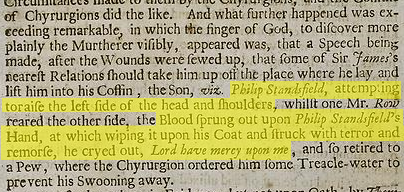
From A True Relation of a Barbarous Bloody Murther etc., available here.

The King’s Advocate insisted — over the objections of a defense attorney that “it was a superstitious observation, founded neither upon law nor reason” — that the corpse’s having bled on Philip Standsfield but none of the others in his party simultaneously attempting to move it “he must ascribe … to the wonderful Providence of God, who in this manner discovers murder.”

Divine forensics. That’s even better than the arson evidence Texas used to kill Cameron Willingham.

And it had the same result, to wit,

the said Philip Standsfield to be taken upon Wednesday next, being the 15th of February instant, to the Market-cross of Edinbrugh, and there, betwixt two and four o’clock in the afternoon, to be hanged on a gibbet till he be dead, and his tongue to be cut out and burnt upon a scaffold, and his right hand to be cut off and affixed to the east port of Haddingtoun, and his body to be carried to the Gallowlie betwixt Leith and Edinburgh, and there to be hanged up in chains; and ordains his name, fame, memory, and honours to be extinct, his arms to be riven forth and delete out of the books of arms …†

Well, you get the idea. Executed Today would like to apologize to the dempster of Edinburgh for keeping Philip Standsfield’s name, fame, and memory alive.

In our defense, we are hardly the only ones: this is thought to be the last time that Scottish law employed the bleeding-corpse “test”.

* Some other instances of purported “bleeding at the touch” may be perused here.

** In a 1927 piece in the Journal of the American Institute of Criminal Law and Criminology, Canadian jurist William Renwick Riddell says this folk belief “was wide spread and is not dead yet” and offers in a footnote (perhaps by way of explaining his interest) that “when at the Bar, I was once offered such evidence by my client; but I declined to use it.”

† The execution was botched, and the gibbeted body illicitly pulled down and tossed in a ditch — which is where the elder Standsfield’s had been discovered.

On this day..

1611: Three accomplices of Elizabeth Báthory, the Countess of Blood

Four hundred years ago today, on Jan. 7 1611, three servants of the legendary “Countess of Blood” Elizabeth Bathory (Báthory ErzsĂ©bet, in the Hungarian) were tried, convicted, and immediately put to death for the noblewoman’s stupendous career of homicide.

This date’s entry is occasioned by the deaths of three subalterns — manservant Janos Ujvary, beheaded; and female attendants Ilona Jo and Dorottya Szentes, fingers ripped off and burned — but the headline attraction is their employer, who was never tried or condemned.

Not, at least, juridically. Posterity’s condemnation of this classic vampire inspiration has been little short of … voluptuous.


A 1971 film based on Elizabeth Bathory’s exploits. Horror star Ingrid Pitt later reprised her “role” with guest vocals on a Cradle of Filth concept album devoted to the Countess, Cruelty and the Beast.

Bathory was rarefied Hungarian nobility, the niece of the King of Poland, which is also the biography of countless aristocrats you’ve never heard of.

The world remembers Elizabeth Bathory because she exploited her rank to butcher hundreds of peasant girls, allegedly to bathe in their rejuvenating blood.

On one occasion, a lady’s-maid saw something wrong in [Elizabeth Bathory’s] head-dress, and as a recompence for observing it, received such a severe box on the ears that the blood gushed from her nose, and spirted on to her mistress’s face. When the blood drops were washed off her face, her skin appeared much more beautiful — whiter and more transparent on the spots where the blood had been.

Elizabeth formed the resolution to bathe her face and her whole body in human blood so as to enhance her beauty.


McFarlane Toys figurine of Erzsebet (Elizabeth) Bathory from its grotesque “Faces of Madness” series.

These scrub-ups are what the Countess of Blood is best remembered for, but however striking the visual, it’s an atrocity that actually doesn’t turn up in the trial records.

But she could hardly complain of the embroidery, having given her interlocutors so much material.

Elizabeth Bathory is supposed to be responsible for over six hundred deaths, starting while her husband was away on campaign, and then carrying on into a wholesale operation after he died. When she and her servants were finally busted at Csejte Castle the end of 1610, their captors found a dead girl, a dying girl, and several others imprisoned and awaiting that fate.


Elizabeth Bathory, a sexually charged 1893 painting by Hungarian impressionist Istvan Csok depicting one of the countess’s victims being drenched in icy water for death by exposure.

So although the confessions the servants made this date to seal their own fates were undoubtedly torture-adduced, the documentary record turns out to be amazingly strong for such a fantastical spree. Hungarian King Matthias II convened a tribunal that examined 200 to 300 witnesses.

One can postulate that the woman ran afoul of a patriarchal culture affronted by her exercise of power or that she became a parable for the “unnatural” lust of a middle-aged woman … but so far as we are left to understand, Erzsebet Bathory really did lure young girls to her castle, and then inflict (pdf) a Nazi doctors’ litany of sadism on them … like jabbing them with needles to drain out their blood. She even kept a log of the victims in her own hand.

So, locals disappearing into the creepy castle, never to be seen again, or possibly to turn up pallid and dead. (Disposing of all those corpses became a logistical problem for the creepy castle.) No surprise to find it associated with the vampire legend.*

And no surprise that the tale became magnified, twisted, and reconfigured by popular culture.

In 1817, as accounts of the testimonies about the alleged murders and sadistic tortures were published for the first time, national and international headlines sensationalized the already misconceived story. From that on [sic], the literary countess took on a life of her own: the Grimm brothers wrote a short story about her, the romantic German writer, Johann Ludwig Tieck (1774 – 1853), cast her as a Gothic femme fatale, Swanhilda, in his short story Wake Not the Dead. It is alleged that Sheridan le Fanu shaped his female vampire Carmilla on Elizabeth Bathory. If we can believe some etymological explanation the compound English word blood-bath is of mid-nineteenth century origin possibly connected to the bloody countess’ rising popularity in England.

-LászlĂł KĂĽrti, “The Symbolic Construction of the Monstrous — The Elizabeth Bathory Story,” Croatian Journal Of Ethnology and Folklore Research, Jan. 2009

A few books about Erzsebet Bathory

To say nothing of the death porn (link not safe for work).

The noblewoman never faced an executioner herself, owing to her rank; she was shut up in the castle.

* As it turns out, a Bathory ancestor actually fought with the “original Dracula” Vlad the Impaler in the 15th century.

On this day..

1603: The men of the Bye Plot, but not those of the Main Plot

On this date in 1603, priests William Watson and William Clark were executed for a dramatic (that is, harebrained) plot “to take away ‘the KINGE and all his cubbes.'”

The year was 1603, the first in the reign of James I. (However, he’d been James VI of Scotland since the tender age of 13 months, when his mother Mary, Queen of Scots had been forced to abdicate. He made himself quite a reputation for witch-hunting.)

With the death of the Protestant Queen Elizabeth and all her schismatic Anne Boleyn mojo, hard-pressed English Catholics greeted Jamie’s ascension hopeful of relief from official persecution. Although raised Protestant, both his parents had been Catholic.

Watson was one of these hopeful adherents, and hastened himself to Scotland as Queen Elizabeth lay ailing to extract from the future English monarch the soothing blandishments of good favor that future monarchs make.

When toleration was not extended to Catholics upon the new king’s elevation in late March 1603, the disenchanted Watson almost immediately embarked on a preposterous scheme to

assemble force and strengthe, and on Midsommer-day last, in the night, to come to the Parke pale at Grenewich, to enter in by the gardein with a key, that should be borowed; and when the numbers were come in, there should be a watche set at the dores of principall persons, and at the passages; and then to goe up to the KING’S loding. And when they cam to the KING, they should surprise his person, and carry him to the Tower, and they would move him for 3 things: — 1, for there pardon; 2, for tolleration of relligion; 3, for assuraunce thereof, to preferre Catholiques to places of credit, as WATZON the priest to be Lord Keper; GREY, Erle Marshall; GEORGE BROOKE, Lord Treasorer; and MARCAM, Secretary. They concluded to cutt of many of the Privy Councill, and to have made a Proclamation, purporting howe the KING had bene misled, and to have had many things reformed. They determined to have possessed the principall ports of the realme, and to have kept the KING in the Towre a quarter of a yeare.

The Bye Plot was ironically busted by other Catholics — Jesuits, as distinct from “secular clergy” (clergy not affiliated with an order) like Watson. Jesuits and secular clergy were at loggerheads in this period over tactics, church structure … more or less everything. The need to steal the thunder of whatever restore-the-Church scheme the Jesuits might be cooking up might have helped precipitate Watson into such immediate and desperate disaffection.

At any rate, these other more respectable fathers of the church blew the whistle on the Bye Plot lest it provoke anti-Catholic pogroms, and you’d have to concur with their estimate that taking the king hostage is the sort of thing that would have prompted some blowback.

In the course of rolling up the now-exposed Bye Plot, investigators also caught wind of the parallel Main Plot, courtesy of one conspirator who was involved in both and unable to hold his tongue under torture.

The Main Plot was a sketchier affair to a similar end, allegedly among Catholic-sympathizing nobles to depose James for his cousin. As befits its title, the Main Plot implicated much bluer blood than Watson’s: Lord Cobham,* Baron Grey, and the knighted soldier Griffin Markham.

Oh, and a guy you might have heard of by the name of Walter Raleigh.

All these Main Plot gentlemen were likewise condemned to death. December 9, 1603 was the date appointed for Watson and Clark to expiate the Bye Plot in the grisly manner that commoner priests were wont to suffer in that age — they as the undercard to the beheadings of Cobham, Grey, and Markham. (Raleigh was on deck for a later date.)

The drama that unfolded on the Winchester scaffold that day was wonderfully narrated in the correspondence of Sir Dudley Carleton and well worth extracting at length.

The two priests that led the way to the execution were very bloodily handled; for they were both cut down alive; and Clarke, to whom more favour was intended, had the worse luck; for he both strove to help himself, and spake after he was cut down. They died boldly both … Their quarters were set on Winchester gates, and their heads on the first Tower of the castle.

Warrants were signed, and sent to Sir Benjamin Tichborne, on Wednesday last at night, for Markham, Grey, and Cobham, woh in this order were to take their turns … A fouler day could hardly have been picked out, or fitter for such a tragedy. Markham being brought to the scaffold, was much dismayed, and complained much of his hard hap, to be deluded with hopes and brought to that place unprepared. One might see in his face the very picture of sorrow; but he seemed not to want resolution … [and] prepared himself to the block. The sheriff, in the mean time, was secretly withdrawn … whereupon the execution was stayed, and Markham left upon the scaffold to entertain his own thoughts, which, no doubt, were as melancholy as his countenance, sad and heavy. The sheriff, at his return, told him, that since he was so ill prepared, he should yet have two hours respite, so led him from the scaffold, without giving him any more comfort, and locked him into the great hall … The lord Grey, whose turn was next, was led to the scaffold by a troop of the young courtiers … and thereupon entered into a long prayer for the king’s good estate, which held us in the rain more than half an hour; but being come to a full point, the sheriff stayed him, and said, he had received orders from the king, to change the order of the execution, and that the lord Cobham was to go before him … he had no more hope given him, than of an hour’s respite; neither could any man yet dive into the mystery of this strange proceeding.

The lord Cobham, who was now to play his part, and by his former actions promised nothing but matiere pour rire, did much cozen the world; for he came to the scaffold with good assurance, and contempt of death. … [he] would have taken a short farewel of the world, with that constancy and boldness, that we might see by him, it is an easier matter to die well than live well.

He was stayed by the sheriff, and told, that there resteth yet somewhat else to be done; for that he was to be confronted with some other of the prisoners, but named none. So as Grey and Markham being brought back to the scaffold, as they then were, but nothing acquainted with what had passed, no more than the lookers-on with what should follow, looked strange one upon the other like men beheaded, and met again in the other world. Now all the actors being together on the stage (as use is at the end of a play,) the sheriff made a short speech unto them, by way of the interrogatory of the heinousness of their offences, the justness of their trials, their lawful condemnation, and due execution there to be performed; to all which they assented; then, saith the sheriff, see the mercy of your prince, who, of himself, hath sent hither to countermand, and given you your lives. There was then no need to beg a plaudite of the audience, for it was given with such hues and cries, that it went from the castle into the town, and there began afresh, as if there had been some such like accident. And this experience was made of the difference of examples of justice and mercy; that in this last, no man could cry loud enough, ‘God save the King;’ and at the holding up of [the previously executed] Brookes’s head, when the executioner began the same cry, he was not seconded by the voice of any one man, but the sheriff. You must think, if the spectators were so glad, the actors were not sorry; for even those that went best resolved to death, were glad of life … Raleigh, you must think (who had a window opened that way), had hammers working in his head, to beat out the meaning of this strategem. His turn was to come on Monday next; but the king has pardoned him with the rest, and confined him with the two lords to the Tower of London, there to remain during pleasure.

Turns out that James wanted to do only the minimum amount of butchery necessary to establish his bona fides, and it sure seems like the mercy play proved a public relations triumph.** Raleigh was left by this reprieve languishing in the Tower for years, before his own final adventure saw him to the block after all in 1618.

Would you like some bootless speculation that Raleigh’s being caught up in this mess led him to nurture during his imprisonment a decade-long grudge against William Shakespeare and eventually murder the playwright? Of course you would.

In the world of more demonstrable historical consequences, the failure of these plots and continuing frustration with Catholics’ lot under a new boss who seemed a lot like the old led two years later to the ne plus ultra of English sectarian terrorism, Guy Fawkes‘s Gunpowder Plot to blow King James and his court straight to kingdom come.

* Cobham was a descendant of John Oldcastle and is supposed to have forced Shakespeare to redact the family name in his Henry V plays — giving us, instead, the character of Falstaff.

** One is obliged to notice Carleton’s disquieting footnote indicating that the entire affair was staged so well that someone almost actually lost his head:

… there was another cross adventure; for John Gib could not get so near the scaffold, that he could speak to the sheriff, but was thrust out amongst the boys, and was fain to call out to sir James Hayes, or else Markham might have lost his neck.


Topical sourcing: Mark Nicholls, “Treason’s Reward: The Punishment of Conspirators in the Bye Plot of 1603” The Historical Journal, Vol. 38, No. 4 (Dec., 1995).

On this day..

1640: Bishop John Atherton, buggerer

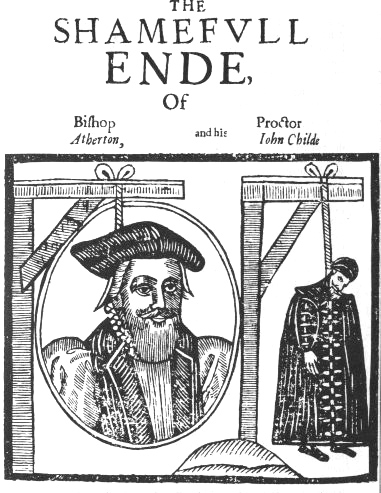
On this date in 1640, John Atherton achieved the unenviable distinction of being the only Anglican bishop hanged for buggery.* (His proctor, and alleged lover, John Childe, got the same treatment a few months later.)


Suppose a Devill from th’infernall Pit,
More Monsterlike, then ere was Devill yet,
Contrary to course, taking a male fiend
To Sodomize with him, such was the mind
Of this Lord Bishop, he did take a Childe
By name, not years, acting a sinne so vilde
-From the text of the pamphlet this image decorates

The Oxford-educated Englishman was appointed Lord Bishop of Waterford and Lismore by King Charles‘s hated governor Thomas Wentworth.

It may well have been the internecine politics of the day that claimed Atherton’s life, just as the civil wars they engendered in the ensuing decades claimed the original trial records.

While posterity is left to speculation, Atherton was defended in print in those years as well. (Defended as no homo, that is — not defended on principle against ubiquitous anti-gay laws.) If it wasn’t really a voracious sexual appetite (not exclusively same-sex**), goes this argument, it was intra-Protestant infighting, with Atherton’s successful clawback of land for the weak Irish Anglican church stepping on the toes of the local land barons who had recently expropriated it.

This politics outside the boudoir argument gets compelling treatment in Mother Leakey and the Bishop, a historical investigative thriller that links Atherton to a weird ghost story† in his native Somerset — that of “Old Mother Leakey,” the Minehead ghost.

Mother Leakey was Atherton’s mother-in-law, and Somerset family members claimed she haunted them — including with a message for the bishop that one of his sisters-in-law actually went to deliver in Ireland. The message isn’t known; in legend, this was a warning from beyond against the prelate’s ungodly behavior; in reality, it was more probably a family shakedown.‡

Despite the skepticism of the Leakey family’s own contemporaries, the facts, allegations, suppositions, and pure flights of fancy somehow managed to blend and recombine into a lasting tale of the paranormal that Minehead still retails to this day.

And it goes right back to the public opprobrium Bishop Atherton endured — as described in that 1641 hanging pamphlet:

“demonstrates the link between the stories of Mother Leakey and Bishop John Atherton … in a highly readable and often entertaining fashion”

… through pride, high fare, and lustfull life,
Incest committed with the Sister of his wife,
For which he sued his pardon, and then fled
To Ireland, where a worser life he led

He surely warned was to mend his life,
By his own Sister Master Leakies wife,
Which Master Leakies Mother being dead,
And in her life-time conscious how he led
His lustfull life, her Ghoast in gastful wise
Did oft appeare before her Sisters Eyes,
But she feare-strucken durst not speak unto it,
Till oft appearing forced her to doe it:
Then thus she spake, Mother in Law what cause
You from your rest, to my unrest thus drawes?
Who answered, daughter tis the wicked life
Your Brother leads, warne him to mend his life;
If not, then plainely tell him tis decreed,
He shall be hangd, bid him repent with speede:
Then shall my restless spirit be at rest,
And not till then; Thus vanisht. She addrest
Herselfe for travaile, Into Ireland went
With this sad message unto him was sent:
Which how he tooke to heart may plaine appeare
By the slight answer he returned her,
What must be, shalbe: If I must, I must dye,
Mariage, and hanging, come by destiny.
Thus scoft her counsell, sent her back, and when
Shee was returnd, he grew farre viler then
He was before, if Viler man may be,
For one bad Act before, committed three.

* According to Who’s Who in Gay and Lesbian History, Atherton and Childe were the second pair of alleged homosexual lovers executed in the British Isles. The first was the Earl of Castlehaven in 1631, along with his manservants.

** “[O]ne should note the compound sexual nature of the ‘sodomy’ charge in this context, a portmanteau omnibus of non-procreative sex, which is what ’sodomy’ was widely held to be.”

† Walter Scott footnotes this legend in Rokeby: “Mrs Leakey … dispatched her [daughter-in-law] to an Irish prelate, famous for his crimes and misfortunes, to exhort him to repentance, and to apprize him that otherwise he would be hanged; and how the bishop was satisfied with replying, that if he was born to be hanged, he should not be drowned.”

‡ Archbishop William Laud dispatched a team of ghost-whisperers to investigate the Leakey story well before the ectoplasm hit the fan for Atherton, and they weren’t buying: “certainly it is a fiction and a practice … it may be some money business.” Bishop Atherton had left home under a cloud with the suspicion that he’d had an affair with his wife’s sister, and this was part of the eventual Irish complaint against the horny goat.

On this day..

1674: The Chevalier de Rohan and Franciscus van den Enden

On this date in 1674, the former Grand Huntsman of France was beheaded in Paris for conspiring to betray Normandy during the Franco-Dutch War.

Your basic debt-mired noble and court cad, the Chevalier de Rohan (French Wikipedia link) through an accomplice “intimated that Normandy was very much dispos’d to a revolt, & that if hee would send a fleet with 6 thousand men, & armes for twenty thousand, with necessaries for sieges & two million of livres, that there was a greate man who would engage himself upon the assurance of thirty thousand crownes pension …”

The correspondence was discovered and Rohan arrested, but his role in the plot was sufficiently anonymized that even an absolutist state didn’t have the goods to convict him. Meanwhile, Rohan’s accomplice was hunted to ground and killed in Rouen during the attempt to arrest him.

This left the authorities in the position, common to every cop show and not a few real-life cases, of requiring a confession from the accused to proceed at all. Rohan’s friends realized this too, and tried desperately to warn him against self-incrimination.

Persons attached to the chevalier de Rohan went every evening round the Bastile, crying through a speaking trumpet, “La Tuanderie is dead, and has said nothing;” but the chevalier did not hear them. The commissioners, not being able to get any thing from him, told him, “that the king knew all, that they had proofs, but only wished for his own confession, and that they were authorized to promise him pardon if he would declare the truth.” The chevalier, too credulous, confessed the whole. Then the perfidious commissioners changed their language. They said, “that with respect to the pardon, they could not answer for it: but that they had hopes of obtaining it, and would go and solicit it.” This they troubled themselves very little about; and condemned the criminal to lose his head. He was conducted on a platform to the scaffold, by means of a gallery raised to the height of the window of the armoury in the arsenal, which looks towards the little square at the end of the Rue des Tournelles. He was beheaded on November 27, 1674.

It is hoped that, should the reader ever become a person of police interest, s/he will recall from Rohan’s example that inspectors do not have suspects’ best interests in mind.

A couple of other nobles also lost their heads along with our chevalier.

Hanged for his trouble was Franciscus van den Enden (English Wikipedia page | Dutch), the elderly Dutchman — and accused Dutch agent — who recruited these toffs for the purpose of seizing Le Havre.

Van den Enden is an interesting, perhaps underappreciated, radical intellectual of secular-democratic persuasion (he attracted the suspicion of atheism, and his Vrye Politijke Stellingen made an unabashed case for democratic government). He’s best known for being a schoolmaster of philosopher Baruch Spinoza; W.N.A. Klever, in an October 1991 paper in the Journal of the History of Philosophy (“A New Source of Spinozism: Franciscus Van den Enden”) traces the connections between the philosophy of the master and that of the pupil and rather dramatically argues that

Van den Enden must be considered as a kind of “Proto-Spinoza.” … He was the hidden agent behind Spinoza’s genius … [t]he origin of Spinoza’s anomalous philosophy.

A variety of (untranslated) references to the “Proto-Spinoza” from 17th century correspondence are available here.

Those inclined more towards geopolitics than philosophy might enjoy Victor Magagna’s podcast lecture on the great-power calculus driving France’s conflict with the Netherlands — which, as we have noticed in these pages, claimed the life of the longtime Dutch leader Johan de Witt.

On this day..