1648: Margaret Jones, the first witch executed in Boston

We expediently cadge today’s entry from the public-domain Memorial History of Boston, in a section penned by Chicago public librarian William F. Poole.

(The illustrations, their captions, and the footnotes are interpositions from ExecutedToday.com.)


In Boston, the earliest execution for witchcraft was that of Margaret Jones, of Charlestown, on June 15, 1648.* There seems to be no evidence that any earlier case of witchcraft was under investigation in the colony.

Her husband, Thomas Jones, was arrested at the same time on the same charge, but he was not convicted. The little we know of Margaret Jones we find in Governor Winthrop’s Journal. She was evidently a strong-minded woman, and a skilful practitioner of medicine … There was no charge that she had bewitched any one, and the usual phenomena of spectres, fits, spasms, etc. were wanting. The main evidence on which she was convicted was her imps, which were detected by “watching” her …

The Court Records and the Deputies’ Records … for May 18, give an order concerning Margaret Jones and her husband, without the mention of their names, as follows: —

This court, desirous that the same course which hath been taken in England for the discovery of witches, by watching [them a certain time] may also be taken here with the witch now in question: [It is ordered that the best and surest way may forthwith be put in practice, to begin tis night, if it may be, being the 18th of the 3d month] that a strict watch be set about her every night, and that her husband be confined to a private room and watched also” (Deputies’ Records, with the words in brackets inserted from the Court records).

The theory of the English law books was that every witch had familiars or imps, which were sent out by the witch to work deeds of darkness, and that they returned to the witch once a day, at least, for sustenance, and usually in the night. By watching the witch these imps might be detected, and thus furnish certain proof of guilt in the accused.


1647 frontispiece of English witch hunter Matthew Hopkins‘s tract The Discovery of Witches shows witches and their various named familiars.

Michael Dalton’s Country Justice, containing the Practice, Duty, and Power of Justices of the Peace, was a common book in the colonies, and was quoted in the witch trials at Salem. In the chapter on “Witchcraft” it has the following directions: —

Now against these witches, being the most cruel, revengeful, and bloody of all the rest, the justices of the Peace may not always expect direct evidence, seeing all their works are the works of darkness, and no witnesses present with them to accuse them; and, therefore, for the better discovery, I thought good here to insert certain observations, partly out of the ‘Book of Discovery of the Witches that were arraigned at Lancaster, Anno 1612, before Sir James Altham and Sir Edward Bromley, Judges of Assize there,’ and partly out of Mr. [Richard] Bernard’s ‘Guide to Grand Jurymen.’

These witches have ordinarily a familiar, or spirit, which appeareth to them, sometimes in one shape and sometimes in another; as in the shape of a man, woman, boy, dog, cat, foal, hare, rat, toad etc.


A 1579 English image of a witch feeding her familiars. (But not from secret teats.)

And to these their spirits they give names, and they meet together to christen them (as they speak). Their said familiar hath some big or little teat upon their body, and in some secret place, where he sucketh them. And besides their sucking the Devil leaveth other marks upon their body, sometimes like a blue or red spot, like a flea-biting, sometimes the flesh sunk in and hollow (all which for a time may be covered, yea, taken away, but will come out again in their old form). And these Devil’s marks be insensible, and being pricked will not bleed, and be often in their secretest parts, and therefore require diligent and careful search. These first two are main points to discover and convict those witches; for they fully prove that those witches have a familiar, and made a league with the Devil. So, likewise, if the suspected be proved to have been heard to call upon their spirits, or to talk to them, or of them, or have offered them to others. So if they have been seen with their spirit, or to feed something secretly; these are proofs that they have a familiar. They have often pictures [images] of clay or wax, like a man, etc., made of such as they would bewitch, found in their house, or which they may roast or bury in the earth, that as the picture consumes, so may the parties bewitched consume (Edition of 1727, p. 514.)

Mr. John Gaule, in his Select Cases of Conscience touching Witches and Witchcraft, 1646, p. 77, condemning the barbarous methods of discovering witches, thus describes the mode of “watching a witch” in use at the time: —

Having taken the suspected witch, she is placed in the middle of a room upon a stool or table, cross-legged, or in some uneasy posture, to which if she submits not, she is bound with cords. She is there watched, and kept without meat or sleep for the space of four-and-twenty hours. — for they say within that time they shall see her imp come and suck. A little hole is likewise made in the door for the imps to come in at.

Margaret Jones was “searched” and “watched;” the fatal witch-marks were discovered, and her imp was seen in “the clear day-light,” as appears in the record of the case which Governor Winthrop made in his Journal at the time: —

[June 15, 1648].** At this court, one Margaret Jones, of Chalrestown, was indicted and found guilty of witchcraft, and hanged for it. The evidence against her was —

  1. That she was found to have such a malignant touch, as many persons, men, women, and children,, whom she stroked or touched with any affection or displeasure, or etc. [sic], were taken with deafness, or vomiting, or other violent pains or sickness.
  2. She practising physic, and her medicines being such things as, by her own confession, were harmless, — as anise-seed, liquors, etc., — yet had extraordinary violent effects.
  3. She would use to tell such as would not make use of her physic, that they would never be healed; and accordingly their diseases and hurts continued, with relapse against the ordinary course, and beyond he apprehension of all physicians and surgeons.
  4. Some things which she foretold came to pass accordingly; other things she would tell of, as secret speeches, etc., which she had no ordinary means to come to the knowledge of.
  5. She had, upon search, an apparent teat … as fresh as if it had been newly sucked; and after it had been scanned, upon a forced search, that was withered, and another began on the opposite side.
  6. In the prison, in the clear day-light, there was seen in her arms, she sitting on the floor, and her clothes up, etc., a little child, which ran from her into another room, and the officer following it, it was vanished. the like child was seen in two other places to which she had relation; and one maid that saw it, fell sick upon it, and was cured by the said Margaret who used means to be employed to that end. Her behavior at her trial was very intemperate, lying notoriously, and railing upon the jury and witnesses, etc., and in the like distemper she died. The same day and hour she was executed, there was a very great tempest at Connecticut, which blew down many trees, etc. (ii. 397, ed. of 1853).

Mr. John Hale,† in his Modest Inquiry, p. 17, mentions the case, but none of the incidents recorded by Winthrop. He was born in Charlestown, was twelve years old at the time, and with some neighbors visited the condemned woman in prison the day she was executed. He says: —

… She was suspected, partly because that, after some angry words passing between her and her neighbors, some msichief befell such neighbors in their creatures [cattle] or the like; partly because some things supposed to be bewitched, or have a charm upon them, being burned, she came to the fire and seemed concerned.

The day of her execution I went, in company of some neighbors, who took great pains to bring her to confession and repentance; but she constantly professed herself innocent of that crime. Then one prayed her to consider if God did not bring this punishment upon her for some other crime; and asked if she had not been guilty of stealing many years ago. She answered, she had stolen something; but it was long since, and she had repented of it, and there was grace enough in Christ to pardno that long ago; but as for witchcraft she was wholly free from it, — and so she said unto her death.

There is no other contemporary mention of the case. It is a horrible record; and if downright, stolid superstition and inhumanity was not surpassed, if, indeed, it was equalled, at Salem forty-four years later. That it was an incident characteristic of the time, and that similar atrocities were being committed in every nation in Europe without shocking the sensibilities of the most refined and cultivated men of that day, are the only mitigating circumstances which can be suggested.

Thomas Jones, the husband of the woman executed, found, on his release from prison, that his troubles had only begun. He resolved to leave the country, and took passage in the Boston ship “Welcome,” riding at anchor before Charlestown … The weather was calm, yet the ship fell to rolling, and so deep it was feared she would founder … hearing that te husband of the executed witch was on board, between whom and the captain a dispute had arisen as to his passage-money, [the County Court of Boston] sent officers to arrest him, one of them saying “the ship would stand still as soon as he was in prison.” No sooner was the warrant shown, tan the rolling of the ship began to stop, and after the man was in prison it moved no more.‡

* Not to be confused with the first witchcraft execution in all of New England, witchwhich distinction belongs, so far as can be documented, to Alse Young in Connecticut the previous year.

** Winthrop does not date this entry himself. The author of this piece observes in a footnote here that “the date next preceding is June 4, 1648. The true date of the execution was doubtless June 15, as appears in Danforth‘s Almanac for that year.

† John Hale is of particular interest as one of the ministers later involved in the Salem witch trialsproceedings he initially supported, but turned against as they unfolded. He appears in that capacity as a character in Arthur Miller’s The Crucible; there’s a short YouTube video series exploring his character in that play: Part 1 | Part 2

The work cited here, A Modest Enquiry into the Nature of Witchcraft, was Hale’s post-Salem critique of witchcraft theology and jurisprudence.

‡ Suggestive evidence indeed. Montague Summers might encourage us to consider the possibility that the Joneses really were witches.

On this day..

1675: The murderers of John Sassamon, precipitating King Philip’s War

On this date in 1675, Puritan colonists’ hanging of three Wampanoag Indians helped trigger a brutal bout of ethnic cleansing, King Philip’s War.

The condemned men’s victim, Wassausmon — known by his Christian, Anglicized name of John Sassamon — was a converted Massachuseuk, briefly a Harvard attendee (1653)*, and eventually a translator for several tribes when dealing with the early settlers. Sassamon fought on the colonists’ side during the Pequot War, which has graced these pages before, and was generally seen as very sympathetic to the colonial cause, at one point becoming a schoolmaster at the inception of the towns of Natick and Ponkapoag.

After his work as a translator, Sassamon returned to the Puritan fold to become a minister in the Plymouth Colony.

Because of his high position in both the white and native worlds, though, he drew some resentment from both sides. It was Sassamon’s sense of loyalty to both sides of the growing tension between the natives and colonists that led to his demise.

King Philip (natively known as Metacomet) became head (Sachem) of the Wampanoag Confederacy in 1662 after his brother’s death.

Though initially trade-friendly with the burgeoning colonies to the north and east, the Wampanoag were also feeling the squeeze from the Iroqouis Confederation gaining power to the west. In 1671, the colonies presented the Wampanoag with an ultimatum: give up their arms and submit to English law, or be forced out.

The colonists had tried this tactic before with the Pequot (hence the Pequot War), Narragansett, and other native tribes with great success. As expected, Philip blinked, and the English moved in.

But the Sachem was predictably unhappy with the relationship. Three years later, he had assembled a band of warriors and was ready to, er, renegotiate.

Sassamon got wind of Philip’s planned attack on Plymouth Colony and warned its governor Josiah Winslow. Two months later, Sassamon was fished out from under the ice of Assawompset Pond.

With one witness claiming that a trio of King Philip’s men had knocked off the translator and dumped the corpse, the Puritans became convinced that Philip was already getting involved in their affairs.

In June 1675, four months after Sassamon’s body was found, a mixed jury of Indians and colonists convicted three Pokanoket Indians of murdering Sassamon, and on June 8, they were hanged.**

The executions helped bring tensions to the breaking point, and Philip decided it was his time.

On June 18, he launched an attack on homesteads in Swansea, and the war was on. The colonists struck back, laying siege to Mount Hope with the thought of gutting the insurgency by capturing its leader. That move failed, and King Philip escaped to recruit more tribes to his cause. Eventually, the forces included five major native tribes fighting colonists and two other major tribes.

Things got ugly fast: the conflict would become one of North America’s bloodiest colonial wars, and touch everyone who lived in the region. In September, the New England Confederation officially declared war on the Native Americans of the area.

After suffering months of casualties, the colonists finally gained a foothold in the conflict in December. By spring, King Philip’s War was in full swing, with atrocities happening on both sides. But the native forces were being worn down, and the colonists began clawing back. Despite rampant destruction of towns across the colonies (including complete abandonment of a dozen or more), the colonists had fortresses to retreat to and boats to resupply them; the natives needed to trade with the colonists to get their arms. The situation was unsustainable, and when Canadian supply lines fell through, King Philip’s adventure was over.

Persistent enemies of many of the raiding tribes, the Plymouth-allied Mohegans took the offensive and broke up Philip’s warrior bands, scattering them across the Northeast. By the following summer, the Narragansett were defeated and dispersed, and the colonists were granting amnesty to natives who surrendered and could document non-participation. (Others were not so lucky.) In July, King Philip himself was isolated and on the run, taking refuge in Mount Hope. It was there that John Alderman, a Native American, shot him on August 12, 1676.

Philip’s body was mutilated: he was quartered and beheaded, and his head was displayed in Plymouth Colony Fort for years to come.

After the war, Mary Rowlandson, who was taken captive by Philip’s men, wrote a memoir about her experience. Philip’s escapades were also later made into a play.

* Harvard, founded in 1636, started its “Indian Harvard” in 1655 which saw a total of five students: Caleb Cheeshahteamuck (Aquinnah Wampanoag) took a degree in 1665 and died of tuberculosis a year later; classmate Joel Iacoombs (Aquinnah Wampanoag) disappeared in a shipwreck off Nantucket before walking; John Wampus (Aquinnah Wampanoag) bailed after a year and went to sea; and Benjamin Larnell and an otherwise unnamed “Eleazer” caught smallpox and died the year they enrolled.

** One account reports that only two of the Indians died on the first drop; the third was spared by his rope breaking, and after confessing the guilt of all three, he was re-executed.

On this day..

1606: Caravaggio murders Ranuccio Tomassoni

This site is occasionally prepared to stray outside its execution-anniversary beat to cover especially fascinating manifestations of the death penalty in history.

So for this date, we observe the anniversary not of a punishment, but of the crime itself: a capital homicide in the capital of the world that changed art forever.

NNDB summarizes Caravaggio as a “temperamental painter,” but a less generous interlocutor might prefer a descriptor like “lowlife.”

Painter, he certainly was.

Caravaggio’s pioneering realism and flair for the dramatic …


Caravaggio’s Judith Beheading Holofernes, 1598-1599. Though the young painter on the make would hardly want for models of public decapitation in 16th century Rome, the gendered intimacy with the act invites consideration of Caravaggio’s likely attendance at the execution of Beatrice Cenci.

… made him a rock star on the canvas.

Though the papacy in its dogmatic counter-reformation aspect may have viewed Caravaggio’s eye-catching chiaroscuro with suspicion, there were scudi enough to burst the coinpurse of a talent who could grace a chapel with awe-inspiring stuff like this:


Caravaggio’s Crucifixion of St. Peter, painted in 1601 for Rome’s Santa Maria del Popolo.

However many souls his stark brushwork won for the Church, Caravaggio’s reverential fare belied the creator’s own distinctly profane pastimes: gambling, boozing, brawling, and whoring around. He needed the intervention of well-placed patrons to duck prosecution on several occasions.

May 29, 1606 finds our “temperamental” antihero encountering a wealthy scoundrel by the handle of Ranuccio Tomassoni and a problem that would outstrip any political pull the artist could muster.

Allegedly, the two met to settle a paltry tennis wager, although this may have been a cover story for a rivalry over a courtesan.*

On whatever pretext, the young hotheads fell into a melee. Caravaggio won … and Tomassoni bled to death from the gash his foe dealt to his femoral artery.**

Caravaggio now had mortal blood on his hands. Homicides were treated very harshly by the authorities. Caravaggio was about to have a price put on his head, and if he were caught, that head would be summarily removed from his body and hung on a public street. Allies of Ranuccio bent on revenge were likely to be after him as well. … Caravaggio, the celebrated Italian painter, was now a notorious wanted killer. (Source)

Condemned an outlaw by Pope Paul V — himself fruit of Rome’s Borghese family, great patrons of art in their own right — Caravaggio fled the Eternal City. His brilliance went with him, perhaps even amplified by the exile.

“The fall from grace was huge,” a curator of late Caravaggio works argued. “It had a profound impact. He started expressing the psychological essence of the stories he is telling.”

The painter and killer had four years left to him — an exile spent sleeping clothed and armed, forever looking over his shoulder. But what his jangled nerves could still spare for the canvas would help launch the baroque artistic epoch and still influences us today.

Flight, fancy, and fortune took Caravaggio to Malta and to Sicily, but the year or so he spent as Naples’ visiting genius would make his artistic legacy: that city’s succeeding generations of painters took enthusiastic inspiration from Caravaggio’s Neapolitan offerings — like a Seven Works of Mercy that must have carried a very personal meaning for the hunted man.

He was reportedly as arrogant and hot-tempered on the run as he had been in Rome, but Caravaggio’s art in exile also traces his desperate attempts to undo the consequences of his bad behavior.

Exploiting his apparent affinity for the sawing off of heads, Caravaggio rendered his own head in a severed state in at least two apparently penitential paintings during this vulnerable period.

This Salome with the Head of John the Baptist was made for the Grand Master of the Knights of Malta after the latter had in 1608 booted Caravaggio from that island refuge:

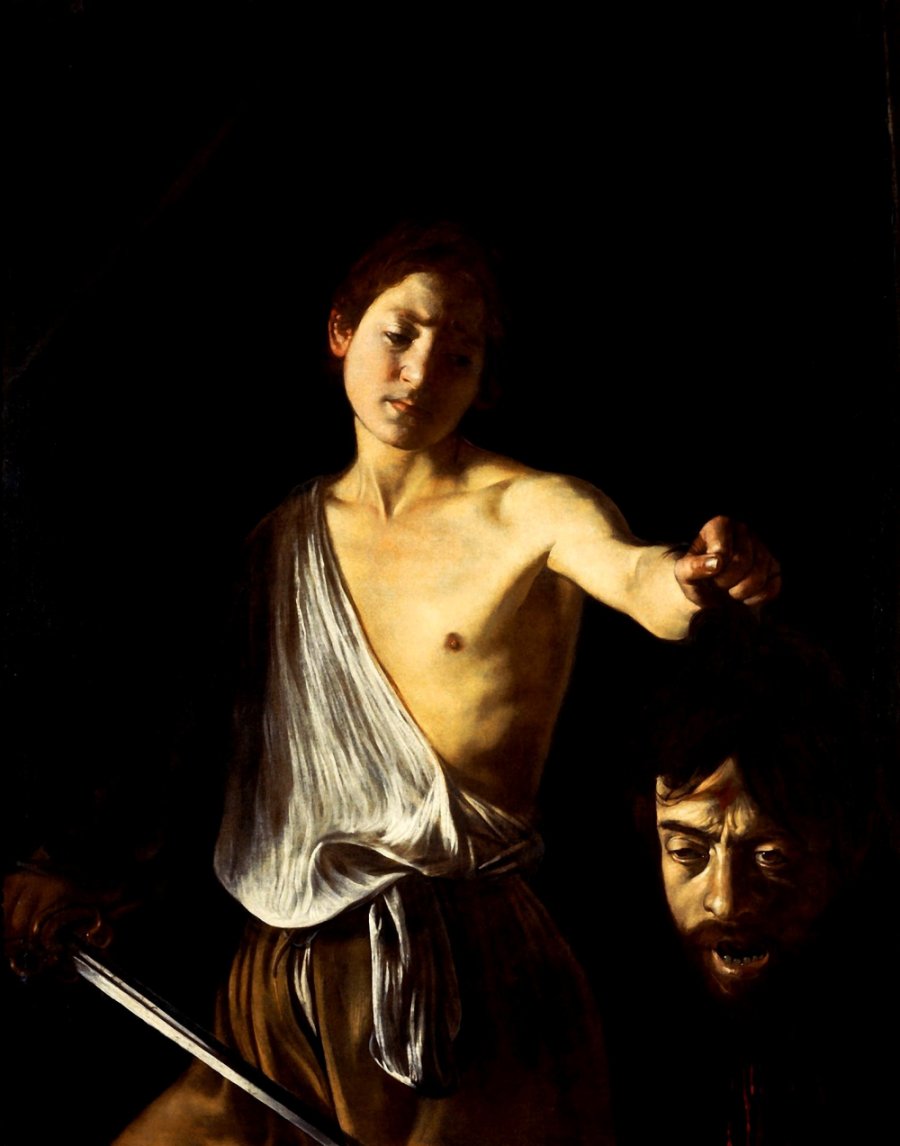
While David with the Head of Goliath seems to have been created shortly before Caravaggio’s own death for the pope’s art-hounding “Cardinal Nephew” Scipione Borghese, in a bid to earn a pardon. Caravaggio’s self-portrait as the dead man, and Latin inscription “humility kills pride” on the Israelite hero’s sword, suggest an attempt to effect through his creative virtuosity his own execution in effigy.

That would be, at any rate, the only execution Caravaggio ultimately had to endure. He died in the summer of 1610 under unclear — and inevitably suspicious — circumstances while attempting to return to Rome.

A few biographical books about Caravaggio …

… and some Caravaggio art books

* Ranuccio Tomassoni was the pimp and lover of a prostitute named Fillide whom Caravaggio had painted years before, and become enamored of. This Fillide was also Caravaggio’s model for Judith in the arresting painting of the Biblical heroine in mid-decapitation above.

** Possibly, if you like the love triangle angle, in a botched attempt to castrate his rival.

On this day..

1647: Alse Young, the first witchcraft execution in New England

On this date in 1647, the state of Connecticut carried out the first recorded execution of a witch in the American colonies.

A good half-century before the more renowned Salem witch trials, Alse Young — about whom little is recorded safe her infernal affiliations — hanged at Windsor for her devilry.

She was the first of several in Connecticut to suffer that penalty over the generation to come.

And though we’d be happy to blather on about it, we think you’ll find that Tim Abbott’s peripatetic Walking the Berkshires blog — still a font of compelling and original content in its sixth year on the beat — has Alse Young (and early Connecticut witchery) covered.

On this day..

1673: Thomas Cornell, on spectral evidence

(Thanks to Meaghan Good of the Charley Project for the guest post. -ed.)

On this day in 1673, alleged mother-slayer and arsonist Thomas Cornell was hanged in Portsmouth in the colony of Rhode Island.

The death of his elderly mother, Rebecca, and the subsequent homicide investigation have got to be one of the strangest murder stories in American colonial history.

The Cornells were a respectable and prosperous Quaker family, the ancestors of the man who founded Cornell University. (Their descendants also included Lizzie Borden of the “forty whacks” fame, but that’s another story.)

Rebecca, a 73-year-old widow, was the legal owner of the family’s hundred-acre spread by Narragansett Bay. Her oldest son, Thomas, and his wife and six children lived there with her, along with one lodger and one male servant, a Narragansett Indian named Wickopash.

Crowded as the house was, Rebecca had the master bedroom all to herself. It was well known that Rebecca and Thomas didn’t get along. For some time, both parties had been complaining bitterly about each other to anyone who would listen. Thomas resented the fact that, at 46, he was still financially dependent on his mother, who had made generous gifts from her late husband’s estate to her other children but not to him. Rebecca, for her part, said Thomas was “a Terror to her” and that she was neglected and had to fetch her own firewood.

None of her complaints were taken seriously until after her mysterious death, which is chronicled in Elaine Forman Crane’s 2002 book Killed Strangely: The Death of Rebecca Cornell.

Rebecca died on the evening of February 8, 1673.

That night, she refused to join the family for dinner because she didn’t like what was being served. After the meal was over, her grandson came to her room to check on her and found her charred body lying on the floor by the fireplace, burnt “to a cole.” She was recognizable only by her shoes.

Her death was originally ruled “an unhappie accident.”

It could have been spontaneous human combustion, but a more likely explanation is that embers from the fireplace or from the pipe Rebecca smoked landed on her dress.


An alleged victim of spontaneous human combustion.

No one heard her scream, no one smelled smoke, and somehow the fire didn’t spread to the rest of the house. No one seems to have suspected foul play at that time.

Two nights later, however, Rebecca’s younger brother, John Briggs, received a spiritual visitation from his sister as she slept. “See how I was burned with fire,” she said. He inferred that someone had intentionally burned her.

Briggs didn’t report his experience for a week, but when he did his account was taken seriously by the superstitious colonials. Rebecca’s body was exhumed and given a thorough inspection, and this time a wound was found on her upper abdomen. The authorities decided she had been stabbed by something like “the iron spyndell of a spinning whelle.” No murder weapon was ever produced, however.

Thomas quickly became the prime suspect: he was the last person to see Rebecca alive, and the whole town knew of the enmity between them. After Rebecca’s death, Thomas and his wife Sarah reportedly made some incredibly crass remarks; Sarah said her mother-in-law’s demise was “a wonderfull thing,” and Thomas said that his mother had always liked a good fire, and “God had answered her ends, for now shee had it.”

This hearsay was presented as evidence at Thomas’s trial, along with John Briggs’s dream.

Thomas was convicted and, although many of the townspeople had doubts about the verdict and death sentence, he chose not to appeal. He was hung before a crowd of over one thousand people.

Did Thomas Cornell murder his mother?

Certainly he wasn’t the only one who had the opportunity to do so; the house was full of people that night. In fact, a year after Thomas’s death, the servant Wickopash was tried as an accomplice to the murder. Nothing is known about the case against him, but he was acquitted.

In 1675, Rebecca’s son William tried to make a case against Thomas’s wife for the murder, but he failed to produce any witnesses or evidence against her.

Was this even a murder at all?

The fire, as noted above, could have been accidental; as for the “suspicious wound” the authorities found after they dug up the body, Rebecca could have stabbed herself in her struggles after her dress caught fire, or perhaps those who performed the exhumation saw only what they expected to see.

And there is yet a third possibility: prior to her death, Rebecca told her daughter she had contemplated suicide on several occasions, but her religious beliefs prohibited such action.

One final note: Thomas’s wife, Sarah, was pregnant at the time of his execution and later gave birth to a daughter.

She named the baby Innocent.

On this day..

1691: Jacob Leisler, “a Walloon who has sett at the head of the Rable”

On this date in 1691, Jacob Leisler was executed in New York, a New World casualty of the Glorious Revolution back in the mother country.

In an era when transatlantic communication moved at the speed of a galleon, the 1688 overthrow of England’s Stuart monarchy initiated an agonizing period of political uncertainty in Albion’s far-flung American provinces.

And to the question of who was really in charge were appended the many local political issues of the colonies — religious, economic, political.

One of the empire’s dominant fault political fault lines in the foregoing years had been the succession to follow England’s last Catholic monarch, James II. For Calvinists whose dynastic champion was the House of Orange, the marriage of their guy William III to James’s daughter raised the prospect of an eventual claim on the English throne. Those hopes seemed dashed when James fathered a son, to the elation of Catholics who now aspired to a lasting Catholic line.

When word reached New York, still a majority-Dutch city thanks to its original mother country, of the ascent of that their countryman William III and England’s Protestant establishment had forcibly disinherited the infant prince and his dad, it did not take long for local Dutch factions to run off the former King James’s plenipotentiaries. (An irony, since New York was named for that very same now-deposed King James: he’d been the Duke of York when it was seized for the Dutch in the 1660s.)

That ex-monarch’s brief reign had seen the establishment of a much-resented Dominion of New England, welding together everything from New Jersey to Maine into a super-colony whose high-handed boss was arrested by a Boston mob. (He sailed for England.) That gentleman’s lieutenant, in New York, likewise absconded as his own authority crumbled … a sort of American Glorious Revolution shadowing the one across the pond.

The Frankfurt-born Leisler was a colonial mercantile magnate, one of the 17th century’s wealthiest New Yorkers, notable for his Orangist sympathies and Calvinist religious inclination. It was to this important private citizen (who was also a militia captain) that de facto executive power fell in the New York colony — and it was indeed the New York colony specifically, since the reassertion of local prerogatives and pre-1685 administrative units had been one of the immediate consequences of the shakeout in America.


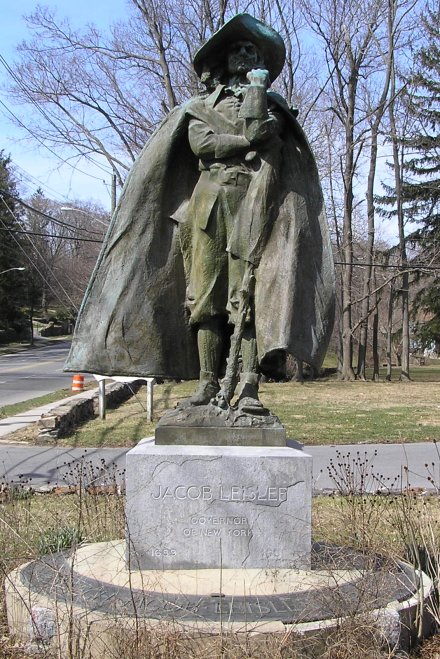
Statue of Jacob Leisler in New Rochelle, N.Y. — which Leisler helped create as a settlement for refugee Huguenots.

And once in the saddle, the Dutch Calvinist Leisler essentially ran a populist administration against the colonial oligarchy, which replied by vilifying him as a “usurper” and “rebel”.

Internal politics in New York and its neighbors during those months make fascinating reading.* Quakers and Catholics aligned against Protestants. Albany aligned against New York, until Leisler brought the former to heel. Clergy chose up sides. Leisler summoned a sort of proto-continental congress of colonial representatives (all the way to the West Indies) to hash out their situation.

And what was that situation? There had been a revolution, after all, and there was no agreed-upon representative of the royal authority present in New York. An assembly of militia leaders had asked Leisler to assume leadership, so was he really outside his rights to treat as his the London dispatches addressed to “such as, for the time being, take care for preserving the public peace and administering the law in New York”?

It’s a moment whose ferment of democratic energy can be read to presage the next century’s (proper) revolution.

Yet it was also not a revolution in the Cromwellian, world-turned-upside-down sense. For the English polity, and certainly for the conduct it preferred in its frontier possessions, continuity was the order of the day. Even in England herself, William and Mary were more than pleased to govern with Tories who could see their way to releasing their fealty to the Stuarts.

There was an empire to run, after all.

From that standpoint, Leisler’s anti-oligarchical policies and fractious disputes with other colonial elites were a bad business. There’s no sense in letting France make inroads because your governors are bickering over predestination or some such.

So formally, the realm’s new rulers continued all non-Catholic personnel in their posts. With the Dominion governors ejected, it was just a matter of dispatching fresh executives to take over. It’s just that this process required months … during which Leisler was managing New York the way he figured it ought to be managed, and his enemies were consequently painting him as a rebel.

Leisler pronounced himself, this whole time, anxious to submit his authority to the new governor upon the production of proper credentials. If he was surprised that the new monarchs tendered appointees of the very same factions recently expelled,** Leisler showed it only in his exactitude for procedure: because of a logistical cock-up, an aide to the new colonial governor arrived first, and when Leisler refused to hand over his fort without the royal warrant, a tense standoff ensued. It was resolved when the real governor, Henry Sloughter of ominous name, finally showed up.

Sloughter had his “predecessor” immediately arrested, along with others of his circle and harshly tried for treason and murder by a court stacked with anti-Leisler political enemies.†

Ultimately Leisler was condemned to die along with his secretary and son-in-law Jacob Milborne, but even Sloughter was loath to enforce the sentence. The story goes that Leisler’s most implacable foes had to get Sloughter drunk to put his signature on the death-warrant. (Sloughter died a couple of months later himself, for maximum operatic effect.)

On Saturday morning, May 16, 1691, the largest crowd ever gathered in New York City stood, rain soaked and weeping, all eyes fixed as a limp body was cut from the gallows and placed on the block. With a clean blow, the executioner’s ax cut off the head of the “halfe dead” Jacob Leisler — loyal lieutenant governor or rebel tyrant, depending on one’s point of view. Amid the “shrieks of the people,” fainting women (some “taken in labour”), and tumultuous jostling for “pieces of his garments” and strands of his hair, as “for a martyr,” the newly arrived and unfortunately named royal governor, Henry Sloughter, worried that his decision to execute Leisler might not, after all, end the “diseases and troubles of this Government.” Indeed, for years afterward New Yorkers bitterly divided over Leisler and the 1689 uprising that, in the wake of England’s Glorious Revolution, had led to his assumption of power in the provincial government.

-David Voorhees, who elsewhere contends that these divisions “continue to inform American politics to the present day.”*

A few years later, a more Leisler-friendly Parliament restored the dead man’s estate to his heirs, a sort of implicit admission that the whole head-chopping thing might have been a bit much.

This character figures to bear more historical consideration than he has heretofore enjoyed; further to that end, there’s a Jacob Leisler Papers Project devoted to marshaling at New York University the primary documents connected with Leisler.

* See, for instance, David Voorhees in “‘to assert our Right before it be quite lost’: The Leisler Rebellion in the Delaware River Valley” in Pennsylvania History, Winter 1997 — and, Voorhees again in “The ‘fervent Zeale’ of Jacob Leisler,” The William and Mary Quarterly, July 1994.

** Literally so: Francis Nicholson, whom Leisler ousted from New York, tried to get himself appointed governor; he was instead sent to Virginia and continued in royal service in the colonies for decades to come.

† e.g., Joseph Dudley, one of Leisler’s judges, whose penchant for authoritarian justice has been noted elsewhere in these pages.

On this day..

1689: Patrick O’Bryan, like a dog to his vomit

From the Newgate Calendar:


PATRICK O’BRYAN

Hanged once for Highway Robbery, but lived to rob and murder the Man for whom he had been executed. Finally hanged 30th of April, 1689

The parents of Patrick O’Bryan were very poor; they lived at Loughrea, a market-town in the county of Galway and province of Connaught in Ireland. Patrick came over into England in the reign of King Charles II, and listed himself into his Majesty’s Coldstream Regiment of Guards, so called from their being first raised at a place in Scotland which bears that name. But the small allowance of a private sentinel was far too little for him. The first thing he did was to run into debt at all the public-houses and shops that would trust him; and when his credit would maintain him no longer, he had recourse to borrowing of all he knew, being pretty well furnished with the common defence of his countrymen — a front that would brazen out anything, and even laugh at the persons whom he had imposed on to their very faces. By such means as these he subsisted for some time.

At last, when he found fraud would no longer support him, he went out upon the footpad. Dr Clewer, the parson of Croydon, was one of those whom he stopped. This man had in his youth been tried at the Old Bailey, and burnt in the hand, for stealing a silver cup. Patrick knew him very well, and greeted him upon their lucky meeting; telling him that he could not refuse lending a little assistance to one of his old profession. The doctor assured him that he had not made a word if he had had any money about him, but he had not so much as a single farthing. “Then,” says Patrick, “I must have your gown, sir.” “If you can win it,” quoth the doctor, “so you shall; but let me have the chance of a game at cards.” To this O’Bryan consented, and the reverend gentleman pulled out a pack of the devil’s books; with which they fairly played at all-fours, to decide who should have the black robe. Patrick had the fortune to win, and the other went home very contentedly, as he had lost his divinity in such an equitable manner.

There was in Patrick’s time a famous posture master in Pall Mall; his name was Clark. Our adventurer met him one day on Primrose Hill, and saluted him with “Stand and deliver.” But he was mightily disappointed, for the nimble harlequin jumped over his head, and instead of reviving his heart with a few guineas, made it sink into his breeches for fear, he imagining the devil was come to be merry with him before his time, for no human creature, he thought, could do the like. This belief was a little mortification to him at first; but he soon saw the truth of the story in the public prints, where Mr Clark’s friends took care to put it, and then our Teague’s qualm of conscience was changed into a vow of revenge if ever he met with his tumblership again; which, however, he never did.

O’Bryan at last entirely deserted from his regiment, and got a horse, on which he robbed on the highway a long time. One day in particular he met Nell Gwyn in her coach on the road to Winchester, and addressed himself to her in the following manner: “Madam, I am a gentleman, and, as you may see, a very able one. I have done a great many signal services to the fair sex, and have in return been all my life long maintained by them. Now, as I know you are a charitable w— —e, and have a great value for men of my abilities, I make bold to ask you for a little money, though I never have had the honour of serving you in particular. However, if an opportunity should ever fall in my way, you may depend upon it I will exert myself to the uttermost, for I scorn to be ungrateful.” Nell seemed very well pleased with what he had said, and made him a present of ten guineas. However, whether she wished for the opportunity he spoke of, or no, cannot be determined, because she did not explain herself; but if a person may guess from her general character, she never was afraid of a man in her life.

When Patrick robbed on the highway he perverted several young men to the same bad course of life. One Claudius Wilt in particular was hanged at Worcester for a robbery committed in his company, though it was the first he was ever concerned in. Several others came to the same end through his seducements; and he himself was at last executed at Gloucester for a fact committed within two miles of that city. When he had hung the usual time, his body was cut down and delivered to his acquaintance, that they might bury him as they pleased. But being carried home to one of their houses, somebody imagined they perceived life in him; whereupon an able surgeon was privately procured to bleed him, who by that and other means which he used brought him again to his senses.

The thing was kept an entire secret from the world, and it was hoped by his friends that he would spend the remainder of his forfeited life, which he had so surprisingly retrieved, to a much better purpose than he had employed the former part of it. These friends offered to contribute in any manner he should desire towards his living privately and honestly. He promised them very fairly, and for some time kept within due bounds, while the sense of what he had escaped remained fresh in his mind; but the time was not long before, in spite of all the admonitions and assistance he received, he returned again to his villainies like a dog to his vomit, leaving his kind benefactors, stealing a fresh horse, and taking once more to the highway, where he grew as audacious as ever.

It was not above a year after his former execution before he met with the gentleman again who had convicted him before, and attacked him in the same manner. The poor gentleman was not so much surprised at being stopped on the road as he was at seeing the person who did it, being certain it was the very man whom he had seen executed. This consternation was so great that he could not help discovering it, by saying: “How comes this to pass? I thought you had been hanged a twelvemonth ago.” “So I was,” says Patrick,” and therefore you ought to imagine that what you see now is only my ghost. However, lest you should be so uncivil as to hang my ghost too, I think it my best way to secure you.” Upon this he discharged a pistol through the gentleman’s head; and, not content with that, dismounting from his horse, he drew out a sharp hanger from his side and cut the dead carcass into several pieces.

This piece of barbarity was followed by another, which was rather more horrible yet. Patrick, with four more as bad as himself, having intelligence that Lancelot Wilmot, Esq., of Wiltshire, had a great deal of money and plate in his house which stood in a lonely place about a mile and a half from Trowbridge, they beset it one night and got in. When they were entered they tied and gagged the three servants, and then proceeded to the old gentleman’s room, where he was in bed with his lady. They served both these in the same manner, and then went into the daughter’s chamber. This young lady they severally forced one after another to their brutal pleasure, and when they had done, most inhumanly stabbed her, because she endeavoured to get from their arms. They next acted the same tragedy on the father and mother, which, they told them, was because they did not breed up their daughter to better manners. Then they rifled the house of everything valuable which they could find in it that was fit to be carried off, to the value in all of two thousand five hundred pounds, After which they set the building on fire, and left it to consume, with the unhappy servants who were in it.

Patrick continued above two years after this before he was apprehended, and possibly might never have been suspected of this fact if one of his bloody accomplices had not been hanged for another crime at Bedford. This wretch at the gallows confessed all the particulars, and discovered the persons concerned with him; a little while after which, O’Bryan was seized at his lodging in Little Suffolk Street, near the Haymarket, and committed to Newgate; from whence before the next assizes he was conveyed to Salisbury, where he owned the fact himself, and all the other particulars of his wicked actions that have been here related.

He was now a second time executed, and great care was taken to do it effectually. There was not, indeed, much danger of his recovering any more, because his body was immediately hung in chains near the place where the barbarous deed was perpetrated. He was in the thirty-first year of his age at the time of his execution, which was on Tuesday, the 30th of April, in the year 1689.

On this day..

1649: Robert Lockyer, Leveller

On this date in 1649, Robert Lockyer (or Lockier) was shot before the scenic backdrop of London’s St. Paul’s Cathedral* for the Leveller-inspired Bishopsgate mutiny.

These weeks following the epochal execution of the late king Charles I were also the climax of a pivotal intra-party conflict among the triumphant Parliamentarians … one whose class dimensions map a lot more readily to a modern template. Levellers were, “in a small way, the precursors of the ‘Socialists’ of 1849” in the words of this popular history.

The prosperous gentry represented by the Grandee faction were just fine with the whip hand they’d obtained in government by overturning the monarchy; against them were arrayed the more radical Levellers (or “Agitators”) who could not fail to notice that they had no say in electing the Parliament upheld by their victorious arms, and an oligarchy governing them that bore a suspicious resemblance to the supposedly defeated nobility.

So there was that.

Meanwhile, up in high statecraft, Oliver Cromwell was preparing to make his name accursed of Ireland by smashing up the island and the Grandees hit upon an arrangement as expedient for fiscal ambitions as for territorial: the soldiers assigned to this expedition would have the opportunity to opt out of it, for the low low price of forfeiting the substantial back pay they were due from those years of civil war — pay whose fulfillment was naturally a chief Leveller demand.

How did this cunning plan to pillage the soldiery’s pensions to conquer Ireland go over in the ranks? Reader, not well.

Since the same reason that shall subject them unto us in generall, or any of us singly, may subject us unto them or any other that shall subdue; now how contrary this is to the common interest of mankind let all the world judge, for a people that desire to live free, must almost equally with themselves, defend others from subjection, the reason is because the subjecting of others make(s) the subdued strive for Dominion over you, since that is the only way you have left them to acquire their common liberty.**

So there was that, on top of that.

Grumblings gave way to refusals to march, and the refusal by a regiment stationed in Bishopsgate to leave London lest it also leave its leverage soon became the eponymous mutiny of this post — the Bishopsgate Mutiny.

Grandees quelled this particular insubordination without need of bloodshed, but thought it meet to deliver a little anyway as proof in this fraught political environment against the next such affair. Six of the soldiers drew military death sentences; Cromwell pardoned five, but let known Leveller/Agitator firebrand Lockyer go to his death over the appeals of Leveller leaders like John Lilburne and Richard Overton.

The signal was unmistakable — certainly to the thousands who donned Leveller colors to follow Lockyer’s funeral procession through London.

In the days following Lockyer’s execution, several Leveller-inspired regiments would openly rise … what proved to be the movement’s last great stand, efficiently crushed by Cromwell.

*The Parliamentarians had twisted high church dogmatists by putting Old St. Paul’s Cathedral to profane use as a cavalry stable, which employment actually made it a sort-of suitable place for a military execution. (The current structure was rebuilt on the same site after the previous church succumbed to the Great Fire of London.)

** From Mercurius Militaris, quoted by Norah Carlin, “The Levellers and the Conquest of Ireland in 1649,” The Historical Journal, June 1987 — which, however, makes the case that while the Levellers were obviously not cool with the pay expropriation, their opinion on the Ireland conquest in the abstract was far from uniformly anti-imperial.

On this day..

1655: Massacre of Waldensians

On this date in 1655, Catholic forces under the Duke of Savoy carried out a notorious massacre of Waldensians* in the Piedmont.

This interesting, excommunicate sect had persisted for centuries in those hard-to-reach places in Alpine foothills, intermittently ignored and hunted. After Martin Luther, many Protestants inclined to see them as a proto-Reformation movement, or even a counter-papal apostolic succession reaching back to ancient Christianity.

At any rate, they sure weren’t Catholic.

And our friend the Duke decided — perhaps piqued by the murder of a missionary Catholic priest, or for whatever other reason — to mount one of those heresy-extirpating sorties and make them Catholic in 1655.

On April 17, the Marquis of Pianezza appeared with an overwhelming force of mixed Piedmontese, French, and Irish** troops. They conducted a few skirmishes, then made nice with the Waldensian civic leaders and induced them to quartering their troops temporarily further to some expedient pretext.

Alas! alas! these poor people were undone. They had received under their roof the executioners of themselves and their families. The first two days, the 22d and 23d of April, passed in peace, the soldiers sitting at the same table, sleeping under the same roof, and conversing freely with their destined victims …

At last the blow fell like a thunderbolt. At four of the clock on the morning of the 24th April the signal was given from the Castle of La Torre. But who shall describe the scenes that followed? On the instant a thousand assassins began the work of death …

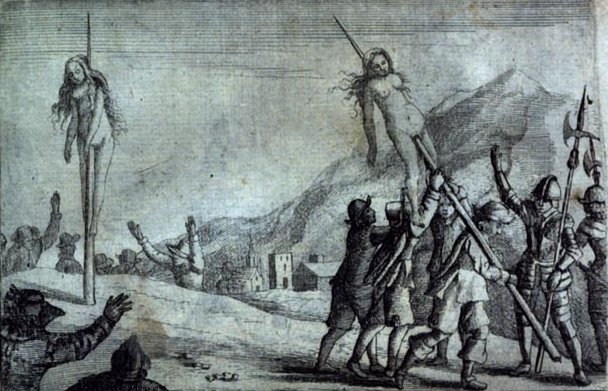
Little children were torn from the arms of their mothers, and dashed against the rocks; or, more horrible still, they were held betwixt two soldiers, who, unmoved by their piteous cries and the sight of their quivering limbs, tore them up into two halves. Their bodies were then thrown on the highways and the fields. Sick persons and old people, men and women, were burned alive in their own houses; some were hacked in pieces; some were bound up in the form of a ball, and precipitated over the rocks or rolled down the mountains … Some were slowly dismembered, and fire applied to the wounds to staunch the bleeding and prolong their sufferings; some were flayed alive; some roasted alive; others were disembowelled; some were horribly and shamefully mutilated, and of others the flesh and brains were boiled and actually eaten by these cannibals.

Source, whose atrocity accounts channel those in this French tome

Without doubting the capacity of man’s inhumanity to man, the cannibalism charge reminds that we’re dealing with propaganda alongside historiography. And what great propaganda — like, babies-torn-from-incubators great.

Thumbnails (click for a larger, disturbing view) of selected images of this date’s atrocities from Samuel Morland’s The History of the Evangelical Churches of the Valleys of Piedmont

And there’s little doubt as to the overall savagery of the affair, which could well have become the opening salvo in a full-scale sectarian cleansing campaign. (A later addendum to Foxe’s Book of Martyrs narrates the ensuing Piedmontese armed struggle, petering out before any definitive resolution in the field.)

Outrage at this hecatomb spread in Protestant Europe — which would also refer to the day’s doings as the “Bloody Easter,” since it corresponded with the eve of that celebration as reckoned by the Julian Calendar (source).

It was felt especially in Protectorate England, which intervened diplomatically.

A “day of solemn fasting and humiliation” was promulgated in Albion, along with collections for the relief of the survivors. Oliver Cromwell personally put £2,000 into the kitty.

More importantly, he dispatched diplomat Samuel Morland† to force the House of Savoy to lay off the persecution; in fact, he threatened to disrupt high statecraft between England and France unless the French twisted arms on behalf of the Waldensians.

Written correspondence for Morland’s diplomatic tour addressed to Louis XIV of France and various other continental potentates, as well as a fiery bit of oratory that Morland delivered to Savoy, all seem to have originated from the pen of Republican scribbler John Milton — the future author of Paradise Lost.‡

Milton, for whom the whole thing was more than just a day job, was further moved to put his umbrage at the slaughter into sonnet form:

Avenge O Lord thy slaughter’d Saints, whose bones
Lie scatter’d on the Alpine mountains cold,
Ev’n them who kept thy truth so pure of old
When all our Fathers worship’t Stocks and Stones,

Forget not: in thy book record their groanes
Who were thy Sheep and in their antient Fold
Slayn by the bloody Piemontese that roll’d
Mother with Infant down the Rocks. Their moans

The Vales redoubl’d to the Hills, and they
To Heav’n. Their martyr’d blood and ashes sow
O’re all th’ Italian fields where still doth sway

The triple Tyrant: that from these may grow
A hunder’d-fold, who having learnt thy way
Early may fly the Babylonian wo.

* The Waldensians in question here are interchangeably known as the Vaudois for their geographic region, actually above the Piedmont and abutting the Swiss region also known as Vaud. (These pages have visited the latter.)

** Fresh from being on the receiving end of another infamous massacre.

† Morland is more regarded for his post-Restoration labors as an inventor; he created an early calculator and internal combustion engine.

‡ The speech in particular is not definitively attributed; see Robert Fallon, “Milton in Government: Denmark and Savoy,” Milton Quarterly, May 1989.

On this day..

1647: Domenica Gratiadei and her coven of witches

This date in 1647 marked the execution of five supposed witches in Trentino.

Secular and modernist as this grim site‘s curators confessedly stand, we have perhaps given too little credence to those devout officers of the law who labored in those years to uphold the throne of heaven besieged by Satan’s varied earthly minions.

Montague Summers

In an effort to balance the record, we present this date’s account as rendered by a guy who took the supernatural a bit more seriously: Montague Summers.

Summers is a weird figure, but if he wasn’t really a throwback believer in Rome’s phantasmagoric early modern theology, he was the century’s most sublime performance artist.

Converting to Catholicism as an Anglican deacon, he went about in spooky clerical robes although his ordination status remains unclear to this day, immersed his capacious mind in supernatural arcana, and penned voluptuously eloquent books credulously treating the spectral evidence another era had given against sorcerers, vampires, lycanthropes, and suchlike habitues of the Monster Manual.*

I have endeavoured to show the witch as she really was -– an evil liver: a social pest and parasite: the devotee of a loathly and obscene creed: an adept at poisoning, blackmail, and other creeping crimes: a member of a powerful secret organization inimical to Church and State: a blasphemer in word and deed, swaying the villagers by terror and superstition: a charlatan and a quack sometimes: a bawd: an abortionist: the dark counselor of lewd court ladies and adulterous gallants: a minister to vice and inconceivable corruption, battening upon the filth and foulest passions of the age.

Summers projected (perhaps intentionally) a mysterious and vaguely sinister persona and did not disdain to cultivate a friendship with nefarious occultist Aleister Crowley, his contemporary. There were even rumors of an unwholesome interest in pederasty.

We’re confident that none of this has done his sales a bit of harm. So who are we social pests and parasites of the blogosphere not to batten upon it ourselves?

The below is drawn from Summers’ The Geography of Witchcraft — and as the reader will perceive, Geography at least purports to treat the flying-off-to-infernal-orgy stock in trade of those bygone witch hunters as legitimate evidence of the lead crone’s “attendance at the Sabbat, sometimes, no doubt, an experience on the psychic plane, for she was undoubtedly a medium of unusual powers, and sometimes in actual fact.”

A typical case of Witchcraft, and one which owing to its prominence and the meticulous investigations of the authorities has luckily been reported in full, attracted considerable attention in the winter of 1646 and the following spring. It will, moreover, be found to present so many factors and features, which occur again and again in the contemporary trials of wellnigh every European country, that it may profitably be dealt with in some detail.

A certain old woman of Castelnovo, Maria Salvatori, nicknamed “la Mercuria,” who had long been suspected of sorcery, was arrested on 26 October, 1646, and formally examined. At first the two principal charges, sufficiently damning in themselves, seem to have been that at her communions she did not swallow the Sacred Host, but kept It in her mouth to spit It out secretly and reserve It for some abominable purpose, and also that by her ecbolic spells she had caused the young Marchesa Bevilacqua to miscarry in childbirth. She was again interrogated on 8 November and put to the torture of the cord when she accused Domenica, the widow of a certain Tomaso Camelli, and Domenica’s daughter, Lucia, the wife of Antonio Caveden, both of whom dwelt at the hamlet of Villa, of being rank witches. She also avowed she had taken a Host from her mouth to give to Lucia Caveden, who thereby confected a charm which caused the abortion of the Marcioness. She added that she had also bewitched Cristoforo Sparamani, the son of Cecilia Sparamani, and that a certain Delaito Cavaleri was a necromancer and a worshipper of Satan. A further interrogation followed on 15 November, as a result of which the court, consisting of Paride Madernino, delegate in all criminal and civil cases in the districts of Castelnovo and Castellano, and his assessor Giovanni Ropele, doctor utriusque iuris, promptly gave orders to GiuseppeCoriziano, “bargello di questa turia,” to arrest Domenica and Lucia. This was done, and on Saturday, 24 November, 1646, at Nogaredo, the proceedings against the witches were formally opened. “Processus Criminalis pro destructione lamiarum.” On 27 November Domenica Carnelli was questioned by the judges, but they got little enough out of her. Two days following Lucia Caveden was brought before the tribunal. She vehemently declared that the charges were all malice; the hag Salvatori was her enemy; and with many cries she called Heaven to witness her innocence, repeatedly exclaiming “per grazia del Signor Iddio no son una stria” But the next day she proved less firm and implicated yet another woman, Domenica Gratiadei, who was immediately thrown into prison, a number of suspicious objects being found in her house when it was closely searched by the officers. Certain pots of a dark unguent and a mysterious powder being produced in court, Lucia Caveden confessed that these were for the destruction of human life and cattle. Seeing that the game was up Domenica Gratiadei, upon being put to the torture, soon laid bare all the secrets of the infernal sisterhood. She had made this unguent with which she annointed herself to attend the Sabbat “trasformata in gatto,” she had cast the evil eye on Cristofero Sparamani, she had renounced her baptism, defiled the Blessed Sacrament, adored Satan with divine honours. The judges were filled with horror, and trembled at the hideous tale of diabolism these women poured forth. Cecilia Sparamani, a plain honest woman, was next summoned as a witness and told how her son fell into fits of no ordinary kind. The doctors had acknowledged their skill baffled, and in spite of the prayers of two Capuchin fathers and the exorcisms of Monsignore the Bishop of Brondolo, this preternatural sickness still persisted. She informed the court that as soon as summer came and the roads were passable she intended to take the boy to the shrine of S. Antony at Padua, to whom she had a special devotion.

On 18 December, 1646, Benvenuta, the daughter of Domenica Gratiadei, made a startling confession. She declared that she had been taken by her mother “as if in a dream” to a place where there was dancing and singing, where she had been welcomed by a large number of revellers, and especially by a young man, who having kissed and fondled her awhile afterwards had connexion with her. This was, her mother averred, Satan himself. When closely questioned as to these proceedings the girl could only reply: “Tutto mi sembra, come ho detto, un sogno: e parevami che sempre vi fosse il diavolo in forma di quel giovene.” It would seem from these very striking and significant words that the girl was a hypnotic subject, entirely under her mother’s control, and that on these occasions she passed into a semi-trance state. The case dragged on throughout the months of January and February, 1647. There were interminable interrogations, and a large number of persons were gradually implicated.

On 2 January 1647, Domenica Gratiadei gave a detailed description of the Sabbats she had attended. She and an old warlock named Santo Peterlino always led the coven. “The rest followed in the shape of cats; but the Devil went first of all.” They enjoyed banquets, dances, plays, music, songs, and afterwards all worshipped Satan, presenting him with Hosts which they kept from their last communion. Before attending the Sabbat she anointed herself with an unguent made of “the Blessed Sacrament, the blood of certain small animals, Holy Water, the fat of dead babies” which was mixed with horrible imprecations and blasphemies to confect the charm.

On 10 January, a strange figure, Maddalena Andrei, nicknamed “La Filosofa,” first appears in the case. She confessed that she had assisted in the making of the ointment and had also adored the Devil who frequently appeared to her, “brave, like a gallant captain, dressed all in red.” On 9 March, when Giuseppe Goriziano entered the cell of La Filosofa to summon her to court he found her lying dead upon the floor. The common people believed that she had been carried off by Satan, especially as the Archpriest of Villa, Don Giovanni Bragliardi, shrewdly suspecting that the unhappy woman had committed suicide, refused her sepulture in consecrated ground.

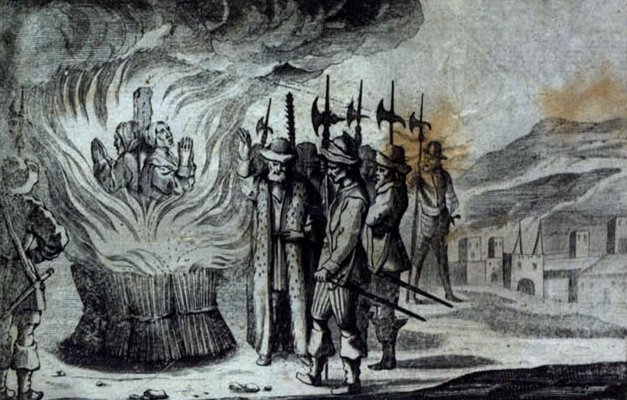
This long and complicated Witchcraft-trial at length came to an end in April 1647. The court was throned with an excited yet hushed crowd, when the judge Paride Madernino and his assessors the Counts of Lodrone and Castel-Romano delivered the sentences. Domenica Camelli, Lucia Caveden, Domenica Gratiadei, Catterina Baroni, Zinevra Chemola, Isabella and Plonia Gratiadei, and Valentina Andrei were condemned to death. Maria Salvatori, “la Mercuria,” and Maddalena Andrei, “la Filosofa” had expired in prison. The condemned were beheaded and their bodies burned. It would seem, however, that Isabella and Polonia Gratiadei and Valentina Andrei managed to escape and could not be traced. The execution of the rest took place on 14 April, 1647, when Leonard Oberrdorfer the common hangman carried out the judicial sentence.

The chief witches here naturally fall into four groups each constituted of one old and one young woman, Domenica Camelli and Lucia her daughter; Domenica Gratiadei and Benvenuta her daughter; Isabella Gratiadei and Plonia her daughter; Maddalena Andrei and her daughter Valentina. The chief of the coven was undoubtedly Domenica Gratiadei, whose vile confessions, a mixture of most horrid blasphemies and lewdest obscenity, convince her of being a wretch wholly devoted to evil, and an active propagandist of the Satanic cult. It was she who had debauched her own daughter to “the Devil,” that young man whose name and individuality do not appear, but who may be guessed to have been a noble of the district, using the witches for his own ends and, presumably, supplying them with money to carry out his dark designs. That the whole gang frequently attended the Sabbat, at which he was not unseldom present, there can, I think, be no question.

This case is recounted in much greater detail in Italian in this Google book; this page has another summary, also in Italian.

* “[I]n every way a ‘character,’ and in some sort a throwback to the Middle Ages,” the London Times blurbed Summers at his death (obituary in the Aug. 11, 1948 issue). But his “preoccupations with the supernatural, however, represented only one side of his nature. His solid services to learning lie rather in his copious editorial and critical work on the English Restoration drama — a field in which he possessed the most comprehensive and expert knowledge.”

Summers’ edited compendium of 17th century playwright Aphra Behn‘s works is available free at gutenberg.org.

For exemplars of the stuff more topical to this post, one can also peruse free online his The Vampire: His Kith and Kin and his translation of the notorious witch-persecution manual Malleus Maleficarum.

On this day..