When Christian died, Ulfeldt was the de facto ruler of the realm or a few months in 1648 while the elective monarchy sorted out where to pass the crown next.
The choice ultimately fell to the late king’s son Frederick III, but this saturnine prince was distrusted by the Danish nobility, who forced on him as the price for his power a Haandfaestning — a sort of temporary Magna Carta circumscribing a monarch’s power for the period of his individual reign. It set a less than comradely tone for the two men’s relationship.
In 1651, an accusation surfaced that Ulfeldt was in on a plot to poison the king — an accusation that cost Ulfeldt’s lover her own head. Deciding that he didn’t need to be around when the next specious regicide allegation made the rounds, Ulfeldt pre-emptively fled the country.
From there, Ulfeldt’s lust for power and personal enmity for Frederick would light his path to infamy.
He signed up with Sweden’s King Charles X — Denmark’s greatest foreign rival — and mounted an invasion of his native country, possibly even financed by stolen Danish treasure. Rewarded with a Swedish noble title, he promptly began double-dealing against them, until his disgusted new sovereign dispossessed him, leading Ulfeldt to return hat in hand to Copenhagen.
Imprisoned there for that whole leading-an-enemy-invasion incident, Ulfeldt again managed to wriggle out and immediately tried to raise a German army against Denmark. Really — enough, dude.
Frederick certainly thought he’d seen enough too. Not having the compulsive traitor available to execute bodily, he resorted to the weird ritual of punishing a mannequin, and ordered the prison governor:
Know that you have to command the executioner in our name, that to-day, November 13, he is to take the effigy of Corfitz, formerly called Count of Ulfeldt, from the Blue Tower where it is now, and bring it on a car to the ordinary place in the square in front of the castle; and when he has come to the place of justice, strike off the right hand and the head, whereafter he is to divide the body into four parts on the spot, and carry them away with him, whilst the head is to be placed on a spike on the Blue Tower for remembrance and execration.
A few months after, the hunted Ulfeldt was reported to have died in Switzerland, a report considered highly suspicious in his native land. Nevertheless, he was never captured or heard from again, so whenever or however he died, it seems he managed to cheat the executioner of his flesh. As to the judgment of posterity: that, he had long since squandered.
The royal and loyal widow Leonora Christina enjoys a reputation quite a bit more favorable than her husband. She swallowed every draught of his exile, and more — remaining imprisoned under harsh conditions long after Corfitz’s death, only released in 1685 with the passing of King Frederick’s wife, her vengeful personal enemy. In that time, and in between fending off in her dungeon the local vermin, lecherous jailers, and the poison of personal bitterness, she wrote voluminous and well-regarded memoirs.
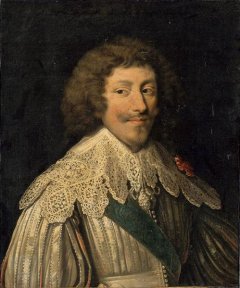
On this date in 1632, French noble Henri II de Montmorency was beheaded at Toulouse for rebellion against Louis XIII.
The lordly Montmorency (English Wikipedia page | French), sister to a famous knockout whom Henri IV wooed, was a Grand Admiral for his achievements knocking heads during the 1620s’ Huguenot rebellions. (It was Montmorency who, in the naval battle to capture Re Island, commanded the English ships controversially supplied by the Duke of Buckingham.)
The red eminence had just attained his rank as Louis XIII’s consigliere, and set about using it to centralize the state in the king’s hands.
Toward that end, Richelieu pressed Montmorency to give up his “grand admiral” title, fearing that “grand” military generals running around the realm were liable to become a locus of sedition sooner or later. Similarly, Richelieu reduced Montmorency’s power as governor of Languedoc.* He wanted, altogether, fewer stumbling-blocks of leftover feudal authority laying about his absolute monarchy.
Orleans fled the country, not half so committed to his revolt as Montmorency — who assailed the king’s lines practically alone. The latter, captured wounded on the battlefield, was attested to have given a ferocious account of himself in a hopeless cause: “seeing a single man charge through seven ranks and still fight at the seventh, he judged that that man could be only M. de Motmorency.”
Jolly good show, and all the more reason for Richelieu to take his head, to make an example of the man to other powerful men who demanded clemency for the rebellion as if it were Montmorency’s birthright. Richelieu would argue in his memoirs that this pitiless act to pacify the realm at the risk of his own popularity was the height of patriotism.
Plaque at the spot of Montmorency’s execution in Toulouse. Image (c) [Cova] and used with permission.
The Montmorency title eventually became that of the Dukes of Enghien, in which guise it’s associated with an altogether more famous execution.
* Among Montmorency’s other titles, less obnoxious to Richelieu, was viceroy of New France — that mysterious land across the Atlantic. There’s a Montmorency Falls in Quebec, named for him by Champlain.
The rack, or question, to extort a confession from criminals, is a practice of a different nature: this being only used to compel a man to put himself upon his trial; that being a species of trial in itself. And the trial by rack is utterly unknown to the law of England; though once when the dukes of Exeter and Suffolk, and other ministers of Henry VI, had laid a design to introduce the civil law into this kingdom as the rule of government, for a beginning thereof they erected a rack for torture; which was called in derision the duke of Exeter’s daughter, and still remains in the tower of London: where it was occasionally used as an engine of state, not of law, more than once in the reign of queen Elizabeth but when, upon the assassination of Villiers duke of Buckingham by Felton, it was proposed in the privy council to put the assassin to the rack, in order to discover his accomplices; the judges, being consulted, declared unanimously, to their own honour and the honour of the English law, that no such proceeding was allowable by the laws of England.
Although the jurisprudence of 17th century England with its proscription of legal torture* still stacks up favorably next to that of Berkeley law professors, it certainly did not stand in the way of assassin John Felton‘s execution on this date in 1628.
Felton, an army officer passed over for promotion, stabbed to death nobby royal favorite George Villiers, Duke of Buckingham at Portsmouth — a private grievance fused to a widespread public one. Reams of laudatory verse churned out in the two months between crime and punishment suggest the popular opprobrium for the duke.**
Or you, late tongue-ty’d judges of the land,
Passe sentence on his act, whose valiant hand
Wrencht off your muzzels, and infranchiz’d all
Your shakl’d consciences from one man’s thrall?
But O! his countrie! what can you verdict on?
If guiltie; ’tis of your redemption.
Felton’s victim, the Duke of Buckingham — portrayed in 1625 by Rubens.
Villiers, “handsomest-bodied” scion of the minor gentry, had parlayed his comeliness into power as the favorite (and possibly the lover) of King James I. He had, as Alexandre Dumas put it in The Three Musketeers (in which adventure Buckingham is an important character) “lived one of those fabulous existences which survive, in the course of centuries, to astonish posterity.”†
Buckingham latched himself to the king’s 20-something son and heir Charles I and became a dominant influence in foreign policy as well as wildly unpopular in England. He raised Protestant hackles with Machiavellian statecraft like angling for a Spanish queen and aiding the French against the Huguenots, and since he exercised a share of the royal power he vigorously upheld the rights of the crown as against those of the commons. An opponent once compared him to Sejanus.
Indeed, Buckingham helped the youthful Charles, king since March of 1625, set the tetchy tone for his relationship with Parliament that would define his rule and ultimately cost the monarch his own head. When Parliament demanded Buckingham “be removed from intermeddling with the great affairs of State” as a condition for coughing up any more money, Charles haughtily dissolved Parliament rather than give up his favorite.
That forced the king into sketchy expedients like the “forced loan” and, when the money disputes continued after Buckingham’s death, the king’s eventual legislature-free Personal Rule that set up the Civil War.
So one can see how the sudden 1628 murder of this resented courtier, to whom was imputed every fault and abuse of Charles himself, would have been celebrated. “Honest Jack” — the assassin’s widely-honored nickname — was likewise credited with every perceived virtue of the Parliamentarian party. Juridically, the man was doomed — but in the popular eye,
[t]he passage of Felton to London, after the assassination, seemed a triumph. Now pitied, and now blessed, mothers held up their children to behold the saviour of the country; and an old woman exclaimed, as Felton passed her, with a scriptural allusion to his short stature, and the mightiness of Buckingham, “God bless thee, little David!” Felton was nearly sainted before he reached the metropolis. His health was the reigning toast among the republicans.
While he’s sometimes described — or dismissed — as merely a disgruntled careerist, the assassin’s own ideological commitment ought not be downplayed. Whatever Felton’s personal pique, the assassination was unambiguously political: our killer had returned from war wounded and melancholy and proceeded to marinate in the era’s anti-monarchical currents. In time, Felton came to understand — surely in concert with many of his countrymen now forgotten by time — that there was a greater good to be served by the sin of murder.
He had left behind in his trunk a few propositions that underscored his state of mind: “There is no alliance nearer to any one than his country” and “No law is more sacred than the safety and welfare of the commonwealth.” He justified himself at trial in similar terms, and did so without desiring to escape the extremities of the law that his crime demanded.
Felton had really expected to be killed in the act of the assassination himself. To that end, he had left a note pinned in his hat that is as good an elegy for him as any a republican ballad. “That man is cowardly and base and deserveth not the name of a gentleman that is not willing to sacrifice his life for the honor of his God, his king, and his country. Let no man commend me for doing it, but rather discommend themselves as to the cause of it, for if God had not taken away our hearts for our sins, he would not have gone so long unpunished.”
While Felton played his part in the generations-long struggle to subordinate king to parliament, the most immediate beneficiary of this affair was not so much the Commons as it was the noble rival who usurped the late Buckingham’s power — the Earl of Strafford.
* Certain though we are of the human rights commitment of Felton’s prosecutors, the man himself made sure of it by dint of a deft bit of interrogatory jujitsu. Menaced with the prospect of torture, he cheerfully resigned himself to it — “Yet this I must tell you by the way,” he added. “That if I be put upon the rack, I will accuse you, my Lord of Dorset, and none but yourself.”
That’s the way to convince judges not to torture you.
† Felton also appears in The Three Musketeers, committing the murder of Buckingham at the instigation of the seductive fictional villain Milady de Winter just days before the musketeers execute Milady herself.
On this day in 1675, in the then-Puritan Massachusetts Bay Colony (now Essex County, Massachusetts), 27-year-old Samuel Guile was hanged for “violently and forcibly” raping Mary Ash on Christmas Day the previous year.
What little is known about the case comes from the Records of the Court of assistants of the colony of the Massachusetts bay, 1630-1692, which is available for free with Google Books.
Samuel Guile of Hauerill being Committed to Prison in order to his trial for Comitting a Rape was presented & Indicted by the Grand Jury, was brought from prison to the bar where holding up his hand was Indicted by the name of Samuel Guile for not hauving the feare of God before his eyes & being instigated by the divill did on or about the 25th day of December last in the woods violently and forcibly seize on & Comitt a rape on the body of Mary Ash the wife of John Ash of Amesbury Contrary to the peace of our Soueraigne Lord the King his Croune & dignity the lawes of God & of this jurisdiction — to which he pleaded not Guilty and put himself on God & country. After the Indictment and eudicenes were Read Comitted to the Jury & are on file with the Records of this Court the Jury brought in y’r verdict they found the prisoner at the barr Guilty & he accordingly had sentenc pronounct ag’ him yow Sam Guile are to Goe from hence to yo place from whence yo came & thence to yo place of execution & there be hang till yow be dead wch was accordingly donn 16 october 1675.
His estate paid six pounds, eighteen shillings in court costs and five pounds in damages to Mary.
Although rape was a capital crime, it was inconsistently punished in the Massachusetts Bay Colony. In 1680, five years after Guile swung, William Nelson was convicted of raping a girl under ten and he was only whipped.
Nearly forty years earlier, in 1642, Daniel Fairfield, John Hudson and Jenkin Davis were found guilty of gross immorality for molesting and raping two sisters over a period of years, starting when they weren’t even seven years old. The men confessed to everything but penetration, but the girls’ statements and a physical examination contradicted the suspects’ statements.
Governor John Winthrop was horrified and wrote at length about the case, calling it “a very foul sin.” Fairfield was whipped twice and had his nostrils slit, Hudson and Davis were also whipped and Davis had to wear a halter for life (like a scarlet letter, it would remind everyone of his crime), and all three men were fined heavily … but they were not executed.
One wonders, then, why Samuel Guile was. Did he have a bad reputation? Were Mary and John Ash prominent people? Or did the colonial court just decide they’d better exercise the law to its full extent for once?
On this date in 1675, an Indian (tribe uncertain insofar as I can ascertain) named Little John (or John Littlejohn) was publicly executed on Boston Common for murder.
Though the attributed crime was of a venial variety, the situation was conditioned by a dirty war of ethnic cleansing that had only just that summer erupted — King Philip’s War.
Strained by a series of Native American raids, Little John — lying in jail for murder — apparently became a popular target of Bostonian fury, which was a very bad place to be. Just a few days before this execution, two accredited Indian envoys in the city had been hailed as King Philip’s warriors by two whites, and upon that “recognition” put to death.
about the 10th of September, at nine O’clock at Night, there gathered together about forty Men (some of Note) and came to the House of Captain James Oliver; two or three of them went into the Entry to desire to speak with him, which was to desire him to be their Leader, and they should joyn together and go break open the Prison, and take one Indian out thence and Hang him: Captain Oliver hearing their Request, took his Cane and cudgelled them stoutly, and so for that Time dismist the Company; which had he but in the least countenanced, it might have been accompanied with ill Events in the End. Immediately Captain Oliver went and acquainted Mr. Ting his Neighbor, (a Justice of Peace) and they both went next Morning and acquainted the Governour, who thank’d Captain Oliver for what he had done last Night, but this rested not here; For the Commonalty were so enraged …
an Order was issued out for the Execution of that one (notorious above the rest) Indian, and accordingly he was led by a Rope about his Neck to the Gallows; when he came there, the Executioners (for there were many) flung one End over the Post, and so hoised him up like a Dog, three or four Times, he being yet half alive and half dead; then came an Indian, a Friend of his, and with his Knife made a Hole in his Breast to his Heart, and sucked out his Heart-Blood: Being asked his Reason therefore, his Answer, Umh, Umh nu, Me stronger as I was before, me be so strong as me and he too, he be ver strong Man fore he die.
Thus with the Dog-like Death (good enough) of one poor Heathen, was the Peoples Rage laid in some Measure, but in a short Time it began to work (not without Cause enough).
This date in 1692 was the third of four execution dates during the notorious Salem witch trials.
Five souls were dispatched at Gallows Hill this date. With the executioner’s due respect to John Willard, George Burroughs, George Jacobs, Sr. and The Crucible main character John Proctor, we’re elated this date to focus on the only woman among them — Martha Carrier.
Carrier is the subject of the recent historical novel The Heretic’s Daughter by her tenth-generation descendant Kathleen Kent, whom we’re delighted to welcome for an interview on this anniversary.
How did you first learn of your connection to Martha Carrier, and how does your family feel about this link?
I was very fortunate to have heard stories of the colonial Carriers from the time I was a young child. My first memory of hearing about the Salem witch trials was when I was eight years old, visiting my maternal grandmother. She was the first one to tell me that my grandmother back nine generations, Martha Carrier, had been hanged as a witch in 1692. When I asked her if Martha was in fact a witch, my grandmother said, “Sweetheart, there are no such things as witches, just ferocious women.”
She, along with the rest of my family, had a great sense of pride over Martha’s courage in standing up to her accusers. She was one of the few people, out of the 150 New Englanders accused of practicing witchcraft, who not only refused to admit to being guilty, but also never accused anyone else of being a witch, which most people did to save themselves.
Your book tells the story of Martha Carrier from the perspective of her 10-year-old daughter. As an author, how did you approach the research, especially when it comes to Martha as an individual? Is that something you were able to source pretty strongly or did it require a lot of filling in the blanks?
The Heretic’s Daughter was my first novel, and it took five years of research and writing to complete it.
Fortunately, there is a wealth of historical information about the colonies during that time. The courts where the witch trials were conducted kept very meticulous records so I was able to gather a lot of facts regarding the magistrates and deponents, as well as the accused. There are so many wonderful fiction and non-fiction books alike that have been written about the Salem witch trials, but I wanted to write a very personal story about the Carrier family; how they lived day to day, how they survived disease, Indian raids, hostility from their neighbors, and ultimately the witch trials. I was able to weave in a lot of my family’s stories — the cow that gave golden milk, Andrew’s near death experience in the prison — that have been passed down through 10 generations.
When I first began working on the book, it was written from Martha’s point of view, but I decided it would make more compelling reading if the narrator was one of the Carrier children, Sarah, and it is through her eyes that we see the growing hysteria over witchcraft, and her struggle with Martha’s strong, unyielding character. This theme of mother-daughter conflict is central to the book’s development.
So, who was Martha Carrier and why did she become one of the people caught up in the Salem witch trials?
Martha Carrier had evidently long been resented by the community in Andover, where the Carrier family lived during the Salem witch trials, because of her forceful nature. She argued over boundary lines with several neighbors (which was a common occurrence amongst the settlers), telling one neighbor, “I will stick as close to you as bark on a tree.” (source: Salem witch trial deposition; see this document) She was also married to a man who had fought in the English Civil War, and was widely rumored to be one of the executioners of King Charles I of England. Martha fell outside of the Puritan ideal of what a woman was supposed to be and was so vocal in her own defense during the trials that when she was asked by her judges if she had ever seen the Devil, she responded by telling them that the only devils she had ever seen were the men sitting in judgment before her.
Her own children accused her of witchcraft. Are you descended through those kids as well? And do we know anything about how they later dealt with or rationalized that act?
My family is descended from Tom, Jr., and I learned the full genealogy at an early age from my grandparents. Four of Martha’s five children were arrested to compel her to admit to being guilty. Her two oldest sons were arrested first, and they were tortured until they agreed to testify against their mother. Tom and Sarah were then arrested — the real Sarah being only 7 years old at the time, and the second youngest child to be imprisoned during the trials — and they quickly admitted that they, too, were complicit in witchcraft.
During the research, I discovered how truly awful the conditions were in the Salem jail. Nearly half of the 150 people arrested from towns all over New England were under the age of 18. The surprising thing was not that people died, but that anyone survived at all. The four children were kept imprisoned for months after their mother was hanged and they were finally released in the fall of 1692. Within a few years, their father, Thomas, collected his children and grandchildren and moved to the wilds of Connecticut to start a new life.
How did she try to defend herself?
Martha Carrier was so vocal in her own defense during the trials that Cotton Mather, one of the most famous theologians of his day, named her the “Queen of Hell.”
This Rampant Hag, Martha Carrier, was the Person, of whom the Confessions of the Witches, and of her own Children among the rest, agreed, That the Devil had promised her, she should be Queen of Hell.
When she was confronted by the accusing girls, she turned to her judges and said, “It is a shameful thing that you should listen to these folks who are out of their wits.”
By the time of her arrest, several women had already been sentenced to be hanged, and she knew that her refusal to confess would mean death. She never wavered in her testimony and never accused another person to save herself, even when her four children were arrested and two of her sons were tortured.
Do you feel like she’s an overlooked figure in this affair? She’s not, for instance, even a character in The Crucible.
Arthur Miller did extensive research for The Crucible, but he did make changes to the historical facts for fictional purposes: for example John Proctor was in his seventies during the trials; hardly the strapping figure played by Daniel Day Lewis in the film adaptation.
There were so many remarkable people and events during the trials that he had to choose selectively in order to illustrate his primary motivation in writing the play which was to shed light on the McCarthy era communist “witch” trials.
Nathaniel Hawthorne wrote about Martha Carrier, as did Cotton Mather, but her forceful character made her a difficult subject, especially when there were more motherly figures like Rebecca Nurse, or titillating young characters like Abigail Williams to explore.
At this distance of time, Martha Carrier must have a great many descendants. Are you in touch with other branches of the family?
Soon after publishing The Heretic’s Daughter, I started getting emails and letters from fellow descendents of Thomas and Martha Carrier telling me that they, too, had heard many of the stories that I had grown up with.
For the release of my second novel, The Wolves of Andover, about Thomas Carrier’s life, I decided it would be fun to invite some of these extended family members to Salem for a book launch. On November 5th, 2010, nearly 250 Carrier descendents, some of them flying in from as far away as Washington State, California and Arizona, came to Salem for a weekend of author talks, receptions and story swapping. A video on my web site captured some of the highlights from that remarkable weekend.
We came as strangers and left Salem as family.
Ultimately, what’s changed about you yourself from your literary encounter with this famous ancestor?
The Salem witch trials were a dark period in American history, but from researching those events I discovered that positive changes occurred over time in the judicial system, the penal system, and for religious tolerance. I am awe-struck by the courage and fortitude of the settlers who sacrificed so much for their children and grandchildren.
And I am especially proud of my heritage: that my 9x great-grandmother defended her principles and conscience, even in the face of death. An interviewer once asked if, having written the novel, I felt I was speaking for Martha Carrier, and I said that I felt she had been speaking for me. A ferocious woman indeed!
With your second book, The Wolves of Andover, you’ve written two about the Carrier family. What’s your next project?
Wolves is a prequel to Heretic, as it explores the life of Thomas Carrier during the English Civil War and his journey to the new world from London.
I am about halfway through my third novel, but this one is quite different from the first two. It takes place during reconstruction era Texas in 1870, and chronicles a particularly chaotic, violent time in Texas history.
There’s another fine interview with Kathleen Kent here. -ed.
On this date in 1634, a Paris tribunal “declare[d] the said Urbain Grandier duly guilty of the crime of sorcery, evil spells, and the possession visited upon some Ursuline nuns of this town of Loudon and of other laywomen mentioned at the trial, together with other crimes resulting from the above. For redress of these, he has been condemned … to be taken to the Place of Saine-Croix of this said town, to be tied to a post on a pile of faggots that is to be built in the said Place. There his body is to be burned alive … and his ashes are to be scattered to the winds.”
The sentence was immediately enforced.
These Loudon possessions were a disgraceful carnival of simulated enspellment by the local Ursuline nuns engineered to destroy Grandier, a parish priest with a knack for acquiring enemies.
Alexandre Dumas, pere would write about Grandier in his Crimes Célèbres, and later in a stand-alone play. In Dumas’s rendering, Grandier arrived in Loudon as a handsome outsider, eloquent in the pulpit and doubly so in pursuit of a pretty girl,* as inexorable as Shylock in his victorious lawsuits against the local grandees.
Most recklessly of all, he made a foe of Cardinal Richelieu — snubbing him, opposing him politically, and (so it was alleged) authoring a scathing and anonymous lampoon of the Grey Eminence.
When Richelieu’s deputy came to town, the locals got the Ursuline nuns into their fits and got Grandier fast-tracked for hell.
The nuns put on a circus of frothing, profane, hip-thrusting demoniac possession accusing Grandier of bewitchment as they melodramatically underwent exorcism. (Fabulously attended, these public displays of possession and exorcism went on for several years after Grandier’s death as a perverse tourist attraction.)
Richelieu’s guy arranged to try Grandier in his own court (no appeal possible) and threatened to arrest for treason anyone who testified in his defense. In case that were insufficient advantage, a contract with Lucifer — a literal, signed document — was produced for the magistrates’ edification.
In fairness, this “contract” must have been a hell of a lot of fun to forge.
Heck, even nuns who tried to recant were turned away. Must be back under Lucifer’s influence!
Before proceeding to the stake, Grandier was subjected to one last “extraordinary” torture. His holy persecutors, “lest the Devils should have the power to resist the blows of a profane man, such as the hangman was, they themselves took the hammers and tortured the unhappy man” until the bone marrow leaked from his legs. Satan’s subcontractor suffered the blows without confessing or naming an accomplice.
In 1952, Aldous Huxley molded the horrible Grandier story into a non-fiction novel, The Devils of Loudun. Huxley’s take helped to popularize the tale — one that polemicists in the 17th century also recognized as an injustice — for the modern era of flesh minced by ideological madness.
From beginning to end, the trial proved a farce in which the condemnation of the accused was a foregone conclusion. By means of a series of trumped-up charges reinforced by an official philosophy and falsified theological dogmas, the resources of the state were mobilized to crush the offending individual. Huxley is not slow to point to the modern counterpart of such proceedings, notably in Fascist or Communist countries.
-Book review by S. van Dantzich, The Australian Quarterly, June 1954
Evidently, it struck a chord.
A 1971 cinematic adaptation of this book, The Devils, a captivating and sacrilegious tapestry of violent, sexual, and religious iconography, won critical praise and censor board bans, as well as an “X” rating in the United States. It’s hard to find, but worth the trouble.
Henri of Navarre, in prevailing over his rivals for power in France and becoming King Henri IV, had good cause to appreciate Gontaut’s service, and even consider the man a friend.
But our Gontaut, having ascended the posts of Admiral, Marshal, Governor of Burgundy — and, of course, Duke — still coveted greater prestige. “Ambitious, arrogant, and of no great intelligence,” is this popular history’s judgment. (p. 360)
So he started conspiring with the Duke of Savoy — even as Gontaut bore the French standard in the field against this same character — for an arrangement to set himself up as an independent ruler or otherwise do something seriously deleterious to Henri’s kingdom.
The stories consistently report (pdf) that the lenient Henri was disposed to pardon his man if Gontaut would but make the show of submission implied in begging pardon, confessing his sin, vouchsafing loyalty, and all the rest of it, but out of pride and/or stupidity, Gontaut did not do it.
This fatal vanity recommended the Duc de Biron as a character study for his contemporary, English playwright George Chapman, whose The Conspiracy and Tragedy of Charles, Duke of Byron was published in London (heavily censored, at the insistence of the French ambassador) in 1608.
* Charles de Gontaut’s father, Armand de Gontaut, was also godfather to the child who would grow up to become Cardinal Richelieu.
On this date in 1635, Domingos Fernandes Calabar was garroted at Porto Calvo.
A mulatto plantation owner, Calabar (Portuguese Wikipedia page) did his patriotic duty according to the dictates of Brazil’s Portuguese colonizers when an expansionist Netherlands showed up hungry for a bite of Brazil.
But after rounding up a volunteer militia and helping repel Dutch incursions in 1630 and 1632, Calabar switched sides and joined Holland.
Why he switched sides remains permanently obscure. Popular explanations include: the seductions of Netherlander lucre (Calabar’s detractors like this one); a politically mature calculation that the Dutch would make more progressive colonizers than the Portuguese (this was Calabar’s own defense: “I spilled my blood for … the slavery of my homeland … With its actions, the Dutch have proven better than the Portuguese and Spanish”);* or … somewhere in between
He was rewarded for his devotion [to the Portuguese] by the contempt of his countrymen, who were envious of his prowess. Wounded by this conduct, he left the Portuguese and joined the Dutch.
Whatever the reason(s) for it, Calabar’s switch was efficacious: he knew the lay of the land, and he was vigorous in helping the Dutch foothold of “New Holland” expand. The Dutch commissioned him a Major, and he gained a reputation for his ambushes.
I never met a man so well-adapted to our purposes … the greatest damage he could cause to his countrymen, was his greatest joy.
-English mercenary in the Dutch service
The Portuguese official Matias de Albuquerque eventually turned the tables and captured Calabar in a Portuguese ambush. He not only had the disloyal subject strangled, but quartered the body for public display.
This gruesome warning against collaboration did not prevent New Holland from growing to around half the Brazilian territory … but since Brazilians don’t speak Dutch today, you might have an idea how this is going to end.
After “New Holland” was re-conquered and re-re-conquered, the Dutch Republic under Johan de Witt — preferring a commercial empire to a territorial one — gave up its untenable position in exchange for 63 tons of gold.
As the (eventual) winners of this imperial affray, the Portuguese wrote a distinctly unflattering history of Domingos Fernandes Calabar, the disreputable traitor. He’s a sort of Benedict Arnold character synonymous with disloyalty for any Brazilian schoolchild.
But other interpretations are available.
During Brazil’s Cold War military dictatorship, when traitorousness might seem downright reputable after all, the “official version” was slyly subverted in several different stage productions, the best-known of which is a musical called Calabar: In Praise of Treason.**
Most of the information about Calabar online is in Portuguese; for instance, biographies here and here.
* Let it not be implied that the Dutch were out for anything other than the plunder of empire themselves: Calabar’s own home region of Pernambuco was desirable precisely because of its sugar cane cultivation.
Incidentally, the vicissitudes of war enabled many African slaves to escape to Maroon communities like Palmares — just a few miles away from Porto Calvo.
** See Severino Jaão Albuquerque, “In Praise of Treason: Three Contemporary Versions of Calabar,” Hispania, Sept. 1991. “Less interested in settling the issue of Calabar’s martyrdom than in provoking serious debate about the meaning of loyalty and national identity in times of political repression and in the context of a dependent culture, these plays … bring to the fore the manifold ambiguities the colonized face reacting to the hegemonic rule of the colonizer.”
The Salt Riot is exactly what you’d think from its name, right down to being over in a matter of weeks.
Common folk irked at a new salt tax* that made the commodity dramatically more expensive besieged tsar Alexei I at the beginning of June, soon joined by opportunistic Streltsy who hadn’t been paid in a while.
The specific target of their rage was the boyar Boris Morozov, the elder brother-in-law of the teenage monarch, and the true power behind the throne. He accordingly played the traditional role of bad cop to the tsar’s presumptive good cop.
Of course, both guys were really on the same team.
A few days of mayhem, a few boyars’ heads on pikes later, the Streltsy had been bought off and the rioters divided and quashed. Alexei avoided handing over Morozov to the vengeance of the mob, and “exiled” him to a monastery. He would return from “exile” in a few months, once everyone had chilled out and the rising could be taken with a grain of salt.
This passing spasm in the Russian polity left a long-lived and troublesome legacy: one of the demands of the rioters was the convocation of the Zemsky Sobor to hammer out a new legal code.
This happened to be a need for the Russian state anyway, since its rulers were governing by the haphazard issuance of countless ukases nobody could keep straight. So, 1649 saw the promulgation of the Sobornoye Ulozheniye, helpfully rationalizing the lawmaking process.
Win, and win! Except that this legislative milestone also codified serfdom in its most heavy-handed form, formally binding most Russian peasants to their estate without freedom of movement, and making this unhappy condition hereditary. The legal code, and the institution of serfdom subsisted until the 19th century.
* According to The Cambridge History of Russia, the salt tax itself had actually been abolished at the end of 1647, but “other direct taxes were tripled to compensate for the loss of revenue.”

 Ulfeldt (English Wikipedia page | Danish) is notorious as his country’s greatest traitor.
 The lordly Montmorency (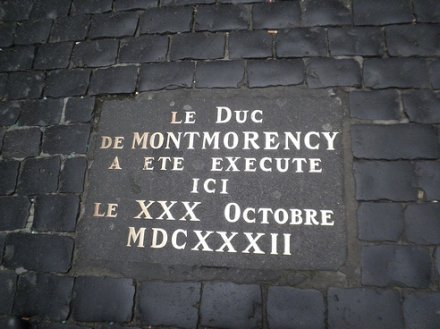


 The sentence was immediately enforced.
 The son of
  A mulatto plantation owner, Calabar (

