2007: Not Sina Paymard, saved by a flute

On this date one year ago, a teenager who saved himself with a flute cheated Iran’s hangman by the narrowest of margins.

Sina Paymard had had the hemp about his throat the previous fall for murdering — at the tender age of 16 — a drug dealer in a pot buy gone bad.

The bipolar young musician’s last request was to play the ney (a Persian flute), and in a feat fit for legend, he played so movingly that the family of the victim reprieved him.

This power under Islamic sharia law comes with a price: the reprieve bought time for the families to negotiate alternative financial compensation known as diyeh. Come July, the lad’s family was still $90,000 short, and he was shifted to Tehran’s Evin prison to do the whole thing over again.

Sina’s new execution date received worldwide attention:

… helping them scrape together enough from donors (“notably a substantial donation from a university lecturer”) to make good his escape.

Such are the vicissitudes of the Iranian judiciary that Paymard went from all but dancing on air twice to outright liberty: he’s a free man today, or was as of a few months ago.

Though things worked out for Sina Paymard, other juvenile offenders continue to face the ultimate sanction in Iran — virtually the last outpost of the practice on the globe. Earlier this month, StopChildExecutions.com detailed 138 Iranian prisoners condemned for crimes committed as children; Iran has executed at least two such prisoners this year.

On this day..

2007: Zheng Xiaoyu, former Director of the State Food and Drug Administration

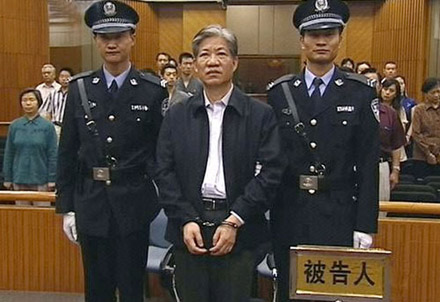
One year ago today, China made to clean up its image — with public health advocates, if not with human rights advocates — by executing* its former Food and Drugs minister for economic crimes.

Zheng Xiaoyu, China’s drug regulation capo from 1994 to 2005 and only (“only”?) the fourth minister-level official to be put to death in China since the immediate aftermath of Mao Zedong’s reign, was sentenced for extracting bribes from pharmaceutical companies he nominally regulated in exchange for approving their worthless and/or unsafe products.

One bogus antibiotic he rubber-stamped killed ten in China before it was pulled from the market, but it was dangerous Chinese products exported abroad — including lethal pet food ingredients to the United States and a cough syrup that killed dozens in Panama — that lit a fire under the export-driven colossus. The court that rejected his appeal explicitly referenced Zheng’s danger to China’s international reputation — simultaneously shifting focus from structural weaknesses by individualizing them to Zheng’s personal failings.

Zheng Xiaoyu hears his death sentence.

On this same day it announced Zheng’s death, China anxiously unveiled plans to safeguard the food supply for its upcoming turn under the Olympic klieg lights. That acid test is now upon it: opening ceremonies are mere weeks away as of this writing.

It may have been a politically-driven execution and an unusually heavy sentence, but Zheng’s passing was exulted in China. Someone even tried to put his name on a rat poison — rejected for that most distinguished reason of modern capitalism, Zheng’s own intellectual property in his name.

For an interesting dive into the social and legal currents surrounding this case, check out this .pdf edition of Criminal Bar Quarterly.

* The method of execution was not announced, and to my knowledge has not been conclusively documented. Gunshot was the longtime standby for Chinese executions, but China has shifted heavily towards lethal injection in recent years; it’s generally assumed that Zheng suffered the latter fate.

On this day..

2001: Timothy McVeigh, Oklahoma City bomber

At 7:14 a.m. on this date in 2001, Oklahoma City bomber Timothy McVeigh was executed at the federal penitentiary in Terre Haute, Ind.

More ink has been spilled about the 33-year-old Gulf War veteran and his infamous crime than this space can possibly hope to summarize. Books can be — and have been — written debating whence McVeigh sprang and whether he was rightly convicted.

McVeigh tended to keep coy about his version of his activities on April 19, 1995,* but he was never less than frank about his philosophy.

Though his avowed motive, the Waco slaughter that occurred two years to the day before Oklahoma City, has never exactly been secret, the way he’s connected those events has also never been particularly welcome. And McVeigh would say that the fact that he suffered execution while the only parties punished in the Waco siege were the survivors makes his point.

For all its moral monstrosity, the Gulf War veteran’s critique of his violent actions vis-a-vis those the state claims legitimacy for makes discomfiting reading, and is not always so easy to answer. From our distance of time, knowing that three months after McVeigh’s execution another terrorist act to beggar Oklahoma City would propel the United States back into Iraq, it strikes eerily prescient notes.

In a 1998 essay, McVeigh savaged the government for its hypocritical posture towards the country he had once fought, Iraq:

The administration has said that Iraq has no right to stockpile chemical or biological weapons (“weapons of mass destruction”) — mainly because they have used them in the past.

Well, if that’s the standard by which these matters are decided, then the U.S. is the nation that set the precedent. The U.S. has stockpiled these same weapons (and more) for over 40 years. The U.S. claims that this was done for deterrent purposes during the “Cold War” with the Soviet Union. Why, then is it invalid for Iraq to claim the same reason (deterrence) — with respect to Iraq’s (real) war with, and the continued threat of, its neighbor Iran?

If Saddam is such a demon, and people are calling for war crimes charges and trials against him and his nation, why do we not hear the same cry for blood directed at those responsible for even greater amounts of “mass destruction” — like those responsible and involved in dropping bombs on [Dresden, Hanoi, Tripoli, Baghdad, Hiroshima and Nagasaki]?

The truth is, the use of a truck, a plane, or a missile for the delivery of a weapon of mass destruction does not alter the nature of the act itself.

These are weapons of mass destruction — and the method of delivery matters little to those on the receiving end of such weapons.

Whether you wish to admit it or not, when you approve, morally, of the bombing of foreign targets by the U.S. military, you are approving of acts morally equivalent to the bombing in Oklahoma City. The only difference is that this nation is not going to see any foreign casualties appear on the cover of Newsweek magazine.

It seems ironic and hypocritical that an act viciously condemned in Oklahoma City is now a “justified” response to a problem in a foreign land.

Another note sent shortly before his execution to author Gore Vidal travestied government warmaking talking points:

[T]his bombing was also meant as a pre-emptive (or pro-active) strike against those forces and their command and control centers within the federal building. When an aggressor force continually launches attacks from a particular base of operations, it is sound military strategy to take the fight to the enemy. Additionally, borrowing a page from U.S. foreign policy, I decided to send a message to a government that was becoming increasingly hostile, by bombing a government building and the government employees within that building who represent that government. Bombing the Murrah Federal Building was morally and strategically equivalent to the U.S. hitting a government building in Serbia, Iraq, or other nations. Based on observations of the policies of my own government, I viewed this action as an acceptable option. From this perspective what occurred in Oklahoma City was no different than what Americans rain on the heads of others all the time, and, subsequently, my mindset was and is one of clinical detachment.

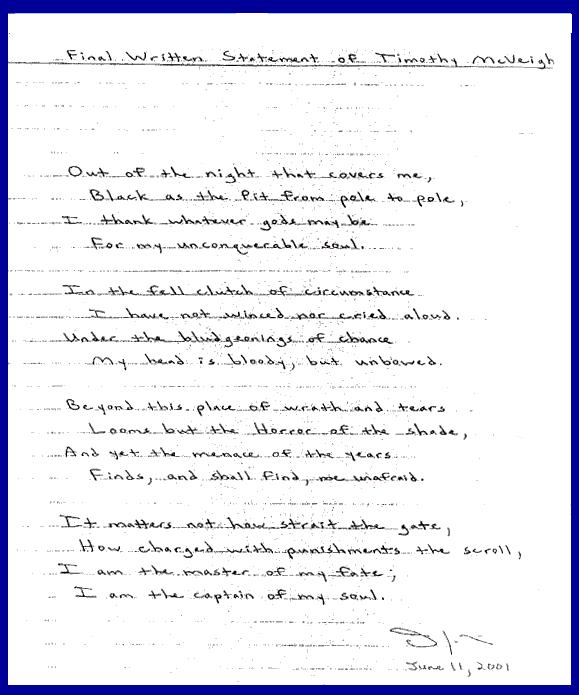
He broadcast clinical detachment in the execution itself — the first conducted by the federal government since 1963, technically imposed for the eight federal employees among his 168 victims — from his waiver of appeals to his unnervingly unblinking death mask to the stoic 19th century poem “Invictus” that formed his written (and only) final statement.

* Also — coincidentally or not — the execution date of Richard Snell in Arkansas, a militia man (and white supremacist, which McVeigh was not) who had once tried to blow up the Murrah building himself.

On this day..

2004: Nam Cam, Vietnamese crime lord

On this date in 2004, at Ho Chi Minh City’s Long Binh execution ground, Vietnamese mafioso Truong Van Cam was shot with four of his lieutenants for ordering the murder of a rival crime lord.

An anti-communist soldier during the Vietnam War, “Nam Cam” (“Cam the fifth sibling”) survived a communist re-education camp and ingratiated himself sufficiently with the powers that be through the late 1970’s and 1980’s to ensconce himself as a wealthy and influential power broker within the country.

Nam Cam emerges from court after hearing his death sentence on June 5, 2003.

His arrest in 2001 for ordering a hit in a characteristic underworld turf war mushroomed into a vast corruption scandal, implicating a network of official protectors who ran interference for his criminal syndicate.

More than 150 people stood trial with Nam Cam — including “two expelled members of the 150-member Communist Party central committee, the former head of the state radio system, and the former director of police in Troung Nam Cam’s base of operation, Ho Chi Minh City.” (Source)

The doomed capo reportedly indulged the comfort of gloating that “the Communists may have thought they defeated South Vietnam, but I have shown that they are rotten to the core with corruption.”

The more things change …

On this day..

2004: Case Study: Kelsey Patterson

The case of Kelsey Patterson, who was executed in 2004, is one of the most compelling examples of what can happen when the mental health system fails to provide adequate care and in doing so, puts the public at risk. For more than two decades, Patterson struggled with paranoid schizophrenia. His severe delusions and elaborate conspiracy theories led him to commit several irrational and motiveless assaults. Yet instead of investing resources in a long-term treatment plan, the state of Texas largely left Patterson to his own devices, until one day his mental illness pushed him to the point of no return.

A Cycle of Illness, Violence, and Neglect

Kelsey Patterson spent much of the 1980s in and out of two state mental hospitals. His condition would be stabilized, but would deteriorate once he was removed from psychiatric care. According to a Houston Chronicle from 11 August 2002 (“Mentally Ill Killer’s Life on the Line”), when he stopped taking his medication, he would become belligerent. An earlier article in the same newspaper (“Is Mentally Ill Death Row Inmate Sane Enough to Die?”, Houston Chronicle, 14 November 1999) noted he was “left half-treated and unsupervised by the state for years despite a history of psychotically inspired, near-fatal assaults.”

Kelsey Patterson: Not all there.

In 1980, Patterson shot and wounded Richard Lane, a Dallas co-worker who he believed was conspiring against him and attempting to poison his food (it was Lane’s first day on the job). Lane survived and Patterson was sent to the maximum security unit at Rusk State Hospital, where he was found incompetent to stand trial and diagnosed with schizophrenia. Although restored to competency through treatment, doctors determined that he had been unable to conform his conduct to the law, a key provision of Texas’ insanity statute at the time. Prosecutors dismissed the charges, deeming him insane at the time of the crime.

In 1983, Patterson shot and wounded a co-worker in his hometown of Palestine in another motiveless, delusional assault. Again he spent months at Rusk State Hospital before being restored to competency. Once again he was found unable to conform his behavior to the law, and the attempted murder charge was dismissed.

Back in Dallas in 1986, he assaulted yet another co-worker and was sent to Terrell State Hospital. As with the previous incidents, no charges were filed because of his mental health status. He was hospitalized once more in 1988 after reportedly threatening family members and complaining that people were trying to poison him. That hospital stay lasted only 34 days.

Throughout this period, Patterson denied that he was mentally ill, would stop taking his medications, and refused to comply with treatment plans. His delusions continued to worsen, and he believed that everyone was out to get him, particularly “the authorities.” According to his brother, he sometimes would tape the edges of his windows and doors to determine if anyone had come in the room. He also heard voices talking to him through the walls and over the loudspeakers during his time in jail.

On September 25, 1992, just days after his brother once again tried to have him committed to a psychiatric facility, Patterson walked a short distance from his home to a local oil supply business in Palestine, where he shot and killed both the owner, Louis Oates, and his secretary, Dorothy Kay Harris, at whom he screamed “You ain’t going to get away with it.” After the shooting, he put down the gun, stripped to his socks, and paced, shouting incomprehensibly until the police arrived. As with his previous assaults, there seemed to be no real motive or explanation for the crime – Patterson had only a casual acquaintance with the victims. Yet in this instance, the state not only decided to pursue charges but also to seek the death penalty, arguing that Patterson met the new legal standard of sanity, which merely required the defendant to know that his conduct was wrong. The ability to conform one’s conduct to the law was no longer part of the insanity defense in Texas. By all accounts, however, Patterson’s delusional beliefs were the same as always.

Excerpt from a 13-page letter from Kelsey Patterson to the Texas Court of Criminal Appeals. (Image owned by author.)


Patterson’s Competency Hearing and Capital Trial

At his competency hearing, two physicians did not dispute his mental illness but declared Patterson to be competent to stand trial. Dr. James Grigson – who had diagnosed Patterson with schizophrenia 12 years earlier – reversed course and testified that in this latest assault, Patterson had been sane at the time of the crime. He had spoken with Patterson for less than five minutes and had not conducted a comprehensive evaluation, yet was absolutely confident in his assessment.*

Against the advice of his attorneys, Patterson took the witness stand during the hearing and rambled about the conspiracies against him. He offered this explanation for his behavior:

They have some type of implant devices that they used on me in the military, which I receive. Like the device that they put in the inner ear in which they can send subliminal message and make a person act beyond their controllability to know you have taken an action.”

The jury found him competent to stand trial, in spite of the clear evidence that he did not possess a rational or factual understanding of the proceedings against him and was unable to consult with his attorneys, whom he believed were plotting against him. Patterson was constantly removed from the courtroom during his trial because of his disruptive behavior and outbursts about the devices implanted in his body. The jury rejected his insanity defense, found him guilty of capital murder, and sentenced him to death.

A Permanent Stay of Execution

During his time on death row, Patterson consistently maintained that he was the victim of an elaborate conspiracy, and he wrote rambling, incoherent letters to court officials, his family, politicians, and others. He refused to meet with mental health professionals or his lawyers, which made it impossible to formally assess his competence. Both state and federal courts upheld his conviction and found him competent to be executed. In November 2003, the U.S. Supreme Court refused to hear his appeal and the state set his execution for the following May.

Upon learning of his execution date, Patterson’s letters referred to a “permanent stay of execution” that he said he had received on grounds of innocence. Competency for execution requires an inmate to be aware of the impending execution and the reason for it.

On May 17, 2004, the Texas Board of Pardons and Paroles issued an extremely rare recommendation of clemency for Kelsey Patterson because of his mental illness; the vote was 5-1 and was only the second such recommendation in the board’s history. Governor Rick Perry rejected the recommendation, however, “in the interests of justice and public safety.” Kelsey Patterson was executed on May 18, 2004, delusional until the very end, as evidenced by his incoherent last statement:

Statement to what? State what? I am not guilty of the charge of capital murder. Steal me and my family’s money. My truth will always be my truth. There is no kin and no friend; no fear what you do to me. No kin to you undertaker. Murderer. … Get my money. Give me my rights. Give me my rights. Give me my rights. Give me my life back.

For more information on death penalty cases involving mental illness, go to http://www.tcadp.org/index.php?page=mental-illness or visit http://preventionnotpunishment.blogspot.com

* Dr. Grigson was known as “Dr. Death” because his testimony was instrumental in sending so many people to death row. He later was expelled from the American Psychiatric Association and Texas Society of Psychiatric Physicians because of his unethical, unscientific testimony in such cases.

Kristin Houle is a 2007 Soros Justice Fellow based in Austin, Texas.

On this day..

2002: Ahmed Sultan and Mohammad Humayun, who murdered Meena

On this date in 2002, the killers of one of Afghanistan’s most noted feminists were hanged in Mach Jail outside Quetta, Pakistan.

Afghan feminist Meena Keshwar Kamal had founded in 1977 the Revolutionary Association of the Women of Afghanistan. RAWA works (and has done so against the successive Soviet, Taliban and Karzai regimes) for secularism, democracy and equality — per this poetic manifesto of its founder (Source):

I am a woman who has awoken
I have arisen and become a tempest through the ashes of my burnt children
I have arisen from the rivulets of my brother’s blood
My nation’s wrath has empowered me
My ruined and burnet villages replete me with hatred against the enemy
O compatriot, no longer regard me as weak and incapable
My voice has mingled with thousands of arisen women
My fists are clenched with fists of thousands of compatriots
To break together all these sufferings, all these fetters of slavery
I am the woman who has awoken
I’ve found my path and will never return.

Meena was assassinated in Quetta in 1987 just shy of her 31st birthday; that her killer(s) be brought to justice was long one of RAWA’s key political demands, and the organization supported this day’s hanging.

RAWA itself — which enjoyed a brief turn at the height of worldwide vogue as the United States prepared to invade Afghanistan and found itself suddenly inspired by the plight of women under the mullahs — holds its fallen founder as a martyr and continues to agitate.

On this day..

2004: Jerry McWee, a former policeman

On this date in 2004, South Carolina executed a man who had once been on the other side of the law.

Jerry Bridwell McWee hardly fit the profile of a future death row inmate when he met one George Scott. McWee was pushing 40, had no criminal record, and had once done a stint as an Augusta, Ga., police officer.

But it wasn’t many months that the two had iced a couple of Aiken County denizens in a hunt for drug money.*

It may have worked to Scott’s advantage that he was a career criminal, and had the instinct to turn state’s evidence before his confederate could send him to the gurney. Even so, it took some wheedling to get a death sentence out of the jury, which was clearly better inclined to give McWee life. A law (since reversed) at that time forbade advising jurors on parole scenarios, so the jury’s repeated pleas to know when the prisoner might be released under a life sentence — actual answer: age 71, at the earliest — were denied.

It was bum luck for Jerry under the circumstances, but also a mess of his own making; there was no question of innocence or some other mitigating point that gave him any likelihood of winning South Carolina’s first executive clemency.

The invaluable archives at the Clark County (Ind.) prosecutor’s web page collect news stories about every modern execution in the United States. On Jerry McWee’s page, an Associated Press report from the death chamber sketches an affecting portrat of two families’ grief.

In his final statement read by his lawyer, McWee asked both his own family and [victim John] Perry’s family to forgive him. “I only wished that things could have been different,” McWee wrote. “I would give anything if only that could have been the case.” A tear formed in his eye as his mother blew a kiss back at him and his final words were read. That tear finally rolled down the side of his head moments after he stopped breathing. More than 10 minutes later, McWee was officially declared dead at 6:18 p.m.

Celia McWee softly sobbed, a well-wadded tissue in her hand, as she waited for prison officials to open the curtain to the death chamber. She gasped “Oh my God” and her cries got louder as the curtain opened and she saw her clean-shaven son strapped to the gurney, his arms extended, and intravenous tubes stretching through a nearby wall. A minister put his hand on her shoulder. After glancing at his mother, Jerry McWee looked back at the ceiling, softly mumbling as the tubes shuddered. He blinked several times and his breathing got shallow, then stopped. Celia McWee’s sobs got softer as it was obvious McWee was no longer breathing. But she never took her eyes off her son.

A member of Perry’s family also witnessed the execution, and his gaze never left McWee’s body either. After the execution, Perry’s wife and family issued a statement thanking the community, law enforcement and prosecutors and saying it was not a time to rejoice. “God has given us free will – we are each responsible for our actions,” part of the statement read. “Please make choices you can live with. Please pray for the soul of Jerry B. McWee.”

The executed man’s mother, Celia McWee, also lost a daughter to murder in 1980; she had been, and remains, a mainstay of the anti-death penalty movement. On this biographical page, she sets the scene through a mother’s eyes.

One day Jerry came to my work. We said hello but I was still angry and didn’t ask if he wanted to talk. I thought, “If you’re going through a hard time, then good, because now you’re being punished for what you did.” To this day I’ll never forgive myself for not reaching out to him.

Jerry didn’t want me to witness the execution but I fought tooth and nail to be there. I couldn’t let him die in front of a room full of strangers. … The wife of Jerry’s victim wasn’t there, and I would say she’s the most sympathetic person I’ve ever known. She never publicly denounced what my son did, nor did she ever call for his execution.

Just before the lethal injection, Jerry turned to take a good long look at me and then blew me a kiss. After that he closed his eyes and I watched the blood drain from his face. I don’t know what could be harder than watching your son die like that. A mother does not see a 30, 40, 50-year-old man strapped to that cross-like gurney. She sees the child she gave birth to, the child that in her eyes never grew up.

* In two separate crimes, each had been the triggerman once. Formally, McWee was executed only for the first murder, a clerk McWee had shot in the course of robbing a convenience store of $350. He subsequently pleaded guilty to the second murder, for which he received a life sentence; Scott did likewise.

On this day..

2007: Du’a Khalil Aswad, honor killing victim

On or about this date one year ago, a 17-year-old Kurdish Yazidi (alternatively, Yezidi) girl was stoned to death by her own community for falling in love with a Muslim boy.

Details on exactly how Du’a Khalil Aswad came to her end are slightly unclear: whether or not she converted to Islam, for instance, and whether she was lured to her death or simply taken by force.

What is blood-chillingly plain is the end itself — a mob “honor killing,” carried out publicly by (at least in part) men of her family, and anachronistically filmed with cell phones and therefore soon to rocket around the Internet. The existence of this video is what makes this incident notable to the wider world.


Caution: This video contains graphic footage. We have issued this warning before in these pages, but what follows here is of a different character: this is a powerless child, communally beaten to death while she pleads for help, recorded from a couple meters’ distance by someone (one of many, one can see) who felt filming was the most pressing possible occupation of his time at this moment. It’s exceedingly violent, exceedingly personal and exceedingly recent. Even at that, this is only an excerpt of a half-hour ordeal.

The fact that this video is hosted by Spiked Humor and comes with the associated teaser link adds an unwanted layer of perversity, but YouTube has repeatedly censored it; it takes some digging (this clip turned up here; a longer one can be downloaded here) to find any extended clip.

So, to repeat: This video contains extraordinarily graphic footage.

This is, to be sure, borderline as an execution — although it is one community’s ritual slaying in judgment, which is an uncomfortably close definition. Whatever one calls it, it apparently prompted a retaliatory massacre of Yazidis by Sunni gunmen,* and some months later, the deadliest suicide bombing of the American occupation.

It has also prompted at least some agitation for addressing the continued existence of honor killings especially in northern Iraq. Arrests for carrying out this killing were reported last spring, but I have been unable to find any subsequent report indicating a trial, conviction, acquittal or release.

** Although the existence of that context for the latter massacre was immediately reported, the video itself didn’t reach a worldwide audience until some days afterwards.

Update: Honor killing activists remember Aswad on the anniversary of her death here.

On this day..

2001: Robert Lee Massie, who spent a lifetime dying

On January 7, 1965, 23-year-old Robert Lee Massie shot and killed Mildred Weiss during a botched robbery near her home. He pleaded guilty and, sentenced to die by the state of California, came within 16 hours of execution in 1967, when then-Governor Ronald Reagan temporarily halted his execution so that he could testify at the trial of his alleged co-conspirator. By this time, Massie had begun complaining to anybody who would listen about the conditions on death row, and greeting the prospect of an execution date as a welcome deliverance, was dubbed “the prisoner who wants to die” by the press.

However, Reagan’s reprieve bought him just enough time to live to see a California Supreme Court decision temporarily halting executions, which was followed by the US Supreme Court Furman v. Georgia decision of 1972 banning the death penalty as then being enforced as unconstitutionally arbitrary and capricious.
With Furman, death rows across the country were summarily cleared, and Massie, a model prisoner, was paroled for good behavior in 1978. By this time, the US Supreme Court had handed down the Gregg v. Georgia decision holding that states had revised their death penalty statutes sufficiently to allow executions to resume.

Only months after his release, Massie killed Boris Naumoff in his liquor store and wounded a clerk in another botched robbery. Again pleading guilty, this time over the objections of his court-appointed lawyer, Massie was again sentenced to die.

As before, Massie welcomed his sentence and, acting on a own novel interpretation of the Sixth Amendment guarantee of self-representation, argued that he had a constitutional right to bypass the appeals process usually automatic in capital cases and that there “is no meaningful difference between forcing an automatic appeal upon a defendant and forcing unwanted counsel upon him.” The appeals court disagreed, ruling that “while a litigant may waive the advantage of a law intended solely for his benefit, he may not waive a law established for a public reason.”

Appeals in capital cases were never intended to allow the prisoner to “choose his own sentence,” the Court wrote, and were in fact in place for just such a reason of ensuring full investigation into the “real issue [of] the propriety of allowing the state to conduct an illegal execution of a citizen.” The state was obliged to proceed with Massie’s appeals against his stated wishes, a charge unique to capital cases, because of the singular obligations imposed by the death sentence on the legal machinery of the state — and in fact imposed by the Furman and Gregg decisions that years earlier had ushered Massie unwillingly off death row.

His appeals continuing against his wishes, Massie’s conviction was ultimately overturned in a 1985 California Supreme Court decision holding that the sentence was invalid because his lawyer had not consented to the guilty plea.

Convicted again in a retrial in 1989, Massie was, once again, sentenced to death. Though he was briefly heartened enough to pursue appeals in earnest, those, too, foundered; increasingly convinced that corrupt judges were violating their oath to uphold the Constitution and greasing the machinery of death, he determined once again to pursue his own death.

As his appeals ran out, lawyers and advocates of all stripes stepped in to try to prevent Massie’s execution. A lifetime of abuse in foster care and juvenile detention centers and evidence of clinical depression and mental disorder were all presented at the last minute in a last-ditch attempt to save a man who didn’t want saving.

All were denied, and Robert Lee Massie was executed at the age of 59 on March 27, 2001. He was just the ninth prisoner executed in California in the post-Furman era and the 703rd nationwide.

Massie is one of a growing trend of death row volunteers, prisoners who voluntarily seek to run through their appeals and bring their lives on death row to an end. His frequent visitor in his last years in prison and “next friend,” Michael Kroll,* writes:

My friend, Bob Massie, maneuvered the state of California into assisting in his suicide. He had his own lawyer doing the dance of death with the attorney general and managed to avoid being declared incompetent.

And in the words of a relative of one of Massie’s victims:

I know he wants to die. It makes me think, if he wants out of the suffering, well, maybe we shouldn’t be killing him. Maybe he should just be left there to suffer.

Tossed hither and yon with the shifting legal tides of death penalty law spanning eight presidential administrations, Massie had to aid his executioners to the very last breath: when finally strapped to a gurney 36 years since that young man had murdered Mildred Weiss, he obligingly flexed his arm to help the technician find a suitable vein.

* Kroll tried to prevent Massie’s execution on the grounds that he was mentally ill, incurring his friend’s wrath.

On this day..

2005: Han Bok-nam, whose death was illicitly filmed

On this date in 2005, at an outdoor trial near Yuson, North Korea, Han Bok-nam was sentenced to death for trafficking across the nearby Chinese border and immediately executed by firing squad.

Hard information on death sentences from the opaque People’s Republic is notoriously rare on the ground. This day’s execution, and two in a nearby location the previous day, became known thanks to an illicit video smuggled out of the country in the following weeks — a gutsy operation that might well have exposed its perpetrators to a death sentence of their own had they been detected.

The 12-minute film — showing bicycle-riding citizens summoned to attend the grisly spectacle for maximum salutary effect — made international headlines and proved at least a momentary embarrassment for Pyongyang. This three-minute excerpt of the events of March 2 has been made freely available with English narration.

Caution: This video contains graphic footage.

On this day..