1941: Numberless Poles and Jews by Felix Landau’s Einsatzkommando

(Thanks to Meaghan Good of the Charley Project for the guest post. -ed.)

On this date in 1941, near the city of Lvov in eastern Poland (now called Lviv and part of Ukraine), an Einsatzgruppe—mobile Nazi killing squad—shot an unknown number of Poles and Jews. We know a little bit about what happened because of Felix Landau, a young SS Hauptscharführer of Austrian origin, who kept a diary of his experiences in the Einsatzkommando.

The diary has been translated and published in several anthologies; this version of it comes from “The Good Old Days”: The Holocaust as Seen by Its Perpetrators and Bystanders, edited by Ernst Klee, Willi Dressen and Volker Riess.

Landau was a Nazi of the Old Guard who’d been involved in National Socialist activities since the age of fifteen, served time in prison for his role in the assassination of Engelbert Dollfuss, and ultimately became a naturalized German citizen. He volunteered for the Einsatzkommando on June 30, 1941 — the same day the Wehrmacht arrived in Lvov — and went right to work.

It should be emphasized that Landau was not, by SS standards, a particularly vicious man. He rapidly became disillusioned with the kommando, writing that he preferred “good honest open combat.” In his first diary entry he referred to “scum” who “did not even draw the line at children” and also wrote, “I have little inclination to shoot defenseless people — even if they are only Jews.”

Yet shoot them he did, and he described it in his diary in a flat, matter-of-fact way.

Often he simply put down the dry numbers, as on July 22: “Twenty Jews were finished off.”

Other times, Landau recounted his gruesome work in chilling detail. And so it was on July 4, when over 300 people were killed. His entry describing that day is worth quoting at length:

One of the Poles tried to put up some resistance. He tried to snatch the carbine out of the hands of one of the men but did not succeed. A few seconds later there was a crack of gunfire and it was all over. A few minutes later after a short interrogation a second one was finished off. I was just taking over the watch when a Kommando reported that just a few streets away from us a guard from the Wehrmacht had been discovered shot dead.

One hour later, at 5 in the morning, a further thirty-two Poles, members of the intelligentsia and the Resistance, were shot about two hundred meters from our quarters after they had dug their own grave. One of them simply would not die. The first layer of sand had already been thrown on the first group when a hand emerged from out of the sand, waved and pointed to a place, presumably his heart. A couple more shots ran out, then someone shouted — in fact the Pole himself — “shoot faster” What is a human being? […]

The stench of corpses if all pervasive when you pass the burnt-out houses… During the afternoon some three hundred more Jews and Poles were finished off. In the evening we went into town for an hour. There we saw things that are almost impossible to describe… At a street corner we saw some Jews covered in sand from head to foot. We looked at one another. We were all thinking the same thing. These Jews must have crawled out of the grave where the executed are buried. We stopped a Jew who was unsteady on his feet. We were wrong. The Ukrainians had taken some Jews up to the former GPU citadel. These Jews had apparently helped the GPU persecute the Ukrainians and the Germans. They had rounded up 800 Jews there, who were supposed to be shot by us tomorrow. They had released them.

We continued along the road. There were hundreds of Jews walking along the street with blood pouring from their faces, holes in their heads, their hands broken and their eyes hanging out of their sockets. They were covered in blood. Some of them were carrying others who had collapsed. We went to the citadel; there we saw things that few people had ever seen. […] The Jews were pouring out of the entrance. There were rows of Jews lying one on top of the other like pigs whimpering horribly. We stopped and tried to see who was in charge of the Kommando. “Nobody.” Someone had let the Jews go. They were just being hit out of rage and hatred.

Nothing against that — only they should not let the Jews walk about in such a state.

Writing on July 6, Landau described himself as “psychologically shattered” — not due to what he had just seen and done, but because he was homesick and especially missed his girlfriend Trude. He complained of not being able to find stationery to compose a letter to her. (Landau was forever fretting when they weren’t able to write to each other, constantly worried she would leave him.)

He was, however, able to find “a lovely big traveling bag” for only 3.80 reichmarks.

Just another day on the job.

It is often said that the reason the Nazis stopped using the Einsatzgruppen to kill Jews and started using gas chambers was because it was more efficient: they could kill more people in less time using gas. This isn’t true. The Einsatzgruppen’s shooting at Babi Yar, for example, killed more than 33,000 people in two days. Gas chambers could not have done better than that.

In fact, the reason for the switch to the quieter, cleaner method of gassing had more to do with the effect the shootings were having on the Einsatzkommando men themselves. Men would rapidly develop what, in the modern parlance, would be called post-traumatic stress disorder; many were ruined for life. Given the conditions Landau described in his diary, it’s no wonder.

August Becker, a gas van inspector, later stated, “The men in charge of the Einsatzgruppen in the East were increasingly complaining that the firing squads could not cope with the psychological and moral stress of the mass shootings indefinitely. I know that a number of members of these squads were themselves committed to mental asylums and for this reason a new and better method of killing had to be found.”

The first gas vans wouldn’t be created until December 1941, however, and gas chambers came later still. In the meantime, the Einsatzgruppen traveled from town to town, massacring civilians everywhere they went.

As for Felix Landau: in late 1941 he moved in with Trude, and they married in 1943 after Landau divorced his first wife. He and Trude divorced in 1946, though, and that same year he was recognized and arrested for war crimes. Escaping from an American prison camp, he adopted an alias name and lived in plain sight as an interior decorator.

In 1959 he was arrested again and ultimately sentenced to life in prison for his role in the killings, but pardoned in 1973. Felix Landau died a free man in 1983, at the age of 73.

On this day..

1865: Okada Izo, barbarian-expeller

On this date in 1865, the Japanese samurai Okada Izo was dispatched by crucifixion.

He was one of* the “Four Hitokirimanslayers — whose legendary blades coruscated in the Bakumatsu era that marked Japan’s pivot from an isolationist feudal state, one where samurai were big men on prefectures, to a burgeoning modern power ruled by industry and mass conscription.

The irony was that dinosaurs like the Hitokiri helped bring the asteroid down on their own heads.

During the chaotic Bakumatsu period, triggered by Japan’s becoming involuntarily opened to the outside world, the emperor — long a figurehead marginalized by the shogun — entered the political fray under the xenophobic banner “revere the emperor, expel the barbarians.”

Warriors/assassins like the Hitokiri were wooed by the imperial camp and the promise of a policy that would maintain the purpose and privilege of elite swordsmen. But once power was conquered, the Meiji emperor repaid those knights’ exertions by doing the modernization thing that Hitokiri types had hoped to avoid.

Okada Izo was among the first barbarian-expellers to be caught up by the policy swing. After a couple of years running amok in Kyoto, the anti-foreigner movement was suppressed and its leader forced to commit seppuku, which was still more deference than Izo received.

The execution, usually conceived as the end, is the jumping-off point for the surreal time-and-space-hopping 2004 Takasha Miike bloodbath Izo, “one of the most difficult works of art to be made in recent times.”

* Along with fellow-execution victim Kawakami Gensai, and two other guys who met violent deaths that were not (more’s the pity for this site) executions.

On this day..

1752: Thomas Wilford, the first hanged under the Murder Act of 1751

On this date in 1752,* Thomas Wilford hanged at Tyburn — the first person executed under the Murder Act of 1751.

Approved the previous year but just come into effect on the first of June of 1752, the Murder Act proposed “that some further terror and peculiar mark of infamy be added to the punishment of death” for homicides.**

Since even shoplifting could get you hanged at this period, actually killing someone required an extra twist on the punishment. Parliament killed two birds with one stone here by also addressing the country’s need for anatomical corpses, requiring that the bodies of hanged murderers be delivered “to the hall of the Surgeons Company” where it “shall be dissected and anatomized by the said Surgeons.”†

Wilford presented the surgeons a one-armed specimen with questionable impulse control. As a teenager, he met a prostitute named Sarah Williams in their shared workhouse, and married her, but the honeymoon did not last long. Four days later, his bride stayed out late and to his queries admitted having gone “to the Park” — whereupon Wilford grabbed a knife and slashed her neck so deep as to nearly decapitate her.

“He had no sooner committed the horrid deed than he threw down the knife, opened the chamber door, and was going downstairs when a woman, who lodged in an adjacent room, asked who was there; to which Wilford replied: ‘It is me. I have murdered my poor wife, whom I loved as dearly as my own life,'” quoth the Newgate calendar.

A simple and pathetic crime with an easy disposition for the judiciary. The Newgate Ordinary’s account has a few more details. As specified, his remains were indeed turned over for anatomization.

Another provision of the Murder Act: a death sentence for murder is to “be executed according to law, on the day next but one after sentence passed, unless the same shall happen to be the Lord’s day, commonly called Sunday.” Wilford was condemned on a Tuesday and hanged on Thursday morning; however, the predominant practice moving forward would be to issue such sentences on Fridays in order to give the doomed an extra day to prepare themselves.‡

* Thursday, July 2 was the Julian calendar date of Wilford’s hanging. Our norm has been to prefer the local date (Gregorian or Julian, depending on the country) prior to England’s changeover in 1752 — and then generally to prefer the Gregorian date thereafter. (We’ve made a few exceptions.)

England spent the first eight months of 1752 on the Julian calendar, then transitioned to the Gregorian calendar in September of that year, so in this particular instance we’re hewing it close to the bone.

I infer that the calendar switch is probably also the reason why the Newgate Calendar incorrectly attributes Wilford’s hanging to June 22: the discrepancy between the Julian and Gregorian calendars at this point was 11 days, so a later interlocutor might have supposed that July 2 was a Gregorian date that wanted subtraction. It was a confusing, 355-day leap year for Old Blighty, complete with a new New Year’s Day, so if that’s the explanation I’m inclined to give the author a mulligan for making an unnecessary date adjustment and then miscounting the number of days to adjust.

** The Act’s preamble claims that the “horrid crime of murder has of late been more frequently perpetrated than formerly, and particularly in and near the metropolis of this kingdom, contrary to the known humanity and natural genius of the British nation.” We lack dependable crime statistics for this period to verify this sense of parliamentarians.

† The Murder Act also empowered judges, at their discretion, to order a criminal hung in chains, like these blokes.

‡ The eleven other people — non-murderers — condemned at the same assize were not executed until July 13.

On this day..

1819: Neyonibe and Naugechek

From the Northern Sentinel, June 18, 1819:

Extract of a letter, dated Danbury, (Ohio) May 6, 1819, addressed to a gentleman in Albany.

I thought it would be prudent to inform you of some unhappy circumstances which have recently occurred in our neighborhood, in order to save you from any groundless alarm, which common report might create about us.

Last Sunday, a week, (April 25,) we received the intelligence, that two of our neighbors, George Bishop and John Wood, had been found a little above the forks of Portage river, cruelly butchered by the Indians. We immediately armed ourselves, and proceeded to the river’s mouth, where the bodies had been brought.

An inquest was immediately held over them, and on examining them, found “they were murdered willfully, by persons unknown.” — I dare say, in your time, you have seen men sufficiently cut up, but never like them. On the head of Bishop alone, there were six strokes of a tomahawk, each of which let out the brain; his eyes ran out, &c. A page would not be sufficient to give you a description of one body.

The Indians in the neighborhood appeared much alarmed, and kept coming in all day. A number of them volunteered their services to go with us in pursuit of the murderers — some of them we accepted.

After we had buried the bodies, we held a council among ourselves, and agreed that we would parade all the Indians, and express to them what our determination was. The duty of addressing them was performed by me, through an interpreter, in which I set forth to them, our determination to have the murderers at all hazards — our ample abilities to take them, wherever they were — and it was their duty to have had Indians cut off to prevent future crimes.

After I had finished, Sasa, a young, bold and enterprising chief, (who with the other Indians, had listened with extreme attention, and great solemnity,) said in answer “that he with his party, would find the bad Indians, or never return again; he was thankful that the white men did not think them guilty, and they would show by their conduct, that our confidence in them was not misplaced.”

We organized them under a Mr. Tupper, and two other white men — gave them rations, and on Monday morning early they started. They left their squaws to whom we issued rations.

We then returned home, to act as circumstances should require.

On Wednesday, an express came to us, with the report that the murderers, with many of their tribe (Potowattomies,) had assembled near the place of the murder with hideous shrieks, yells, &c.

We immediately got together and I was chosen to command. Away we marched, or rather ran, and encamped at Portage, after sunset. Early in the morning we started — forded rivers, creeks, marshes and prairies, and crosses Toupoint river, before noon, (30 miles,) about two miles beyond this river we met Tupper & his party, with the three murderers, prisoners. These had taken them by the consent of their chiefs two nights before, near the forks of the Miami river — surprised them in their camp about midnight, in the midst of a large settlement of that powerful tribe, and travelled back, with all their strength for fear of being pursued and overpowered. We were still among them and in danger of a rescue.

I accordingly ordered our refreshments to be given them, and in fiteen [sic] minutes we marched again. Before dark we reached Portage again; and the next day at 4 o’clock we delivered them at Portland, or Sandusky city, to the sheriff.

The same night a legal examination of the prisoners took place, who made a full confession of the murder. They also told where they had secreted the plunder. A party was despatched to find it, who have returned it. Our circuit court sits the 18th of this month, and they will undoubtedly condemn them to be hung.

There is not in the annals of the United States, an instance of such a rapid pursuit and capture of Indian murderers, as the one I have now related. Our friendly Indians received handsome presents, and all is now in peace and quietness.*


From the Cleveland Register, June 8, 1819:

TRIAL FOR MURDER.

We have been politely favored with the trial of the three Indians, who were taken on suspicion of having murdered Messrs. Wood and Bishop, on Portage river, Huron county, Ohio.

At the court of Common Pleas, held at Norwalk, Huron county, Ohio, May term, 1819: three Indians by the names of Neyonibe, Naugechek, and Negossum, were indicted and tried for a murder committed a few weeks since on the bodies of two white men John Wood and George Bishop — Wood and Bishop were out hunting and taken lodgings for the night, in a small hut, a few rods from Carrying river, and 8 or 10 miles from its mouth, where the horrid deed was perpetrated.

The Indians could neither speak nor understand English; all communications with them was [sic] by means of an interpreter. Counsel were assigned them by the court, and on the indictment being read and interpreted to them, they elected to be tried by the court of common pleas, and severally plead not guilty, and the court proceeded to try them separately.

Neyonibe was first tried, who was informed of his privilege of peremptorily challenging twenty three jurors. This privilege, on the jurors being singly called and presented to his view and after a short but critical view of the jurors countenance, he exercised with much promptness and decision. He challenged nearly half that were called.

The evidence to support the charge was chiefly derived from the confession of the prisoner. From these, it appeared to have been a deliberately formed plan by Nangachek and Neyonibe, who knew where Wood and Bishop spent their nights, to murder them and pillage their property.

They accordingly accompanied by Negossum, and armed with hatchets, went in the night to the hut where Wood and Bishop were; and each took his man in a profound sleep, and by repeated strokes with their hatchets, upon the heads and breasts of their victims, they dispatched them, in a few moments and took what property they had with them a part of which they concealed near the place.

It was proved that the property was afterwards found in the place, where they acknowledged they had concealed it.

This case was so plain that the counsel, on both sides deemed it useless to argue it to the jury. Judge Todd, on submitting the cause to the jury, in a very concise and lucid manner instructed them, by what principles they were to be governed in forming their verdict; and the jury after retiring a short time, returned a verdict of Guilty.

Naugechek was next tried and convicted. This case did not differ in a material point from Neyonibe’s, and the circumstances attending their trials were similar.

The case of Negossum who was last tried excited much the most interests.

He is a lad about 16 years old, of good appearance, and as was proved had sustained a good character.

He also peremptorily challenged a number of jurors.

The principal evidence in this case was also derived from his confession, and his declarations accompanying them. From these it appeared, that the other two had taken him into their company without disclosing to him their plan, until they had approached near to the place of murder.

He then being partially intoxicated went on with them voluntarily, but carried no weapon to the hut where Wood and Bishop were; but it did not appear that he knew that to be the place where they lodged, until he entered it with his companions.

Upon entering the hut he went to the opposite side from where Wood and Bishop were, asleep, and there stayed until the murder was committed.

Then Naugechek, told him he should do something, and ordered him to come and strike but he did not move, Naugachek then reached forth his bloody hatchet, and in anger told him to come and strike, he then took the hatchet, and with the handle of it, struck several times across the legs of the dead body of Bishop.

He took none of the plunder, at the hut, but some of it was given to him, afterwards by the other Indians.

After hearing the testimony, the attorney for the state entered a Nolle Prosequi, and the prisoner was released.

Naugechek, and Neyonibe received their sentence, and are to be executed on the first day of July next, between the hours of ten and twelve o’clock. They are of the Potawatama tribe — Negossum is of the Ottowa tribe.

Naugechek, in attempting after he was taken to make his escape, was severely wounded by a shot from one of the keepers. Probably he never could recover from his wounds, and they may prove mortal before the time set for his execution.


From the Utica (N.Y.) Columbian Gazette, July 20, 1819:

Warren, (Ohio) July 8. — On Thursday last, agreeably to their sentence, Naugechek and Neyonibe were executed for the murder of John Wood and George Bishop, at Huron [county, specifically Norwalk -ed.].

They met their fate, we are informed by a gentleman who was present at the execution, with that stubborn impertinence and unconcern so characteristic of the savage tribes; regretting only that they could not be shot or tomahawked instead of being hung, stating the the Great Spirit would be angry with them for appearing before him with a halter about their necks.

One of them, however, a day or two previous to their execution, expressed a wish that he might live to kill six more white people to make up the number of twenty, saying that he had already killed fourteen — and then he would not care how he died. It was thought that there were upwards of two thousand spectators present; and among them but six Indians, who viewed the scene with apparent indifference.

* The reader will surely guess that no pleasant feelings from this or any other incident between the peoples would serve to protect the Potawatomi in the end from westward removal — which is why the name of this nation from the Great Lakes region adorns a creek in Kansas, and the pre-Civil War “Pottawatomie massacre” of John Brown‘s anti-slavery partisans that occurred near said creek.

On this day..

1921: Richard and Abraham Pearson, the Coolacrease killings

On this date in 1921, an Irish Republican Army detail detained Richard and Abraham Pearson at their farm in rural County Offaly.

While the Pearson brothers watched in horror along with their mother, three sisters, and other family members, the Republicans readied the kindling to fire the family house. Then, Richard and Abraham were executed by an IRA firing detail.

The shooters were inexperienced as executioners and nobody delivered a coup de grace, so the Pearson brothers took hours to bleed to death from their assortment of debilitating torso wounds; Abraham did not expire until the next morning, some 14 hours later.

It might perhaps be said that few places exemplify like Ireland after its dirty war of independence Faulkner’s bromide that the past is never dead, and it’s not even past.

The Irish network RTE exhumed these once-past Killings at Coolacrease in a 2007 broadcast —

— claiming that the evangelical Protestant Pearsons were essentially targeted by neighboring Catholics on grounds of sectarian bigotry and/or an interest in pinching their 341 acres. (The surviving Pearsons emigrated to Australia and their land was indeed broken up and distributed.)

This line, whose upshot obviously impugns Irish Republicanism, occasioned a furious counterattack from that sector arguing that the Pearsons were punished for a much more prosaic reason: that they had shot at and wounded IRA volunteers who were setting up a roadblock by cutting down trees at the perimeter of the Pearson farm.

The family patriarch, William Pearson, was away at the time and later filed for compensation from London, noting that “I was always known as a staunch Loyalist and upholder of the Crown. I assisted the Crown Forces on every occasion, and I helped those who were persecuted around me at all times.” “Crown Forces” in this instance would have been the hated paramilitaries, the Black and Tans, who pack their own upshots.

Extrajudicial executions might perhaps rate among the inevitable casualties of a tooth-and-claw war over the nation’s destiny, but so too are the clash of interpretive meanings given them by later generations. Even eighty-odd years later, the urgent need to confute RTE’s “revisionist” gloss on the Pearson executions led almost immediately to a book of essays by Republican historians.

On this day..

1900: Benjamin Snell, electricity in his head

(Thanks to Robert Elder of Last Words of the Executed — the blog, and the book — for the guest post. Fans of this here site are highly likely to enjoy following Elder’s own pithy, almanac-style collection of last words on the scaffold. -ed.)

As the rope was placed around his throat:

“Oh, I’ll smother with that on. I’ve got electricity in my head now.*”

– Benjamin Snell, convicted of murder, hanging,** Washington, DC.
Executed June 29, 1900

“A man of education and good family,” Snell was convicted of murder after breaking in to the house of child Lizzie Weisenberger and cutting her throat with a razor. Other prisoners shunned Snell, and when Frank Funk heard that he was to be executed on the same day and scaffold as Snell, he petitioned the courts to change the day. President McKinley reprieved Funk for several days, and Snell and Funk maintained “bitter hatred” until Snell’s death.


* Snell, who pursued an insanity defense that was not persuasive to the jury but was convincing enough to induce the entire Congressional delegation of his home state of Georgia to petition President McKinley for a commutation, regularly complained of electricity buzzing in his brain. “I told a physician about it and he laughed at me,” Snell complained (Washington Evening Star, June 28, 1900) of the incredulity this complaint elicited. -ed.

** A giant at two meters tall and a reported 17 stone on the day of his execution, Stone was nearly decapitated by the noose — presumably the consequence of the characteristic American practice of making an impressionistic guess at the right length of the drop, rather than scientifically calculating it.


San Jose (Calif.) Evening News, June 30, 1900.

The victim’s father had the goriest seat in the house for this, standing “directly at the foot of the scaffold, within a few feet of where the body swung after the fall” (Evening Star, June 29, 1900) at the private hanging. -ed.

On this day..

1816: Five Ely and Littleport rioters

On this date in 1816, England hanged five men for a bread riot.

The war against Napoleon, only just concluded, had from 1812 enthroned a dyed-in-the-wool reactionary government under the Earl of Liverpool.

The 1810s were rough years for England’s working population, and distinguished by violent class conflict whose suppression was among the Crown’s chief cares.

The particular locus of conflict here is the most pressing and ancient in civilization: the price of bread.

During the Napoleonic Wars, Napoleon had embargoed continental Europe’s trade with Britain. With the Corsican’s end, the Tory government had in 1815 enacted Corn Laws protecting English grain markets from a sudden onset of competition.

This sop to the Tories’ landowner supporters propped up the already inflated price of bread and triggered social unrest throughout Great Britain.

Preoccupied as she was by the specter of Jacobinism, London could hardly imagine that even geology was conspiring against her: the gigantic 1815 eruption of Mount Tambora in Indonesia caused a global volcanic winter that made 1816 a year without a summer in the northern hemisphere — crippling agriculture across Europe.

But the bottom line was that war-inflated grain prices having fallen precipitously in the immediate aftermath of Napoleon’s defeat turned right around and spiked back up once British farmers were protected from import competition. Wages, it need hardly be said, did not enjoy a similar spike; to the contrary, they were suppressed by the legions of demobilized soldiers who returned from Waterloo in glory to discover a ruinous cost of living with scant prospect for employment. Dr. Marjorie Bloy contends that Britons “suffered more, economically, socially, and politically” during the aftermath of the Napoleonic Wars than during their prosecution.

Landholders as a class had gained more than anyone else from the preceding generation of warfare and its attendant embargo, and not neglected to aggressively enclose more and more acreage on which to raise their ever more lucrative produce. Their transparent cupidity in gouging from the hard-won peace chagrined their countrymen. In “Age of Bronze” (1823), Lord Byron skewered the sententious patriotism of “The landed interest — (you may understand / The phrase much better leaving out the land)”:

See these inglorious Cincinnati swarm,
Farmers of war, dictators of the farm;
Their ploughshare was the sword in hireling hands,
Their fields manured by gore of other lands;
Safe in their barns, these Sabine tillers sent
Their brethren out to battle — why? for rent!
Year after year they voted cent per cent,
Blood, sweat, and tear-wrung millions — why? for rent!
They roar’d, they dined, they drank, they swore they meant
To die for England — why then live? — for rent!
The peace has made one general malcontent
Of these high-market patriots; war was rent!
Their love of country, millions all mis-spent,
How reconcile? by reconciling rent!
And will they not repay the treasures lent?
No: down with every thing, and up with rent!
Their good, ill, health, wealth, joy, or discontent,
Being, end, aim, religion — rent, rent, rent!

On May 22, 1816, some residents of the Cambridgeshire village of Littleport collected at a local pub to commiserate with one another about this common grievance.

Fortified by their tankards, the crowd spilled out into the streets and began abusing their most prosperous neighbors — in some cases merely menacing them; in others, invading and looting homes, extorting money, and gorging on wine.

A Rev. John Vachell fled the unfolding riot to the nearby (and larger) town of Ely where he alerted authorities. By daybreak, the Ely rioters, now swollen to a mob of hundreds and armed with pitchforks and guns, had arrived at Ely too. There local grandees engaged them in a dilatory negotiation with liberal wage concessions to mellow the mood — while the dragoons, cavalry, and militia that had been called for at Rev. Vachell’s first alarm were being summoned from Bury St. Edmunds.

They did not arrive until late the afternoon of the 23rd, and were not able to press their confrontation with the unrulies until the following day.

A small-scale but frightening urban skirmish took place on May 24 with rioters firing at the gendarmes from houses and the soldiers returning same, until the crowd was pinned down at last in the George and Dragon and from there its members either surrendered or scattered to flight.

Out of an estimated 300 or so rioters, about 80 went to trial, and 24 received capital sentences — all of this taking place within a month after events. The court understood in imposing its sentences that the punitive bloodbath would be a bit more constrained: 19 sentences were commuted, many of them joining comrades who had been directly sentenced to convict transportation.

William Beamiss, George Crow, John Dennis, Isaac Harley, and Thomas South were the five left to pay for the day’s excesses; their black-shrouded gallows-cart had to be rented from Cambridge lest a local provisioner incur the wrath of the populace.

Hauled to the suitably evil-sounding “Parnell Pits”, they were swung off after making penitential remarks submitting to the justice of their doom. As an example, Dennis (who also managed to attribute his end to those old gallows saws, “Sabbath-breaking, whoremongery, and bad company”) begged the crowd come to watch him die to “refrain from breaking the laws of your country! Remember the words o the Judge, that tried us for the crimes for which we are now going to suffer, who said, ‘The law of the land will always be too strong for its assailants, and those who defy the law, will, in the end, be subdued by the law, and be compelled to submit to its justice or its mercy.'” (Norfolk Chronicle and Norwich Gazette, July 6, 1816)

Though the speaker evidently meant his words earnestly, some of those onlookers scrabbling to afford their daily bread must have heard them with a certain amount of bitterness. To argue the law’s strength is not to argue its justice.

But the address, and the strangulation that its author was put to directly thereafter, served their purpose. Cambridgeshire’s fens became quiescent — though it was very far from deterring the rest of the English working class.


Memorial to the executed rioters at St. Mary’s church, Ely. ((cc) image from John McCullough)

The Corn Laws were not repealed until 1846.

* Edward Christian, older brother of HMS Bounty mutineer Fletcher Christian, was Chief Justice of the Isle of Ely (not a literal island) and one of the presiding magistrates at the rioters’ tribunal.

On this day..

1948: Tessie Hutchinson, Lottery winner

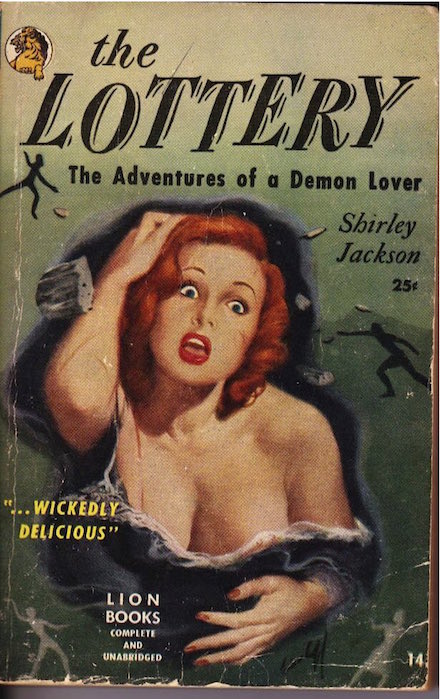
June 27 — of 1948, implicitly — was the setting for Shirley Jackson‘s classic short story “The Lottery”.


Before we dive into the grim stuff, here’s a hilariously campy pulp cover (mis)interpretation.

Less an “execution” than a human sacrifice — the village old feller’s folksy “Lottery in June, corn be heavy soon,” evokes a primal flash of blood trickling off the maize-god’s altar — the titular event is an annual tradition for a tiny American town. Though unnamed, the town and some of its denizens were patterned on North Bennington, Vermont, where Jackson was living as the wife of a professor at Bennington College.

The setting was entirely contemporary to the story’s publication, right down to the day: it hit print in the June 26, 1948 edition of The New Yorker magazine. And what took Jackson two hours to write has continued to disturb and perplex generations of readers.

In “The Lottery” (available online here (pdf)), friendly townsfolk gather “in the square, between the post office and the bank” to enact a curious civic ritual dating to a time and purpose they no longer even remember.

We see each household’s father draw a slip of paper from a battered old box and although we do not understand the reason we grasp from the dark atmosphere afoot in the crowd that something ominous is unfolding.

After the last slip is drawn,

there was a long pause, a breathless pause, until Mr. Summers. holding his slip of paper in the air, said, “All right, fellows.” For a minute, no one moved, and then all the slips of paper were opened. Suddenly, all the women began to speak at once, saving. “Who is it?,” “Who’s got it?,” “Is it the Dunbars?,” “Is it the Watsons?” Then the voices began to say, “It’s Hutchinson. It’s Bill,” “Bill Hutchinson’s got it.”

“Go tell your father,” Mrs. Dunbar said to her older son.

People began to look around to see the Hutchinsons. Bill Hutchinson was standing quiet, staring down at the paper in his hand. Suddenly. Tessie Hutchinson shouted to Mr. Summers. “You didn’t give him time enough to take any paper he wanted. I saw you. It wasn’t fair!”

“Be a good sport, Tessie.” Mrs. Delacroix called, and Mrs. Graves said, “All of us took the same chance.”

“Shut up, Tessie,” Bill Hutchinson said.

Tessie has good cause to fear. A second drawing now ensues among the five members of the Hutchinson family — Tessie and Bill, plus their three children.

And as soon as Tessie reveals the slip of paper with the black spot, her friends and even her family (“someone gave little Davy Hutchinson a few pebbles”) immediately turn on her and stone her to death.

“I hoped, by setting a particularly brutal ancient rite in the present and in my own village to shock the story’s readers with a graphic dramatization of the pointless violence and general inhumanity in their own lives,” Jackson explained.

On this day..

1621: Christenze Kruckow, philanthropic witch

On this date in 1621, Christenze (or Christence) Kruckow was beheaded as a witch — the only known noblewoman to suffer that fate in Danish history.

Kruckow first came under the witchsmeller’s nose in the 1590s. As a young woman, she lived in the household of a man named Eiler Brockenhuus — common practice at the time in Danish high society. The supposition is that when the lady of the house died in 1582, Kruckow might have aspired to make a permanent move. Instead, the position of wife no. 2 went to another woman named Anne Brille.

From the sound of it, Anne Brille spent the ensuing decade-plus in a state of continual pregnancy, punctuated only by periods of mourning as all 15* of her prospective progeny miscarried or died in infancy. Pick your environmental toxin or genetic abnormality of choice, but it’s no surprise this started to give the poor would-be mother the heebie-jeebies. Eventually, two of the estate’s servants got caught up in a 1596 witchcraft interrogation and were burned at the stake — but not before implicating Christenze Kruckow as part of the coven.

On that occasion, the usual reticence to visit on elites the sanctions intended for their lessers prevailed, and Christenze simply had to relocate to a sister’s household in Alborg.

But a reputation for black magic wasn’t the best thing to have to one’s name in early 17th century Europe, when witch-hunting reached a horrifying acme. Like his brother-in-law James VI of Scotland (also James I of England), the long-reigning Danish king Christian IV developed a personal obsession with the diabolical, leading to an effusion of witchcraft trials in the 1610s and early 1620s.

Now, Kruckow’s elite status served to attract instead of deflect attention; it didn’t help that she was become a never-married hexagenarian. When a neighbor’s wife fell ill in witch-spooked Alborg, the accusations against her snowballed into their customary colorful forms, such as that she’d been seen delivering a pregnant woman (Danish link) of a troll or ogre at some fell sabbath. King Christian took a personal interest in seeing her case prosecuted, and in the end it was his own Privy Council that tried her, and then sentenced her to the privileged death by the sword instead of the stake: the last deferences to her social rank. She confessed at that time to having attempted to lay a curse on the wedding-bed of her long-ago rival, Anne Brille.

In between her witch episodes, Christenze Kruckow had taken an interest in education for poor children in Alborg. She carried her philanthropy (more Danish) even beyond the scaffold, bequeathing 1,000 rigsdalers to a university scholarship that the University of Copenhagen was still awarding into the 20th century — popularly known as the “beheaded virgin grant”.

* Or 17. Sources vary, but you’d lose count too.

On this day..

1483: Anthony Woodville, Earl Rivers

On this date in 1483, Anthony Woodville, 2nd Earl Rivers, was beheaded with his nephew Sir Richard Grey and royal chamberlain Sir Thomas Vaughan at Pontefract Castle.*

These noble heads rolled a bare 10 weeks after the death of King Edward IV to whom Woodville was certainly quite loyal: the Earl’s sister, Elizabeth Woodville, was Edward’s queen Consort.

This marked the acme of the family’s meteoric, single-generation rise from gentleman nobodies. Anthony’s dad, Richard Woodville, vaulted the family into the nobility with an illicit marriage to the Duke of Bedford’s widow. Their pretty daughter Elizabeth scandalized Britain’s elite by conquering Edward’s heart and his hand in 1464 — though this was her second marriage: the first, to Sir John Grey of Groby, had produced two children, one of whom was the Richard Grey who went to the block with Sir Anthony Woodville.

But while heads were still attached to shoulders, Woodville employed his in literary pursuits: he’s credited with publishing (via the pioneering English printer William Caxton) some of the very first books in English: Earl Rivers’s own translation into “right good and fayr Englyssh” of Jean Mielot‘s Cordyale, or Four last thinges (image); and, the 1477 Dictes and Sayings of the Philosophers, another Rivers translation that he knocked out while on pilgrimage to Santiago de Compostela. It’s distinguished as the first English printed book that dates itself (November 18, 1477).


Earl Rivers presents Edward IV with the fruits of movable type.

But for sure, circa Regna tonat — especially here during the long-running War of the Roses for control of the English throne.

The reason that Anthony Woodville and not his father was the current Earl Rivers was because dad had his own head cut off when King Edward was temporarily deposed in 1469. (Exile to Bruges was also the reason that the second Earl Rivers met William Caxton.)

After Edward came roaring back at the Battle of Tewkesbury in 1471, the Woodville family would have been feeling pretty well set up: their Yorkist faction seemed to have won as decisive a victory as could be imagined over the Lancastrians.

But King Edward’s early death meant that Anthony’s nephew Edward V inherited all too early — which is to say that he did not truly inherit at all. The 12-year-old Edward and his younger brother Richard, Duke of York, both of them children of Elizabeth Woodville, were the boy-princes left to the care of Edward IV’s brother Richard, Duke of Gloucester.

Now, they believe it; and withal whet me
To be revenged on Rivers, Vaughan, Grey:
But then I sigh; and, with a piece of scripture,
Tell them that God bids us do good for evil:
And thus I clothe my naked villany
With old odd ends stolen out of holy writ;
And seem a saint, when most I play the devil.

Shakespeare’s Richard III, Act 1, Scene 3

The next part of the story is quite notorious, and it directly concerns the Woodvilles: the reason that Richard infamously disappeared those tragic princes into the Tower of London was because they were in Elizabeth Woodville’s own custody — and Richard, soon to seize power for himself as King Richard III, feared that if given the opportunity to gather themselves the Woodvilles and not he would dominate English politics.

Events could easily have turned out differently — even with Richard on the blade end of the Woodvilles’ executioner. In the chaotic days following Edward’s death, as news made its way ponderously around the realm, Richard raced to get ahead of the Woodvilles before they were secure in their patrimony. On April 30 of 1483, Richard intercepted the royal party traveling to London and took king into custody along with Rivers, Thomas Vaughan, and Richard Grey.

Gloucester-cum-Richard III acted with dispatch from that point. He had Elizabeth Woodville’s marriage to the late king invalidated, effectively disinheriting her children. While Gloucester made ready for his coronation, Anthony Woodville and his friends made sad poetry and last wills and testaments.

Glories are fleeting. Two years later, Richard III was unhorsed, too.

“I dye in right, beware you dye not in wrong.”

Purported last words of Sir Thomas Vaughan

* There are some citations equivocating on Vaughan’s precise death-date. Yet another man, Sir Richard Haute (Hawte) is also sometimes numbered a fourth in the doomed party; however, a man of this name took part in Buckingham’s Rebellion against King Richard III, and received a pardon in 1485.

On this day..