2014: Amin Abdullah Mohammed Al-Mu’alimi, an American spy in the Arabian peninsula

On this day last year, Al-Qaeda’s Ansar Al-Sharia group (Partisans of Islamic Law) executed an alleged American spy in the town of Shahr, in southeast Yemen.

Al-Qaeda also released a video (titled “An American Spy in the Arabian Peninsula”) in which a man calling himself Amin Abdullah Mohammed Al-Mu’alimi denounced himself as a spy and saboteur, who had placed tracking chips that enabled the U.S. to target militants with drones.

His bullet-riddled body was found lashed to the goalposts on a dirt football pitch.

On this day..

1684: John Dick, Covenanter

Covenanter John Dick was hanged at the Grassmarket in Edinburgh on this date in 1684. He had been condemned for rebellion just the day before.

This divinity student had been due to swing the previous September, but broke out of Canongate Tolbooth with 24 others. Upon his re-arrest, the existing sentence was simply reinstated by the judges; Dick had only a single night between that sentence and his execution.

From the time the Protestant Reformation had launched 160-odd years prior to Dick’s death, the customary prerogative of the condemned to make a rostrum of the scaffold had become contested territory. Where once condemned thieves and murderers would make a last reconciliation with their fellows, now heretics made of their own deaths blazing confessional placards by seizing the language of martyrdom. (Paul Friedland addresses this phenomenon as part of the evolution of the execution “spectacle” in his excellent Seeing Justice Done: The Age of Spectacular Capital Punishment in France. We previously interviewed Friedland here.)

Scottish Covenanters too had this tradition — and likewise the authorities that put them to death the tradition of silencing the wrong message. All the more true given the intense partisan-religious alignments on the eve of the Glorious Revolution; the Whig party name derives from the Whiggamores — Covenanter raiders, whose association was meant to smear that faction.*

Dick, according to a friend who visited him in jail on the day of his hanging, was asked if he would pray at his gallows. “Yes, if ye permitt [sic] me,” he replied.

“You must not reflect upon authority in your prayers, so as there may be no offence taken,” one of Dick’s gaolers replied.

“I will pray no limited prayers; I will pray as Christ has taught me.”

Upon this response, there was a debate among Dick’s keepers. “Some were for suffering him to pray, and stopping him if he pleased them not,” our observer recorded, “but that was not thought fit, so he prayed none there [at the gallows].”

Although Dick had to be circumspect at his hanging, his fellow Presbyterians’ alignment with the soon-to-be-triumphant side in the Glorious Revolution would soon make Covenanter martyrologies a hot publication.

The 1714 A Cloud of Witnesses for the Prerogative of Jesus Christ, or The Last Speeches and Testimonies of Those Who Have Suffered for the Truth in Scotland since 1680 celebrates dozens of Presbyterian martyrs.


Illustration of Covenanter punishments (not Dick’s specifically) from A Cloud of Witnesses.

In Dick’s entry, we have a firm of heart last letter to his father penned on the morning of the devout youth’s execution.

Dear Sir, —

This hath been one of the pleasantest nights I have had in my lifetime. The competition is only betwixt it and that I got eleven years ago at Nesbit in Northumberland, where and when, in a barley ridge upon the Saturday’s night and Sabbath morning before the last communion I did partake of in Ford Church, the Lord firmly laid the foundation-stone of grace in my heart, by making me with my whole soul close with Him upon His own terms, that is, to take Him to be my King, Priest, and Prophet, yea, to be my all in all ; to renounce my own righteousness, which at best is but rotten rags, and to rest upon His righteousness alone for salvation; as also, to give myself entirely, without reserve, in soul, body, heart, affections, and the whole faculties of my soul and powers of my body, to be by Him disposed at His pleasure for the advancement of His glory, and the upbuilding of my own soul, and the souls of others; inserting this clause (being conscious to myself of great infirmity) that the fountain of free grace and love should stand open for me so long, and so oft as my case should call for it.

This my transaction with my ^whole soul, without the least ground of suspicion of the want of sincerity, which I found had been amissing in endeavours of that nature formerly, now my blessed Lord helped me to, or rather made in me, and solemnised that night and morning ere I came off that ridge.

I confirmed it no less than ten or twelve times, and the oftener I reiterated, the gale continued so fresh and vigorous, that I was forced to cry, Hold, Lord, for the sherd is like to burst: so that I hope my dearest Lord is now a-coming, and that the hands of Zerubbabel, who hath laid this foundation, is now about to finish it ; and, indeed, He is building very fast, for which my soul blesseth Him, desiring you may join with me in so necessary a work.

I hope, ere long, the copestone shall be put on, the result of all which shall be praises and shouting to Him that sits upon the throne, and to the Lamb throughout all the ages of eternity, of long-lasting eternity.

This, with my earnest prayers while in the body, that the Lord would help you to mind His glory, and your own soul’s eternal welfare, is all the legacy you can expect from him who is both,

Your affectionate son and Christ’s prisoner,

John Dick.

P.S. — I hope, ere I come home, to get another sight of you. Let none see this till I be in my grave. The Lord gave me to you freely, so I entreat you, be frank in giving me to Him again, and the more free this be, the less cause you shall have to repent.

* “Tories” comes from a word for an Irish (and Catholic) outlaw, and was conferred by the Whigs as a reciprocal calumny. It is not accidental that each term throws a non-English shade.

On this day..

1852: “Brown”, lynched in California

In extending [Cesare] Beccaria‘s views on capital punishment to the history of lynching in the West, one begins to see that the “violent passions” of the mob were regularly invoked to justify their actions, but as Beccaria predicted, these passions were often little more than a ruse to justify the cold-blooded — and often premeditated — lynching of an accused criminal. Taken as a whole, the case list demonstrates that by and large, lynching had as much to do with vengeance as with the pursuit of justice.

The frequent invocation of San Francisco’s vigilance committees in many of the case records is clearly intended to link extrajudicial execution to “tradition,” an essential element found in the Tuskegee definition of lynching.* On a formal level, well over 50 percent of lynching cases that give a time, record that the lynching took place between midnight and 2 a.m. when the accused was usually encouraged to confess his or her crimes before being strung up. Sometimes they were allowed to make a statement, to smoke a cigarette, or confess to a priest, and after it was over, the bodies would usually be left to hang through the night. This public display of the body can be found in every case, with the shortest times usually lasting around thirty minutes, and the longest, until the bodies decayed.

In one instance, in the small village of Newtown, an African American man known only as “Brown” was apprehended for stealing money. The evidence was completely circumstantial but he was found guilty and sentenced to be hung by the mob on March 4, 1852. Unfortunately for Brown, the rope was a little too long, and once he was hanged to the tree, the branch slowly gave way — until his legs dangled to the ground. Struggilng in agony, the poor man was cut down in order to be properly hanged. Once he was fully revived, he was tied to a higher branch and the whole process was repeated. When he was finally cut down, a physician was asked to examine the body, at which point he annunced that if Brown’s body was left above ground for five minutes that he would regain consciousness. As a result, “he was therefore hastily dumped into a grave that had been dug and was half full of water, and quickly covered from sight.” Whether completely true or not, it’s hard to imagine that anyone could argue that this killing really served the greatest good.

* The Tuskegee lynching definition: “there must be legal evidence that a person has been killed, and that he met his death illegally at the hands of a group acting under the pretext of service to justice, race, or tradition,” where “a group” connotes three or more persons.

On this day..

1882: Bob Jones and Billy Miller, murderers on the open road

Bob Jones and Billy Miller were hanged together on this date in 1882 for the murder of three sons of Judge J.P. Walker.

The Walker boys had been traveling together for an Arkansas plantation to which their prosperous Alabama father was relocating the family. They “encamped three miles west of Aberdeen [Mississippi], and on Sunday evening some persons passing by found them lying on mattresses, covered with quilts, each with his head split open as though with an axe.”

Miller, a black man, was picked up “under suspicious circumstances” and at the point of lynching he was forced to confess the crime. When he later attempted to disavow it, Judge Walker visited him in his cell, and (per the New Orleans Times-Picayune of Dec. 8, 1881) made the following chilling-but-practical appeal:

I am the father of these murdered boys. I can assure you that you will certainly be hung, if you don’t meet a worse death. It will do you no good to die with a lie on your lips about this matter. I came to get the truth, and you can gain nothing by telling me a lie, for your doom is sealed. Tell me all about the murder of my sons.

According to to the newsmen, Miller then proceeded to tell all. There’s just something persuasive about the grief of a father with a lynch mob at his back.

Per Miller’s confession, he happened by the camp of the Walkers, whose party was actually a foursome. The other white man with them, also just a chance fellow-traveler, pulled Miller aside as he rested by the campfire and indicated that the Walkers, schlepping a wagon full of effects from the Alabama plantation to the Arkansas one, were worth the trouble to put out of the way: “There’s big money in this.” They then axed the trio as they slept.

Miller said that the white man took all the money they could find, giving Miller only a bogus promise to meet him to divide it, and then absconded. The two would next lay eyes on each other in late December, when Jones was apprehended. It had been a job to get him; descriptions of him were shaky and Miller himself didn’t know anything about his accomplice — so random tramps, strangers, and solo sojourners were grabbed and interrogated willy-nilly for some weeks until Jones’s own brothers finally supplied the tip that he had met the Walkers and come back with a gold watch.

Once located, Jones too confessed — in his case, we are assured, “without a semblance of violence and by kind argument.” Surely there was some semblance of violence, since both men were reportedly “in great fear of lynching” even by that time, a month after the murders.


Columbus (Ga.) Daily Enquirer, Dec. 29, 1881.

Four thousand people were reported to have turned up in Aberdeen to witness these accidental confederates hang for their opportunistic crime. Jones fainted away as he was being arranged on the scaffold; Miller bore it better and swung off with a sad dirge on his lips.

On this day..

1401: William Sawtre, Lollard heretic

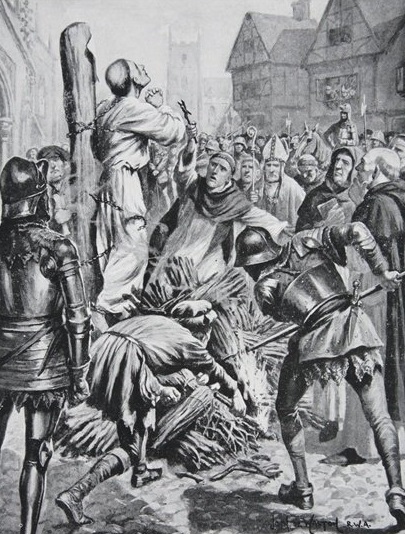
On this date in 1401, Lollard priest William Sawtre(y) was burned at Smithfield for heresy — the first known heresy execution in England.

The highlight of late 14th century English literature, Piers Plowman, was a great favorite of Lollards. Though this lengthy allegorical poem is not itself a Lollard text, it spawned a Piers Plowman tradition with many spinoffs that are overtly Wycliffite.

Witness Wycliffe, who told them the truth;
For in good nature he greatly warned
To mend their wickedness and sinful works.
Who these sorry men damned his soul
And overall lolled him with heretics’ works!

Piers Plowman’s Creed*

Sawtre was a follower of John Wycliffe, the Biblical translator and church reformer 16 years dead as we lay our scene.

Wycliffe anticipated much of Luther’s later critique of the Catholic Church. His call to study Scripture directly without the intercession of doctors in Rome touched a spiritual thirst; his summons to apostolic poverty for the wealthy vicars of Christ was a message with a ready audience.

“From about 1390 to 1425, we hear of the Lollards in all directions,” notes this public domain history, “so that the contemporary chronicler was ale to say that of every two men found on the roads, one was sure to be a Lollard.”

Lollardy did not immediately manifest as an outlaw movement; it had many adherents among England’s elites and even the royal household. Although the papacy had declared various Wycliffe doctrines heretical in that prelate’s time, England had shown little appetite for calling an Inquisition — a step that would project papal authority into the kingdom.**

But with a ferocious ecclesiastical pushback and a change in the occupancy of the throne,† the English state gradually shifted over the course of the 1390s and 1400s towards recognizing Wycliffe’s principles as heresy — and towards treating that heresy into a capital crime. Through spectacles like Sawtre’s burning, Lollards were gradually made to understand that the price of their scruples might run all the way to martyrdom.

This was novel territory for English jurisprudence, and part of a centuries-long European transition towards treating doctrinal dispute as capital crime. There are only a bare handful of alleged quasi-precedents in English history, sketchily documented — like the unnamed apostate deacon burnt to ashes for Judaizing. It was only as late as William Sawtre that Old Blighty clearly established the practice and legal machinery for putting men and women to death for heresy.

Many Lollards capitulated as they came under pressure. This was true of our man Sawtre, a humble parish vicar. When put to questioning by the bishop in 1399, Sawtre initially recanted his unorthodox skepticism as to the transubstantiation of communion bread into Christ’s own literal body — a doctrinal mystery that would be a tougher and tougher sell to dissidents yet to come.

But upon moving from Lynn to London where he served at St. Osyth’s, Sawtre relapsed — and some stirring moved his soul to vindicate himself in the face of mortal peril.

Charged before Parliament, Sawtre now defended his heresies under close questioning by the Archbishop of Canterbury, Thomas Arundel. Arundel was even then pressuring this same Parliament for a statute, which he did indeed soon receive — one with the ominous title De Heretico Comburendo, at last elevating heresy to a death penalty offense and making the bishops themselves the decisive arbiters on the matter. It is overtly and all-but-explicitly aimed at the Lollards.

divers false and perverse people of a certain new sect, of the faith of the sacraments of the church, and the authority of the same damnably thinking and against the law of God and of the Church usurping the office of preaching, do perversely and maliciously in divers places within the said realm, under the color of dissembled holiness, preach and teach these days openly and privily divers new doctrines, and wicked heretical and erroneous opinions contrary to the same faith and blessed determinations of the Holy Church, and of such sect and wicked doctrine and opinions they make unlawful conventicles and confederacies, they hold and exercise schools, they make and write books, they do wickedly instruct and inform people, and as such they may excite and stir them to sedition and insurrection, and make great strife and division among the people, and other enormities horrible to be heard daily do perpetrate and commit subversion of the said catholic faith and doctrine of the Holy Church …

the diocesans of the said realm cannot by their jurisdiction spiritual, without aid of the said royal majesty, sufficiently correct the said false and perverse people, nor refrain their malice, because the said false and perverse people do go from diocese to diocese and will not appear before the said diocesans…

[let] none within the said realm or any other dominions subject to his Roval Majesty, presume to preach openly or privily, without the license of the diocesan of the same place first required and obtained, curates in their own churches and persons hitherto privileged, and other of the Canon Law granted, only except; nor that none from henceforth anything preach, hold, teach, or instruct openly or privily, or make or write any book contrary to the catholic faith or determination of the Holy Church, nor of such sect and wicked doctrines and opinions shall make any conventicles, or in any wise hold or exercise schools; and also [let] none from henceforth in any wise favor such preacher or maker of any such and like conventicles, or persons holding or exercising schools, or making or writing such books, or so teaching, informing, or exciting the people, nor any of them maintain or in any wise sustain, and that all and singular having such books or any writings of such wicked doctrine and opinions, shall really with effect deliver or cause to be delivered all such books and writings to the diocesan of the same place within forty days from the time of the proclamation of this ordinance and statute.

Any Lollard not so complying could be arrested on the say-so of the diocesan bishop and tried for the offending heterodoxy; if convicted, the clergy was then empowered to hand the unfortunate fellow over to the civil authorities who were obliged to carry out an execution without any further inquiry or say-so. Judge, jury, and (virtually) executioner … the same as the guy waiting for you in the confessional.

[I]f any person … do refuse duly to abjure, or by the diocesan of the same place or his commissaries, after the abjuration made by the same person be pronounced relapsed, so that according to the holy canons he ought to be left to the secular court … [then] after such sentence promulgate shall receive, and them before the people in an high place cause to be burnt, that such punishment may strike fear into the minds of others, whereby, nosuch wicked doctrine and heretical and erroneous opinions, nor their authors … be sustained or in any way suffered.

With such wicked doctrine and heretical and erroneous opinions afoot Sawtre was not suffered to live even the enactment of the law that killed him: De Heretico Comburendo was passed only on March 10, but Sawtre was eight days’ dead by that point. It’s a bit unclear how the sentence was legally effected, but it would seemingly have proceeded under canon, not civil, law.

Both the law and the execution were great victories for the Church. “The king and the archbishop hurried to burn their victim to show that they could send a heretic to the stake whenever they wished, without relying on statute” Leonard Williams Levy writes. “Parliament could neither give nor take the authority to burn a heretic. If the scepter supported the miter, canon law prevailed.”

Be that as it may, the victims of the Lollard-burning period were not nearly so numerous as the chilling language of De Heretico Comburendo might lead one to anticipate. The next Lollard to go to the stake was John Badby in 1410; two merchants were executed in 1415, and the Lollard rebel John Oldcastle was burnt “gallows and all” in 1417. Another handful suffered in the 1420s. It’s thought that about 50 people overall (Lollards and otherwise) were executed as heretics from the enactment of De Heretico Comburendo until Henry VIII broke with Rome 133 years later — an occasion that made heresy-hunting a whole different animal.

The History of England podcast covers Sawtre and Lollardy in episode 141.

* My artless rendering from the Middle English version given in D.A. Lawton in “Lollardy and the ‘Piers Plowman’ Tradition”, The Modern Language Review, Oct. 1981.

** Despite overall caution about the authority of Rome onto Albion’s soil, the English had no overall principled rejection of Inquisitors as such: they convoked such a tribunal to deal with Joan of Arc.

† The political situation in the realm was also been a factor: the usurper Henry IV had taken the crown only in 1399 by deposing, and later murdering, King Richard II. One readily supposes Henry’s keen interest in shoring up the loyalty of the church and keeping tabs on itinerant rabble-rousers, the latter of whom appear to have disproportionately skewed towards Richard’s faction. (All those heretics in the king’s household were in Richard’s household.)

On this day..

1996: Antonio James, final judgment

On this date in 1996, Antonio James downed a last meal of fried oysters and crab gumbo, then went to the death chamber of Angola Prison to suffer lethal injection for the murder of Henry Silver.

Silver was a 70-year-old fellow whom James shot dead in a New Orleans robbery way back in 1979. (Net return: $35.) A few weeks later, he bungled another robbery and ended up shot with his own gun … and under arrest. It was his second murder conviction. Although James dodged 13 death dates and was the senior figure on the state’s death row when his time came, his was pretty unremarkable as death penalty cases go.

This did chance to be the first execution in Louisiana after the film Dead Man Walking (which is set in that state) was released, and it got a bit of additional media coverage as a consequence.

James’s last hours became the subject of the ABC Primetime Live documentary Final Judgment (or Judgment at Midnight). It’s a little hard to come by clips of this program online, but here’s one review, and here’s another. In it, the warden Burl Cain* described James’s execution.

Well, he was laying there, and then he kind of grabbed my hand, so I held his hand, and then I told him, ‘He’s waiting for us. Get ready, we’re going for the ride.’ And I said, ‘The angels are here.’ He kind of smiled, and he said, ‘Bless you.’ That’s the last words he said. And then I nodded my head to go ahead. He was holding my hand real tight. And then after a couple of minutes, he took about three or four deep breaths, and then he relaxed my hand. I do believe right now his soul is in heaven, and he’s OK. And since I believe that, it makes it easier.

* In the Angola memoir In the Place of Justice: A Story of Punishment and Deliverance by onetime Louisiana death row habitue turned prison journalist Wilbert Rideau, Cain comes off as a real camera-hound.

On this day..

628: Khosrau II, Sassanid emperor

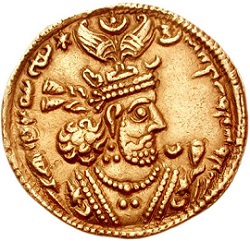
On this date (or very close to it) in 628, the Persian emperor Khosrau* II was put to death by the order of his son and usurper.

Chip off the old block, that boy, since he was taking power the same way as Khosrau himself had done way back in 590. But with the old man’s fall, the Sassanid Empire entered its death spiral: by 651, it would be overwhelmed by the armies of Islam.

Little could the younger Khosrau have conceived of his glorious Persian state laid low by these desert zealots! Persia’s last great pre-Muslim empire flourished in Khosrau’s heyday.

Briefly deposed in his youth, Khosrau reinstated himself with the aid of the Byzantines — ironic aid, in retrospect. After his Constantinople angel Emperor Maurice was deposed and slain in 602, Khosrau availed the pretext of vengeance to make war on Byzantium.

The season of this war would span the entire quarter-century to Khosrau’s own death — and would initially redound to Khosrau’s glory. Byzantium foundered in civil war, coming near the brink of outright destruction under continuous Persian pummeling. Khosrau’s top general Shahrbaraz won a crushing victory in 614, capturing Jerusalem where they carried off thousands of prisoners, the city’s patriarch, and the True Cross. In the years to follow, Persia conquered Egypt and pressed so deep into Anatolia that the Byzantines are said to have considered evacuating the capital to Carthage. Khosrau aspired, wrote Theophanes the Confessor more than a century later, “to seize the Roman Empire completely.”

The fall of the Sassanids, and Khosrau, from this apex was precipitous and entire.

The Byzantines under Heraclius rallied dramatically and in the winter of 627-628 carried Roman arms to the city of Dastagerd, just a short march from the Sassanid capital Ctesiphon. The intrepidity of the counterattack threw the Sassanids into a commotion; Khosrau disgracefully fled Ctesiphon, and in the power vacuum that followed, his heir Kavadh seized power. A usurper cannot afford to found his authority on sentiment; Kavadh not only had his father executed — allegedly by being shot slowly with arrows — but he ordered the deaths of all his half-brothers to extinguish as many future rivals as possible.

The precautions did not grant Kavadh a long reign: he died of the plague later that same year, beginning a dismal progression of feeble claimants overthrowing one another. The Arabs overran Ctesiphon by 636, leaving the rump of the Sassanid state shrinking towards nothingness, and its last emperor to be ignominiously slain by a miller.

Dig into the seventh century Byzantine-Persian frontier during gym time with an ample selection of audio product:

  • The History of Byzantium podcast has treated this period in some detail: for Byzantium, it was a dramatic phoenix-from-the-ashes story, and the running war with Persia is one of its principal themes. Try episodes 44, 45, and 46
  • The (defunct, but still available) Twelve Byzantine Rulers podcast has a snappy episode on Khosrau’s Byzantine opposite number, Heraclius
  • The BBC In Our Time podcast has an enjoyable 2011 episode on the Sassanids available here.

* Also rendered Chosrou or Chosroes, among many others.

On this day..

1786: Joseph Rickards, aspiring milkman

(Thanks to Meaghan Good of the Charley Project for the guest post. -ed.)

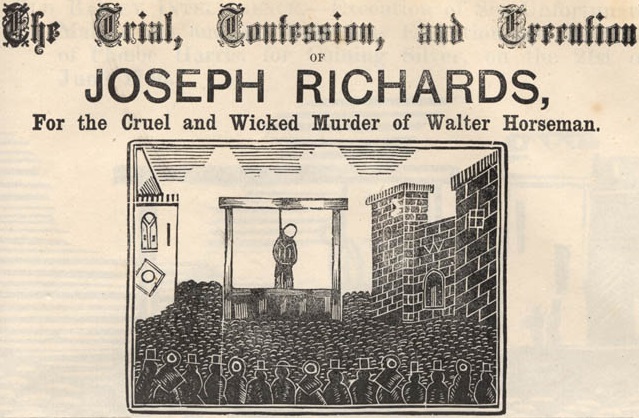
On this day in 1786, Joseph Richards or Rickards was executed in Kentish Town, London for the murder of his former employer, Walter Horseman, whom he attacked on February 11.

Graham Jackson and Cate Ludlow described the crime in the most graphic terms in their book A Grim Almanac of Georgian London:

At around 2:00 a.m., Mary Horseman of Kentish Town was woken by the sound of her ten-year-son calling out that his father, London milkman Walter Horseman, needed her… Mary found her husband sitting on his bed. By the light of the moon, which was flooding through the large bay windows, she could see that he was quite black with blood, which covered him from his face to his waist. “Lord bless me,” he said. “Something has run over my face!”

“Run over your face?” she responded. “Why, you are nothing but blood!” She ran for a candle, and when she returned, the light revealed a truly hideous sight: her husband was cut to pieces, his forehead, eyes and nose smashed. His skull, which was broken, was described in court as “cut and mangled in a desperate manner.” The two sections of the skull had broken apart, and his eye sockets had been smashed into shards.

There was nothing to be done for Walter, but amazingly, he lingered until the 19th, over a week after the assault. Due to his head injuries and the fact that he’d been attacked while he was sleeping, he wasn’t able to provide any useful information as to what happened.

The murder weapons were left behind at the crime scene: they proved to be a wooden hedge stake and an iron bar, which was “jellied” with gore.

Only a few farthings were missing from the house. The Horsemans’ four-year-old daughter, who was sleeping in the same room as her father, was not harmed. Suspicion quickly fell on Rickards, the Horsemans’ former apprentice, whom they’d recently sacked for laziness. He had no alibi for the night of the murder, a night watchman saw him near the Horsemans’ home about an hour after the attack, and Mary identified the hedge stake as one he had cut several days before the attack.

Nevertheless, he seemed confident and didn’t bother to leave the area. In fact, in an incredible display of chutzpah, he actually visited his ailing former master and shook his hand before Walter died. Perhaps his cockiness — or obliviousness — was a product of his immaturity; in an age of doubtful record-keeping, we can’t be sure of Joseph Rickards’s age but he was certainly quite young. Mary Horseman speculatively pegged the ex-apprentice as an 18-year-old; the London Times (Feb. 24, 1786) thought that he did “not appear to be more than sixteen years of age.” Although even 16 would be quite old enough to hang in Bloody Code London, the magistrate felt constrained on account of the boy’s age to caution his jurors against excess confidence in the confession he ultimately produced:

I should not for one, though he is very near the state of manhood, chuse to rest singly and merely on his confession, as he is not at full age, though he is above that age of discretion, which the law assigns to be at the age of fourteen years, and certainly it is near the time that human reason is supposed to be mature.

On the 20th, the day after Walter’s death, Rickards was arrested. Within a day he had admitted to concealing himself in a large cupboard in one of the bedrooms in order to beat his former boss to death in his bed. (The trial records are here.) He tried to shift some of the blame to Mary Horseman, claiming they had frequently kissed and he had “laid hold of” her breasts, and that she had told him she wished her husband was dead.

He was hanged in a field across the way from the Horseman family’s dairy — a pathetic spectacle, to judge by the account of the Public Advertiser (Feb. 28, 1786), during which he recanted his allegations against the milkman’s widow.

In his way to the place of execution, the convict appeared to be in a state of mind bordering upon stupefaction: He had no book, nor did he employ the short remnant of time in those preparations for eternity which his miserable situation rendered so indispensably necessary.

Before being turned off, the prisoner desired to see the widow of the deceased; she was sent for to her house, but was gone to London: he declared he had no accomplice in the fact, and that he was induced to the perpetration thereof by the supposition, that after the decease of his master he should succeed to his business as a milkman. Just before coming to the village, he burst into tears, and when he came to the place of execution wept bitterly; his expressions of sorrow and contrition being only interrupted by fervent appeals to Heaven for mercy till the last moment of his existence. He desired his hat might be given to one, and his buckles to another man; and he also made some other trifling dispositions.

One of the Sheriffs, and a great number of their officers on horseback and on foot, attended on the above occasion. Considering the nature of the criminal’s offence, and the disposition of the English to behold spectacles of horror, the crowd was not near so great as might have been expected, owing, no doubt, to the fall of snow, and going so early. The body of the malefactor was conveyed from Kentish Town to Surgeons Hall for dissection, without a shell, and covered only with a coarse cloth, which by the motion of the cart was frequently so removed, that the head and different parts of the body were frequently seen by the passengers on the road and in the streets.

The anatomization, and accompanying public lecture on the late Rickards’s thorax, was performed by a “Dr. Cooper” (General Evening Post, Feb. 28-Mar. 2, 1786); this would appear to be the budding anatomist Astley Cooper who was only 17 years old himself at this time — just at the outset of a scintillating medical career.


THE TRIAL.

Old Bailey, February 24th, 1786.

Joseph Richards was arraigned for the wilful murder of Walter Horseman, milkman, in Kentish Town. The deceased’s widow deposed, that the prisoner was formerly a servant to her husband; that he was discharged for negligence; that he had frequently threatened vengeance on the deceased; that on the morning the murder was committed, she was awakened by a noise, and on entering the room her husband slept in, she found him sitting up in the bed, and as far as his waist in blood; that a stick which the prisoner had cut some time before, lay in the room, and an iron bar, covered with blood; that her husband was mangled in a shocking manner: — he lingered a few days, and died a shocking spectacle.

Four other witnesses were examined, whose testimony proved certain corroborating circumstances; such as, being from his lodging the night the murder was committed, being seen to melt lead, and to pour it into the stick that was found in the deceased’s room, &c.

The prisoner confessed the murder to one of the magistrates who committed him for trial; but pleaded Not Guilty at the bar.

The jury, after a few minutes’ consideration, brought in their verdict Guilty.

Mr. Recorder pronounced judgment. He said the voice of innocent blood cried to heaven for vengeance. He dwelt upon the atrociousness of the crime of murder, observing, that the Divine Law had ordained, that whoever sheddeth man’s blood, &c., and then expatiated on the peculiar circumstances of the murder, the murder of an innocent master, to whom he owed duty and reverence.

The sentence was then passed as usual, that he be hanged till dead, and anatomized; and an order of Court was made out, to execute him on Monday, at Kentish Town, as near as possible to the house of the deceased.

THE EXECUTION.

Joseph Richards, a youth about eighteen, who was convicted on Friday last, for the wilful murder of Walter Horseman, with whom he lived servant, was executed at Kentish Town, opposite the house where the horrid fact was perpetrated. The malefactor came out of Newgate about twenty minutes before eight o’clock, and with some alertness stepped into the cart, which conveyed him through Smithfield, Cow Cross, and by the two small-pox hospitals to the spot, where he was removed from that society of which he had proved himself a most unworthy member, at a time of life when such atrocity of guilt as he possessed has been seldom known to degrade humanity. In his way to the place of execution, the convict appeared to be in a state of mind bordering upon stupefaction; he had no book, nor did he employ that short remnant of time in those preparations for eternity which his miserable situation rendered so indispensably necessary.

Before being turned off, the prisoner desired to see the widow of the decreased; she was sent for to her house, but was gone to London; he declared he had no accomplice in the fact, and that he was induced to the perpetration thereof by the supposition, that after the decease of his master he should succeed to his business as a milkman. Just before coming to the village, he burst into tears and when he came to the place of execution, wept bitterly; his expressions of sorrow and contrition being only interrupted by fervent appeals to Heaven for mercy till the last moment of his existence.

On this day..

1785: Barbara Erni, the Golden Boos

Tiny Liechtenstein last conducted an execution 230 years ago today: Barbara Erni — the legendary “Golden Boos”.

Nicknamed for her strawberry blond hair, the Golden Boos had an ingenious scam that required every bit of her Bunyanesque strength: she would wander the countryside and check into inns with a large chest or pack. Intimating that the parcel contained something of great value, she would insist upon its overnight safekeeping in a very secure room.

Once the inn had tucked in for the night, a diminutive accomplice would emerge from the trunk, plunder the lonely room of its valuables, and the two would escape into the night. Evidently, secure rooms in 18th century Liechtenstein were never secured from the inside.

She admitted to 17 such thefts. Liechtentein, whose population at the present time numbers fewer than 40,000 souls, had to import the executioner to chop off Barbara Erni’s Golden Boos on a public scaffold in Vaduz on February 26, 1785.

Liechtenstein officiall abolished the death penalty in 1987.

On this day..

1601: Robert Devereux, Earl of Essex

On this date in 1601, Queen Elizabeth’s last great favorite became the last man beheaded in the Tower of London.

Vain and dashing Robert Devereux rolled into the royal court in 1584 around age 19 and immediately established himself as the new favorite of the monarch, 30-some years his senior. They spent long walks and late nights in enchanted private company, and Devereux “commeth not to his owne lodginge tyll the birdes singe in the morninge.” Ye olde walke of shayme.

In becoming the (presumed) lover* of the aging Virgin Queen, the Earl of Essex was only following the family** trade: his stepfather Robert Dudley was the younger Elizabeth’s longtime intimate.

It is up to the artists to postulate the relative measures of passion and cynicism in these dalliances; many have tried, inspired by the scaffold sundering of one of history’s great May-December affairs. The Essex-Elizabeth drama was a popular topic for broadsides, ballads, and stage treatments from the 17th century to the present day.


Benjamin Britten put the Elizabeth-Essex romance into opera in Gloriana, based on Lytton Strachey’s popular book.

He was wildly popular in London, but Essex was also afflicted by the follies of youth. Rash, temperamental, vainglorious; he aspired to leverage the favor of his sovereign into statesmanship and he achieved heroic repute for his swashbuckling raid on Cadiz.

Yet Essex reads like a whelp who never quite grew into a man’s boots. Every sketch of Essex includes, because it seems so starkly illustrative of his unstable character, the story of the time his impertinence led the queen to box his ears publicly — and the hothead’s hand flew instinctively to his sword-hilt. Everyone reconciled over this brush with lese-majeste, but only after Essex scribbled some skulking reproaches (“What, cannot princes err? cannot subjects receive wrong? is an earthly power or authority infinite?”) that he had the petulance to actually send to Elizabeth.

The less mercurial Earl of Salisbury, Robert Cecil, who was the son of Elizabeth’s earliest close advisor and the protege of her spymaster, was just two years Essex’s senior but smoothly outmaneuvered the loverboy in their mutual pursuit of England’s Secretaryship of State.†

Essex chased martial glory with mixed results. His last great enterprise was an ill-starred 1599 offensive in Ireland to bring Gaelic rebels to heel in the Nine Years’ War.

Not for the last time an Englishman found this conquest more easily aspired than achieved. Essex liberally overused his authority to knight men as a reward for their service, but his soldiers mostly slogged to and fro with little headway to show for it. After a frustrating campaign season chasing his tail, Essex defied the increasingly strident directives to attack issuing from Elizabeth’s irate pen, and made terms with the Irish commander Hugh O’Neill, Earl of Tyrone. Then he defied Elizabeth’s order to remain in Ireland and hastened back to London to justify himself. It was said of him that he “never drew sword but to make knights.”

This was the beginning of Essex’s end. Elizabeth’s fury at the aimless military campaign was compounded when her churlish captain turned up from Ireland unbidden and burst into her private chambers while she was still dressing to report on his unauthorized summit. Cecil et al, whose ascendance Essex had meant to reverse with the triumph of his arms, now murmured that the earl had strayed near outright treason to parley with the rebel whom he was supposed to be routing. The Privy Council put him under house arrest.

Heaped in debt and deprived of the prestigious proximity to power he had enjoyed literally throughout his adulthood, the man’s turbulent spirit stirred strangely in York House. We have seen that Robert Devereux, Earl of Essex, was a man to abhor an indignity even past the point of self-preservation. He unwisely sent secret missives to try to turn the ongoing succession negotiations‡ against Robert Cecil; when the Privy Council caught wind of this intrusion, he refused its demand that he present himself to account for his actions. Instead, he made matters worse by mounting a pathetic march through London with his supporters.

This “Essex Rebellion” was meant to rally the citizenry to him and turn some sort of coup against Robert Cecil. It seems so foolhardy and ill-considered that it’s difficult to think what was in the earl’s head. If you squint at it just so, it perhaps had a big-R Romantic quality, a gallant band of brothers saving the nation from its duplicitous ministers; the night before the rebellion, Essex (a liberal arts patron in his time) splurged to have William Shakespeare’s company§ stage a special performance of Richard II — a play wherein the English monarch is deposed. Presumably this was his inspirational pregame speech.

Thinking much more clearly than Essex, Londoners vigorously ignored his summons and the marching party trudged alone — and surely increasingly frightened — through the city until it was stopped by a barricade. Its participants then fled back to Essex House where they soon found themselves surrounded.

Whatever the fancy that led the Earl of Essex on his fatal February 8 march, and whatever the extent of his ambitions for that occasion, the careless threat to the public peace went several bridges beyond a boyish foible that Elizabeth could overlook in her impulsive courtier. He was prosecuted for treason within days and Elizabeth signed his death warrant on February 20th. The only mercy extended the ex-favorite was to suffer the noble execution of beheading, rather than a traitor’s drawing and quartering. Essex also successfully appealed for a private execution within the walls of the Tower, away from the gawks of those London masses who had so signally failed to rebel along with him.

On the specially built wooden platform, Essex favored his select audience with a bog-standard execution-day mea culpa:

My sins are more in number than the hairs on my head. I have bestowed my youth in wantonness, lust and uncleanness; I have been puffed up with pride, vanity and love of this wicked world’s pleasures. For all which, I humbly beseech my Saviour Christ to be a mediator to the eternal Majesty for my pardon, especially for this my last sin, this great, this bloody, this crying, this infectious sin, whereby so many for love of me have been drawn to offend God, to offend their sovereign, to offend the world. I beseech God to forgive it us, and to forgive it me — most wretched of all.

He prayed a Psalm. Then, stretching out his neck on a low block and thrusting his arms from his sides, he bid the headsman strike. The executioner had to oblige his patient in triplicate in order to sever the puffed-up head.

The Earl of Essex has the distinction of being the last person beheaded on the Tower Green, within the walls off the Tower of London — the last name on the little placard of headless notables photographed by tour groups. Note that Essex was not the last person beheaded at the Tower, when the adjacent Tower Hill is included (that distinction belongs to Jacobite rebel Simon Fraser); nor was he the last person executed within the Tower (that distinction belongs to World War II spy Josef Jakobs, who was not beheaded but shot).

Weary and depressed, Elizabeth died little more than two years afterwards.

* There’s a mind-bending speculative hypothesis out there — cousin to the Shakespeare-focused Prince Tudor theory — that Essex was actually Elizabeth’s secret, illegitimate son. This secret history is obviously more congenial with the queen’s early favoritism for Essex than with her eventually chopping off his head.

** Essex was also a distant cousin of Elizabeth herself: his maternal great-grandmother was Mary Boleyn, sister of Anne Boleyn — who was Elizabeth’s mother.

Walter Raleigh was a notable Cecil ally in this factional conflict. Raleigh attended Essex’s execution … and, of course, shared that fate many years afterwards.

‡ Elizabeth was nearing age 70; her childless death was imminent. James VI of Scotland was being vetted by Robert Cecil as the successor. Essex tried to stick his thumb in the pie by warning James that the Cecil faction would conspire to foist the English crown on the Spanish infanta — daughter of the Spanish king who had been the Catholic Mary Tudor’s husband. (The infanta was not Mary’s own daughter.) This was no idle threat, as at this point it was only a few years since the Spanish Armada had sallied for English seas.

§ Another noteworthy Shakespeare connection: one of the participants in the Essex Rebellion was the Earl of Southampton (he was spared execution). Southampton, whose given name was Henry Wriothesley, is often identified as the “Fair Youth” to whom Shakespeare dedicated numerous love sonnets. (Some of those are directly addressed to a Mr. “W.H.”)

On this day..