1937: Desta Damtew, Haile Selassie’s son

On this date in 1937, Ethiopian prince Desta Damtew — the son-in-law of Emperor Haile Selassie — was captured by the Italian troops occupying his country, and summarily executed.

An aristocrat who married Selassie’s eldest daughter, the Ras* Desta Damtew (English Wikipedia entry | Italian) became governor of the southern Sidamo Province upon his father-in-law’s ascent to the Ethiopian throne in 1930.

When Italy invaded Ethiopia in 1935, it committed a disproportionate quantity of its forces to the northern reaches of its target. Consequently, resistance was stronger in the south — and Ras Desta was one of its chiefs. In January 1936 he led Ethipoian forces at the Battle of Ganale Doria.

Though the two sides had forces of similar sizes, Italy’s was the mechanized, industrial army — and the Ras was routed by Gen. Rodolfo Graziani. It was a milepost for Graziani on his way to lasting infamy in Ethiopia as the conquered realm’s brutal Viceroy for 1937. (He was recalled at year’s end.) Graziani vowed that Italy would dominate Ethiopia “at whatever cost” and threatened “extreme severity towards anyone who resisted.”

On February 19, 1937 — Yekatit 12 by the Ethiopian calendar — two ethnic Eritreans expressed their resistance by pelting Graziani with grenades. He had shown his viceregal person at a hearts-and-minds almsgiving, and having been received with such cordiality, he returned immediately to the Extreme Severity plan.

While doctors dug shrapnel out of Graziani, somehow saving his life, an aide named Guido Cortese condemned untold numbers of humans to punitive death with a dread order:

Comrades, today is the day when we should show our devotion to our Viceroy by reacting and destroying the Ethiopians for three days. For three days I give you carte blanche to destroy and kill and do what you want to the Ethiopians.

For the next several days, Italian forces delivered a punitive rampage to their new subjects, claiming up to 30,000 lives.**

Desta Damtew, who had been lucky to flee the battlefield slaughter after Ganale Doria, was not directly a casualty off this three days’ bloodbath, but when he was captured in the bush along with fellow insurgent commander Beyene Merid, no-quarter treatment was a given. Both men were immediately shot.

The Jamaican Pan-Africanist Marcus Garvey penned a poetic eulogy for our man:

The flow’r of a nation’s strength
Had thrown their valour and their might
Against the charging hordes of death
In history’s most unequal fight!
One man remained — the last of them —
To stand for Ethiopia:
All else surrendered, died or fled
But, he, the lion-hearted-Ras Desta.

Graziani, Italian butcher
Had valiant Desta quickly shot,
To seal his lips and tie his hands
In fear of what he called a plot.
With death of such a noble man,
A reign has passed to history;
But time will bring to us again
More men to fight for victory.

Ras Desta left a number of children. One of them, Iskinder Desta, became a Rear Admiral in the Ethiopian navy and was among the officials slaughtered in the Derg’s 1974 “Black Saturday” purge.

* Ras is a title, literally meaning “Head” and akin to “Prince” or “Duke”. Before he was royalty, Haile Selassie was born Tafari Makonnen, and then eventually known as Ras Tafari … hence, rastafarianism.

** According to Ethiopian figures. Italy’s numbers put the post-Yekatit 12 casualties “merely” in the hundreds.

On this day..

1513: Pietro Boscoli and Agostino Capponi, but not Niccolo Machiavelli

Niccolo Machiavelli‘s exile from Florentine politics — and subsequent entry into the intellectual canon — was cinched this date in 1513 when two of his friends (or possibly co-conspirators) were executed for a plot against the Medici.

Before he was an adjective, Machiavelli was a powerful minister of state for the Florentine Republic — the polity ensuing the 1498 execution of Savonarola.

Days after that stern friar burned to ashes on the Piazza della Signoria, Machiavelli was named the secondo segretario fiorentino,* alongside a primo segretario counterpart, the older and more cautious Marcello Virgilio Adriani.

What a moment this was to be a Florentine! The mighty Medici had been chased out of Florence and with the fall of Savonarola and his grim morals police the humanist dream of a classical republic suddenly seemed within grasp.

Machiavelli was just 29 years old when he reached this office, bursting with a patriot’s reckless exuberance — and a virile young man’s hedonism. He delighted in whores and in boozing around with his Chancery cronies Agostino Vespucci** and Biagio Buonaccorsi.

The correspondence of these indiscreet young Turks fill with profane and cutting takes on the leading citizens of Florence; Machiavelli, who was known in his own time as a playwright and not a political philosopher, was even bold enough to put such ridicule in print. The 1504 play Le Maschere is tragically lost, but by surviving accounts it lampooned “under feigned names, many citizens who were still living.”†

A few books about Niccolo Machiavelli

While not scribbling pasquinades and getting laid, the Second Secretary had matters of state to attend to. We have met him in these pages, as the Florentine ambassador to the court of Cesare Borgia; Machiavelli could not help but admire the condottiero‘s ruthlessness. Machiavelli also represented Florence in Rome, Spain and France.

Showing an equal aptitude for politics by other means, Machiavelli moved the Florentine military muscle towards a citizen militia, presciently replacing its dependence on mercenaries. In 1509 this force captured Pisa.

But Machiavelli’s excessive regard for this strategic advance married to his excessive affinity for the republic of Piero Soderini undid him in the end. While the First Secretary, Adriani, quietly cultivated contacts of various political persuasions, Machiavelli went all in against the stirring Medicean party. This became a problem when the fortunes of peninsular war drove Florence’s French allies away, leaving the city ripe for recapture by Giuliano de’ Medici, who also happened to be the brother of the pope in waiting.

In 1512, a hastily-assembled city militia of about three or four thousand infantry and 100 men-at-arms met an overwhelming Spanish-Papal-Medicean force at Prato. Scrambling to defend a lost cause, Machiavelli had mustered about a third of the militia and was trying to organize the city’s defenses. Florence’s crushing defeat in this battle and the ensuing civic massacre in Prato (with “countless murders, sacrileges and rapes”) convinced the Florentines to depose Piero Soderini and throw open the gates to Giuliano de’ Medici.

This was the end of Machiavelli the statesman … and, of course, the birth of Machiavelli the philosopher. The ensuing 15 years’ frustrating exile left him no other outlet for his political passions save his pen; needless to say, works like The Prince and Discourses on Livy retain exalted seats in the canon down to the present day. (They made little impression on Machiavelli’s contemporaries; Florentines still knew him for the plays he kept writing.)

A few books by Niccolo Machiavelli

When evening comes, I return home and enter my study; on the threshold I take off my workday clothes, covered with mud and dirt, and put on the garments of the court and palace. Fitted out appropriately, I step inside the venerable courts of the ancients, where I nourish myself on that food that alone is mine and for which I was born; where I am unashamed to converse with them and to question them about the motives for their actions, and they, out of their human kindness, answer me. And for four hours at a time I feel no boredom, I forget all my troubles, I do not dread poverty, and I am not terrified of death. I metamorphose into them completely.

-Machiavelli, December 10, 1513

The cautious primo segretario Adriani, who could better see where the winds were blowing, survived the transition by having the wisdom not to align himself with the losing party. Whatever the verdict of posterity, the 1510s were Adriani’s time to bask in the center of events while Machiavelli did his work of ages in obscurity.

But what cinched Machiavelli’s unhappy permanent banishment from Florentine politics — notwithstanding unctuous expedients like dedicating The Prince to the Medici ruler — were the events culminating in two February 23, 1513 beheadings.

Machiavelli had been dismissed in November 1512. Four months later, a nascent (or wildly exaggerated) anti-Medici conspiracy led by a republican named Pietro Boscoli came to light. Its chief, and paltry, evidence was little more than a written list of around 20 fellow-travelers, upon which appeared the name of Niccolo Machiavelli. It’s more than likely that the “treason” comprised merely to the idle chatter of some disaffected republicans, but after a generation in exile the newly restored Medici dynasty wasn’t taking any chances.

For the onetime Second Secretary, this meant prison and torture by the strappado. Three months on, he was released to his estate with no political succor save the haunts in his head.

But the head he got to keep — and that was better than one could say for Pietro Boscoli.

Boscoli and one Agostino Capponi were beheaded early in the morning of February 23, a bare eight hours after their death sentences were announced. Their last hours were recorded as a Recitazione by a young friend named Luca della Robbia: the tender Passion scene of Boscoli in particular struggling to come to grips with his shockingly sudden fate. The full narrative can be found in translation by Alison Knowles Frazier in The Art of Executing Well: Rituals of Execution in Renaissance Italy. We excerpt a little taste below:

At about 8 o’clock, having had his supper, Boscoli was brought with his legs in irons to the chapel where … he was told that he had to die …

Pietro Paolo cried out “Oh Pietro Paolo, oh poor Pietro Paolo! What has become of you!”

Then I, moved by the greatest compassion, seeing my beloved friend in such great distress, went first to him as lovingly as I could, with a gesture full of mercy, and greeted him like this: “God save you, dearest friend. ‘Do not fear those who kill the body, for they cannot kill the soul.’

Poor Pietro Paolo struggles on here for 15-odd pages in evident anguish, veering between practical considerations of the family he is leaving behind and whom to rustle up as his last-minute confessor, and his uncertain spiritual readiness for death (he was particularly upset at being told of his fate after dinner, for “I am too loaded down with food, and I have eaten salty things, so that I don’t feel able to join my spirit to God”). Della Robbia stays with him the whole time; in the latter’s introduction, he says he “noted diligently all his words, both questions and replies, and kept them in my memory … that such a great and well-formed example of strength and spiritedness would not be lost” and recorded them faithfully later on.

By the end, Boscoli has reconciled his mind to the scaffold.

He is escorted down the stairs from the chapel of the Bargello to its interior courtyard where

leaving the first step, he encountered the Confraternity’s‡ crucifix.

“What am I to do?” [Boscoli] said.

“This is your captain, who comes to arm you,” the friar responded. “Greet him, honor him, ask him to make you strong.”

Then he said, “Greetings, Lord Jesus. I adore you, hanging on the cross. Make me, I beg you, like to your Passion. True Lord, I ask you for peace.”

And thus, going down the second step, he kept commending himself, saying, “‘Into your hands, Lord, I commend my spirit. You redeemed me, Lord, God of truth.’” When he was on the little platform of the stair, he said, “Is it enough, a good preparation towards God? For I feel some battle. Recall to me those three things.”

Then I, who was behind him, said, “Well you know that it is enough. Say to him, Fra Cipriano, that verse by David, ‘Your ear heard the preparation of their heart, Lord.’

“Okay, yes,” the friar replied, “Your ear heard the preparations …,” and told him once again the three things.§

And he answered, and said, “‘Let your ear hear the preparation of my heart, Lord Jesus.'”


Then the executioner, because he wanted to put a kerchief over his eyes, asked his forgiveness and offered to pray to God for him.

“Go ahead and do your duty,” Pietro Paolo said. “And when you have put me at the block, leave me like that for a bit and then finish me off, and that you pray God for me, I accept.”

The reason why he asked for a little time at the block, was that he had all night long always desired a great joining with God and he didn’t feel that he had achieved it as he desired, so that he hoped in that last moment to make a great effort and so to offer himself wholly to God …

And placing himself down, and the executioner, giving him the shortest time, cleanly removed his head, which, so cut, continued to move its mouth for a time.

Agostino Capponi, whom della Robbia has seen only glancingly over his long narrative, follows Boscoli. Although Capponi required two blows of the executioner’s blade, he perhaps went into the hereafter with a soul better at peace — for he “retained on his face a certain wry expression, perhaps not distant from true sincerity.”

* Summary of Machiavelli’s career based on William Landon’s Politics, Patriotism and Language: Niccolò Machiavelli’s «Secular Patria» and the Creation of an Italian National Identity.

** Machiavelli’s clerk Agostino Vespucci — a cousin of the explorer Amerigo Vespucci for whom the American continents were named — made the headlines recently when discovery of a scribble he left in the margin of a 16th century text established the identity of the long-mysterious first lady of Renaissance art, Mona Lisa: she was Lisa del Giocondo, the wife of a Florentine cloth merchant.

† Landon says the primo segretario Adriani encouraged Machiavelli to publish this play, even though Adriani himself is one of its targets — in Landon’s view, because Adriani was playing a long game for power, and revenge: quietly encouraging Machiavelli’s excesses while positioning himself politically to profit from his consequent fall.

‡ The Confraternity of the Blacks: a lay brotherhood associated with Florence’s [former] Chiesa di Santa Maria Vergine della Croce al Tempio, tasked with the spiritual assistance of prisoners condemned to death.

§ Shortly before proceeding to execution, Boscoli steeled himself for the ordeal by resolving that “In this journey I have to have three things. I have to believe the faith. I have to have firm hope that God will pardon me. And the third is that I have to suffer this death for love of Christ and not for others.”

On this day..

1848: Harriet Parker, crime of passion

(Thanks to Meaghan Good of the Charley Project for the guest post. -ed.)

On this date in 1848, Harriet Parker was publicly hanged in front of the Debtors’ Door at Newgate for the murder of her lover’s two young children.

The sad story is described in Nicola Sly’s In Hot Blood: A Casebook of Historic British Crimes of Passion.

Harriet was a widow. Her partner, Robert Henry Blake, was legally married to another woman, but they were separated and he lived with Harriet and two of his children by his wife: Amina, age seven, and Robert Jr., age five.

Despite residing at Cupid’s Court in London, their relationship was far from blissful. Robert was an inveterate womanizer who openly flaunted his affairs. It all came to a head on New Years’ Eve, 1847, when Robert told Harriet he was going to the theater without her. He’d made plans with a friend, Stephen Hewlett, and she wasn’t invited.

Harriet was furious and suspected, rightly, that Robert was actually going to be with another woman. She followed him as he left their home and tagged along behind him wherever he went, telling him he’d better get used to it because she would be with him all night.

Robert did meet up with his friend Stephen and complained of Harriet’s jealousy. “If I was to kiss that post,” he said, “she would be jealous of it.” Eventually he was able to give Harriet the slip, though, and went immediately to a prostitute’s house, where he stayed the night.

Harriet, meanwhile, angrily searched for her errant lover for hours, saying darkly that Robert would regret his actions for the rest of his life.

“I will do something that he shall repent and will die in Newgate,” she told Stephen Hewlett. She added, “I have something very black in mind … You will hear of me before you see me.”

He didn’t take her seriously. He should have.

A few hours after midnight on New Years’ Day, witnesses saw Harriet walking the city streets with little Amina, still asking people if they’d seen Robert. The next time anyone saw her was at 4:00 a.m. She was alone, and knocked frantically at her neighbor’s door. The neighbor opened the bedroom window and looked out, and asked what on earth was wrong.

“Oh, Mrs. Moore, I have done it,” Harriet said. She added that Blake had “met a little strumpet” and left her last night, and hadn’t come home. “A pretty spectacle is there for him when he does come home,” she added. “I shall go and deliver myself up to a policeman.”

Her neighbor asked why and she replied, “I have murdered the two children.”

That got Mrs. Moore’s attention and she sent her husband to find a police officer. Harriet herself went looking and found one, and asked to be arrested, but she didn’t disclose the reason until they were on the way to the station house. Finally she unburdened her secret:

I have murdered the children to revenge their father. They were innocent — through my vindictiveness I have done the deed.

A look in at the Blake/Parker house showed Harriet was telling the truth: Amina and Robert Jr. were lying in bed, quite dead. They had been smothered and their bodies were still warm. Harriet’s clothes were stiff with dried blood, but it wasn’t the children’s; it was her own blood, from a beating Blake had given her a few days before.

Harriet had to be persuaded not to plead guilty to her crimes from the outset. At her trial, which was presided over by two judges, her defense was that of provocation. Her attorney argued that Robert’s horrible treatment of her had driven her out of her mind and she was not a “responsible agent” at the time of the murders.

The jury was out for only ten minutes before returning with a verdict of guilty of willful murder. The automatic sentence was death, but the jurors included a strong recommendation of mercy because of the provocation Harriet had received. (Even after the murders Robert had boasted of all the women he’d seduced during the time he lived with Harriet.)

Judge Baron didn’t agree with the jury, pointing out that “the children gave her no provocation at all.”

Nevertheless, he promised to pass the recommendation on to the Home Secretary. When the two judges passed their sentence on the convicted woman, they emphasized that she had no right to take her feelings about Blake out on two “unoffending children” who were “in a sweet, innocent sleep.”

Harriet cried out, before being lead from court, “God forgive you, Robert. You have brought me to this.”

The Home Secretary did receive the jury’s recommendation of mercy, but didn’t act on it. The widespread perception was that if Harriet had murdered her louse of a partner rather than his children, she would gotten off with a lesser verdict of manslaughter. But the deaths of two small children, killed for the actions of their father, could not be countenanced.

Harriet spent her last days dictating letters to people. In one of several letters sent to Blake, she wrote, “Awful as my fate is, I would rather die than live again the wretched life I have done for the last twelve months.” She sent him a Bible and a pair of cuffs she’d knitted, and advised him to return to his wife and forsake drinking, bad company and other women.

The crowd of persons assembled to witness the awful scene was immense, and far exceeded in number those present at any execution of late — their conduct, also, we regret to add, was worse than usual, the yells and hootings which prevailed for some time previous to the culprit making her appearance being perfectly dreadful.

London Times, February 22, 1848

Mrs. Moore visited her in her cell and found her surprisingly at ease. “I have received more kindness in Newgate than ever since I left my mother’s home,” Harriet told her former neighbor.

Harriet was hanged by one of Britain’s most famous executioners, William Calcraft — although it was never the tidiness of his executions that he was famous for. Calcraft didn’t handle Harriet all that well, either: according to one account, Harriet’s “muscular contortions and violent motion of the hands and arms … were truly dreadful” as she choked to death. Her frame was so slight that the fall didn’t break her neck.

On this day..

1815: Six militiamen, Andrew Jackson’s electoral dirty laundry

If present-day electoral politics strike you as disreputable, take comfort in the knowledge that the Republic has survived its share of low-down, brass-knuckle campaigns in the past. The presidential election of 1828 might have been the very dirtiest.

This race pitted incumbent John Quincy Adams, the silver-spoon New Englander and son of Federalist founding father John Adams, against Andrew Jackson, the uncouth self-made westerner of Scotch peasant stock. Jackson was [in]famous for his duels, and his willingness to push the envelope on acceptable use of the military forces he commanded. Some foes saw him as an American Napoleon; some supporters, likewise.

One of the juiciest gobs of slung mud in that 1828 campaign involved Jackson’s actions as a Major General during the War of 1812, and specifically right around the Battle of New Orleans.

Karl Rove would have approved of this tactical attack on the strength of a candidate, for it was to this service that Jackson owed his national repute. De Tocqueville, who considered Jackson “a man of violent temper and very moderate talents,” said that he “was raised to the Presidency, and has been maintained there, solely by the recollection of a victory which he gained, twenty years ago, under the walls of New Orleans.”*

At any rate, back in 1815, when army regulars were engaged on the east coast (or in the quixotic attempt to invade Canada), battle in the south and west pitted shaky American militia against British-allied Indian tribes in dirty, bloody ethnic cleansing.

Immediately prior to New Orleans, Jackson, west Tennessee’s biggest landowner and therefore its militia commander, took his forces south to Alabama, combined them with other militia, and routed the Creek, ending the Creek War subplot to the War of 1812. ‘Twas this conquest gave Jackson his “Old Hickory” nickname for controlling the Muscogee Creeks of Hickory Ground.

Cool beans for A.J., but not everyone on his team was equally excited.

After the Creek surrendered at the newly-raised Fort Jackson — vanity, vanity, all is vanity! — a number of soldiers stationed there with the 1st Regiment West Tennessee Militia started agitating to pack up and leave, even with the British navy still lurking. Come September, some even went so far as to demonstratively tramp out of Fort Jackson, vowing to return to hearth and home.

These were not enlisted soldiers of a standing army, so they did not necessarily conceive themselves bound to fight the British in Louisiana or the Creeks in Alabama: rights and obligations and loyalties were still being sorted out in the young Republic. These deserters had, however, been mustered that June for an announced six-month term, and September was only three months later. Moreover, these weren’t the only rumblings of desertion in Jackson’s ambit, and since he was potentially facing the prospect of defending the whole Gulf Coast against the world’s preeminent military power using nothing but a motley collection of farmers, Indian allies, pirates, and what-have-you, Old Hickory was not inclined to countenance anything that could erode his forces’ tenuous unity. Like George Washington before him, Jackson shot some malcontents today to pre-empt trouble tomorrow.

On November 21, 1814, Jackson ordered the six deserters/mutineers to court-martial. The next day, he departed to New Orleans where he would cover himself with glory.

After winning that battle, Jackson adjudicated a message from the Alabama court-martial, announcing six men condemned who had not been recommended for leniency.

As is well-known, the War of 1812 had officially been settled by treaty for weeks at this point, but it took approximately f.o.r.e.v.e.r for word to get around in these pre-telegraph days. Jackson didn’t know the war was over: he did know that British ships were still lurking around in the Gulf. (They also didn’t know the war was over.)

So Jackson behaved just as if he had a going conflict on his hands and sent back confirmation of the sentences. His six mutineers were shot kneeling on their coffins before 1,500 troops in Mobile, Ala. on February 21, 1815. Only after that did everybody (British included) find out that there wasn’t anything left to fight for.

But when Andrew Jackson eventually ran for U.S. President in 1828, the poor militiamen were exhumed (only metaphorically!) to traduce the general, whose reputation already ran to the bloodthirsty. This was a country where a great many of the men casting ballots would be, actually or potentially, subject to militia duty: the prospect of a frontier Queeg actually executing militia was calculated to impair Jackson’s famous appeal to the common man and raise the specter of the president as a potential strongman.

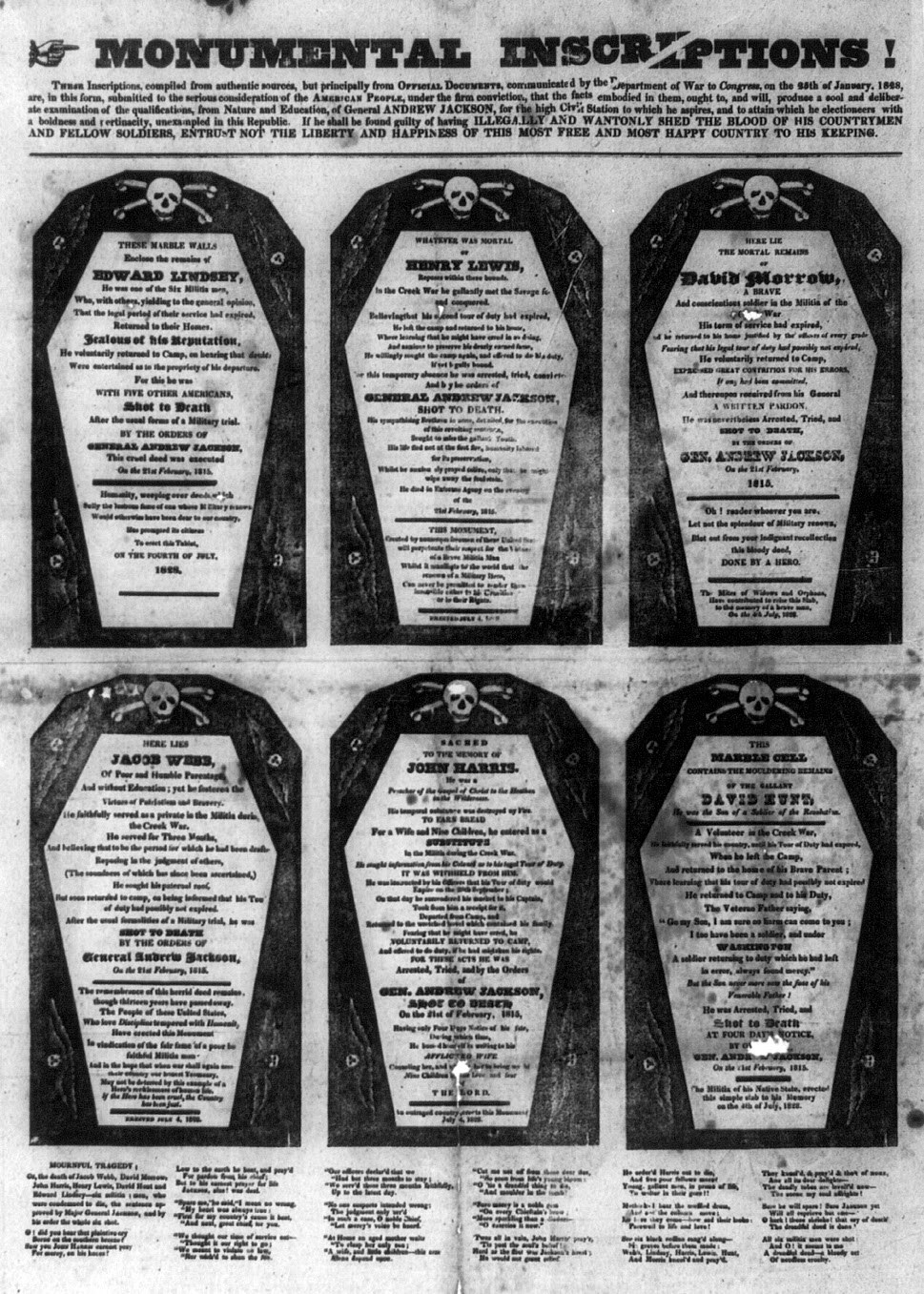
Propaganda pamphlets circulated this execution story widely that year, the swiftboating of the 19th century.

Their inevitable inclusion of six coffin-shaped blocks to symbolize the dead men this date eventually gave to anti-Jackson broadsides the name “Coffin Handbills” — a term that eventually extended to the entire genre of political libels. This linguistic relic is surely due for a bicentennial resurrection.

Sordid campaigning over Jackson’s questionable military freelancing was somewhat ironic in 1828, since Jackson also had that reputation from his extra-legal Florida incursions, after the War of 1812. Those adventures rankled many within the Monroe administration, but were stoutly defended by Monroe’s Secretary of State — none other than John Quincy Adams. (Adams’s own signature graces the 1819 treaty with Spain which ceded Florida; it was largely secured by Jackson’s depredations.)

Irony or no, the attacks had to be dealt with.

Jackson’s partisans responded with equal vigor. For instance, newspapers (the excerpt below comes from the May 1, 1828 Maryland Gazette) carried a lengthy vindication penned by a Jackson partisan and fellow-Tennessean then sitting his first term in Congress … but destined in time to follow Jackson to the White House.**

I had supposed it scarcely possible that any candid, intelligent man, could for a moment doubt the correctness of General Jackson’s conduct, in relation to this subject … No man has ever been more misrepresented and slandered by his political adversaries than Gen. Jackson, and upon no subject more than that in relation to the execution of the ‘six militia men.’ …

The corps to which the ‘six militiamen’ belonged, was stationed at Fort Jackson. Between the 10th and 20th of September 1814, before the period even of three months, much less six months, had expired, an alarming mutiny, such as was seldom ever witnessed in any army, took place in the camp, of which these ‘six militia men’ were the ringleaders. Harris who seems to have been the principal, several days before the mutiny broke out, carried about a subscription paper thro’ the camp, obtaining the signatures of all who would agree to go home. In defiance of their officers commanding the post, they on the 19th of September 1814, violently and tumultuously assembled together, to the number of near two hundred, broke open the public stores, took out provisions, demolished the bake house, shot down breves, and in the face of authority, left the camp on the next morning ‘at the end of revielle beat;’ yelling and firing scattering guns as they departed, proclaiming to all who would, to follow them.

Th proceedings of the court martial were forwarded to General Jackson then at New Orleans, for his approval. The six ringleaders were not recommended to mercy by the court martial. No palliating circumstances existed in their case, known to him. He knew they had been tried by a court martial composed of their fellow citizens and neighbours at home. The news of peace had not then arrived. The enemy’s forces were still in our waters and on our border. When an attack might be made was unknown, and the militia under General Winchester‘s command at Mobile, were ‘threatening to mutiny.’ … General Jackson saw that the salvation of the country was still in jeopardy, if subordination was not preserved in the army. He approved the sentence, and these six unfortunate, tho’ guilty men, were executed. This approval of the sentence of the court martial was made at New Orleans on the 22d of January, 1815. The first intimation which the General had of the news of peace even by rumour, was received on the 18th or 19th of February, 1815 … Col. G.C. Russell, who commanded on the day the sentence of the court martial was carried into execution, states in a letter of the 29th of July, 1827, that ‘we had no knowledge of a treaty of peace having been signed at Ghent, till more than a month after the approval of the sentence, and fifteen or twenty days after its execution.’ The official news of peace did not reach General Jackson until the 18th of March, 1815, and on the 19th of the same month, the British commander received the official intelligence from his government. It was not until after this period that the British forces left their position on that border of the union.

The effect which the execution of these men produced in the army was most salutary. Not a whisper was afterwards heard of the mutiny which had threatened General Winchester’s command. Subordination was restored, and all the troops in the service were willing, and did without a murmur perform their duty. Mutiny and desertion were no longer heard of in that part of the military service.

it is impossible to conceive how censure can attach to General Jackson. At the time he approved the sentence of the six ringleaders, he pardoned all those who had been recommended to mercy by the court martial that tried them. At the time of the execution all acquiesced in its justice. Every officer in the army responded to the importance of the example, for the good of the service. At that time the whole country was satisfied. Not a whisper of censure was heard against the commanding General, or any member of the court martial in reference to it.

James K. Polk

Polk, indeed, advised his friend Jackson closely during the latter’s 1828 campaign, and specifically counseled an active campaign to rebut the “six militiamen” attacks.

Polk’s energetic response and others like it must have worked well enough: Jackson crushed John Quincy Adams as handily as he had once done the Creeks, and wound up with his hatchet face on the American $20 bill.

* The De Tocqueville quote in the text is the part germane to this post, but it disdainfully goes on to pronounce New Orleans “a victory which was, however, a very ordinary achievement and which could only be remembered in a country where battles are rare. Now the people who are thus carried away by the illusions of glory are unquestionably the most cold and calculating, the most unmilitary, if I may so speak, and the most prosaic of all the nations of the earth.” Sniff.

** And to follow Jackson’s policy of dubious southerly land-grabs.

On this day..

1942: Max Hertz, chronicled by Oskar Rosenfeld

(Thanks to Meaghan Good of the Charley Project for the guest post. -ed.)

On this date in 1942,* a middle-aged man was hanged in the Lodz Ghetto in front of an audience of twenty thousand. His name was Max Hertz, son of Salli Hertz and Helena Hertz née Abraham. He was from Germany.

His death was recorded in heartbreaking detail by Oskar Rosenfeld, a resident of the ghetto. Rosenfeld was an Austrian-Jewish writer and translator who’d published six novels before the war. After the Anschluss in 1938, he and his wife emigrated to Prague in Czechoslovkia to escape Nazi aggression. Nazi aggression followed them, however, and the couple made plans to move to England.

Mrs. Rosenfeld left in 1939 and her husband was supposed to come later, but the war started and Rosenfeld found himself trapped in Prague.

Deported to the Lodz Ghetto in 1941, within a few months he secured a relatively cushy position as an archivist with the ghetto administration. He helped write the official Lodz Ghetto Chronicle, a diary of the day-to-day events of the ghetto.

Oskar Rosenfeld

Behind closed doors, Oskar Rosenfeld was keeping his own, personal diary, accumulating twenty-one notebooks in all. Sixty years later, the director of the Yad Vashem libraries described his style as “riveting. At times he is philosophical and literary, at others he is spare and raw. Often instead of full sentences, Rosenfeld writes strings of words words so packed with meaning that normal sentence structure is superfluous.”

The diary was mostly in German, with occasional parts in Hebrew, Yiddish and English.

Rosenfeld employed a simple, fairly transparent code to avoid trouble if his notebooks should come into the wrong hands. He refered to the Nazis, for example, as “Ashkenes.” When he wrote “Germans,” he meant only German Jews. The Ghetto Chairman, Mordechai Chaim Rumkowski, designated Eldest of the Jews, was often called “Praeses.” The words “Gestapo” and “Kripo” were written using the Greek alphabet.

His entries described in painstaking detail the grotesque land in which he was imprisoned: the religious and cultural life of the ghetto, the residents’ attitude toward the administration, the rumors flying around about the war front, the deportations, and above all everyone’s struggle to survive from day to day.

Starvation, overwork, disease and despair wore away at the Lodz Jews, like sand castles crumbling. The Nazis’ Jewish problem, Rosenfeld noted wryly, was being solved “in installments.”

During the frigid Polish winters—unusually harsh in those years—the coal ration was pitiful, and people chopped up their own furniture for firewood. When that was gone, they turned to the streets and stole whatever they could get their hands on: fences, even sheds and outhouses were dismantled for burning. In spite of this hundreds of people froze to death.

A bigger problem was food. Or rather, lack of food.

“According to German scientific findings,” Rosenfeld wrote,

the consumption of calories in normal times was 3,640 calories with 93 grams of albumen [protein] per person. The allocated ration in the fall of 1941 was 1,300 calories and 36 grams of albumen. Since the fall of 1941, the ghetto — with the minor exception of the workers in the factories — received a mere 900 calories and 25 grams of albumen per person. Not taking into account the lack of vitamins. This was no longer nutrition, this was a prescription for a slow death.

People traded everything they had, literally the clothes off their backs, for a few turnips or some sausage. During times when food was particularly scarce, a diamond necklace or a good pair of shoes might fetch a single loaf of bread. And sometimes one loaf was all a person could expect to get for an entire week.

When someone died — and there were deaths in nearly every family — their surviving relatives would often wait several days to report it, so they could claim the dead person’s rations. There were even reports of cannibalism, which Rosenfeld dutifully recorded.

The Lodz Ghetto was a work camp, not a death camp, and was designed to squeeze all the labor it could out of the inhabitants. People who were just too sick or weak to keep up were likely to find themselves on the next list for deportation to mysterious “labor camps in the East.”

Nobody knew for sure where the deportees were going, but the ghetto residents had reason to be suspicious and fearful and most of them did everything they could to stay out of the transports. No one who was deported ever returned to the ghetto. These were supposed to be long journeys and deportees were advised to pack several days’ worth of food, but like as not, the trains would come back empty the very next day.

In fact, the deportation transports usually traveled no more than forty miles outside of Lodz.

Their destination was Chelmno, the Germans’ first death camp. There they used gas vans to asphyxiate their victims. These were relatively primitive and inefficient; it wasn’t until later that they came up with the idea of gas chambers instead of vehicles.

The Lodz Ghetto had its own police force staffed by Jewish volunteers (who were universally despised as collaborators by the others) and a court that presided over criminal trials.

Violent crime, and for that matter most crimes against other persons, was rare: most of the court cases involved crime against the ghetto community as a whole. (Demolishing public fences and buildings for fuel, for example. See above.)

The rules were harsh. Kitchen workers caught sneaking even a spoonful of soup or some half-rotted beets were subject to prosecution. A carpenter could be brought up on charges of sabotage if he took some scrap wood home to burn. Jozef Zelkowicz, another employee in the Ghetto Archives, wrote about one case where a tailor forgot he’d draped a length of of thread over his shoulder for easy access during his work. After leaving at the end of his shift, he was arrested for “stealing” the thread.

Offenders usually got a short jail term of a few weeks or months. That was the least of the punishment, however: when they got out, they were often banned from working again and their families were banned from receiving welfare, essentially a death sentence. Convicted criminals and their families also had priority for deportation, however, and tended to get shipped out before they starved to death.

Not this time, however. For whatever reason, the Nazis decided to make a public example of Max Hertz.

It was the very first public execution in the ghetto. In fact, Rosenfeld said, they’d constructed the gallows just for this occasion:

At 5 p.m. on Friday, the building department had received the order for a gallows to be erected on Fischplatz by 7 a.m. the next morning. Precise specifications were given: wooden beams, heavy iron hooks, bent to a shape just this long and that wide. A man from Germany was entrusted with the job. He worked hard and long, and got it done on time. This worker was, it turned out, an intimate friend of the condemned man.

The Nazis were so pleased with the craftsmanship that they placed another for a set of gallows designed to hang twelve people at once.

Rosenfeld’s description of the execution is worth of being quoted almost in full:

Friday, collective, six o’clock in the evening, impersonal declaration to all members of the collective… Meet at nine o’clock at the Fish Market. Rumors: military parade, directives from the German military, the Eldest to speak. –Afterward some reported that they knew… The sick had express dispensation from attending the meeting. Shabbat from nine o’clock on a queue of men and women being led by room commandant through the almost empty streets across the “little bridge” at the Old Market Place between the ghetto and the city, past Hamburgerstrasse to the Fish Market. Along the way local passersby asked what was going on… Nobody had the answer. Frost. Clear. Biting wind. Terribly uncomfortable in the open air. The closerto the square, the clearer that something terrible was about to happen. The streets usually teeming with people on Shabbat — empty…

The rumor of the true drama seems to have gained credence in the ghetto, none of the local inhabitants want to risk being forced to participate and therefore remained at home.

Goaded by the sharp commands of the Jewish police, took their places, men in the front, women in the back, similar queues were streaming toward the square from other directions. It didn’t take long. Shortly before nine o’clock, Fish Square was filled with a human wall, was encircled, a horrifying silence, a few locals out of curiosity.

Finally the masses begin to understand. Sense of foreboding during the march that they were to attend an execution scene (or a witch burning); in the square, many for the first time, gallows. It had been erected early in the morning by the Jewish police. Several women fainted at the sight, others fell into convulsive sobbing; several of the men managed to send some of the women back home or took them (secretly!) to nearby apartments. Those who wanted to go back later found the street blocked off; then order to seal off the surrounding area of Fish Square.

Quite low on three steps, small podium, to the left across from the post office for newly settled rectangular trapdoor; above the trapdoor a vertical balcony, at the upper end a horizontal beam with a hemp cord.

A cold shudder went through the onlookers… No more illusions, no dream, raw reality, for everybody knew who was Ashkenes.

Several well-fed, field-gray SS officers. At the corner of the square, soldiers with mounted machine guns to keep the crowd in check. Nobody had the courage to flee. The transport leader warned of the most severe consequence for anybody who tried to leave. A few managed to get to the collective. An Ashkenes car was parked not far from the square.

Word making the round: cause and candidate. Cause: Jewish star; another variant: a Communist wanted for a long time, flight only a pretext. Left wife and child to take better care of them from Germany (name: Herz [sic], Cologne). The wife is said to be among the onlookers, unaware of what’s happening.

Men quite numb. Some of the women somewhat worried. The Ashkenes men are in a good mood, well fed, smoking, looking cheerfully at the crowd.

Almost an hour and a half. Cold is intensifying…rubbing to generate warmth, with hands on the knees. About ten-thirty suddenly complete silences. From the direction of Zgierz, probably from the Baluter Ring (Gestapo Headquarters, office of the Praeses — government square), appears a man without a hat, flanked right and left by field-gray soldiers, his gray hair in the wind, no collar, open neck, moving closer slowly, in a short winter jacket…directly to the gallows. Most onlookers, especially the women, avert their eyes, others turn their backs to the square; many look nevertheless sideways to the spot where the scene is to unfold. (Tragic irony…joke, perhaps to be released again!!!) Most of them after all witnessing for the first time such business and desire for sensationalism. Since none had ever attended a witch burning or torture or pillory, they didn’t know how to behave, didn’t find the right style; tugged embarrassed on their clothing, clenched the fists, and waited for a sign that was to tell them what it was they should do. Suddenly the silence was so horrifying that the healthy voices of the field-gray Ashkenes could clearly be heard in the square. A man of more than eighty suddenly remembered hearing from his room a strong voice by the wire around midnight, a song that began with la-la and ended with “and if the world were full of devils,” and began to make, quite unexpectedly, his own observations about this. Yes, this old man even rolled up the torn gloves for a moment to make sure that his fingernails were clean. A women her lipstick —

Not a word was heard. Silence. The candidate shivered in the cold. The field-grays in furs. His overcoat was taken from him. He folded his hands. Saw the entire scene, the crowd. Implacable. Mounted the steps to the podium. There was met by two Jewish policemen and a third man who busied himself callously with the cord.

It was said that a Jewish policeman, a well-known Communist, had been ordered to assist in this execution — as a deterrent. Completely dull expression of the crowd, who didn’t like to see Ben Israel [son of Israel] under the gallows. Sensationalism won out over disgust, women there with handkerchiefs over their faces but peering nevertheless, men completely dispassionate. The symbolism — a people pilloried — did not enter their consciousness. The bareheaded man shivered, folded his hands. Something was wrong with the cord. The Jewish policeman handled it very clumsily. The field gray standing next to him straightened it out, busied himself; the Jewish policemen in their excitement had made a wrong move, not well familiar with the executioner’s tool, more used to tefellin [phylacteries] (observation of an onlooker). The moment came when the crowd thought something was going to happen, a declaration or reading of the sentence or some other matter. But nothing. Continued silence. When the man saw that there was no escape, he again folded his hands and suddenly, with a lamenting voice: “Why don’t you let me live…”


A hanging (not necessarily this one) in Lodz Ghetto.

Many expected instead of this plea some kind of demonstration as a legacy from the crowd, some inspiring motto. But nothing of the sort. He was no hero in our sense. Now eyes averted from the gallows, dull thumping was heard of heavy material and wood, a few seconds for the convulsing body, dangling. The crowd was even able to look at it for some time—seconds (counting to thirteen). The corpse softly in the wind. Rigid features, rigid limbs.

The field grays gave a sign, Jewish police gave a sign, and the crowd quickly began to disperse, going home, the wife of the delinquent was present…

The body remained hanging the entire Shabbat. The Jews avoided the place.

The Lodz Ghetto Chronicle includes an entry on this execution, noting it took place in a large square at Bazarna and Lutomierska Streets. According to the chronicle, Max Hertz had escaped the ghetto and spent several days in Lodz proper. He was arrested at the train station when he tried to buy a ticket to Cologne. This was about three weeks before his execution.

The Polish writer and child Holocaust survivor Henryk Grynberg later honored him in a fragment of poetry:

Max Hertz brought from Cologne
on October 23, 1941
went back to the station
but when paying for his ticket
a star fell out of his pocket
right into the ticket clerk’s eye
and he hung over the bazaar
showing the shortest way back
to Europe

The spectacle of Max Hertz’s death had indeed left an unforgettable impression on its audience, just as the Nazis intended.

As for Oskar Rosenfeld: he continued working in the Ghetto Archives up until August 1944. His final diary entry was on July 28 of that year. He was well aware that the fate of the ghetto hung in the balance:

We are facing either apocalypse or redemption… There are plenty of skeptics, nigglers, who don’t want to believe it and still have doubts about that which they have been long and waiting for years… After so much suffering and terror, after so many disappointments, it is hardly surprising that they are not willing to give themselves over to anticipatory rejoicing. The heart is marred with scars, the brain encrusted with dashed hopes.

It turned out to be apocalypse: in August, before the Red Army liberated Lodz, the ghetto was liquidated and almost all of its inhabitants sent to Auschwitz. Like most of the others, Rosenfeld was gassed on arrival. He was sixty years old. But his notebooks survived him, and ultimately ended up in the custody of Yad Vashem. His diary was published in English for the first time in 2003, under the title In the Beginning was the Ghetto: Notebooks From Lodz.

* Rosenfeld places the date of the execution on Friday, February 20. All other sources, including the Lodz Ghetto Chronicle and Max Hertz’s Yad Vashem page of testimony, place it as Saturday, February 21, but I’m sure Rosenfeld is right. The execution seems to have taken place at the beginning of the Jewish Sabbath. The Sabbath is on Saturday, but to religious Jews it actually starts after sunset on Friday; Rosenfeld writes that the body “remained hanging the entire Sabbath” which implies it hung for some time. If it hung “for the entire Sabbath” starting Saturday night, that would have been for less than two hours.

On this day..

1861: The Bascom Affair hangings, Apache War triggers

The retaliatory executions a U.S. Army lieutenant carried out on this date in 1861 helped set in motion a decade-long war with the Apaches.

Three years out of West Point and brand new to Arizona’s Fort Buchanan, George Bascom in retrospect was probably not the ideal ambassador to send out with orders to retrieve a young half-Apache boy kidnapped from a ranch by an Indian raid. (Along with all the cattle.)

Since nobody was present at the time, the identity of the raiders just wasn’t known — but someone’s suspicions affixed on the wily and dangerous* Chiricahua warrior Cochise. The Chiriachuas were just one group among the Apache peoples; they ranged from Mexico to southeastern New Mexico and southwestern Arizona, and were divided into many small local groups each with their own leader — like Cochise.

Lt. Bascom would be killed in a Civil War engagement a year after the events in this post without leaving posterity his memoirs, so his understanding of Apache society can only be guessed at. But his on-the-make bullheadedness is universal to every time and place where young men can be found. “Bascom was a fine-looking fellow, a Kentuckian, a West Pointer, and of course a gentleman,” Arizona frontiersman Charles Poston later remembered. “But he was unfortunately a fool.”


Lt. Bascom and Cochise.

The greenhorn lieutenant rode out with 54 cavalrymen to Apache Pass and lured Cochise to a confabulation. Cochise showed up with his brother, wife, and children — clearly expecting some sort of social call.

Cochise was entirely unaware of the kidnapping, and unaware that Bascom considered him the kidnapper. He offered to find out about it and retrieve the boy from whomever had him.

Bascom, whose troops had surrounded the tent during the parley, accused Cochise of lying to him. Cochise had twice the impertinent lieutnant’s years and at least that multiple of Bascom’s sense, and must have been affronted by his opposite number’s behavior — but when Bascom announced that he would be taking Cochise and his companions as prisoners pending the return of the raiders’ spoils, the Apache commander whipped a knife out of its sheath and instantly slashed his escape route through the wall of the tent. Bursting past the shocked troops (they were as inexperienced as their officer), Cochise escaped into the twilight. This “Bascom Affair” (to Anglos) is remembered more evocatively by Apaches as “Cut Through The Tent”.

But the tent-knifing was only the start of it.

Cochise’s party did not manage to follow his escape, so Bascom now held Cochise’s brother, wife, son, and two other warriors. The Apache tried to put himself in a negotiating position by seizing hostages of his own — first a Butterfield stagecoach stationmaster named Wallace, and later three white men seized from a passing wagon train.

Nor were the hostages’ the only lives at stake. Cochise’s band, including the soon-to-be-legendary Geronimo, had assembled and their campfires burned menacingly in the hills around the little stage station where Bascom’s force fortified themselves. Bascom could have defused it all with a hostage swap, but the kid had his orders and stubbornly refused to make the trade unless it included the one hostage Cochise didn’t have: that little boy from the ranch.

At length, reinforcements for the beleaguered cavalry began arriving, one such party bringing three other Apaches captured en route and entirely unrelated to Cochise. “Troops were sent out to search for us,” a much older Geronimo recalled in his memoirs. “But as we had disbanded, it was, of course, impossible for them to locate any hostile camp … while they searched we watched them from our hiding places and laughed at their failures.”

Despairing now of seeing his family again, Cochise had his hostages killed and dispersed, leaving the mutilated remains to be discovered by his antagonists with the help of circling buzzards. When they did so, they retaliated in fury — releasing only Cochise’s wife and child, but hanging the six other hostages, including Cochise’s brother. In the narration of Sgt. Daniel Robinson,

After witnessing the fiendish acts committed by the Apaches, the minds of our officers and men were filled with horror, and in retaliation, it was decided in Council, that the captive Indians should die. On the 19th we broke camp to return to our respective posts leaving a Sergeant and eight men to take charge of the station until relieved. We halted about half a mile from the station where there was a little grove of Cedar trees. The Indians were brought to the front with their hands tied behind their backs, and led up to the trees. Noosed picket ropes were placed around their necks, the ends thrown over the limbs of the trees and manned by an equal number of willing hands. A signal was given and away flew the spirits of the unfortunate Indians — not to the happy hunting grounds of Indian tradition. According to their ideas or belief in a hereafter, those who die by hanging can never reach that region of bliss. I was in an ambulance with the other Sergeant, and must confess it was a sad spectacle to look upon. An illustration of the Indians sense of Justice: “That the innocent must suffer for the guilty.” And the white man’s notion — “That the only good Indians are dead ones.” Whatever it may be, I do not think it was much worse than the present policy of penning them up on Reservations and starving them to death. (See Cochise: Firsthand Accounts of the Chiricahua Apache Chief.)

A devastating decade-long war against Cochise and his equally able father-in-law Mangas Coloradas ensued, and right when the army most needed its military resources for the Civil War. The conflict claimed hundreds or thousands of lives, crippled mining and ranching, and depopulated fearful white settlements around Apache country in favor of “gravestones … by the road-side like sentinels, bearing the invariable description ‘Killed by the Apaches'”.

A fort near the Texas border was later named for Bascom. The kidnapped boy was never recovered and grew up in a different Apache tribe.

The events of, and following, the Bascom Affair were depicted on the silver screen in the 1950 Jimmy Stewart western Broken Arrow and its 1952 prequel Battle at Apache Pass — among many other cinematic adaptations.


Tom Jeffords (Jimmy Stewart): “Cochise didn’t start this war! A snooty little lieutenant fresh out of the east started it. He flew a flag of truce which Cochise honored, and then he hanged Cochise’s brother and five others under the flag.”

* Cochise was officially at peace with the Americans at this point and hostile to Mexicans. In “Cochise: Apache War Leader, 1858-1861,” in the Journal of Arizona History (Spring 1965), Barbara Ann Tyler argues that the reality of the situation was that his warband flexibly shifted between temporary peace and opportunistic small raids, moving north and south of the Mexican border as convenient.

On this day..

1813: W. Clements, War of 1812 deserter

(Thanks to Meaghan Good of the Charley Project for discovering the original June 1813 broadsheet we reprint here.)

LINES

COMPOSED ON THE EXECUTION OF

W. CLEMENT’S: [maddening sic]

Who was SHOT for Desertion, on Fort Independence, Feb. 18
having been four times Pardoned, but having last Deserted his Post, was condemned to die.

The thoughts of death to every mind,
Most sad reflection’s [sic] brings;
But when man’s life is seek’d for crimes,
Then conscience gives its stings.

No cheering hope attends the soul,
Which with black guilt is stain’d;
The waves of trouble o’er it roll,
And seldom peace is gain’d,

Alas! that man should treasure woe,
And bring upon his head,
The curse of heaven, the curse of man.
To strike his comforts dead.

Ah! how the bosom of a wife,
Must throb with anxious care,
When once the object of her love,
Is caught in guilt’s dire snare.

His children raise their little hands,
Compassion to implore;
But oh! the father whom they love
Shall never see them more.

Condemn’d for crimes his life to pay,
The fatal hour draws nigh;
Stern justice heard no widow’s moans,
Nor heeds the orphan’s cry.

His comrads [sic] silent stand around,
And heave the mournful sigh,
Their bosoms heave with mingled grief,
No eye from tears is dry.

And now the solemn dirge begins,
They march towards the spot
Where he receives his crimes reward,
And meets his dreadful lot.

For him, perhaps a mother sighs,
And hopes relief to come;
He’ll never bless her longing eyes,
But hear the muffled drum.

And now the holy man of God,
To Heaven addresses prayer
And bids the poor unhappy man,
For his sad doom prepare.

And now the solemn drum rebounds.
His last funereal hymn,
Again the trumpet slowly sounds,
Each eye with grief is dim.

Advancing to the fatal spot,
Still sadder flows the strain;
Ah! now the dreaded scene is o’er,
The corps returns again.

See, see him welt’ring in his blood,
His spirit now has fled,
His life has paid the fatal debt,
He’s number’d with the dead.

Learn, then, ye who for Freedom fight,
To stand firm by your post,
To vindicate your country’s Right,
Nor let your fame be lost.

O! let poor CLEMENT’S [sic] awful fate,
A warning be to all,
Remember he who duty slights,
Will meet a dreadful fall.

On this day..

1526: Guillaume Jobert, Genevieve-blasphemer

Guillaume Jobert, one of the first Reformation martyrs in Paris, had his tongue bored through on this date in 1526,* then was burned at the stake at the Place Maubert.

Jobert, the young gentleman son of the avocat du roi of La Rochelle, incurred this ghastly punishment by making some impious cracks about the faith and in particular the devotions given St. Genevieve.

Genevieve was no one to be trifled with. She was supposed to have stopped Attila the Hun dead in his tracks with her prayerful intercession and saved Paris from the sack in 451, in remembrance of which feat she had become honored as the patron saint of Paris.

Genevieve’s cult really took off in the High Middle Ages, the period when a burgeoning Paris firmly established itself as the hub of all France. So powerful was the Parisian devotion to the saint (and the saint’s devotion to Paris) that her cult became a defining marker of the community — and when that community was ruptured by the Reformation, affinity for the cult came to mark the community’s boundaries. To the extent that Genevieve was identified with Paris, with France, with the sacraments, with the royal family — and she was identified with all these things — the Protestant skepticism of saints posing as divine intercessors with demigod-like spheres of influence positioned reformers in opposition to a good many things more than “merely” theology. There is a secular echo of this same critique from centuries later in Voltaire:

The girl that was born in the stubble fields of Nanterre,
Has become a saint that is implored by hollow and stupid people …
But a good citizen should be devout only to you.

As Moshe Sluhovsky notes in “The Politicizations of Sainte Genevieve”, a chapter of his Patroness of Paris: Rituals of Devotion in Early Modern France, the Protestant Reformation in particular

challenged the sacrality of Paris, the identity of France, and the cult of the saints. It was therefore necessary to reaffirm the city’s Catholicity by redefining it in opposition to heresy. Sainte Genevieve was used to delineate who should be included in the sacred social body and who should be excluded from it.

Overtly blaspheming Genevieve certainly put Joubert in the “exclusion” category.

While we have little specific detail about Joubert, some sense of the gravity of his offense might be gleaned from an event that ensued a decade after his tongue-boring execution, when the Affair of the Placards sparked a furious Catholic backlash against religious dissidents. One week later, six Protestants were burned at the stake following a monumental procession through the city meant to reaffirm France’s devotion to the Catholic faith.

For the occasion, St. Genevieve’s relics were removed from her sacred abbey and marched along with all that abbot’s canons and the king himself. These 1,000-year-old remains never appeared in these sorts of ceremonies “without grette and urgent causes,” an English Protestant observer remarked. Notably, accrding to Sluhovsky, the reliquary on this occasion crossed the Seine to the Right Bank for the first time ever.

* Date from this public-domain French journal.

On this day..

1894: Joe Dick, “allowed to go anywhere he desired”

On this date in 1894, a young Indian named Joe Dick was executed outside the courthouse of Eufaula in present-day Oklahoma.

At the time, Eufala was part of the Muscogee Creek jursidiction of Indian Territory. Until the 1898 Curtis Act, the tribal governments in Indian Country enjoyed full legal jurisdiction, up to and including application of the death penalty.

One interesting feature of that jurisdiction (previously noted in these annals) was the absence of standing jails to incarcerate death-sentenced prisoners. Joe Dick was only loosely guarded and on “Christmas week, he told the officers that were guarding him that he was of a lively nature and would like to attend some of the dances that were going on through the country.” They happily loaned him a horse and saddle, and Joe Dick was as good as his word: after dancing all night, he returned and “reported the next morning for breakfast.”

On another occasion, with firewood running short, an officer John Hawkins set Dick loose in the woods with a cart. The murderer came back three hours later, loaded with firewood. “After that, he was allowed to go anywhere he desired, if he would promise to report for duty at meal times.”

Hawkins and a fellow-officer named Bob Roberts conducted the execution by musketry — both shooting Dick dead through the heart from five yards’ distance as Dick stood against a large tree. (In the Indian Territory, only the Cherokee had enough death penalty cases to warrant a standing gallows; other nations generally carried out executions by shooting.)

Dick had opportunistically murdered a man named Thomas Gray against whom he held a grudge. Chancing upon Gray at work in an orchard one day, Dick simply shot him and rode away. Dick confessed the crime.

On this day..

904: Pope Leo V and Antipope Christopher, at the dawn of the Pornocracy

Around this time in 904, Pope Sergius III allegedly had one or both of his deposed predecessors put to death in prison.

Sergius held the throne of St. Peter for seven years, which was a longer incumbency than achieved by his seven immediate predecessors combined:* they march speedily through the Vatican’s annals like so many third-century Caesars, acclaimed by one faction within Rome’s political vipers’ nest only to offer flesh for their rival factions’ fangs; most are eminently forgettable save when they are utterly insane.

So pell-mell turned the scepter from one pretender to the next that the Church has even waffled in its official histories on just who was legitimate. Officially, Leo V is considered Sergius’s immediate predecessor; in reality, Leo was deposed and imprisoned two months after his July 903 election by a fellow named Christopher who was counted as a pope on canonical papal rolls until the 20th century. Today, he’s considered an antipope who was illegitimately elected.

“Legitimacy” in this period meant little but who had the muscle make their election stick. And though Sergius was the beneficiary, the man doing the flexing in this instance was Theophylact, Count of Tusculum along with his wife Theodora. For the next century the papacy would be a bauble of the Theophylacti family, who liberally plundered its perquisites. It is this Count who is thought to have forced the murder of Pope Leo — and possibly (Anti)pope Christopher, although Hermannus Contractus says Christopher was merely exiled to a monastery.

The resulting stability (relatively speaking) was the ascent with Sergius of the so-called “pornocracy”, or “Harlot State”.** The harlots in question are the Theopylacti women in a vicious bit of historiographical branding sourced ultimately (since there are very few to choose from) to the highly partisan histories of Liutprand of Cremona.

The count’s wife, Theodora, elevated to the unprecedented rank of “senatrix”, was the first voracious woman so designated and the possibly spurious charge that it was she who steered the Count’s hand is of course meant to redound to the detriment of both. Theodora’s daughter, Marozia, is alleged to have become Pope Sergius’s concubine at age 15.

As Marozia grew into womanhood, she would succeed as the de facto ruler of Rome, and become for propagandists the principal Pornocrat: “inflamed by all the fires of Venus,” gaped Liutprand; “a shameless whore … [who] exercised power on the Roman citizenry like a man.” She married the Duke of Spoleto and later the Margrave of Tuscany and was reputed to have manipulated numerous other paramours with her charms.

“A more inquisitive age would have detected the scarlet whore of the Revelations,” mused Edward Gibbon, who speculated that Marozia’s domination of the papacy might have sparked the later legend of a female “Pope Joan”. Our age might better see a ruthless conqueror entitled to indulge a Triumph or two. She made and unmade pontiffs in her own lifetime, and no fewer than six men tracing lineage directly to Marozia were Bishop of Rome in the next century and a half:

  • Marozia’s son (by either Pope Sergius or by the Duke of Spoleto) John XI, whose election Marozia forced in 931 when John was all of 21 years old;
  • Her grandsons John XII and Benedict VII;
  • Her great-grandsons (we’re into the 11th century for these) Benedict VIII and John XIX; her great-great-grandson Benedict IX

* In fact, you have to go back to Nicholas the Great (858-867) to find a longer-serving pope than Sergius.

** Saeculum obscurum, or Dark Ages, is historiography’s less colorful term.

On this day..