He never disclosed the money’s whereabouts, presumably taking the secret with him to the grave. (Or to the organ donor market.)
As gangster capitalists go, Yang could hardly be considered exemplary either by scale or by ruthlessness. His peculation undoubtedly harmed many people, but there’s no known whiff of violence about him; he was caught after attempting suicide.
But by the same token, the occasional sacrifice of such middling malefactors potentially helps discharge some of the tension generated by the structural inequality accompanying China’s new oligarchy. What to do in such a world?
“Preserve your moral integrity and don’t set too much store by business results,” Yang told a newspaper prior to his execution. You said it, brother.
One hundred fifty years ago today, Qing China’s last great ruler, the Empress Dowager Cixi, having seized the helm of the state she would drive for 47 years, had her deposed predecessor executed.
Formally, China was being “ruled” at this time by the illustrious Tongzhi Emperor, age five.
This child’s old man, depressively self-medicating at the drubbing China was taking in the Second Opium War, had died young, leaving his only son the throne, in care of a council of regents.
As one of the late monarch’s key advisors, Sushun was among that eight-strong panel, and he was popularly regarded as the worst of the lot — vicious, drunken, spendthrift, and just the guy to blame (along with co-regents Zaiyuan and Duanhua) for all the vicious, drunken, and spendthrift stuff the deceased emperor had put his seal to. Or, just the sort of stories trumped up by the rivals of the man really steering the state. Either way is good.
The Empress Dowager Cixi (1905 photograph)
More perilous for Sushun was his burgeoning rivalry with “the Concubine Yi,” the master of harem politics and mother of the new boy-emperor. She had long distrusted the courtier.
Recast in both title and name with her lover’s passing, the woman now known as “Empress Dowager Cixi” was able to obstruct the regency’s policies. And she did one better than that, intrepidly allying with disgruntled princes to engineer a coup d’etat against Sushun’s faction.
The end of Sushun’s regency arrived within months, and transpired within days: less than a week separated Sushun’s liberty from his beheading in a vegetable market. (Striking a liberal pose, Cixi declined to have him put to death by lingchi.) Cixi’s side simply took him into custody, decreed his execution on the attainder of a secret committee, and speedily carried it out. Zaiyuan and Duanhua were ordered to commit suicide the same day.
But whatever the form, the poor torn country was in the hands of the Empress Dowager Cixi from here on in.
For a half-century, she would be the consummate survivor — but it was survival during an epoch of terminal decline for the Qing. Riven by conflicts within and without, the imperial system simply couldn’t adapt.
And when the cagey Empress Dowager finally died in her 73rd year, the whole enterprise came apart.
On her deathbed in 1908, Cixi named as emperor the toddler Puyi. A few years later, revolution ensured that Puyi would be the last person ever to hold that title.
(There’s a BBC page preserving a good deal of the original coverage here.)
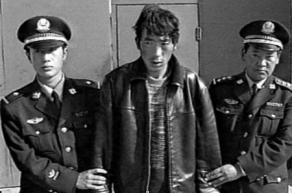
Loyak, one of those executed Oct. 20, 2009.
The two most prominent prisoners — in fact, the only two confirmed in some of the first media reports — were Lhasa residents Lobsang Gyaltsen and Loyak. A court spokesperson said both had been “given death penalties had committed extremely serious crimes and have to be executed to assuage the people’s anger.”
Specifically, both had been convicted of torching shops during the Lhasa riots, which arsons both led to deaths.
The other two executed, a woman named Penki (also for arson) and an unnamed man, received less comment, although they might have been executed despite having been condemned only to a “suspended” death sentence, which for China is generally no death sentence at all.
Executions in Tibet turn out to be relatively rare; these were the first known Tibetan executions since early 2003. Widely condemned abroad, this date’s events were barely or not at all reported internally by Chinese state media.
On this date in 1907, Chinese poet, intellectual and activist Qiu Jin (Ch’iu Chin) was beheaded for plotting an anti-Qing rising.
The daughter of a well-to-do gentry family, Qiu was shunted into the arranged marriage that would have been usual for her milieu.
It did not suit her.
Hers had been an active mind from youth, and after several years of domestic misery, resolved to make her own way in the world, separated herself from her husband, and headed for Japan.
She prepared herself for this journey by an act taxing symbolism as heavily as physique: painfully un-binding her feet. “Unbinding my own feet to undo the poisoned years / Arousing the souls of a hundred flowers to passionate movement,” she wrote in verse while en route to Japan.*
She would later issue a plea for women to emancipate themselves by doing likewise.
[W]e women, who have had our feet bound from early childhood, have suffered untold pain and misery, for which our parents showed no pity. Under this treatment our faces grew pinched and thin, and our muscles and bones were cramped and distorted. The consequence is that our bodies are weak and incapable of vigorous activity, and in everything we do we are obliged to lean on others.
Being thus necessarily dependent on external aid, we find ourselves, after marriage, subjected to the domination of men, just as though we were their household slaves. All our energies are confined to the home, where we are occupied in cutting out clothes, cooking and preparing food, making tea and boiling rice, sprinkling and sweeping, waiting on our husbands, and handing them basin and towel.
In any important business we are prevented from taking the least part. Should a guest arrive, we are obliged to make ourselves scarce and hide in our private apartments. We are not allowed to inquire deeply into any subject, and should we venture to speak at any length in reply to some argument, we are told that our sex is volatile and shallow.
My sisters, do you know where the fault lies that has brought us to this pass? It is all due to women’s lack of energy and spirit. We ourselves drew back in the first instance, and by-and-by that came to be regarded as an immutable rule of conduct.
Sisters, let us today investigate the causes which have led to this want of spirit and energy among women. May it not be because we insist on binding up our girls’ feet at an early age, speaking of their “three-inch golden lilies” and their “captivating little steps”? May it not be, I say, that this process of foot-binding is what has sapped and destroyed all our energy and spirit?
Today my blood is up, and I want to stir your blood as well, my sisters, and rouse you to a sense of your degradation. All women should, in the first place, refuse to adorn themselves with paint and powder, or trick themselves out in seductive guise, realizing that every human being has his own natural countenance given to him by God … In bringing forward this question of unbound feet, my sisters, I want you to realize that the result of having feet of the natural size will be to abolish the evils attendant on injured bones and muscles and an enfeebled constitution — surely a cause for unbounded rejoicing. …
If one day we succeed in wiping out this horrible blot on our civilization, our bodies will begin to grow stronger, and the steps we take in walking will become a pleasure instead of a pain. Having thus regained their natural energy, the whole sex will progress without difficulty, and an endless store of happiness will be built up for thousands of generations of women yet unborn.
But if you shrink from this reform, and wish to retain the pretty sight of small feet beneath your petticoats, you will remain imprisoned to the end of the chapter in the seclusion of your inner apartments, quite devoid of any strength of character, and it will be impossible to manifest the native brilliancy of the female sex. … Let there be thorough enlightenment on the subject of foot-binding, and progress in the matter of equal rights for men and women will surely follow.
That’s being on the right side of history.
In these last days of the decrepit Qing, prophets and revolutionaries with visions of a better tomorrow grew thick on the ground.
Qiu distinguished herself by her eloquence among Tokyo’s Chinese expatriates. Her powerful vision of women reborn as equals, and China reborn as independent and strong, must have had a bit of that personal-is-political vibe.
We sisters must learn to put aside everything we have preoccupied ourselves with before and focus on what we must do for our future — as if our former selves are dead and we have returned to this world in other forms of humanity.
Returning to her homeland, she found wage work as a teacher and her life’s work as her era’s most famous female activist: she artfully combined vocation and avocation by using her school as a cover to train revolutionary fighters.
And if contemporaries had been shocked by her foot un-binding and marriage un-doing, they hadn’t seen anything when it came to gender transgression. Qiu dressed in men’s clothes, rode horseback astride, trained in swordplay, and put out China’s first women’s journal. Her intimate friend — and possibly her lesbian lover — Wu Zhiying, whose biographical essays helped cement Qiu’s posthumous fame, remembered her friend as
forthright. When she happened to meet benighted ones, she would confront them head-on, leaving little room for compromise. People often held this against her. Some even compared her to Sophia [Perekovskaya] and Madame Roland. She would answer [to such appellations] without much thought.
(Quoted in Hu Ying, “Writing Qiu Jin’s Life: Wu Zhiying and Her Family Learning,” Late Imperial China, December 2004)
How it would have crowned the character arc for this once-hobbled housewife had the insurrectionary plot she masterminded with her cousin Xu Xilin succeeded! Maybe it was a little too operatic even for the fates to swallow.
In the event, the hour of the Manchus’ destruction would not arrive for another four years, although it would come at the hands of another secret-society plot.
But Qiu Jin’s got sniffed out by the authorities and busted pre-emptively; our day’s hero made a brave but only symbolic last stand at her school, then was taken into custody and tortured. She yielded a line of poetry, but would not implicate comrades.
“Autumn wind, autumn rain — they make one die of sorrow.”
Qiu Jin was publicly beheaded at Shaoxing. Within five years (and the realization of that revolution she had lost her life pursuing), memorial sites and statues were going up to her memory around China.
Shaoxing statue of Qiu Jin. (cc) image from jensimon7.
* She wrote poetry throughout her life; there are some selections of Qiu Jin poetry translated to English here.
On this date in 1951, Kazakh national hero Ospan Batyr was executed in Urumqi.
Ospan — the second name is an honorific, not a family name — hailed from an ethnic Kazakh region in China’s eastern Xinjian region, noted today for its still-robust Uighur separatist movement.
Executed Today does not envy any ethnic group attempting to sort out its national aspirations on the frontiers of great powers, and this was the dangerous matter to which our day’s principal applied himself.
The powers in question here are the Soviet Union and China; their degree of sway over Xinjiang (or “East Turkestan”) shapes the parameters of the struggle.
During the early 1940’s, the Soviets’ dire wartime position gave them less weight to throw around; accordingly, the formerly Soviet-allied local warlord Sheng Shicai — an ethnic cleanser of Kazakhs from way back — made nice with the Koumintang.
As Moscow gained the upper hand over Berlin, however, it had leave to tend its eastern ambitions as well.
Since Sheng’s attempt to sell out to Stalin failed, he left Xinjiang with 50 trucks full of loot, and retired to Taiwan to write this 1958 volume on his erstwhile demesne.
When Sheng got bounced from his post trying to re-defect to the victorious Soviets, Ospan Batyr (alternatively, Osman or Uthman Batur) led Kazakh forces in a multi-ethnic Muslim rebellion that established a short-lived East Turkestan Republic, allied with the Soviet Union.
But what the political expediency of great powers giveth, it also taketh away.
The postwar partition of the globe left Xinjiang in China’s sphere of influence, drawing down the East Turkestan Republic’s Soviet support. When that state-like entity became involved in a border conflict with Soviet-backed Mongolia, Osman and the Kazakhs lined up with the Koumintang — not Russia.
As a matter of straight realpolitik, this was an inauspicious moment to get with Chiang Kai-shek since he was on the verge of finally losing China’s long civil war. But it’s a move that would be subsequently vindicated by the way Kazakhs voted with their feet under Mao.
Ospan Batyr had to settle for the judgment of history when the People’s Liberation Army absorbed Xinjiang, and in 1950 finally corralled the remnants of his Kazakh resistance. He repelled demands under torture that he sign on with the Reds and make an appeal to his people in their name: “I can give a life. My nation will continue the struggle.”
Ospan Batyr awaits execution.
Most of the information readily available online about this Kazakh martyr is not in English, and a good deal of it tends to the hagiographical — like this Turkish-language page, lavishly illustrated.
Today in China, overseas Filipino workers Ramon Credo, 42, Sally Villanueva, 32, and Elizabeth Batain, 38, were executed by lethal injection in China as drug smugglers — the first two in Xiamen, and the last in Shenzhen.
The three had been arrested in 2008 and convicted in 2009 for carrying heroin — they said unknowingly — into the People’s Republic.
Vice President Jejomar Binay, who personally traveled to China to plead their case, called it “a sad day for all of us.” (Unusually, China actually granted a few weeks’ reprieve from the original February execution dates. This was viewed as a concession, and why not? China has rolled stronger countries in similar cases before without even that courtesy.)
While this case was in the headlines for weeks in the Philippines and around the world, the condemned at the heart of it seem not to have realized their deaths were imminent until relatives flew in from China to meet with them on this very day, just hours before execution.
This execution date also happens to be the 40th anniversary of another landmark event in Sino-Filipino relations, the hijacking of a Philippines airliner by six students, who diverted it to China. Those illicit airborne arrivals were greeted with considerably more leniency than our present-day drug couriers enjoy.
Seventy-two more Philippines nationals are reportedly under sentence of death in China for drug crimes(or not), and around 120 more for various offenses throughout the world.
It was on this date that notoriously corrupt Chinese minister of state Heshen or Ho-Shen was forced to commit suicide in lieu of execution.
The able child of a Manchu military officer, Heshen came of age in the long reign of the emperor Qianlong.
That Heshen rose above his modest station with this monarch’s favor was the source of no small resentment. Rumors circulated that the attractive young former bodyguard reminded the emperor of a lost, beloved concubine — with all that implies.
“Elegant in looks, sprucely handsome in a dandified way that suggested a lack of virtue,” a Korean diplomat described Heshen.
Whatever there might have been to the homosexuality angle, Heshen exploited the imperial protection to gorge himself on the state’s revenues; he’s reported to have filled the bureaucracy with clients who saw to it that Heshen got a yuan out of every tael that passed through state business in the last quarter of the 18th century. He even dynastically married his own son to one of Qianlong’s daughters.
It was the peak of the Qing dynasty’s glory, and the dawn of its imperial stagnation. Heshen — resplendent, omnipotent, and sunk in vice* — remains to this day its persona par excellence.
As long as the emperor lived, Heshen had a virtual free hand.
But as soon as the emperor died — on February 7, 1799, at the age of 87 — the successor** Jiaqing destroyed him.
Citing Heshen’s inability to suppress the nettlesome White Lotus and Miao rebellions, Jiaqing arrested and tortured the former retainer into copping to all manner of offenses both mortal and venial.
My thoughts dwell ever on the Confucian precept: ‘For three years after a parent’s death none of his former surroundings should be changed.’ …
But as regards Ho Shen, his crimes are too grave to admit of possible pardon … Ho Shen is a deep-dyed traitor, lost to all moral sense, who has betrayed his Sovereign and jeopardised the State. As self-constituted dictator he has usurped supreme authority.
Seeing the man’s abrupt change of fortunes, Heshen’s people in the bureaucracy fell over each other to denounce him.
He was condemned to the horrific expiation of “slow slicing”; however, given “the undesirability of executing the chief Minister of State like a common felon in the public square,” Jiaqing “allowed him the privilege of committing suicide, as a mark of high favour and out of regard to the dignity of the nation.”
A principal accomplice was made to witness Heshen ceremonially hanging himself; then the accomplice was reprieved of his own death sentence and sent into exile.
The new sovereign found his nation’s dignity sufficiently upheld by the doomed man’s melancholy inventory of loot destined (of course) for the re-appropriation of the Qing … and sufficiently outraged that, upon discovering weeks after the some artifact Heshen had failed to enumerate,
Had these facts come to Our knowledge before the 18th day of the 1st Moon [i.e., February 22], we should assuredly have decreed Ho Shen’s decapitation, even if We had spared him the lingering death and dismemberment.
However, he has already been permitted to commit suicide, and thus luckily escaped the extreme penalty of public execution. We do not, therefore, insist on his corpse being hacked to pieces.
Jiaqing had better to worry about his own now-declining state, which was about to be hacked to pieces by encroaching European powers.
Having made an example of Heshen and a handful of his most visible allies, he was still saddled with the endemic structural corruption Heshen had fostered in the institutions of Qing governance.
“Historians have tended to see Jiaqing’s failure of nerve in purging the bureaucracy of all tainted officials as something of an original sin whose commission predetermined the dynasty’s steady decline,” writes William T. Rowe of this turning point. “But given the need for at least some continuity in routine administration, it is not at all clear that he could have acted otherwise.”
And so Jiaqing struggled in vain to maintain China’s fading prestige; his reign would witness economic erosion and a burgeoning opium trade that eventually led it to war with the British and humiliating western domination.
Since a sclerotic bureaucracy at once crushing in its expanse, helpless in its effect, and riven with self-dealers, is a timeless theme (especially in China), Heshen persists as a lively emblem of corruption.
Heshen’s luxurious mansion — which was also among Jiaqing’s indictments — still stands; today, it’s a museum.
* It bears remembering that it is principally by the testimony of Heshen’s enemies that we know him.
** Technically, Jiaqing had been ruling since Qianlong symbolically “abdicated” in 1796; in reality, Qianlong continued to run the realm until his death.
On this date in 2004, the former deputy governor of China’s Anhui province was executed for official corruption.
It was just weeks after Wang’s conviction for grifting some 100 million yuan in real estate transactions dating back to the mid 1990’s.
We suppose Wang did his appeals no favors by steadfastly denying guilt — although he might have reckoned that the national “determination … to fightcorruption” thwarted any such plan.
Instead of confessing to his crimes, Wang had stood against the public prosecutors and even continued to seek bribes during the investigation from some private business owners, said Wang Huanhai, head of the investigation team.
According to the prosecutor, Wang attempted to use the bribe to buy over more relations, hoping the Central Commission for Discipline Inspection of the Chinese Communist Party would spare him from being inquisited.
During the first trial on Dec. 29, 2003, Wang denied all the allegations, but in the latest trial confessed to most of the crimes and argued for a light penalty on the grounds that the bribes he had taken were not big enough to justify a death penalty.
His request was turned down, given the amount involved in the case as well as his resistance to investigation.
Wang’s prosecutors said he was an orphan and had climbed up the social ladder with an inferiority complex. “That’s why he was dictatorial and could not stand anyone questioning him,” said Wang Huanhai, “Nor did he ever confess to his wrongdoing in public.”
Two “prime members” — in the words of the Xinhua report — of a central China gang were executed on this date last year in Hubei province.
Liu Lieyong* was sentenced to death for the crimes of organizing and leading an organized criminal gang, murder, blackmail, illegal possession of arms and gambling, said a statement from the SPC.
Chen Xiaohui was convicted of participating in an organized criminal gang, murder, intentional injury, inciting disorder and illegal possession of arms.
…
Another 19 people convicted in the case received jail terms from one year with two-year reprieve to suspended death sentences, said the statement.
The crime gang, founded by Liu in the city of Xiantao in Hubei in 2001, had opened casinos, which were illegal in China, illegally forced the transfer of shares in local bus companies and manipulated local cement and food markets.
Liu instructed gang members, including Chen, to murder one person. Chen was also held responsible for another death and nine injuries, the statement said.
The statement did not give details about their victims. According to a report in the Wuhan Morning Post in February 2008, one of the victims was Hu Dongfeng, head of a rival gang in Xiantao. Six of Liu’s gang members ambushed him and shot him dead.
On this day in 2009, Chinese citizens Zhang Yujun and Geng Jinping were shot to death in connection with China’s tainted milk scandal.
The affair caused some 300,000 infants to became sick, six of them fatally. They were killed by powdered milk tainted with melamine, an industrial chemical used in plastics and fertilizer. Zhang, a dairy farmer from the province of Hebei, sold hundreds of tons of tainted milk powder in 2007 and 2008; he was the largest supplier. Geng supplied toxic milk to dairy companies.
The scandal was stupendous and made headlines all over the world. According to Time magazine, the tainted milk found its way to Taiwan, Singapore and Japan. China’s $232 million dairy export industry cratered as the European Union and a dozen nations in Asia and Africa banned Chinese milk and milk products. The farmers who depended on milk sales for their livelihood were reduced to simply pouring their surplus stock down the drain, and since nobody wanted to buy dairy cows under these conditions, some farmers just slaughtered their animals.
Top: Chinese farmers destroy tainted milk. Bottom: Zhang Yujun (left) and a supplicating Geng Jinping (right).
Nor was milk wasn’t the only export product with this problem; Wikipedia’s timeline of the scandal states melamine was subsequently discovered in Chinese eggs, egg powder, baking ammonia, chicken, crackers and animal food.
Melamine was added to the milk to fool government protein tests, which would show whether the milk had been diluted or not. (Watered-down milk had been a problem in the past; in 2004 thirteen Chinese babies died of malnutrition after being fed milk that was so watery it had almost zero nutritional value.) Melamine, like protein, is high in nitrogen, so the presence of melamine in food would cause the protein content to appear higher than it really was.
It isn’t clear whether the people who altered the milk knew — or cared — that it was poisonous. Very poisonous. Melamine is never supposed to be used in food; it causes kidney stones and in some cases complete renal failure, especially in young children. A child can take over six months to recover from exposure.
Some blame must be attached to the (suspect) Chinese food safety administration, which in May 2008 reported that over 99% of baby milk powders had been deemed safe. (In fact, one major dairy company had begun hearing complaints about its baby milk as far back as the previous December.) The Ministry of Health was informed about the sick infants in July. There are strong suspicions that the government tried to suppress the reports to avoid embarrassment; the Olympics were in Beijing that summer and the world’s eye was on China. The scandal was only made public in September, after the Games.
Twenty-one people involved in the scandal were brought to trial on various charges in December 2008, and convicted in January.
Tian Wenhua, the general manager of the Chinese dairy giant Sanlu, pleaded guilty to producing substandard goods and was sentenced to life in prison. She admitted she’d known the milk was bad for four months before she reported this fact to the authorities. Sanlu tried to keep complaining parents quiet by giving them free milk, which was also tainted. Tien was widely perceived as being the person most responsible for the scandal, and many were disappointed that she didn’t get the death sentence.
Other defendants received various prison terms. One of them was given a suspended death sentence, but only Zhang (guilty of endangering public safety) and Geng (guilty of producing and selling toxic food) were actually executed.

 The first person executed for securities corruption in China, Yang used his position as a trader for Galaxy Securities to embezzle some 65 million yuan for personal gain.
 The daughter of a well-to-do gentry family, Qiu was shunted into the arranged marriage that would have been usual for her milieu.
 Ospan — the second name is an honorific, not a family name — hailed from an
 The able child of a
  It was just weeks after Wang’s conviction for


