1594: Jean Châtel, lipstabber

On this date in 1594, Catholic militant Jean Châtel was dismembered for the near-assassination of King Henri IV.

Just two days before his public butchery, the 19-year-old clothier’s son (English Wikipedia entry | French) had milled about in a crowd awaiting the Huguenot* king’s return from Picardy. As Henri entered the Hotel de Bouchage and bent over to accept the obeisance of two courtiers, Châtel sprang out of the crowd and daggered him. The blade cut Henri’s lip — a glancing blow just a few degrees distant from a history-altering one.

Châtel would cite Jesuitical inspiration, and when his instructors’ quarters were searched they yielded seditious exhortations against Protestant princes. One Guignard, who had authored the most inflammatory tracts (e.g., regretting that Henri had not been slain at the St. Bartholomew’s Day massacre), was put to death on January 7; the rest of the order was expelled from Paris — as was Châtel’s family, whose home was razed and replaced with a monument against religious fanaticism.


The pyramid memorial was replaced by a succession of fountains, of which the most recent is the present-day Fontaine Cuvier.

It was of course far too much to hope that this scolding plinth could bring down the dangerous sectarian temperatures raised by a half-century of civil war. In his time Henri IV evaded numerous — some 20 or more — attempts on his life, before a different Catholic enragee, one Francois Ravaillac, successfully murdered him in 1610.

* The threat of pedantry in the comments section obliges us to allow that Henri nominally converted to Catholicism in order to take the throne and end the Wars of Religion — the occasion on which he was purported to murmur that (staunchly Catholic) Paris is worth a Mass.

On this day..

1914: The six martyrs of Vingre

On this date in 1914, a France consumed by the First World War made martyrs of six at Vingre.


The men in this post were rehabilitated in 1921, and this marker dedicated to their memory in 1925. Flickr users have posted some striking photos of the memorial site.

An event horribly underscoring the heartlessness of the brass against frail flesh in their ghastly war of machines, this shooting succeeded a surprise German attack on November 27 whose short-lived push into the French line momentarily drove part of the 298th Regiment to fall back out of their forward trench, before the French rallied and retook their own position to restore the status quo ante. The whole back-and-forth spanned mere minutes — just another snapshot of the trench war stalemate that would become so grindingly familiar to all belligerents in the years ahead.

French commanders in the earliest months of the war had shown a notable lack of empathy for any vexation of plans arising from the fog of war; indeed, exemplary executions became policy for enforcing military discipline to an unrealistic expectation. So, as punishment for their units’ “unauthorized* retreat,” six were selected for execution as an example to their fellows.

Some heartbreaking (or blood-boiling) last letters of the doomed survive.

Corporal Henri Floch (to his wife)

My darling Lucie,

By the time you receive this letter I shall be dead by firing squad. This is why: on 27th November, around 5pm, after 2 hours of heavy shelling in a trench on the front line, just as we were finishing our supper, Germans got into the trench. They captured me and two others. In the confusion I was able to escape from the Germans. I followed my comrades and then I was accused of dereliction of duty in the face of the enemy.

Twenty-four of us went before the War Council last night. Six were condemned to death and one of them was me. I am no more guilty than the others, but they want to make an example of us. My wallet will be sent home to you along with its contents.

In haste I say my last farewell to you, with tears in my eyes and a heavy heart. I humbly beg your forgiveness for all the grief that I will cause you and the difficulties that you will have to face because of me.

My dear Lucie, again, please forgive me. I’m going to Confession now and I hope to see you again in a better place. I die innocent of the crime of desertion of which I stand accused. If, instead of escaping from the Germans, I had remained a prisoner, my life would have been spared. It must be fate.

My last thoughts are for you, right to the end.

Henri Floch

Jean Quinault (to his wife)

I am writing to you my latest news. It’s over for me. I do not have the courage. We had a story in the company. We went to the court martial. We are 6 condemned to death. I am in the six and I am no more guilty than the comrades, but our life is sacrificed for others. Last farewell, dear little woman. It’s over for me. Last letter from me, deceased for a reason of which I do not know well the reason. The officers are all wrong and we are condemned to pay for them. I should never have thought of finishing my days at Vingre, and especially of being shot for so little and not guilty. It never happened, a case like this. I am buried in Vingré

Jean Blanchard (to his wife)

3 December 1914, 11.30 pm

My dear Beloved, it is in great distress that I begin to write to you and if God and the Blessed Virgin do not come to my aid it is for the last time …

I will try in a few words to tell you my situation but I do not know if I can, I do not feel the courage. On November 27, at night, as we occupied a trench facing the enemy, the Germans surprised us, and panicked us, in our trench, we retreated into a trench behind, and we returned to resume our places almost immediately, with this result: a dozen prisoners in the company of which one was in my squad, for this fault our squad (twenty-four men) spent today before the council of war and alas! We are six to pay for all, I can not explain it further to you, my dear friend, I suffer too much; friend Darlet will be able to explain to you better, I have a calm conscience, and submit entirely to the will of God who wants it so; It is this which gives me strength to be able to write to you these words, my dear beloved, who have made me so happy the time that I spent with you and of which I had so much hope to find. December 1 morning we were deposed on what had happened, and when I saw the charge that was brought against us and which no one could suspect, I cried a part of the day and have not had the strength to write to you …

Oh! Blessed be my parents! My poor parents, my poor mother, my poor father, what will become of them when they learn what I have become? O my beloved, my dear Michelle, take good care of my poor parents so long as they are of this world, be their consolation and support in their grief, I leave them to your good care, tell them I have not deserved this hard punishment and we will all find each other in the other world, assist them in their last moments and God will reward you for it, beg my forgiveness of your good parents for the punishment that they will experience by me, tell them well that I loved them very much and that they do not forget me in their prayers, that I was happy to have become their son and to be able to support and care for them their old days but since God has judged otherwise, that His will be done and not mine. Goodbye up there, my dear wife.

Jean


(cc) image from Soissonnais 14-18.

* The “cowards” contended that a falling-back had been ordered by a lieutenant who no doubt was as war-befogged as everyone else. Since this order could have set up Lt. Paulaud himself to be the guy shot for example, he naturally denied issuing it; when the six were exonerated after the war, Paulaud was indicted for perjury, but acquitted.

On this day..

1944: Victor Gough, of Operation Jedburgh

On this date in 1944, British Capt. Victor Gough was shot at Ehrlich Forest as a German POW.

Gough had been parachuted into occupied France a few months before as part of Operation Jedburgh — a campaign to grow internal anti-German resistance to complement the Allied push via Normandy.*

Unfortunately as Colin Burbidge details in Preserving the Flame, Gough’s destignated stomping-grounds — the Vosges Mountains on the eastern borderlands — had some of France’s most pro-German populace. (Burbidge is Gough’s nephew.)

His complications were exacerbated when his wireless operator was injured — and the wireless set wrecked — in the parachute jump. The British wireless man was soon captured and their third, a French officer, killed in a gunfight, leaving Gough on his own. “Great difficulty working alone,” he managed to report to SOE headquarters. He was finally captured in October of that year, tortured by the Gestapo, and eventually shipped to the labor camp at Gaggenau.

In accordance with Hitler’s anti-saboteur Commando Order Gough was shot at a nearby forest in a gaggle of 14 POWs — six British special forces, four American airmen, and four French civilians. Their fate was discovered in part thanks to a German fellow-prisoner, a former officer in the Wehrmacht who had been sent to the camps for refusing orders to issue his men sawed-off shotguns, a weapon prohibited by the Hague Convention, who escaped shortly before the executions using a British map that Gough gifted him. That Captain Werner Helfen survived the war and gave evidence to a British war crimes investigation.

Many years later, Helfen gave something else too: according to Burbidge, his mother — Gough’s sister — in 1991 received a package from Germany containing a photo of Werner Helfen by Victor Gough’s grave, and the escape map that Gough had given to Helfen.

* Future CIA director William Colby was a notable Jedburgh alumnus.

On this day..

1803: Ludovicus Baekelandt, Vrijbos bandit

On this date in 1803, Flemish outlaw Ludovicus Baekelandt was guillotined at Bruges with about 20 of his gang.

Deserting the army of the conquering French, Baekelandt set up as a bandit preying the deep spruce forests of the Vrijbos, eventually attaining leadership of a gang more than 30 strong.

Baekelandt is one of those whom popular memory and national sentiment (resentful here of the French occupation) has elevated into huggable social banditry. But the evidence remaining us testifies to little but a garden-variety brigand whose offenses were in no way confined to property crimes.

The gang was rounded up in 1802 and the Bruges court heard testimony from more than 100 witnesses, eventually dooming 21 men and three women to death for a litany of murders and robberies.

Almost all the information about Baekelandt available online is in Dutch; if that tongue is in your toolkit, gentle reader, this public-domain book is sure to level you up on Ludovicus Baekelandt and friends.

On this day..

1914: Lt. Jean-Julien Chapelant, mort pour la France

On this date in 1914, the French army shot Lt. Jean-Julien Chapelant as a coward.

Most resources about Lt. Chapelant are in French, as are almost all the links in this post — but within France this case has been contested since the interwar years when his father fought in vain ferocity to reinstate the honor of his son.

Four days before his execution, Chapelant, commanding a machine gun section near a village in the Somme, was captured with four other gunners when the Germans overran their position. Though he’d been shot in the leg, Chapelant managed to escape his captors and return to French lines. (Three of the other gunners escaped, too.)

While the categorical rehabilitation of Great War soldiers “shot at dawn” as cowards or deserters has been a going concern in recent years, Chapelant also has a compelling individual argument that he ought not have been construed such even by the standards of his time.

The luckless lieutenant was shot for “capitulating in open country”. This was at best an extremely prejudicial interpretation of the facts, seemingly one that commanding officers themselves still adjusting to the unexpected prowess of German arms had already settled upon before any proper investigation, out of their pique at losing the position. The verdict was so certain that Chapelant’s commanding officer gave him his revolver back urging him to “burn out his own brains” and save everyone the trouble.

Chapelant refused, insisting that he had done his proper duty, and military justice was edified by the spectacle of a crippled man who could not stand propped up in his stretcher against an apple tree for the tender ministry of his firing squad.

“I die innocent. You will all know it later,” he told his executioners — then added, futile wish, “do not tell my parents.”

Although we have been treated in these pages to the heartbreaking scene of an officer comforting a man about to be shot with the remark that “yours also is a way of dying for France,” the idea has until very recently been confined to the precincts of personal sentiment and certainly not to the institutions responsible for the dying.

On November 11, 2012the centennary of Lt. Chapelant’s execution* — he was ceremonially rehabilitated and his death officially ascribed to that same cause that laid so many of his comrades low: “mort pour la France.”

* Adding round numbers is hard, apparently.

On this day..

1783: Jacques Francois Paschal, rapist monk

For this date’s post, we are indebted to Rictor Norton, who maintains the invaluable Homosexuality in Eighteenth-Century Enland site. Norton wrote a book about England’s proto-gay “molly house” culture, and his site includes a nigh-comprehensive index of 18th century reportage touching same-sex activity.

Norton quotes these reports — luridly horrible, if slightly contradictory — here.


Wednesday 29 October 1783

A correspondent from Paris, who was present at the late execution of the Friar convicted of an unnatural crime, has favoured us with the following particulars: the monk who murdered a young boy that would not submit to his infernal solicitations, was tried at two o’clock in the afternoon, and sentenced to be broke alive on the cross, and then burnt to ashes at four the same day. He was allowed some time in a house to prepare himself for the awful moment, but did not remain there half an hour. He was then taken to the Grève, the place of execution, tied to the cross of St Andrew, and broke with amazing celerity. He had eight bones broken, and was thrown alive into the fire. It is usual for criminals on these occasions to receive the coup de grace, that is, the criminal being tied down on the cross, which is fixed upon a scaffold, the executioner sets a halter round the said criminal’s neck, and passing the ends of the rope through two holes made on purpose in a board of the scaffold, one of Jack Ketch’s* men, who attends underneath, joins the aforesaid ends in a kind of press, and takes care to strangle the malefactor at the very instant he receives the first stroke. The Friar in question was denied this extraordinary favour, though he begged it with many dreadful cries. Monsieur Jack Ketch made his appearance in his own coach, dressed in scarlet laced with gold, with three of his men behind. (Caledonian Mercury)

Thursday 30 October 1783

On Friday, the 10th inst. a friar was executed at Paris for an unnatural crime, and afterwards attempting to murder a young boy of 14, a commissionaire, a kind of porter to waits at the corner of the streets to run of errands. the sentences on criminals are published in France by the Courts of Justice in which they are passed; the present runs in the following manner: Jacques François Paschal, is condemned to the amende honorable, before the principal door of L’Eglise de Paris, where he shall be conducted by the executioner of haute justice, in a tumbril, in his shirt, his feet and head naked, holding in his hand a burning torch of yellow wax of two pounds weight, having a rope about his neck and a label before and behind, on which shall be written these words: Debauche contre nature & assassin: “The crime against nature, and murder”; and there, on his knees shall declare in a loud and intelligible voice that wickedly, rashly, and ill-advisedly, he had delivered himself up to an excess the most criminal towards a young commissionaire, aged fourteen, and had enticed him into his chamber, on the 3d of the present month of October, where, irritated by his resistence [sic], he had attempted to murder him, by giving him a great number of stabs with a knife on the head, reins, and in the back; of which he repents, and demands pardon of God, the King, and Justice: He shall then be taken in the same tumbril to the Place de Greve, to have his arms, legs, thighs, and reins, broken on a scaffold erected for that purpose in the said Place de Greve, and shall afterwards be cast into a burning fire, there to be consumed to ashes, and his ashes scattered in the wind, &c. The boy, though desperately wounded, we hear is not dead.

from Thursday 30 October to Thursday 6 November 1783

A Gentleman who arrived in Town a few Days ago from Paris, was present at the Execution of the Monk on the 10th Inst. for Murder, and an Attempt to commit a detestable Crime, says, the Particulars on the Subject, as stated in some of the English News-papers, are erreoneous; but the following may be depended on as a Fact. — The Monk, who belonged to the Convent of Montmartre, having formed a Design of gratifying his unnatural Passion on a Savoyard Boy, Commisionaire, or Messenger frequenting the Boulevards, Corner of Rue Poissoniere, enticed him to the Convent, and pretending to confess him, took him into his Cell, where, under the Mask of Religion, the Monster in Iniquity attempted to satisfy his brutal Desires, which the Boy resisting, he gagged, and bound him with Cords, to prevent his crying out, or making any Noise, and then stabbed him in several Parts of the Body, locked the Door and fled. Being missed in the Evening at Vespers, the Superior sent to his Cell, the Door of which remaining fastened, notwithstanding being repeatedly knocked at, was ordered to be broke open, when a most shocking Scene presented itself to View, the poor Boy weltering in his Blood, and near expiring. Every possible Assistance was immediately given, but in vain; for he survived no longer than just to be able to relate the dreadful Story, and to discover who was the nefarious Perpetrator of so inhuman a Deed; in pursuit of whom the Police instantly dispatched the Marrechausse, and he was apprehended the next Morning in the Forest of St. Germain, disguised as a Peasant. Being conveyed to the Prison of the Grand Chatelet at Paris, he was privately tried according to the Custom of that Country, though on this particular Occasion his Sentence was not announced so soon as is usual; for it was not till after the Expiration of twenty Days allotted for the Arrival of the Chief Executioners from the provincial Cities, summoned to give their personal Attendance at this Execution extraordinary, that his Sentence was read to him, that within forty-eight Hours he was to be broke on the Wheel, and his Body, whilst yet alive, burnt; at which he seemed very little affected. About one o’Clock on the Day mentioned, under strong Guard, and escorted by a very numerous Procession of Capuchin Friars, bareheaded, with lighted Torches in their Hands, chanting a Requiem for his departing soul, he was brought on Foot to the Church of Notre Dame, where, bare-footed, and stripped to his Shirt, with Labels behind and before, denoting, in Capital Letters, his Crimes, he made his final Confession, and asked Pardon from God, his King, and Country. He was, then, in the same Order, conducted to the Grève, the Place of Execution, where a large Scaffold, with the Apparatus of Death, was erected. At the same Time arrived the Executioner of the Capital, stiled Monsieur de Paris, who alighted from a most elegant Cabriolet, beautifully ornamented with his Arms and Crest on the Pannels, and two Servants in rich Liveries behind. He was a tall, handsome Man, between thirty and forty Years of Age, dressed in Scarlet and Gold, with the Insignia of his Order embroidered over the right Shoulder, a Sword by his Side, and from Head to Foot fashionably and well equipped. After bowing three Times to the Spectators, who were amazingly numerous, he ascended the Scaffold, whereon the Criminal had, in the Interim been placed, and accompanied by a large Body of provincial Executioners, and other Officers of Justice, his Confessor now took leave, and he being fastened to the Cross, Monsieur de Paris, by Means of an Iron Bar, which he used with both Hands, very expeditiously executed Part of the first of the Sentence; and then ordered the Body to be trussed on a Wheel, they were together thrown into a large Fire, kindled at a little Distance from the Scaffold. The poor Wretch mounted the Steps with seeming Composure; but from the Moment he received the first Blow, he continued to utter the most piercing Shrieks, till the Fire put a Period to his Life and Misery. (Derby Mercury)

* The reference here is to the notorious English hangman whose name became the metonym for an executioner. The high executioner of Paris by this point would have been Charles-Henri Sanson, the man who would eventually guillotine Louis XVI. (Sanson was 44 years old at this date, contrary to the estimate in the the excerpt quoted above.)

On this day..

1646: The effigy of Jean de Mourgues

According to a note in the memoirs (French, natch) kept by Le Puy master tanner Antoine Jacmon, “the portrait and effigie of the noble Jean de Mourgues” was publicly beheaded in place of the flesh of the noble Jean de Mourgues, as penalty for the latter’s attempt to murder his own uncle.

According to the author’s note, this punishment had so little effect that Jean de Mourgues successfully carried out the assassination in a hail of gunfire two years later.

On this day..

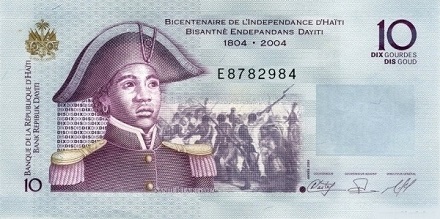
1802: Sanite Belair, tigress

On October 5, 1802, Haitian soldier Suzanne Bélair, called Sanité Bélair, was shot with her husband by the French.

This “tigress” is the most famous of the Haitian Revolution’s numerous female protagonists. A free black woman, she married Charles Belair, the nephew and aide of the man who in the 1790s established pre-eminence on Saint-DomingueToussaint L’Ouverture.

L’Ouverture tragically vacillated when the French made their move in 1802 to reverse the revolution’s gains and re-establish slavery, but the tigress rallied General Belair to take the field in resistance — and not only rallied him, but fought alongside him as a regular in his army, attaining the rank of Lieutenant.

It’s said that at her capture, when threatened with beheading, she successfuly asserted the right to an honorable soldier’s death by musketry, and standing before their muzzles cried “Viv libète! Anba esclavaj!” (“Long live freedom! Down with slavery!”)

On this day..

1822: Augustin Joseph Caron, entrapped

On this date in 1822, French Lt. Col. Augustin Joseph Caron was shot at Strasbourg as a rebel.

Little is known of his background, but Caron (English Wikipedia entry | French) enlisted in his army during the revolutionary year of 1791 and advanced into command positions under Napoleon. From his later conduct it’s apparent that these years shaped a political passion that would be starkly at odds with the post-Napoleon Bourbon restoration.

As we have noted elsewhere on this site France’s Liberal (often Bonapartist) opposition during these years was urged by the persecution of the monarchist party into conspiracy as the common coin of its politics.

Out of this mire grew both charbonnerie (France’s analogue to the carbonari terrorists who proliferated in Italy) and an overvigilant secret police whose campaigns of entrapment and threat exaggeration did nothing so well as to further obscure the line between mundane opposition and treason.

The strange interplay between these midnight foes would shape the fate of Col. Caron.

Caron’s path to execution begins with the thwarted rising of the Belfort garrison for New Year’s 1822 — a real plot that the government spies were able to squelch. This resulted in a number of executions, by dint of which it has featured in these very pages.

Caron enters this story in its second chapter: a pensioned former officer of known Bonapartist sympathies, Caron was (with another man named Roger) baited by police spies into mounting an attempted raid on Colmar prison where the arrested Belfort conspirators were being held. Officers chosen to play the part were detailed to meet him as “conspirators” and march with him to Colmar, allowing Caron to make compromising “Vive l’Empereur” exhortations along the way, before finally arresting him.

Though Caron himself had been a willing participant who most certainly did intend to raise a mutiny, the ridiculous spectacle of His Majesty’s warriors congratulating themselves for crushing a plot that they themselves controlled from the get-go came to crystallize the Liberal fulminations against abusive use of agents provocateur. As Alan Barrie Spitzer puts it in Old Hatreds and Young Hopes: The French Carbonari against the Bourbon Restoration,

the means employed to net such a minor, and such a vulnerable, agitator gave the critics of the regime and the defenders of other conspirators the opportunity to assimilate all the operations of the political police to this contemptible one. The government was placed on the defensive from the first. It proved difficult to demonstrate the Caron and Roger had initiated the seditious proposals … Two entire squadrons of chasseurs had conducted their brilliant operation to net only the two original suspects. And then there was the abrasive question of who, under what circumstances, shouted out “Vive l’Empereur!” — that is, tempted innocent passersby-into political crime. The original story … described the squadrons as riding through the countryside crying “Vive l’Empereur,” and innocently wondered whether these purveyors of seditious slogans would be arrested along with Caron, their alleged “leader.”

One Liberal deputy sneeringly pictured future French veterans boasting of their service, “I was in those squadrons that rode through the countryside of the Haut-Rhin shouting ‘Vive l’Empereur!’ in order to test the disposition of the inhabitants.” Indeed, what if the dispositions had been otherwise? It had been only a few years since the emperor really had returned from exile and raised a brief civil war; the idea that the military had risked triggering “the insurrection of a town and the massacre of its inhabitants” for no better reason than to compromise an utter nobody blossomed into a gigantic scandal. Caron became France’s metonym for a patsy;* demands to grant Caron leniency and turn the investigation against his persecutors multiplied discomfitingly.

But this was only one of several high-profile trials against anti-Bourbon plotters unfolding in 1822, and the Liberal denunciations against them practically staked the government’s credibility upon their outcome. So the government saw to the outcome it required — by invoking Caron’s military rank to have him transferred out of the civilian justice system and tried by a military tribunal that would be sure to convict him. Just to complete the shambles, the execution was then hurriedly conducted before Caron’s appeal could be brought before the Court of Cassation.

The Journal of the Lower Rhine gives the following details concerning the execution of Colonel Caron: —

Colonel Caron, who was unanimously condemned to death for the crime of embauchage [“hiring” -ed], by the first permanent council of war of this division, the judgment of which was likewise unanimously confirmed by the council of revision, was executed at two o’clock in the afternoon, in the presence of a small detachment of the garrison, and a numerous concourse of people who were attracted by curiosity. The Abbe Schittig zealously administered to him the consolations of religion, which he received with humility, and he died with the courage of a Christian and an old soldier. Caron was alone in a carriage, amidst the retinue which conducted him to the place of execution. At the entrance of the horn-work, called Finkmatt, where the execution took place, he alighted from the carriage without the assistance of the driver. On arriving in front of the 12 men who were to be his executioners, he refused to have his eyes bandaged. With his hat on, he himself gave the signal. Immediately the muskets were fired, and Caron was no more.

London Times, Oct. 10, 1822

He’s buried in Strasbourg, under a slab that reads MORT POUR LA LIBERTE.

* In The Red and The Black, the main character Julien Sorel at one point muses that, should a provocative letter be attributed to his hand, it could make him “the next Colonel Caron at Colmar.”

On this day..

1554: A false coiner and a masked dummy

From the diary of Felix Platter, a Swiss youth studying in Montpellier, France. It is not completely evident from context (“afterwards …”) whether the masked dummy was “executed” on the same occasion as the coiner, or whether that effigy was punished on a different day.

On the next day [after a September 28 execution] a false coiner was hanged in the same place. The gibbet was not vety high and had only one arm.

Afterwards a masked dummy was brought on a hurdle, and was laid on the cross and its limbs broken, as I have described. This dummy represented a Greek who had studied at Montpellier and had been accounted one of the keenest blades of the town. He had married Gillette d’Andrieu, a girl of doubtful reputation, who had neither beauty nor fortune. She had a very long nose, and her lover could scarcely manage to kiss her on the lips, especially since he too had a nose of respectable size.

The Greek was insulted by a canon, Pierre Saint-Ravy, who taunted him, at the moment when he was about to relieve himself, of having had intercourse with his wife. The husband at once stabbed the canon and fled; he could therefore be executed only in effigy. His wife continued to live in Montpellier, and was often in Rondelet’s house she was a relative of his.*

She often came there to dance, and one day I danced with her, all booted and spurred, on my return from Vendargues. As I turned, my spurs entangled themselves in her dress, and I fell full length on the floor. Some tablets I had in a breast pocket were broken into pieces, and I was so stunned that I had to be helped up.

* Guillaume Rondelet was one of Platter’s instructors, a professor of medicine. He had been friends with Rabelais and has the distinction of appearing in Gargantua and Pantagruel under the name Rondibilis.

Part of the Daily Double: Felix Platter’s Diary.

On this day..