1730: A Natchez woman tortured to death at New Orleans

On this date in 1730, French-allied Tunica Indians put a captured Natchez woman to grisly public death under the walls of New Orleans.

This is the English translation of Marc-Antoine Caillot’s Relation du voyage de la Louisianne ou Nouvelle France fait par le Sr. Caillot en l’année 1730, a key firsthand source for the incident in this post.

Months earlier the Natchez had risen in rebellion against the colonists in Louisiana — a bloody settling of accounts the that answered a French push to colonize more land with an attack meant to drive them out of Louisiana altogether. The initial, surprise attacks slew 237 French subjects, many in stomach-turning fashion. Friend of the site Dr. Beachcombing details a particularly atrocious murder in his post on the affair at Beachcombing’s Bizarre History Blog.

So the French were in a state of rage and fright on April 10 — the day after Easter — when an allied tribe, the Tunica, showed up at the Big Easy with six Natchez captives in tow, three women and three children. Chief among them was a woman readily recognized by the French as the wife of a once-friendly Natchez chief now “known for being an enemy of the French.” Indeed, escapees from Natchez captivity slated her with having given the go-ahead for the torture-murder of three of their countrymen.

And this hated foe the Tunica proceeded to offer to the French, as a gesture of goodwill.

As Sophie White explains in her “Massacre, Mardi Gras, and Torture in Early New Orleans” (The William and Mary Quarterly, July 2013),* Louisiana territory governor Etienne Perier in slyly declining the prisoner intentionally condemned her to a speedy and spectacular death. Rather than taking her into official custody for disposal by the French judiciary or diplomatic organs, Perier put her up for a night in the French jail while her captors prepared a performance for the morrow calculated to slake the bloodlust of French and native alike.

White’s narrative is worth excerpting at length here; all the parentheticals come from White’s original text.

Officially, Governor Perier could claim that he had maintained French notions of justice by rejecting the Tunica offer of the prisoner of war (even though at a later date he would openly write of another four male and two female Natchez having “been burnt here”). Yet he allotted a space for the Tunica to torture her and arranged for her to be kept in jail overnight while the Tunica danced the black “calumet of death” in preparation for her execution. In the morning, after gathering firewood, erecting a frame, and painting their faces and bodies, the Tunica “began to run as if possessed by the devil and, while yelling (it is their custom), they ran to the jail where she was in chains”; she was engaged in a final assertion of sartorial self-preservation, “fixing a ribbon to her braided hair,” hair that she knew would soon be scalped.

Like Perier, the colonial populace also became involved in exacting revenge on this member of the Natchez nation. Not only were “all the Sauvages who were in New Orleans” present at the torture ritual but colonists also attended the performance as spectators, as they might in France attend a public execution. They watched as the Tunica tied her to a frame and as a Natchez man who had abandoned his kin and been adopted by the Tunica stepped forward to burn her, starting with “the hair [poil, or body hair] of her … then one breast, then the buttocks, then the left breast” (the ellipses represent a deliberate authorial omission on the part of Caillot). Commentators described the methodical burning of torture victims as a form of slow-cooking (“a petit feu”). For Caillot, the ritual burning of the victim’s genitals, breasts, and buttocks was marked by the carefully observed but gruesome sight of “the abundance of grease mixed with blood that ran onto the ground.” His description evoked the cooking of meat basted in fat, with the frame simulating a spit on which the victim was roasted; if this frame/spit did not physically turn its meat, the torturers made sure that she was evenly roasted on all sides by their methodical movement across her body. This food preparation imagery was followed by other cooking analogies. As they were about to kill her (in contrast to the procedure in France, where spectators waited for the execution to be complete before grabbing souvenir pieces of the criminal’s body), “the French women who had suffered at her hands at the Natchez [settlement] each took a sharpened cane and larded her,” just as French culinary techniques called for piercing meat with a sharp stick prior to the insertion of thin strips of lard.

The Natchez woman was not impressed, but “during that long and cruel torture never shed a tear. On the contrary, she seemed to deride the unskilfulness of her tormenters, insulting them, and threatening that her death would soon be avenged by her tribe.”


Detail view (click for the full image) of a generic depiction of the torture frame, from Jean-Francois-Benjamin Dumont de Montigny’s memoir. Sophie White notes that this figure is identifiably female based on her genitalia and the long scalped hair mounted on the adjacent pole.

Over the next several years, the French not only turned back the attack but largely shattered and Natchez peoples, dispersing their remnants to fragmented communities throughout the U.S. South. Today only a few thousand Natchez souls remain, and their interesting language has died out entirely.

* Though it’s a bit tangential to the subject of this post, readers interested in this milieu might cotton to White’s Wild Frenchmen and Frenchified Indians: Material Culture and Race in Colonial Louisiana.

On this day..

1864: Jose Maria Chavez Alonso, governor of Aguascalientes

On this date in 1864, the French executed the governor of Aguascalientes.

Elected to the post during early months of the unfolding French intervention in Mexico, Jose Maria Chavez Alonso (English Wikipedia entry | Spanish) was deposed by the invaders in December 1863 — to be succeeded by a different Chavez who met an equally violent fate.

Alonso formed a popular militia and continued a short-lived resistance against the French but was captured early in 1864, and although this was still some months before the dirty war’s notorious “Black Decree” the French determined to make an example of him.

Alonso aside, the Mexican adventure proved a right catastrophe for France and its adherents.

On this day..

1975: Pierre Galopin, hostage of Hissene Habre

On this date in 1975, French Major Pierre Galopin was executed by Chad rebel Hissène Habré.

Galopin (English Wikipedia entry | French) had been dispatched to the former French colony to negotiate the release of two French nationals* seized as hostages by Habre’s Command Council of the Armed Forces of the North (CCFAN).

You’ll never guess it: CCFAN also took Galopin hostage.**

CCFAN tried to leverage its new captive into an arms trade. When France dragged its feet, the Chadians terminated the negotiation by having Galopin condemned by a “revolutionary tribunal” and hanged to a roadside tree.

Habre would eventually take power as President of Chad in 1982, and was subsequently welcomed on state visits to the former mother country — much to the disgust of those who remembered the Frenchman sacrificed to his ambitions. Galopin was hardly the last man to be so distinguished: as of this writing, Habre is serving an eternal prison sentence in neighboring Senegal for crimes against humanity committed during his eight years ruling Chad.

* Archaeologist Françoise Claustre and development worker Marc Combe. (A third hostage, West German doctor Christoph Staewen, had also been taken, but had quickly been ransomed by his government.) Combe escaped in 1975. Claustre was not released until 1977.

** CCFAN was also riven by a major internal division that by 1976 would split the movement into two rival organs. It has long been murky (French-language pdf here) just whose interest within CCFAN was best served by the hostile course of events.

On this day..

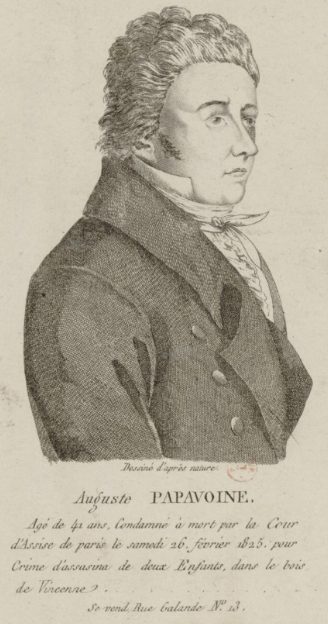
1825: Louis August Papavoine, An Execution in Paris

(Thanks to Dr. Robert Macnish, a young Scottish surgeon, writer, and polymath whose wide-roaming intellect earned him the nickname of “the Modern Pythagorean.” While resident in Paris, Macnish witnessed the public beheading of a French murderer on March 24, 1825 … an experience he rendered into the essay below. The crime which occasioned this spectacle was notorious in his brief day; Victor Hugo refers to Papavoine by name as “the horrible madman who killed the children with a knife to the head!” in The Last Day of a Condemned Man. -ed.)

AN EXECUTION IN PARIS.

In the month of March 1825, Louis Auguste Papavoine lost his head. He was guillotined at the Place de Greve for the murder of two children in the Bois de Vincennes. The man was mad, beyond all doubt, and in Great Britain would have been sentenced to perpetual confinement as a lunatic; but the French criminal court refused to admit the plea of insanity, and he was given over to the executioner: the Cour de Cassation having rejected his appeal from the decision of that which tried him.

To my shame be it spoken, I wished to see an execution by the guillotine. There was a sort of sanguinary spell attached to this instrument, which irresistibly impelled me to witness one of its horrid triumphs. When I thought of it, the overwhelming tragedy of the Revolution was brought before my eyes — that Revolution which plunged Europe in seas of blood, and stamped an indelible impression upon the whole fabric of modern society. There was something appalling in the very name of this terrific engine. M. Guillotine, its inventor, was also one of its victims — he perished by his own contrivance. [this popular legend is untrue -ed.] Let no man hereafter invent an instrument of punishment. Perillus contrived the brazen bull, and was among the first to perish by it. Earl Morton, who brought the “Maiden” to Scotland, underwent a like fate; and Deacon Brodie was hanged upon his own drop.

The day on which Papavoine suffered was beautifully fair; and, profiting by this circumstance, the idle population of the French capital flocked in myriads to witness his exit. It was calculated that there were not fewer than eighty thousand spectators. The Place de Greve was literally paved with human beings. A person might have walked upon their heads without difficulty; and so closely were they wedged together, that had any object larger than an apple been thrown among them, it could not have found its way to the ground. Men, women, and children, were clumped into one dense aggregate of living matter; and as the huge multitude moved itself to and fro, it was as the incipient stirring of an earthquake, or as the lazy floundering of the sea, when its waves, exhausted by a recent storm, tumble their huge sides about, like the indolent leviathan which floats upon their surface. There was no spot of the Place unoccupied save immediately around the scaffold, where a portion was squared off, and kept clear by a strong body of mounted gendarmerie, who kept back with their horses the living wall, which was every moment threatening to break asunder by the pressure behind, and intrude its animated materials into the proscribed area. Nor was the Place de Greve the only spot so crowded. The quays along the Seine were equally peopled, and even the opposite banks of that broad stream were filled with multitudes. Notre Dame shone with spectators, who had mounted its beetling towers to catch a dim prospect of the sacrifice; and every window and height, which afforded the most distant view, were similarly occupied.

In Paris, as in London, it is customary to let out those windows where a good view can be obtained; and on any occasion of particular interest — as the present happened to be — considerable sums are asked, and given. Sometimes half a Napoleon is demanded for a single place; and the sum varies from that to half a franc, according to the eligibility of the situation. Many of the windows are so near to the guillotine, that a very favourable prospect of the painful spectacle can be obtained; and these, of course, are crowded with persons who can afford to pay well for the gratification of their curiosity — if there be, indeed, any gratification in witnessing the instantaneous and sanguinary death of a fellow creature. Yet the view, even from the best windows, is not equal to that from within the open area. But into this space, it is no easy matter to get a footing; the few who are admitted being military men, and such of their friends as they choose to bring along with them. Indeed, at this time, there were few or no officers of any rank within the opening. It was mostly occupied by the gendarmes, who were there upon duty; and by a few dozens of common soldiers, whom curiosity or idleness had brought together. This, however, was the spot to which my wishes led me; and under the guidance of a young French officer of hussars, I was led into the area, and placed in front of the guillotine, not ten feet from its dreadful presence. But dreadful as it is from association, and from its destructive rapidity, this machine is by no means so appalling to look at as the gallows. The same feeling of horror does not attach to it; nor is the mind filled with the same blank dismay, or the same overpowering disgust, which are universally felt on beholding the gibbet, with its looped rope, its horrid beam, and its deceitful platform, which, slipping from beneath the feet of its victim, leaves him dangling and gasping in the winds of heaven. Somehow the same strong idea of disgrace is not connected with the axe as with the gibbet; but this may be from the thought that the noble and the good have shed their blood in torrents beneath its edge, thus giving it a sort of factitious interest, and deadening even with the most criminal the ignominy of its punishment. Nor is it coupled with such inveterate disgust, and such decided outrage to the feelings of humanity. Prolonged physical suffering is at all times revolting; and to see a human being struggling with a violent death — writhing in agony, and perishing like a dog — is the most detestable sight in existence. The guillotine distracts the fancy with no such sickening imagery. Whatever agony is sustained, is the more noble and enduring agony of the spirit, previous to the fatal hour. There is no struggle here with the grim tyrant — no painful encounter between life and death — no tortures like those which wrung Laocoön and his miserable offspring. From perfect life, the individual is transported to as perfect annihilation. He does not enter eternity by slow, unwilling steps: the spirit does not quit its fleshly mansion painfully and tardily, but leaves it with a sudden bound, and plunges at once into a new existence, there to be saved or lost, as its fate chances to be decreed in the Book of Life.

At the period of my admission, it was two o’clock — one hour exactly from the time of execution; and I had, therefore, abundant leisure to contemplate the engine of death, and to witness the behaviour of the vast multitude around it. Things were as quiet as could well be expected in so great an assemblage. There was plenty of talking, but much less disturbance than would have occurred in England upon any similar occasion. In truth, the only quarter which manifested tumult, was in the immediate neighbourhood of the area, which threatened every moment to be broken in, not so much by the fault of those directly in front of it, as by the immense pressure of those in the back-ground. Every now and then its square proportions were destroyed by a portion of the crowd which bulged inwards in a solid mass; and almost at the same moment, this violation of the straight line was repaired by the gendarmes, who kept riding along the square, and pressing back the intruding body into its proper place. The recklessness and fierce temper of the French soldiery were manifest, and formed a strong contrast to the good-humoured forbearance of our own troops. No ceremony was used towards intruders. Whoever came, or was forced into the square by his rearward companions, was thrust back with wanton violence. Where the pressure of the horses was resisted, the gendarmes made use of the flat sides of their sabres, and belaboured the crowd without mercy. The whole scene presented a strange picture of the fearful and the ludicrous. While it was distressing to witness the terrified crowd recoiling before the soldiers, it was amusing to witness the dexterity with which the latter treated the refractory — sometimes pushing them back with their steeds, sometimes beating them with their swords, and sometimes dexterously pitching off their hats into the assemblage. When any unfortunate fellow lost his chapeau in this manner, or received a salutary blow from the weapon of a gendarme, a loud shout of laughter was set up among the spectators. In fact, the whole, except thosewithin reach of punishment, were in excellent humour, and seemed to have come together more to enjoy a farce than witness the horrors of a public execution. Things continued in this state till the hour of three, which, pealing from the clock of the Hotel de Ville, announced the approach of the criminal. Scarcely had the fatal sounds swung upon the air, than the whole host was hushed into silence. They knew that the destined time was at hand, and that Papavoine was on his way to the scaffold; — and every man held his breath with deep interest, and felt, in spite of himself, a solemn awe fall over his spirit. But this dreadful silence did not continue long — for far off, in the direction of the bridge over which the criminal must pass, there was seen a heaving among the assemblage, which moved as if borne on the bosom of a vast wave; and murmurs like the half-suppressed voice of a remote volcano, were heard to proceed from this moving multitude. It was now evident that the procession approached; and every eye was turned towards that direction, and every ear wrought to its keenest pitch to catch the strange sounds which denoted its coming. Each moment the noise became louder, and the motion of the crowd more general. At last the trampling of horses was heard, and a troop of gendarmes, forcing a path through the recoiling people, were seen to approach. Behind them came a cart drawn by two horses; and in this cart sat Papavoine and an old Catholic priest. To the rear of this a second body of gendarmes brought up the procession. The criminal was a small, thin man, of about five feet six. He was dressed in a shabby blue surtout, and brown trowsers, and wore a fur cap upon his head. His arms were pinioned behind him, not by the elbows as with us, but by the wrists. He had no neckcloth on, nor shirt; and the collar of his surtout was drawn some way over his shoulders, so as to leave the neck quite bare and ready for the axe. Though pale and death-like, and seemingly impressed with the marks of sorrow and bad health, he exhibited no signs of terror or dismay. His demeanour was quiet and composed; and to the exhortations of his spiritual adviser he appeared to pay deep attention.

Now, here a scene took place which baffles description. No sooner had the wretch entered the area appropriated for his fate, than a shout of deafening execration arose from the hitherto silent multitude. No preparatory murmurs of hatred and revenge preceded this ebullition of feeling. It sprung up simultaneously, and as if those from whom it proceeded were animated with one soul, and felt one pervading vengeance thrilling through their hearts. “Wretch!” “Villain!” “Miscreant!” “Assassin!” arose in a wild swell from the crowd; and above the deeper voices of the men were heard the shrill imprecations of females, denouncing, with even more bitter wrath, the murderer. Had it been for almost any other crime, the women would have felt towards him more kindly than his own sex; but that for which he was to suffer was one of all others the most heinous to a maternal heart — and the natural fountains of woman’s tears were no longer free to flow in their wonted channel.

But Papavoine did not seem to hear the imprecations which were poured like vials of wrath upon his head — nor did he even appear sensible of the presence of those who so bitterly reviled him in his last moments. The cart stopped at the foot of the scaffold, and descending firmly, he conversed for one moment with the old priest, previous to mounting the fatal steps. I was at this time only a few yards from him, and marked him most distinctly. His look was perfectly calm and composed, and, had he died in a better cause, it would have been impossible not to admire his steady heroism. He said a single word in the ear of the priest who kissed him on the cheek, and left him, apparently much affected. Papavoine now ascended the guillotine rapidly and firmly, and committed himself to the hands of the executioner and his assistant satellite. At this part of the scene the loud execrations of the people had melted into breathless awe. Not a whisper was heard, nor even a movement among the vast and silent assemblage. The whole spectacle was dreadful — the very stillness of the crowd had something appalling in it; and the systematic dispatch with which the executioners proceeded among such universal silence, was sickening to the last degree. While gazing upon the victim, my respiration was almost totally suspended — my heart beat violently, and a feeling of intense anxiety and suffocation pervaded my frame.

The process was incredibly short. In a few seconds Papavoine was bound to a board which stood upright, and reached to the middle of his breast. The board moved on a pivot, and as soon as the malefactor was buckled to it, it was depressed, and shoved with its burden towards the groove of the guillotine, at the top of which hung the axe, ready to descend, on the pulling out of a small peg which kept it in its situation. A moveable piece of wood being now drawn down upon the root of the neck, to prevent all attempt at motion, and everything being ready, the executioner pulled a cord, and with the impetuosity of lightning, down came the axe upon its victim. Papavoine was annihilated in a moment. I saw his head slip from the body and tumble into a basket ready to receive it, while the blood spouted forth in little cataracts from the severed trunk, and dyed the scaffold with a purple tide. From the time when he appeared upon the guillotine till the head was severed, only twenty-five seconds elapsed — such is the appalling, yet humane rapidity of a French execution.

I looked attentively to observe if there was any motion in the trunk — any convulsive start at the instant of decapitation, but there was none. It lay from the first perfectly motionless, nor exhibited the slightest shudder — the least quivering — or the faintest indication that, the moment before, it was part of a sentient being, instinct with all the energies of life. This I did not expect. I conceived that a strong muscular spasm would have convulsed it at the fatal instant: and such, I am told, was the case with Brochetti, an Italian, executed some time before, and whose trunk sprung violently from its situation, and shook with universal tremor.

The momentary silence which pervaded the crowd previous to the axe’s descent was now broken, and an instantaneous movement ensued among its before tranquil numbers. The windows were deserted by their occupants; the doors poured their population into the streets; and the house-tops and black Gothic towers of Notre Dame were rid of the crowds which sat perched like eagles upon their lofty summits. But long ere this assembly had melted away, the guillotine had disappeared from the Place de Greve. Two minutes were allowed to elapse, that the head and body of the criminal might part with their blood.

They were then thrown into a long basket, and sent in the cart — which brought them alive — to the Ecole de Medecine for dissection. And the scaffold, after being cleansed of the gore, by having several buckets of water dashed over it, was taken to pieces, and deposited in the Hotel de Ville, till its sanguinary services were again required. The execution, together with the process of cleansing and dismantling the guillotine, did not occupy above seven minutes.

Next morning, the same curiosity which led me to witness this revolting sight took me to the Ecole de Medecine, to witness the remains of Papavoine. There were a number of scientific men present — among others, the celebrated Doctor Gall, who was employed in investigating the developements of the head, and pointing them out to several of his pupils. [A topic of great interest to Macnish, who also wrote a book about phrenology. -ed.] There was no portion whatever of the neck remaining attached to the trunk. It, as well as the head, had been severed from the body. The axe had struck at its very root, and even grazed the collar bone where it is fixed to the sternum. This is not in general the case, the neck being in most instances pretty accurately cut through the middle — one half of it adhering to the head, the other to the trunk.

I am not sure that I had done right in making such a scene as the above the subject of an article. There is something in the minute details of an execution, at which the mind shudders; and it is probable the reader may think that my impressions of the spectacle just related, should have been confined to my own bosom instead of being made public.

(For writerly firsthand accounts of the guillotine in action in the 19th century, compare to Tolstoy or Turgenev. -ed.)

On this day..

1563: Jean de Poltrot, assassin of the Duke of Guise

On this date in 1563, Jean de Poltrot de Méré was ripped apart in the streets of Paris for assassinating the Duke of Guise.

The opening act of the civil war between Catholics and Huguenots that would devour France in the late 16th century was but a year old at this moment, and Guise was the very man who had set off the powderkeg with a notorious massacre of Huguenots the previous March that had sent agitated confessional armies into the fields.

During the ensuing months, Guise stood at the fore of Catholic forces, opposite the Huguenot commander Conde.

Come early 1563, Guise was besieging the Huguenot-held city of Orleans when Poltrot (English Wikipedia page | French) contrived to ambush him on a nearby road. Poltrot shot Guise with a pistol* and fled; he’d be arrested a day later.

In the Wars of Religion, each previous atrocity justified the revenge that followed it; Guise’s death — and Poltrot’s confession under torture** that it was the Huguenot Admiral Coligny who directed his hand — would help to set the scene for the St. Bartholomew’s Day Massacre visited by Catholics on the Huguenots nine years later. (In fairness we ought also to add that this was not Guise’s first brush with Protestant assassins.) And heavily Catholic Paris was even before the Guise murder violently agitated against Huguenots. During the fighting in 1562,

Reputed Huguenots were struck down in the streets. Sometimes mock trials were held; the attackers grilled the captives on their religious beliefs and, when not satisfied with the answers, killed them on the spot. Officials who tried to intervene were themselves in danger, and edicts against violence were bitterly protested. As one anonymous memoirist described it, “The people wanted nothing less than permission to kill and exterminate the Huguenots without any form of trial; but the consequences were too dangerous.” He implied that permission might have been given, had it been possible to contain the violence.†

All this rage, when focused on the assassin of the Catholic party’s champion, was enough to tear a man limb from limb.

Poltrot’s sentence was to be publicly ripped apart by horses straining his limbs to the four points of the compass. It didn’t quite work: sinew and muscle is too dense and tough to shred by main force, even for a horse; it was only by dint of the the executioner’s helpful hacking that the beasts could dismember their prey.


Here’s a similar take in color.

Quartering by horses is a punishment so preposterously horrific that it could only belong to an age of intentional spectacle.

Indeed, Florike Egmond and Peter Mason argue‡ that until the 16th century such a theatrical execution “was a purely fictional punishment in Europe, which ever since Roman times emerged occasionally in literature, legend and folk-tales as an outrageous form of retribution for (high) treason and related offences” — such as Livy’s mythic rendering of the end given faithless ex-ally Mettius Fufetius, the supposed treatment of St. Hippolytus, and foggy distant Frankish legends

Although the concept might have existed in imaginations for centuries before, equine execution was at best a vanishingly rare event in reality; certainly when Poltrot was butchered, nobody present had ever before beheld such a sight. For Egmond and Mason, this was an innovation of his judges who “jumped the gap between fiction and historical records” in pursuit of ever “more expressive forms of punishment in order to emphasize the outrageousness of the offense.”

It was an outrage whose time had come, however, for quartering by horses was employed several times more for regicidal offenses in the ensuing decades — including for the Catholic militant who assassinated the Huguenot King Henri IV.

* This event would appear to dislodge the 1570 murder of Scotland’s Regent Moray from its popular acclamation as history’s earliest firearm assassination. As Guise lingered for six days and finally succumbed to effects of his doctor’s own bloodletting, perhaps the view is that Poltrot’s pistol only earned half-credit.

** Poltrot would later retract the claim, when not under torture.

† Barbara Diefendorf, “Prologue to a Massacre: Popular Unrest in Paris, 1557-1572,” The American Historical Review, Dec. 1985.

‡ “Domestic and Exotic Cruelties: Extravagance and Punishment,” The Irish Review, Autumn 1999

§ The chronicler Matthew Paris records a thirteenth century would-be regicide condemned “to be torn limb from limb by horses, at Coventry, a terrible example, and lamentable sight to all who dared to plot such crimes. In the first place, he was dragged asunder, then beheaded, and his body divided into three parts; each part was then dragged through one of the principal cities of England, and was afterwards hung on a gibbet used for robbers.”

On this day..

1944: Missak Manouchian and 21 French Resistance members, l’Affiche Rouge

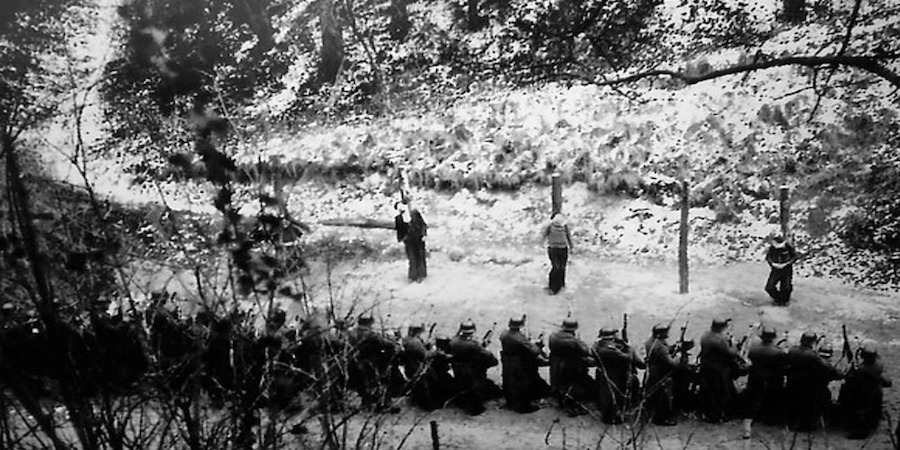
On this date in 1944, 22 members of the anti-Nazi French Resistance’s “immigrant movement” Francs-tireurs et partisans – main-d’œuvre immigrée (FTP-MOI) were executed by firing squad on the outskirts of Paris.

Comprised of foreign communists whose backgrounds amply motivated them to desperate resistance, FTP-MOI was a notably aggressive partisan unit; a few months before this date’s executions, it had stunningly assassinated SS Col. Julius Ritter on the streets of Paris. Risky tactics, including larger-scale operations like the one that claimed Ritter (these required more partisans to know each other) entailed greater risk of penetration, and the November 1943 arrest of the Armenian commander Missak Manouchian and his group devastated FTP-MOI. After the customary interlude of torture, these were subjected to a show trial with 23 condemned to execution.*

As a gaggle of foreign terrorists, heavily Semitic, this clique looked to the occupation like a marvelous tar with which to blacken the Resistance. To that end the Germans produced a scarlet poster denouncing the Resistance as an “Army of Crime,” its soldiery labeled with strange names and alien nationalities converging on the swarthy Manouchian.**

Soon known as l’Affiche Rouge, the poster instead apotheosized its subjects. In the postwar period it became an emblem of the best of the Resistance — its multinational unity, France as an idea powerful enough that men and women of distant birth would give their lives for her. (Not to mention the postwar French Communists’ claim on le parti des fusillés.)

To this day in France, the backfiring propaganda sheet is one of the best-recognized artifacts of the Resistance.

The executions were naturally conducted quietly; the Germans strictly forbade public access to or photography of Resistance heroes in their martyrdoms for obvious reasons.

That made it especially surprising when a few pictures of this execution surfaced recently, surreptitiously snapped from an overlooking vantage by German motorbike officer Clemens Rüter, who kept them hidden for decades. They are to date the only known World War II photos of French Resistance members being executed.

* The 23rd, and the only woman in the group, was Romanian Olga Bancic, also known by the nom de guerre Pierrette; she was not shot on this date but deported to Stuttgart and beheaded there on May 10, 1944. There was also a 24th, a man named Migatulski, who was initially part of the same trial; he was instead remanded to French custody. (See coverage in the collaborationist La Matin from Feb. 19, 1944 and Feb. 22, 1944.)

** We’ve noted before that a Polish Jew named Joseph Epstein who was part of the same cell (and a prime candidate for racist demagoguing) avoided a place on l’Affiche Rouge thanks to his preternatural talent for remaining mum under interrogation.

On this day..

1943: The five martyrs of the lycee Buffon

On this date in 1943, Nazi guns immortalized five student martyrs of the French Resistance.

The Five Martyrs of the lycee Buffon were Parisian high school students who greeted the fascist occupation of their republic with every form of opposition they could command.

Jean-Marie Arthus (“Marchand” by his nom de guerre), Jacques Baudry (“Andre”), Pierre Benoit (“Francis”), Pierre Grelot (“Paul”) and Lucien Legros (“Jeannot”)* started small with subversive pamphleting and placarding but soon moved on to sabotage and armed opposition in affiliation with the Francs-Tireurs et Partisans.

The arrest of one of their teachers, Raymond Burgard, in 1942 spurred them to lead a student demonstration whose mass arrest they barely escaped. By that time their identities were known, and the boys had to go underground; for their remaining months at liberty they lived on the run and participated in occasional (albeit not very damaging) armed attacks on occupying forces — until that summer, when French intelligence arrested Arthus, Baudry, Grelot and Legros, and French police later caught Benoit.

All five were handed off by their collaborationist countrymen to the eager claws of the Germans, who condemned them as terrorists at a military trial.

A number of public places in France honor their memory, like the 14th arrondissement’s Place des Cinq-Martyrs-du-Lycée-Buffon. Their touching and determinedly optimistic last letters to their families can be read at the Cinq martyrsFrench Wikipedia page.

* A sixth school chum, Michel Agnellet, could easily have joined them at the execution posts and in the martyrologies, but the five who were captured did not permit their interrogators to extract his name.

On this day..

1939: Maurice Pilorge, Le Condamné à mort

On this date in 1939, the murderer Maurice Pilorge dropped his beautiful head under the blade.

This strange execution by retrospect almost marks the pivot between eras of crime and culture. Public executions were about to disappear entirely; the Third Republic that ordered them would not long outlive them.

And Pilorge’s death specifically would prove to be the last performance of the guillotine in Rennes. It was also to have been the 396th in the legendary career of 75-year-old headsman Anatole Deibler … except that Deibler dropped dead on a Paris metro platform two days before, as he set out for the lethal rendezvous.

So too did Pilorge’s crime belong to that interwar moment of cosmopolitan decadence. He fatally slashed the throat of a Mexican visitor named Escudero after what Pilorge claimed, in an unsuccessful attempt to leverage the “gay panic” defense, was an indecent proposition. The facts of the case appear better to fit the hypothesis that indecent propositions were Pilorge’s stock in trade: a black book full of dates and initials whose owners he would not identify, a short late-night visit to Escudero’s hotel room, and a total refusal to explain his activities.

Pilorge, who maintained a wry and mirthful attitude throughout his trial, could not but laugh at the judge’s speculation — inspired by the swarthiness of his victim in the case at hand? — that his prisoner was involved in traite des blanches, the white slave trade: “I was never cut out for that. I assure you that I have never fallen so low.”

If Pilorge’s character entered the public gaze awash in same-sex eros, he was fixed in the firmament as such by the pen of Villonesque criminal/writer Jean Genet after the war years.

Claiming (falsely) to have had a prison intimacy with this doomed “Apollo”, Genet dedicated to Pilorge, “assasin de vingt ans,” one of his breakthrough works. Written in prison in 1942, Le Condamné à mort is a homoerotic hallucination of lovemaking ahead of a gathering doom and it helped to launch the theretofore Genet into literary superstardom. I’ve found the lengthy poem available online only in the original French, but here’s a translated excerpt via The Columbia Anthology of Gay Literature:

O come my beautiful sun, o come my night of Spain,
Arrive in my eyes which will be dead tomorrow.
Arrive, open my door, bring me your hand,
Lead me far from here to scour the battleground.

Heaven may awaken, the stars may blossom,
Nor flowers sigh, and from the meadows the black grass
Gather the dew where morning is about to drink,
The bell may ring: I alone am about to die.

O come my heaven of rose, o my blond basket!
Visit in his night your condemned-to-death.
Tear away your own flesh, kill, climb, bite,
But come! Place your cheek against my round head.

We had not finished speaking to each other of love.
We had not finished smoking our gitanes.
Well we might ask why the Courts condemn
A murderer so beautiful he makes the day to pale.

Love come to my mouth! Love open your doors!
Run through the hallways, come down, step lightly,
Fly down the stairs more supple than a shepherd,
More borne up by the air than a flight of dead leaves.

O cross the walls; so it must be walk on the brink
Of roofs, of oceans; cover yourself with light,
Use menace, use prayer,
But come, o my frigate, an hour before my death.

The poem was one of several that Genet wrote later set to music by herhis friend, Helene Martin. (It’s also been covered and reinterpreted by several others.)

On this day..

1573: Gilles Garnier, loup-garou

On this date in 1573, Gilles Garnier was burned at the stake as a lycanthrope.


Detail view (click for the full image) of The Werewolf, or the Cannibal by Lucas Cranach the Elder (1509)

The “Werewolf of Dole” was a scavenging hermit resident on the outskirts of that Burgundian town when a little girl was strangled and partially eaten in October of 1572. Townsfolk feared a maneating wolf but a subsequent pattern of attacks would point at something even more frightful.

As kitsch as it becomes for us in modernity, it is not difficult to discern in the werewolf legend the shadow of a truly terrifying era when predatory wolves and predatory men alike prowled the dangerous byways in Europe, especially France.

And a sure way to conflate the two was through a figure like Garnier (English Wikipedia entry | French), who, in a starving winter, monstrously ate the flesh of his victims. He would later confess — we can only guess through what combination of disordered mind and torturer’s suggestion — that as he foraged one day, wracked by hunger, a phantom appeared to him and offered him an ointment that would confer the lifesaving hunting prowess of the wolf.

Like any opportunistic carnivore, the loup-garou Garnier knew enough to prey upon the weakest.

Shortly after slaying that first victim, Garnier grabbed another little girl and was in the process of a bestial hands-and-teeth attack when some villagers came upon the scene. Garnier fled, but at least some of these accidental witnesses were convinced that they had seen a wolf attack — for what man tears into his still-dying quarry with his bare teeth?

Then again, as observed by Sabine Baring-Gould* — whose The Book of Were-Wolves makes for a goosefleshing Halloween read — there would even post-Garnier in 1573 be an edict promulgated against what Parlement suspected was continuing werewolfery in the vicinity, directing all and sundry “to assemble with pikes, halberts, arquebuses, and sticks, to chase and to pursue the said were-wolf in every place where they may find or seize him; to tie and to kill, without incurring any pains or penalties.” Lycanthropy is stirring deep within this society, authorities, onlookers and offender(s?) all suggestible to one another.

Garnier killed a little boy later that same November, perhaps his most gruesome as he not only cannibalized the fresh corpse but tore off the child’s leg to save for later.

His fourth known victim was his last and resulted in his capture when he was again surprised on the scene. (This time, the witnesses saw only the man — not the wolf.)

His trial, which was for all its fantastic content notably a secular one, was a monument to the fear that must have gripped Dole while children vanished only to turn up as carrion: some fifty witnesses were summoned, many to make connections between Gilles Garnier and canis lupus that one would strain to credit as speculative but were probably quite sincere. Everyone knew there was a werewolf, and then everyone knew Gilles Garnier was that werewolf.

Like the French peasantry, posterity has seen in Garnier what it hopes or expects to see. Do we witness the grim and commonplace effects of torture upon a bystander being scapegoated for the natural incursions of wolves? The predations of a “normal” serial killer refracted through his society’s superstitions? A mentally ill man truly convinced (as with the wendigo psychosis) of his own beastliness? An entirely false confession reflecting Garnier’s own complicity in the same evolving myth that captivated his neighbors?

Or might we allow with Montague Summers the genuine historicity of the monster?

As Nabuchodonosor was so punished by God, so Heaven may also well have permitted Gilles Garnier and the sorcerers of Savoy owing to their vile appetites and their lust for human flesh to have become wolves, losing human form.

From whatever cause this shape-shifting may arise, it is very certain by the common consent of all antiquity and all history, by the testimony of learned men, by experience and first-hand witness, that werewolfism which involves some change of form from man to animal is a very real and very terrible thing. (The Werewolf)

If you prefer your rending human flesh in podcast form, Stuff You Missed In History Class covered this story in a (graphic) Halloween episode.

* An occasional Executed Today guest blogger, through the magic of public domain.

On this day..

1755: Henri Mongeot, Lescombat assassin

On this date in 1755, Henri Mongeot was broken on the wheel for assassinating the husband of his adulterous lover, Marie.

Louis Alexandre Lescombat was a Paris architect; the betrayal of his flighty wife Marie Catherine Taperet was all the talk of Paris after her lover Mongeot slew the husband whilst out on a walk in December of 1754 — then summoned the watch to present a bogus self-defense claim.

This tactic has been known to work when the killer enjoys sufficient impunity; perhaps a respectable bourgeois like Lescombat could have done it to Mongeot — but when the horny 23-year-old busts up the family home with one blade and then the other, it’s La Mort de Lescombat, a tragedy.

For the widow, one good betrayal would deserve another: Mongeot faithfully avoided implicating her in the murder but when he discovered on the very eve of his death that she was already making time with a new fellow, he summoned the judge and revenged himself by exposing her incitement to the crime. His evidence would doom her to follow him many months later, after the sentence was suspended long enough for the widow Lescombat to deliver a son.

Joining Mongeot on the scaffold this date was a 15-year-old heir to the family executioner business apparently conducting just his second such sentence — Charles-Henri Sanson, the famed bourreau destined in time to cut off the head of the king and queen. Mongeot makes a passing appearance in the 19th century Memoirs of the Sansons; in it, Charles-Henri’s grandson remarks from the family notes that “Mdme. Lescombat … was confronted with him [i.e., her doomed lover] at the foot of the scaffold. She was remarkably handsome, and she tried the effect of her charms on her judges, but without avail.”

On this day..