1386: The Sow of Falaise, seeing justice done

There exists a receipt for January 9, 1386, in which the executioner of Falaise, France, acknowledges payment of ten sous and ten deniers

for his efforts and salary for having dragged and then hanged at the [place of] Justice in Falaise a sow of approximately three years of age who had eaten the face of the child of Jonnet le Macon, who was in his crib & who was approximately three months old, in such a way that the said infant died from [the injuries], and [an additional] ten s. tournoise for a new glove when the Hangman performed the said execution: this receipt is given to Regnaud Rigaut, Vicomte de Falaise; the Hangman declares that he is well satisfied with this sum and that he makes no further claims on the King our Sire and the said Vicomte.

From this tiny kernel of primary documentation — the only primary source that exists — an impressive legend has grown up around the “Sow of Falaise”. It’s been alleged by subsequent interlocuters that the condemned sow was dressed up as a person for execution, that other pigs were made to attend in order to take warning by their swinish sister’s fate, and even that the incident became so famous as to merit depiction in a church fresco.
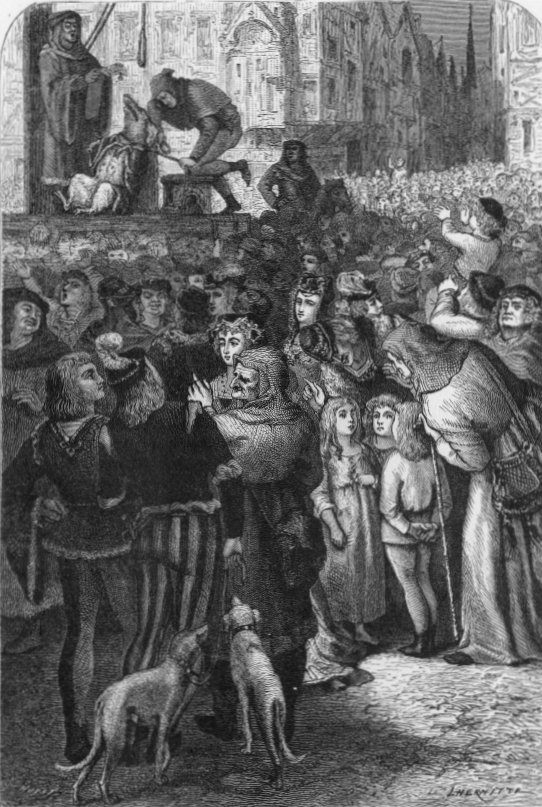

The supposed fresco has been whitewashed, but Arthur Mangin’s L’Homme et la Bete (1872) took a stab at reconstructing it.

This bizarre scenario can’t help but raise the question for we later observers — just what was the objective in trying and “executing” a farm animal? Did the human supporting cast to this scene not feel itself ridiculous?


Scene from The Hour of the Pig.

Book CoverAccording to Paul Friedland‘s research for his fascinating recent survey of public executions, Seeing Justice Done: The Age of Spectacular Capital Punishment in France, the subsequent embroideries around the Sow of Falaise have no basis in fact. They were simply made up … or rather, they were interpolations of authors who were baffled as we to see a sow hoisted on a gibbet.

“Punishment may be about many things, but in the last instance, we citizens of the modern world have an almost visceral need to believe that it is primarily about one thing: deterrence,” Friedland opines.

“The punishment of a pig for murder violates our modern understanding of the essential purpose of punishment because it punishes an animal, which we ordinarily do not believe to be capable of criminal intent, and because it does not lend itself very well to the principle of exemplary deterrence.” The tale’s evolution in later centuries “allowed an incomprehensible anecdote from the past to fit neatly into the modern paradigm of penal deterrence.”

Well, the past is a foreign country. They do things differently there.

Seeing Justice Done situates that murderous pig within an unfolding saga of penal theory and practice stretching from the Roman Empire to the 20th century. And while Friedland’s study focuses on France in particular, the historical threads he teases out will look familiar much further afield.

We had the pleasure of interviewing Dr. Friedland about his book recently, and we’re pleased to present it here not in our customary Q&A form, but as Executed Today‘s debut podcast. The mediocre sound quality is on me, but Dr. Friedland’s insights are more than worth it. (Unlike your host, Friedland is a podcasting natural; catch him in a July 2012 episode of the New Books In Human Rights podcast.)


Trouble seeing the podcast player? Access the interview on podbean.

Other executions referenced in this podcast: Christ | the brutal 1757 execution of Damiens | Louis XVI and Marie Antoinette | the filmed 1939 execution of Eugen Weidmann | the last execution in France ever | Saddam Hussein‘s filmed hanging

(n.b. the intro/outtro music is Blind Lemon Jefferson‘s “‘Lectric Chair Blues”, a 1928 recording now in the public domain.)

On this day..

1942: Fernand Bonnier de La Chapelle, Darlan’s assassin

On this date in 1942, just two days after he had assassinated Admiral Francois Darlan, Fernand Bonnier de La Chapelle was shot by the Vichy army in Algiers.

Despite its shorthand reputation as a Nazi puppet, Vichy France — especially in 1940-42 — was a more nuanced animal that’s enjoyed increased study of late. Vichy controlled southern France under the obvious pressure of the next-door German occupation and effected state collaboration with Berlin including deportations, but it also maintained diplomatic relations with the U.S. Vichy France even shot German spies.

Vichy was one contender among several for political legitimacy in the aftermath of France’s disastrous 1940 defeat at German hands. The most obvious (and here, topical) rival was de Gaulle’s Free French.


Appropriately, the classic film Casablanca premiered in November 1942, featuring Claude Rains as the unprincipled Vichy Captain Renault. The film’s pro-Free French, anti-Vichy slant was not, however, representative of American foreign policy at the time.

This was the background when, in 1942, the US spearheaded Operation Torch to invade Vichy-controlled French North Africa. “This is not the end,” Churchill epigrammed of the Torch landings. “It is not even the beginning of the end. But it is, perhaps, the end of the beginning.”* (Correction: Churchill actually said this in reference to the November 1942 Battle of El Alamein, as a very gracious comment observes.)

At the time of that operation, Admiral Darlan happened to be in Algiers. He was the former number two man in the Vichy government, but also a guy whose cooperation with the Nazis had been half-hearted … which is the reason he was the former number two man.

Darlan nevertheless remained the chief of the Vichy armed forces, which meant that it was worth the Torch commanders’ while to come to an arrangement with him when Darlan proved amenable to cooperation.

They cut that deal. Darlan shut down armed resistance and took Vichy North Africa over to the Allies’ side. (He had, indeed, hinted previously to American diplomats that he was prepared to switch sides; see Arthur Funk, “Negotiating the ‘Deal with Darlan'” in Journal of Contemporary History, April 1973.) In exchange, the Allies installed him as High Commissioner of France for North and West Africa — big man on campus for French North Africa.

Like all good compromises, it satisfied nobody.

De Gaulle was enraged: a Vichy official remained in charge of a Vichy state now under Allied auspices. Would Allied recognition set Darlan up to direct France’s postwar direction?

Equally pissed by the defection, Hitler triggered the German contingency plan to occupy Vichy France.† This is why the “especially in 1940-1942” proviso above: after Operation Torch, Vichy France had no independent military muscle, and was significantly more beholden to Nazi Germany.

Back in North Africa, we finally come to our date’s principal.

A 20-year-old student of monarchist and anti-fascist political proclivities, Fernand Bonnier de La Chapelle (English Wikipedia entry | French) decided with a couple of friends to cut the Gordian political knot that Darlan’s adoption had created.

Bonnier de La Chapelle drew the short straw (literally, they drew straws) for the privilege/responsibility of murdering the Vichy admiral.

Officially, the young man acted alone. Unofficially, there’s been no end of speculation as to the secret intrigues at work. Nobody’s really clear on exactly how murdering Darlan was supposed to advance the gunman’s supposed agenda. And the Vichy French disposed of the killer with suspicious haste.

Just after lunch on December 24, Fernand Bonnier de La Chapelle surprised Darlan upon the latter’s return to his study and shot him through the mouth and torso at point-blank range. He was arrested attempting to flee.

The very next evening, he was condemned by a tribunal at Algiers. There was already a coffin on order before that body gaveled into session.

For some reason, the condemned thought his perceived service to the nation would out. “They will not shoot me. I have liberated France,” he assured his confessor. “The bullets will be blank cartridges.” They weren’t. Churchill recorded that Bonnier de La Chapelle was “surprised to be shot.”

Darlan was laid to rest later that morning at a dry-eyed requiem service. One British intelligence officer remembered that Darlan’s “murder fell like a stone into a small pond and the ripples were only brief. It was as if Darlan had never been.” (Source for the quotes in the last two paragraphs)

Henri Giraud, a French general who escaped German custody and took refuge in Vichy France — Vichy refusing to return him to the Germans, who openly intended to kill him — succeeded Darlan’s command of the now-Allied-aligned French North African forces and maintained the objectionable Vichy institutions. He joined the Allied Casablanca Conference a few weeks later. Giraud had already secretly arranged with the Allies to take exactly this position and had repaired to North Africa in anticipation of the invasion before being aced out by Darlan.

Giraud’s Vichy North African government gradually increased cooperation with de Gaulle’s Free French; the two eventually co-founded the French Committee of National Liberation, which de Gaulle, of course, eventually took control of.

In 1945, a postwar appeals court posthumously reversed Bonnier de La Chapelle’s conviction — on the grounds that he’d pulled the trigger “in the interest of liberation of France.”

* Stalin, whose Red Army was then fighting the Wehrmacht tooth and claw at Stalingrad, begged to differ. He’d been imploring the western allies to open a second front, and was none too impressed with their calculation that they weren’t ready to invade continental Europe in 1942. “A man who was not prepared to take risks could not win a war,” Stalin griped to Churchill.

** One knock-on effect of Operation Torch: the Germans reinforced North Africa against the Allies’ imminent push. It was in this campaign that future Hitler almost-assassin Claus von Stauffenberg lost a hand and an eye, leading to his transfer back to the Berlin desk job that would give him his opportunity to try to kill the Fuhrer.

† This resulted in Vichy France’s gesture of resistance, scuttling the Toulon fleet to keep it out of German hands … although this also irritated de Gaulle, who wanted the fleet to defect to North Africa instead.

On this day..

1721: Jean-Pierre Balagny, Cartouche lieutenant

On this day in 1721, Jean-Pierre Balagny, alias Capuchin, was broken on the wheel in Paris. He was one of the lieutenants and boon companions of legendary French outlaws Cartouche.

We have noted that that renowned bandit crowned his fame at the last by enduring all tortures, only to voluntarily give up the names of his companions as he approached the scaffold and perceived that they had failed to arrange a rescue.

“Capuchin”, who was with Cartouche when he was captured and subject to much the same interrogation, proved as good as his captain. He, too, endured the boot without breaking. And he, with two companions, likewise reached the scaffold and only there coughed it up.

They gave information as to their accomplices, and made, at the foot of the scaffold, confessions which torture had failed to elicit from them.

They implicated so many persons, that another series of trials began, which lasted as long as the declarations of convicted prisoners compromised other persons, and threw new light on the immense ramifications of an association of miscreants which had for many years defied the police. More than sixty persons were under lock and key at the time of the execution of Cartouche and Balagny. This number increased every day in consequence of the confession of those who hoped to save their lives by denouncing their accomplices, and in June of the following year it rose to one hundred and fifty … all this blood, instead of washing the affair away, seemed rather to make it more serious. Every day brought to light some new discovery; and this shows how profoundly mistaken were those who denied that Cartouche, the centre and wire-puller of this horrible association, possessed the organising spirit without which he could not have extended this immense net over the Parisian society.

One is left to infer from this entry in the memoirs of the Parisian hereditary executioner-family Sanson that Balagny likewise did in his friends over some ornate notion of honor … although if the anecdote is true, one could as easily suppose any number of less “creditable” reasons.

At any rate, Balagny’s evidence added to that of Cartouche’s snowballed into a bloody cycle of tortures and executions and fresh denunciations over the year to come.

Of course, getting rid of all the criminals did not get rid of crime.

“In spite of the executions at La Greve, there are more thieves than ever in Paris,” lamented one observer (quoted here). “Cartouche has died on the wheel; but his name and memory engender robbers.”

On this day..

1871: Gaston Cremieux, Marseilles Commune leader

On this date in 1871, Gaston Cremieux was shot at Marseilles for his role in that city’s lately-destroyed Commune.

Cremieux (French Wikipedia page: most external links in this post are also in French) was a gifted young lawyer with a social conscience who was known for taking on indigent-defense cases and working-class causes.

Given his prominence in radical circles, Cremieux was naturally thrust into leadership when word of the Paris Commune brought Marseilles, too, into a popular rising.

Lissagaray called Cremieux “an elegant and effeminate speaker … a mild enthusiast, who beheld the revolution under rather a bucolic aspect.” His admirable principles were not those of bloody revolutionary will, and he was accordingly viewed (or disdained) as a moderate.

The Marseilles Commune lasted only a fortnight: neighboring towns did not rally to it, and elsewhere in the south Toulouse and Narbonne communards were crushed within days.

When troops of the bourgeois Versailles government — the city to which it had fled from Paris — took Marseilles, according to Lissagaray, they “arrested at random, and dragged their victims into the lamp-stores of the station. There an officer scrutinized the prisoners, made a sign to one or the other of them to step out, and blew out his brains. The following days there were rumours of summary executions in the barracks, the forts and the prisons. The number of dead the people lost is unknown, but it exceeded 150.”

Cremieux’s own conscience was pretty clean in all this — he’d even advocated against keeping hostages. (Unsuccessfully, but Marseilles did not kill its hostages, unlike Paris.) “Show me those whom Cremieux has shot,” his lawyer would later protest to the military tribunal called to try him.

Cremieux’s own shooting would have to suffice. He died crying “Vive la République!” as the firing squad emptied its barrels into his torso … as per Cremieux’s request to preserve his face lest his parents be too shaken by his corpse. Just call him a family man.

A posthumously-published French volume of Cremieux’s work contains verse, a play about Robespierre’s fall, and his “Impressions of a Condemned Man”.

On this day..

1868: Giuseppe Monti and Gaetano Tognetti, by the Papal guillotine

On this date in 1868, Italian revolutionaries Giuseppe Monti and Gaetano Tognetti were guillotined in Rome.

Theirs was a passion of the Risorgimento, the 19th century drive to unify as a single nation the peninsula’s quiltwork of minor kingdoms, duchies, and city-states.

Following the Third Italian War of Independence, this had largely been accomplished … with the notable exception of the Papal States surrounding Rome. You can hardly have Italy without the Eternal City.

So national liberator Giuseppe Garibaldi gathered a force under the slogan Roma o morte and prepared to march … while Pope Pius IX began receiving reinforcements from the sympathetic French emperor Napoleon III.

Inside Rome, Monti and Tognetti prepared a little morte of their own. Intending to mount a fifth-column uprising to coincide with the arrival of Garibaldi’s army, the two detonated a couple barrels of gunpowder under the Serristori barracks, killing 23 French zouaves and four Roman civilians. (All links in this paragraph are Italian.)

Unfortunately for the bombers, no general rising ensued, and the Papal and French armies subsequently repulsed Garibaldi at the Battle of Mentana on Nov. 3, 1867 — extending the papal enclave’s lease on life only slightly, but just enough to deal with Monti and Tognetti.

Their fate at the hands of the civil and religious authorities (one and the same, at this time), is dramatized in the 1977 Italian film In Nome Del Pap Re. (This Google books freebie purports to relate their final days.)

The triumph, such as it was, was short-lived for the Papal States: these were the very last executions by guillotine in Rome; the Papal States polity as a whole had time for only two more executions in its history before the Italian nationalist army completed the risorgimento by capturing Rome in 1870.

The two are memorialized in a celebratory ode by Giosue Carducci.

PER GIUSEPPE MONTI E GAETANO TOGNETTI
MARTIRI DEL DIRITTO ITALIANO

I
Torpido fra la nebbia ed increscioso
Esce su Roma il giorno:
Fiochi i suon de la vita, un pauroso
Silenzio è d’ogn’intorno.

Novembre sta del Vatican su gli orti
Come di piombo un velo:
Senza canti gli augei da’ tronchi morti
Fuggon pe ‘l morto cielo.

Fioccano d’un cader lento le fronde
Gialle, cineree, bianche;
E sotto il fioccar tristo che le asconde
Paion di vita stanche

Fin quelle, che d’etadi e genti sparte
Mirar tanta ruina
In calma gioventù, forme de l’arte
Argolica e latina.

Il gran prete quel dì svegliossi allegro,
Guardò pe’ vaticani
Vetri dorati il cielo umido e negro,
E si fregò le mani.

Natura par che di deforme orrore
Tremi innanzi a la morte:
Ei sente de le piume anco il tepore
E dice – Ecco, io son forte.

Antecessor mio santo, anni parecchi
Corser da la tua gesta:
A te, Piero, bastarono gli orecchi;
Io taglierò la testa.

A questa volta son con noi le squadre,
Né Gesù ci scompiglia:
Egli è in collegio al Sacro Cuore, e il padre
Curci lo tiene in briglia.

Un forte vecchio io son; l’ardor de i belli
Anni in cuor mi ritrovo:
La scure che aprì ‘l cielo al Locatelli
Arrotatela a novo.

Sottil, lucida, acuta, in alto splenda
Ella come un’idea:
Bello il patibol sia: l’oro si spenda
Che mandò Il Menabrea.

I francesi, posato il Maometto
Del Voltèr da l’un canto,
Diano una man, per compiere il gibetto,
Al tribunal mio santo.

Si esponga il sacramento a San Niccola
Con le indulgenze usate,
Ed in faccia a l’Italia mia figliuola
Due teste insanguinate. –

II
E pur tu sei canuto: e pur la vita
Ti rifugge dal corpo inerte al cuor,
E dal cuore al cervel, come smarrita
Nube per l’alpi solvesi in vapor.

Deh, perdona a la vita! A l’un vent’anni
Schiudon, superbi araldi, l’avvenir;
E in sen, del carcer tuo pur tra gli affanni.
La speme gli fiorisce et il desir.

Crescean tre fanciulletti a l’altro intorno,
Come novelli del castagno al piè;
Or giaccion tristi, e nel morente giorno
La madre lor pensa tremando a te.

Oh, allor che del Giordano a i freschi rivi
Traea le turbe una gentil virtù
E ascese a le città liete d’ulivi
Giovin messia del popolo Gesù,

Non tremavan le madri; e Naim in festa
Vide la morte a un suo cenno fuggir
E la piangente vedovella onesta
Tra il figlio e Cristo i baci suoi partir.

Sorridean da i cilestri occhi profondi
I pargoletti al bel profeta umìl;
Ei lacrimando entro i lor ricci biondi
La mano ravvolgea pura e sottil.

Ma tu co ‘l pugno di peccati onusto
Calchi a terra quei capi, empio signor,
E sotto al sangue del paterno busto
De le tenere vite affoghi il fior.

Tu su gli occhi de i miseri parenti
(E son tremuli vegli al par di te)
Scavi le fosse a i figli ancor viventi,
Chierico sanguinoso e imbelle re.

Deh, prete, non sia ver che dal tuo nero
Antro niun salvo a l’aure pure uscì;
Polifemo cristian, deh non sia vero
Che tu nudri la morte in trenta dì.

Stringili al petto, grida – Io del ciel messo
Sono a portar la pace, a benedir –
E sentirai dal giovanile amplesso
Nuovo sangue a le tue vene fluir…

In sua mente crudel (volgonsi inani
Le lacrime ed i prieghi) egli si sta:
Come un fallo gittò gli affetti umani
Ei solitario ne l’antica età.

III
Meglio così! Sangue dei morti, affretta
I rivi tuoi vermigli
E i fati; al ciel vapora, e di vendetta
Inebria i nostri figli.

Essi, nati a l’amore, a cui l’aurora
De l’avvenir sorride
Ne le limpide fronti, odiino ancora,
Come chi molto vide.

Mirate, udite, o avversi continenti.
O monti al ciel ribelli,
Isole e voi ne l’oceàn fiorenti
Di boschi e di vascelli;

E tu che inciampi, faticosa ancella,
Europa, in su la via;
E tu che segui pe’ i gran mar la stella
Che al Penn si discovria;

E voi che sotto i furiosi raggi
Serpenti e re nutrite,
Africa ed Asia, immani, e voi selvaggi,
Voi, pelli colorite;

E tu, sole divino: ecco l’onesto
Veglio, rosso le mani
Di sangue e ‘l viso di salute: è questo
L’angel de gli Sciuani.

Ei, prima che il fatale esecutore
Lo spazzo abbia lavato,
Esce raggiante a delibar l’orrore
Del popolo indignato.

Ei, di demenza orribile percosso,
Com’ebbro il capo scuote,
E vorria pur vedere un po’ di rosso
Ne l’òr de le sue ruote.

Veglio! son pompe di ferocie vane
In che il tuo cor si esala,
E in van t’afforza a troncar teste umane
Quei che salvò i La Gala.

Due tu spegnesti; e a la chiamata pronti
Son mille, ancor più mille.
I nostri padiglion splendon su i monti,
Ne’ piani e per le ville,

Dovunque s’apre un’alta vita umana
A la luce a l’amore:
Noi siam la sacra legion tebana,
Veglio, che mai non muore.

Sparsa è la via di tombe, ma com’ara
Ogni tomba si mostra:
La memoria de i morti arde e rischiara
La grande opera nostra.

Savi, guerrier, poeti ed operai,
Tutti ci diam la mano:
Duro lavor ne gli anni, e lieve omai
Minammo il Vaticano.

Splende la face, e il sangue pio l’avviva;
Splende siccome un sole:
Sospiri il vento, e su l’antica riva
Cadrà l’orrenda mole.

E tra i ruderi in fior la tiberina
Vergin di nere chiome
Al peregrin dirà: Son la ruina
D’un’onta senza nome.

On this day..

1328: Na Prous Boneta, Beguine heresiarch

“Her heart began to marvel that so great a light as the great light that they revealed could be changed so quickly to so great a smoke …”

-Female Beguine quoted by ‘So Great a Light, So Great a Smoke’: The Beguin Heretics of Languedoc

On this date in 1328, the Inquisition relaxed the heretic Na Prous Boneta (or Bonnet) to the secular authorities at Carcassonne for execution.

Na Prous Boneta was part of the great religious movements towards poverty and spiritual rebirth then shaking Europe — the same impulse that drove men like Segarelli and Dolcino to the stake.

In southern France, the first name in this movement so suspect to Catholic orthodoxy was Peter Olivi, a charismatic prophet of egalitarian poverty from the Franciscan order. The Franciscans were the institutional expression of that same renewal movement, but their incorporation into the church had co-opted their once-radical energy. They were divided internally between the ascetic “Spiritual Franciscans” (or Fraticelli) and their brethren grown comfortable with worldly emoluments.*

After Olivi’s (natural) death in Narbonne, France, in 1298, he became an object of popular veneration for the Fraticelli’s lay admirers, among whom the communities of lay Beguin(e) women were especially prominent.**

As we have seen, the Church would soon resolve upon a fearful suppression of the Fraticelli and the Beguines, who came to be closely identified with one another. Scores went to the flames; the Inquisitor Bernard Gui complained that fugitive Beguines (and their Beghard brethren) had the gall to keep up their own calendar of martyrology. (Executed Today fully endorses this practice.)

According to the confession her adversaries would later extract, a mystical vision on Good Friday 1321 in her home town of Montpellier would transport Na Prous Boneta into Beguine leadership — fully aware of the dangers to life and limb.

“Put your heart and mind into the work of the Holy Spirit,” she preached. And “keep your body prepared for martyrdom if it should be necessary.”

And boy, did she have to be prepared.

Prous was all-in on her heretical denunciation of a church that had committed itself to bloody suppression of her sect. She denied the efficacy of the sacraments, said that salvation followed from good deeds even for “Jews and Saracens” and as for the guy in charge just down the way at Avignon …

this present pope, John XXII, is like Caiaphas, who crucified Christ. Moreover, the poor beguins who were burned, and also the burned lepers, were like the innocents beheaded by Herod’s command. Again, just as Herod procured the death of innocent children, thus this Herod, the devil, procured the death of those burned beguins and lepers. Again, she claims that Christ told her the sin of this pope is as great as the sin of Cain.

Though all these confessions were given in 1325, Na Prous Boneta appears to have been kept in prison for three years in an effort to persuade her to change her tune. That Caiaphas-like pope himself took an interest in the case, even ordering (perhaps suggestive of the woman’s following) that her eventual execution take place not in her own city but in Carcassonne.

That execution took place on this date when the visionary, having refused every blandishment to save her soul, caused the inquisitors to declare that

knowing from experience that those who are evil simply get worse by the day when they think they will go unpunished, we, compelled by our office which we are obliged by holy obedience to fulfill diligently, since we neither should nor indeed wish to tolerate any longer such abominations and such dangerous opposition to the entire church and the catholic faith, having obtained counsel concerning the above matters from many religious and secular persons learned in both laws, having God before our eyes and the holy gospels of Jesus Christ placed before us so that our judgment should proceed from God and appear right before God and our eyes should see what is just, on this day, in this place and time assigned by us to hear definitive sentence, sitting as a tribunal, invoking the name of Christ, we pronounce, judge and declare you, Na Prous, to be an impenitent heretic and heresiarch and pertinacious in your obduracy. Since the church can do nothing more with such people, we release you to the secular authorities.

* This conflict is the subject of The Name of the Rose; Olivi’s heir as the Spirituals’ leader, Ubertino of Casale, is a character in that novel.

** One need not stretch too far to see a bit of comeuppance in the emergence of a feminine anti-papal voice at this period; the original movement into all-women beguinages is thought to have been facilitated by the surplus population of unmarried or widowed women created by Europe’s recent enthusiasm for sending young men to die on Crusade.

On this day..

1812: Claude-Francois de Malet and his conspirators

Two centuries ago today,* the author of one of the weirdest attempted coups in history was shot with his co-conspirators.

Picture Valkyrie in Napoleonic Europe.

Claude-Francois de Malet (English Wikipedia entry | French) had spent the years of his confinement for republican sensibilities painstakingly readying bogus orders and decrees for the eventual rollout of the most audacious putsch you’d ever want to putsch.

While Bonaparte was off on campaign trashing Russia, Malet broke out of his sanitarium and went to work.

Donning a general’s uniform, Malet on Oct. 23, 1812 presented a forged announcement of the Emperor’s recent demise … and started issuing orders. He bluffed the release of imprisoned allies, and got a legitimate general to order the arrest of Napoleon’s most prominent deputies in Paris. (It’s a good job that general obeyed Malet, because when one officer asked to kindly see the arrest warrant Malet was using on him, Malet responded by shooting him in the face.)

For a few hours that morning the Malet conspirators almost put themselves in control, almost normalized their sudden rearrangement of authority with its reassuringly familiar official paperwork. Later, when interrogated for the identities of his accomplices, Malet would retort, “You, yourself, Sir, and all of France — if I had succeeded!”

But the attempted coup which aimed so high ultimately made for little but tantalizing counterfactual history. Officers with clearer heads soon realized that they had received communiques from the Emperor dated after his purported October 7 death; one of those officers arrested Malet.

A tribunal was constituted later that same date. It had little difficulty condemning 14 (French link) during the small hours of the morning on Oct. 29. They were shot later that same day (at least, most of them were; there are oddly conflicting accounts on this point). This public-domain French text preserves a first-person narration of the scene, in which Malet himself — usurping authority to the very last — commands the firing platoon that’s lined up to shoot his comrades.

120 bullets riddled these unfortunates, who fell all except Malet. He stood on his hands and knees and raised his hands to his chest as he was only wounded, and retreated to the wall on which he leaned:

“And me, my friends!” cried he, “You forgot me!”

(One of the executed fellow-officers was Gen. Victor Lahorie. Lahorie’s lover was Sophie Trebuchet, and his lover’s son, Victor Hugo, was about to catapult himself to literary fame.)

While the Malet plot failed on its own terms, it got quite a lot farther than it had any right to expect — and this fact rightly alarmed the Corsican.

“Bad News From France”, by Vasily Vereshchagin, depicts a retreating Napoleon — bunking in an Orthodox church — finding out about Malet.

Was his position that precarious? And why, if some officers genuinely believed him dead, did nobody hail as emperor his infant son and designated heir?

Napoleon had already begun his catastrophic retreat from Russia when he got word of Malet’s attempted coup d’etat; the struggling Grande Armee was dwindling daily under the battering of cold, desertion, and Russian snipers. Now this?

Upon discovering his late narrow escape from a homefront conspiracy, Napoleon left his miserable troops under the command of Murat* and raced ahead of them back to Paris to secure his own position.

This new confluence of domestic vulnerability and foreign defeat marks the beginning of the end for Napoleon. Europe ganged up on the weakened French, and less than 18 months after Malet faced his executioners, France’s own generals forced Napoleon to abdicate.

* Murat soon ditched the army himself to try to preserve himself as King of Naples. (That didn’t end well.) The once-gigantic army’s remnants finally straggled home under the third-string leadership of Eugene de Beauharnais — the capable son of Josephine’s guillotined first husband.

On this day..

782: 4,500 Saxons by order of Charlemagne

On an unknown date in the latter half of 782, Charlemagne did some seriously nasty business with a captured army of Saxons.

In the late 8th century, the King of the Franks was fighting a decades-long running campaign against Saxon tribes at the edge of his sprawling European empire.

One part Christianizing the pagans and two (or more) parts territorial aggrandizement, Charlemagne’s exertions on the Rhinish frontier were opposed by Widukind, or Witikind, or Widochind, whose “forest-child” name belies its owner’s legendary ferocity.


Widukind was reclaimed in the Renaissance as a patriotic or national figure. (Source)

In the summer of 782, when Charlemagne perhaps thought he had whatever passed for peace among the querulous Saxons, Widukind raised a revolt and dealt the Franks a stinging defeat that put a couple of imperial legates into the ground and made some martyrs out of clerics he found in the wrong place at the time.

Charlemagne’s forces counterattacked and routed the Saxons at the Battle of Suntel (or Sonnethal) Mountain, and thereupon

questioned the primores of the Saxons, all of whom be had summoned to attend him, as to who was responsible for the rebellion which had taken place. And since they all declared that Widukind was the author of this wickedness but were unable to deliver him up in view of the fact that he had taken himself off to the Northmen once the deed had been done, no fewer than 4500 of the others, those who had fallen in with his promptings and committed such a gross outrage, were handed over and at the place on the river Aller called Verden, at the king’s command, all beheaded in a single day. Thus was punishment executed; and the king then retired to winter-quarters at Thionville, where he celebrated both the Lord’s birthday and Easter in the customary fashion.

This merciless slaughter of prisoners is one of the lasting blights on Charlemagne’s impressive reputation. Even so, the reputation had the last word: three years later, Witikind was finally defeated and delivered up, in person, to the Frankish ruler … who accepted the Saxon pagan’s submission and forced him to convert to Christianity.


Charlemagne receives Witikind’s submission at Paderborn in 785.

On this day..

1944: Noor Inayat Khan, SOE operative

(Thanks to Meaghan Good of the Charley Project for the guest post. -ed.)

On either September 12 or (as we’re going with here) the early hours of September 13* in 1944, 30-year-old French spy Noor Inayat Khan (also known as Nora Baker, or by her code name Madeleine) was executed at Dachau for her activities on the behalf of the Resistance in Nazi-occupied France.

Noor, the first woman radio operator to be sent into France, came from a rather unusual background: her father was a Sufi religious leader descended from Indian royalty, and her mother an American from New Mexico.

Born in Russia, raised in England and France, Noor studied psychology and wrote poetry and a book of Buddhist-inspired short stories before the war intervened and her she and her family fled to England.

Although Noor had strong pacifist leanings, she decided to join in against Nazi Germany. Because she was fluent in French and English and was a good radio operator, they decided to send her to France. She went in June 1943.

Many of those who had trained her had grave doubts about her suitability as a spy. As part of her Sufi upbringing she had been taught that lying was the worst of all sins. Leo Marks, who taught her cryptography, later wrote his initial impressions of her in his book Between Silk and Cyanide:

She was cycling towards her ‘safe-house’ to practice transmitting when a policeman stopped her and asked what she was doing.

“I’m training to be an agent,” she said, “here’s my radio — want me to show it to you?” She then removed it from its hiding place and invited him to try it. […]

She’d been so startled by an unexpected pistol-shot that she’d gone into a Sufi-like trance for several hours, and finally emerged from it to consult a Bible.

Once in France, however, she displayed lion-like courage.

Even when the Nazis were making mass arrests of the French agents she associated with and the British forces offered to let her come home, she refused to desert her post.

After three and a half months she was betrayed, and pacifism notwithstanding she fought so furiously on arrest that her Nazi guards were afraid of her. In spite of considerable pressure (and we know what that means) she refused to provide them with any information about herself or her Resistance colleagues. On top of all that, she also made two escape attempts.

They decided to send her to Germany to better keep an eye on her.

Noor spent the rest of 1943 and most of 1944 in prison in KahrsruleKarlsruhe, subject to repeated interrogations by the Gestapo. She never gave anything away. In September 1944 she was sent to Dachau and shot to death with three other female agentsYolande Beekman, Madeleine Damerment, and Eliane Plewman — their bodies cremated.

Her last word? “Liberté.”

After her death she was awarded with the French Croix De Guerre and the British George Cross, and made a Member of the Order of the British Empire. Shrabani Basu published her biography, Spy Princess, in 2007 … and there’s a memorial in the works for her for London’s Gordon Square.

* Not everyone buys these dates or the story of these SOE agents’ execution.

On this day..

1642: Henri Coiffier de Ruze, Marquis of Cinq-Mars

On this date in 1642, with the last words “Mon Dieu! Qu’est-ce que ce monde?”, 22-year-old former royal favorite Cinq-Mars was beheaded at Lyon’s Place des Terreaux.

Henri Coiffier de Ruze (English Wikipedia page | French) had been under Cardinal Richelieu’s protection since the boy’s father died in 1632; in 1639, the Red Eminence introduced the then-19-year-old whippersnapper to Louis XIII as a prospective royal favorite (read: lover).

Though the king did indeed take to the youth, Cinq-Mars, in the age-old custom of sullen teenagers everywhere, soon found the luxurious profligacy of the favorite’s life rather overbalanced by irritation at both of his sickly, aging patrons.

Tart talk to intimates graduated to something more serious after Richelieu rudely put the kibosh on Cinq-Mars’s (unrealistic) designs on a wealthy noblewoman — which was also a bid to parlay his tenuous favorite gig into some lasting power.

Now considering himself personally begrudged of the Cardinal, Cinq-Mars fell into the conspiracies (French link) to depose, assassinate, or otherwise replace him.

Eventually Cinq-Mars would go so far as a real blockbuster (French again): he signed a secret pact with the Spanish king to support a noble revolt in exchange for handing over French possessions, a seditious plan also backed by perennial plotter Gaston d’Orleans, the king’s scheming brother.

Our angry moppet had more than met his match in Richelieu, however: the cardinal’s agents intercepted (more French) the treasonable correspondence and had Cinq-Mars dispatched this date along with his confederate de Thou.


Execution of Cinq-Mars and De Thou in Paris (1642), engraving by Johann Luyken, Paris, Bibliothèque nationale de France (via)

Richelieu himself was already dying as he undid this last conspiracy against him. The cardinal succumbed on December 4, 1642 … with Louis following him into the grave the next May.

While Richelieu’s name is fixed in the firmament of history and literature, Cinq-Mars has to make do as the namesake of a rarely-seen Gounod opera, based on the 1826 historical novel Cinq-Mars by Alfred de Vigny.

On this day..