1704: Roland Laporte, posthumously, and five aides, humously

On this date in 1704, the great Camisard commander Pierre Laporte was publicly burned. He was already two days dead, but the same could not be said by five comrades-in-rebellion who were quite alive as they were broken on the wheel.

Familiarly known by the nom de guerre “Roland”, Laporte (English Wikipedia entry | the far more detailed French) was a whelp of 22 when entrusted with command of about 400 Protestant guerrillas operating around Lassalle, and his native Mialet.

These were rebels in a very dirty regional civil war in France’s heavily Protestant southeast, following the crown’s revocation of tolerance for the heretics. Roland proved himself one of its ablest prosecutors, putting Catholics to fire and sword be they enemy troops or wrongthinking neighbors.

By 1704 the insurgency was circling the drain as Camisard officers were either killed off or bought off. Our self-proclaimed “general of the children of god” was not the type to be had for 30 pieces of silver plus an army commission,* and so only violence would do for him. On August 14, betrayed by an informer who was amenable to purchase, Roland was slain in a Catholic ambush at Castelnau-les-Valence. Five officers escorting him opted not to go down fighting and surrendered instead, which proved a regrettable decision.

But even death could not slake the vengeance of his foes. “On the 16th August, 1704, the body of Roland Laporte, general of the Camisards … was dragged into Nimes at the tail of a cart and burnt, while 5 of his companions were broken on the wheel around his funeral pyre.”

For the unusually interested reader, there’s a 1954 French biography by Henri Bosc — who also authored a multi-volume history of the Camisard war — titled Un Grand Chef Camisard Pierre Laporte dit Roland, 1680-1704. It’s long out of print and appears to be difficult to come by.

* Not long before Roland’s defeat, just such a deal had shockingly induced fellow Camisard commander Jean Cavalier to turn coat.

On this day..

1866: Barthelemy Cellier, true sangfroid

Dying graciously is a — in that blessed space of unfeigned equanimity, in between fright and bluster — is a difficult art. On this date in 1866, the central France town of Riom guillotined an otherwise forgettable criminal who attained that Stoical condition.

By the account of La Petit Journal (French, obviously), double murderer Barthelemy Cellier was awoken at 3 a.m. on the morning of his beheading, with news of the rejection of his appeals. “Ah, ah,” said Cellier calmly, “it’s today!” Well, it’s as good today as it is tomorrow!”

Cellier listened to the curé “avec beaucoup de calme”, called for a glass of Bourdeaux wine and a cigarette, and then,

bare-headed, dressed in the prison outfit: gray trousers, white clogs, a gray jacket thrown over his shoulders, smoking his cigarette, walked with a firm step between the two ecclesiastics … Behind came the executioners and mounted gendarmes.

The course was about two hundred meters. Throughout this journey, Cellier’s face was marked by the most perfect serenity; a gracious smile wandering in his eyes and on his lips gave him rather the countenance of a man walking towards his deliverance than of a criminal going to execution.

The scaffold was surrounded by a large number of people from Riom and the surrounding area; but, thanks to excellent preparation, the dismal machine was separated from the crowd by fifty yards at least. Detachments of soldiers rigorously maintained this perimeter.

Arriving at the foot of the scaffold, Cellier raised his head and looked, without pallor, the fatal cleaver.

He threw out his cigarette and crushed it with his foot.

Then, turning to the honorable priests, he spoke for a few seconds with them, kissed both effusively and climbed alone with a sure stride the steps separating him from the platform.

There, with a sudden movement, he dropped the jacket which hid his shoulders, and having with a glance examined the crowd, without bravado, without affectation, always with the same calm and the same smile, he twice graciously greeted the apparatus. Not a single word was spoken. The hour had just tolled. A sudden noise, immediately accompanied by a few women’s comments and a shriek from the crowd, announced that the supreme act had been accomplished. Cellier’s spirit had not been broken for a moment. He died demonstrating true sangfroid. The crowd slowly went away, deeply moved by the dreadful drama which had just been broken up in a few seconds.

On this day..

1944: Raymond Burgard, lycee Buffon inspiration

Anti-fascist teacher Raymond Burgard was beheaded on the fallbeil on this date in 1944, in Cologne.

A literature instructor at Paris’s lycée Buffon, Burgard (English Wikipedia entry | French) was dangerously forthright about his resistance to the Nazi occupation. He wrote and published resistance newspapers and on one occasion publicly sang La Marseillaise at a march celebrating Joan of Arc.

Evidently he was an inspiring teacher, too.

Burgard was arrested over the Easter 1942 break, and as soon as school re-convened the pupils

organized a demonstration, involving children from other schools. Around a hundred school students took part, chanting Burgard’s name and throwing leaflets in the air. (Source)

Alas, Executed Today has already encountered these brave schoolchildren: the five youths who organized this protest were themselves executed in early 1943.

On this day..

1916: Henri Herduin and Pierre Millant, “cry against military justice”

Cry, after my death, against military justice!

-Henri Herduin, in his last letter to his wife

On this date in 1916, which happened to be Pentecost, two French lieutenants were shot on the Western Front for not surrendering.


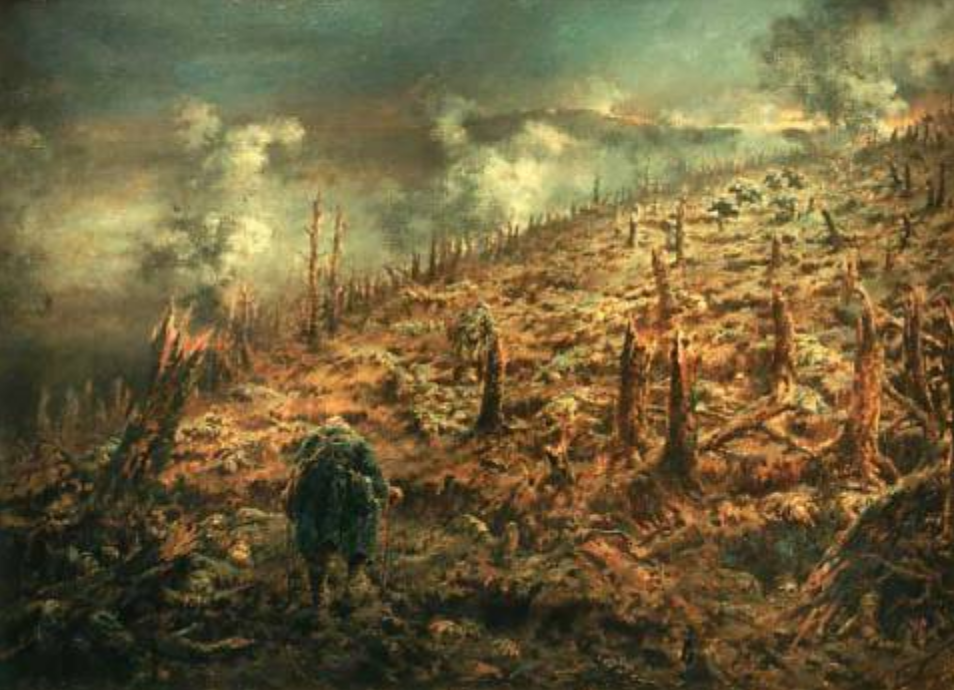
“Le ravin de la mort a Verdun”, by Ferdinand Gueldry.

During the endless Battle of Verdun, which spanned most of 1916, the Germans at one point overran a French bunker called Fort Vaux. German bombardment of the Thiaumont Farm area during this attack smashed the 347th Infantry Regiment to which both Henri Herduin and Pierre Millant belonged. With the regiment commanders killed into the bargain, Herduin and Millant found themselves at the head of a remnant of 40 or so survivors spent of both energy and ammunition, forced to fall back to avoid German encirclement.

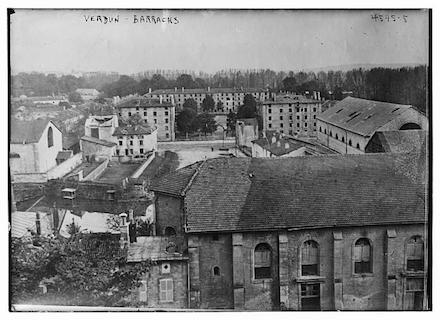
“Our division is broken, the regiment annihilated; I have just lived five terrible days, seeing death at every moment,” Herduin wrote to his wife Fernande on June 9th after he had presented himself at Anthouard barracks. He had not yet any inkling that he too would be a casualty of those terrible days. “Four days without drinking or eating, among the mud and the shells, what a miracle that I’m still here!”


Anthouard barracks during World War I. (U.S. Library of Congress)

Fate and the brass had a perverse sense of humor, for when the two lieutenants presented themselves and their fellow survivors to the reassembled remains of their regiment, about 150 men strong, they discovered that they’d survived all that mud and shelling only to die for France at the stake.

Their unit’s captain held a standing order to execute Herduin and Millant on sight for deserting their post: no need for even the pro forma proceedings of a tribunal. Indeed, the extrajudicial command might have been a fuck-you to civilian authorities who had recently attempted to curtail the army’s enthusiasm for executions. The captain, having no pleasure himself in this order, suffered Herduin to write a hasty explanation/appeal, to which the captain appended his own attestation of good character. Their missive was returned unopened, coldly marked Pas d’observation. Exécution immédiate. Had they not endured those privations to retreat but simply surrendered to the Hun, they would have been better off.

Herduin, a career soldier aged 35, gave his last service as an officer steadying the nerves of his own younger comrades in the firing squad with a demand to “hold to the end for France” — before issuing the firing command from his own lips.

Fernande made good on her husband’s own dying plea to her, and once the Great War’s guns fell silent she waged a public, and embarrassing for the army, fight to clear the men’s names. She eventually achieved a formal posthumous exoneration in 1926, as well as the honor- and pension-clinching appellations “Mort pour la France” applied to their death certificates. She even got a still-extant Rue Lieutenant Herduin christened in that man’s native city of Reims. On Armistice Day 2008, a marker to both men was unveiled on that street; yet another memorial stands to them in Fleury-devant-Douaumont, near the place they were shot.

On this day..

1944: The Massacre of Tulle

On June 9, 1944, the 2nd SS Panzer Division hanged 99 habitants of the French town Tulle as revenge upon the French Resistance.

On June 7, the Communist Francs-Tireurs et Partisans (FTP) guerrillas launched a pre-planned attack on German and milice positions in Tulle. By the 8th, the FTP had liberated the town* … temporarily.

Come the evening of the 8th, the 2nd SS Panzer Division — which had been stationed in southern France but was rumbling north to fortify the German position in the wake of the Allied landing at Normandy — arrived at Tulle and re-occupied the city.

On the morning of the 9th, the Germans went door to door and detained nearly all the men in Tulle over the age of 16, an estimated three to five thousand potential hostages. By the afternoon these had been efficiently culled to 120 semi-random targets for exemplary revenge to cow the populace, people who looked too scruffy to the Germans and didn’t have an alert contact with sufficient pull to exclude them from the pool. The count was determined, as a poster announcing the executions explained, as the multiple of 40 German soldiers estimated lost* during the FTP action.

Throughout the afternoon, that threat was enacted with nooses dangled along lampposts and balconies on the Avenue de la Gare — although not to the full 120 but rather to the odd number of 99. It remains unclear why the hangings stopped early; certainly it was no excess of sentiment on the part of the Panzer division, which had been redeployed to France after giving and getting terrible casualties on the far bloodier eastern front.

“In Russia we got used to hanging. We hanged more than 1,000 at Kharkov and Kiev, this is nothing for us here,” a Sturmbannführer Kowatch remarked to a local official.

And so in batches ten by ten, before an audience of other prisoners and frightened townspeople peeping through shuttered windows and mirthful SS men, the hostages were marched to their makeshift gallows, forced up ladders with rifle-butt blows, and swung off to publicly strangle to death. The avenue’s unwilling gibbets were not suffered to discharge their prey until the evening, when the 99 were hurriedly buried in a mass grave. Afterwards, another 149 were deported en masse to Dachau, most of whom would never return.

The never-repentant commander who ordered the mass execution, Heinz Lammerding, was condemned to death in absentia by a French court; however, West Germany refused extradition demands,** and Lammerding died in 1971 without serving a day in prison.

This event remains a vivid civic memory in Tulle, as well as the namesake of the Rue du 9-Juin-1944; travelers might peruse a guide to the numerous memorials in the vicinity available here (pdf).

The 2nd SS Panzer Division proceeded the next day on its northerly route to Oradour-sur-Glane, and there participated in the mass murder of its inhabitants, an atrocity that is much better remembered today than that of Tulle. The journey and operations of this division are the subject of a World War II microhistory titled after the unit’s nickname, Das Reich: The March of the 2nd SS Panzer Division Through France, June 1944.

* The 40-to-50 German dead in Tulle include some summarily executed. For example, nine officers of the SD were shot in a graveyard after capture.

** Lammerding’s comfortable liberty became headline news in the 1960s, which was not long after Israeli commandos had kidnapped the fugitive Nazi Adolf Eichmann. France allegedly mulled such an operation to bring Lammerding to justice.

On this day..

1639: The Duke of Valette, in effigy

On this date in 1639, the Duke of Valette was beheaded in Paris as a traitor. Having anticipated this cruel stroke, however, he was happily away in England at the time.

Valette (later the Duke of Epernon, like his dad) outlived his execution by 22 years.

Valette‘s father, the Duke of Epernon, was a rival of the realm’s mighty consigliere, Cardinal Richelieu, which was a dangerous thing to be. The rivalry had already impacted the duke’s second son: Valette was married to Richelieu’s niece in 1634, in a vain bid for detente. (Valette preferred his mistress.)

Valette’s military reversal at the French Siege of Fuenterrabia in 1638 set him up for the revenge of his scheming in-law. Blamed for refusing to lead an ill-conceived charge, he got the Iraq War critic treatment when that charge turned into a debacle as he had warned.

But rather than face Richelieu’s summons to answer a charge he obviously had no odds of defeating, Valette crossed the channel and chilled in the exile court of another defeated Richelieu foe, Marie de’ Medici.

The Cardinal de Richelieu not contented with his having left the Kingdom, caus’d a Process to be commenc’d against him,” outrageously fixing the verdict.

Just as Valette lost his head only ceremonially, he lost his homeland only temporarily. When Louis XIII died in 1643, Valette — by this time become the Duke of Epernon — was able to return and re-enter the ranks of respectable nobility, unimperiled by the headsman’s blade for the remainder of his days. He died in 1661.

On this day..

1431: Beaumont and Vivonne

From The Law of Treason and Treason Trials in Later Medieval France:

Little is known about the prosecution of treason during the first fifteen years of Charles VII‘s reign. A few minor cases only came before the Parlement of Poitiers. Struggling to consolidate his position against the Anglo-Burgundians, Charles VII appears to have tacitly approved of, even to have subtly encouraged, court intrigues. But when political machinations went beyond certain limits, as was the case with Louis d’Amboise, vicomte of Thouars, Andre de Beaumont, baron of La Haye, and Antoine de Vivonne, Charles VII did not hesitate to act with the full authority at his disposal. During the winter of 1429-30 Amboise, Beaumont and Vivonne plotted not only to seize Georges de La Tremoille, the most powerful lord at court, and to kill him if necessary, but also to take the king into custody. Amboise was one of Artur de Richemont‘s staunchest allies, and one does not have to look very hard to see the hand of the constable, then fallen from grace, in this conspiracy to take control of the government. Amboise, Beaumont and Vivonne were arrested in mid-November 1430, but it seems that not all the details of their treason were known to the king at that time. When Charles VII decided to take Amboise with him from Loches to Saint-Aignan, Amboise managed to send word to his intimates and advised them to ambush the royal party in order to free him. It was the king’s discovery of this communication that sealed Amboise’s fate. He, Vivonne and Beaumont were subsequently imprisoned at Poitiers. Charles VII then commissioned the presidents and lay councillors of the Parlement there, along with several members of the grand conseil, to conduct their trial. On the advice of his commissioners Charles VII himself then condemned the three traitors to death, with confiscation of their property. This procedure was a compromise between the king’s personal act of justice and condemnation by a court, and was to be a regular feature of the prosecution of treason in the reigns of Charles VII and Louis XI. On 31 May 1431 Beaumont and Vivonne were executed, but Charles VII commuted Amboise’s death sentence to a term of imprisonment ‘at our good pleasure’; and Amboise’s children were spared the penalty of complete disinheritance that would ordinarily have ensued. In not having Amboise executed Charles VII demonstrated for the first time the clemency towards members of the higher nobility that was a distinct characteristic of his rule. In 1434, at the intercession of Yolande d’Aragon and Charles d’Anjou — La Tremoille had since fallen from power and the Angevins were now in the ascendants at court — Charles VII released Amboise from prison and restored to him all of his property except for the castellanies of Chaumont, Chateau-Gontier and Amboise.

On this day..

1942: Georges Politzer and Jacques Solomon, academics in resistance

Left-wing intellectuals Georges Politzer and Jacques Solomon were shot at Fort Mont-Valerien on this date in 1942 for their exertions in the French Resistance.

Both numbered among interwar France’s great radical intellectuals: Politzer, a Hungarian Jew nicknamed the “red-headed philosopher” and and Solomon, a Parisian physicist, both numbered among interwar France’s great radical scholars.

The red-headed philosopher hung with the likes of Sartre, taught Marxism at the Workers University of Paris, and critiqued psychology. (A few of his works can be perused here.) Solomon, son-in-law of physicist Paul Langevin, made early contributions to the emerging field of quantum mechanics.

Politically both were Communists and supporters of the anti-fascist Popular Front; with the onset of German occupation, they carried their activism into the French Resistance.

They were arrested (separately) in March 1942 and executed (together) with other Resistance hostages on the outskirts of Paris.

On this day..

Feast Day of St. Baudilus

January 20 is the feast date of Christian martyr Saint Baudilus, patron of Nîmes, France — also known as Baudilio or Baudelio in Spain, where his cult is also quite widespread.

Baudilus supposedly dropped into a festival of the Roman god Vejovis in the late third century and paid his respects by desecrating the pagan shrine, with predictable consequences for Baudilus.

Baudilus was neither a native of that place nor the first to carry the religion of the Galilean there, but his spectacular and confrontational martyrdom granted Baudilus pride of place locally as Christianity rose.

The location of his tomb, called Valsainte, became a pilgrimage destination and eventually the place of a church and monastery; three springs of water were by legend attributed to the holy bounces of the saint’s decapitated head, and an oratory built for them dedicated to Baudilus.

His cult spread widely in southern France and especially in Spain where you can call him Baudilio, Baudelio, or even Boal. There are over 400 churches named for him, notably San Baudelio de Berlanga in central Spain, a hermitage nearing its thousandth year and renowned for its ancient friezes.

On this day..

1775: A robber under the apartments of Joseph Jekyll

We owe this date’s entry to Joseph Jekyll, a young gentleman (kin to the late judge of the same name whom Alexander Pope had once teased as an “odd old Whig/Who never changed his principle or wig”) who had just taken up residence in Paris in his 22nd year. Just a year later, he would be back in Albion’s soul, bound for his life’s calling as barrister, M.P., and celebrated wit.

Jekyll’s correspondence with his father shows him consumed with a worldly young man’s affairs, alternately French society (in whose salons he left a happy impression) and Europe’s churn of news and rumors. But we catch a glimpse in one of his first letters of a scene to which, perhaps, young Jekyll soon became as inured as most Frenchmen: an exceptionally brutal execution right outside the window of his quarters.

What follows is from Jekyll’s letter dated Ash Wednesday, April 12, 1775.


The police of this country is much commended, and deservedly; yet in Paris I was assured murders were so frequent that it is customary to see five or six bodies to be owned in the morning at a place called the Morgue, and there are nets on the Pont-neuf let down every night to receive persons thrown over by banditti. The morning we saw the Greve there was a gibbet erected. We inquired if there would be much crowd, and were told “No,” for there was generally an execution every day.

The road from Paris hither is full of crosses, with inscriptions to perpetuate the infamy of some robber or murderer. We lodge in a beautiful place or square, and saw from our balcony yesterday evening a criminal broke on the wheel. He arrived at five o’clock in the evening, in a cart guarded by the marechaussee (who constantly patrol the roads). He was attended by a cordelier, and held in his hands two laths nailed together in the form of a cross. He had received the tonsure and unction, and, while he was undressing, the crowd around the scaffold (which was far from being great) sang a voluntary requiem. The executioner, a very spruce fellow in a bag and a bien poudre, extended the criminal’s bare arms and legs on a St. Andrew’s cross, which had two deep notches under the long bones of each limb; then with an iron crow, bent like the blade of a scythe, struck him nine violent blows, the last across the reins. [kidneys] Thus with two fractures in every limb, at each of which he cried out Mon Dieu! the agonising wretch was untied and thrown on the forewheel of a waggon elevated about four feet above the scaffold. The holy father drew a chair near him, and muttered something during his last gasps. At night the body was exposed in the neighbouring forest. Horrible and frequent as these executions are (for there are twelve more now in the chatelet here under the like condemnation), their effects are as insufficient as ours in England. The crime of the unfortunate creature we saw yesterday was burglary, as we learnt from his sentence, which is posted up at every corner in the streets.

On this day..