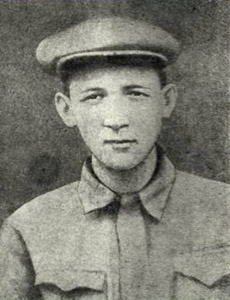
1943: Lepa Radic, Yugoslav Partisan

On this date in 1943, young Yugoslav partisan Lepa Svetozara Radic went to a German gallows.

A Bosnian Serb — her village today lies in Bosnia and Herzegovina’s Republika Srpska, steps inside the river that forms its border with Croatia — Lepa Radic was just 15 when Europe’s Axis powers invaded Yugoslavia in April 1941. Her family’s established left-wing affiliations brought them swift arrest by the fascist Ustashe, but Lepa and her sister escaped in December and joined Tito‘s Communist partisans.

In early 1943, Nazi Germany mounted a huge offensive against the partisans. On a strategic plane, the offensive failed: the partisans were able to preserve their command structure and fall back, also decisively defeating in the field their nationalist/monarchist rivals, the Chetniks, which set them up to dominate postwar Yugoslavia.

But for those upon whom the blow fell, it was a winter of terrible suffering. The Germans claimed 11,915 partisans killed, 2,506 captured … and 616 executed.

So it was with Lepa Radic. This Serbian Zoya Kosmodemyanskaya was captured during the engagement trying to defend a clutch of civilians and wounded. They publicly noosed her at Bosanska Krupa after she scorned the opportunity to preserve her life by informing on fellow guerrillas with the badass retort, “my comrades will give their names when they avenge my death.” (Various translations of this parting dagger are on offer online.)

After the war, Yugoslavia honored her posthumously with the Order of the People’s Hero.

On this day..

1935: Kemal Syed, assassin

A 28-year-old Afghan nationalist was executed in Berlin’s Ploetzensee Prison on this date in 1935.

“During a heated argument” with Sardar Mohammed Aziz Khan* on June 6, 1933, Kemal (or Kamal) Syed on June 6, 1933 “accused the minister of treason and of selling out his country to the British. He then pulled a revolver and shot him fatally.” (UP wire report via the redoubtable pages of the Oshkosh (Wisc.) Northwestern, Jan. 14, 1935)

His punishment was delayed by diplomatic wrangling between Germany and Afghanistan over possible extradition. In the end, Berlin handled matters directly.

* This man also happened to be the brother to the late (and likewise assassinated) King of Afghanistan. In time, the assassinated diplomat’s son would overthrow the assassinated king’s son and rule from 1973 to 1978 as Afghanistan’s first president. (Although if you like, you could also consider him the last of the Musahiban dynasty.) That diplomat’s son in turn was deposed in a palace coup by the ham-handed Communist who would set off the catastrophic Soviet-Afghan War.

On this day..

1940: Carl Heinrich Meier and Jose Waldberg, the first hanged under the Treachery Act

I went into this with both my eyes open, telling myself that a man who has an ideal must be willing to sacrifice everything for it or else the ideal isn’t an ideal at all, or the man isn’t a man at all, but a humble creature who deserves only pity.

-Carl Heinrich Meier, last letter to his fiancee (Source)

On this date in 1940, Great Britain carried out the first two executions under its brand-new-for-wartime Treachery Act of 1940.

Raced into the books in May of 1940 amid Nazi Germany’s onslaught on France, the Treachery Act made it a capital crime if, “with intent to help the enemy, any person does, or attempts or conspires with any other person to do any act which is designed or likely to give assistance to the naval, military or air operations of the enemy, to impede such operations of His Majesty’s forces, or to endanger life.” Naturally the realm had centuries of treason statutes to fall back on; the intent in creating this new capital crime of treachery was to target spies and saboteurs who might not themselves be British citizens — and therefore evade “treason” charges on grounds of not owing loyalty to the British Crown. Instead, the Treachery Act explicitly governed “any person in the United Kingdom, or in any British ship or aircraft.”

Carl/Karl Heinrich Meier and Jose Waldberg were textbook cases. They had rowed ashore at Dungeness on September 3 intending to pose as Dutch refugees while reconnoitering ahead of a potential German cross-channel invasion. With them were two other Abwehr agents with the same intent, Charles Albert van der Kieboom and Sjoerd Pons.

While his comrades were noticed by routine coastal patrols and picked up near the beach, Meier picturesquely showed up that morning at a public house in Lydd where his clumsy command of contextual slang and etiquette led the proprietress to turn him in.

They were tried in camera weeks later, by which time the Luftwaffe was systematically bombing the jurors; despite this radically prejudicial context, Sjoerd Pons was actually acquitted — successfully persuading the court that he’d been forced into the mission on pain of a concentration camp sentence for smuggling. (Pons was detained as an enemy alien despite the acquittal.)

The other three men were not so fortunate. Perhaps most to be pitied was “Waldberg” who was really a Belgian named Henri Lassudry: although he had not presented Pons’s same defense to the court it appeared that he also had been coerced into the operation, in his case by Gestapo threats against his family. But none of the three death sentences was to be abated. A week after Meier and Waldberg/Lassudry hanged at Pentonville Prison, van der Kieboom followed them to the gallows.


“Jose Waldberg” aka Henri Lassudry.

The Treachery Act would be used against German agents repeatedly through the war years and in time had the distinction of noosing the last person hanged in Britain for a crime other than murder.

On this day..

1900: A day in the death penalty around the world

… courtesy of the Foreign News dispatch in the pages of the Boston (U.S.) Daily Advertiser, Dec. 8, 1900:

On this day..

1663: Volkmar Limprecht

Volkmar Limprecht, a pedagogue and city councilor of Erfurt in Thuringia, was beheaded on this date in 1663. Almost all the links in this post are in German.

“A Mephistophelian mixture of reckless egoistic ambition and restless energy, worldly agility, and unfettered frivolity,” our man Limprecht was a pedagogue turned demagogue who won election to the city council and briefly rode his acumen to control of the city and the absurd prospect of asserting leadership of the Electorate of Mainz.

The Elector, Johann Philipp von Schoenborn, dispatched an army to Erfurt to put it in its place, leading the city’s other grandees to overthrow Limprecht for self-preservation and have him condemned a traitor. He was beheaded the day after his sentence, and his head mounted on a spike as a gesture of submission to the Elector.

Google Books has digitized a public domain blackletter summary of the man’s fall here.

On this day..

1925: Fritz Angerstein, crime without criminal

German spree killer Fritz Angerstein was beheaded on this date in 1925.

This tuberculotic managerial type (English Wikipedia entry | German) completes an infernal trinity of notorious mass murderers of Weimar Germany, along with Fritz Haarman and Peter Kürten.

He lived a life of moderate domestic angst, with a sickly wife Käthe whom he loved and who could not carry to term any of her six pregnancies with him; once they had contemplated committing suicide together but called it off; once (seemingly no more than that) Fritz had cheated on her, but he returned to his wife willingly and didn’t actually want to discard her. Things were frostier with the meddling mother-in-law and even known to come to blows, yet still little other than a bog-standard rocky in-law relationship.

By 1924 this family was mired in debt, living in a villa owned by the mining firm who had detected Angerstein’s peculation.

On the night of November 30 to December 1, 1924, as his wife lay coughing up blood, the man snapped and turned that company villa into a charnel house.

After wildly stabbing his wife to death with a hunting knife, Angerstein went downstairs to kill himself only to be interrupted in the act by a scream upstairs as his mother-in-law discovered her daughter’s corpse. He stalked upstairs and visited a like fate on that poor woman; when the family maid burst in, he chased her down the halls as she fled for the door of her attic chamber and hacked her down too.

In a home now with the stillness of the grave, Angerstein caught a few hours’ sleep to ready himself to continue the rampage in the morning.

His 18-year-old sister-in-law arrived overnight on a train: Angerstein butchered her with an axe. A clerk and a bookkeeper of the mining firm came later in the morning, reporting in for work: Anger axed them too. The gardener, the gardener’s assistant, even a german shepherd — all met the same fate.

One might anticipate that this slaughter would culminate in that suicide the man kept attempting but instead he gave himself some non-lethal stab wounds and attempted to set his house on fire, then summoned the police with a story about a deadly home raid by a gang of bandits. Forensics, and Angerstein’s own admissions, soon rubbished this cover story.

The out-of-nowhere senselessness of this bloodbath fascinated and perplexed observers who struggled over interpretations of the — the what? the criminal? the madman? the abyss of the modern soul? He had to be sure points of stress and provocation, ingredients that could plausibly suit the backstory of a monster, but they were also ingredients carried by numberless functionaries of state indistinguishable from Angerstein who were day by day merely quietly dissipating their pains in little hobbies or shabby love affairs, in career obsession, career neglect, alcoholism, cat-fancying, countryside rambles, newspaper perusal, games of darts down the pub, and all the million little ways that we little people pass our little days. That seemed to leave Angerstein’s own instance of these slings and arrows markedly insufficient for the extraordinary consequence, if the money troubles and ailing wife are really supposed to stand for cause. Why this explosion, from this guy, at this time? Surely it wasn’t merely because the hated mother-in-law had ruined the soup that night?

One prominent knight upon these lists was thinker-scribbler Siegfried Kracauer, who might be best-known to later generations as a film critic and a mentor of Adorno. In ruminations published as Tat ohne Täter: Der Mordfall Fritz Angerstein (Crime Without Criminal: The Murder Case of Fritz Angerstein), Kracauer decoded in Angerstein’s outrage the horror of relationships dehumanized, “become objectified, with emancipated things gaining power over people rather than people seizing hold of the things and humanizing them.” Small wonder, then that “the disfigured humanity that has been repressed into the deepest recesses of unconsciousness will reappear in hideous form in the world of things.” (Quoted in Cool Conduct: The Culture of Distance in Weimar Germany.)

A deed without a doer — that is the provocative, the incomprehensible aspect of the Angerstein case. The deed is inconceivable: an orgy of ax blows and arson. Intimidating in its mere magnitude, the crime bursts the bounds of customary statutes as only an elemental event can. It is impossible to do more than stare at it; it is not to be subsumed within existing categories. Nevertheless, there it is, an undeniable fact that, for well or ill, must be registered.

But where is the doer that belongs to the deed? Angerstein? The little, subordinate fellow with modest manners, a feeble voice, and a stunted imagination? … At bottom a mere petit bourgeois, Angerstein can be outfitted with a vicious appearance only in retrospect by overheated journalists. Had one encountered him prior to the crime on the street, one would have asked him for a light and quickly forgotten his features.

Even today, or today once again, he remains stubbornly at home in the narrow confines of inborn mediocrity. His behavior during the trial has been minimal in every respect. There have been no sudden eruption to help us chart a connection between the man and what he did, no outbursts to suggest a subterranean fiendishness, nor the kind of silence that would correspond to what happened. Instead, he has withdrawn into trivialities into a dull state of shock wholly incommensurate with its cause, a confused acceptance of what he himself does not understand.

Angerstein, in Professor Herbertz’s depiction of the events, did not commit the deed; the deed happened to him. Having transpired, it detached itself from him and now exists as a purely isolated fact for which there is no proper cause. It rose up out of nothing for the while of the murders, a dreadful “it” out there in space, unconnected with him. If the soup had not been burned — a triviality become a link in a chain of external causation — Angerstein’s victims would have gone on living and no one but his fellow citizens of Haiger would ever have heard his name. The crime looms gigantically over him; he disappears in its shadow.

In the winter of 1924, the event comes out of nowhere. Minor illegalities preceded it, a confusing swindle, no one knows how or why. Running amok, it seems that a physician’s attentions merely added to the burdens. His previously neatly bounded world was slipping through his fingers. The woman of his obsession draws him with her toward a longing for death, for an end to it all. He may have been thinking of suicide as he stabbed her — but why the frenzy with the hunting knife and the ax, why the senseless bashing of the skulls of uninvolved others? What sucked him, the minor administrator, for a night and a day into the cyclone of devastating violence?

Many details confirm the assumption that the quiet manager was caught unawares by some unknown something inside him. He admits that he himself cannot understand, cannot conceive, that the gigantic fact came out of him. His early attempts to deny it are ridiculously petit bourgeois. Now that he has acknowledged being the perpetrator, he gazes fixedly at what others designate his crime. His evasions from now on have to do with incidentals, his excuses with mere details. The actual misdeeds weigh on him like a block of lead he cannot cast off.

If he is conscious he flees into sleep, sleeping double the usual amount, because his memory wants to disappear. The fact outside there, which is undeniably related to him is completely overwhelming; he does not like to taste or feel it. Suicide is also beyond the bounds of his horizon, now narrowed to a point. His reading is the Bible, which perhaps brings him by way of detours into contact with his wife.

A deed without a doer that has nothing, but nothing, in common with those great crimes committed by people whose names live on in popular memory. Those crimes were manifestations of a will, however misguided; they were eruptions of unbridled natures, twisted minds, the expression of outsized drives and passions. They stemmed from a place in the guilty person, were not just there alongside him, existing inadequately in space.

The deeds that now go by the name of Angerstein lack a personal point of reference, without, however, that meaning that they were born of mental illness. That there is no sufficient reason for them in the consciousness of the doer is what turns them into a tormenting puzzle, what lends them the uncanny remove of mere facts. It may be that depth psychology is correct in claiming that they emerge to the light of day out of the craters of unconscious psychic life; it has not, however, solved the puzzle of how such a thing is possible.

On this day..

1941: Shura Chekalin, Hero of the Soviet Union

Sixteen-year-old partisan Alexander Chekalin earned his martyrs’ crown as a Hero of the Soviet Union when he was executed by the occupying Third Reich on this date in 1941.

“Shura” (English Wikipedia entry | the predictably better-appointed Russian) joined along with his father a unit of guerrillas in the vicinity of Tula just weeks into the terrible German onslaught.

The city of Tula, a transport hub 200 kilometers south of Moscow, was a key target for the German drive on the Soviet capital in those pivotal months; the Wehrmacht’s eventual inability to take it from determined defenders was crucial to thrwarting the attack on Moscow by protecting her from the southern tong of the intended pincer maneuver.*

Chekalin didn’t live long enough to see any of this come to fruition but in his moment he did what any one man could do: ambushes, mining, and other harassment of the occupation army in the Tula oblast (region) with his comrade irregulars. Our principal was found out by the Germans recuperating from illness in a town called Likhvin — see him defending his house of refuge against hopeless odds in the commemorative USSR stamp below — and then suffered the usual tortures and interrogations before he was publicly strung up on November 6. He hung there for 20 days before the Red Army took the town back and buried him with honors

In 1944, the tiny town of Likhvin was renamed in his honor: to this day, it’s still called Chekalin.

* Tula was recognized as a Hero City of the USSR for the importance of its defence.

On this day..

1915: Fernando Buschmann, certified

Brazil-born, German-descended businessman turned World War I spy Fernando Buschmann was shot for espionage at the Tower of London this date in 1915. Don’t believe us, Francis Woodcock Goodbody will vouch for the lethal effect of “gunshot wounds on the chest.”

Court martialled in September and unable to satisfactorily explain his dealings with known German agents, his woeful business record, trips to Southampton and Portsmouth, and the presence of invisible ink in his record books, he was found guilty. In his defence, he argued “I was never a soldier or a sailor, and I am absolutely ignorant of all military matters. I am not a good businessman as I am more wrapped up in my music than business.”

Buschmann was sentenced to death by firing squad and transferred to the Tower on 18th October. He was permitted the solace of his violin which he played throughout the night. The sentence was carried out at 7:00am on the 19th October at the Tower Rifle Range.

On this day..

1636: Johann Albrecht Adelgrief, king-scourged

October 11, 1636 was a grievous date for self-proclaimed prophet Johann Albrecht Adelgrief, who was burned as a sorcerer and heretic.

Adelgrief (English Wikipedia entry | the equally terse German) was the educated son of a Protestant minister and could wield multiple ancient languages including whatever tongue was the address of seven heavenly angels who “had come down from heaven and given him the commission to banish evil from the world, and to scourge the monarchs with rods of iron.” Not going to lie, there are some a few monarchs out there that could use a good scourging.

Alas, the nearest potential scourgee, the Duke of Prussia, made sure the rods were wielded in their customary direction. Adelgrief met his fate aptly in Königsberg (“King’s Mountain”: it’s modern-day Kaliningrad, Russia), where he was condemned for witchcraft. All his writings were suppressed.

On this day..

1946: Walter Grimm and Karl Mumm, judicial murderers

Our friends at Capital Punishment UK favored us with an absolutely fascinating story for the post-World War II execution farm manager Walter Grimm and Gestapo officer Karl Mumm for orchestrating the 1942 hanging of one of Grimm’s Polish slave laborers. The pair falsely charged entire story is a fascinating read.

After the war, Szablewski’s brother was able to bring the matter to the attention of the Allied occupation in Germany, which found that Grimm was exacting revenge for Lütten’s spurning his advances; Grimm and Munn were punished by hanging in Hameln prison on October 8, 1946. There’s a memorial plaque to Szablewski — unveiled in 2003 in the presence of the still-surviving Hildegard Lütten — as well as a Stolperstein (stumbling-stone) unveiled in 2016, both at the Hohenbuchenpark in Hamburg where Szablewski was killed.


copyrighted image authorized for general public use by Bully59.

On this day..