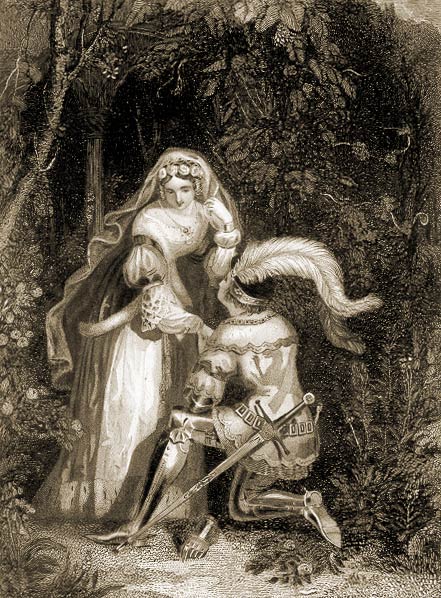
408: Stilicho, whose execution let in the barbarians

Sixteen hundred years ago today, the general whose talents were the last bulwark against barbarian conquest of the Western Roman Empire submitted for the sake of civil peace to execution at the hands of a callow boy-emperor.

The half-Vandal patrician Stilicho comes to the notice of posterity late in the reign of Theodosius the Great, the last Roman to rule both Eastern and Western Empires. At Theodosius’s death in 395, his two sons ascended the separate thrones.

Honorius, a 10-year-old child, took the purple in the west and somehow held it for 28 lackluster years that saw Rome’s long erosion finally set the realm on the slide into collapse.*

An apt commander, Stilicho had held Visigoth king Alaric at bay in two invasions of Italy (the crucial Battle of Pollentia stanched the first).


Stilicho and his wife Serena, with their child: two were executed, one was murdered.

Distrusted because of his part-barbarian parentage — and hated by the still-significant pagan community for burning the Sibylline Books — Stilicho’s service never made him popular. Because Alaric had escaped his battlefield defeats, it was whispered that Stilicho had connived with him … and Stilicho’s alliance of his legions with Alaric against other barbarians in Illyrium and Burgundy only heightened the suspicions.

We have little reliable basis to judge the possible truth of these accusations; the fundamental fact was that Rome no longer exercised its accustomed hegemony, and its principals needed to balance interests, cut deals and allocate scarce resources in ways that would have been unthinkable a century or two before.** The army itself was mostly barbarian; Alaric himself had once been a Roman officer.

In the story as related by Zosimus — a later Byzantine historian, a pagan famously abusive towards Christians and elsewhere critical of Stilicho, here softening his stance as he turns to savage his executioners — a wormtongued advisor got the ear of the still-youthful emperor and turned him against the general who was holding back the cataclysm.

Stilicho … was not conscious of any ill intention either against the emperor or the soldiers, [but] Olympius, a native of the vicinity of the Euxine sea, and an officer of rank in the court-guards, concealed under the disguise of the Christian religion the most atrocious designs in his heart. Being accustomed, because of his affected modesty and gentle demeanor, to converse frequently with the emperor, he used many bitter expressions against Stilicho, and stated that he was desirous to proceed into the east, from no other motive than to acquire an opportunity of … placing the empire in the hands of his own son, Eucherius. … Olympius, accustoming himself to visit the sick soldiers, which was the master-piece of his hypocrisy, dispersed among them, likewise, similar insinuations. … they were excited almost to madness … then dispersing themselves about the city, killed as many of the magistrates as they could lay hands on, tearing them out of the houses into which they had fled, and plundered all the town. … The tumult continued till late in the night, and the emperor fearing lest any violence should be committed against his own person also, for which reason he withdrew. … There likewise perished so great a number of promiscuous persons as is beyond all computation.

When intelligence of this reached Stilicho, who was then at Bononia, he was extremely disturbed by it. Summoning, therefore, all the commanders of his confederate Barbarians, who were with him, he proposed a consultation relative to what measures it would be most prudent to adopt. It was agreed with common consent, that if the emperor were killed, which was yet doubtful, all the confederated Barbarians should join together, and fall at once on the Roman soldiers, and by that means afford a warning to all others to use greater moderation and submissiveness. But if the emperor were safe, although the magistrates were cut off, the authors of the tumult were to be brought to condign punishment. Such was the result of the consultation held by Stilicho with his Barbarians. When they knew that no indignity had been offered to the person of the emperor, Stilicho resolved to proceed no further in punishing or correcting the soldiers, but to return to Ravenna. For he reflected both on the number of the soldiers, and that the emperor was not steadfastly his friend. Nor did he think it either honourable or safe to incite Barbarians against the Roman army.

It came to a bad end, Stilicho nobly refusing the prospect of his allies upholding his cause by arms:

Stilicho being therefore filled with anxiety concerning these circumstances, the Barbarians who were with him were very desirous of putting in force their former resolutions, and therefore endeavoured to dissuade him from the measures which he afterwards thought proper to be adopted. But being unable to prevail with him, they all determined to remain in some place until they should be better apprized of the emperor’s sentiments towards Stilicho, … In the meantime Olympius, who was now become master of the emperor’s inclination, sent the imperial mandate to the soldiers at Ravenna, ordering them immediately to apprehend Stilicho, and to detain him in prison without fetters. When Stilicho heard this, he took refuge in a Christian church that was near, while it was night. His Barbarians and his other familiars, who, with his servants, were all armed, upon seeing this expected what would ensue. When day appeared, the soldiers, entering the church, swore before the bishop that they were commanded by the emperor not to kill Stilicho, but to keep him in custody. Being brought out of the church, and in the custody of the soldiers, other letters were delivered by the person who brought the first, in which the punishment of death was denounced against Stilicho, for his crimes against the commonwealth. Thus, while Eucherius, his son, fled towards Rome, Stilicho was led to execution. The Barbarians who attended him, with his servants and other friends and relations, of whom there was a vast number, preparing and resolving to rescue him from the stroke, Stilicho deterred them from the attempt by all imaginable menaces, and calmly submitted his neck to the sword. He was the most moderate and just of all the men who possessed great authority in his time. … he never conferred military rank for money, or coverted the stipend of the soldiers to his own use. … In order that no studious person, or astrologers, may be ignorant of the time of his death, I shall relate that it happened in the consulship of Bassus and Philippus, during which the emperor Arcadius submitted to fate, on the twenty-second day of August.

This date is the end of the line for Stilicho, but hardly the end of the troubles that laid him low. A spasm of mob violence against barbarians on the peninsula ensued; the executed general’s son was among those murdered. Teutons, many of them Roman soldiers, in turn flocked to the banner of Alaric, who promptly swarmed into the enfeebled Italian lands and for the first time in 800 years sacked Rome.

Romans knew just who to blame: Stilicho’s widow, who was herself executed at the order of the Senate. In Gibbon’s relating:

The first emotions of the nobles, and of the people, were those of surprise and indignation, that a vile Barbarian should dare to insult the capital of the world: but their arrogance was soon humbled by misfortune; and their unmanly rage, instead of being directed against an enemy in arms, was meanly exercised on a defenceless and innocent victim. Perhaps in the person of Serena, the Romans might have respected the niece of Theodosius, the aunt, nay, even the adoptive mother, of the reigning emperor: but they abhorred the widow of Stilicho; and they listened with credulous passion to the tale of calumny, which accused her of maintaining a secret and criminal correspondence with the Gothic invader. Actuated, or overawed, by the same popular frenzy, the senate, without requiring any evidence of his guilt, pronounced the sentence of her death. Serena was ignominiously strangled; and the infatuated multitude were astonished to find, that this cruel act of injustice did not immediately produce the retreat of the Barbarians, and the deliverance of the city. That unfortunate city gradually experienced the distress of scarcity, and at length the horrid calamities of famine.

Alaric made out quite a lot better.

* Such, at least, is the conventional assessment of Honorius. For a take friendlier to the emperor (and less so to Stilicho), see here.

** Stilicho, incidentally, called home the second-last legion of Roman troops from Britain for use closer to home, and the island’s remaining Roman presence was cut off by barbarian incursions into Gaul during his lifetime … setting that island on its independent way (into, if you like, the Arthurian age); Honorius would later answer a plea for help from those lands with a note to the effect of, “good luck on your own.”

On this day..

1571: Marco Antonio Bragadin, flayed Venetian

On this date in 1571, the commander of a Venetian garrison was flayed by the Turks.

Marco Antonio Bragadin (English Wikipedia entry | Italian) — or Marcantonio Bragadin — was the captain of Famagusta as an Ottoman Empire near the peak of its power began to wrest Cyprus from eight decades of Venetian control.

The Turks sacked the wealthy Cypriot capital Nicosia in September 1570, slaughtering or enslaving the inhabitants. Bragadin thereupon received an inducement from the invaders to surrender the last Venetian outpost still remaining in Cyprus: the severed head of Nicosia’s general.

Bragadin was having none of it.

Milord pasha of Carmania,

I have seen your letter. I have also received the head of the lord lieutenant of Nicosia, and I tell you herewith that even if you have so easily taken the city of Nicosia, with your own blood you will have to purchase this city, which with God’s help will give you so much to do that you will always regret having encamped here.

The Famagustans didn’t get quite that much help from God, but they forced a dear purchase in blood. For nearly a year, they repelled the siege; starving and exhausted, they at last accepted a merciful surrender only to have the entire garrison slain (the link is in Italian) at the beginning of this month.

The entire garrison, save Bragadin.

Special torments were reserved for the general who had given them such trouble. Executed Today friend Melisende’s Historic Biography post on Bragadin recounts the nauseating Calvary of the Venetian: mutilated, dragged around his fallen fortress, then exposed on the docks for flaying alive. The skin was stuffed with straw and sailed back to Istanbul as a war trophy for the Sultan Selim II.

One can see here, of course, the narrative of East vs. West in a war for civilization itself, although one should observe that the overthrow of Catholic hegemony on Cyprus restored the privileges of the Orthodox church. But the fall of Cyprus was itself the backstory for one of the pivotal naval battles of the age two months later, the Battle of Lepanto, at which a league of Mediterranean powers including Venice decisively checked Ottoman influence at sea, pre-empting a likely invasion of Italy.

Bragadin, for his part, became a potent symbol blending civic and religious martyrdom in what turns out to be (post-Lepanto) a victorious cause. One might say that he fulfilled a need.

Cultures which have drawn nourishment from their legendary martyrs feel a need to prolong the spectacle of their suffering. They hark back to the desire to keep the dying man with them; and the memory of this desire strengthens their tales of holy victimhood, dramatizes them, keeps them alive. Bragadin’s torture was long-drawn-out, and it must be constantly remembered as such.

… Christians’ preoccupation with relics has been complex, enduring and, at times, feverishly obsessive. It has reached high points in moments when Catholic doctrines and practices have felt most dramatically threatened. During Marcantonio Bragadin’s lifetime, and during the period immediately following, Christendom trembled before the encroaching Muslims. In this context, the story of Bragadin’s martyrdom acquired particular potency: not because the Church proclaimed him a saint, but because by analogy, he seemed to bring the ancient Christian matrydoms up to the present. He seemed to make those sufferings real and explicit, lifting them out of their legendary fogginess. Step-by-step, piece-by-piece, he “demonstrates” the martyr’s ordeal, almost as in a manual of suffering.

Nor was the fulfillment merely conceptual. According to this page on Rome tourist destinations, the painting of St. Bartholomew‘s flaying executed for the ancient basilica of Santi Nereo e Achilleo in the 1600 Jubilee alludes directly to the more contemporary event — notice the dark, turban-clad figure on the left.

In 1596, one of the few survivors of Cyprus nicked Bragadin’s hide from Istanbul and returned it to Venice, where it remains today entombed as a relic at the Basilica di San Zanipolo.

On this day..

472: Anthemius, twilight emperor of Rome

On this date in 472, one of the last “twilight emperors” of the western Roman Empire — and the last of any conspicuous ability — was beheaded by his rebellious general Ricimer.

Here in Rome’s dying days, the dangerous, centuries-old game for the purple was played with the twist of political triangulation with barbarian kings who had set up permanent shop within the old empire’s borders.

Maybe it was his closet paganism, or his Greek patrician breeding, or the way he slung his toga — whatever it was, Anthemius didn’t have the knack for winning them over.

Born and reared in Constantinople, Anthemius was being groomed for succession in the relatively less treacherous eastern empire when his royal patron (and father-in-law) suddenly got gangrene and died.

The Alan commander who held military power in the east wasn’t into Anthemius, so he got the Al Gore treatment and Leo I got the laurels. Interestingly, although barbarian tribes were establishing themselves as the power behind the throne — and this was even more true in the west — they were not yet prepared to assert the imperial majesty in their own names. That last feeble cultural bulwark, however, would not hold out much longer.

Leo “rewarded” Anthemius for taking it all in stride by appointing him emperor of the perilous west. (He also rewarded the kingmaking barbarian chieftain by having him murdered. “Leo the Butcher,” he’s called.)

That pissed off legendary Vandal king Genseric (or Gaiseric, or Geiseric), who had sacked Rome in 455 and settled into a long career lucratively plundering the Mediterranean. And with good reason: Leo’s idea was for the two emperors jump Genseric.

Now, before this time Leo had already appointed and sent Anthemius as emperor of the west, a man of the senate of great wealth and high birth, in order that he might assist him in the Vandalic war. And yet Gaiseric kept asking and earnestly entreating that the imperial power be given to Olybrius, who was married to Placidia, the daughter of Valentinian, and on account of his relationship well-disposed toward him, and when he failed in this he was still more angry and kept plundering the whole land of the emperor. (Procopius)

That war was a debacle and left Genseric merrily raiding Italy, but Anthemius’ real problem was domestic: his new realm had its own Germanic commander who also preferred to pick his own emperors, and he took an instant dislike to the foreign ponce. Anthemius and Ricimer managed a brief detente, during which the new guy tried to take Gaul back from the Visigoths (no dice), but the two fell to fighting in 472. After a brief siege, Ricimer overran Rome and set up in Anthemius’ place that Genseric-favored Olybrius (who would last all of 39 days).

Anthemius took refuge in one of Rome’s churches — either St. Peter’s or Santa Maria in Trastevere — where he was betrayed, and beheaded by (naturally) Ricimer’s Burgundian nephew.

On this day..

1570: Aonio Paleario, Italian religious reformer

On this date, Antonio della Pagliara was hanged across the Tiber from the Castel Sant’Angelo in Rome for heresy.

The present-day view from the square where Paleario is thought to have been put to death, over the Ponte Sant’Angelo’s span across the Tiber to the Vatican’s imposing citadel.

Better known as Aonio Paleario (English Wikipedia entry | the considerably deeper Italian), the humanist scholar grew into his intellectual career just as Martin Luther’s doctrine was shaking Christendom.

Paleario’s positions were dangerously — and at length, fatally — close to Protestantism. He counted himself a humanist, a great admirer of Erasmus, who from the Low Countries managed to hold his critical positions without running afoul of the Catholic Church.

This would prove an increasingly difficult trick as the century unfolded … especially in the pope’s back yard.

Paleario’s most particular offenses were to take what amounts to the Lutheran side on the primacy of scriptural text over ecclesiastical tradition, and of salvation through Christ alone without the Church’s intermediation. (He also denied Purgatory.)

Since the Italian academic also cottoned to the Protestant-humanist critique of clerical corruption, he pitched Martin Luther and John Calvin on the notion of convening a Christendom-wide ecclesiastical council to reconcile competing sects. He seems to have wanted to reconcile the reformist current of humanism still within the Catholic tradition, and that of those critics who had broken, perhaps not yet irrevocably, with Rome.

The effort ultimately foundered. Instead, the curia-approved Council of Trent formulated a Roman Catholic doctrine that insured the permanent schism with Protestantism.

The Counter-Reformation was on. Still, with contending theologies — and contending polities — afoot in the Italian quiltwork plus his own towering reputation as the greatest orator in Italy, Paleario was able to find protectors and carry on. He taught in Siena, Lucca and Milan for more than three decades, surviving two bouts with the Inquisition before a Rome in crackdown mode finally pinned a heresy rap on him.

By that time, the septuagenarian didn’t much bother to fight it.

If your Eminences have so many credible witnesses against me, there is no need to give yourselves or me any further trouble … Judge, therefore, and condemn Aonio; satisfy my adversaries, and fulfil your office.

The office was fulfilled consuming the old man in flames, but they did extend the favor of hanging him (and apparently exposing the corpse for several days) first.

A book uncertainly attributed to Paleario, Beneficio di Criso (The Benefit of Christ’s Death) is available free at Google Books.

On this day..

1498: Girolamo Savonarola, as he had once burned vanities

On this date in 1498, the Dominican friar who had once bent Florence to his austere will was hung in chains and burned.

Girolamo Savonarola preached standing-room-only, millenial sermons against worldly immorality, in the early 1490’s. By 1494, when peninsular politics chased a weak Medici scion from Florence, he had become its master.

He makes a complex character, with a streak of flawed greatness even his contemporary enemies recognized; his anti-Renaissance theology was severe but not dour, fired as it was by a genuine spiritual passion that spoke to real needs of his audience and a real crisis growing in the Church. And he did not disdain the revolutionary real-world implications of his faith.

Savonarola instituted Republican government with a touch of the Taliban — a vice squad of young hooligans to rough up rouged ladies and card-players;* a famous Bonfire of the Vanities in which Botticelli incinerated some of his own work — but also a populist economic touch.

For reasons both internal (the killjoy factor of busting up dice games wore out its welcome) and external (his French ally Charles VIII was driven from Italy, and Savonarola made a dire enemy of the corrupt Borgia pontiff Alexander VI), the priest’s grip on Florence weakened. In April 1498, he was arrested with two other clerics; all three were tortured into signing confessions, then hanged in the Piazza della Signoria by an insolent executioner.

The doomed Savonarola anguished that he had not been strong enough to resist the tortures of the rack, and penned in contrition the Latin meditation Infelix ego:

Alas wretch that I am, destitute of all help, who have offended heaven and earth — where shall I go? Whither shall I turn myself? To whom shall I fly? Who will take pity on me? To heaven I dare not lift up my eyes, for I have deeply sinned against it; on earth I find no refuge, for I have been an offence to it…

Like Savonarola’s memory and teachings, it spread — often illicitly — in a Europe ready for religious reform. Infelix ego has been frequently set to devotional music, like this version by Orlande de Lassus:

[audio:Infelix_Ego_Lassus.mp3]

Savonarola might have been in himself a dead end, an unsuccessful prophet quickly rolled back, but he nonetheless possesses a recognizable essence that distills both the Zeitgeist of his time and the immemorial hunger for simplicity and virtue that coexists with the equally human celebration of pleasure and beauty. He left complex legacies to both the Church and the city his reforms sought (and ultimately failed) to scourge.

In religion, his castigation of the vice and sin of the Church (a position of which he was an outstanding but hardly a lonely advocate) prefigured the coming Reformation. But Savonarola also never left off the most devout affiliation to Catholicism, nor sought institutional schism even when he had been excommunicated.** What to make of such a man? He is both depicted (at the base of a Martin Luther statue) at the Worms Reformation Monument, and proposed for present-day Catholic canonization.

So too his secular legacy — the theocrat who burned books and expelled the Medici and was reduced to ashes for his reactionary principles — merits a respectful recollection in Florence, even if few would actually want to live in his republic. He repelled Machiavelli, a libertine counselor of the post-Savonarola Florentine Republic, but perhaps fascinated him as well, as a prince with a precisely backward grasp of his own power.

This stone marking the site of the execution stands at a crossroads of tourist traffic in a thicket of statuary, mostly nude and/or classically inspired, outside the entrance to one of Europe’s principle collections of Renaissance art.

One wonders what the old Dominican would have made of it.

Books about Savonarola’s Florence

* Savonarola also made sodomy punishable by death.

** Alexander VI tried first to get him (in Lyndon Johnson’s fragrant phrase) inside the tent pissing out by making him a cardinal, which Savonarola spurned.

On this day..

1425: Parisina Malatesta and Ugo d’Este, for incest

On this date in 1425, the Marquess of Ferrara had his wife and son beheaded for an incestuous affair, along with a courtier who had kept their secret.

The “incest” was social rather than sanguinary: the lovers were not related. Like many a Renaissance despot, Niccolò III d’Este produced a multitudinous assortment of illegitimate children and underaged dynastic wives. Small wonder, one might think, that the 14-year-old (at her marriage) Parisina Malatesta (the link is to her Italian Wikipedia page) should come to prefer the attentions of the Duke’s eldest bastard Ugo (one year her junior) to those of a spouse more than twenty years older.

Awww.

Still, the affair has its curious aspect, apart from the obvious. The Duke was on that timeless monarchical quest for legitimate male issue; Parisina Malatesta would bear him two surviving daughters and a son who died in infancy during her teenage years.

One can hardly fail to think of that more renowned decapitated queen of the next century Anne Boleyn. Like Anne, Parisina lost her head to an incest allegation after a few years’ failure to give her husband an heir.

The need for specifically legitimate succession, however, was somewhat less pressing in tightly run Ferrara than early Tudor England. As the oldest illegitimate son, Ugo himself had a chance to succeed by his father’s appointment — in fact, the second illegitimate son Leonello ultimately did just that. For this reason, Ugo and Parisina — the latter threatening to supplant the former with a legitimate child of her own — might have been natural rivals, and there is some hint of initial enmity between the two. One wonders if there might not have been a twist of obscured courtly skullduggery about this day’s bloody climax.

In any event, interlocutors have preferred the personal aspect, and little wonder. The Marquess played his part by being stricken with anguish and remorse for his ruthless treatment of a favored son, possibly aided by a general reaction of horror among most contemporaries.*

Retold in later years as scandal (though never with much sympathy for the marquess**) its Byronic potential as tragic love story was eventually seized by, well, Lord Byron. His “Parisina” gives us two true hearts in the flower of youth crushed by the cruel weight of their unjust world … although he found it more apt to conclude with only the boy losing his head while the wail of his lover signals a more ambiguous fate.

With all the consciousness that he
Had only passed a just decree;
That they had wrought their doom of ill;
Yet Azo’s† age was wretched still.
The tainted branches of the tree,
If lopped with care, a strength may give,
By which the rest shall bloom and live
All greenly fresh and wildly free:
But if the lightning, in its wrath,
The waving boughs with fury scathe,
The massy trunk the ruin feels,
And never more a leaf reveals.

Mascagni also adapted it for the opera in 1913 — a legendarily tiresome four-hour affair. One review’s famous recommendation (apt enough for the subject as well as the performance) was “Cut, cut, cut!”

* The Marquess was less troubled about his wife, and promulgated a decree imposing like punishment for any other wife guilty of such a crime. The sentence was actually carried out upon a magistrate’s wife.

** Gibbon tut-tutted the affair, simultaneously helping circulate it anew:

Under the reign of Nicholas III, Ferrara was polluted with a domestic tragedy. By the testimony of a maid, and his own observation, the Marquis of Este discovered the incestuous loves of his wife Parisina, and Hugo his bastard son, a beautiful and valiant youth. They were beheaded in the castle by the sentence of a father and husband, who published his shame, and survived their execution. He was unfortunate, if they were guilty: if they were innocent, he was still more unfortunate; nor is there any possible situation in which I can sincerely approve the last act of the justice of a parent.

† Niccolo is “Azo” in the poem, for metric convenience. The House of Este had produced a number of lords named Azzo over the preceding centuries.

On this day..

1945: Benito Mussolini, his mistress, and his aides

On this date in 1945, Communist partisans shot Benito Mussolini and his mistress, Clara Petacci near Lake Como, along with fifteen or so additional fascist aides and officials.

It was an inglorious end for the flamboyant onetime socialist turned violent rightist, the man who had founded (and named) fascism; whose had inspired Hitler when the latter was still a streetcorner rabble-rouser, and then wandered suicidally into Germany’s orbit.

The next day, the victims’ bodies were hung up in Milan — the heart of Mussolini’s own power and still a stronghold of neo-fascist parties today — at Piazza Loreto for public abuse. The deposed Duce still had it in his power to stir the imagination of his Teutonic partner: news of the Italian dictator’s fate made it to the Fuhrer’s bunker and was said to have steeled Hitler’s resolve to take his own life with the dread vision of what should befall him if he were taken alive.

On this day..

1478: Pazzi Conspiracy attempted … and suppressed

On this date in 1478, a coup d’etat against the Medici family in Florence was attempted during Easter mass — and by day’s end, its leading perpetrators had been hanged.

The Pazzi conspiracy implicates, even more than the municipal political rivalries of the Pazzi and Medici families, the peninsular geopolitics pitting Florence against the Pope, each side with its own constellations of allied lords and city-states.

The arrangement of players and their assorted interests is amply covered elsewhere; we shall suffice for this space to say that the Pazzi were a family of wealth and lineage (another death-sentenced Florentine, Dante, had dropped a couple of their ancestors into his infernal tableau), and proceed to the aftermath.

When one strikes a king, one must strike to kill. In this case, the co-ruling Medici brothers, Giuliano and Lorenzo were both attacked — but Lorenzo survived, and visited a terrible vengeance upon the assailants.

An enraged mob — the Pazzi had misjudged the city’s mood to begin with, and committing murder in church was ill-calculated to win sympathy — and a star chamber of Medici loyalists immediately began rounding up the numerous conspirators, many of whom were summarily hanged from the windows of the Palazzo Vecchio.

Along with a number of obscure foot soldiers and family retainers who suffered such indignities as being thrown from high windows onto cobblestones and torn apart by the mob, the most prominent victims this day were Francesco de Pazzi (the link is to his Italian wikipedia page) and Archbishop Francesco Salviati, a papal loyalist whose grievance against Florence for delaying his seat as archbishop of Pisa had done much to instigate the conspiracy.

They were far from the only victims: fugitives who had escaped the city were hunted for weeks and months thereafter, although Lorenzo “the Great” — who cuts the very model of the enlightened prince to posterity, rightly or not — was disposed in several cases to grant mercy to innocents against the dictates of political expediency.

However, the culpable after this day had every reason to fear. Perhaps the most affecting story is that of elderly Pazzi patriarch Jacopo de Pazzi (Italian again), caught in flight by Tuscan villagers whom he tried desperately (and unavailingly) to bribe for the privilege of suicide rather than a return to the fate of his kinsmen. Florentine communal pride celebrated popular participation in vengeance against the papal plot. Botticelli was commissioned to paint the executed conspirators hanging in their death throes on the very facade of the palace where they had in fact been put to death.

The Pazzi family wasn’t quite blotted out literally — later, it would even be restored to the city — but a comprehensive sentence of civic damnatio memoriae followed in the weeks after the immediate danger was checked. The family property was confiscated, its name and coat of arms banished, even the public festival its Crusader forebear had inspired was (unsuccessfully) renamed. For a time, merely to marry a Pazzi was to exclude oneself from public office.

Niccolo Machiavelli was a boy of eight at the time the Pazzi conspiracy was attempted. As a political theorist in later years, the event would liberally illustrate his writings. In Machiavelli’s Discourses (available free from Project Gutenberg), for instance, the Pazzi conspiracy is a lesson in the danger of conspiring against two princes at once, the risk inherent in having any great number of people aware of the plot, and the unpredictable small turns of fortune and minor slips in execution upon which a great matter may succeed or fail.

[I]n these grave undertakings, no one who is without such experience, however bold and resolute, is to be trusted.

The confusion of which I speak may either cause you to drop your weapon from your hand, or to use words which will have the same results. Quintianus being commanded by Lucilla, sister of Commodus, to slay him, lay in wait for him at the entrance of the amphitheatre, and rushing upon him with a drawn dagger, cried out, “The senate sends you this;” which words caused him to be seized before his blow descended. In like manner Messer Antonio of Volterra, who as we have elsewhere seen was told off to kill Lorenzo de’ Medici, exclaimed as he approached him, “Ah traitor!” and this exclamation proved the salvation of Lorenzo and the ruin of that conspiracy.

Machiavelli also renders his account of this day’s affair in his History of Florence, another Gutenberg freebie.

A detailed exploration of the event is available here.

On this day..

1622: Antonio di Nicolo Foscarini

(Thanks to Melisende at Women of History and Historic Biography for the guest post -ed.)

As dawn broke over the Piazzetta San Marco in Venice, the body of a man hung from the gallows between the columns. There were no witnesses to this execution — it was a quiet affair carried out under the veil of night. The citizens of the Serenissima were understandably worried. This man was not common criminal — he was a man from a distinguished noble family.

What events had led to a man of such stature becoming victim of such a fate?

Antonio the Ambassador

Antonio Foscarini was the third son of Nicolo di Alvise de ramo di S.Polo and Maria Barbarigo di Antonio.

Antonio began his diplomatic career as one of the representatives of the Republic of Venice to the Court of King Henri IV of France (1601) and was there, at Paris, in this capacity to celebrate Henri’s wedding to Marie de Medici. Despite being elected as Ambassador to France — “Ambasciatore ordinario in Francia” — (26th May 1607), he did not actually take up his position until February of the following year.

When he was elected Ambassador to England — “Ambasciatore ordinario in Inghilterra” — (July 1610), he again did not take up his position until the following year (4th May 1611). Unfortunately, Foscarini’s position came under question in Venice. One of Foscarini’s secretaries denounced his to the Council of Ten, accusing him of selling state secrets to Venice’s mortal enemy at the time — Spain.

Foscarini was summoned to return to Venice immediately. Upon his arrival he was imprisoned, where he remained for three years whilst in inquiry into the allegations took place. Foscarini was duly released upon being found “not guilty” (30th July 1618) — there was no blemish on his service record. Two years later he was elected Senator (1620).

The Council of Ten

The Council of Ten was formed in 1310 “to preserve the liberty and peace of the subjects of the republic and to protect them form the abuses of personal power”. In effect, the Council of Ten was actually made up of 17:

  • the Doge – who presided over all and was elected ruler for a specific term.
  • the Prime Minster – elected chairman of the government
  • the Signoria – comprised of three Capi (three chiefs of the Great Council); six Savii Grandi (modern-day Cabinet); three Savii da Terra Firma and three Savii agli Ordini or da Mar (Ministers of War, Finance and Marine).

These men, for there were no women, were elected for a specific term, depending upon their position. In effect, this ensured that any attempt on the part of one person or a family or a group to gain sole power was neutralized. Even the Church was excluded from taking any part in the government of the Republic.

The Countess of Arundel

At the age of 35, this formidable woman arrived in Venice in 1621.

Alatheia Talbot was the granddaughter of the infamous Bess of Hardwick (goddaughter of Queen Elizabeth I of England) and the wife of Thomas Howard, 2nd Earl of Arundel, and a leading figure at the court of King James I of England. Both Alatheia and Thomas were passionate art lovers, and used their boundless wealth to amass the first great private art collection in England. And this was the reason for Alatheia’s journey to Venice – that and the education of their sons. Alatheia left her children at the villa in Dolo whilst she continued onto Venice and settled in Palazzo Mocegnigo on Grand Canal.

The Senator & the Countess

It was whilst situated in the Palazzo Mocegnigo, that the Senator possibly renewed his acquaintance with the Countess. In his position as Ambassador to England, Foscarini would have come into contact with both the Countess and her husband, who was, we must remember, a prominent official of the royal Court. As to the true nature of this acquaintance, it has been suggested that the two were not particularly close.

Whatever the suggestion, on the evening of 8th April 1622 as Foscarini was departing the Senate, he was arrested on the orders of the Consiglio dei Dieci and charged with:

… having secretly and frequently been in the company of ministers of foreign powers, by day and by night, in their houses and elsewhere, in this city and outside it, in disguise and in normal dress, and having divulged to them, both orally and in writing, the most intimate secrets of the Republic, and having received money from them in return …

Less than a fortnight later, Foscarini was strangled in prison and the following morning found hung between the two columns in Piazzetta San Marco.

Aftermath

The news of Foscarini’s execution spread like wildfire throughout the length and breadth of Europe. Many rulers, upon hearing the news, were shocked.

Countess Alatheia was perturbed for her name had been linked with that of Foscarini. It was in her house that Foscarini had been accused of passing state secrets to Venice’s enemies — notably Spain (via the Secretary of Emperor Ferdinand) and the Church (via the Papal Nuncio).

Sir Henry Wotton, England’s Ambassador to Venice, notified Alatheia by letter that the Council of Ten would be passing a sentence of banishment upon her, and that it would be in her best interests to leave immediately.

But Sir Henry had greatly underestimated this woman — for she was aggressive adversary (they had crossed swords many times). Instead, Alatheia went immediately in person to Sir Henry, vigorously denying the charges and informing him of her intentions to seek an audience with the Doge, Antonio Priuli. Alatheia laid the blame for Foscarini’s death firmly at his doorstep, and let him know in no uncertain circumstances that she intended to bring about his dismissal.

Alatheia was granted her audience with the Doge. She was warmly received and assured that there was never any question of neither her banishment not implication in the recent tragic events. She generously accepted his assurances, but requested a public exoneration in writing in both Venice and London; this duly occurred. She was given lavish gifts by the Doge and with her wagons heavily laden with, left Venice six months later.

Exoneration

Murray Brown begins his “The Myth of Antonio Foscarini’s Exoneration” (.pdf) thus:

In January of 1623, a unique event occurred in Venice: Antonio Foscarini was posthumously exonerated by the Council of Ten. Ten months previously, it had unanimously found him guilty of treason and had him executed. King James I’s ambassador to the Serenissima, Sir Henry Wotton, characterized the event: “…surely in 312 years that the Council of Ten hath stood, there was never cast a greater blemish upon it.”

And so, after much investigation, Antonio Foscarini was officially exonerated of all charges (16th January 1623).

Throughout the summer, proof of Foscarini’s innocence gathered momentum, and was such that none could ignore it. Those who had accused Foscarini of the act of treason were brought before both the Inquisitors of the State and the Council of Ten themselves to answer certain questions. It was determined, during the course of events, that both accused had perjured themselves by making false accusations against Foscarini. Why they did so is not known, but Murray Brown presents a number of credible scenarios in his “The Myth of Antonio Foscarini’s Exoneration”.

The Council of Ten publicly confessed its error — copies were given to Foscarini’s family and were also distributed throughout Europe. Foscarini’s body was exhumed and he was given a state funeral. A statue of Foscarini is in Foscarini Chapel of the Church of S.Stae.

On this day..

1944: Ardeatine Massacre

On this date in 1944, Nazi troops occupying Italy avenged a partisan attack by executing 335 Italian hostages in the Ardeatine caves outside Rome.

Part of the cave complex where the massacres took place, barred by a decorative gate.

It was six months since Germany had invaded her onetime ally, eliminating those fascists who had deposed Mussolini. Now an occupied country — an increasingly tenuous occupation as the Allied war effort bore down on Germany — Italy’s partisans multiplied.

On March 23, some of them bombed a German army column, killing 33.

The Germans ordered an immediate reprisal, although there were administrative debates over how many hostages to shoot for each casualty. Hitler initially ordered a staggering 100:1 ratio, the sort of boundary-pushing command that makes 10:1 look like the choice of moderate, reasonable mass-murderers.

A motley collection was hastily assembled to fill the quota: regular prisoners, captured partisans, men from the neighborhood and from the Jewish community rounded up randomly,* even a young Italian diplomat (the link is in Italian) being held as a political suspect. So hastily was it done, the killers miscounted the harvest — as one later explained in a deposition:

Q. It was discovered that the number of people killed was more than intended, five extra. Can you explain that to us?

A. [At the Ardeatine,] Priebke was there with the copy of the list. He got the people down [off the trucks] and canceled out their names. At a certain point, one of the prisoners was not on Priebke’s list. At the end, in fact, there were five extra men. That was when Kappler said, “What do I do with these five? They’ve seen it all.”

For much of this day, in groups of five in these manmade caves that form part of the ancient catacomb network, German soldiers went about their sanguinary business. The bodies were stacked; some of the caves dynamited — as surely many Germans realized it would not be many months before the less that was known of such crimes, the better.

But publicity is the point of reprisals, after all, and the five extra men were far from the only ones who had seen the awful business. The butchery was known from the very next morning.

Intended to alienate leftist partisans from the general populace, the massacre instead united Italians of every stripe in disgust. Even the Italian fascists were horrified; according to Richard Lamb’s War in Italy 1943-1945, Mussolini ordered all political prisoners released to safeguard them from a repeat performance.

Like many wounds of the Second World War, this infamous war crime is far from healed over.

For one thing, the Pope was notably — outrageously — silent about a crime in his own back yard and directed largely against his own flock, feeding charges of Vatican collaboration.

For another thing, there was far from a complete accounting for its authors after Italy’s liberation. An American investigative series famously caught one of the massacre’s perpetrators, onetime Gestapo officer (and little apologetic about it) Erich Priebke, living in Argentina — in 1990.

The relevant parts two and three are below (part one is here).

Part 2:

Part 3:

And finally, the affair, or more particularly the partisan bombing that precipitated the massacre, has been the subject of postwar critique and revisionism, especially given the years of terrorist tit-for-tat between far-right and far-left factions that followed the war. Just last year, an Italian court intervened in the historical dispute, ruling against a Berlusconi newspaper’s campaign to smear the resistance with responsibility for this day’s executions.

* Notorious informer Celeste di Porto, “the black panther,” reputedly helped fill up the rolls by fingering Jews. A childhood friend of hers, Lazzaro Anticoli, scribbled before his execution, “If I never see my family again, it is the fault of that sellout Celeste di Porto. Avenge me.” According to Susan Zuccotti, the informer had had Anticoli’s name added at the last minute to bump her own brother off the list; di Porto’s Italian Wikipedia page charges her with responsibility for 26 of the Ardeatine victims. She was almost lynched at one point after the war for collaborating; she spent seven years in jail.

On this day..