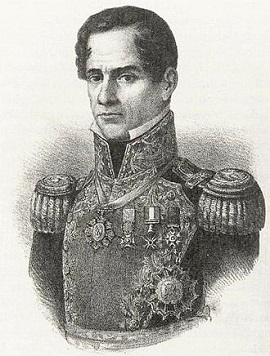
1917: Otilio Montaño, Zapatista

One hundred years ago today, Otilio Montaño Sánchez was shot as a traitor to the Mexican Revolution.

Montaño was a rural schoolteacher who came to mentor Emiliano Zapata via Zapata’s cousin.

Montaño had the distinction of helping Zapata draw up his movement’s “sacred scripture,” the egalitarian Plan of Ayala, and rose with his protege to become Secretary of Public Instructions in the Zapatista governing junta.

This association was destined to be displaced by a different (ex-)revolutionary, Venustiano Carranza, who would break with Zapata and emerge from the Revolution as Mexico’s president. Montaño suffered the fate Carranza’s former allies would have wished to impose upon him: being accused of supporting a pro-Carranza revolt, a revolutionary tribunal had him shot (dishonorably, shot in the back) wearing a defamatory sign reading “So die all traitors to the fatherland.”

A small town in Morelos is named for Montaño.

On this day..

1909: A triple execution in Chalco

The composed image in this date’s post would almost lead one to believe it posed, but Mexican campesinos Arcadio Jiménez, Hilario Silva, and Marcelino Martínez really were all shot together at Chalco on this date in 1909, for killing a policeman during the tense twilight of dictator Porfirio Diaz, on the verge of the Mexican Revolution. It’s believed to have been taken by Augustin Casasola.


From this lengthy dissertation pdf. (See the 384th page of the pdf, or page 354 as numbered within the document.)

According to Photographing the Mexican Revolution: Commitments, Testimonies, Icons, the event was luridly covered by the magazine El Imparcial, which described the execution in these words:

The bodies fell simultaneously, slowly backward, and a hoarse whisper flowed from either the enormous holes made by the bullets or their tightly pressed lips. The clothing smoked from the gunpowder, and their contractions denoted an extraordinarily cruel suffering. A death rattle, like that of a sheep with its throat cut, escaped from the three bodies. Their families sobbed, and their cries filled the countryside. Those of us who were present will never forget it.

On this day..

1864: Jose Maria Chavez Alonso, governor of Aguascalientes

On this date in 1864, the French executed the governor of Aguascalientes.

Elected to the post during early months of the unfolding French intervention in Mexico, Jose Maria Chavez Alonso (English Wikipedia entry | Spanish) was deposed by the invaders in December 1863 — to be succeeded by a different Chavez who met an equally violent fate.

Alonso formed a popular militia and continued a short-lived resistance against the French but was captured early in 1864, and although this was still some months before the dirty war’s notorious “Black Decree” the French determined to make an example of him.

Alonso aside, the Mexican adventure proved a right catastrophe for France and its adherents.

On this day..

1659: William Lamport, the real Zorro?

On this date in 1659, an Irish adventurer named Don Guillen Lombardo went to the stake in Mexico City as a heretic — en route to a destiny as a romantic swordsman

William Lamport was born in Wexford, by blood the descendant of English aristocracy and by conviction kin to Ireland’s Gaelic resistance to English incursion. His grandfather Patrick fought for Irish rebels at the Battle of Kinsale.

This was years before Lamport’s own birth but the youth must have been a chip off the old block: by the 1620s, as a student, William got himself run out of London for his aggressive Catholic proselytizing. Or at least, this is what William would say of himself: for his early years, we have mostly just his own word to go by.

Lamport took exile in Spain and there found his niche as a soldier and ladies’ man under a Hispanicized name: “Guillen Lombardo de Guzman” — that last nombre taken in tribute to his patron, the Count of Olivares. Guillen Lombardo de Guzman was a considerable enough figure in the Spanish court to have his portrait painted by Rubens.

These were formative years for the young man, but the crucial formative events we can only guess at: how did his thought evolve to the seditious or heretical form that set him against the Inquisition? Why did he cross the Atlantic to New Spain with the Marques of Villena in his late twenties?

This undergraduate thesis (pdf) tries to unravel the mystery of the man. What we know is that he was denounced to the Inquisition in October 1642 after attempting to enlist a friend in a subversive plot. The records here come via the Inquisition and are colored accordingly, but they indicate that Don Guillen aspired to cleave off New Spain with himself as the king of a radically egalitarian new state that would abolish all race and caste divisions. Among the papers he prepared for this visionary future was the first known declaration of independence in the Indies.

He spent the next 17 years in dungeons — less a few days when he escaped prison on the morrow of Christmas in 1650 and quixotically proceeded to nail up revolutionary manifestos on the cathedral door and around town denouncing the Inquisition. He was quickly recaptured, having now assumed the character of a determined rebel against powers both spiritual and temporal and consigned to an auto de fe in Mexico City’s main square. He was supposed to burn alive, but is said to have effected a cleverly merciful self-strangulation on the iron collar that staked him to his pyre.

It has been postulated that Johnston McCulley borrowed from a 19th century historical romance starring Lamport and his underground circle in McCulley’s The Curse of Capistrano — the serialized novel that introduced the dashing Mexican nobleman with a double life as champion of the little guy, Zorro. Lamport’s native Wexford — the one in Ireland — has consequently celebrated him in a “Wexford Zorrofest”.

On this day..

1807: Ephraim Blackburn, low roller

On this date in 1807, a throw of the dice noosed Ephraim Blackburn.

The son of a Pennsylvanian who served in George Washington’s army, Blackburn sought his own martial adventure by joining the expedition of Louisiana-Mexico border trader Philip Nolan in 1801.

Nolan had spent the 1790s living and trading along the frontier of Mexico and (Spanish, until 1800) Louisiana. Nolan worked in a legal twilight, earning the connivance of some Mexican officials and the hostility of others; perhaps no Anglo was better-acquainted with Texas.

By 1800 he was barred from the territory but assembled a coterie of 30-plus armed men and ventured into Texas once agan on an apparent filibustering operation seeking to carve out control of some piece of Texas. Our man Ephraim Blackburn was among these daring souls, whose wooden palisade somewhere near the Brazos River was quickly overwhelmed by a Mexican attack.

Nolan died in the battle, leading the remainder of his men to surrender. From there they would embark on a strange years-long legal road, their numbers continually winnowed by escapes. Ordinarily when one is prosecuted as a foreign invader, one is not permitted to have the liberty of the city or to go into business, but that is exactly what occurred with the Nolan men.

One of their number, Peter Ellis Bean, is known to have survived his incarceration; he escaped and fought for Father Miguel Hidalgo‘s Mexican revolutionaries against Spain, returned to the United States in 1818, then re-settled in post-independence Mexico. Bean conferred on posterity a memoir recalling that during their imprisonment,*

Some of my companions got leave of the general to go to other towns to live, but I thought I would find out some way of making something. I gave myself out as a hatter. There was a gentleman who trusted me for whatever was necessary to carry on that business. I employed two Spanish hatters to work with me, for, in fact, I was no hatter at all. In about six months I had so raised my name, that no one would purchase hats except of the American. By this means I got a number of journeymen to work with me. I was clear of debt, and making from fifty to sixty dollars per week.

All this entrepreneurialism was unfolding while capital case meandered with no great urgency among Spanish courts. One judge recommended the prisoners’ outright release in 1804; by the time the message had been shipped across the Atlantic and back, it was 1807, and the judge had died. The crown’s reversal horrifyingly required the death of one in every five of the invaders — although since deaths and escapes had now reduced their ranks to just nine, the local authorities mercifully rounded the figure down to one.

On the 9th of November, the nine remaining prisoners were gathered in a Chihuahua barracks and made aware of their situation. They agreed among themselves to cast dice in order of seniority — low roll hangs.**

Blackburn was the oldest, and the first to roll. He threw a 3 and 1. Bean narrates, beginning with the frighteningly mysterious arrival of confessional priests the night before the survival lottery:

all our conversation that night was in view of our being put to death. I told them that we should trust to fate, and not fret ourselves about what we could not remedy. One of them said the bravest would be cast down to see his open grave before him. “But,” said I, “if you find no way to escape that grave, is it not better to march up to it like a man, than to be dragged to it like one dead? It is enough for them to drag me to it when life is gone. The most cowardly, where under sentence of death, have marched up with great bravery. And, as for myself, if I must die, I mean not to disgrace my country.” The reason I talked so was that I did not believe they would put us to death.

Soon the next morning the priests returned, and David Fero asked them if we were to be put to death. They said they did not know — perhaps some might be. I then began to conclude it would be me, and all my companions thought the same thing. I, however, said nothing; for, as I had before talked of valor in such cases, it became necessary for me to support that character. The priests said we must confess all our sins to them, and we should be forgiven. As for myself, I had been taught that God knew all my crimes and it was not worth while to relate them to the parsons. But some of my companions began to confess, and had their sins forgiven. When they asked me, I told them I must have four or five days to recollect all my sins — that they were so many, it was doubtful whether I could ever remember them all. The parsons advised me to begin, and God would enlighten me, and help me to remember them. I told them I could not that day, but perhaps by the next day I could remember some things. They then left us. All that day the talk among us was as to who it would be. I told them, I supposed, as I was the worst, it would be me; and, as my friend Tony Waters had been put in with us to share our fate, I thought, as he had broken open my letter, that if the thing went according to justice, and they hung the worst man, it must be him, for he was, without doubt, the greatest villain and ought to have been dead some years ago. Waters sighed, but said nothing. The next day the parsons came again, and brought with them a colonel, who read to us the king’s order — which was, that every fifth man was to be hung, for firing on the king’s troops. But, as some were dead, there were but nine of us, and, out of the nine, but one had to die. This was to be decided by throwing dice on the head of a drum. Whoever threw lowest, was to be executed. It was then agreed that the oldest must throw first. I was the youngest, and had to throw last. The first was blindfolded, and two dice put in a glass tumbler. He was led to the drum which was put in the room, and there cast the dice on the head of the drum. And so we went up, one by one, to cast the awful throw of life or death. All of my companions, except one, threw high: he threw four. As I was the last, all his hopes were that I should throw lower than he. As for my part, I was indifferent about it, for I had resigned myself to fortune. I took the glass in my hand, and gained the prize of life, for I threw five.

After two days to prepare himself, Blackburn hanged on Chihuahua’s Plaza de los Urangas. The remaining prisoners were scattered to different prisons for many years to come; among the survivors, only Bean is known to have set eyes on his native soil again.

* On the expedition that would staple his name to mainland America’s highest peak, Zebulon Pike was briefly captured by the Mexicans and taken to Chihuahua, where he met some of the Nolan gang prisoners.

** Both the random selection and its circumstances — punishing Anglo adventurers — strongly foreshadow Mexico’s later Black Bean Lottery.

On this day..

1612: The slave rebels of Mexico City

On this date in 1612, Spanish colonial authorities smashed an alleged plot among Mexico City’s black slaves with a grisly mass execution.*

In Mexico as elsewhere in the Americas, African labor had been imported en masse in the 16th and 17th centuries; David Davidson estimated** that Mexico City had a black population ranging from 20,000 to 50,000. And as elsewhere in the Americas, they frequently resisted: Mexico City slave risings dating back to the 1540s had badly shaken the city, and led the viceroy Luis de Velasco to worry in 1553 that “this land is so full of Negroes and mestizos who exceed the Spaniards in great quantity, and all desire to purchase their liberty with the lives of their masters.”

The most illustrious name of this era was Gaspar Yanga, who was kidnapped into bondage from the Gold Coast, and escaped bondage by leading a large band of fugitive slaves into the highlands of Veracruz and founded an outlaw colony that still bears his name today.

Yanga’s palenque — known in his time as San Lorenzo de los Negros de Cerralvo — had to fend off military action by the Spanish authorities from 1609 until a truce in 1618.

Still, a truce was possible: a refuge like San Lorenzo offered slaves the unwelcome-to-their-masters prospect of escape from the scourge economy, but the real threat to New Spain was that purchasing liberty with lives bit.

As we have seen in the American South, the situation on the ground begat paranoia that makes it nigh impossible for later interlocutors to disentangle fact from fantasy: was there really a phenomenal slave rebellion nipped in the bud? Or just informers and torturers refracting the terrors of those outnumbered Spaniards?

The slaves in this case were said by a Portuguese merchant who overheard them to be readying themselves to exploit Spanish inattention during Holy Week celebrations, and to bloody those days by falling upon their masters and taking possession of the colony. In the inevitable rounds of arrests and torture that ensue, the alleged plot as recorded by the annalist Chimalpahin (Spanish link) sounds suspiciously like a psychosexual projection, for it

involved castrating any surviving Spanish males, making sexual slaves of white women, and gradually “blackening” the latter’s descendants.**

Certainly the punishment blackened Mexico City; our correspondent uses this same word to describe the condition of the gibbeted corpses when they were finally let down from their gallows on the feast of the Holy Cross. Even then, the flesh of the would-be slave kings could not rest: most were beheaded posthumously and mounted on pikes while six others were quartered for display on all the roads entering the capital. This in itself was a small moderation for the public good. Chimalpahin reports that doctors advised the state that “if all the dead were to be quartered and hung up in the main streets to rot, their stench will blow a sickness across the city.”

* Thirty-five is the execution count supplied by Chimalpahin; some sources give 33.

** “Negro Slave Control and Resistance in Colonial Mexico, 1519-1650,” The Hispanic American Historial Review, Aug. 1966.

† Maria Elena Martinez, “The Black Blood of New Spain: Limpieza de Sangre, Racial Violence, and Gendered Power in Early Colonial Mexico,” The William and Mary Quarterly, Jul. 2004.

On this day..

1836: Maria del Rosario Villa and Gervasio Alipas lynched in Alta California

California on April 7, 1836 saw the first known installment of what would become a rich tradition of history of vigilance committee lynchings in the state — over an affair of the heart.

This was Alta California under Mexican rulership, a decade before the Yankees gobbled it up in the Mexican-American War.

Maria del Rosario Villa had abandoned her husband Domingo Felix (or Feliz) back in 1834 to take up with a vaquero named Gervasio Alipas (or Alipaz). The honor-stricken husband spent two years fruitlessly trying to reconcile until in 1836 at his behest the alcalde successfully pressured Maria into returning to her husband.

But on the couple’s return trip to their ranch, the lover Alipas intercepted them and did the husband Felix to death. Narciso Botello’s* annals describe that Alipas “took hold of his [Felix’s] horse and threw himself on Felix, grabbed him by his neckerchief, and pulled him off, dragging him along downhill and twisting the neckerchief, strangling him” — then pitched the choking victim into a gully where he finished him off with a machete. “Later it was proven by the tracks that the wife had been present.” (Source) She helped him dump the body near San Gabriel Mission, too.

Outraged both by the dastardly murder and by the wanton violation of matrimony that precipitated it, a gang of 55 organized themselves as a Junta of the Defenders of the Public Safety, led by Victor Prudon, a recent arrival to the area from the Hijar-Padres colony.** As no militia could be mustered inclined to oppose its will, on April 7 the junta forced open the jail where Alipas was interred, stood him up behind a church, and shot him to death. Villa — being held in an apartment at a private residence — was likewise forced out and marched to a nearby stable where she got the same treatment.

The vigilantes deposited the bodies back at the jail with the communique,

Junta of the Defendres of the Public Safety —

To the First constitutional Alcalde:

The dead bodies of Gervacio Alispaz and Maria del Rosario Villa are at your disposal. We also forward you the jail keys that you may deliver them to whomsoever is on guard. In case you are in need of men to serve as guards we are at your disposal.

God and Liberty. Angeles, April 7, 1836.

Victor Prudon, President
Manuel Arzaga, Secretary

And that was the end of the Defenders of the Public Safety, who disbanded a few days later, never to reconstitute. Indeed, while vigilance committees became regular features on the Californian landscape in later years, this is the sole such incident ever known to have occurred there under Spanish or Mexican rule.

* A Mexican who would serve two terms in the state assembly of California after it became a U.S. state in 1850.

** Mexico at this point was still in its first generation of independence; its hold on sparsely-populated California was not strong — and the missions set down there to convert natives to Christianity and project a Spanish presence had Russian competition.

The Hijar-Padres colony (Padres was the name of the colony’s organizer, Hijar its financier) was a nucleus of 200-odd souls dispatched to settle in California by one of the liberal intra-Santa Anna governments. The leaders soon became embroiled in a complex political rivalry with California’s governor and the colony itself failed to take root, its emissaries settling and taking work wherever they could. Many set down roots in California’s “Southlands” where Los Angeles, then just a small town but still the regional capital, would one day splay out its sunlit superhighways. While colonists were involved in the vigilance committee proceedings, no member of the love triangle was a colonist. (See C. Alan Hutchinson, “An Official List of the Members of the Híjar-Padrés Colony for Mexican California, 1834,” Pacific Historical Review, Aug. 1973.)

On this day..

1858: William Williams, guano-freighter cook

From the Daily Alta California, April 20, 1858:

Thomas P. Lewis, master of the ship Adelaide, loading guano at Elide Island, off the coast of Lower California, was killed there on the 12th ult. by Wm. Williams, colored cook off that vessel. Three other vessels happened to be there at the time, and the officers united to hold a court, taking six sailors as part of the jury, and tried Williams, convicted him of murder, and then hanged him on the island.

Elide Island is a “naked rock, one mile in circumference” off the coast of Mexico’s Baja California which for a few years in the mid-19th century was heavily exploited for its guano supplies. 28,000 tons of bird crap later, the supply was tapped out.

On this day..

1867: Not Santa Anna

On this date in 1867, the Mexican general and onetime president Antonio Lopez de Santa Anna avoided execution at his court-martial.

Best recognized north of the Rio Grande for overrunning the Alamo, Santa Anna actually enjoyed an amazing career with a near half-century as Mexico’s definitive caudillo.

Antonio López de Santa Anna joined the military he would come to personify as a 16-year-old cadet in 1810 … except it was the Spanish colonial army, where he had hands-on training in the cold counterinsurgency tactics he would subsequently apply in his maturity.

Within barely a decade, the ambitious young officer was advanced to general — the last step by dint of his timely adherence to the incoming emperor of now-independent Mexico, Agustin de Iturbide.

Iturbide was destined for a firing squad, but Santa Anna had a better knack for tacking with his new country’s political gales — turning against his recent patron just in time to help depose the guy.

Santa Anna’s P.T. Barnum*-quality panache for shameless self-promotion — at one pont he repelled Spain’s last attempted reconquista and pronounced himself the “Napoleon of the West” — soon self-promoted himself right to the presidency. From 1833 to 1855, he held the office during 11 distinct stints.

His dictatorial exercise of power and abundant graft aroused resistance from more than just Texan Anglos, so he was often engaged in suppressing internal rebellions, and occasionally in being chased by them into exile. His last turn at president was aborted in 1855 by liberal reformers. Santa Anna fled to Cuba.

Considering the mad twists of fortune in his long career, it’s a miracle that none of his enemies ever actually executed Santa Anna. He was: both adoit and lucky to avoid purging during the tumultuous 1820s; captured by rebelling Texans, who preferred to avenge Alamo by forcing him to treaty terms; handed over to the U.S. government, which eventually sent him back to Mexico; captured again by rebelling Indians in Veracruz who sold him to the Mexican government which sent him to exile; and, tried by the liberals who finally toppled him, but in absentia since he had escaped once more. He had more lives than a cat; small wonder that here in his sixties and seventies he still wasn’t done plotting.

A full decade out of power, Santa Anna spent 1866-1867 in Staten Island, New York,** until the fall of Mexico’s French-backed Emperor Maximilian induced him once more — at the age of 73 — to sail for home with one last summons to his banner. Instead he was captured in a position that must have looked like curtains for sure.

The New York Times actually reported on July 5, 1867 that Santa Anna had been summarily executed; in fact, the restored liberal government of Benito Juarez clapped the nettlesome general in prison and subjected him to a court martial that ran Oct. 7-10. Juarez allegedly expected the old snake to be convicted of treason and finally executed, but like the Times, Juarez too was frustrated: the commission sentenced Santa Anna to exile and he was carried away to Havana once again.

It proved to be a waking death: cheated of the glory of a firing squad, the old general was pitiably forgotten.

“His schemes” — for still he schemed — “became increasingly the ravings of an old, deluded, sick man,” writes Robert Scheina in Santa Anna: A Curse Upon Mexico.

Permitted with Juarez’s death in 1874 to return to Mexico, Santa Anna now fought only for a pension. (He lost that fight.) So long his country’s first man, he “became increasingly depressed which was only relieved by his increasing senility. Santa Anna was suffering the worst possible punishment — obscurity and irrelevancy.” He died penniless of diarrhea in 1876.

* Santa Anna eventually came to hobble about on a cork leg, courtesy of a war wound. The leg was captured during the Mexican-American War, and Barnum put the artificial limb on exhibit.

That limb has never been returned to its native soil: Santa Anna’s prosthesis remains available to the Yankee gawker at the Illinois State Military Museum in Springfield.

** Santa Anna’s legacy in the United States (apart from that Alamo unpleasantness) was the importation of chicle, which the general liked to chew. Santa Anna’s American secretary, Thomas Adams, used it to create the chewing gum marketed as chiclets.

On this day..

2008: Jose Medellin, precedent

On this date in 2008, Mexican national Jose Medellin was executed by Texas, pleasurably sticking its thumb in the eye of the International Court of Justice.

U.S. state and local officials have often displayed the ugly-American tendency to view binding treaty obligations as a Washington thing of no moment to the likes of a Harris County prosecutor. So when Medellin was arrested for the 1993 rape-murder of two teenage girls in a Houston park, the idea of putting him right in touch with Mexican diplomats to assist his defense was, we may safely suppose, the very farthest thing from anyone’s mind.

Yet under the Vienna Convention, that is exactly what ought to have occurred. The idea is that consular officials can help a fellow on foreign soil to understand his unfamiliar legal circumstances and assist with any measures for his defense — and by common reciprocity, every state is enabled to look after the interests of its nationals abroad.

A widespread failure to do this, in death cases and others, has involved the United States in a number of international spats over the years.

Jose Medellin was among more than 50 Mexican prisoners named in one of the most noteworthy of these: the Avena case, a suit by Mexico* against the United States in the International Court of Justice.

In its March 31, 2004 Avena decision, the ICJ found that U.S. authorities had “breached the obligations incumbent upon” them by failing in these instances to advise the Mexican nationals it arrested of their Vienna Convention rights, and of failing in almost all those cases likewise to advise Mexican representatives that a Mexican citizen had been taken into custody.

“The appropriate reparation in this case,” the 15-judge panel directed, “consists in the obligation of the United States of America to provide, by means of its own choosing, review and reconsideration of the convictions and sentences of the Mexican nationals.”

If you think the Lone Star State’s duly constituted authorities jumped right on that “obligation,” you must be new around here.

Several years before, the United Nations Special Rapporteur on Extrajudicial, Summary or Arbitrary Executions visited the United States and filed a report complaining “that there is a generalized perception that human rights are a prerogative of international affairs, and not a domestic issue.”

“Domestic laws appear de facto to prevail over international law, even if they could contradict the international obligations of the United States,” the Special Rapporteur noted.

Texas, famed for not being messed with, took a dim view indeed to being bossed about from The Hague. Indeed, the very concept of foreign law and international courts is a gleefully-thrashed political pinata among that state’s predominant conservative electorate.

U.S. President George W. Bush — a former Texas governor who in his day had no time at all for appeals based on consular notification snafus — in this instance appealed to Texas to enact the ICJ’s proposed review.† In fact, he asserted the authority to order Texas to do so.

Texas scoffed.

“The World Court has no standing in Texas and Texas is not bound by a ruling or edict from a foreign court,” a spokesman of Gov. Rick Perry retorted.

This notion that America’s federalist governance structure could insulate each of her constituent jurisdictions from treaty obligations undertaken by the nation as a whole naturally seems preposterous from the outside. But in the U.S., this dispute between Washington and Austin was resolved by the Supreme Court — and the vehicle for doing so was an appeal lodged by our man, Medellin v. Texas.

The question at stake in Medellin was whether the treaty obligation was binding domestic law on its own — or if, by contrast, such a treaty required American legislative bodies to enact corresponding domestic statutes before it could be enforced. The high court ruled for the latter interpretation, effectively striking down Avena since there was zero chance of either Texas or the U.S. Congress enacting such a statute.

Medellin, the decision, spelled the end for Medellin, the man — and, at least for now, the end of any prospect of effectual intervention in American death penalty cases by international tribunals.

* Mexico, which no longer has the death penalty itself, has the heavy preponderance of foreign nationals on United States death rows at any given time.

** The Texas Attorney General’s press release announcing Medellin’s execution included a detailed appellate history of the case which pointedly excluded anything that happened in the ICJ.

† The Bush administration did take one effective step to avoid a similarly embarrassing situation in the future: it withdrew the U.S. from the consular notification convention.

On this day..