1906: Robert E. Newcomb and John Mueller

(Thanks to Meaghan Good of the Charley Project for the guest post. -ed.)

On this day in 1906, Robert E. Newcomb and John Mueller were hanged together in Chicago, Illinois. Both were multiple murderers, with six deaths between them.

Newcomb, who was, described as “crazed” and “maddened,” hanged for the murder of Chicago police sergeant John Peter Shine.

On October 10 the previous year, Shine heard reports of a gunman terrorizing people on the streets of Englewood. Newcomb had already shot three people and one, a woman named Florence Poore who was the wife of Newcomb’s friend, was dead. Shine found out the gunman had barricaded himself in his apartment. Although he was off duty, he decided to make the arrest himself.

When he knocked on the apartment door and demanded entry, however, Newcomb simply fired through the closed door, hitting Shine in the abdomen and mortally wounding him. The officer died two hours later at Englewood Union Hospital, at the age of 42. Walter Blue, one of the others Newcomb had shot, also died of his wounds.

After Shine was shot, over 100 police officers surrounded Newcomb’s apartment and fired into it, hoping to apprehend or kill the gunman. After a long siege, Newcomb surrendered to an equally certain death in the judiciary.

Little is known about John Mueller or his crimes. Daniel Allen Hearn, in his book Legal Executions in Illinois, Indiana, Iowa, Kentucky and Missouri: A Comprehensive Registry, 1866-1965, describes Mueller as “a drunk and a loser who went berserk when refused money with which to buy liquor.” The 32-year-old slaughtered his wife, Annie, and their two daughters, two-year-old Martha and 18-month-old Mary, by shooting them and slashing them repeatedly with a razor.

The two killers were executed in the Cook County Jail. It was an integrated execution: Newcomb was black and Mueller was white.

On this day..

2014: A.R. and N.J., a double hanging caught on video

The initials of the two men in the double hanging are all the identification I have found — but the spectacle of this February 15, 2014 public double hanging in Karaj amid fulsome praise for both God and the state security forces is a riveting horror.

Warning: Mature Content. Two men die in this video.

On this day..

1943: Dora Gerson, cabaret singer

Jewish cabaret singer and silent film actress Dora Gerson was gassed with her family at Auschwitz on this date in 1943.

IMDB credits the Berlin entertainer (English Wikipedia entry | the more detailed German) with two silver screen roles,* both in 1920 and both now believed lost.**

Gerson’s cabaret career was the more robust through the roaring twenties but with benefit of retrospection we admit with Liza Minelli that from cradle to tomb, it isn’t that long a stay.

And the ominous next act would not belong to Weimar Jews.

After being elbowed off German stages by Reich race laws, Gerson recorded several songs in German and Yiddish; her “Vorbei” (“Beyond Recall”) hauntingly commemorates the lost world before fascism — “They’re gone beyond recall / A final glance, a last kiss / And then it’s all over.”

Gerson fled Nazi Germany to the Netherlands; once that country fell under its own harrowing wartime occupation, she tried to escape with her family to neutral Switzerland but was seized transiting Vichy France. Gerson, her second husband Max Sluizer, and their two young children Miriam (age 5) and Abel (age 2) were all deported to Auschwitz and gassed on arrival on Valentine’s Day 1943.

* Her first marriage was to film director Veit Harlan, who would later direct the notorious anti-Semitic propaganda film Jud Süß — based on an executed Jewish financier. From the German-occupied Netherlands, Gerson unsuccessfully appealed to this powerful ex for protection.

** Future horror maven Bela Lugosi also appeared in both Gerson films, Caravan of Death and On the Brink of Paradise. Gerson’s German Wikipedia page also identifies her as the voice of the evil queen in the 1938 German-language dub of Disney’s Snow White and the Seven Dwarves.

On this day..

1818: Samuel Godfrey, American picaro

“The day was remarkably calm, serene and placid, for the season — as was also, the mind, the countenance, and the conduct of the prisoner” on February the 13th of 1818 when “more than ten thousand persons” witnessed the execution of Samuel Godfrey on Woodstock (Vt.) Green.

That’s per A Sketch of the Life of Samuel E. Godfrey, which is reproduced in full in this post; some version of the publication was sold on Woodstock Green on the day of the hanging, presumably without the final appendix actually reporting the execution’s result.*

Alternating between mariner and hatter, with frequent brushes against authority and a keen feel (up to and including the transaction that cost him his own life) for the injustices visited upon him by the powerful, Samuel Godfrey emerges episodically as an American picaro on the Canadian frontier — which he is made to cross thanks to the hated British practice of seizing and impressing American seamen.

Although the man’s personal history is impossible to audit, the historical events in which he situates his autobiography were quite real: the dramatic naval battle of the HMS Cleopatra and the Ville de Milan is narrated here; there were American-British skirmishes at Odelltown, Quebec during the War of 1812; and certainly his audience would have been familiar with the flood that devastated Woodstock in 1811.

* Despite the extensive prepared “valedictory address” printed in the document in this post, Godfrey’s scaffold statement was actually quite cursory thanks to a planning snafu. According to the Amherst, N.H. Farmers’ Cabinet (Feb. 21, 1818), he said only: “I have no remarks to make, only that I declare before God and man, that I am innocent of the crime for which I am about to suffer. I had an address prepared for the occasion, but it is not here; if it was, I should be glad to have it read.”

On this day..

1584: Five young thieves

Nuremberg executioner Franz Schmidt on this date in 1584 hanged a gang of five young — very young — thieves. He marked the occasion in his diary:

February 12th. Hennsa of Geyselwind, alias the fat lad; Hennsa Pallauf of Hernda; Killian Wurmb of Virnspach, alias Backendt; Hans Schober of Weher, alias Pulfferla; and Hennssla Klopffer of Reigelsdorff; five thieves who, with the previously executed ‘Silly Mary’ and ‘Country Kate,’ had burgled and stolen (they had also formerly been whipped out and put in the stocks ten times). They had to be clothed, for they were naked and bare; some of them knew no prayers and had never been in a church; the eldest were 22, 17, 16 and 15 years old, the youngest 13 years. All five hanged here in Nuremberg.

On this day..

1584: Silly Mary and Country Kate

Executioner Franz Schmidt records in his journal for this date in 1584 the hanging of two women — according to Schmidt, the first women hanged in Nuremberg.

February 11th. Maria Kurschnerin of Nuremberg, alias Silly Mary, who had formerly been whipped out of town with rods, and had her ears cropped; also Katherine Schwertzin of Weher, alias Country Kate, who had also formerly been whipped out of the town; both of them thieves and whores, who with thievish youths and fellows climbed and broke into citizens’ houses and stole a mighty quantity of things; both hanged at Nuremberg. It was an unheard of thing for a woman to be hanged in Nuremberg, and it had never yet happened.

Thought Schmidt doesn’t say it, both of these girls were very young — according to Joel Harrington’s The Faithful Executioner, both would be minors by today’s standards.

This helps account for the huge crowd that turned out to see them executed — many of them no doubt had also been in the huge crowd that had previously seen “Silly Mary” suffer a non-fatal corporal punishment the year before. The executioner Schmidt administered that punishment as well, and likewise noted it in his diary on January 10, 1583.

January 10th. Mary Kurssnerin, a young prostitute, who was a watchman’s [musketeer’s?] daughter, a girl who had thieved considerably and a handsome young creature with whom the young Dietherr had dealings; Elizabeth Gutlerin, a bath attendant; Katherine Aynerin, alias die Gescheydin, a blacksmith’s wife and a handsome creature; all three children of citizens, and prostitutes, were here pilloried and afterwards flogged out of the town. Such a dreadful crowd ran out to see this that several people were crushed to death under the Frauenthor. Subsequently Mary’s ears were cut off, and she was hanged.

On this day..

1956: Elifasi Msomi, witch doctor

(Thanks to Meaghan Good of the Charley Project for the guest post. -ed.)

On this date in 1956, Zulu witch doctor Elifasi Msomi was executed in at Pretoria Central Prison in South Africa for the murders of fifteen people.

The devil made him do it, he said. Or, rather, Tokoloshe, an evil spirit in Zulu folklore.

Msomi had not been successful in earning a living at witch-doctoring, so he consulted an experienced colleague for advice. According to Msomi, the man introduced him to Tokoloshe and said, “Get me the blood of 15 people.”

Over the next year and a half, Msomi stalked KwaZulu Natal, slaughtering victims as the demon pointed them out, and collecting their blood in bottles. He would attack them with a knife, hatchet or knobkierie after luring them to an isolated area.

The first victim was a young girl. To prove to the demon just how dedicated and obedient he was, Msomi hacked his victim to death in front of his girlfriend. Tokoloshe was delighted, but the girlfriend was horrified. She went straight to the cops and had Msomi arrested. Then he escaped from custody … with Tokoloshe’s help, he said.

Msomi followed up on his first act by slaying five children. In April 1955, he was linked to multiple murders and arrested again, but again he escaped and picked up where he’d left off.

In his book Murder By Numbers: The 100 Most Deadly Serial Killers From Around The World, Robert Keller says,

Serial killers seldom stop killing of their own accord, but that is exactly what happened with Elifasi Msomi. Having collected the blood of his fifteenth young victim, he said that Tokoloshe thanked him for his service, then bathed with him in the river before they parted company.

Without Tokoloshe to help him anymore, Msomi soon came to police attention again when he was arrested for petty theft. In custody once more, he freely confessed to the murders and led authorities to some bodies, but he said he wasn’t responsible for his actions and was only following Tokoloshe’s orders.

There was, however, the problematic fact that he had raped some of his victims and robbed others; Tokoloshe hadn’t requested THAT. At the trial, two psychologists testified that Msomi was very intelligent and got sexual pleasure by causing pain to other people.

Writing of this case in Real Vampires, Night Stalkers and Creatures from the Darkside, Brad Steiger says,

Such was the reputation of the witch doctor’s power of channeling the Tokoloshe that prison officials granted permission to a deputation of tribal chiefs and elders to view Msomi after he had been hanged on February 10, 1956. These men were thus able to return to their respective tribes and proclaim that the witch doctor was really dead and that Tokoloshe had left him to seek out another host body.

On this day..

1883: Milton Yarberry, Marshal of Albuquerque

On this date in 1883,* Albuquerque hanged its Town Marshal.

Milton Yarberry was one of those belt-notching Wild West gunmen badass enough to be worth deputizing for a frontier town with a spiraling crime problem — which Albuquerque was experiencing as the just-completed railroad boomed its population. A number of crimes had been attributed to him in a career that took him from stage-robbing in his native Arkansas, to the Texas Rangers, to a Colorado saloon, to a New Mexico cathouse, a veritable bucket list of spaghetti western tropes packed into 34 roughhewn years with bodies planted at nigh every stop. Yarberry was even reputed to have fought alongside Billy the Kid.

The last of these tropes, of course, was as the bad hombre upon whom the townspeople foist a badge.

It will not surprise that even when minted as a peace officer, Marshal Yarberry continued his manslaying ways. Still, nobody in our present age of impunity could well imagine a lawman standing trial for murder twice in the space of a year.

Yarberry in early 1882 defeated a charge for wasting his lover’s paramour during a row in the street, as witnesses said Harry Brown shot first, just like Greedo.

There was no administrative leave or counseling after that, just straight back on the beat — and barely a month later, the copper gunned down a guy whom he was trying to stop for questioning. It was a confusing encounter in which the Marshal insisted that he fired when the victim, Charles Campbell, wheeled on him with a gun. A single state’s witness was able to establish in the court’s mind that there was no gun in Campbell’s possession.

Our hard-living triggerman would never waver from his self-defense story as his appeals were made;** he had many supporters who believed that he was being railroaded on account of the public relations hit the city was taking for employing a dude who had so liberally populated the Republic’s Boot Hills — and those advocates included the sheriff who recruited Yarberry as a Marshal, Perfecto Armijo, who was also the sheriff detailed to hang Yarberry in the end.

The local Albuquerque podcast City on the Edge has an episode dedicated to Yarberry here.

* In the anarchic game of telephone that was 19th century reporting, some editor somewhere mistakenly understood a story of Yarberry’s condemnation in 1882 as an actual report of his execution; as a result, there were news stories (themselves repeated by multiple papers) announcing Yarberry’s hanging in June 1882. In this business, once one wrong date is out there it’s bound to be echoed into eternity, so it’s still possible to find sources that misdate the execution to June 16, 1882. Past the question of the calendar, the fact that these stories actually expanded with details about the fictitious hanging scene strongly underscores the degree to which the hang-day bulletin had become colorfully but generically abstracted from any save accidental relationship to the actual scene at the gallows.


Cincinnati Daily Gazette, June 17, 1882, vividly peopling an imaginary scene.

** Because New Mexico was still just a territory — it was only admitted to the Union as a state in 1912 — Yarberry’s clemency decision went to the U.S. President, Chester A. Arthur.

On this day..

1943: The five martyrs of the lycee Buffon

On this date in 1943, Nazi guns immortalized five student martyrs of the French Resistance.

The Five Martyrs of the lycee Buffon were Parisian high school students who greeted the fascist occupation of their republic with every form of opposition they could command.

Jean-Marie Arthus (“Marchand” by his nom de guerre), Jacques Baudry (“Andre”), Pierre Benoit (“Francis”), Pierre Grelot (“Paul”) and Lucien Legros (“Jeannot”)* started small with subversive pamphleting and placarding but soon moved on to sabotage and armed opposition in affiliation with the Francs-Tireurs et Partisans.

The arrest of one of their teachers, Raymond Burgard, in 1942 spurred them to lead a student demonstration whose mass arrest they barely escaped. By that time their identities were known, and the boys had to go underground; for their remaining months at liberty they lived on the run and participated in occasional (albeit not very damaging) armed attacks on occupying forces — until that summer, when French intelligence arrested Arthus, Baudry, Grelot and Legros, and French police later caught Benoit.

All five were handed off by their collaborationist countrymen to the eager claws of the Germans, who condemned them as terrorists at a military trial.

A number of public places in France honor their memory, like the 14th arrondissement’s Place des Cinq-Martyrs-du-Lycée-Buffon. Their touching and determinedly optimistic last letters to their families can be read at the Cinq martyrsFrench Wikipedia page.

* A sixth school chum, Michel Agnellet, could easily have joined them at the execution posts and in the martyrologies, but the five who were captured did not permit their interrogators to extract his name.

On this day..

1940: Peter Barnes and James McCormack, the last IRA men hanged

“The two that swung in Birmingham, with ordered step
From off the gallows floor.”

Brendan Behan

On February 7, 1940 — Ash Wednesday, as it happened to be — Peter Barnes and James McCormack became the last Irish Republican Army men executed by the British

They were condemned by the outraged British after a then-shocking terrorist bombing that has largely vanished from the historical memory, subsumed by the simultaneous outbreak of World War II.

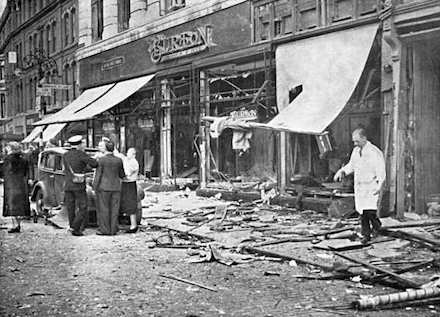
Although it was neither the first nor the last strike in the 1939-1940 campaign of Irish Republican attacks on English soil aimed at forcing London to relinquish control of Northern Ireland, the five-pound bicycle-mounted bomb that ripped apart Broadgate on August 25, 1939, might have been the one that most hardened British hearts against the authors.* Five people were killed in the explosion and some 70 injured; the scene resembled a war zone.**

The resulting investigation — explored in great detail here — never laid hands on the man who actually planted this bomb, eventually revealed to be Joby O’Sullivan.

Many years later and near his death, O’Sullivan claimed that the bomb was supposed to be parked at the Coventry police station; other reports have it destined for an electrical station, and the decision to abandon the ticking bicycle in a crowded street a freelance cock-up by O’Sullivan. Maybe. What is known is that on August 24, London police had busted an IRA plot to place explosives at Westminster Abbey, Scotland Yard, and the Bank of England — all timed to explode at the very same moment as the Coventry package, 2:30 the next afternoon. Had that coordinated fourfold bombing occurred, it would have rated one of the bloodiest and most spectacular terrorist events in history.

But the single blast that did take place was more than enough to bring down the crown’s fury.

Five faced trial for their lives, even though no hand among them had actually set the Coventry bomb. In Ireland and many other places, this latter stipulation made the entire affair an outrageous injustice, especially if one takes as a given that the bomb was not meant to hit civilians. We leave that interesting question of justice to the reader’s consideration, but it must be understood that our hanged men were certainly party to the IRA’s bombing project. The accused, for a trial that December, were:

  • Barnes, an IRA operative in London who had delivered bomb components to Coventry
  • McCormack, part of an IRA cell in Coventry who had rented the house where the bomb was constructed
  • Joseph and Mary Hewitt, and Mary’s mother Brigid O’Hara, Irish immigrants who had taken on McCormack as a lodger

Little evidence could be produced against Hewitt family, who appeared to be quite innocent of their tenant’s intentions. The latter three were cleared of all charges, and then vengefully deported.

McCormack kept stoically silent during the trial, rising only at his sentencing to announce “that the part I took in these explosions since I came to England I have done for a just cause. As a soldier of the Irish Republican Army I am not afraid to die, as I am doing it for a just cause. I say in conclusion, God bless Ireland and God bless the men who have fought and died for her.”

Barnes, whose role on the far end of the supply was even more remote from the final detonation, said as he would maintain to the end, “I am innocent and later I am sure it will all come out that I had neither hand, act or part in it.”

The pair hanged together in Birmingham’s Winson Green Prison. The return of Barnes and McCormack’s remains from that gaol’s unmourned yards to Irish soil soon became a running national demand; the remains were finally repatriated (to great fanfare) in 1969.

Amid the patriotic encomia, civil war veteran Jimmy Steele gave an address on the occasion of the republicans’ reburial critical of the Sinn Fein leadership — an address that is often considered a milepost en route to the imminent (December 1969) splitting-away of the Provisional IRA.

* And in a less justifiable expression, against the Irish generally; Coventry’s Irish immigrant populace faced an immediate racist backlash.

** A chilling preview, for the next year Coventry was devastated by German planes — one of the cities hardest hit by the Reich’s bombing campaign.

On this day..