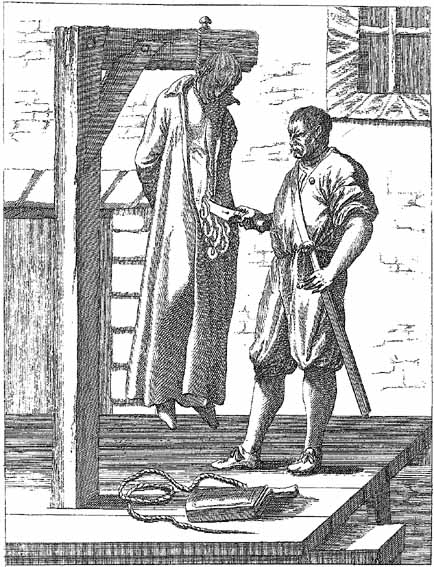
1615: St. John Ogilvie

On this date in 1615, Scotland’s only post-Reformation Catholic martyr was hanged at Glasgow Cross.

The Protestant-born Ogilvie had been educated in Europe and there fallen under the sway of the Catholic faith forbidden in his homeland. He converted, trained as a Jesuit, and at his own request returned to minister to the secret Catholic population in Glasgow.

Within a year he was in irons, awaiting a death sentence he refused to spurn with a timely submission to King James‘ spiritual supremacy. Ogilvie greeted his conviction for treason — and like most Catholic martyrs in the British Isles, he protested his loyalty in vain — with the words,

God have mercie upon mee! … if there bee heere anie hidden catholikes, let them pray for me, but the Prayers of Heretickes I will not have.


John Ogilvie? (See Update below)

There’s a multilingual Jesuit text celebrating Ogilvie available free from Google books.

Glaswegians can watch for more demonstrative tribute at St. Andrew’s Cathedral, which is poised to produce a monumental mural by Peter Howson.

Part of the Themed Set: The Church confronts its competition.


Update: Friend of the blog Louise Yeoman, whose guest post on a witchcraft execution remains one of the best pieces in this humble space, has an interesting correction to offer on Saint J.O. According to Yeoman, disemboweling “was not part of Scots law until 1708, when the British government wanted to hang draw and quarter some of those involved in the abortive Jacobite uprising of that year and were shocked to find that Scotland had no such penalty.” She’s backed by this contemporaneous account of Ogilvie’s death, which observes that even the “quartering” part of the sentence was not carried out.

So, what gives with the image, if Ogilvie’s corpse wasn’t carved up?

It’s from this (U.S.) Library of Congress page which marks it as a representation of Ogilvie in a late 17th-century text of Bohemian Jesuit propagandist Matthias Tanner. That provenance, of course, would be consistent with a bit of sanguinary exaggeration. It’s also possible that it’s mislabeled on the Library of Congress page, whose identification of it seems a bit oblique.

Working as I am from secondary sources, I tread cautiously here and welcome further clarification or correction.

On this day..

1323: Andrew Harclay, too chummy with the Scots

On this date in 1323, Andrew Harclay was hanged, drawn and quartered in London for having attempted to conclude peace with Scotland.

A commoner whose abilities lifted him into the nobility, Harclay may have been northern England’s ablest military commander during ceaseless warfare between Robert the Bruce of Scotland (yes, that one) and the English King Edward II, the latter struggling to maintain the conquests of his father, Edward I “Longshanks”.

It was the defeat of a domestic enemy — Edward had no shortage of foes — that elevated Harclay into the peerage; he engineered English victory at the Battle of Boroughbridge over the rebellious Earl of Lancaster.

Campaigns against the Scots were less to the king’s liking; Robert the Bruce consistently thwarted English expeditions, establishing an ever-firmer grasp on Scotland and raiding into the frontiers — Harclay’s lands included. Settlement of the fruitless conflict was the order of the day, and it was Edward’s intransigence that withheld it. As a century-old volume on England’s political history puts it, “To such a pass had England been reduced that those who honestly desired that the farmers of Cumberland should once more till their fields in peace, saw no other means of gaining their end than by communication with the enemies of their country.”

Secretly, Harclay ventured to work out the terms of a peace with Scotland, an act outside his station which he evidently intended to present as a fait accompli. Here is the contemporaneous account from the Chronicle of Lanercost:

Wherefore, when the said Earl of Carlisle perceived that the King of England neither knew how to rule his realm nor was able to defend it against the Scots, who year by year laid it more and more waste, he feared lest at last he [the king] should lose the entire kingdom ; so he chose the less of two evils, and considered how much better it would be for the community of each realm if each king [Edward II and Robert the Bruce] should possess his own kingdom freely and peacefully without any homage, instead of so many homicides and arsons, captivities, plunderings and raidings taking place every year. Therefore on the 3rd January [1323] the said Earl of Carlisle went secretly to Robert the Bruce at Lochmaben …

Now the Earl of Carlisle made the aforesaid convention and treaty with the Scots without the knowledge and consent of the King of England and of the kingdom in parliament; nor was he more than a single individual, none of whose business it was to transact such affairs. … But after all these things had been made known for certain to the King and kingdom of England, the poor folk, middle class and farmers in the northern parts were not a little delighted that the King of Scotland should freely possess his own kingdom on such terms that they themselves might live in peace. But the king and his council were exceedingly put out (and no wonder!) because he whom the king had made an earl so lately had allied himself to the Scots, an excommunicated enemy, to the prejudice of the realm and crown, and would compel the lieges of the King of England to rebel with him against the king; wherefore they [the king and council] publicly proclaimed him as a traitor.

….

[A]lbeit he merited death according to the laws of kingdoms, his aforesaid good intention may yet have saved him in the sight of God.

Debate continues over just how treasonous — grossly so, or only “technically” — was this fatal negotiation; that it was practical cannot be gainsaid. Twelve weeks after Edward sent this key noble to the block for his unauthorized collaboration with the enemy, England herself concluded a similar truce. Although this version did not acknowledge the Bruce’s kingship, the peace it established would, ere the decade was out, lead to England legally recognizing Scotland’s independence.

On this day..

1634: Anna Tait, “trublit in conscience”

(Thanks to historian and witchcraft expert Louise Yeoman for this guest post on an obscure and once-forgotten “witch” whose human tragedy all but leaps off the page. This post was originally an article prepared for the National Library’s now-defunct journal Quatro. Her work has appeared in many more high-falutin’ places than this here blog, and she is a co-creator of the Survey of Scottish Witchcraft.)

On the trail of Anna

If you look in Christina Larner’s Sourcebook of Scottish Witchcraft, you won’t find Anna Tait. That’s because she was one of many accused witches whose names were unknown to the compilers of the sourcebook. The details of Anna and almost a hundred others were recorded in a National Library of Scotland Advocates manuscript, which was overlooked many years ago when the huge edition of Scotland’s Privy Council records was in preparation. In the closing years of the last century, the editors of the Privy Council volumes carefully combed the holdings of the National Archives of Scotland for their material. What they didn’t realise was that a single volume of the Register of Commissions for the years 1630-42 had escaped them. In it were hundreds of records of Privy Council commissions to try criminal trials.

In it was Anna Tait.

I first came across Anna and Adv. Ms. 31.3.10 when my friend and fellow researcher Dr Michael Wasser of McGill University, Montreal showed it to me in the Library’s North Reading Room. Michael was (and still is) a historian of crimes of violence in 16th-17th century Scotland, and he was instantly aware of the significance of the manuscript. Almost the first thing he pointed out to me in it was a remarkable story of family tragedy. Out of hundreds of records, this one tale of domestic misery, horror and a woman’s life stood out. It stood out to the clerk who wrote the volume too. A commission is normally a bare record of who is accused of what crime and who is to try them. But the commission to try Anna contained harrowing detail. Almost straight away I agreed to transcribe her commission and to edit it for Scottish History Society. Why was it so remarkable?

Anna Tait ‘alias ‘Hononni’, was in the Scots of the original ‘thrie several times deprehendit putting violent hands to herself at her awne hous,’ in Haddington in 1634. In other words, she was caught trying to kill herself.

In 17th century terms suicide was one of the most heinous acts one could commit. It was like witchcraft, considered to be a particularly odious crime against God’s law and it was punishable by forfeiture of the entire goods of the victim and by a dishonourable burial in unconsecrated ground. What drove Anna to such terrible lengths?

The rest of the commission made the reasons clear. When Anna was apprehended for attempted suicide, she told a terrible tale of adultery, poisoning, domestic murder, unwanted pregnancy, botched home-abortion and death. Here is this part of the commission slightly adapted and with the spelling modernised.

She was for that cause, upon the 18th of December, taken and committed to ward within the tolbooth of the said burgh where being demanded and examined why she put hands to herself, she answered that the intolerable trouble of her mind, which she conceived for the murder of her first husband called John Coltart, nolt driver [cattle drover], and for the murder of her daughter, moved her thereto.

Confessing plainly that about 28 years ago, she being married to the said John, ane aged man, before the marriage she had sundry times committed fornication with William Johnston, her present husband, and that within the time of the marriage she had likewise committed adultery with him. To be quit of her first husband, she consulted with the Devil for his destruction, and that the Devil having directed her to make a drink of foxtrie leaves [foxglove leaves], she did the same, and gave it to her husband to drink who within three hours departed this life.

Concerning her daughter, she confessed that the daughter being with child, and she [Anna] having a purpose to murder the infant in the mother’s belly, at last she consulted with the Devil. He gave her direction to buy wine and to mix it with salt and give it to her daughter to drink, which she having drunken, she shortly thereafter departed this life.

So far, so sadly comprehensible, except for the inclusion of a character whose presence might seem unnecessary to modern readers — The Devil. The Commission finally proceeds ‘upon the 8th of December instant; she had carnal copulation with the Devil in her own bed, and that upon the 11th of December the Devil came to her bedside, gripped her by the hair of her head and did nip her cheek’. Suddenly a classic case of domestic murder and family tragedy is turned to that strangest of all 17th century phenomena to the modern mind: a witchcraft accusation. This was not just a case of three in a marriage, but three plus the Prince of Darkness. However, this wasn’t a strange notion to 17th century people. Where two, three or even just one person were engaged in works of wickedness, it went almost without saying that Satan was somehow present too. Anna was tried not as an adulteress or a murderer but as a witch – the commission was the licence to the magistrates of Haddington to try her, but where was her trial?

Records of such witchcraft trials held in local, rather than central, courts rarely survive. Whilst I was working on the commissions, I happened by chance to be helping someone with a totally different enquiry. Dr John McGavin was researching records of early modern Scottish drama. We discussed his research on poet and minister James Melville and Melville’s account of a dramatic performance in St Andrews. Hearing that John was soon going to be searching through the Haddington Burgh records in the National Register of Archives, I asked him if he would keep an eye out for Anna and any other witches he might happen to spot. To my delight, I soon had an e-mail from John telling me that her trial records were in the Haddington burgh court book.

Researching witchcraft cases can be an intense mixture of horror and delight for a historian. On the one hand to find unexpected light on a unique case is a matter for rejoicing. On the other hand, the details I found in the court book were even grimmer than those of her commission.

Anna had tried several times to hang herself using her own head-dress (her curch). When she was taken into custody, her suicidal behaviours became even more extreme. She attempted suicide again, both by trying to cut her own throat and then ‘when your hands were bound and your feet maid fast in the stocks, no other meanes being left to accomplish your devilishe designes, ye knocked your heid to the wall and stocks, wherby thinking to dispatch your self.’ The court book went into more detail, it claimed that Anna had sex with the Devil in the form of a black man and in the form of the wind and had made a covenant with him. Shape-shifting was a not uncommon piece of Scottish popular belief about Auld Nick, but on top of it were overlaid the sinister assumptions of European theories about demonic pact. One didn’t just meet the Devil according to the demonologists, one had sex with him, took his mark and swore one’s soul away to him. Anna was explicitly accused of all three actions.

The trial also gave more personal information about Anna to add to that from the commission. Taking both sources together we can say a little about her. She had married her first husband John Colthard, the cattle drover, 28 years ago at a place called ‘Furd Kirk’ in England in 1606. Cattle drovers went far afield in the course of their work and Anna had obviously travelled too. Interestingly enough she was accused of having made an appointment to meet the Devil at ‘Ellerslie’. The only places of this name are to be found over in the West of Scotland and not near her home in Lothian. Given 17th century spelling this may also have been the little Lanarkshire village of Elderslie, famed as the birthplace of William Wallace. Whichever it was, Anna’s world clearly stretched well beyond the confines of Haddington.

Age of marriage could be quite late in 17th century Scotland, so Anna was probably about or just under 50 years of age. Her second husband William Johnston was a miller who had lived at Winram, nearby Anna and her first husband. The proximity had assisted their illicit affair. Millers and cattle drovers could be prosperous members of an early modern community, so it is likely that Anna too had some standing in her community to keep up. She was probably very far from the stereotypical portrait of an accused witch as a poor begging woman going door to door looking for alms.

At sometime in her life Anna had acquired the alias ‘Hononni’, a Scottish variant of the English ‘Hey nonny no!’ a popular nonsense refrain in songs. It was an ironically jolly nickname for someone whose life was characterised by murder, tragedy and despair. We find the name of her beloved daughter too –- Elizabeth Johnston who died from the botched abortion. The records of this are chilling

The said Elizabeth, being as ye confessed with child (to whom, few but yourself knows and neither will ye reveal the truth of it), and apparently being loath to let it be known to whom the child belonged, she and ye sought all means to kill, to murther the child in her belly, that it might not come to light who was the father thereof, or how it was gotten, whether in adultery or incest, or what other unlawful way.

To that effect ye consulted with diverse of your confederates fra whom, ye got sundry feall [evil] counsel and by their advice, administered feall drinks to your daughter. But these not doing your turn and all other means failing you, ye went to your old maister the devil … who gave you advise to buy ane mutchkin of white wine, and mix a pint thereof with salt and minister the same unto your daughter, and it would do your turn. The which cruel and devilish counsel ye willingly obeyed and fetched the wine, mixt with the same with salt and gave it to your daughter to drink. By which she presently swelled and shortly thereafter both she and the child died.

In token wherof, you have confessed that the devil gave you as much money in true and real turners [small copper coins] as would buy the said mutchkin of wine and salt. And this deed only of all the devilish and abominable actions has most troubled you, and been the greatest cause of your desire to murder yourself.

In trying to cover up her daughter’s unwanted pregnancy, Anna ended up killing her child. Blaming herself for Elizabeth’s death, Anna no longer wanted to live. She tried repeatedly to kill herself. When it was put to her that the Devil had advised her do all this and that she had become a witch, it seems she barely bothered to defend herself. After all, even though she might have wanted to avoid the shameful death of being strangled and burned at the stake, at least it would have the virtue of ending her life. When the court asked whether she wanted anyone to speak in her defence, she answered ‘none but God in heaven’.

To modern eyes, Anna’s situation seems clear-cut. She had done some terrible things and for very understandable human reasons she wanted to die. Even in 21st century Scotland we would insist that, at the very least, Anna should go to jail for murdering her first husband and that she should be prevented from killing herself. Yet in 21st century Scotland, Anna would have been able to obtain a divorce from her first husband and her daughter would have been able to obtain an abortion (whatever you think of that). So the whole catalogue of tragedy might not have happened at all, or then again, perhaps it might. Was Anna a victim of a society which stacked the cards against women through its interpretation of the Bible or was she the sort of callous person who might have murdered a spouse despite all the advantages of a modern legal system? After all, the murders of spouses still occur. These are questions the historian can only raise and cannot answer.

Even in today’s society, however, a female criminal who had committed crimes of violence comparable to Anna’s would be unusual. To a 17th century society she was such a paragon of horror that the Devil had to be invoked to explain her conduct. In a society which stressed a woman’s subordination to her husband and saw her only rightful adult roles being those of a wife or a mother, Anna was a monster. To her community, she was not only an attempted self-murderer but also an adulteress and the unnatural murderer of her husband, daughter and unborn grandchild. By confessing to witchcraft, she had just about collected the set of the most appalling crimes a 17th century woman could commit. To be regarded with such horror in contemporary society, a woman would probably need to be accused of a string of serious offences against children or young people.

However Anna’s case also raises the question of her mental state and how issues of mental disturbance and suicidal urges were dealt with in her society. Such a suicidal defendant in a modern case might be found unfit to plead, but how did Anna’s contemporaries see her mental distress? Anna was ‘trublit in conscience’ and this points to the beliefs which probably helped to seal her fate. Despair as to whether one was part of the Calvinist ‘Elect’ or whether one was going to hell was a perfectly respectable state in Early Modern Scotland –- even to the extent of repeated suicidal impulses. This can be seen from the diaries, books, letters and sermons of radical Presbyterians and Covenanters. It was a very common phase of the Calvinist conversion experience of the 17th century. Demonic or even suicidal temptations were an almost a normal complication of the road to heaven. To despair over committing terrible sins worthy of hell-fire was not seen as being mentally unstable but as being eminently sane. Any reasonable Bible-believing person might think that way.

So Anna’s despair may have made her seem more culpable, rather than less culpable, to her interrogators whose beliefs would be that in her agony she had done utterly the wrong thing and turned in absolutely the wrong direction. She had, in their minds, turned to the Devil and not to God. Instead of despair proving to be a half-way stage for Anna on the road to conversion and eternal glory, Anna, it seemed by her confession, had failed to choose eternal life and had instead perversely chosen the ultimate dead-end: Hell. This was an offence made all the more horrible, as heaven in its Calvinist form, was no doubt being held out to her every Sabbath in their local church. Perhaps the reason it was necessary to punish the despairing so emphatically was pour encourager les autres; to make sure that when people experienced despair, they would in the Church’s eyes make the right choice: that they would resist the temptation and intensify their piety until the threat was overcome.

Faced with the reality of burning large numbers of accused witches amongst whom they found the suicidal and the mentally disturbed, later generations of Scottish Privy Councillors increasingly doubted the wisdom of this approach. In 1662 in the midst of a nation-wide witch-panic the council issued commissions under strict orders that to proceed with executing a convicted witch, it must be found that ‘At the tyme of their confessions they were of right judgement, nowayes distracted or under any earnest desyre to die’. Almost 30 years after Anna’s death, Scotland’s elite were becoming sensitive to the issue of attempted suicide by witch-confession and the mental state of the accused. It came much too late to affect Anna and because of her murder confession wouldn’t have saved her anyway, but it shows a little how things moved on even in that relatively short time frame. For Anna there could only be one ending — execution. Because she had confessed she was not burnt alive [burning alive tended to be reserved for those who died ‘impenitent’ ie. they refused to confess]. Her sentence was as follows:

It was given for doom [sentence] by the mouth of William Sinclair dempster [pronouncer of sentence] that the said Anna Tait should be taken, her hands bound behind her back and conveyed by William Allot, lockman [executioner] of Haddington to the ordinary place of execution, and there wirried [strangled] to the death at ane post and thereafter her body to be burnt in ashes, desuper act.

Note on sources

The commission for Anna’s trial is edited from Adv.Ms.31.3.10, f.102v. Her trial records may be found in National Archives of Scotland, Haddington Burgh Court Register B30/10/13, fos.24r-26v. A calendar of the witchcraft commissions in Adv. Ms 31.3.10 (including transcriptions of Anna Tait’s commission and her trial records) has been prepared by the author for Julian Goodare (ed.), Miscellany XIII, Scottish History Society, forthcoming.

On this day..

1615: Kate McNiven, the Witch of Monzie

(It’s Samhain — the ancient, pagan wellspring of Halloween. Thanks to Royelen for this timely remembrance of a completely undated witch-burning from Scottish folklore.)

A gurgling fountain at the property border announces a gentle place. The fountain has a small pond filled with friendly goldfish which swim your way. They are hoping for morsel of food but it feels like an appropriate welcome to a local herb shop.

The mission is to find a remedy for leg pain. For a few moments the pain can wait while the lemon thyme gets rubbed by fingers gathering up the smell for a delightful inhalation. And then there is the basil, the chocolate mint, the rosemary — and so it goes with rows and rows of little pots of tiny green plants, each fragrant in a unique way. Each creating its own sensation.

When sated with nasal stimulation, it’s time to enter the house. It causes no surprise when cheery sounding chimes ring as the door opens. Inside the walls are lined with shelves. Each shelf is filled with glass jars. Each jar has a different dried leaf. There are many jars. An herb shop employee is happy to help.

“Pain, long-standing muscle pain? In your leg. Uh-huh. It’s possibly a nutritional deficiency, you want to take calcium, two pills twice-a-day. You’ll know in two weeks if this is the cause.”

This knowledge, long forgotten and now denied by Western medicine, may have been the kind of knowledge that got Kate McNiven killed.

Scottish lore has it that Kate McNiven’s community of Monzie in Scotland first sought her out for her wisdom, maybe for her herb cures and curse-ending charms. Then, in the era of witch burnings, her community pulled her from her service and burned her to death. After killing her, Kate McNiven’s community made her a local legend.

Today we might assess Kate McNiven as a real witch based on the power of the curse she left behind — a curse which the generations passed down and which now comes to us across the Internet; a curse which leaves us the tale of a talisman known as the Inchbrakie Moonstone.

Though there are no official records, the curse is said to begin in 1615* when Kate was accused of witchcraft. Having been found guilty, word spread of her immediate execution by fire. A landowner of a nearby estate, having come upon the fire preparations, asked the gathered crowd to stop their execution plan. While he had no success, he did win favor from the named witch.

As the fires around her grew, Kate McNiven began her curse. The landowner of execution site was cursed, then the area known as Monzie was cursed, and finally she honored the unsuccessful estate owner who attempted to stop her execution. She threw from the fires a charm — a blue stone that had been around her neck — and told him that if he kept it close, he would always be blessed with sons and they would always be blessed with lands.

The legend goes that the cursing was successful. The landlord on whose land she died was not able to pass the property on. Monzie withered.

Of course, the land owner who pleaded her case kept the stone near as directed. As the legend goes it always was put on the fingers of the daughter-in-laws and heirs were always produced. Centuries of fecundity were enjoyed until one descendant made the mistake of allowing the stone to be moved outside of the estate. That was the end of the good run and proof of Kate’s powers as a witch.

Is the legend of the Witch of Monzie a romantic retelling of a woman’s death or is it a community reassuring itself that the executed woman was guilty of her crimes? Maybe both. Maybe more.

Swiss psychotherapy pioneer Carl Jung’s theory of the shadow tells us that Kate McNiven’s peers attributed to her what they could not accept in themselves. They found her untrustworthy and capable of doing strange things. For some reason, she of all people was chosen as the one to be the scapegoat. It may have been for no other reason than she didn’t point the finger at someone else. The people of Monzie did not fight for her release, and they likely felt relieved that the pressure was off of them. Their untrustworthiness and strange behaviors were not under scrutiny. For the moment, they were safe.

It’s easy to imagine Kate McNiven as Tessie in Shirley Jackson’s short story, “The Lottery”:,

The children had stones already. And someone gave little Davy Hutchinson a few pebbles.

Tessie Hutchinson was in the center of a cleared space by now, and she held her hands out desperately as the villagers moved in on her. “It isn’t fair,” she said. A stone hit her on the side of the head. Old Man Warner was saying, “Come on, come on, everyone.” Steve Adams was in the front of the crowd of villagers, with Mrs. Graves beside him.

“It isn’t fair, it isn’t right,” Mrs. Hutchinson screamed, and then they were upon her.

* Not only the year but the century of Kate McNiven’s — or M’Niven, McNieven or Nicniven — execution is disputed. Sources report both 1615 (in the midst of King James’ witch-sniffing reign), and 1715 (which would make her one of the last witchcraft executions in Scotland).

But there is no original documentation — a University of Dundee archivist has confirmed this for Executed Today — and McNiven is not listed in Scotland’s witch executions database. She was promulgated in a 19th-century text, The Holocaust, or, the Witch of Monzie and could be entirely fictional. (Update: The myth dissected in comments.)

On this day..

1724: Half-Hangit Maggie Dickson

Allegedly on this date in 1724, a young woman was hanged at Edinburgh’s Grassmarket for concealing her pregnancy.

Any number of details in this horrible/wonderful story are shaky, including the date: some sources make it 1728, a few say 1723, and only a handful attest a specific calendar date. Nobody seems to doubt the tale in the main, however — and it’s certainly excellent enough lore to deserve even a heavily asterisked entry.

Deserted by her husband, young Maggie Dickson took lodgings at an inn in exchange for work, and became pregnant by either the innkeeper or his son. (Again — details in the various sources available read like a game of telephone.) Since single* pregnant working-class women had about as many employment options as birth control options, Maggie kept quiet about her condition in the interest of keeping her job.

And since male parliamentarians figured their job was to keep young lasses of loose character and modest means on the straight and narrow by criminalizing their options, Maggie’s sleight-of-womb put her in violation of a law against concealing a pregnancy. (The same situation was playing out elsewhere in the British sphere at this time.)

When the resulting infant turned up dead, the trail led straight to Dickson … but the concealment of the pregnancy and birth were capital crimes on their own, making it immaterial whether it had been a miscarried pregnancy, an act of infanticide, or simply one of the many early 18th century babies to die in the cradle. The law was an indiscriminate instrument to prevent women terminating their pregnancies.

Nothing noteworthy about the hanging itself is recorded; it seems to have been one of the routine public stranglings of the age, and even the scuffle over the body between family and medical students hunting dissection-ready cadavers was a normal occurrence.

The family won. And en route to Musselburgh for burial, Maggie started banging on the inside of the coffin, and was forthwith revived. Officials decided the sentence of hanging had already been carried out … and her awestruck neighbors suddenly started seeing Maggie sympathetically

And they all lived happily ever after. This day’s principal, at any rate, gained a foothold in adequate prosperity, bore more children, and answered to the nickname “Half-Hangit Maggie Dickson” all the many more years of her life.

The story passed into legend; the dates, as we’ve alluded, fuzzed. One entrepreneurial English broadside publisher of the 19th century even transported the affair to February 1, 1813 — four years after a Concealment of Pregnancy Act reduced the penalty for Maggie Dickson’s “crime” to penal servitude. And near the site of the not-quite-Passion, should you call sometime in Edinburgh, you can raise Half-Hangit Maggie a pint at Maggie Dickson’s Pub.

I’le crye as fu’ o’ tears an egg,
‘Death, I’ve ae favour for to begg,
That ye wad only ge a flegg,
And spare my life,
As I did to ill hanged Megg,
That graceless wife

-Broadside, ‘The last speech and dying words of John Dalgleish, Hangman of Edinburgh’

* Technically, she was still married but separated.

Part of the Themed Set: Judging Abortion.

On this day..

1305: William Wallace, Braveheart

On this date in 1305, Scottish knight Mel Gibson — er, William Wallace — was hanged, drawn and quartered at Smithfield for treason to a British crown he refused to recognize.

Just like so:

Well, close enough. Some wags have alleged one or two historical liberties in Braveheart.

Among the lesser (but more pertinent here): that they weren’t — you knew this already — offering the former Guardian of Scotland the opportunity to reduce his suffering with a public submission, or use the stage for theatrical defiance. Hanging, drawing and quartering was a brand new execution Edward I was experimenting with for emasculating, disemboweling, and (so the idea went) utterly cowing the rebellious hinterlands of the British Isles. Wallace may have been just the second person to suffer it.

But only a pointy-headed blogger could possibly care when the main point is that back before Christendom succumbed to nancy decadences like Vatican II, men wore woad, defenestrated queers, and tapped top-shelf babes.


Among the few things known for certain about William Wallace is that he did not score with Isabella of France. Or with Sophie Marceau.

Facts? This is show business!

Mel’s bloodbath only riffs the already-fantastic 15th century epic of “the Wallace” by Scottish minstrel Blind Harry, which in turn got a lyrical call-out in Robert Burns’ 18th century Scottish patriotic tune Scots Wha Hae.

National martyrs — and, sure, it helps to die at the right time, as Wallace did just before Robert the Bruce secured Scottish independence — feed a train of hungry authors and ready audiences in every time, place and medium.

However genuinely flesh-and-blood the limbs that wrought his feats and were torn apart on this day, Wallace returns to his generations of interlocutors half-shrouded in mythology. Seven centuries on, his contested (and sometimes absurd) use as precedent or metaphor stakes a claim to his Truth at least as compelling as battlefield tactics at Stirling Bridge. What does he “really” have to tell us? No matter how grisly his end, William Wallace doesn’t get to decide: it’s between you, me, Mel, and a few billion other folks.

Only a character really worth remembering is worth that kind of fictionalizing.

On this day..

1963: Henry John Burnett, Scotland’s last hanging

On this date in 1963, the executioner paid his last call to Scotland with the hanging of Henry John Burnett for the murder of a rival-in-love seaman.

The type whom parents hope their daughter never dates, Burnett liked to keep his squeeze Margaret May Guyan under lock and key to keep her stepping out on him.

It’s an old, old tale. Boy meets girl, boy makes girl his prisoner, girl gets creeped out and returns to estranged hubby Thomas Guyan at 14 Jackson Terrace in Aberdeen, boy blasts Guyan in the face with a shotgun. How many times have we heard it told?

Even though the noose was on its way out — this is not only the last execution in Scotland, but the only hanging in Aberdeen in the past century and a half — there wasn’t much pussyfooting around when they’d made up their mind to use it: Burnett outlived his victim by only eleven weeks — notwithstanding an insanity plea and clemency petitions from both his own and the victim’s families — before hanging at Craiginches Prison, a facility that surely ought to be somebody’s porn name.

It’s got pride of place in a book about Aberdeen crime history, Blood and Granite. Because you can find anything on YouTube, there’s also this fine teaser for a forthcoming animation project of some kind:

Part of the Themed Set: At the End of the Rope.

On this day..

1747: Alexander Blackwell, who left them smiling

On this date in 1747,* the Swedes beheaded Scottish-born adventurer Alexander Blackwell for meddling with their line of succession.

Blackwell, “a man of mercurial and adventurous temperament,” had his printing business busted in England for having failed to precede it with the required apprenticeship, and was thrown in jail as a debtor.

To extricate the family from poverty, Blackwell’s wife Elizabeth thereupon launched an amazing career as an herbal limner, drawing, engraving, and hand-coloring editions with hundreds of plants that became a standard reference in the field in the late 1730’s, and whose revenues managed to liberate her spouse. (Elizabeth is still remembered on a plaque at the Chelsea Old Church, in her old neighborhood.)

That mercurial ex-deadbeat might have done better to stick close by his now highly esteemed wife (or possibly his brother, a bloviating classicist), but the wanderlust sent Alex abroad to wash ashore in Stockholm as physician to King Frederick I, where he was soon convicted (on evidence uncertain, apart from the torture-extracted confession) of having intrigued to alter the royal line of succession further to enmeshing Sweden in an alliance with Britain.

He protested his innocence on the scaffold. More memorably, perhaps, he laid his head the wrong way upon the chopping block, requiring the executioner to correct him — whereupon Blackwell cracked wise that he, after all, lacked experience at the art of being beheaded.

Mental Floss mined this outstanding exemplar of gallows humor in a cartoon about memorable exits. (Via History News Network.)

* Some sources, like this Google Books biography, offer August 9 as Blackwell’s execution date. The 11-day discrepancy is due to the still-pending adoption of the Gregorian calendar: July 29 was the date on the Julian calendar still in use in the realms both of Blackwell’s birth and death; in 1752 and 1753, respectively, Britain and Sweden would adopt the Gregorian system.

On this day..

1685: Margaret McLachlan and Margaret Wilson, the Solway Martyrs

On this date in 1685, a woman of 63 and another of 18 were staked to the tidal channel of Bladnoch River near Wigtown and drowned by the rising waters.

Margaret Wilson remembered in heroic — and sexy — marble at Knox College in Toronto, Canada. (Larger version.)

They were holdout Covenanters — Scottish Presbyterians resisting English Episcopalian control in a struggle both theological and political (here’s a backgrounder).

To skip over much meaningful history, the Covenanter movement of local presbyter control had at this point been defeated politically and militarily, if not spiritually. The due demanded by the British crown was prayer for the king — an oath, in effect, of submission to the Episcopal hierarchy and, by the same token, to London. Many Scots remained obdurate, including children — the 18-year-old Margaret Wilson was arrested with her 13-year-old sister, though their father managed to scrape together a bond payment to save the younger girl.

And fiendish penalties were deployed to force their capitulation or cow their sympathizers. In this case, a recent law prescribed public drowning for Covenanter women, and the two Margarets were duly condemned to be

ty’d to palisados fixed in the sand, within the flood mark, and there to stand till the flood overflowed them and drowned them.

The ploy on this day was to put the old woman further out, where she would drown first, in hopes of terrifying the teenager into submission. The young Margaret held firm.

Here is the women’s end related in The History of the Sufferings of the Church of Scotland by Robert Wodrow, who dubbed the bloody suppression of the Covenanter movement in the 1680’s “The Killing Time”:

The two women were brought from Wigton, with a numerous crowd of spectators to so extraordinary an execution. Major Windram with some soldiers guarded them to the place of execution. The old woman’s stake was a good way in beyond the other, and she was first despatched, in order to terrify the other to a compliance with such oaths and conditions as they required. But in vain, for she adhered to her principles with an unshaken steadfastness. When the water was overflowing her fellow-martyr, some about Margaret Wilson asked her, what she thought of the other now struggling with the pangs of death. She answered, what do I see but Christ (in one of his members) wrestling there. Think you that we are the sufferers? No, it is Christ in us, for he sends none a warfare upon their own charges. When Margaret Wilson was at the stake, she sang the 25th Psalm from verse 7th, downward a good way, and read the 8th chapter to the Romans with a great deal of cheerfulness, and then prayed. While at prayer, the water covered her: but before she was quite dead, they pulled her up, and held her out of the water till she was recovered, and able to speak; and then by major Windram’s orders, she was asked, if she would pray for the king. She answered, ‘She wished the salvation of all men, and the damnation of none.’ One deeply affected with the death of the other and her case, said, ‘Dear Margaret, say God save the king, say God save the king.’ She answered in the greatest steadiness and composure, ‘God save him, if he will, for it is his salvation I desire.’ Whereupon some of her relations near by, desirous to have her life spared, if possible, called out to major Windram, ‘Sir, she hath said it, she hath said it.’ Whereupon the major came near, and offered her the abjuration, charging her instantly to swear it, otherwise return to the water. Most deliberately she refused, and said, ‘ I will not, I am one of Christ’s children, let me go.’ Upon which she was thrust down again into the water, where she finished her course with joy.”

Update: Gravestone photos and maps of the area can be found here.

On this day..

1670: Major Thomas Weir, a Puritan with a double life

On this date in 1670, a 70-year-old upstanding Edinburgher went to the stake for confessing — unbidden — to witchcraft.

The “Wizard of West Bow” had had a distinguished military career and an exactingly pious public life among Edinburgh’s strictest Presbyterians. So it came as something of a surprise when, after being struck by an illness, he up and copped to a lifelong sexual relationship with his sister Jean … and a lifetime of hitherto unknown black arts, powered by a Satanic walking-staff. He was so far from being suspect that town elders at first thought him daft.

Only when Jean backed his story with the sort of details to give vapors to the “Bowhead Saints” neighborhood did things get serious. She especially warned about that staff.

So on this day, the dumbfounded city worthies had to tote one of their own to the area around Edinburgh’s modern Pilrig Street and have him strangled and burnt at the stake. Whatever moved Weir to issue his damning (literally!) admission, he was plainly quite in earnest: when asked to pray at the stake, he shot back, “Let me alone, I will not. I have lived as a beast, and I must die as a beast.” The staff was thrown onto the pyre with him; it was said to burn abnormally slowly.

His sister was hanged shortly thereafter for the same offenses, scandalizing her upstanding neighbors by tearing her clothes off on the way to the scaffold.

For a century, nobody dared live in Weir’s house, which the cremated major — and/or that staff, floating about looking for its owner — supposedly haunted. The house is long torn down, but the tale is natural fodder for any “haunted Edinburgh” tour.

One is struck in such a story by its modernity — perhaps the reason it could speak to a Victorian novelist like Robert Louis Stevenson.

The interpretive framework we begin with for witch hunts is — well, a “witch hunt.” Our own sense of what unjust social persecution is shapes the way we read these long-gone cases, the confessions forced from the victims’ lips. We identify with the “witches”; it is the alien world that ferrets them out and burns them that wants explaining.

Major Weir unnervingly turns the tables on such voyeurs as your correspondent. He steps without warning out of a forgotten mass of long-gone peoples, his confession not merely voluntary but insistent against skepticism — and suddenly we grapple for our bearings not in sociology but in abnormal psychology: here is a man very much of his society who has unexpectedly rejected it, boasts of rejecting it all along, and does so not craving after reconciliation to his people but in order to die (as does his sister) obstinate in that rejection. We can perhaps identify less readily with this individual than with his crestfallen friends.

Whether or not the Weirs really did anything that would count as a crime today — although one is practically forced to agree that at a minimum, the siblings violated a sexual taboo still enforced now — we have a template for this man not in the McCarthy hearings but straight from the evening news: the unassuming neighbor revealed to be a serial killer; the trusted rector who turns out to have been a pedophile.

On this day..