22 February 1684. — After dinner I went to the Laigh Council house, where the three condemned men were brought before Baillie Chancellour, who inquired if they had any more to say for themselves, and if they would bid God save the King? They said, they were not now come to answer, neither would they answer questions, and the refused not to obey all the King’s lawful commands. They refused to hear one of the town curates pray; but he beginning, not desired, George Martin offered to interrupt him the time of his prayer, by saying, ‘Let us be gone, what have we to do here?’ but he ended his prayer without stopping. They were hanged in the Grassmarket, but I went not to the place of execution.
On this date in 1677, Janet Mathie, Bessie Weir, Margaret Jackson, John Stewart, and Marjory Craig were hanged for having bewitched a Sir George Maxwell of Pollok.
God hath taken away the tongue and ear of the dumb, and hath given them a rich gift of knowledge in the room of it; and by this would teach all of us his goodness to his creatures, and that we should study humility and sobriety of mind.
So, when the Pollok lord started ailing, the indications by “a young deaf and dumb girl, of unknown origin,” to the effect that a local family was doing him mischief by stabbing a wax effigy, well, that was enough to open a case. When they found a wax effigy right where the girl pointed, “The prosecution wanted no stronger proof.”
So they got the 14-year-old daughter (she was spared execution this date) to confess, and tortured her brother into agreeing that the devil appeared as a cloven-hooved Negro, and our unnamed detective-girl miraculously found not one, not two, but three different effigies all attributed to the diabolical voodoo parties to cinch the condemnation.
It’s rather embarrassing what tripe did then and can still now pass for persuasive indicia of guilt among parties already committed to convicting someone. Like show trial victims, even the condemned were swept into the act of auto-denunciation — one final tenuous strand to link an outcast to her community, even from the stake. At least, some of them were.
John and Annabel exhorted their mother to confess, reminding her of all the meetings which she had had with the devil in her own house, and that “a summer’s day would not be sufficient to relate what passages had been between the devil and her.” But Jennet Mathie was a stern, brave, high-hearted Scotch woman, and would not seal her sorrow with a lie. “Nothing could prevail with her obdured and hardened heart,” so she and all, save young Annabel, were burnt; and when she was bound to the stake, the spectators saw after a while a black, pitchy ball foam out of her mouth, which, after the fire was kindled, grew to the size of a walnut, and flew out into sparks like squibs. This was the devil leaving her. As for Bessie Weir … the devil left her when she was executed, in the form of a raven; for so he owned and dishonoured his chosen ones.
“The dumbe girl, Jennet Douglas, now speaks well, and knows Latine, which she never learned, and discovers things past!” says Sinclair. But she still followed her old trade. She had mesmeric visions, and was evidently a “sensitive;” and some of the people believed in her, as inspired and divine, and some came, perhaps mockingly, to test her. (FromE.L. Linton)
Sometimes, at least, these malevolent professional accusers get their comeuppance.
The dumb girl herself was afterwards carried before the great council at Edinburgh, imprisoned, scourged through the town, and then banished to “some forraigne Plantation,” whence she reappears no more to vex her generation. God forgive her! She has passed long years ago to her account, and may her guilty soul be saved, and all its burning blood-stains cleansed and assoilzed!
That prospectively apocalyptic year of 1666 saw the onset of the Scottish Covenanters‘ mass martyr-making under the English gallows.
Three dozen or so were put to death in the aftermath of the Battle of Rullion Green. Among them, nine men — seven in Ayr, two in Edinburgh — paid with their necks on this date.
The Covenanter tragedy stretches back to the first English Civil War, when English parliamentarians enlisted the aid of Scottish Presbyterians by agreeing to a covenant guaranteeing presbyterian church governance in Scotland and England. Essentially, that meant representative ecclesiastical authority, rather than top-down power from the king, via bishops.
The Presbyterians took this covenant very seriously indeed.
This expedient political arrangement flew apart post-hostilities, especially when the Presbyterians’ parliamentary faction got on the wrong side of Cromwell‘s New Model Army.* “Pride’s Purge”, the de facto army coup d’etat which made possible the execution of Charles I, essentially consisted of kicking out of Parliament the Presbyterian types who were ready to strike a deal with the king at the army’s expense and then governing with the remainder.
This made Presbyterians, for whom reformed church governance was the issue, amenable to inroads from the royalist camp. As soon as Charles I lost his head, the un-purged Presbyterian Scottish Parliament recognized Charles II … on condition that he get on board.
Charles was not exactly an enthusiastic partner.
A political cartoon shows Scottish Presbyterians literally holding King Charles II’s nose to the grindstone.
Nevertheless, Charles II did sign on the dotted line as the price for a Scottish throne and a play at restoration … but the army stomped that, too. An exasperated Cromwell asked of these quarrelsome Scots with their presbyter hangup,
“I beseech you, in the bowels of Christ, think it possible you may be mistaken!”
Mistaken or not, the beaten Presbyterians were optimistic — it’s a ridiculous optimism, in retrospect — that the post-Cromwell Restoration of the exiled monarch would finally Presbyterianize the island. But in 1660, it was Charles wielding the grindstone.
Much to his former allies’ chagrin, Charles rolled back the previous years’ church reforms, booted dissenting clerics, and cemented episcopacy.
The Presbyterian frustration here is understandable; they twice came out on the winning side in the civil war carrying signed pledges from the victors, and were twice balked of their prize. And the balked prize was only God’s work on earth.
The remaining seven executed this date in Ayr are notable in part because they ought to have been eight.
Memorial stone for the Covenanters executed in Ayr on December 27, 1666. Image (c) Stephen Wagstaff and used with permission.
Ayr’s public executioner fled rather than put godly Scotsmen to death. A Highlander named William Sutherland, who served the same office, was retrieved from nearby Irvine, but he too refused even when threatened with torture.**
The beneficiary of these principled refusals, in body if not in soul, was Cornelius Anderson, one of the eight doomed to die in Ayr who was finally prevailed upon to take the job of hanging his fellows in exchange for his life. Faltering spirit fortified with too much brandy, Anderson clumsily dispatched this group; later, since the obdurate Irvine hangman had been sacked, he had to do the same to two more Covenanters there.
Guilt-ridden and reviled, Anderson actually might have been the most miserable man on the scaffold. He came to a miserable end.
His conscience troubling him, he went to Ireland, where he was no better; nobody would either give him work or lodging. He built a little house in some common place near Dublin, where he and it and all were burnt to ashes. (Source)
* Specifically, they wanted to disband said army, and do so without coughing up its back pay.
** Sutherland’s torture included the summoning of a firing squad ostensibly to execute him if he failed to perform the executions. He called that bluff and was not executed, thereby depriving this site of a rare and precious “Executioner executed for failing to execute” entry.
On this date in 1715, four Jacobites who had participated in the 1715 Jacobite rising were shot together at Preston.
These executions came in the aftermath of the Battle of Preston, with the Jacobite cause in full collapse. It was an affecting scene, the first of many among the Preston captives.
After [Major John Nairn] was shot, Captain Lockhart would not suffer any of the common soldiers to touch his friend’s body, but, with his own hands and the help of the other two gentlemen [about to be executed], laid Major Nairn in his coffin, and, with the greatest composure of mind, performed the last offices to his dear companion: After which, he was shot, and the other two performed the like to his body.
Then the others [John Shaftoe and John Erskine] were shot, and laid together, without a coffin, in a pit digged for that purpose. Which tragical scene being thus finished, Mr. Nairn and Mr. Lockhart were decently buried. (Source)
False Equivalent
The “Captain Lockhart” named here was Philip Lockhart, brother to anti-unionist politician George Lockhart.* George Lockhart, years before, somehow ended up on the committee whose job it was to hammer out the terms on which that union would take place.
As a result, Lockhart’s memoirs record an inside look at the tawdry payoffs that roped Scottish elites into the union arrangement — beginning first of all with “the Equivalent”, a massive British inducement to Scottish lords who had lately gone comprehensively bust gambling on the dot-com scam of New World colonization, the Darien scheme.
the Equivalent was the mighty Bait; here was the Sum of 398,085 Pound Sterling to be remitted in Cash to Scotland (tho’ the Scots were to pay it and much more back again in a few Years, by engaging to bear a Share of the Burthens impos’d on England, and appropriated for Paymnt of England’s Debts.) … here was a swinging Bribe to buy off the Scots Members of Parliament from their Duty to their Country, as it accordingly prov’d: For to it we may chiefly ascribe, that so many of them agreed to this Union. The Hopes of recovering what they had expended on the African Company, and obtaining Payment of Debts and Arrears due to them by the Scots Government (it being articled in the Treaty, that it should be expended this Way) prevail’d upon many to overlook the general Interest of their Country.
Just Deserts
This, however, was not the reason that Philip et al were first in line for punishment after Preston. Instead, they were in trouble because they were British officers who had deserted.
At least, that was the crown’s position. As a legal matter, it wasn’t quite that simple: the “deserters” weren’t on active duty, but rather, were half-pay officers.
This ambiguous category had been introduced as a sort of reserve system to keep idled officers available to the army, but developed into a general dumping-ground of incompetents, invalids, and retirees (half-pay could be used as an ad hoc pension) in an army still only semi-professionalized. Moreover, according to Margaret Sankey, the system
was thoroughly corrupt by 1715. Much of the half-pay list was made up of men who were unfit to be called back into active service, while many of the commissions had been sold to brokers for an immediate cash settlement … [some officers] saw half-pay as a well-deserved personal gift from Queen Anne for … service under Marlborough, and one that carried no obligations to the current monarch whatsoever ‘as no more than a gratuity and a reward for the hazards they had run and the fidelity they had shewn their late mistress.’
It was also a period of dynastic turnover: six different monarchs representing three different houses had ruled England/Great Britain in the preceding 30 years, each man or woman coming to the throne under contestable circumstances. Various gentlemen-officers had sworn various oaths to various entities and they in good faith did not necessarily consider those blanket oaths transferable to the new “British” state and to every Tom, Dick, and German elector who styled himself king of it.
Martial Prowess
These neither-fish-nor-fowl soldiers, then, presented a delicate jurisprudential question. No less a personage than the Lord High Chancellor suggested back in Privy Council that, since half-pay officers would not be eligible to sit on a court-martial jury, they must likewise not be eligible to be court-martialed.
The plurality of the government, and certainly the military, saw it otherwise.
Nevertheless, all concerned were constrained not to be entirely indiscriminate. Of six men prosecuted, the one who was able to prove that he had “thrown up” his half-pay commission walked altogether: he’d been in rebellion, but he hadn’t deserted to do it. Another defendant, who threw himself on the court’s mercy rather than trying to parse a half-reason why half-pay licensed his revolt, received that mercy. (It didn’t hurt that that one was also the child of a (loyal) duke.)
The rest of the lot was abandoned to its fate, leading the correspondent who recorded the particulars of their execution concluded to conclude,
this is a swatch of the usage people may expect that fall into some men’s clutches, from whom all good Christians and true Scotsmen should fervently pray, that God, out of his infinite goodness and mercy, would deliver every honest man!
On this date in 1818, murderer Matthew Clydesdale was publicly hanged at Glasgow’s High Court building, along with a habitual burglar named Simon Ross.*
But they weren’t there only to mete out justice to the killer of elderly Alexander Love: there as another attraction, too. Ross, the small-timer, was done for after his hanging and buried away unceremoniously.
But Clydesdale’s body “was put into a coffin, and was forthwith conveyed, for the purpose of dissection, to the Professor of Anatomy. The cart was followed by a large portion of the crowd.” (London Times, Nov. 11, 1818)
Before a mob of rubbernecking — sometimes fainting — onlookers, the flesh that had lately belonged to Matthew Clydesdale was subjected to the fashionable and creepy science of galvanism.
Andrew Ure and James Jeffray hooked up a galvanic battery and for an hour excited the corpse with various electrically-charged proddings. Ure, at least, dreamt of the hypothesis that the right jolt to the right spot might in principle achieve a Frankenstein-like reanimation.
We are almost willing to imagine, that if, without cutting into and wounding the spinal marrow and blood-vessels in the neck, the pulmonary organs had been set a-playing at first … life might have been restored. This event, however little desirable with a murderer, and perhaps contrary to law, would yet have been pardonable in one instance, as it would have been highly honourable and useful to science.
I mean, you’d have to think it would at least be good enough for tenure.
every muscle of the body was immediately agitated with convulsive movements … the leg was thrown out with such violence as nearly to overturn one of the assistants, who in vain attempted to prevent its extension …
Every muscle in his countenance was simultaneously thrown into fearful action: rage, horror, despair, anguish,and ghastly smiles united their hideous expression in the murderer’s face …
When the one rod was applied to the slight incision in the tip of the forefinger, the fist being previously clenched, that finger extended instantly; and from the convulsive agitation of the arm, he seemed to point to the different spectators, some of whom thought he had come to life.
* Two others condemned for the same date’s harvest of souls — James Boyd (housebreaking) and Margaret Kennedy (passing forged notes) — were reprieved.
On this day in 1843, 84-year-old Allan Mair was hung in Stirling, Scotland.
He was condemned for the murder of his wife. Mair is notable not only for being the oldest person ever executed in Scotland, but also for his unusually long, bitter scaffold speech, as recorded in Alex Young’s book The Encyclopaedia of Scottish Executions 1750 to 1963.
The meenister o’ the paarish invented lees against me. Folks, yin an’ a, mind I’m nae murderer, and I say as a dyin’ man who is about to pass into the presence o’ his Goad. I was condemned by the lees o’ the meenister, by the injustice of the Sheriff and Fiscal, and perjury of the witnesses. I trust for their conduct that a’ thae parties shall be overta’en by the vengeance of Goad, and sent into everlasting damnation. I curse them with the curses in the Hunner an’ Ninth Psalm: “Set thou a wicked man o’er them” — an haud on thee, hangman, till I’m dune — “An’ let Satan stand at their richt haun. Let their days be few, let their children be faitherless, let their weans be continually vagabonds”; and I curse them a —
At this point, the executioner drew the bolt, but Allen wasn’t done raging against the dying of the light. The old fella got his hands free and grabbed the rope, delaying his strangulation; the slipshod executioner had to fight off his prey’s clutches to hang him.
There’s an original broadside from this execution here.
On this date in 1573, William Kirkcaldy of Grange was hanged at Edinburgh. A marker at Edinburgh Castle honors the man who “held this castle for Queen Mary from May 1568 to May 1573 and after its honourable surrender suffered death for devotion to her cause.”
It’s a surprising epitaph.
The fellow’s father, James Kirkcaldy, was one of the realm’s prominent Protestants, and young William worked in France as an English secret agent in the 1550’s while that same Queen Mary held court there as the consort of crown prince turned underprepared child-king Francis II.
After Francis died in 1560, his widow returned to Scotland — not only as Mary, Queen of Scots but as a potential Catholic champion for the throne of England itself.
Kirkcaldy was a natural enemy in a confusing political situation. Scotland in the 1560s slid into civil war between the “Marian” party and the (more Protestant, more pro-English) “king’s men” supporting the regents governing in the name of Mary’s son, James VI.*
As one might expect, Kirkcaldy was a king’s man. He beat Mary in battle in 1567 and took her prisoner, helping force her abdication; after she escaped and had another go at it, he beat her again, and Mary fled to England, never to see Scotland again.
But a funny thing happened to Kirkcaldy on his way to the winner’s circle. In the jockeying that followed Mary’s flight, a fellow pol pulled him over to the Marian party.
Kirkcaldy’s considerable talents now strained themselves for the return of the monarch and the curtailment of the regents. He lost.
When it came again to open conflict, the king’s men (backed by aid from England) trapped Kirkcaldy in Edinburgh Castle and besieged it until the man was forced to surrender to the scanty mercy of his captors and the immortality of that latter-day plaque.
Earlier this year, a gentleman named John Nelson made the news for a 150-mile horse ride in Scotland — tracing the route his great-great-great-grandfather had taken in 1811 on a legendarily Javert-like pursuit of a horse thief.
“I didn’t expect to see you, Knockburnie” a surprised George Watson is supposed to have said to that relentless ancestor, naming place where farmer John Kerr had given the itinerant tinker shelter.
“I didn’t expect you would steal my horse,” Kerr replied.
He’d had a full week in the saddle to think of the right action-hero one-liner for this moment, ever since spontaneously setting out in pursuit of the absconded equine on the morning of the theft.
On this date in 1811 at Ayr, said George Watson paid with his neck for abusing the hospitality of such an implacable victim. He was the last man executed for horse theft in Scotland.
The stolen mare came home with its rightful owner, and an appropriate new name: Tinker.
On this date in 1705, another century’s supposed terrorist was hanged on Leith Sands with two of his “pirate” crew by a Scottish court “drunk with patriotic prejudice.”*
This execution took place in the feverish run-up to England and Scotland’s Acts of Union welding the neighboring realms into Great Britain in 1707.
Arising as it did from the same causes that animated that national marriage of convenience, Green’s execution also endangered it: Daniel Defoe, who was at this time a pro-Unionist mole (and prolific pamphleteer) for English pol Robert Harley, described this hanging as one of the six crises that had to be overcome en route to the Union.
A Man, A Plan, A Calamity
Panama.
That’s where it all started, for Green and Union alike.
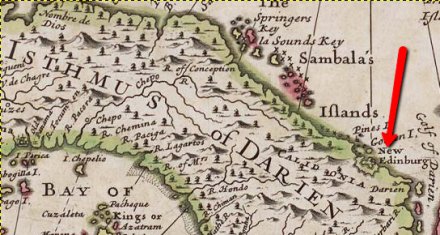
Mired in economic backwardness as neighboring European states carved up the world, Scotland made a bold, doomed bid for a chit in the empire game: the Darien scheme. One part visionary and (at least) two parts daft, this venture attempted to establish a Scottish colony on the Isthmus of Panama (aka the Isthmus of Darien) with a view to porting freight across the narrow strip of land separating Atlantic and Pacific, and dominating the dramatically more efficient east-west trade route that would result.
Students of the Panama Canal project will be aware that this malarial tropic would not be described as especially hospitable; to the natural disadvantages of the climate were added the political interpositions of England herself, whose hostility to the advent of her Caledonian neighbor as a New World rival was expressed in legislation choking the Darien adventure of foreign aid.
(Also a problem: Spain. The colony was abandoned at last under Spanish siege.)
So Scotland went it intrepidly, injudiciously alone in this last bid for real independent muscle in Europe. The hyperbole of the Isthmus’s publicists eventually sucked in 20 percent or more of the capital circulating in Scotland. And when Darien-dot-com went bust by 1700 at the cost of a couple thousand lives, it cratered the Scottish economy too. That set the stage for Edinburgh’s partnership in a different scheme: Great Britain.
Green with Envy
In the years following the Darien catastrophe, the Scottish corporation chartered to undertake it was still throwing stuff against the wall in the world trade game, trying to get something to stick to at least take the edge off the losses.
This company (theoretically a potential rival of England’s own East India Company) had suffered the further national indignity of having one of its ships, the Annandale, seized in the Thames for infringing the East India Company’s royal monopoly. Its appeals for redress falling on deaf ears, the Darien company apparently induced Scottish authorities to undertake the retaliatory seizure of an English merchant ship, the Worcester, that had the ill luck to weather a storm at the Firth of Forth.
Rumor soon connected this ship to another vanished Darien company vessel overdue from its return trip from the East Indies … and, as it quickly became understood by all right-thinking Scots, overtaken in the Indian Ocean by this same Worcester and its crew butchered.
Captain Thomas Green and his English crew were hailed before an Admiralty court** on piracy charges on this extremely fantastical connection in a virtual mob atmosphere.
It never was clearly established that an act of piracy had been committed as a distinct fact, but by putting certain circumstances together it was inferred that Green was guilty of piracy. The very shape in which the accusation is set forth, shows that the accusers could not point to the specific act of piracy which had been committed …
[There] was no specification as to the vessel taken, which might enable the accused to prove that it had not been taken; no names of parties murdered, who might be shown still to be alive; no ownership of cargo, which might admit of proof that the owner’s goods had arrived safe. As Green himself is made justly to say in the document published as his dying speech, “We are condemned as pirates and murderers on a coast far distant from this place — is there any of you who wants either a friend whom we have murdered, or whose goods we have taken?”
Worcester Sauce
The Worcester‘s Malabari cook provided a highly dubious charge — dubious, for he was not yet among the crew when it last called at the location he claimed the crime took place — of Green and crew hatchet-murdering approximately ten English-speaking mariners on an unnamed vessel off the Indian coast.
Upon this evidence, 14 or more members (the ready sources are a little loose on the total number) of the Worcester crew were condemned for piracy, and initially slated for three batches of hangings. Queen Anne‘s personal intervention managed a stay,
The Scottish Privy Council unto the very last hours debated what to do with the diplomatic appeals, with evidence forwarded from London to the effect that the crew these Worcester men had supposedly slaughtered were alive, their vessel having been hijacked in another place, by another man.
But a surging Scottish mob aggrieved by the preceding years’ misadventures and the impending shotgun marriage to Westminster rather than anything Green himself had really done was already engorged on the blood of the supposed English corsairs. Most of the Council thought better than to deny them their sacrifice.†
The Streets fill’d with Incredible Numbers of Men, Women and Children, calling for Justice upon those ENGLISH Murtherers. The Lord Chancellor Seafield‘s Coach happening to pass by, they stop’d it, broket he Sashes, haul’d him out, and oblig’d him to promise Execution should speedily be done before he could get from ’em … According to the Chancellors promise, soon after, on the same Day, being Wednesday, Captain Green, Madder [the mate], and Sympson [the gunner] were brought out, and convey’d to Execution, which was at Leith Road upon the Sands, and all the way was Huzza’d in Triumph as it were, and insulted with the sharpest and most bitter Invectives. Being come to the place of Execution, Good God! what a moving sight was it to see those Men stand upon the very Varge of Life, just launching in to Eternity, and at the same time see the whole Multitudet ransported with Joy!”
-From an anonymous Letter From Scotland To a Friend in London, quoted by James Kelly, “The Worcester Affair,” The Review of English Studies, Feb. 2000
In the event, these three were the only ones actually hanged; passions cooled enough for the other “pirates” to be quietly released.
But the wider, national passions unleashed by this date’s executions would long provide fodder for intemperate patriotic recrimination, and specifically anti-Unionist propaganda — on both sides of the border.
Competing propagandisticbroadsides framed and re-framed the events, as the affair of unscrupulous English buccaneers or perfidious highland barbarians. (Defoe, maneuvering for Union, wrote to chill such bad-for-business hostility: “Nothing could be more horrid, than that the Scots should Execute these Men on a meer Pique at the English Nation. Nothing can be more like it, than to conclude rashly, that it is so, and improve it on purpose to Exasperate our People against the Scots.” (Kelly))
And that, of course, is precisely the viewpoint that prevailed.
While the hemp neckties issued to Green et al this date threatened to (ahem) scotch the Union project, that very danger might have ultimately hastened its completion — as elites recognized, in Defoe’s words, that Union represented “the only way to preserve the publick Tranquillity, and prevent the certain Mischiefs that threatened the whole Body,” (Kelly, again) and rammed it through with dispatch.‡
‡ The ebb and flow of national resentment continued long after the Acts of Union, of course; continuing Scottish support for the restoration of the Stuart monarchy was one expression of Scottish nationalism and anti-Union sentiment.
This date in 1716 saw the beheading of two Jacobite lords, but it was more famous for the third who ducked the executioner in one of the Tower of London’s greatest escapes.
They were the fruit of Parliament’s impeachment of Jacobite leaders. Six of these fellows threw themselves upon the mercy of the Commons, and were rewarded with a death sentence by William Cowper. Only half managed to wrangle mercy from the crown.
On the eve of this date’s execution, Lord Nithsdale received a visitation of his wife, Winifred … who helped him swap clothes with one of her maids, in which garb he audaciously marched out the Tower gates in the train of his spouse.
The king whom Nithsdale had purposed to dethrone was a good sport about it. “It was the best thing a man in his condition could have done,” he declared.
The fugitives managed to cross the channel — that required another bit of dress-up, in the livery of the Venetian ambassador — and absconded to Rome. William Maxwell, Lord Nithsdale, outlived his appointment with the headsman by 28 years.
They are gone — who shall follow? — their ship’s on the brine,
And they sail unpursued to a far friendly shore,
Where love and content at their hearth may entwine,
And the warfare of kingdoms divide them no more.
Her reputation as a romantic heroine (only enhanced by the romantic futility of the Jacobite struggle itself) has lent itself to all manner of literary expropriation, like this 19th century historical novel.
All very well for these two lovebirds. But the remaining 67% of the day’s scaffold carrion did not escape the Tower in women’s clothing, or men’s, and paid with their heads as scheduled.
Derwentwater went out with a peevish scaffold a ballad, “Lord Derwentwater” (or “Lord Allenwater”, or several similar variants), and another aptly titled “Derwentwater’s Farewell”.
His partner at the chop, Lord Kenmure,** also made the folk playlist in “O Kenmure’s On And Awa, Willie”, one of the ditties gathered by Robert Burns.
Having beheld all these various exemplars, Derwentwater’s brother and fellow Stuart supporter Charles Radclyffe decided to emulate them all.
Later that same year, Charles Radclyffe also made a successful prison break and got to the continent.
As a result, he was still around to participate in the 1745 Jacobite rising … and finally get executed for that.
* It’s impossible not to notice that this cross-dressing escape foreshadows that of Bonnie Prince Charlie when the Jacobite cause flamed out for good thirty years later.
** And like Lord Nithsdale, he was also blessed with a perspicacious wife — albeit one who wasn’t able to extricate him from the Tower.


 It’s a surprising epitaph.