Oh Gentlemen, see, see dead Henrys wounds,
Open their congeal’d mouthes, and bleed afresh.
Blush, blush, thou lumpe of fowle Deformitie:
For ’tis thy presence that exhales this blood
From cold and empty Veines where no blood dwels.
Thy Deeds inhumane and unnaturall,
Provokes this Deluge most unnaturall.
There long persisted superstition* of ancient vintage that the wounds of a murder victim will bleed in the presence of the murderer.**
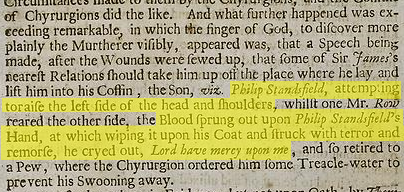
This date in 1688 saw the execution in Edinburgh of one Philip Standsfield (sometimes Stansfield or even Standfield) for parricide, his conviction being secured in part by the supposed accusation of his father’s corpse.
The prodigal firstborn of James Standsfield was an incorrigible scoundrel, and the state had a considerable circumstantial case to the effect that said scoundrel finally popped the old man to prevent disinheritance. (It also appeared that he’d tried to do it other times over the years.)
Circumstantial evidence is nice.
But how about some forensic evidence to really cinch a conviction? No DNA evidence here in the 17th century, so maybe something a little more … supernatural?
From A True Relation of a Barbarous Bloody Murther etc., available here.
The King’s Advocate insisted — over the objections of a defense attorney that “it was a superstitious observation, founded neither upon law nor reason” — that the corpse’s having bled on Philip Standsfield but none of the others in his party simultaneously attempting to move it “he must ascribe … to the wonderful Providence of God, who in this manner discovers murder.”
Divine forensics. That’s even better than the arson evidence Texas used to kill Cameron Willingham.
the said Philip Standsfield to be taken upon Wednesday next, being the 15th of February instant, to the Market-cross of Edinbrugh, and there, betwixt two and four o’clock in the afternoon, to be hanged on a gibbet till he be dead, and his tongue to be cut out and burnt upon a scaffold, and his right hand to be cut off and affixed to the east port of Haddingtoun, and his body to be carried to the Gallowlie betwixt Leith and Edinburgh, and there to be hanged up in chains; and ordains his name, fame, memory, and honours to be extinct, his arms to be riven forth and delete out of the books of arms …†
Well, you get the idea. Executed Today would like to apologize to the dempster of Edinburgh for keeping Philip Standsfield’s name, fame, and memory alive.
In our defense, we are hardly the only ones: this is thought to be the last time that Scottish law employed the bleeding-corpse “test”.
* Some other instances of purported “bleeding at the touch” may be perused here.
** In a 1927 piece in the Journal of the American Institute of Criminal Law and Criminology, Canadian jurist William Renwick Riddell says this folk belief “was wide spread and is not dead yet” and offers in a footnote (perhaps by way of explaining his interest) that “when at the Bar, I was once offered such evidence by my client; but I declined to use it.”
† The execution was botched, and the gibbeted body illicitly pulled down and tossed in a ditch — which is where the elder Standsfield’s had been discovered.
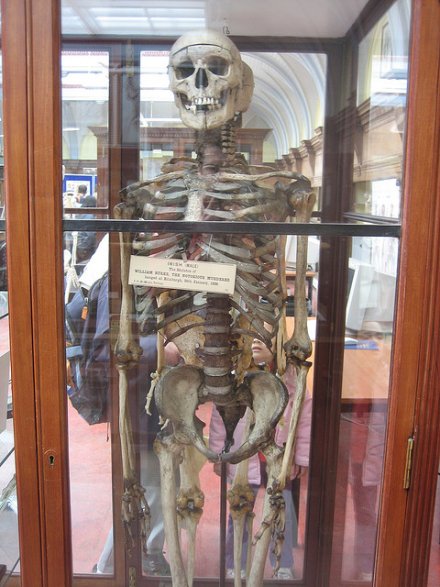
Wanted: corpses. Apply to Doctor Robert Knox, MD, FRSCEd, Professor of Medical Studies, Barclay’s Medical College, Surgeon’s Square, Edinburgh. Reference William Burke, hanged Jan. 28, 1829.
Robert Knox was a noted physician in his prime, in the early 1800s.
A surgeon, anatomist, and zoologist, Knox studied anatomy in London, then headed off to Africa in the army. Field surgery was a brutal business, and the poor anatomical knowledge at the time made it even more terrifying for those involved.
In 1821, Knox moved to France to work in the shadow of his heroes, Georges Cuvier and Étienne Geoffroy Saint-Hilaire; a year later, he was back in Edinburgh, making himself a career academic.
When his old professor came calling in 1826 with an opportunity to teach at Surgeon’s Square in Edinburgh, Knox jumped at the chance. As a partner to Barclay and curator of the school’s museum, Knox was well aware of the significant problem that faced the school: corpses were hard to come by.
And since the Royal College of Surgeons at Edinburgh certified the school as a prep course for entrance to University, coming up with bodies became a very important task.
If there’s one way to ruin your career, it’s to be caught paying a few pounds for fresh murder victims.
So it was for Knox, who gave out 7 pounds, 10 shillings for the body of an itinerant lodger who died in William Burke’s building in 1827.
This transaction led Burke to realize that such lodgers weren’t paying as much alive as dead. As a collector of bodies, Knox also had a strict no-questions-asked policy, and Burke and his partner William Hare exploited that to its fullest extent.
Almost a score of suspicious bodies later (and after the price had inflated to 10 pounds per), the pair was found out, given away as suspects by the lame and mentally disabled “Daft Jamie” Wilson, then caught when the late Marjory Campbell Docherty was found by a fellow tenant under one of Burke’s lodge’s beds.
Hare copped to a string of murders* and played stool pigeon in exchange for a lighter sentence.
Burke went to the gallows to “vehement cheering from every quarter, mingled with groans and hisses.” (London Times, Feb. 2, 1829)
“When the cheers had subsided, the wretched man was assailed with every epithet of contempt and abhorrence,” the Times continued. “Not a single indication of pity was observable among the vast crowd: on the contrary, every countenance wore the lviely aspect of a gala-day.”
William Burke’s hanging.
As a corpse himself, Burke made one final contribution to science’s insatiable desire for bodies: his cadaver went straight from the gallows to the practiced hands of one Dr Alexander Monro, who performed a complete lecture while dissecting the murderer’s corpse.
Knox, for his part, paid not with his neck but with his reputation.
Though never charged with a crime, the doctor was run out of the the lecturing business, first by subtle and not-so-subtle actions by the University, and eventually by the passage of the Anatomy Act of 1832.
He was also unable to obtain any surgical post after the incident and spent his later years writing academic books and papers, none of which have lasted like the doggerel that shadowed his steps.
Burke’s the butcher, Hare’s the thief,
Knox, the boy who buys the beef.
A few books about Burke and Hare
Anatomy of Anatomy
Robert Knox was operating under the Murder Act of 1751, which expressly forbade the burial of an executed murderer while permitting the malefactor’s dissection.
The Act had the dual effect of allowing the state to gibbet executed criminals (both hanging in chains and dissection were considered an added ignominy, beyond the punishment of the gallows), and of supplying the budding medical community with an immediate source of fresh bodies.
As courses in anatomy became more commonplace, though, the need for cadavers increased dramatically, and the business of selling bodies for science was born.
Typically, these sales manifested themselves in body-snatching — wherein “resurrectionists” illicitly exhumed a freshly buried corpse and conveyed it to some physician’s ready scalpel.
This grim trade in turn spawned a variety of security measures. The favored dead were defended by fences, watchtowers, and human lookouts. But nothing could eliminate the industry.
In particular, those with little money or no immediate relatives were unlikely to be buried in these gated graves; that left their remains ripe for the remaindering. As well, the increase in demand made so-called anatomy murder a possibility. Burke and Hare may have been notorious for the offense,** but they did not invent it.
In that case, two nurses (Jean Waldie and Helen Torrence) on death watch bartered a decent price of two shillings to sell the body of an ill child to a local surgical college. His death was delayed, and the nurses smothered him, possibly through simple carelessness.
Shortly after the Murder Act, simple economics made pikers of Torrence and Waldie. In the 17th century, England executed hundreds of prisoners a year, each a potential dissection. As Dr D.R. Johnson writes in his Introductory Anatomy:
The dissections performed on hanged felons were public: indeed part of the punishment was the delivery from hangman to surgeons at the gallows following public execution, and later public exhibition of the open body itself. …
Agents representing surgeons would bargain with condemned prisoners not under sentence of dissection (remember this only happened for murder: hanging was in vogue for stealing a sheep or even a loaf): occasionally prisoners struck a bargain to pay expenses, to provide for a family or to buy the customary decent apparel for the hanging.
Supply was unreliable, however: riots at public hangings became common, partly because of the paltry nature of hanging events, partly from superstition. The body was often reclaimed by relatives and the unpopular anatomists stoned, defeated and out of pocket. Competition was often so fierce that a rival anatomy school carried off the body.
Dissection was unpopular and other medical uses were to be found for a recently hung body – the cure of scofula, goitre, wens, ulcers, bleeding tumours, cancers and withered limbs for example. To prevent riots and disorder the Sheriff of London took all bodies of hanged men, except those sentenced to dissection, into his own custody and handed them to the relatives for burial.
Human Trafficking
Hanoverian Britain sure did keep the gallows busy. But the pace of hangings had abated by the 19th century just as demand boomed. The math didn’t add up.
Anatomy schools (officially) dissected some 592 corpses in 1825; at the time of the Burke and Hare murders, only about 50 executions were carried out annually, and each college was guaranteed just one a year.
That meant a shortfall of close to 550 bodies. With limited supply and significant demand, surgical colleges and anatomical lecturers were willing to pay top dollar for new cadavers … and the anatomical murder business really got legs.
And while the execution of Burke was met with applause from the community, in London, another group was already hard at work both body snatching and murdering its way into the classroom.
The London Burkers were caught in 1831 and convicted of murdering a 14-year-old whose cadaver they sold to St Bartholemew’s Hospital for 9 guineas.† The killers, Thomas Williams and John Bishop, had offed several others prior to the lad in question, making about the same price on each body.‡ In the grand, Burkean tradition of anatomical murderers, these miscreants were also dissected after their execution.§
Williams and Bishop were just two of a group of resurrectionists known collectively as the London Burkers, who claimed to have stolen upwards of 1,000 bodies from nearby cemeteries. That made the Burkers the largest known exploiters of the anatomical trade.
Over the decades after the Murder Act, though, resurrectionists were walking a dangerous line in their communities.
Reverence for the dead sparked community outrage when graves were found empty or disturbed, and it was often the anatomists themselves who felt the wrath of crowds.§§ In Glasgow in 1803, surgeons were threatened by an unruly mob and were forced to seek police protection; in 1813, an empty grave caused a similar furor. Punishments moved from fines to jail time as the surging demand made body-snatching an ever more lucrative trade.
A few books about body-snatching
By the time of the Burkers, anatomists were generally presumed to be body thieves in some capacity, a hostile sentiment graphically underscored during the Aberdeen riots of 1831. When a dog unearthed what looked like a human bone behind the Aberdeen surgical college, a mob coalesced and stormed the lecture hall.
The lecturer (“Dr Moir” — little else is known about the man) fled in terror as the hall was burned to the ground. Soldiers and police clashed with the crowd, which was thought to be over 10,000 strong. Hours later, the riot subsided, but Aberdeen was no longer a friendly place for a prospective medical talent.
And where Burke and Hare were still not quite sufficient to convince the House of Lords to take up a measure providing anatomists with alternatives for corpse acquisition, the Burkers and the Aberdeen riots apparently were.
The underground economy of resurrectionists was supplanted by the Anatomy Act of 1832, which allowed individuals to donate themselves or their unwilled kin to science for a pittance of compensation.
Anatomy murder is, of course, still the subject of horror movies. Like this one, or for the more classically inclined, this 1945 Boris Karloff/Bela Lugosi vehicle adapted from a Robert Louis Stevenson story inspired by Burke and Hare:
* The murders included at least one husband/wife pair, a mother and, later, her (adult) daughter, and a grandmother and her young grandson. They are also known as the West Port Murders.
** Burke entered the English language as a verb meaning … well, pretty much exactly what Burke got up to.
Dr. Murray, in the new English Dictionary, gives the following definition of the verb to ‘burke.’ ‘To murder in the same manner or for the same purpose as Burke did: to kill secretly by suffocation or strangulation, or for the purpose of selling the victim’s body for dissection,’ and the familiar lines are quoted from the Ingoldsby Legends: —
But when beat on his knees, that confounded De Guise
Just whipped out the “fogle” that caused all the breeze,
Pulled it tight round his neck until backwards it jerked him,
And the rest of the rascals jumped on him and burked him.
† 9 pounds, 9 shillings; by the time of the transactions, the guinea was no longer technically in use, but the term had stuck at the 21-shilling mark.
‡ Over the course of their 6 active months, the pair went from asking 8 guineas to asking 12 guineas; apparently 9 was the negotiated price with St Bartholemew’s.
§ The Burkers are the subject of the song “The Resurrectionist” by the Pet Shop Boys. (Lyrics)
§§ Edinburgh also had trouble as far back as 1742, when several surgeons’ homes were attacked by locals; a local beadle suspected of the crimes also had his home, dubbed resurrectionist hall, burned during the mob incident.
Of John Stewart, who was executed within the Flood-
Mark at Leith, upon the 4th January 1721, for
the Crime of Piracy and Robbery.
UPON the 28 Day of March, one Thousand seven Hundred and Ninteen Years ; I Sailed from Dartmouth in England, in the Ship, called, the Mark de Campo, belonging to Ostend, Captain Mathias Garribrae Commander, in Order to make a Voyage to Guinea, and Mosambequie in the East-Indies; and having in some short Time thereafter arrived upon the Cost of Guinea; We hapned to our sad Misfortune upon the 2d Day of June next, thereafter, to be taken by a Pirate Ship, commanded by Captain Davies;* after we had made what Resistance we could, they compelled me and several others out of our Ship to go along with them; and upon our Refusal threatned to puts us immediatly to Death, or leave us upon some Desolate Island, which was nothing better than Death; and I refer it to every ode to Judge, whither or not any Man would have preferred immediat Death to go along with them, while there remained some Hopes of making an Escape, which I and those that were taken with me still endeavoured, and made several Attemps to Effectuat.
And I do solemnly Declare as a dying Man, that whatever I did while I was Aboard of the Pirate Ship, was by Force, and upon the Peril of my Life; and that I and these taken With me, are not only Innocent of What is laid to our Charge, but during the Time We Was Aboard of them, I never seed them wrong Man, Woman or Child; and I with several others having at last made our Escape, We Sailed for Britain, with no other Design but to free and clear our selves from the Tyranny of those Pirates, that had detained so fair contrary to our Inclinations; and having landed in the West of Scotland, every Body knew how we have been treated since that Time, and I might have purchast my Life, had my Conscience allowed me to Comply with the Sollicitation of them, who would have had me appear as an Evidence against those that were as Innocent as my self, but I never could think of Saving my Life at so dear a Rate.
And for the Judge and Jury I shall not Reflect on them, but do declare that I am Innocently put to Death, as to the Crimes for which I am condemned; And beg GOD Almighty that he may not lay this Innocent Blood to their Charge, but forgive them as I do. And begs GOD may forgive my other Sins, (through the Merits of JESUS CHRIST my only Redeemer) which has been the Cause of this Dismal Death.
Into thy Hands, O GOD, I recommend my Spirit.
EDINBURGH, Printed by Robert Brown in Forrester’s-Wynd, 1721.
(From the National Library of Scotland’s Digital Library here.)
* Stewart apparently refers to the Welsh buccaneer Hywel Davies, aka Howell Davis, and this story of hijacking would put Stewart in some pretty august company: it was approximately this time and area that the Davies crew captured the slave ship Princess carrying third mate Bartholomew Roberts, who was pressed into navigational service for the freebooters.
Davies was killed in another pirate adventure later that same month of June 1719, and Roberts was elected to succeed him despite being only a few weeks aboard the ship. The latter went on to one of the most illustrious raiding careers in the Golden Age of Piracy … the original Dread Pirate Roberts.
On this day in 1818 in Edinburgh, Scotland, 22-year-old Robert Johnston faced capital punishment for the robbery of a candlemaker. The authorities were nothing if not zealous: that day, Johnston would be hanged no less than four times.
Alex Young, in his book The Encyclopaedia of Scottish Executions 1750 to 1963, provides an account of the gruesome debacle that was Robert Johnston’s execution:
After praying and shaking hands with the clergymen, he mounted the scaffold and looked boldly around him, before helping the executioner adjust the rope, and giving the signal.
The drop fell – but the excessively short length of rope enabled him to stand on the platform. As the Magistrates ordered carpenters to cut a wider opening, cries of “Murder” came from the crowd.
The cries were followed by a shower of stones, which sent the Magistrates and the carpenters to the shelter of the Tolbooth Church doorway, through which they passed into the police office.
Almost every window glass in the church suffered from the stones, as did Johnston who had been abandoned on the platform.
“Cut him down—he’s alive!” rang out, as the crowd took possession of the scaffold. Johnston, despite hanging many minutes, was alive, and after taking the rope from his neck and arms and the cap from his head, he was carried off towards High Street. The scaffold structure proved too robust, but Johnston’s waiting coffin was broken up and thrown through the church windows.
The police and military combined forces to wrest the hapless Johnston from his would-be saviors and took him, unconscious, to the police office, where a surgeon bled him until he was determined fit to be re-hanged.
This time Johnston was carried by six men and the scaffold, surrounded by soldiers.
Again the executioner made a bungle of it. The rope was now too long and Johnston had to be lifted while the rope was shortened by winding it around the hook.
Again, shouts of “Murder!” and “Shame! Shame!” rang out, and only the military presence prevented another riot. Johnston struggled for many minutes before passing into eternity.
The next day, the Magistrates fired both the master of works and the executioner, who was named John Simpson. They also issued a fifty-guinea reward for information leading to the identification of Johnston’s rescuers. It went unclaimed.
If there’s one thing King James VI of Scotland (eventually to also become James I of England) worried a lot about, it was witches.
The Al Qaeda of the 16th century imagination, those shadowy yet omnipresent necromancers were especially feared around this time for their powers of supernatural mayhem, and you can take your pick on the phenomenon’s psychosocial explanation. (It washardlylimitedto Scotland.)
THE fearefull aboundinge at this time in this countrie, of these detestable slaues of the Deuill, the Witches or enchaunters, hath moved me (beloued reader) to dispatch in post, this following treatise of mine, not in any wise (as I protest) to serue for a shew of my learning & ingine, but onely (mooued of conscience) to preasse / thereby, so farre as I can, to resolue the doubting harts of many; both that such assaultes of Sathan are most certainly practized, & that the instrumentes thereof, merits most severly to be punished: against the damnable opinions … not ashamed in publike print to deny, that ther can be such a thing as Witch-craft.
In 1589, Jamie sailed to Denmark to wed a Danish princess. When ferocious storms nearly wrecked the royal convoy on its return trip, there was only one possible explanation: witchcraft. And security theater for 16th century Scotland wasn’t taking your shoes off when ferrying across the nearby loch — it was publicly burning human beings to death for consorting with the devil.
So once the king made it back home, he initiated the North Berwick Witch Trials, the first notable witch-hunt of his reign.
It was what you’d expect. Seventy people accused, the doomed tortured into confessions like Jack Bauer would do, and a respectable harvest of souls, most famously (because interrogated by the king himself) Agnes Sampson. “Most of the winter of 1591,” writes one chronicler, “was spent in the discovery and examination of witches and sorcerers.”
Our day’s principal, whose name has various different renderings (such as Eufame Mackalzeane), was the last to suffer for some months.
Euphan McCalzeane was a lady possessed of a considerable estate in her own right. She was the daughter of Thomas McCalzeane, lord Cliftenhall, one of the senators of the college of justice, whose death in the year 1581 spared him the disgrace and misery of seeing his daughter fall by the hands of the executioner. She was married to a gentleman of her own name, by whom she had three children. She was accused of treasonably conspiring of the king; of raising storms to hinder his return from Denmark; and of various other articles of witchcraft. She was heard by counsel in her defense; was found guilty by the jury, which consisted of landed gentlemen of note; and her punishment was still severer than that commonly inflicted on the weyward sisters; she was burned alive, and her estate confiscated. Her children, however, after being thus barbarously robbed of their mother, were restored by act of parliament against the forfeiture. The act does not say that the sentence was unjust, but that the king was touched in honour and conscience to restore the children. But to move the wheels of his majesty’s conscience, the children had to grease them, by a payment of five thousand merks to the donator of escheat, and by relinquishing the estate of Cliftonhall, which the king gave to sir James Sandilands, of Slamanno.
As a striking picture of the state of justice, humanity, and science, in those times, it may be remarked, that this sir James Sandilands, a favourite of the king’s, ex interiore principis familiaritate, who got this estate, which the daughter of one lord of session forfeited, on account of being a witch, did that very year murder another lord of session in the suburbs of Edinburgh, in the public street, without undergoing either trial or punishment. (Source
Like any number of other executed “witches,” this one professed innocence at the scaffold.
Before she was strangled and burnt, the poor woman “tooke it on her conscience that she was innocent of all the crymes layed to her charge.”
Inscription on a marker on the road from Kirkintilloch to Kilsyth* in Scotland:
In this field lies the corpse of John Wharry and James Smith, who suffered in Glasgow, 13 June 1683, for their adherence to the Word of God, and Scotland’s Covenanted Work of Reformation: ‘And they overcame them by the blood of the Lamb, and by the word of their testimony; and they loved not their lives unto the death'” (Rev. xii. 11)
Halt, courteous passenger, and look on
Our bodies dead, & lying under this stone.
Altho’ we did commit no deed,** nor fact
That was against the Bridegroom’s contract,
Yet we to Glasgow were as prisoners brought,
And against us false witness they sought.
Their sentence cruel and unjust they past,
And then our corps on scaffold they did cast.
There we our lives and right hands also lost.
From Glasgow we were brought unto this place
In chains of iron hung up for certain space.
Then taken down interred here we ly–
From ‘neath this stone our blood to heaven doth cry.
Had foreign foes, Turks, or Mahometans,
Had Scythians, Tartars, Arabian Caravans,
Had cruel Spaniards, the Pope’s blood seed,
Commenced the same, less strange had been the deed;
But Protestants, profest our Covenants to,
Our countrymen, this bloody deed could do.
Yet notwithstanding of their hellish rage
The noble Wharry stepping on the stage
With courage bold and with a heart not faint,
Exclaims, This blood now seals our covenant–
Ending, They who would follow Christ should take
Their cross upon their back, the world forsake.
The probability is, that what is called on the new stone “the old tombstone” is not much older than this [the 19th] century, and that it is the successor of an older one on which may have been inscribed the following epitaph:
Halt, passenger, read here upon this stone
A tragedy, our bodies done upon.
At Glasgow Cross we lost both our right hands,
To fright beholders, th’ enemy so commands;
Then put to death, and that most cruelly.
Yet where we’re slain, even there we must not lie,
From Glasgow town we’re brought unto this place,
On Gallow tree hung up for certain space.
Yet thence ta’en down, interred here we lie
Beneath this stone; our blood to heaven doth cry.
Had foreign foes, Turks or Mahometans,
Had Scythian Tartars, Arabian caravans,
Had cruel Spaniards, the Pope’s bloody seed,
Commenc’d the same, had been less strange their deed.
But Protestants, once Covenanters too,
Our countrymen, this cruel deed could do:
Yet, notwithstanding this, their hellish rage,
The noble Wharrie leapt upon the stage.
With courage bold, he said, and heart not faint,
‘This blood shall now seal up our covenant,’
Ending, ‘they who would follow Christ, should take
‘Their cross upon their back, the world forsake.'”
** Smith and Wharrie, apparently uninvolved civilians, were seized as the nearest available guys to punish after a Covenanter guerrilla attack near Inchbelly Bridge.
On this date in 1723, Margaret Fleck was hanged in Glasgow for murdering her infant child.
According to “The Last Speech and Confession of Margaret fleck who was Executed at the Howgate-Head of Glasgow on the 5th of June for the Murdering of her Own Child”* (it does what it says on the tin):
I am brought this day, and that justly, to suffer for the murder of my own child, and I doubt not but that it will be expected, and I think it most proper and my indispensable duty, that as I have sinned so heinously against God, so I should glorify him by repenting my unnatural, atrocious and bloody fact — the murder of mine own child … For which crime, and all my other sins I desire heartily to mourn, and to fly to the fountain that is opened to the House of David and the Inhabitants of Jerusalem for sin and uncleanness; and I desire to take shame and confusion of face to my self for my sins and iniquities, especially for the bad entertainment I gave to the gospel of Christ.
At the time, death sentences in Scotland had to be pronounced not only by the judges but by the dempster, a juridical office responsible for the actual execution.
Major League Baseball pitcher Ryan Dempster: would he hang Margaret Fleck?
In this case, dempster Thomas Cochran refused to join the sentence, evidently partaking in a popular discomfort with Fleck’s hanging. Nothing daunted,
their Lordships having desired the Sheriff Depute to provide another Dempster instantly, or else to do it himself, he craved their lordships might delay the same till the next day, against which time he should have one provided. Which being condescended to by their Lordships, they continued pronouncing of sentence against the said Margaret Fleck till to-morrow at nyne o’clock; with certification that if the Sheriff Depute did not provide a Dempster against that time, they would oblige him to do it himself …
The Sheriff Depute wriggled off the hook when a guy named Robert Yeats stepped up and did the Dempstering.
* As cited by Anne-Marie Kilday in “‘Monsters of the Vilest Kind’: Infanticidal Women and Attitudes to their Criminality in Eighteenth-Century Scotland,” Family & Community History, Nov. 2008.
Kilday observes that “pamphlet material relating to deviant behaviour … became popular sooner [in Scotland than in England], with publications beginning in earnest in and around 1702, nearly three quarters of a century ahead of publishers south of the Tweed. In addition, it was unquestionably infanticide (and latterly child killing in general), more than any other crime, which became the focus for the pamphlet literature produced.”
On this date in 1591, Scotsman John Dickson was condemned to death (which he immediately suffered) for murdering his father.
“The criminal record,” observes this volume of Scottish crime, “contains neither the particulars of the murder, nor the evidence against the prisoner.”
What is particular to this case is the method of execution: the breaking-wheel, or something very similar to it, a tortuous death used throughout continental Europe but that never caught on in the British Isles.
John Dickson, younger of Belchester, being apprehended, ta’en, and brought to Edinburgh, was put to the knawledge of ane assize for the slaughter of his awn natural father [in July 1588], and also for the lying for the said offence at the process of excommunication. [Being convicted, he was] brought to the scaffold, and at the Cross broken on ane rack, [and] worried—where he lay all that night, and on the morn [was] carried to the gallows of the Burgh-moor, where the rack was set up, and the corpse laid thereupon. (Passage from here or here.)
Dickson’s is the first of only two such “breaking” death sentences, in which the doomed is staked out spread-eagled and has his limbs shattered one by one, documented in Scotland. (The other is that of Robert Weir in 1604; an assassin in 1571 “is said, also” to have suffered such a fate, but actual documentation has been lost.)
Unprincipled, octogenarian Scottish noble Simon Fraser,* Lord Lovat was on this date in 1747 the last to lose his head on Tower Hill.
The Clan Fraser patriarch was an expert double-dealer from his youth in Restoration England — when he recruited a small regiment in nominal service to William and Mary but allegedly plotting to desert to the Stuarts at the opportune moment.
That moment never came … and the Stuarts’ fruitless quest for it in the decades to come would eventually claim the Lord Lovat.
But first up: a long life of opportunistic, frequently reprehensible political maneuvering.
He kidnapped, raped, and forcibly married a woman from a rival clan in order to gain claim on a contested succession (Lovat had to flee the country, a death sentence in absentia at his heels)
He expediently converted to Catholicism to get in with the exiled Stuarts and their continental allies
He forged incriminating documents in an unsuccessful bid to undermine rival nobles
He played both sides of the Hanover-Stuart intrigue, ingratiating himself with both Jacobites and London during the 1715 rising. He did this so adeptly that George I served as Lovat’s son’s godfather
When the Jacobites decided to double down on doomed risings in 1745,** this wily knave finally managed to commit himself to the wrong team at the wrong time. Hey, everyone should be allowed one fatal mistake every 80 years or so. (Read all about those years in this public-domain biography.)
Though Lovat was so infirm he had to be borne on a litter, his military acumen would have been worth the rebels’ while had they possessed the muscle to get into a fair fight.
But they didn’t, and Lord Lovat was captured in the undignified circumstance of being stashed in a tree, and at length fitted for a no less undignified trial.
He could neither walk nor ride, as he was almost helpless; he was deaf, purblind, eighty years of age, ignorant of English law, and it was therefore not a matter of surprise that the high-born tribes, who thronged to his trial, were disappointed in the brilliancy of his parts, and in the readiness of his wit. “I see little of parts in him,” observes Walpole, “nor attributed much to that cunning for which he is so famous; it might catch wild Highlanders.” … It appeared, indeed, doubtful in what form death would seize him first, and whether disease and age might not cheat the scaffold of its victim.
Oh, well.
Only the good die young.
By his public life, he has left an indelible stain upon the honour of the Highland character, upon his party, upon his country.
* Not to be confused with the Canadian explorer for whom British Columbia’s Simon Fraser University is named.
** The 1745 rebellion spawned a popular patriotic song that became the national anthem: “God Save the King/Queen”.
One of the tune’s impolitic verses you won’t hear performed at glitzy official ceremonies (or much of anywhere at all) is this nationalist blast at the Jacobite party:
Lord grant that Marshal Wade
Shall by thy mighty aid
Victory bring
May he sedition hush,
And like a torrent rush
Rebellious Scots to crush
God save the King.
All of which, one supposes, gives Simon Fraser claim to a spot in the fine print of the credits for the song, and for that matter, for the Sex Pistols’ riposte.
Q. Why is divorce so expensive?
A. Because it’s worth it!
This date brings us a cautionary parable of the dangers of wedlock.
John Chiesly (or Chiesley, or Cheisly), an ill-tempered bloke with a wife he’d wished to put aside, had been ordered in arbitration to support her (and their 11-strong brood) to the tune of a £93 annuity.
Chiesly had a counteroffer to this liberal award: he shot dead the magistrate, Sir George Lockhart, the highest-ranking judicial officer in Scotland.* And he did it in broad daylight, making no attempt to fly.
“I have taught the President how to do justice,” Chiesly boasted as he was arrested.
That was on March 31, 1689.
On April 1, he was tried and convicted (torture was authorized “for discovering if ther were any accomplices, advysers, or assisters to him in that horrid and most inhumane act … yet the samen shall be no preparative or warrand to proceed to torture at any tyme hereafter, nor homologatione of what hes bein done at any tyme bypast”).
On April 3, he was drawn to execution at either Drumsheugh or at the Gallowlee, had the offending right hand cut off while still alive, then was hanged in chains with the murder weapon around his neck.
Then his spirit went on to haunt Dalry as “One-Armed Johnny,” until his remains were discovered and properly buried in 1965.
Still.
If you think this guy had relationship issues, consider the fate of his daughter, Rachel.
When her husband tried to ditch her, the woman now known as Lady Grange stalked him so relentlessly that Lord Grange kidnapped her, faked her death, and held her secretly imprisoned in the Hebrides for 15 years. (More in this pdf)
Now that is an expensive divorce.
* Chiesly’s murder orphaned George Lockhart, later a notable anti-union politician; George’s brother Philip Lockhart was himself executed for the 1715 anti-Hanoverian Jacobite rising.

 Almost a score of suspicious bodies later (and after the price had inflated to 10 pounds per), the pair was found out, given away as suspects by the lame and mentally disabled “Daft Jamie” Wilson, then caught when the late Marjory Campbell Docherty was found by a fellow tenant under one of Burke’s lodge’s beds.


 The Clan Fraser patriarch was an expert double-dealer from his youth in Restoration England — when he recruited a small regiment in nominal service to
