On this date in 1950, Milada Horakova was hanged with three others in Prague’s Pankrac Prison as a spy and traitor to the Communist Czechoslovakian government.
Not (yet) as internationally recognizable as Rudolf Slansky,* the Communist General Secretary in Horakova’s time who would run afoul of Stalin and die on the same gallows two years later, Horakova (English Wikipedia page | Czech | the detailed French) is a potent symbol domestically of her country’s Cold War nightmare.
Lawyer, social democrat, and a prominent feminist in the interwar and postwar periods — her life’s work, rather overshadowed by an end that was memorable for different reasons — Horakova survived Nazi imprisonment and was a member of parliament when the Communists seized power in 1948.
She spurned counsel to flee the country, and found herself the headline attraction at a show trial for a supposed plot to overthrow the government. In a hopeless scenario, she distinguished herself with off-script defiance despite having broken under torture and signed a confession; Albert Einstein, Winston Churchill and Eleanor Roosevelt all pleaded in vain for clemency.
Horakova left the world clear in her purpose. In a letter to her teenage daughter awaiting execution, she justified her own dangerous choices:
The reason was not that I loved you little; I love you just as purely and fervently as other mothers love their children. But I understood that my task here in the world was to do you good … by seeing to it that life becomes better, and that all children can live well. … Don’t be frightened and sad because I am not coming back any more. Learn, my child, to look at life early as a serious matter. Life is hard, it does not pamper anybody, and for every time it strokes you it gives you ten blows. Become accustomed to that soon, but don’t let it defeat you. Decide to fight.
Hours before her hanging, she wrote a few last words for her loved ones:
I go with my head held high. One also has to know how to lose. That is no disgrace. An enemy also does not lose honor if he is truthful and honorable. One falls in battle; what is life other than struggle? (Both excerpts cited here)
The only woman among Czechoslovakia’s postwar political executions was abortively rehabilitated during the 1968 Prague Spring. Since the fall of the Iron Curtain, her resistance to both Naziism and Communism — worthy of an opera (topical interview) and a forthcoming film — have elevated her into her country’s official pantheon.
As a result, this date is “Commemoration day for the victims of the Communist regime” in the Czech Republic.
Meanwhile, Horakova’s now-octogenerian prosecutor Ludmila Brozova-Polednova, whose repulsive legal barbs at trial (“Don’t break her neck on the noose. Suffocate the bitch — and the others too.”) were probably the consequence of the foregone conclusion more than the cause, was convicted late last year for her role in the trial. That verdict has kept in the news these past several months — most recently, the Czech Supreme Court returned it for retrial after an appeals court overturned the sentence — a tangible symbol of the challenges inherent to confronting the past. (Brozova-Polednova, for her part, is unapologetic.)
* One of the goons who tortured confessions out of the conspirators in Horakova’s “terrorist center,” Karel Svab, was among those later hanged with Slansky.
On this date in 1953, Julius and Ethel Rosenberg were put to death in Sing Sing’s electric chair as Soviet spies.
Divisive since it was handed down — or more precisely, since a famous article in London’s Guardian challenged the verdict and helped elevate it into a latter-day Dreyfus case — the Rosenbergs‘ sentence has inspired so much acrimony over several generations that merely to observe the date is to invite a debate capable of eminently more heat than light.
Where to begin with a case so towering in the recent cultural milieu?
A textbook might say that Julius and Ethel were convicted of passing atomic secrets to the Russians, that they maintained their innocence and their defenders carried that flame years after their deaths, and that intelligence files opened after the Cold War — notably the Venona project — apparently confirmed that Julius was a spy after all, though Ethel seems to have been little more than an approving bystander and Julius, come to think of it, never had anything so worthwhile as atomic secrets to share with Moscow. This information (which does have its own skeptics, albeit a small minority) undermines the maximal “absolute innocence” position that this day’s victims always asserted, but it’s a curious leap to take it as vindicating the legal outcome.
“My husband and I must be vindicated by history; we are the first victims of American fascism.”
Half a century on, juridical guilt or innocence seems distinctly secondary in the lasting importance of the Rosenberg trial, the two-year battle to save them, and their potent symbolic afterlives.
The Rosenbergs are the only stateside judicial executions for espionage since the Civil War.* That is a remarkable distinction, after all; so, how comes it that it is held by — to state the case against them in its strongest imaginable terms — two enthusiastic but bush-league players, and not by the likes of Aldrich Ames? How was it that a judge with a largely center-liberal career on the bench would read them a sentence of death hysterically accusing these Lower East Siders of causing the Korean War?
[Y]our conduct in putting into the hands of the Russians the A-bomb years before our best scientists predicted Russia would perfect the bomb has already caused, in my opinion, the Communist aggression in Korea, with the resultant casualties exceeding 50,000 and who knows but that millions more of innocent people may pay the price of your treason.
…
I feel that I must pass such sentence upon the principals in this diabolical conspiracy to destroy a God-fearing nation, which will demonstrate with finality that this nation’s security must remain inviolate; that traffic in military secrets, whether promoted by slavish devotion to a foreign ideology or by a desire for monetary gains must cease.
It is here in the age of McCarthyism, in the shadow of the USSR’s balance-altering A-bomb test in 1949, that the Rosenbergs stand in sharpest relief — not because of “guilt” or “innocence”, but as the ne plus ultra of that era’s range of social discipline.
A few years before, the United States and the Soviet Union had made common cause against Hitler in World War II, the United States pumping war materiel to Russians bearing the brunt of the fighting.
No longer operative.
The Communist Party USA enjoyed membership rolls pushing six figures; other socialist parties and movements had found niches in American life in the interwar years.
As the Great War gave way to the Cold War, the great powers remained nominal allies (that’s the reason the Rosenbergs weren’t tried for treason), but shifted rapidly into conflict. The American polity organized to expel the red menace by rendering it foreign and criminal — ideological rigging for the forty years’ imperial contest ahead. Loyalty oaths, blacklists, the House Un-American Activities Committee … in the whole of the self-conscious construction of communism as “contagion”, the power and willingness of the state to kill Julius and Ethel Rosenberg formed the tip of the spear, and an ugly contrast to that same state’s solicitous handling of Nazi scientists then developing the vehicles to deliver atomic technology to Moscow in mushroom cloud form.
Though different in many particulars, the thrust will be familiar to any sentient denizen of post-9/11 America: the extreme penalty enforces a wall between the suspect and abject (but tolerated) loyal liberal and the enemy left. Depend upon Ann Coulter for the most brutal articulation:
We need to execute people like John Walker [the American-born soldier captured fighting for the Taliban in 2001] in order to physically intimidate liberals, by making them realize that they can be killed, too. Otherwise, they will turn out to be outright traitors.
Like most symbols, the Rosenbergs came by their exaltation by accident; at the strictly personal level, their deaths are nearly operatic performances of human stubbornness and bureaucratic inertia. Investigators rolling up a spy ring** were looking for confessions and names to keep the indictments coming.
Julius refused to provide either, so his wife was arrested for leverage against him on the reasoning that he would confess to protect her. The gambit failed: both prisoner and hostage remained obstinate. The government’s bluff had been called, and it ruthlessly executed its threat.
Had the two really been responsible for starting a war, execution would hardly begin to cover the bill — yet to the very foot of the chair, the condemned, and Julius especially for the sake of his wife, were pressed with offers of mercy for confessing and “naming names”.
Abjure or expire: show trial logic.
[audio:Julius_and_Ethel_Rosenberg.mp3]
An Execution in the Family
Given names to name, the personal mystery of their silence — the ultimate heroism or folly or tragedy or transcendence — only deepens the resonance of their fate both for contemporaries and posterity, the poignance of their orphaned children’s subsequent path, the contrast with Ethel’s brother David Greenglass who has since admitted to perjuring testimony against Ethel in order to shield his own wife. (Greenglass says the Rosenbergs died from the “stupidity” of not copping a deal of their own.)
Even before Julius and Ethel went to the chair this date,† they had become the emblem of a paranoid age. In the days following, Sartre savaged the United States for trying “to stop scientific progress by a human sacrifice”:
Your country is sick with fear. You’re afraid of everything: the Russians, the Chinese, the Europeans. You’re afraid of each other. You’re afraid of the shadow of your own bomb.
Decades later, the shadows haven’t faded altogether. In playwright Tony Kushner’s imagination, the spirit of Ethel stalks her real-life prosecutor, closeted McCarthy henchman Roy Cohn, as he succumbs to AIDS in the 1980’s.‡
Rosenberg resources — and vitriol — are in plentiful supply online and off. A good starting point on the case is this page at the University of Missouri – Kansas City. Be sure to check the tale of a last-ditch legal maneuver that almost succeeded.
* There is one partial exception in the unusual case of six German saboteurs electrocuted in Washington, D.C., during World War II on a charge sheet that included espionage. The hearing was held by a military commission and only one of the six was an American citizen, so it was far from the regular judicial process — if one can call it that — the Rosenbergs faced.
** Originating in the investigation of Klaus Fuchs, the man who actually did what Julius and Ethel Rosenberg were accused of doing — passing atomic secrets to Moscow — although with debatable ultimate effect for the Soviets’ research. Fuchs served nine-plus years in a British prison and was released to East Germany; more than a few were galled at the difference between his sentence and the Rosenbergs’.
Stateside, George Koval was another spy far more valuable to Moscow in the nuclear race than were the Rosenbergs. Koval got away clean and died in Moscow in 2006.
† Julius first, then Ethel. Her execution was botched; repeated shocks were required to kill her.
‡ Cohn’s posthumous autobiography did acknowledge illegally rigging the Rosenberg trial, as his Kushner character does.
On this date in 1975, a Saudi prince knelt in the public square before Riyadh’s Great Mosque, and 10,000 onlookers watched a golden-hilted sword took off his head for regicide.
It is little enough to say that, twelve weeks before, Faisal ibn Musa’id (transliterated several different ways — ibn or bin; Musa’id, Musaid, Musaed, or Musad) had approached his uncle King Faisal and shot him three times at point-blank range.
The reason(s) why a prince of the realm should do such an extraordinary thing are the real issue. They were murky then, and remain so to this day.
Certainly, when the monarch of the world’s leading oil producer is slain shortly after denying his product to the world’s leading oil consumer … well, speculation is bound to happen, even if the oil embargo was wrapped up a year before the murder. The assassin had studied (lackadaisically) in the United States a few years before, fueling hypotheses of a CIA hit, but there’s not even much of a satisfying just-so story to go with that, to say nothing of supporting evidence.
Whatever reasons there were seem to have been internal — a personal vendetta arising ultimately from the kingdom’s uneven confrontation with modernity so sensitively treated in Abdelrahman Munif’s Cities of Salt novels.*
The prince’s brother Khalid (or Khaled) had been slain by Saudi Arabia’s security forces in 1965 after demonstrating against television’s entry into the kingdom, an innovation authorized by King Faisal to the chagrin of strict Wahhabists. Khalid remains a martyr figure to Islamic fundamentalists to this day, and the conventional supposition is that Prince Faisal shot King Faisal in vengeance served 10 years cold; some accounts have him announcing as much at the moment of the murder.
(The conspiratorial palace intrigue version suspects Prince Fahd (or Faud) of using the aggrieved young man as his instrument in a coup; a defector from the Saudi diplomatic corps also inculpated Fahd along these lines. King Faisal’s death made Fahd the de facto ruler of Saudi Arabia upon the accession of a politically disinterested brother; Fahd ascended the throne officially when that brother died in 1982 — the succession was passing brother-to-brother, rather than father-to-son — and had steered the ship of state for 30 years by the time of his own death in 2005.)
The official inquiry concluded, as such things do, that Faisal killed Faisal alone, and though early reports had the shooter mentally unbalanced, authorities eventually figured him sane enough for trial and the full measure of the law’s majesty.
Faisal ibn Musa’id remains the only royal prince judicially executed by the House of Saud.
* An assassination inspired by Faisal’s shows up in the second novel of the cycle, Trench.
At 7:14 a.m. on this date in 2001, Oklahoma City bomber Timothy McVeigh was executed at the federal penitentiary in Terre Haute, Ind.
More ink has been spilled about the 33-year-old Gulf War veteran and his infamous crime than this space can possibly hope to summarize. Books can be — and have been — written debating whence McVeigh sprang and whether he was rightly convicted.
McVeigh tended to keep coy about his version of his activities on April 19, 1995,* but he was never less than frank about his philosophy.
Though his avowed motive, the Waco slaughter that occurred two years to the day before Oklahoma City, has never exactly been secret, the way he’s connected those events has also never been particularly welcome. And McVeigh would say that the fact that he suffered execution while the only parties punished in the Waco siege were the survivors makes his point.
For all its moral monstrosity, the Gulf War veteran’s critique of his violent actions vis-a-vis those the state claims legitimacy for makes discomfiting reading, and is not always so easy to answer. From our distance of time, knowing that three months after McVeigh’s execution another terrorist act to beggar Oklahoma City would propel the United States back into Iraq, it strikes eerily prescient notes.
In a 1998 essay, McVeigh savaged the government for its hypocritical posture towards the country he had once fought, Iraq:
The administration has said that Iraq has no right to stockpile chemical or biological weapons (“weapons of mass destruction”) — mainly because they have used them in the past.
Well, if that’s the standard by which these matters are decided, then the U.S. is the nation that set the precedent. The U.S. has stockpiled these same weapons (and more) for over 40 years. The U.S. claims that this was done for deterrent purposes during the “Cold War” with the Soviet Union. Why, then is it invalid for Iraq to claim the same reason (deterrence) — with respect to Iraq’s (real) war with, and the continued threat of, its neighbor Iran?
…
If Saddam is such a demon, and people are calling for war crimes charges and trials against him and his nation, why do we not hear the same cry for blood directed at those responsible for even greater amounts of “mass destruction” — like those responsible and involved in dropping bombs on [Dresden, Hanoi, Tripoli, Baghdad, Hiroshima and Nagasaki]?
…
The truth is, the use of a truck, a plane, or a missile for the delivery of a weapon of mass destruction does not alter the nature of the act itself.
These are weapons of mass destruction — and the method of delivery matters little to those on the receiving end of such weapons.
Whether you wish to admit it or not, when you approve, morally, of the bombing of foreign targets by the U.S. military, you are approving of acts morally equivalent to the bombing in Oklahoma City. The only difference is that this nation is not going to see any foreign casualties appear on the cover of Newsweek magazine.
It seems ironic and hypocritical that an act viciously condemned in Oklahoma City is now a “justified” response to a problem in a foreign land.
[T]his bombing was also meant as a pre-emptive (or pro-active) strike against those forces and their command and control centers within the federal building. When an aggressor force continually launches attacks from a particular base of operations, it is sound military strategy to take the fight to the enemy. Additionally, borrowing a page from U.S. foreign policy, I decided to send a message to a government that was becoming increasingly hostile, by bombing a government building and the government employees within that building who represent that government. Bombing the Murrah Federal Building was morally and strategically equivalent to the U.S. hitting a government building in Serbia, Iraq, or other nations. Based on observations of the policies of my own government, I viewed this action as an acceptable option. From this perspective what occurred in Oklahoma City was no different than what Americans rain on the heads of others all the time, and, subsequently, my mindset was and is one of clinical detachment.
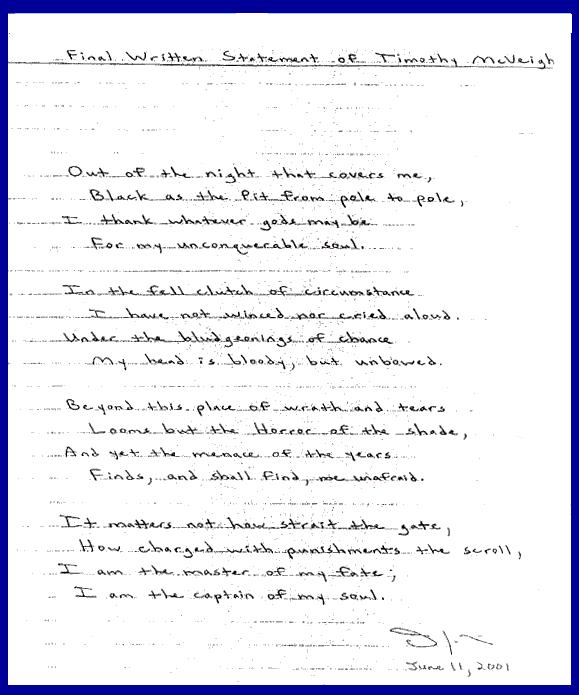
He broadcast clinical detachment in the execution itself — the first conducted by the federal government since 1963, technically imposed for the eight federal employees among his 168 victims — from his waiver of appeals to his unnervingly unblinking death mask to the stoic 19th century poem “Invictus” that formed his written (and only) final statement.
* Also — coincidentally or not — the execution date of Richard Snell in Arkansas, a militia man (and white supremacist, which McVeigh was not) who had once tried to blow up the Murrah building himself.
On this date in 1997, an Exalted Cyclops of the Ku Klux Klan went to Alabama’s “Yellow Mama” for lynching a black teenager.
Henry Francis Hays, son of a top Klan officer in Alabama, had vented dissatisfaction with a jury’s failure to convict a black defendant for a white policeman’s murder by grabbing and stringing up a random black, 19-year-old Michael Donald.
Hays and his 17-year-old accomplice skated for more than two years because Mobile’s finest figured a publicly hanged black man probably had it coming from some drug deal.* Only through the victim’s mother’s persistence — she got Jesse Jackson involved, which helped involve the FBI — did the real murderers feel the heat.
Before long, the Klan would wish it had stayed out of the kitchen.
After Hays’ conviction, Michael Donald’s mother brought a civil action against the United Klans of America with the help of the Southern Poverty Law Center. The $7 million liability verdict she won financially destroyed the United Klans — perpetrators of some of the 1960s’ most infamous anti-civil rights terror — and Donald was awarded its national headquarters building in Tuscaloosa, Ala.
This novel keys on the Michael Donald lynching as part of a (fictional) Mobile teen’s coming of age.
Hays wasn’t through making the sort of history he’d rather not have made.
When his turn in the electric chair finally came in 1997, he became the first white in Alabama put to death for an offense against a black in 84 years.**
Seemingly less cocksure in answering for his crime than he had been in committing it, Hays had always maintained his innocence. A few days before walking his last mile, he finally confessed to the Mobile chapter head of the NAACP.
* Michael Donald was not, in fact, involved in drugs.
** There haven’t been any other executions for white-on-black crime since Henry Hays, a span of 11 more years and 22 more executions as of this writing. (via the Death Penalty Information Center’s Execution Database)
On this date in 1923, a German paramilitary was shot by a French firing squad near Dusseldorf for his anti-occupation sabotage efforts.
Albert Leo Schlageter, a World War I veteran and conservative Catholic who signed up with the right-wing Freikorps and tangled with communists after the war, joined the fledging Nazi party when it absorbed his Freikorps unit in 1922.
The next year, France occupied the Ruhr to secure war reparations payments then crippling Germany, which would do much to speed the rise of the Nazis in the years ahead.
Schlageter was nabbed sabotaging railroad lines in resistance, and Berlin’s protests didn’t help him much.
He became a Nazi martyr literally overnight, and as the nationalist right ascended, the place of his passion was marked with a 90-foot cross and used for party rallies. His name christened a naval vessel, a Luftwaffe fighter wing, two SA units, and several Nazi badges and decorations:
There was also a play about him, Schlageter, whose debut performance was for Hitler’s first birthday as Chancellor in 1933. The most famous work of Hanns Johst, it was notable for the line “Wenn ich ‘Kultur’ höre, entsichere ich meinen Browning!” — “When I hear the word ‘culture’, I reach for my gun!” — subsequently adopted by so many gun-reaching Nazi kulturkampfers that it is provenance is regularly misattributed.
Unsurprisingly, Schlageter’s cult has waned into obscurity since 1945. But one needs not endorse his philosophy or its horrifying posthumous expressions to appreciate the man’s struggle against foreign occupation and bravery in what he took to be the country’s interests.
For the Communist Karl Radek, this martyr of the right stood for many more whose sincere intentions had been bent against themselves — “those German Fascisti, who honestly thought to serve the German people.” Addressing the Communist International’s Executive Committee in the days after the officer’s execution, Radek anticipated Schlageter pointing the way to a future very different from that which came to pass:
Schlageter, a courageous soldier of the counter-revolution, deserves to be sincerely honoured by us, the soldiers of the revolution.
…
Schlageter went … to the Ruhr, not in the year 1923 but in the year 1920. Do you know what that meant? He took part in the attack of German capital upon the Ruhr workers; he fought in the ranks of the troops whose task it was to bring the miners of the Ruhr under the heel of the iron and coal kings. The troops of Waters, in whose ranks he fought, fired the same leaden bullets with which General Degoutte quelled the Ruhr workers. We have no reason to believe that it was from selfish motives that Schlageter helped to subdue the starving miners.
The way in which he risked his life speaks on his behalf, and proves that he was convinced he was serving the German people.
…
[The German Communist Party] believe[s] that the great majority of the nationalist-minded masses belong not to the camp of the capitalists but to the camp of the workers. We want to find, and we shall find, the path to these masses. We shall do all in our power to make men like Schlageter, who are prepared to go to their deaths for a common cause, not wanderers into the void, but wanderers into a better future for the whole of mankind; that they should not spill their hot, unselfish blood for the profit of the coal and iron barons, but in the cause of the great toiling German people, which is a member of the family of peoples fighting for their emancipation.
…
Schlageter himself cannot now hear this declaration, but we are convinced that there are hundreds of Schlageters who will hear it and understand it.
He makes a complex character, with a streak of flawed greatness even his contemporary enemies recognized; his anti-Renaissance theology was severe but not dour, fired as it was by a genuine spiritual passion that spoke to real needs of his audience and a real crisis growing in the Church. And he did not disdain the revolutionary real-world implications of his faith.
Savonarola instituted Republican government with a touch of the Taliban — a vice squad of young hooligans to rough up rouged ladies and card-players;* a famous Bonfire of the Vanities in which Botticelli incinerated some of his own work — but also a populist economic touch.
For reasons both internal (the killjoy factor of busting up dice games wore out its welcome) and external (his French ally Charles VIII was driven from Italy, and Savonarola made a dire enemy of the corrupt Borgia pontiff Alexander VI), the priest’s grip on Florence weakened. In April 1498, he was arrested with two other clerics; all three were tortured into signing confessions, then hanged in the Piazza della Signoria by an insolent executioner.
The doomed Savonarola anguished that he had not been strong enough to resist the tortures of the rack, and penned in contrition the Latin meditation Infelix ego:
Alas wretch that I am, destitute of all help, who have offended heaven and earth — where shall I go? Whither shall I turn myself? To whom shall I fly? Who will take pity on me? To heaven I dare not lift up my eyes, for I have deeply sinned against it; on earth I find no refuge, for I have been an offence to it…
Like Savonarola’s memory and teachings, it spread — often illicitly — in a Europe ready for religious reform. Infelix ego has been frequently set to devotional music, like this version by Orlande de Lassus:
[audio:Infelix_Ego_Lassus.mp3]
Savonarola might have been in himself a dead end, an unsuccessful prophet quickly rolled back, but he nonetheless possesses a recognizable essence that distills both the Zeitgeist of his time and the immemorial hunger for simplicity and virtue that coexists with the equally human celebration of pleasure and beauty. He left complex legacies to both the Church and the city his reforms sought (and ultimately failed) to scourge.
In religion, his castigation of the vice and sin of the Church (a position of which he was an outstanding but hardly a lonely advocate) prefigured the coming Reformation. But Savonarola also never left off the most devout affiliation to Catholicism, nor sought institutional schism even when he had been excommunicated.** What to make of such a man? He is both depicted (at the base of a Martin Luther statue) at the Worms Reformation Monument, and proposed for present-day Catholic canonization.
So too his secular legacy — the theocrat who burned books and expelled the Medici and was reduced to ashes for his reactionary principles — merits a respectful recollection in Florence, even if few would actually want to live in his republic. He repelled Machiavelli, a libertine counselor of the post-Savonarola Florentine Republic, but perhaps fascinated him as well, as a prince with a precisely backward grasp of his own power.
This stone marking the site of the execution stands at a crossroads of tourist traffic in a thicket of statuary, mostly nude and/or classically inspired, outside the entrance to one of Europe’s principle collections of Renaissance art.
One wonders what the old Dominican would have made of it.
Books about Savonarola’s Florence
* Savonarola also made sodomy punishable by death.
** Alexander VI tried first to get him (in Lyndon Johnson’s fragrant phrase) inside the tent pissing out by making him a cardinal, which Savonarola spurned.
Alexandre Dumas recognized the name of Karl Ludwig Sand, who lost his head on this date in 1820 in Mannheim, Germany, for the murder of the dramatist and humorist August von Kotzebue.
The assassination of von Kotzebue* worried the Prussian monarchy — then headed by Friederich Wilhelm III — and precipitated a series of proclamations, reforms, and internal struggles that finally led to a full-scale rebellion 30 years later.
A print showing Sand stabbing August von Koetzebue. Sand is reported to have shouted, “Here, you traitor to the fatherland!”
Sand was a member of a Burschenschaft,** a liberal student fraternity organization which appealed to nationalist Germans seeking a unified German nation-state, and he and others in his group regarded von Kotzebue as a plague on their cause. Von Kotzebue was then Councillor of the Russian Legation, the culmination of over a decade in the Russian civil service, and a spinmeister for the Russian regime. In 1816, while Sand was in college, von Kotzebue was tasked with managing the flow of information into the Prussian state in an effort to increase the monarch’s popularity in Germany.
At the very least, then, von Kotzebue had no love for the Burschenshaft movement from the start, which originated in the university town of Jena, and he did not hold back his criticisms in his weekly literature newpaper Literatische Wochenblatt. He casually disparaged the Burschenschaften, as this stab in the review of a novel in one of the earlier editions evidences:
Longing and love in the work is described in a way which, in the judgment of the Jenaer Recensenten, resembles a light Spring rain that is at least refreshing. That is more than one can say of the Jenaer Literature-Zeitung, which roughly resembles an autumnal rain that simply makes one wet without refreshing at all.
But the student organizations were on the rise during Sand’s time at university as a theology student, and the turbulent events in France during his final days in school were having ripple effects across the German populace. It was in this climate that a young man who was “distinguished at once by the gifts of the mind and the faculties of the soul” (as his Gymnasium rector put it) and who sought to become a pastor was drawn to the nationalistic movement. Sand’s opposition to the imperial rule of Prussia became increasingly more urgent after his studies, and he was determined to make a statement through action, eschewing what he called “simply writing and talking.” On March 23, 1819, the 22-year old found von Kotzebue in his house and stabbed him in front of several witnesses. Sand was quickly arrested and sentenced to death.†
A print depicting the Wartburg Festival of 1817, Burschenschaft colors prominently displayed. (Click for larger image.)
As a result of von Kotzebue’s murder, Prince Klemens Wenzel von Metternich set down a series of decrees, known as the Karlsbad Decrees, which sought to quell any thoughts of rebellion before they could fully ferment. The decrees limited both university activity and press activity, constraining the actions of university employees and setting down harsh restrictions on anyone who might dare question the monarch’s authority.
Sand’s contemporaries outside of Germany were hardly pleased with the death of von Kotzebue, which they saw as the precursor to a greater turmoil, and two decades of removal from the event proved a powerful force. By the time Dumas visited the site of Sand’s beheading and penned his own biography of the man, a thorough rendering of Sand’s brief life — much of it reconstructed from Sand’s writings and the memories of those who knew him — the rebellion of the Burschenschaften was once again afoot, this time with permanent consequences for the German people.
In the end, nationalism and constitutionalism were not the panaceas Sand and other Burschenschaefter may have liked. While Sand would hardly have counted as a Nazi (his Puritanical theology would have fallen on deaf ears in that regime), he would have recognized that group’s near-religious fervor of the public book burnings anti pro-German sentiments as a distant echo of the Burschenschaft’s Wartburg Festival.†† Indeed, the so-called Third Reich could never have existed without the Second Reich, whose seeds Sand and his fellow nationalists were sowing a half century early when his fateful date with the axe arrived.
* The name is also spelled “Kozebue” by some sources.
** The Burschenschaften were roughly based on the Lützow Free Corps, an academic paramilitary group which fought during the Napoleonic Wars. During their height of popularity, the Burschenschaften adopted the black-red-gold flag that was reclaimed by the Frankfurt Parliament in 1949 to be the official German flag.
On this date in 1916, James Connolly was tied to a chair and executed by firing squad along with Sean Mac Diarmada.
James Connolly: Irish revolutionary.
Connolly was born to Irish immigrant parents in Scotland. His first experience in his ancestral home of Ireland was during his stint in the British Army where, stationed in and around Cork, he had the opportunity to witness firsthand both the poor treatment of the native Irish by the British forces as well as the grave disparities between the landowning and peasant classes. When he returned home to Scotland, he fell in with the socialist crowd and quickly rose through the ranks to become one of the movement’s leaders. He actively participated in socialist organizations in several countries and joined the ranks of the Industrial Workers of the World.
A variety of circumstances brought him back to Ireland, where he led Irish socialists in seeking rights for the working class, joining the Irish Transport and General Workers’ Union in 1912. He went on to head the union two years later when the General Secretary, “Big” Jim Larkin, left for a speaking tour. In this capacity, he found a crowd for his increasingly open talks of revolution. Frustrated by what he saw as the unwillingness of the bourgeois Irish Volunteers, Connolly spoke persistently about sacrificing his own life in the name of economic freedom for Ireland, starting The Workers’ Republic journal, then printing his treatise The Re-Conquest of Ireland in 1915. Connolly headed just one revolutionary faction in Ireland at the time. Not wishing to have their festivities spoiled by Connolly, the Irish Republican Brotherhood, another revolutionary paramilitary group, decided to invite him to their Easter party.
The General Post Office in Dublin after the uprising.
The Easter Rising, which had little support from the Irish public at the time, began on April 24, 1916. Connolly led the Dublin Brigrade, which held the Dublin General Post Office, and so was in essence a sort of Commander-in-Chief during the uprising. Six days later, the Easter Rising came to a close with a surrender to British troops; its leaders, who had issued a proclamation of Irish freedom, were quickly sentenced to death by firing squad in the courtyard of Kilmainham Gaol in Dublin.
Injured during the fighting, Connolly had only been given a few more days to live by the doctors that attended him at the Royal Hospital Kilmainham. Unable to stand on his own due to his injuries, he was tied to a chair in order to face the firing squad.
The rapidity and brutality of the executions shocked the Irish public and the conditions of Connolly’s death were most shocking of all. After the executions, the corpses of the 15 put to death (killed between May 3 and May 12) were placed into an unmarked mass grave. The Irish people, previously largely indifferent to the republican rantings of the revolutionaries, angrily regarded British action against the leaders of the Easter Rising, granting legitimacy to the rebellion.
The death of Connolly and the other leaders of the six-day siege presaged the final revolution that led to a free Irish state. Two of Connolly’s cohorts in the Easter campaign were Eamon de Valera and Michael Collins; within a half dozen years, the two* expanded revolutionary tactics through Sinn Fein that forced the British to the bargaining table, meetings that would give rise to the bitterly partitioned Ireland of today. Connolly is still regarded as one of the greatest Britons, though he spent his life fighting the British, and the Irish havecelebrated his memorythrough several songs.
* While de Valera and Collins were regarded as the primary players in Irish statehood, the Easter Rising included dozens of revolutionaries who would spend their lives fighting for Irish independence.
On this date in 1916, a landmark and a holiday — and a founding story of national betrayal — were born with the Ottoman Empire’s hanging separatist nationalists simultaneously in Damascus and Beirut.
The lightning-rod British journalist Robert Fisk has referenced this event numerous times. Here’s his description, focusing on the Beirut location:
Prior to the First World War, 33 Arabs in what is now Lebanon and was then Syria had appealed to the French consul in Beirut to help them to gain independence from the Turks – or at least offer French protection.
The letters — from both Muslims and Christians, one from a Palestinian and another from a senior officer in the Ottoman army — were written in secret and duly reached the consul. But when France broke off relations with the Sublime Porte on the outbreak of war, the diplomat — rather than pack those subversive letters off to his new residence in Egypt — hid them in the abandoned consulate.
And so it came to pass that the local French-language interpreter at the consulate, imprisoned in Damascus, sought to gain his freedom with Ahmed Jemal Pasha, commander of the Turkish Fourth Army in Syria, by betraying to him the exact location where the consul had hidden the documents. Ottoman security agents then broke into the consulate — which was supposed to be under the protection of the still-neutral United States — and found the incriminating letters. Jemal Pasha’s fury was now directed against these treacherous letter writers with Saddam-like fury.
They were dragged from their homes, taken to the hill town of Aley, brutally tortured and sentenced to be hanged by a drum-head military court. And hanged they duly were, only a few feet from the spot where the sea will now wash up to the square and scarcely 50 metres from the tomb where Rafiq Hariri now lies. A priest was hanged in his robes. The Ottoman officer went to his death in full military uniform.
And three days after the last batch of Lebanese patriots were hanged in 1916, François Georges Picot signed his infamous secret agreement with Sir Mark Sykes to divide up the Middle East, taking Syria for France — and Palestine for the Brits — which would ensure that the French government rather than an independent Lebanese government took over Lebanon.
Now here’s the rub. Not only had every leading Lebanese patriot been liquidated just before the Sykes-Picot agreement. But the French diplomat who had shamefully left those fatal letters behind in his consulate in Beirut was – wait for it – the very same François Georges Picot.
Convenient.
It is as martyrs that this day’s victims are best known, rather than their particular individual achievements. But Abdul-Karim al-Khalil had the day’s picturesque exit; just before he kicked away his own ladder, denying the executioner the pleasure, he declared:
O paradise of my country, carry our feelings of brotherly love to every Lebanese, to every Syrian, to every Arab, tell them of our tragic end and tell them: “For your freedom we have lived and for your independence we are dying!”
As a result of this day’s dealings, May 6 is known in both countries as Martyrs’ Day — an apt occasion for renewing the two states’ ties — and both Beirut and Damascus have a Martyrs’ Square. This is the monument in Beirut:


 Though his avowed motive, the